The first strike landed before I understood that Nolan had truly decided to do it. The leather belt cracked against the back of the upholstered chair beside me, missing my shoulder by inches, and the sound tore through the penthouse like a gunshot. I flinched so hard that my knees struck the marble floor. Across the room, Sabrina Vale lifted her glass of red wine and smiled as though she were watching a private performance arranged for her pleasure.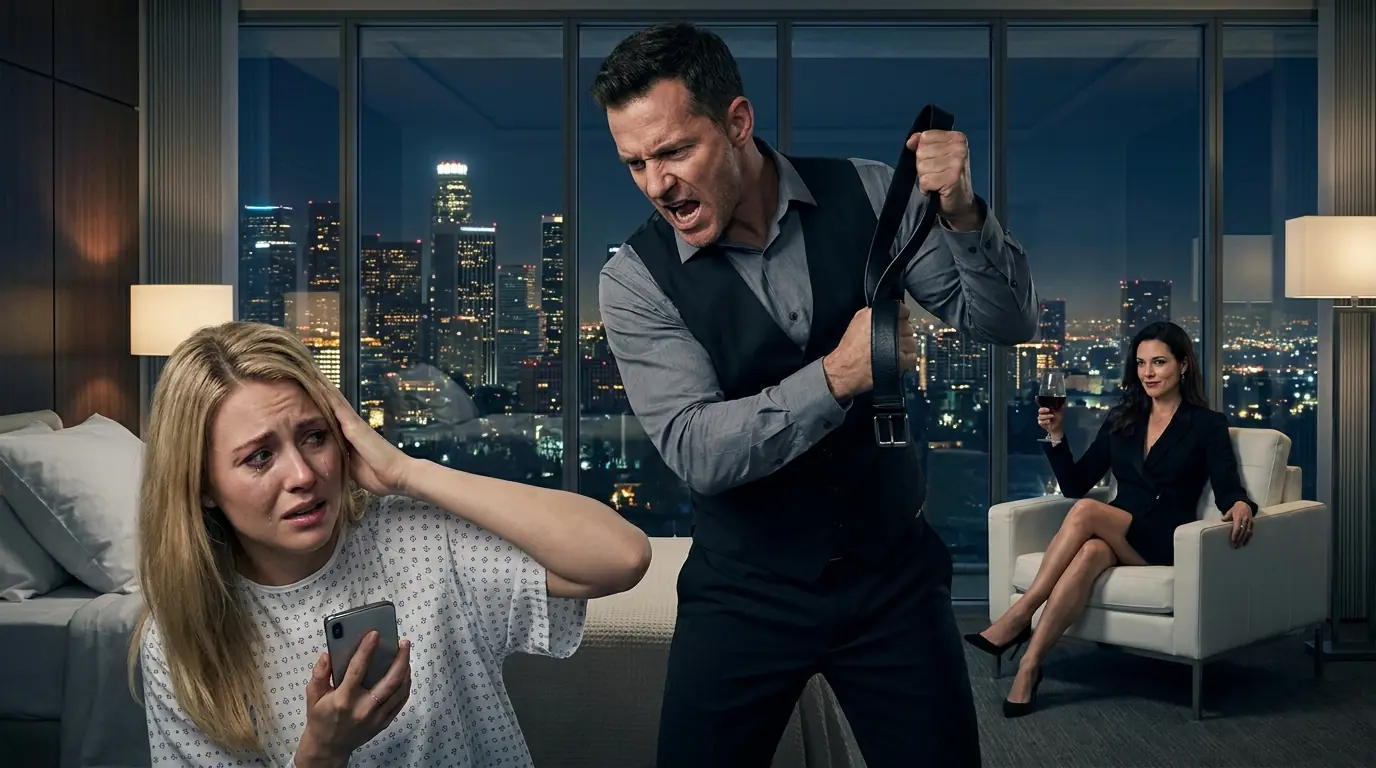
“One,” she said calmly.
Nolan’s jaw tightened. “That one didn’t touch her.”
Sabrina crossed one elegant leg over the other. Her black dress was immaculate, her dark hair falling over one shoulder, and the city lights glittered behind her through the floor-to-ceiling windows. “Then it doesn’t count. Start again.”
I stared at the man I had married twelve years earlier. Nolan Reed had once held my hand through my mother’s funeral, slept in a plastic chair beside my hospital bed after an emergency surgery, and whispered that nothing in the world could make him raise his voice at me. Now his sleeves were rolled to his elbows, his face was twisted with rage, and the belt in his hands looked less like an object than a verdict.
“You can still stop,” I said. My voice came out thin, but it did not break. “You know she manufactured those documents.”
“She found the proof,” Nolan snapped. “You transferred twelve million dollars from Reed Meridian. You planned to run. You planned to destroy me.”
“I found the missing money before she did.”
Sabrina gave a soft laugh. “Listen to her. Even now, she thinks she can confuse you.”
Nolan raised the belt again. I lowered my eyes, not because I had surrendered, but because I needed to see the silver pendant resting against my collarbone. It looked like an ordinary piece of jewelry, a small oval set with a blue stone. Nolan had bought it for my thirty-fifth birthday. He did not know that three weeks earlier I had asked a security engineer to replace the stone’s setting with a silent emergency transmitter.
The device had one function. Press twice, and it sent my location. Hold for five seconds, and it opened a live audio channel to the private emergency team employed by the trust that controlled Reed Meridian’s voting shares. I had activated it before Nolan locked the penthouse doors.
I did not know whether anyone was listening. I only knew that I needed Nolan and Sabrina to keep talking.
The second strike landed across the back of my silk blouse. Pain flashed hot and bright, but the greater shock came from hearing Sabrina say, “One,” in the same bored tone she might have used while counting documents at a board meeting.
Nolan breathed heavily. “Tell me where the money is.”
“I already told you. It is in an account Sabrina opened through Helix Advisory.”
“Liar.”
“Ask her why the transfer authorization used your old digital signature. Ask her why the receiving company was incorporated by her brother.”
For the first time, Sabrina’s smile became still.
Nolan did not notice. He had spent six months learning not to notice anything that contradicted the story she had built for him. She had told him I was unstable. She had told him I resented his success, that I had been meeting lawyers behind his back, that I planned to seize the company and humiliate him. Every accusation contained a sliver of truth carefully wrapped around a lie. I had met lawyers. I had reviewed the company’s ownership. I had prepared to remove Nolan from the chief executive role. But I had done those things only after discovering that someone was draining money from our employees’ pension fund.
That someone was Sabrina.
Nolan had never asked why I was investigating. He had asked only whether I was betraying him, and Sabrina had been waiting with the answer.
The third strike came. Then the fourth. By the seventh, my hands were trembling against the floor, and the room blurred at the edges. Sabrina corrected Nolan twice, claiming the belt had not landed hard enough. Each time, he started the number again. Her cruelty was not impulsive. It was methodical, almost administrative, as though she were finalizing a contract.
At ten, I heard a faint vibration beneath the marble. It came through my pendant, so subtle that Nolan could not have noticed. The emergency channel was open.
Someone was listening.
I lifted my head. “Sabrina, tell him what you said at the Harbor Club.”
Her eyes narrowed. “I have no idea what you mean.”
Nolan froze with the belt raised.
Sabrina’s expression changed for less than a second, but I saw it. Fear. Then she leaned back and let amusement return to her face. “Poor Claire. This is exactly what the doctors warned us about. You build entire conversations in your head and then accuse everyone else of having them.”
There it was: the word that had made every truth I spoke sound like a symptom.
Doctors.
Three days earlier, Nolan had taken me to St. Augustine Behavioral Center under the pretense of attending a marriage counseling session. The moment we arrived, two orderlies met us in a private corridor. A psychiatrist I had never seen before read from a document claiming that I had threatened myself, threatened Nolan, and displayed paranoid delusions about financial theft. Nolan had signed the petition requesting a seventy-two-hour emergency evaluation.
I had looked at my husband and realized he was not taking me to counseling. He was having me confined.
I escaped only because Dr. Maya Chen, a young attending physician, noticed that the petition contained details copied word for word from an email Sabrina had sent to Nolan. Maya delayed the admission and insisted on interviewing me without him present. I gave her the name of my attorney, the number of our board chair, and the location of a file showing the pension transfers. By the time Nolan understood what was happening, my lawyer had arrived with a court order blocking the admission.
He called it another trick.
Sabrina called it proof that I was dangerous.
That evening, they brought me back to the penthouse and took my phone, my keys, and my laptop. Nolan dismissed the household staff and disabled the elevators with his private code. He said we were going to settle the truth without lawyers, doctors, or board members. Sabrina poured herself wine while he laid the belt on the glass table.
Now, as the hidden transmitter carried every word to whoever was listening, I needed them to confess more than violence. I needed them to confess the fraud.
“Nolan,” I said, “ask her who paid Dr. Laughton.”
His eyes flicked toward Sabrina.
She did not move. “Do not let her change the subject.”
“Ask her,” I repeated. “Ask why a psychiatrist who had never examined me signed an opinion declaring me delusional. Ask why Helix Advisory wired him two hundred thousand dollars last month.”
Nolan’s grip loosened slightly.
Sabrina set down her wine. “You see what she is doing? She is choosing numbers because numbers sound convincing. Twelve million. Two hundred thousand. Two hundred lashes. She wants you to hesitate.”
The last phrase seemed to surprise even Nolan.
He turned toward her. “You were the one who said two hundred.”
Sabrina’s face remained smooth. “Because she will never confess if you treat this like another argument.”
I watched Nolan’s confusion harden into anger, but the anger was no longer directed entirely at me. For months, Sabrina had controlled him by making certainty feel like strength. Doubt was weakness. Questions were betrayal. Every time he hesitated, she reminded him that I had already made a fool of him.
So I gave him a question he could not ignore.
“Where is my phone?” I asked.
“In my office,” he said.
“No. Sabrina has it.”
His gaze moved to her handbag.
Sabrina stood. “This is ridiculous.”
“Open the bag,” I said.
Nolan stepped toward her. “Give me the phone.”
She laughed, but her fingers closed around the handbag. “You took it from Claire yourself.”
“And I put it on my desk.”
The silence that followed felt sharper than the belt.
Nolan crossed the room, snatched the bag before Sabrina could turn away, and emptied it onto the white sofa. Lipstick, a gold compact, two key cards, a folded document, and my phone fell onto the cushions. The screen was cracked, but still lit. A call timer glowed across it.
Nolan stared at the screen. “Who are you calling?”
Sabrina moved quickly. “Give it to me.”
He pulled it away. “Why do you have Claire’s phone?”
“She must have put it there.”
“I was on the floor,” I said. “You both watched me the entire time.”
Sabrina’s eyes flashed. “Enough.”
Nolan looked at the call timer again. It had been running for twenty-three minutes. He brought the phone to his ear, but no one spoke. The line had been muted from the other side.
“Who is this?” he demanded.
The call disconnected.
A moment later, the lights in the penthouse flickered.
Sabrina’s confidence vanished. She grabbed the document from the sofa, but Nolan caught her wrist. “What is that?”
“Let go of me.”
He tore it from her hand.
I knew what he was holding before he opened it. I had seen a copy in the office of my attorney, Leah Grant. It was a medical power-of-attorney document naming Sabrina as Nolan’s temporary decision-maker if he were declared mentally unfit. His signature appeared at the bottom.
He read the first page twice. “I never signed this.”
“You signed a stack of corporate documents last week,” Sabrina said. “You never read anything.”
The contempt in her voice was so naked that even I felt it strike him.
Nolan looked at her as though he were seeing a stranger. “What did you do?”
Sabrina’s composure returned, but it came back colder. “I protected the future you were too sentimental to secure.”
My pendant vibrated again: two short pulses. The emergency team was close.
I forced myself to stand, using the edge of the glass table for support. “She needed both of us discredited. Me first, because I control the voting trust. You second, because you know where the operating accounts are.”
Nolan looked from me to Sabrina. “The trust belongs to the family.”
“No,” I said. “The trust belongs to me.”
That truth had been hidden from him for twelve years, though not as an act of deception. My father, Samuel Hart, founded the logistics firm that later merged with Nolan’s technology company to create Reed Meridian. When my father retired, he placed his controlling shares into an irrevocable trust. I was the sole beneficiary and voting trustee, but I allowed Nolan to act publicly as though the company were his because he needed the confidence of investors. I had never used the power against him. Until the pension money vanished, I had never considered using it at all.
Sabrina had discovered the arrangement before Nolan did.
She understood that becoming his mistress was not enough. Marrying him would not give her control. She needed me legally incapacitated, Nolan criminally exposed, and the board terrified enough to accept her as the only person capable of stabilizing the company.
The scheme had almost worked.
Nolan lowered the belt. “You control the trust?”
“I tried to tell you at the lake house. You accused me of threatening you.”
“Because she said you were planning a hostile takeover.”
“It cannot be hostile when the shares are already mine.”
Sabrina took a slow breath. “Do not listen to her. The trust can be challenged. Once a court sees her medical history—”
“I do not have a medical history,” I said.
“You do now.”
The words left her mouth before she could stop them.
Nolan turned fully toward her.
Sabrina’s eyes moved to the ceiling, the doors, the windows. She was calculating distances. The elevator was locked, the private stairwell required Nolan’s key, and the terrace doors were sealed against the night wind. For the first time, she realized she might be trapped inside the cage she had built for me.
Then a tiny red light appeared beyond the glass.
At first, it looked like a star over the city. It grew larger, steadier, moving against the skyline. Nolan stepped toward the window. The red light was attached to a black police helicopter approaching from the east, its shape barely visible against the night. A second aircraft followed farther behind.
“What did you do?” Sabrina whispered.
I touched the silver pendant.
Nolan’s face drained of color.
The helicopter did not land. It hovered at a distance while tactical officers entered the building through the service levels below. The aircraft was there because Reed Tower had private rooftop access and multiple secured entrances. The emergency team wanted the occupants visible through the glass while officers moved upward.
Sabrina recovered first. She snatched my phone from the sofa and ran toward Nolan’s office. He caught her by the arm, but she drove an elbow into his chest and broke free. The phone struck the floor. She reached the office, slammed the door, and locked it.
Nolan stumbled after her. “Sabrina!”
I heard drawers opening inside, then the metallic click of the wall safe. She knew the code. Of course she knew the code. Nolan had given her access to everything except the one thing she actually needed: ownership.
“She is taking the drive,” I said.
“What drive?”
“The one with the pension transfer keys.”
Nolan hit the office door with his shoulder. “Open it!”
Sabrina shouted from inside, “Tell the police Claire attacked us. Tell them she had another episode. We can still control this.”
Nolan stared at the door.
For one terrible second, I thought he might do it. Habit is powerful, and Sabrina had spent months training him to choose the lie that protected his pride. If he admitted the truth, he would also have to admit that he had imprisoned his wife and tried to beat a confession from her while his mistress watched.
The elevator alarm sounded in the foyer.
Sabrina called through the door, “Nolan, think. If she wins, you lose the company. You lose your name. You lose everything.”
He looked at me. I could see the decision breaking him apart.
“You already lost those things,” I said quietly. “The only choice left is whether you lose the truth too.”
The elevator doors opened.
Four officers entered with weapons lowered but ready, followed by my attorney Leah Grant and Dr. Maya Chen. Behind them came Ethan Cole, head of security for the Hart Family Trust. Ethan’s eyes found me immediately, then the belt on the floor, then Nolan.
“Mrs. Reed,” he said, “step away from both doors.”
I moved toward him. My legs nearly failed, and Maya caught me before I reached the foyer. She wrapped a coat around my shoulders and checked my pupils while Leah demanded that no one touch any electronic device.
Nolan raised his hands. “She is in the office. Sabrina Vale. She has a drive from the safe.”
The officers ordered Sabrina to come out. She did not answer.
Then the terrace alarm began to scream.
The office had a private door leading to a narrow exterior balcony used by window-cleaning crews. Sabrina had broken the emergency seal and climbed outside. Thirty-eight floors below, the city moved like a field of light. Wind tore at her dress as she edged along the railing with the drive clenched in one hand.
The helicopter’s searchlight snapped on.
Sabrina froze.
A voice thundered from the aircraft, ordering her to stop moving. For the first time that night, she looked small. Not innocent, not fragile, only suddenly aware that the world had become larger than the room she controlled.
She lifted the drive as though she might throw it into the darkness.
“Do it,” Nolan shouted from inside the office. “Throw it. I already know.”
Sabrina turned her head toward him. “You know nothing. Without me, you would still be begging investors to take your calls.”
“Without Claire, there would be no company for them to invest in.”
The words came too late to repair anything, but they were the first honest words he had spoken in months.
Sabrina’s fingers opened. The drive slipped, struck the balcony railing, and fell onto the terrace below rather than into the street. An officer secured it moments later. Another officer brought Sabrina inside in handcuffs.
As she passed me, she stopped smiling. “You think this makes you strong?” she hissed. “He chose me every time. He believed me because some part of him wanted to.”
I met her eyes. “I know.”
That answer disturbed her more than anger would have.
Nolan was taken into custody after Ethan played the first minute of the audio captured through my pendant. The recording contained his threats, Sabrina’s count, and their discussion of the false psychiatric commitment. He did not resist. He looked at the belt on the marble floor, then at me, but I turned away before he could speak.
At the hospital, the nurses asked me the same questions repeatedly. Did I feel safe? Did I know where I would go after discharge? Was there anyone the staff should prevent from visiting? I answered yes, yes, and both Nolan Reed and Sabrina Vale. The simplicity of those answers felt strange after months of being trained to doubt my own memory.
Maya stayed long after her shift ended. She sat beside my bed while a detective photographed the bruises on my back and another officer collected my torn blouse as evidence. When the room was quiet again, she handed me a cup of water and said, “You do not have to explain why you stayed.”
“I was going to explain,” I admitted.
“Most people do.”
“I kept thinking the man I married was still in there.”
“Maybe he was,” she said. “That does not make you responsible for rescuing him from the choices he made.”
I cried then, not because the pain had become worse, but because someone had finally separated compassion from obligation. I could mourn the person Nolan had once been without returning to the person he had become.
Leah arrived before dawn with a folder of emergency court orders. Sabrina’s assets were frozen. Helix Advisory’s servers were being seized. The board had suspended Nolan and appointed an interim executive committee. The voting trust had formally removed him from every position that allowed access to company funds.
“There is something else,” Leah said.
She placed my phone on the table. The call Sabrina had placed before hiding it in her handbag had not gone to an accomplice. It had gone to my younger sister, Emily.
I had not spoken to Emily in almost two years.
Nolan disliked her from the beginning. He said she was irresponsible, dramatic, and jealous of our life. When Emily questioned the way he spoke to me, he accused her of trying to break up our marriage. I defended him. Eventually, Emily stopped calling.
But my number was still memorized in her phone.
When Sabrina called, she apparently intended to imitate my voice and leave a message suggesting that I was suicidal. Instead, Emily answered immediately. She heard movement, Sabrina muttering, and Nolan shouting in the background. She stayed silent and recorded the call while tracing the number through a family location account I had forgotten we shared.
Then Emily called Ethan Cole.
The pendant had confirmed what she feared, but Emily was the person who first sent help.
“She is outside,” Leah said. “She did not want to come in unless you asked.”
I could not speak. I nodded.
Emily entered wearing jeans, a winter coat, and the same frightened expression she had worn at nineteen when she came to my college apartment after a bad breakup. Her blonde hair was pulled into a loose knot. Tears had dried in lines beneath her eyes.
For several seconds, neither of us moved.
Then she crossed the room and held me carefully, avoiding every place the doctors had marked. “I am sorry,” I whispered.
“No,” she said. “Not tonight.”
“I should have believed you.”
“You believe me now.”
“I let him push you out.”
“And I still knew your number.”
That broke whatever remained of my control. I held her and sobbed against her shoulder until the city outside the hospital windows turned gray with morning.
The investigation lasted eleven months. What began as a domestic violence case became one of the largest corporate fraud prosecutions in the state’s history. Sabrina and her brother Marcus had created six consulting firms, each billing Reed Meridian for risk assessments that were never performed. They moved money through pension accounts, insurance reserves, and overseas subsidiaries, relying on Nolan’s electronic authorization.
Some signatures were forged. Others were real.
That distinction mattered. Nolan had signed documents without reading them because Sabrina told him they were routine. He approved transfers after I questioned them because he wanted to prove that he trusted her more than he trusted me. He used company security to track my car, accessed my medical records without permission, and paid Dr. Laughton to support the commitment petition.
He claimed he had not understood the full scheme.
The prosecutors agreed that Sabrina designed it. They did not agree that Nolan was innocent.
During his first interview, he tried to describe himself as another victim. He said Sabrina manipulated his insecurities, isolated him from honest advisers, and convinced him I was dangerous. The detective asked who had held the belt. Nolan stopped talking.
In court, the audio from my pendant filled the room. Sabrina’s voice sounded clear and controlled as she rejected the first strike because it had missed me. Nolan’s threats followed. Then came the moment she said, “You do now,” after I denied having a psychiatric history.
The jury heard the entire recording.
I did not look at Nolan while it played. I watched the jurors instead. One woman covered her mouth. An older man stared down at his hands. Another juror looked directly at me with an expression I had learned to recognize in the months since the assault: the painful realization that cruelty often grows inside respectable rooms, behind expensive doors, committed by people whose public photographs show perfect smiles.
Sabrina’s attorneys argued that the recording was incomplete and that I had provoked the confrontation to gain control of Reed Meridian. They presented emails in which I discussed removing Nolan as chief executive. Leah responded with the pension records, the forged medical documents, and the safe drive recovered from the balcony.
The drive contained everything.
There were spreadsheets assigning code names to stolen accounts. There were drafts of a press release announcing that I had entered long-term psychiatric care. There was a proposed merger that would have transferred Reed Meridian’s most valuable assets to a shell company controlled by Sabrina and Marcus. There was even a calendar entry scheduled for the morning after the attack: “Crisis board meeting. Establish S.V. as interim authority.”
Her plan had not been to become Nolan’s wife.
Her plan had been to use him until he was as disposable as I was.
Marcus Helix accepted a plea agreement and testified against his sister. Dr. Laughton surrendered his medical license and admitted that he had signed the psychiatric opinion after a ten-minute video call in which Sabrina pretended to be me. He had never met me. He had been promised a consulting position after the planned merger.
Nolan eventually pleaded guilty to unlawful imprisonment, aggravated assault, conspiracy to falsify medical records, and multiple financial crimes. The prosecution dismissed several lesser charges in exchange for his testimony against Sabrina. He received a twelve-year sentence.
Sabrina was convicted on every major count. She received twenty-six years.
The newspapers called it justice. For me, justice was quieter.
Justice was sleeping through the night without checking whether the bedroom door was locked. It was choosing my own doctor. It was hearing a man raise his voice in a restaurant and not immediately calculating the nearest exit. It was learning that fear could leave the body slowly, one ordinary morning at a time.
I moved out of the penthouse before the trial. I did not keep the furniture, the paintings, or the wine glasses Sabrina had used while she counted. I sold the property and donated a portion of the proceeds to a legal fund for patients falsely committed through coercive petitions. The rest went toward restoring the employee pension accounts.
The board asked me to become chief executive of Reed Meridian. I refused at first. For years, I had associated leadership with Nolan’s hunger for control. I did not want to sit in his office or inherit his way of measuring people.
Then I visited one of our distribution centers in Ohio.
A mechanic named Luis approached me during the lunch break. He had worked for the company for nineteen years. His wife was undergoing cancer treatment, and the stolen pension money had represented the only future he believed he could offer his family. He did not ask me for a promise. He simply said, “Please put someone in charge who knows this company belongs to more than the people at the top.”
I accepted the position the next morning.
My first act was to move the executive offices out of the top floors of Reed Tower and place them beside the operations teams. My second was to publish every executive expense, bonus structure, and pension transaction in a portal employees could access. My third was to create an independent medical and legal review process so no executive could use company resources to target a spouse, employee, or whistleblower.
Some directors called the changes excessive.
I told them secrecy had nearly destroyed us.
Emily joined the company six months later, not as an executive but as director of employee advocacy. She insisted on applying through the normal process and refused to let me influence the interview panel. On her first day, she placed a framed photograph on my desk. It showed us at the beach when I was fourteen and she was nine, both sunburned, laughing, and holding a crooked sandcastle together.
On the back she had written, “Still knew your number.”
I kept the silver pendant too.
For a long time, it remained sealed in an evidence bag. After the trial, the detective returned it to me. The blue stone was scratched, and the clasp had bent when I fell against the table. I considered throwing it away, but Maya suggested something else.
“Do not let the worst night own every object from that night,” she said.
So I had the stone reset in a simple silver ring. I wore it on my right hand, not as a symbol of marriage, but as proof that I had sent a signal into the darkness and someone had answered.
Nolan wrote to me from prison. The first letter was twelve pages long. He described Sabrina’s manipulation in detail, as though explaining her methods could reduce his responsibility. He apologized for doubting me, apologized for the company, apologized for Emily, and apologized for the hospital petition.
He did not mention the belt until page eleven.
I did not respond.
His second letter was shorter. He wrote that he had begun a violence intervention program and that one question haunted him: At what moment had he become the kind of man capable of doing what he did?
I almost answered that question. I wanted to tell him there had been no single moment. There had been hundreds of small permissions. The first time he read my messages without asking. The first time he mocked Emily and demanded I choose between them. The first time he treated my disagreement as disloyalty. The first time he accepted Sabrina’s admiration because it required nothing from him except power.
But that answer belonged to him to discover.
I placed the letter in a drawer and went to work.
A year after the trial, St. Augustine Behavioral Center opened a new patient-rights unit funded by the settlement from Dr. Laughton’s malpractice case. Maya invited me to speak at the opening. I stood in a bright room filled with physicians, attorneys, advocates, and families who had learned how easily the language of mental health could be weaponized against someone whose voice was inconvenient.
I did not tell them that psychiatry had failed me. It had not. One dishonest doctor failed me, while another saved my life by asking a simple question without Nolan in the room.
“What do you say is happening?” Maya had asked.
Those seven words gave me back my place inside my own story.
At the opening, I spoke about consent, independent evaluation, and the danger of treating a powerful person’s confidence as evidence. I spoke about how abuse can imitate concern. An abuser may say he is protecting you from stress while taking your phone. He may say he is worried about your stability while telling everyone not to believe you. He may call punishment treatment and control love.
Afterward, a young woman waited until the room had nearly emptied. She told me her fiancé had convinced her family that she was unstable whenever she questioned his finances. She had seen the news coverage of my case and contacted an attorney. She was safe now.
“I thought no one would believe me,” she said.
“I know,” I answered.
That was the moment the story changed for me. Until then, the attack had felt like a wound I had survived. After meeting her, I understood that survival could become a door held open for someone else.
The hardest confrontation after the trial did not happen in a courtroom. It happened in the boardroom on the twenty-fourth floor, three weeks after I accepted the chief executive position. Seven directors sat around the polished table, all men and women who had known me for years. Most of them had sent flowers to the hospital. Several had testified that they trusted Nolan because he appeared decisive under pressure.
They wanted the company to move forward without discussing how Sabrina’s plan had survived for so long.
“We were deceived,” one director said. “There is no value in assigning blame beyond the individuals convicted.”
“There is value if the system helped them,” I replied.
The room went quiet. I placed copies of the fraudulent invoices beside copies of legitimate reports. The differences were obvious once anyone bothered to compare them. Sabrina’s firms used identical language, billed on the same dates, and submitted work without employee names. Yet the invoices had passed through finance, legal, compliance, and audit because each department assumed Nolan’s approval ended the need for questions.
“She did not defeat our controls,” I said. “She discovered we had trained people not to use them when a powerful name appeared at the bottom of a page.”
One director warned that public disclosure could damage investor confidence. Another suggested an internal review whose results would remain confidential. I listened until they finished, then placed my voting trust authorization on the table.
“For twelve years, I protected Nolan from the appearance that his authority depended on my shares,” I said. “That protection became permission. I will not repeat the mistake for this board.”
The review became public.
Three directors resigned. Two senior executives were dismissed for ignoring reports from junior employees. A payroll analyst named Priya Shah, who had raised concerns about Helix Advisory nine months before the attack, received a formal apology and a promotion. Her supervisor had described her questions as disruptive. In reality, she had identified the pattern before any executive did.
When I met Priya, she seemed more nervous about the attention than angry about being ignored. She handed me a folder containing every warning she had sent.
“Why did you keep copies?” I asked.
“Because people kept telling me I had misunderstood,” she said. “I wanted proof that I had not imagined it.”
Her answer stayed with me. Sabrina had used the same weapon against both of us, though in different forms. Make a person defend her own perception long enough, and eventually the defense itself begins to look unreasonable.
We created a protected reporting office that answered outside the normal executive chain. Employees could raise concerns without asking permission from the managers involved. Every report received a written response, even when the concern proved unfounded. I told the board that trust did not mean assuming leaders were honest. Trust meant creating a system where honesty did not depend on courage alone.
Months later, Priya sent me the first quarterly report from the new office. Most cases were ordinary: scheduling disputes, billing errors, conflicts between supervisors and employees. None involved millions of dollars or criminal conspiracies. That was exactly the point. A healthy system did not wait for a catastrophe before allowing someone to speak.
That evening, I placed the report beside Emily’s beach photograph. For years, I had believed strength meant carrying pain privately so other people would not be inconvenienced by it. Now I understood that silence protected the wrong people. Speaking did not make me difficult, disloyal, unstable, or weak. It made the truth available to anyone brave enough to act on it.
Two years passed.
Reed Meridian returned every dollar to the pension fund, including lost interest. The company’s profits fell during the restructuring, then recovered under contracts built without shell firms or hidden commissions. We changed the name to Meridian Hart Logistics after employees voted on five options. I removed Nolan’s name not to erase history, but to stop pretending that a company’s identity should belong to one man.
On the morning the new sign was installed, I stood across the street with Emily and Luis. Cranes lifted the silver letters against the building while commuters hurried past without knowing what the moment meant. Emily linked her arm through mine.
“You could have put Hart first,” she said.
“Meridian belongs to the employees.”
“And Hart?”
I smiled. “Hart remembers who founded it.”
That evening, I returned alone to the rooftop garden. The penthouse had been sold, but the company still owned the lower terrace used for corporate events. The skyline looked almost identical to the night of the assault. Cars moved below. Windows glowed in distant towers. A helicopter crossed the horizon, its red light blinking steadily.
My body reacted before my mind did. My shoulders tightened, and my breath caught.
Then I looked at the silver-blue stone on my right hand.
The red light was not coming for me. It was simply moving through the night.
I let myself breathe until the fear passed.
A door opened behind me. Emily stepped onto the terrace carrying two paper cups of coffee. “I knew I would find you up here.”
“You are becoming predictable.”
“So are you.” She handed me a cup. “You disappear whenever people start making speeches about you.”
Downstairs, the board and several hundred employees were celebrating the company’s second profitable quarter under the new name. They expected me to return for a toast. I could hear music through the glass.
Emily leaned against the railing. “Do you ever wish none of it happened?”
The question should have been easy. Of course I wished Nolan had never lifted the belt. I wished I had never heard Sabrina count. I wished I had trusted Emily years earlier. I wished employees had never opened retirement statements and discovered that their futures were missing.
But wishing the past away also meant wishing away the woman I had fought to become.
“I wish they had chosen differently,” I said. “I do not wish I had remained who I was before they did.”
Emily nodded as though she understood exactly.
We stood together while the city spread beneath us. Somewhere below, thousands of people were making choices no one would ever see: whether to believe a frightened voice, whether to question an easy lie, whether to use power as protection or punishment. I had once believed danger announced itself with shattered glass and raised fists. Now I knew it often entered quietly, wearing concern, carrying documents, asking for trust it had not earned.
I also knew rescue did not always arrive as a heroic stranger breaking down a door.
Sometimes rescue was a doctor who asked one more question. Sometimes it was an attorney who answered at midnight. Sometimes it was a sister who had every reason to let the phone ring, but answered anyway. Sometimes it was your own shaking hand finding a hidden button and pressing it twice.
The party downstairs grew louder. Emily nudged my shoulder. “Ready?”
I looked once more at the dark sky. No red light waited beyond the glass now, only stars blurred by the city and the faint reflection of two sisters standing side by side.
“Yes,” I said.
We went inside together.