My husband's mistress slapped me in front of the entire garden party. The Duke of Foxmere caught her wrist before she could strike me again.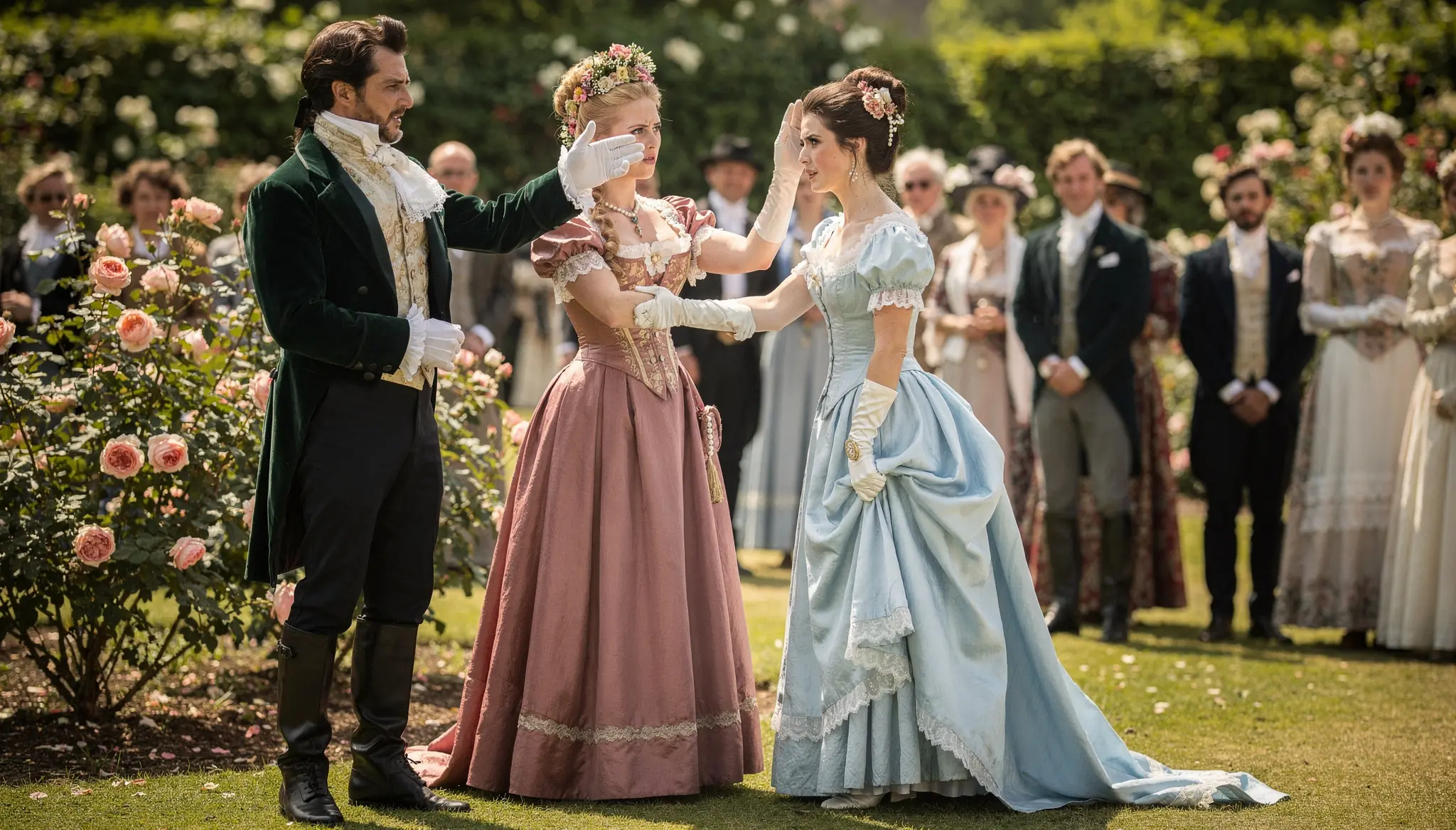
Most love stories begin with a stolen glance. Clara's began with a slap, not behind closed doors or in whispered secrecy, but beneath the bright summer sun in the middle of the grandest garden party in London, with dozens of noble eyes watching every humiliating second. She was twenty-two, a devoted wife of three years, and in a single heartbeat, everything she believed about love, marriage, and loyalty shattered alongside the crystal cup at her feet.
The woman who struck her was not a stranger. She was her husband's mistress. The cruelest part was that the one man who should have defended Clara stood frozen in silence, too cowardly to move. Someone else did.
A cold, untouchable duke, a man who had built his reputation on keeping the whole world at arm's length, stepped forward and caught the mistress's wrist before the second blow could fall. That single intervention changed the course of Clara's life forever. What began as public humiliation would soon become London's greatest scandal, because Clara was no longer fighting only for her dignity. She was about to discover that revenge could wear a gentleman's smile, that healing sometimes arrived in the arms of the last person one expected, and that the end of one heartbreaking marriage could become the beginning of the greatest love story of all.
Most scandals start with whispers. Clara's started with the sound of a hand striking her cheek.
She was standing in the middle of the Duke of Richmond's garden party in her best silk gown, holding a cup of lemon water and smiling politely at nothing in particular, when it happened. One moment she was listening to the small orchestra beside the hedges. The next, her head snapped sideways, her cheek burned bright red, and the crystal cup shattered on the flagstones at her feet.
The garden went silent. A footman froze midstep with a tray of sandwiches. A row of older ladies stopped fanning themselves, and even the orchestra let its music trail off into nothing.
Standing in front of Clara, chest heaving and one gloved hand still raised, was Lady Letitia Harrow. She was beautiful in the sharp, dangerous way of a well-kept knife, and she was, as everyone at the party already knew, Lord Thomas Ashworth's mistress.
"You think you can ignore me at my own dinner table?" Letitia hissed loudly enough for half the garden to hear. "You think smiling sweetly makes you better than me, Lady Clara?"
Clara's hand rose slowly to her stinging cheek. Her eyes searched the crowd for her husband, the man who had promised to love and protect her three years earlier in a church filled with flowers. She found Thomas near a rosebush, pale-faced and doing absolutely nothing except looking for a place to hide.
Letitia raised her hand again, ready to deliver a second blow. This time the crowd gasped as one, but she never got the chance. A blur of dark green velvet cut through the gathering, and a strong, elegant hand closed around Letitia's wrist midswing, stopping it as easily as catching a falling leaf.
"Madam," said a low, dry voice, "while I admire your enthusiasm for outdoor theater, His Grace's hydrangeas are far too delicate for such a dreadful performance. I suggest you take your dramatics and your rather loud perfume somewhere else."
Clara looked up. Standing beside her, still holding Letitia's wrist as though it weighed nothing, was Arthur Pendleton, the Duke of Foxmere. He was twenty-six, tall, and famously cold toward everyone in London society. His gray eyes were fixed on Letitia with the mild, flat interest of a man studying an insect he found only slightly annoying.
Letitia yanked her wrist free, her cheeks flushing with fury and embarrassment. "This is none of your concern, Your Grace."
"On the contrary," Arthur said. "You have just assaulted a lady in front of forty witnesses at a party I happen to be attending. That makes it very much my concern."
"Leave now," he continued, "before I decide to make this considerably more interesting for you."
Letitia opened her mouth, thought better of it, and stormed away through the crowd, her skirt snapping behind her like an angry flag. The garden slowly began to breathe again, though every eye remained fixed on Clara and the man who had just defended her.
"Are you harmed, my lady?" Arthur asked, turning to face her fully.
Clara's hand was still pressed to her cheek. She was shaking, though not from fear. It was fury, hot and humiliating, the kind that made her want to scream in front of the entire garden party. Instead, years of careful training took over. She straightened her spine and lowered her hand.
"I am perfectly well, Your Grace," she said, though her voice wavered slightly on the final word. "Thank you for your assistance."
"You are not perfectly well," Arthur replied. "Your cheek is the color of a ripe plum, and you are gripping your skirt hard enough to tear the seam. But I admire the effort."
Despite everything, Clara felt her mouth twitch. "Is that meant to be comforting, Your Grace?"
"No. It is meant to be true. I find comfort is usually a lie people tell to make themselves feel useful."
Around them, the whispers had already begun, rippling through the crowd like water disturbed by a stone. Clara caught fragments as they traveled. Thomas's mistress had slapped her in public. The Duke of Foxmere had stepped in. By evening, the story would have reached every drawing room in London, twisted and enlarged a dozen different ways.
Thomas finally found his courage, or perhaps merely his embarrassment, and pushed through the crowd toward them. "Clara, darling, are you—"
"Do not call me darling in front of the woman who just struck me because of you," Clara said quietly.
Thomas's face moved through several colors in quick succession. "I can explain."
"I do not want an explanation. I want to go home."
"Allow me," Arthur said smoothly, stepping between them with the same effortless authority he had used against Letitia moments before. "Lady Clara has suffered a considerable shock. I will see her to her carriage myself."
"That is not necessary, Your Grace," Thomas said, some spark of pride finally flaring in his pale face.
"It clearly is, since you appear more concerned with your reputation than your wife's welfare. Step aside, Thomas."
To Clara's astonishment, Thomas stepped aside. Arthur offered his arm, and after a brief hesitation, Clara accepted it, grateful for something solid to hold as her knees threatened to give way beneath the weight of the afternoon.
They moved through the parting crowd while every head turned to watch them pass. In a garden window, Clara caught her own reflection: a woman with a burning cheek and torn dignity walking beside the coldest, most eligible bachelor in England. She had no idea that this humiliating afternoon was about to change the entire shape of her life.
Behind them, the party slowly returned to its usual rhythm, though every conversation had gained a sharper, more eager edge. Older ladies leaned their heads together while young debutantes whispered that they had never seen the Duke of Foxmere touch another living soul before, not even to shake hands, and certainly never to defend a woman he barely knew.
Clara heard none of it. She concentrated only on placing one foot before the other, keeping her chin level and refusing to let a single tear fall until she was safely out of sight. It was not until they reached the garden gate and the noise of the party faded behind the hedges that she allowed herself one shaking breath.
"You held together admirably," Arthur said quietly. "Most people crumble the moment they are out of view. You waited until we were nearly at the gate."
"Is that meant to be a compliment, Your Grace?"
"It is an observation. Though coming from me, I suppose that is very nearly the same thing."
They reached his carriage at the edge of the drive, a sleek, dark vehicle with the Foxmere crest painted small and understated on the door. A footman hurried forward to open it, and Arthur handed Clara into the seat before climbing in after her and tapping twice against the roof to signal the driver.
As the carriage moved away, Clara caught one final glimpse of the garden party through the window. The guests were still murmuring, still watching, still turning the worst afternoon of her life into the finest gossip London had enjoyed in months.
Arthur's carriage smelled of leather and rain. The moment the door closed behind them, the last of Clara's composure began to crumble. She sat rigidly on the velvet seat, staring straight ahead with her jaw clenched tightly enough to ache. She refused to cry in front of a duke with whom she had exchanged perhaps ten words before that day.
"You may weep," Arthur said from across the carriage. "I will not tell anyone. My discretion is one of my few genuinely admirable qualities."
"I am not going to weep," Clara said, and immediately felt her eyes fill with tears, which she thought furiously was deeply unfair.
Arthur said nothing. He reached into a compartment beneath his seat, produced a flask and a clean handkerchief, and offered both without comment. Clara took the handkerchief first and pressed it hard against her eyes. After a moment's hesitation, she accepted the flask as well. The brandy burned pleasantly on the way down.
"I do not need your pity, Your Grace," she said once she trusted her voice again. "I am a married woman. I am supposed to handle these things with dignity."
"You handled it with remarkable dignity, considering you had just been struck in front of half of London's aristocracy. Most people would have screamed. You simply stood there and looked as though you were deciding how best to have the woman arrested."
"I was considering it," Clara admitted, and to her own surprise, she laughed.
The sound came out wet and undignified, half sob and half genuine amusement. She clapped a hand over her mouth as though she could force it back inside. Something in Arthur's expression shifted, the coolness cracking slightly around the edges.
"There it is," he said. "I wondered whether you had a real laugh hiding beneath all that composure."
"You should not find this amusing."
"I do not find your humiliation amusing. I find your husband contemptible, which is an entirely different matter."
Clara looked at him properly for the first time since entering the carriage. His gray eyes held none of the polished emptiness she expected from London's most famously distant bachelor. There was something sharper beneath them, something almost angry, though it did not appear to be directed at her.
"You know him," she said.
"Thomas? I have known him for years. We attended the same schools. He was a coward then, and marriage has apparently done nothing to improve him. I have disliked him for a long time, Lady Clara, long before I knew he had a wife worth disliking him on behalf of."
The carriage rattled through the London streets as rain began to patter softly against the windows. Clara wrapped her hands around the flask, no longer drinking from it, simply holding its solid weight.
"What am I meant to do now?" she asked, half to herself. "By morning, all of London will know I was slapped by my husband's mistress in front of forty witnesses. I will not be able to attend a single dinner without someone whispering behind a fan."
Arthur studied her for a long moment. Then a different kind of smile crossed his face, considerably more dangerous than his earlier dry amusement.
"I have a proposal."
"Your Grace, I have had quite enough excitement for one afternoon."
"Hear me out before you refuse. London does not forgive a woman who is pitied, but it adores a woman who is desired. If, instead of being remembered as the wife who was slapped, you were remembered as the woman the Duke of Foxmere could not stop looking at, the entire story would change overnight."
Clara stared at him. "You are suggesting that we pretend to be involved with one another."
"Exactly. I will become your constant, highly visible companion. I will escort you to balls. I will dance with you when no one expects it. Your husband will be forced to watch another man do what he never bothered to do. Society will be far too busy speculating about us to spare a single thought for pity."
"That is scandalous."
"Yes," Arthur agreed. "Considerably more scandalous than being slapped, and infinitely more entertaining. What do you say, Lady Clara? Shall we give London something truly worth gossiping about?"
Clara looked down at the flask in her hands and then back at the strange, sharp-eyed duke offering her a way to reclaim the one thing Letitia had tried to take in front of the entire garden party: her dignity.
"Very well," she said. "But I warn you, Your Grace, I do not know how to flirt. I have been married for three years to a man who barely looked at me. I have forgotten how it is done, if I ever knew at all."
"Fortunately for you," Arthur said, the corner of his mouth curving upward, "I have a considerable amount of free time and no shortage of opinions on the subject."
Two weeks later, Clara arrived at the Chelsea Assembly Ball wearing an emerald gown chosen specifically because it made Thomas's jaw drop the moment she descended the stairs. She had not looked at him since. That, she discovered, was its own small victory.
The true spectacle began when Arthur arrived. He entered the ballroom, and every debutante within reach straightened her spine and lifted her fan, hoping to catch the eye of London's most notoriously unavailable duke. He did not glance at a single one of them. He walked directly to Clara, bowed low enough to make the surrounding crowd gasp, and offered his hand.
"Lady Clara," he said loudly enough for the nearest cluster of gossips to hear, "I believe this dance belongs to me."
The orchestra began a slow, sweeping waltz, and Arthur led her onto the floor as half the room turned to watch. Clara's heart hammered so hard that she was certain he could feel it through her gloved hand.
"You are stiff as a fence post," Arthur murmured as he guided her through the first turn. "Relax your shoulders, Clara. If we are meant to convince anyone that I have lost my head over you, you cannot look as though you are counting the seconds until this ends."
"I am trying, Your Grace," she whispered. "It is somewhat difficult when you keep stepping near my slippers."
"I have not stepped on your slippers once," Arthur replied, spinning her smoothly beneath the chandelier light. "But your heart, my lady, is beating fast enough to wake the dead. I can feel it from here. Is that my doing, or merely the dance?"
Clara felt her cheeks warm, and this time it had nothing to do with humiliation. "Perhaps a little of both, Your Grace."
"Good." There was something almost pleased in his voice. "That will be far more convincing than stiff shoulders and careful silence."
He drew her slightly closer than propriety strictly allowed, his hand warm at her waist. Clara found, to her considerable alarm, that she did not mind at all. Their banter was light, quick, and effortless in a way nothing in her marriage had ever been. Beneath the performance, something else had begun to stir, something she was not yet prepared to examine too closely.
Near the refreshment table, Thomas stood frozen with a glass of champagne halfway to his mouth. He watched his wife laugh in the arms of the one man in London he had always secretly envied. His knuckles whitened around the stem.
"He is watching," Clara murmured as Arthur spun her past the edge of the dance floor.
"I know. I have been counting how many times he has nearly dropped that glass. We are currently at four."
Clara laughed, a real laugh this time, bright and unguarded. Several heads turned toward the sound. Arthur's gray eyes softened as he watched her, and for one moment something warmer passed behind his usual cool distance.
"You should laugh more often," he said quietly, no longer performing for the crowd. "It suits you considerably better than the careful, polite smile you have worn since I met you."
"No one has ever told me that before."
"Then everyone around you has been remarkably unobservant, which does not surprise me in the least, given the company you have kept."
The waltz ended, but neither of them moved apart immediately. For one suspended moment, the noise of the ballroom seemed to fade, leaving only the two of them standing close beneath the chandeliers. The pretense of their arrangement suddenly felt very thin.
Then the orchestra began another song. The moment broke, and Arthur stepped back with a proper bow before offering his arm to lead Clara from the floor. Yet as they walked away, Clara noticed that her heart had not slowed at all. She suspected, with a small flicker of dread, that their arrangement would become considerably more complicated than either of them had intended.
Later that evening, as carriages lined up outside to carry weary guests home, Clara stood alone near the tall windows overlooking the garden. She was catching her breath after an entire evening of being watched from every corner of the room when Arthur appeared beside her without a sound, carrying two glasses of lemon water. He offered her one with a small, knowing smile.
"You survived your first performance rather well."
"It did not feel like a performance," Clara admitted, turning the glass in her hands. "Not by the end of it."
Arthur said nothing, though something flickered behind his gray eyes, something he did not seem ready to name aloud. Instead, he stood beside her and watched the last of the guests disappear into the night. Neither of them hurried to end the comfortable silence between them.
Three weeks into their arrangement, Arthur invited Clara to inspect a property he was considering purchasing an hour outside London. He promised a pleasant afternoon and a proper picnic. The sky was clear when they set out. It was not clear an hour later.
The storm arrived almost without warning. Dark clouds rolled in fast and heavy, and within minutes rain hammered the carriage roof so hard that Clara could barely hear Arthur's voice beside her. The road, already muddy, became treacherous enough that the driver refused to continue. They were forced to shelter in a small, abandoned gatekeeper's cottage at the edge of the property while they waited for the worst of the weather to pass.
The cottage was cold and mostly bare, but there was a hearth and dry kindling stacked beside it. Arthur set to work building a fire while Clara wrung rainwater from the ends of her hair. Once the flames caught, they sat together on a rough wool blanket brought from the carriage, close enough to the fire to stop shivering.
"This was not part of the plan," Clara said, watching the flames.
"No," Arthur agreed. "Though I confess I am not entirely sorry for it."
The easy banter that had carried them through weeks of public performance softened into something gentler and more honest. Rain drummed against the windows, the fire crackled, and without quite intending to, Clara began telling Arthur things she had never said aloud to anyone.
"Do you know the worst part of my marriage?" she asked. "It was not the mistress. It was the years before her, when Thomas simply stopped looking at me at all. I would speak, and he would nod without hearing a word. I began to feel as though I had become furniture in my own home. Invisible."
Arthur was quiet for a long moment. His gray eyes remained fixed on her with an intensity that made Clara feel, for the first time in years, entirely seen.
"You are not invisible," he said at last. "I have spent three weeks watching half of London fail to look away from you. Thomas was simply too much of a fool to notice what he had."
"You are kind to say so."
"I am not being kind. I am being accurate. There is a considerable difference."
He reached out slowly and brushed a damp strand of hair away from her face. His fingers lingered against the cheek where Letitia's hand had struck her weeks earlier. His touch was nothing like that violent moment. It was careful and warm, and it made something deep inside Clara ache in a way she had not felt for years.
"If you were mine," Arthur said quietly, "I would spend every waking hour making certain you knew your worth. I would not allow another soul on earth to look at you with anything less than absolute reverence."
Clara's breath caught. "Your Grace—"
"Arthur," he corrected softly. "Please. Just Arthur, right now."
"Arthur." His name felt strange and thrilling in her mouth. "This was meant to be pretend."
"I know." His voice was low, and his eyes searched hers in the firelight. "I am no longer entirely certain it is."
He leaned closer, and Clara discovered that she did not want to stop him. Firelight caught in his eyes while the rain roared beyond the walls. For one breathless moment, the entire world narrowed to the small distance between them, his lips only a breath from hers.
The cottage door banged open.
"Your Grace!" Arthur's driver stood dripping in the doorway, entirely unaware of what he had interrupted. "The road has cleared enough to pass, if we leave now before dark."
Arthur closed his eyes briefly. A soft, frustrated breath escaped him before he sat back and offered Clara a rueful, crooked smile.
"It seems the universe has decided we are not permitted a single quiet moment."
"It would appear not," Clara replied, her voice unsteady and her heart still pounding from how close they had come.
They rode back to London in near silence, but it was not an uncomfortable one. Clara sat with her hand resting close to Arthur's on the carriage seat, not quite touching, and wondered how she had ever convinced herself their arrangement was only pretend.
Clara did not see Thomas coming until he was already inside her drawing room the next morning. His face was dark with fury, and the half-empty bottle of brandy in his hand showed that he had not slept.
"You have made me a laughingstock," he snapped, pacing before the cold fireplace. "All of London is whispering that my own wife prefers the Duke of Foxmere's company to mine. You will end this ridiculous arrangement, Clara, or I swear I will send you to the country estate, and you will not set foot in London again."
"You cannot simply lock me away because you are embarrassed," Clara said. She forced her voice to remain steady, though her hands trembled at her sides.
"I am your husband. I can do precisely as I please."
The library doors swung open before Clara could answer. Arthur stood in the doorway, rain still clinging to his coat from the ride over. A thick sheaf of papers was held firmly in one hand, and his gray eyes were colder than Clara had ever seen them.
"Actually," Arthur said as he stepped into the room, "you cannot. Not anymore."
Thomas turned. His bravado faltered the moment he registered Arthur's expression. "This is a private matter, Foxmere."
"It stopped being private the moment Letitia struck your wife in a garden full of witnesses."
Arthur placed the papers on the table between them with deliberate care. "I spent the past two weeks purchasing every gambling debt you owe across London, Thomas. Every single one. That means that as of this morning, I control the majority interest secured against your estate."
Thomas's face drained of color. "That is not possible."
"It is entirely possible. You should have been more careful about which tables you played at, and considerably more careful about how you treated your wife while doing it."
Arthur tapped the papers once. "Sign the deed of separation. Give Clara her freedom cleanly and without complaint, or I will call in every debt by nightfall and have the bailiffs remove you from that estate before the week is over. The choice, for once in your life, is entirely yours."
For a long moment, Thomas stared at the papers as though they might disappear if he looked away. Then, with the same lack of courage he had shown in the garden, he snatched up a pen and scrawled his signature across the bottom.
He fled the room without another word and without so much as a glance at the wife he was leaving behind. The door slammed, and the house fell into a strange, ringing silence.
Clara stared at the papers on the table, hardly able to believe what she was seeing. "I am free," she said quietly, testing the words as though they belonged to someone else.
Arthur remained still.
"I do not know what to say to you," Clara continued. "Thank you does not feel nearly enough."
"You do not need to say anything. Watching that man sign away his power over you was payment enough for me."
Clara smiled, though the expression wavered as unshed tears gathered at the corners of her eyes. "I suppose our arrangement is finished, then. You have done far more than you ever promised."
She expected Arthur to bow, make some dry remark, and take his leave as he always did. Instead, he crossed the room and took both her hands in his. His gray eyes were suddenly uncertain in a way she had never seen before.
"I bought those debts to set you free," he said. "But I am standing here now, Clara, to ask you to bind me instead. I do not want to pretend any longer. I have not wanted to pretend for weeks, if I am entirely honest with myself."
Clara's heart climbed into her throat. "Arthur—"
"I know it is far too soon," he said quickly, before she could finish. "I know the ink is barely dry on that deed of separation. But I have never, in my entire life, felt about anyone the way I feel when I am standing in a room with you. I did not plan this. I certainly did not plan to fall in love with a woman I only meant to rescue from a garden party."
"You did not plan it," Clara said softly. "Neither did I. But I find, Your Grace, that I am not the least bit sorry it happened."
Arthur's careful, guarded expression broke entirely into something open, unguarded, and achingly hopeful. He drew her closer and raised one hand to rest against her cheek, exactly where it had rested beside the fire in the abandoned cottage, and exactly where Letitia's hand had once struck her before the whole garden party.
This time, when he leaned down, there was no driver at the door, no crowd to perform for, and no pretense left between them. He kissed her slowly, the kind of kiss that answered every question neither of them had been brave enough to ask aloud until then.
When they finally parted, breathless, Clara rested her forehead against his and laughed, soft and disbelieving. "To think this all began with a slap."
"The very best things often do," Arthur said, smiling down at her in a way London's coldest duke had never been seen to smile before. "Though I intend to spend the rest of my life making certain nothing ever touches that cheek again except my own hand, and only ever gently."
Outside, the London rain had cleared. Sunlight broke through the clouds for the first time in days, spilling gold across the drawing room floor. Clara stood in the arms of the man who had once caught a stranger's wrist to protect her, and she understood at last what it felt like to be fully seen.
News of the separation, and of the Duke of Foxmere's sudden, very public courtship of Clara, swept through London within a single day, exactly as she had once feared her humiliation would. This time, however, the whispers were different.
Wherever Clara walked, she was no longer merely the woman who had been struck at a garden party. She was the woman who had walked away from a loveless marriage with her head held high and, against every rule of polite society, found something far better waiting on the other side.
Months later, their wedding took place in the same garden where everything had begun. Clara stood beneath the hydrangeas Arthur had so carefully defended that first afternoon. She laughed brightly and without restraint, exactly as he had once told her she ought to laugh more often.
Thomas was not there. Letitia was not there. The people who had once watched Clara's humiliation now watched her choose a different life, not because a duke had rescued her, but because she had finally believed she deserved to be seen, defended, and loved without shame.
Arthur stood beside her beneath the summer sun, no longer London's coldest duke but simply the man who had stepped forward when everyone else remained still. He had begun by catching another woman's wrist. He ended by taking Clara's hand before the same garden and promising never to let it go.