The first finger she lifted from the railing was my little finger.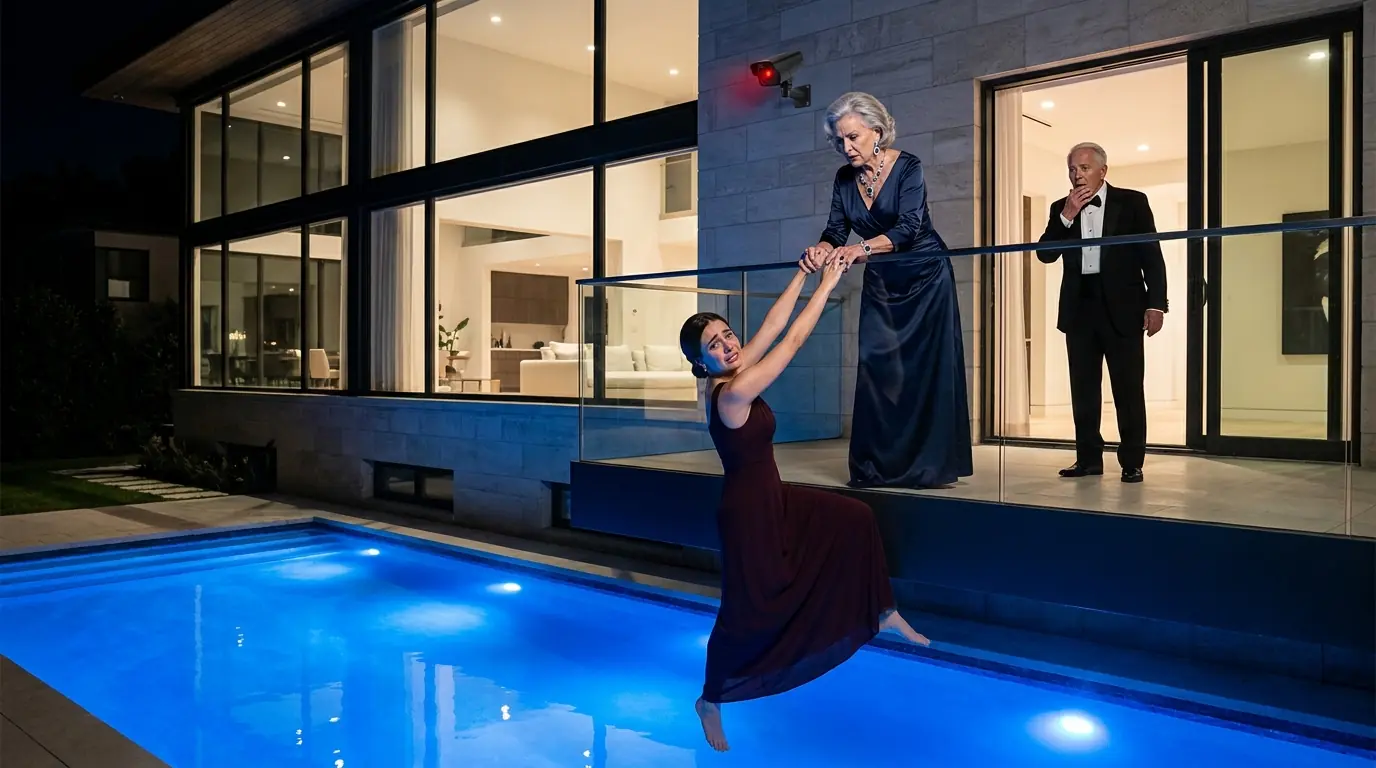
It should have been the weakest part of my grip, but pain made it feel like the only thing keeping me alive. Twenty feet below me, the indoor pool shone beneath the blue lights of the Vale estate, smooth and beautiful enough to belong in a magazine. From where I hung, however, it looked like a sheet of cold glass waiting to close over my head.
Eleanor Vale leaned over the polished steel rail in a midnight-blue gown, her silver hair perfectly arranged and her sapphire earrings motionless against her neck. She looked calm. That was the detail I would remember more clearly than the pain in my shoulders or the blood gathering beneath my fingernails.
Behind her stood my husband, Adrian, dressed in the black tuxedo I had chosen for him two weeks earlier. His face was pale, his hands hanging at his sides. He was close enough to pull his mother away from me, close enough to reach down and grab my wrist, yet he did nothing.
“Adrian,” I cried. “Please.”
His eyes met mine for one terrible second.
Then he looked away.
Eleanor smiled as though she had just received the answer to a question.
“You always believed love made you untouchable,” she said softly. “It only made you careless.”
She lifted my ring finger next.
My wedding ring scraped against the metal rail and nearly slipped free. I tightened the remaining fingers until my muscles screamed. The ballroom music continued beyond the glass doors behind them, muffled by distance and the heavy walls. Two hundred guests were celebrating the Vale Foundation’s fiftieth anniversary less than a hundred feet away, and none of them could hear me begging my husband to save my life.
Eleanor’s sapphire ring pressed into the back of my hand as she worked on my middle finger.
“Tell her,” she said without looking at Adrian.
He swallowed.
I could see tears in his eyes, but I no longer mistook tears for innocence.
“It wasn’t supposed to happen this way,” he whispered.
The last of my hope disappeared before the last of my grip did.
Eleanor pushed my index finger upward. My right hand slipped completely free, and my body swung beneath the balcony. A cry tore from my throat. My left hand held for another moment, my wedding ring flashing beneath hers like a cruel imitation of loyalty.
Then she removed the final finger.
I fell.
The blue light rushed upward. The air vanished from my lungs when I struck the water. The surface swallowed the sound of my scream, and the world became bubbles, darkness, and the distant shape of my husband staring down from above.
He still did not move.
What none of them noticed was the tiny red light in the shadowed corner near the ceiling.
The security camera was still recording.
Three months earlier, I had believed the Vale estate was the safest place in the world.
It stood on twelve acres outside Greenwich, Connecticut, a modern palace of limestone, glass, and carefully controlled silence. The original house had been built by Adrian’s grandfather, but Eleanor had transformed it over the years until nothing remained that did not reflect her taste. Every chair faced the proper direction. Every painting had a story she approved. Every employee knew the exact angle at which a dinner napkin should rest.
I had lived there with Adrian for four years, though I never called it home when speaking to myself.
Home had once been a narrow apartment over my father’s hardware store in Bridgeport. I grew up waking to delivery trucks and the smell of sawdust from the shop below. My mother died when I was eleven, and my father raised me with the kind of practical affection that arrived in packed lunches, repaired bicycle chains, and the light left on above the stairs whenever I came home late.
I learned numbers because numbers did not change their meaning depending on who entered the room. A balance sheet either balanced or it did not. A debt existed whether someone admitted it or not. By thirty-one, I had become a forensic accountant known for finding the truth inside companies determined to hide it.
That was how I met Adrian.
Vale Meridian Holdings had hired my firm to examine irregular payments connected to one of its hotel developments. Adrian was the company’s chief strategy officer, though he introduced himself simply as “the man who keeps getting sent files nobody else wants to read.” He was charming without appearing to know it, attentive without being invasive. He brought me coffee during overnight reviews and remembered that I hated artificial sweeteners.
For the first six months, I did not know he belonged to the family whose name appeared above the lobby.
When I found the hidden payments, Adrian supported my decision to report them even though the investigation embarrassed two senior executives. He told me that integrity mattered more than comfort. I believed him because he seemed to prove it when proving it cost him something.
We married two years later in a small stone church near the coast. My father walked me down the aisle. Eleanor sat in the first pew wearing ivory, which everyone pretended was champagne. After the ceremony, she kissed my cheek and said, “Adrian has always had a weakness for difficult projects.”
I laughed because I thought she was joking.
Eleanor never repeated an insult. She considered repetition inefficient.
Instead, she built them into daily life. At family dinners, she asked whether my father was still “working behind the counter.” When I joined the Vale Foundation’s audit committee, she praised my willingness to do “the small technical things.” She gave me clothes one size too large and then expressed concern that I looked tired.
Adrian always apologized after she left.
Or, “She was raised differently.”
Or, most often, “Give her time.”
I gave her four years.
During those years, I watched Adrian become quieter around his mother. In our apartment in Manhattan, he spoke with confidence and laughed loudly. At the estate, his shoulders tightened as soon as Eleanor entered the room. He consulted her before making decisions that had nothing to do with her, from hiring an assistant to choosing where we spent Christmas.
I saw the pattern, but I gave it a kinder name. I called it loyalty.
The first person to warn me was Adrian’s father, Richard.
Richard Vale had built Vale Meridian from a regional construction company into an international luxury development group. He was sharp, impatient, and unexpectedly gentle with people who could do nothing for him. Unlike Eleanor, he asked questions because he wanted answers.
Six months before his death, he invited me into the old library at the estate. It was the only room Eleanor had never renovated. The shelves smelled of leather and dust, and the desk still carried scratches from Adrian’s childhood.
Richard closed the door and handed me a folder.
Inside were printouts of foundation transfers, consulting invoices, and property purchases routed through shell companies. More than forty million dollars had moved out of charitable accounts over seven years. The payments were approved by Eleanor or by executives loyal to her.
“I thought the discrepancies were administrative mistakes,” he said. “They are not.”
“Does Adrian know?” I asked.
Richard looked toward the windows.
“Adrian knows his mother is capable of frightening things. That is not the same as knowing what she has done.”
I studied the documents. “Why bring this to me instead of your internal counsel?”
“Because internal counsel reports to Eleanor when they think I’m not watching.”
He sat behind the desk and suddenly looked older than he had at breakfast.
“I spent my life building a company,” he said. “She spent hers learning how to make the company believe it belonged to her.”
I told him we needed an external investigation, independent data preservation, and immediate restrictions on foundation transfers. He agreed, but he asked for forty-eight hours to secure copies of records held outside the company network.
He died the following evening.
The official cause was a heart attack. He collapsed in his study after dinner and was dead before the ambulance reached the hospital. Richard had a history of cardiac problems, so no one questioned it. Eleanor arranged the funeral with the speed and efficiency of a corporate merger.
At the reading of the will, we learned that Richard had changed the ownership structure of Vale Meridian ten days before his death.
Eleanor received the estate and a substantial personal trust. Adrian received twelve percent of the company’s voting shares. The remaining eighteen percent, enough to block any major restructuring, was placed in a stewardship trust under my control.
The room became so quiet that I heard the attorney turn a page.
Eleanor did not look at me. She looked at Adrian.
Her expression said I had stolen something from both of them.
The trust terms were specific. I could not sell the shares for five years. I could vote them, request independent audits, and suspend foundation transactions if I had reasonable evidence of misconduct. If I died before the five-year period ended, control passed to my spouse.
At the time, that final clause felt natural.
Later, it would feel like a weapon placed in my husband’s hand.
Eleanor challenged the trust immediately. Her lawyers claimed Richard lacked capacity when he signed the documents. His physician and attorney disagreed. The court upheld the arrangement.
Publicly, Eleanor accepted the decision with dignity. Privately, she began a campaign designed to make me doubt my own judgment.
Documents disappeared from my office and returned days later in different drawers. Meetings were rescheduled without anyone informing me. Foundation employees insisted I had approved payments I had never seen. Twice, Adrian told me about conversations between us that had not happened.
The first time, I assumed he was mistaken.
The second time, I wrote the details in a notebook and locked it in my car.
I also copied Richard’s folder and stored it with my attorney, Maya Chen. Maya had been my closest friend since college and possessed the rare ability to become calmer as everyone else panicked. When I told her I thought the family was trying to destabilize me, she did not call me paranoid.
She asked for dates.
Together, we built a timeline. It showed that each incident occurred shortly before a board vote or audit request. The pattern was too consistent to be accidental.
Adrian rejected the conclusion.
“You’re turning my family into suspects,” he said one night in our apartment.
“Your father already suspected them.”
“My father was sick.”
“He was clear enough to rewrite his will.”
Adrian flinched. “You think that proves he trusted you more than me?”
I had not understood until then that Richard’s decision wounded Adrian’s pride as deeply as it threatened Eleanor’s control.
“I think he trusted me with a specific responsibility,” I said. “That isn’t the same thing.”
“It feels the same.”
After that conversation, something changed between us. Adrian still kissed me before leaving for work. He still asked about my day. Yet his questions began to sound like information gathering.
What records had I copied? Which board members had I contacted? Had I spoken to regulators? Did Maya know about the shell companies?
I answered carefully, then hated myself for needing to be careful with my husband.
The Vale Foundation anniversary gala was Eleanor’s idea.
It would celebrate fifty years of charitable work and announce a new two-hundred-million-dollar medical initiative. The event would be held at the estate, with politicians, donors, board members, and press. Eleanor insisted that I stand beside her during the announcement.
“We should show unity,” she said.
By then, I had traced more than sixty million dollars through the shell companies. Some funds purchased apartments in London and Monaco. Others paid consultants who performed no identifiable work. One company, Blue Aster Advisory, was controlled by an attorney who had represented Eleanor for twenty years.
The night before the gala, I received the final piece of evidence from a former Vale Meridian controller named Samuel Price. Samuel had retired abruptly after Richard’s death. He agreed to meet me in a diner forty miles from Greenwich because he believed his phone was being monitored.
He brought a flash drive containing archived emails.
One message from Eleanor instructed him to disguise foundation transfers as emergency grants. Another directed him to destroy approval logs after quarterly audits. Most damaging of all was an email to a private physician discussing “Richard’s increasing resistance” and asking whether adjustments to his medication might make him “less agitated and more compliant.”
There was no direct admission of murder. There did not need to be for me to understand the danger.
“Why didn’t you come forward sooner?” I asked Samuel.
He stared into his coffee. “Because she told me my son would never work in finance again.”
“And now?”
“My son died last month,” he said. “There’s no one left for her to threaten.”
I placed the flash drive in my purse and called Maya from the parking lot. We agreed to deliver copies to federal investigators the morning after the gala. I wanted one final opportunity to observe Eleanor before she knew the evidence existed.
That decision nearly killed me.
On the afternoon of the event, the estate filled with florists, caterers, security teams, and television crews. The indoor pool atrium sat below the west gallery, separated from the ballroom by a corridor of black marble. Eleanor rarely allowed guests near it because she considered the space too modern for formal entertaining.
At six thirty, I found a folded note on my dressing table.
Richard left something for you in the west gallery. Come alone before the announcement.
The handwriting resembled Adrian’s.
I should have called him. I should have photographed the note and sent it to Maya. Instead, I placed the flash drive inside a hidden pocket in my dress and walked toward the gallery.
The corridor was empty. The music from the ballroom faded behind me.
When I entered the atrium, Eleanor stood near the glass railing overlooking the pool. She wore sapphires at her ears, throat, and fingers. Adrian stood ten feet behind her in his tuxedo.
I stopped.
“What is this?”
Eleanor rested both hands on the rail. “A private family conversation.”
I looked at Adrian. “Did you write the note?”
He did not answer.
The silence answered for him.
I backed toward the door, but it clicked shut behind me. Eleanor’s security director, Conrad Hale, stepped from an alcove and locked it using a control panel. He was a former police officer who had worked for the family for twelve years.
“Open the door,” I said.
Conrad looked at Eleanor, not me.
She extended one hand. “Give me the flash drive.”
My heart began to pound. “You don’t know that I have one.”
“The retired controller was followed.”
I turned to Adrian again. “You told her.”
He stared at the floor.
I remembered every question he had asked over the previous weeks and understood that my husband had not been trying to protect me from his mother. He had been measuring how much damage I could do to them.
“Why?” I whispered.
His face tightened. “You were going to destroy the company.”
“I was going to expose theft.”
“You don’t understand what happens if the lenders lose confidence. Thousands of employees could lose their jobs.”
“That’s what she told you?”
Eleanor’s mouth curved slightly. “He didn’t require much persuasion. Men are often easier to guide when you call their fear responsibility.”
Adrian looked at her, hurt flickering across his face. Even then, he wanted her approval.
I reached for my phone.
Conrad moved toward me.
I ran.
There was nowhere to go except along the balcony. I heard Eleanor’s heels behind me and Adrian shouting my name. I reached the far end, where the glass wall overlooked the lower terrace, but the door there had also been locked.
Conrad grabbed my arm.
I twisted away, and the seam of my dress tore. My phone flew from my hand and skidded beneath a chair. Eleanor reached for my purse. I pulled back, and for a few seconds we struggled in silence, both of us gripping the leather strap.
Then she released it without warning.
I stumbled backward into the railing.
The glass panel beside me had been removed.
Later, investigators would learn that a maintenance request had been filed that morning claiming the panel was cracked. No replacement had been scheduled. No warning barrier had been installed.
My body tipped through the open space.
I caught the steel upper rail with both hands.
My purse fell into the pool below.
For a moment, no one moved.
My feet kicked against empty air. Pain shot through my shoulders as my full weight pulled downward. I tried to swing toward the narrow ledge beneath the balcony, but it was too far away.
“Help me!” I screamed.
Adrian rushed forward, but Eleanor raised one hand.
“Stop.”
He stopped.
I could not understand what I was seeing. My husband stood less than six feet away while I hung above the pool, and a single word from his mother had frozen him.
“She’ll fall into water,” Eleanor said. “It will look like an accident.”
“The pool cover,” Adrian whispered.
“Disabled.”
“She can swim.”
“Not after what was in her champagne.”
Cold moved through me that had nothing to do with the air.
I had taken only two sips of champagne earlier, but my arms already felt strangely heavy. I had blamed nerves and the lack of food. Now the lights above me blurred at the edges.
“You drugged me,” I said.
Adrian closed his eyes.
Eleanor crouched beside my hands. “I offered you many opportunities to be sensible.”
“You stole from sick children.”
“I moved money to protect assets that would otherwise have been wasted by sentimental committees.”
“Richard found out.”
The calm left her face for the first time.
“Richard became weak.”
“What did you do to him?”
Adrian stepped closer. “Mother, don’t.”
Eleanor looked back at him. “You wanted certainty. This is certainty.”
Then she turned to me and placed her jeweled fingers over mine.
The first finger she lifted was my little finger.
I begged Adrian to help me. I reminded him of our wedding, our apartment, the night his father died when he held me and said he did not know how to live without him. I told him I loved him even though part of me already knew that love had become irrelevant.
He cried.
He did not move.
Eleanor lifted my second finger.
“You can still stop her,” I told him.
His lips trembled. “If you had just signed the voting transfer, none of this would be happening.”
The sentence broke something inside me more completely than the fall would.
They had tried to confuse me, isolate me, and frighten me into surrendering the trust. When that failed, they had decided to inherit it.
Eleanor removed another finger.
“What happens after I die?” I asked Adrian.
He looked at me at last.
“The shares transfer to me,” he said.
“And the investigation?”
“Ends.”
“No,” I said. “It begins.”
For one instant, uncertainty crossed Eleanor’s face.
I had placed a copy of the flash drive with Maya. They did not know that. I wanted to tell them, but I understood that the information was the only protection I had left. If they believed all the evidence was in my purse, they might not look elsewhere until it was too late.
Eleanor pried at my index finger.
My right hand slipped free.
My body swung, tearing a scream from my throat. Adrian took one step forward, but Conrad caught his shoulder.
“Don’t,” Conrad said. “You touch her now, the marks complicate the story.”
Adrian stopped again.
Eleanor moved to my remaining hand.
Her sapphire ring flashed beside my wedding band.
“You were never good enough for him,” she said.
I looked past her at Adrian.
“No,” I answered. “He was never good enough for me.”
She removed my final finger.
I fell into the pool.
The impact drove the air from my lungs. My body sank through blue water, my dress twisting around my legs. The sedative slowed my thoughts and turned every movement into a distant instruction.
Kick.
Reach.
Breathe.
I tried to rise, but I could not tell which direction led to the surface. Light rippled above me. For a moment, I saw three figures at the balcony rail.
Then Eleanor stepped back.
Adrian remained.
He watched me sink.
The atrium lights dimmed as the gala program began in the ballroom. Underwater, the music became a deep, meaningless vibration. My chest burned. I thought of my father leaving the stair light on. I thought of Richard’s scratched desk. I thought of every time I had ignored the truth because admitting it would require me to leave the man I loved.
Then a dark shape entered the water.
Someone caught me beneath the arms and pulled upward.
I broke the surface coughing. Voices exploded around me. A man dragged me toward the steps while another person shouted for an ambulance.
The person who saved me was not Adrian.
It was Malik Brooks, a twenty-six-year-old temporary security guard assigned to the lower terrace. He had seen my purse hit the pool through the glass doors and then watched my body fall seconds later. When he tried to enter, the doors were locked. He used a metal chair to break the glass.
Rosa Alvarez, the estate’s head housekeeper, followed him inside and activated the emergency alarm.
By the time Adrian reached the pool deck, there were six witnesses in the atrium.
He knelt beside me, trying to take my hand.
I pulled it away.
“My God,” he said loudly. “The railing gave way.”
Eleanor descended the stairs moments later, her expression arranged into horror.
“I tried to catch her,” she said. “She was confused and climbed over the barrier.”
I attempted to speak, but my tongue felt thick. Conrad told the paramedics I had been drinking heavily. Eleanor claimed I had seemed emotionally unstable for weeks. Adrian repeated that I had argued with him earlier and threatened to embarrass the family.
They built the lie around me before the ambulance doors closed.
At Greenwich Hospital, tests showed a sedative in my blood. The physician explained that the amount could cause disorientation, muscle weakness, and respiratory depression. I told the police detective, Lena Ortiz, that Eleanor had drugged me and removed my fingers from the railing while Adrian watched.
Detective Ortiz listened without interrupting.
Then she asked whether any cameras covered the atrium.
“Yes,” I said. “There’s one in the northeast corner.”
Adrian, sitting across the room, shook his head.
“That camera hasn’t worked in months.”
“How do you know?” I asked.
He looked at the detective. “The system was being upgraded. My mother complained about dead zones after a burglary scare.”
Conrad confirmed the camera had been disconnected during renovations. He produced a maintenance report showing the device was offline. The main security server contained no footage from the atrium.
Eleanor’s attorneys arrived before sunrise.
By morning, several news outlets reported that I had suffered an accidental fall after becoming intoxicated at a charity gala. Anonymous sources described me as distressed over marital problems. One article suggested that grief following Richard’s death had made me obsessed with financial conspiracies.
The story was designed not merely to defend them, but to destroy my credibility before I could speak.
Maya arrived at the hospital carrying clothes, a phone, and fury controlled so tightly it made her voice quiet.
“I have the copy Samuel gave you,” she said once we were alone. “I sent it to two investigators at six this morning.”
Relief moved through me so sharply that I began to cry.
“They think the camera was disconnected.”
“Do you?”
“I saw a red light before I fell.”
Maya opened her laptop. “Then we find out where it was sending data.”
The official security company claimed the atrium camera had been removed from the network eight weeks earlier. The maintenance technician listed on the report had left the company and could not be reached. Conrad insisted the red light was merely a power indicator.
Detective Ortiz was not convinced, but suspicion was not evidence. The only witnesses to what happened on the balcony were the three people accusing me of instability.
Malik and Rosa had seen the fall and the aftermath, not the attack itself.
For two days, Adrian sent messages asking to visit me. I did not answer. On the third day, he arrived without permission and stood in the doorway of my private room holding white roses.
I had once told him I hated white roses because they looked like funeral flowers.
“I need to explain,” he said.
“Explain why you watched?”
His face collapsed. “I panicked.”
“You stopped because she told you to.”
“I thought you would fall into the pool and be safe.”
“You knew I had been drugged.”
He closed the door behind him. “I didn’t know how much she used.”
The casual admission chilled me.
“You knew she put something in my drink.”
“She said it would make you calm enough to talk.”
“And when she removed my fingers?”
“I couldn’t think.”
“You could think about the shares.”
He stared at me.
I saw fear, shame, and calculation moving behind his eyes. He wanted forgiveness, but he also wanted to know what evidence I possessed.
“The drive was in your purse,” he said. “The police didn’t find it.”
“It was waterproof.”
“Clara.” His voice softened. “Where is it?”
I smiled without humor. “There you are.”
He stepped closer. “If those files become public, the company could collapse.”
“If they become public, your mother could go to prison.”
“She is still my mother.”
“And I was still your wife.”
For a moment, neither of us spoke.
Then Adrian placed the roses on the table.
“I never wanted you dead,” he said.
“You only agreed to stand still while it happened.”
He left without asking forgiveness again.
That afternoon, Maya received a call from a man named Owen Mercer.
Owen had designed the estate’s security network five years earlier. He had been fired by Conrad after objecting to a request that would allow security footage to be deleted without an audit trail. Before leaving, Owen installed a redundant safety system required by the estate’s insurance policy.
Every camera streamed to the main local server. Critical areas also sent encrypted backup footage to a cloud account controlled by the property owner, not the security director.
Richard Vale had been the account owner.
After Richard’s death, no one updated the credentials.
The account remained active.
Owen met Maya and Detective Ortiz at a federal field office that evening. Using recovery authorization from Richard’s estate attorney, they accessed the archive.
The atrium camera had never been disconnected.
Conrad had removed it from the visible dashboard and deleted local files, but the cloud stream continued automatically. The red light I saw indicated an active upload.
There were ten minutes of video.
And audio.
Detective Ortiz came to the hospital the next morning. She placed a tablet on the tray table and asked whether I was prepared to watch.
I thought I was.
I was not.
The footage showed me entering the atrium, showed Conrad locking the door, and recorded Eleanor demanding the flash drive. It captured Adrian admitting that the shares would transfer to him if I died. It captured the discussion of the sedative, the disabled pool cover, and the plan to call my death an accident.
Then the camera showed Eleanor lifting my fingers one by one.
From its high angle, my body looked small against the wall of blue light. Adrian looked even closer to me than I remembered. At one point, he leaned forward as though he might act.
Conrad stopped him.
Adrian allowed himself to be stopped.
I turned away before the fall.
Detective Ortiz paused the video.
“There is more,” she said.
After I disappeared beneath the balcony, the camera continued recording.
Eleanor told Conrad to wait ninety seconds before sounding an alarm. Adrian asked whether I could survive. Eleanor replied, “Not with that dose.”
Then Adrian looked over the rail and said five words that ended any remaining doubt about his role.
“How soon can we vote?”
He had not frozen because he was shocked.
He had not failed to move because he was weak.
He was thinking about the board meeting scheduled for Monday and the shares he expected to control after my death.
Detective Ortiz closed the tablet.
“Arrest warrants are being prepared,” she said.
Eleanor was taken into custody at the estate just after noon. Cameras captured her walking between two detectives in the same midnight-blue coat she wore to Richard’s funeral. She said nothing.
Conrad attempted to leave the country using a chartered plane from Westchester County Airport. Federal agents arrested him on the runway.
Adrian disappeared.
His phone was found in a company car near the Connecticut border. His passport was missing from the safe at our apartment. Investigators believed he intended to reach a private airfield in Vermont, but he never arrived.
For thirty-six hours, I waited in a secure hospital room while officers guarded the door. Every sound in the hallway made me sit upright. I knew Adrian’s face better than any face in the world, yet I no longer knew what he might do.
On the second night, Maya fell asleep in the chair beside my bed. Rain tapped against the windows. At two in the morning, the monitor beside me began displaying interference.
Then the lights went out.
Emergency power restored them seconds later, but the door to my room opened before the security guard outside could react.
Adrian stepped inside wearing hospital scrubs and a surgical mask.
He held no weapon. That somehow made the moment worse.
The guard tackled him before he reached my bed. Adrian fought desperately, shouting my name as officers rushed from the corridor. When they pinned him to the floor, a small plastic vial rolled from his pocket.
It contained a concentrated sedative.
He claimed he had come to help me sleep.
No one believed him.
At his arraignment, Adrian looked toward me from behind the defense table. For the first time since I had known him, his mother was not present to tell him what expression to wear. He looked frightened and young and completely responsible for his choices.
His attorney argued that Eleanor had controlled him through lifelong emotional abuse. The claim was not entirely false. Evidence recovered from family records showed that she had monitored his friendships, manipulated his finances, and threatened to disinherit him whenever he resisted her.
But suffering manipulation did not erase the moment he chose profit over my life.
The video showed that choice clearly.
Eleanor faced charges including attempted murder, conspiracy, financial fraud, obstruction of justice, and witness tampering. Conrad agreed to cooperate after prosecutors showed him the cloud footage. He admitted removing the balcony panel, disabling the pool alarm, and falsifying maintenance records.
He also provided evidence concerning Richard’s death.
The private physician named in Eleanor’s emails had altered Richard’s medication under her direction. The change increased his risk of a fatal cardiac event. Eleanor had not poured poison into his glass or smothered him in his sleep. She had done something colder: she had adjusted the odds and waited.
Richard’s death was reopened as a homicide investigation.
The financial case spread through Vale Meridian. Several executives resigned. Two board members were indicted for approving fraudulent transfers. Banks froze accounts connected to Blue Aster Advisory, and investigators recovered properties worth more than thirty million dollars.
The company’s stock price fell sharply, just as Adrian had predicted.
It did not collapse.
Thousands of employees did not lose their jobs. The board appointed an interim chief executive, cooperated with regulators, and placed the foundation under independent management. The truth was expensive, but the lie had been more expensive for years.
My stewardship shares gave me the deciding vote during the restructuring.
At the first board meeting I attended after leaving the hospital, I entered the same room where Eleanor once introduced me as someone who handled “small technical things.” Every seat was filled. Lawyers lined the walls. Reporters waited outside.
I proposed three measures: permanent independent oversight of the foundation, employee representation on the ethics committee, and the sale of the Greenwich estate to fund restitution for the charities that had been robbed.
One director objected that selling the estate would damage the family legacy.
I looked at him across the table.
“A building where people plotted murder is not a legacy,” I said. “It is evidence.”
The measures passed.
The estate was sold nine months later to a nonprofit consortium. The main residence became a training center for survivors rebuilding careers after domestic and financial abuse. The guesthouses were converted into temporary housing. The ballroom where Eleanor hosted donors became a legal resource clinic twice a week.
The indoor pool remained.
I considered asking them to remove it. Instead, the new owners redesigned the atrium, replaced the upper railing, and filled the walls with sunlight. Malik Brooks, the guard who saved me, attended the reopening ceremony. He had used the reward money offered by the board to begin training as an emergency medical technician.
Rosa became operations director for the center.
When we stood beside the pool together, she took my hand.
“I used to think that house belonged to Mrs. Vale,” she said. “Now it helps people she would never have invited through the front door.”
I looked up at the corner where the security camera remained.
The red light was still there.
Not as a threat this time.
As a witness.
The trials lasted nearly two years.
Eleanor never testified. She sat through the footage with her back straight and her silver hair perfect, showing emotion only when prosecutors displayed the records of the money she had lost. The jury convicted her on every major count.
Adrian pleaded guilty before his trial began. The prosecution played the part of the recording where he asked how soon he could vote. His attorney said he wanted to spare me the trauma of testifying.
I suspected he wanted to spare himself the certainty of hearing my answer.
Before sentencing, he wrote me a letter.
It was twenty-seven pages long. He described his childhood, his fear of Eleanor, and the years he spent believing that pleasing her was the only way to survive. He said he had loved me. He said love and cowardice had existed inside him at the same time.
Near the end, he wrote, I know you think I chose the shares. The truth is that I chose the possibility that she would finally see me as worthy.
I read that sentence several times.
Then I understood something I had once been too close to see. Adrian had not chosen his mother only on the balcony. He had chosen her in hundreds of smaller moments and trained me to call those choices helplessness. He let her insult me, isolate me, and undermine me while he stood nearby offering apologies instead of protection.
The balcony was not the beginning of his betrayal.
It was simply the first time there was a camera.
I did not respond to the letter.
My divorce became final six weeks after his sentencing. I kept my own name, my father’s old watch, and the scar beneath my wedding finger where Eleanor’s ring had cut my skin. I sold the Manhattan apartment and moved into a smaller place overlooking the harbor.
For months, I could not swim.
The smell of chlorine made my chest tighten. Blue lighting in restaurants sent me searching for exits. Sometimes I woke with my hands clenched so tightly that my nails marked my palms.
Healing did not arrive as a dramatic moment. It came in ordinary acts. I learned to sleep with the lights off. I sat near water without leaving. I allowed friends to help me without interpreting help as control.
One summer morning, Malik invited me to a community pool where he volunteered teaching children water safety. The pool was crowded, noisy, and bright. Nothing about it resembled the Vale atrium.
I stood at the edge for almost an hour.
Then I entered the shallow end.
The water reached my knees, then my waist. My body remembered panic before my mind did. I nearly turned back.
A little girl nearby was learning to float. Her instructor held one hand beneath her shoulders and told her to trust that the water could carry her if she stopped fighting it.
I closed my eyes and leaned backward.
For one second, I felt the fall.
Then the water held me.
I opened my eyes to the ceiling, the sunlight, and the sound of children laughing. No one stood above me deciding whether I deserved to breathe. No hand reached down to remove mine from safety.
I was alive because strangers moved when the man who promised to love me did not.
I was free because a camera kept watching when powerful people believed they had turned every witness away.
And I finally understood that survival was not the moment Malik pulled me from the pool.
Survival was every choice I made afterward not to return, in memory or in life, to that balcony.