The first neighbor shouted at me before my daughter reached the eighth house.
“Pick her up, you monster!”
I turned because the word monster still finds old doors inside a man, even when he has spent years pretending it does not. I was six-foot-five, close to three hundred pounds, wearing black riding boots, faded jeans, and a leather vest with the Iron Harbor Riders patch across my back. My beard was thick, my head was shaved, and both of my arms were covered in tattoos that made strangers decide my whole life before I opened my mouth.
Ten feet ahead of me, my daughter kept walking.
Her name was Lily Hayes.
She was seven years old, forty-six pounds, and dressed as a silver moon explorer. Her costume had padded shoulders, soft reflective fabric, glow-in-the-dark stars on the sleeves, and a little plastic helmet pushed back from her face so the clear oxygen tube under her nose would not bend.
The tube ran across her cheek, over one shoulder, down the sidewalk, and into the black rocket pack strapped to my back.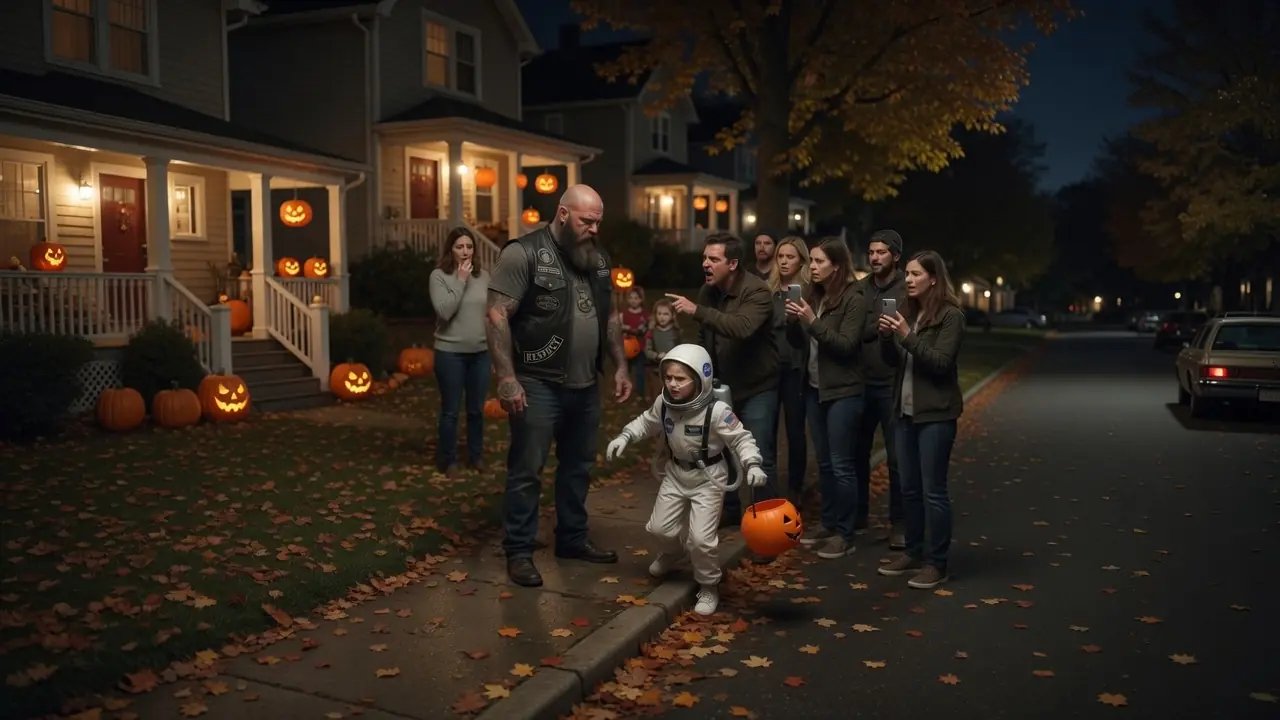
Inside that rocket pack was not candy.
It was her portable oxygen tank.
To everyone else on Briar Lane that night, it looked like a giant biker was following a fragile little girl through the dark while she struggled to breathe. They saw the size of me, the tattoos, the leather, the heavy metal cylinder hidden in a homemade backpack, and they thought they understood the story.
They did not.
Lily was the astronaut.
I was mission control.
That was what she had named us three weeks earlier in our garage while I stood in front of a workbench covered with straps, buckles, foam padding, reflective tape, and half a dozen failed designs. I had been trying to build a safe carrier for her oxygen tank, something I could wear without tugging the tubing or letting the regulator shift. She had sat on an upside-down bucket with her little notebook open, timing my turns like a NASA engineer with pigtails.
“You’re too slow,” she told me.
“I am carrying life support,” I said.
“Astronauts need fast life support.”
“Then astronauts need to hire younger help.”
She looked at my knees, then at my beard.
“That’s true.”
Her mother laughed from the doorway, but I did not.
Not really.
I wanted to laugh more than anything. I wanted to make that garage feel normal, like we were just building a Halloween costume and not negotiating with a disease that had already taken more from my daughter than any child should be asked to surrender.
My name is Roy Hayes.
Most people in the club call me Brick, because I am hard to move and not pretty to look at. I run a small motorcycle repair shop on the edge of a fictional town called Cedar Run, a place with two water towers, one high school, three churches, and enough gossip to travel faster than emergency sirens.
I had been a biker before I was a father.
Then Lily was born, and the order changed.
She arrived six weeks early on a rainy morning in November, too small, too quiet, and already surrounded by people speaking in careful voices. Her heart condition had been diagnosed before birth, but nobody was prepared for how complicated her lungs would become as she grew. The first years of her life were made of hospital bracelets, oxygen alarms, specialist visits, medication charts, and the kind of hope that learns to read numbers before it learns to relax.
People talk about bravery like it is loud.
Lily’s bravery was usually quiet.
It looked like sitting still while a nurse changed tape on her cheek. It looked like telling a doctor exactly where her chest felt tight. It looked like asking whether her oxygen tubing could be pink because clear was “too medical and not fun enough.”
For three Halloweens, she watched other children from our front window.
The first year, we decorated the living room and let her trick-or-treat from room to room. I put candy behind the couch, under pillows, and inside the kitchen cabinets. The Iron Harbor Riders came over one at a time wearing ridiculous hats so she could pretend they were different neighbors.
Gus wore a pirate hat.
Manny wore a plastic crown.
Dean put on a white sheet and called himself a ghost, even though his boots and beard made him look like a haunted lumberjack.
Lily laughed.
I told myself that meant it was enough.
The second year, she asked why the other kids got to know which houses gave big candy bars.
“Experience,” I told her.
She looked out the window at a group of children running across the street in capes and dinosaur tails.
“I don’t have experience.”
That sentence stayed with me longer than she knew.
The third year, she chose the moon explorer costume from a catalog and circled it with a purple marker. Her mother, Emily, sat beside her at the kitchen table, reading the medical restrictions from Lily’s care plan while Lily argued that space people were “supposed to bring air with them.”
“Why a moon explorer?” I asked.
Lily did not even look up.
“Because if Earth air gets hard, I can bring my own.”
I went into the garage after that.
I told Emily I needed to check a fuel pump.
Really, I stood beside a half-finished Harley and cried into a shop rag that smelled like gasoline.
The first time we tried to let Lily walk outside with her rolling oxygen cart, the wheels caught on a crack before we reached the end of the driveway. The cart jerked, the tubing pulled, and Lily spun around too fast, trying to save it.
I caught the tank before it tipped.
Emily caught Lily.
Lily’s face went white, not from lack of air, but from disappointment.
“I hate that cart,” she whispered.
I wanted to say the cart kept her safe.
I wanted to say there were limits.
I wanted to say all the things parents say when fear is trying to sound like wisdom.
Instead, she looked at me and asked, “Can you carry the tank if I carry myself?”
That was the beginning.
I did not build anything until her respiratory therapist saw the idea. I brought drawings to the clinic. I asked questions. I let people half my size tell me exactly why my first three designs were wrong. The tank could not bounce. The regulator had to remain accessible. The tubing could not cross sharp edges. There had to be an emergency release. I had to kneel without pulling her backward.
So I built.
Failed.
Rebuilt.
Failed better.
By the time the final harness passed inspection, it looked like a black rocket strapped to a biker’s back. I had wrapped the frame in foam and reflective tape. Emily sewed silver panels around the outside so it matched Lily’s costume. The club boys painted little flames on the lower edges because they said all good rockets needed attitude.
Lily inspected it like a serious customer.
“Does it have snacks?”
“No.”
“Then it’s only medium good.”
But her shoulders loosened when she said it.
That was the thing people did not understand on Halloween night.
The oxygen tank was not holding Lily back.
It was the thing letting her go.
Her doctor approved a short route with strict rules: no running, frequent rests, pulse checks, backup supplies in the truck, Emily carrying the medical bag, and an immediate stop if Lily’s numbers or symptoms crossed the line. We had practiced stopping. Turning. Climbing one step. Backing up. Letting other children pass without tangling the tube.
Lily chose eighteen houses.
Not twenty.
Not the whole block.
Eighteen.
She counted them herself from our porch using a crayon map.
The first house belonged to Mrs. Pruitt, who gave her a chocolate pumpkin and told her she looked like she belonged on the moon. Lily looked back at me and whispered, “One.”
At the second house, a boy dressed as a vampire asked if I was her robot.
“No,” Lily said. “He’s the air guy.”
I nodded.
“Highly trained.”
The vampire seemed impressed.
By house four, she needed her first rest. We had placed a folding chair at the edge of a driveway with the homeowner’s permission. She sat, sipped water, and let Emily check her pulse and oxygen saturation while I stood behind her with the tank still on my back.
That was when people started noticing.
At first, they smiled.
Then they stared.
Then they whispered.
A few parents pulled their kids closer, not because Lily was sick, but because I looked like the sort of man children should not stand near. I had lived with that my whole adult life. The difference was that now their fear brushed against my daughter.
I could take it when strangers judged me.
I could not take it when their judgment made her feel like a problem.
At house seven, Lily slowed.
Her steps grew smaller. Her breathing sounded louder to me, though every father of a medically fragile child knows the danger of hearing panic before facts. Emily moved to Lily’s side. I checked the tubing slack. Lily stopped at the curb and held up one finger, our signal for pause.
The woman on the porch next door saw only the pause.
“Pick her up!” she shouted.
Another man near the sidewalk said, “She can barely walk.”
A phone came up.
Then another.
I felt the old anger rise in me, hot and familiar.
The biker anger.
The kind that had solved problems badly when I was younger.
But Lily turned toward me, and her eyes were clear.
“Dad,” she said.
I looked down.
“Don’t carry me.”
Her voice was small but steady.
“I didn’t wait three years to be carried past the doors.”
That sentence cut the whole sidewalk open.
Even the woman on the porch stopped talking.
Emily unfolded the chair. Lily sat. I knelt behind her, keeping the tubing loose. She drank water slowly. We checked her numbers. We asked the questions from the plan. Dizzy? Chest pain? Headache? Can you speak in full sentences?
“I can say trick or treat in full sentences,” she said.
“That is not a medical category,” Emily told her.
“It should be.”
After seven minutes, Lily stood.
The woman who had shouted looked embarrassed now.
“I’m sorry,” she said, but not loudly enough for Lily to hear.
Maybe that was good.
Lily did not need apology.
She needed house eight.
At house eight, she got sour gummies and fist-bumped a skeleton.
At house nine, a teenage girl moved a fake tombstone out of the way before we reached the path.
At house ten, the candy bowl had mini peanut butter cups, and Lily looked at me like she had discovered treasure.
“Ten,” she said.
Halfway.
By then, the neighborhood had changed.
The crowd no longer pushed around us. Kids slowed down near the tubing. Parents stepped aside. Someone turned down loud porch music when Lily rested. A man who had been filming put his phone away and walked ahead to warn another group to keep the sidewalk clear.
I hated that we had become a parade.
I was grateful too.
Parenthood is full of feelings that do not fit together but have to share a room.
At house eleven, the alarm sounded.
A high mechanical beep cut through the Halloween noise.
Every adult froze.
Emily moved first. I dropped to one knee immediately, one hand on the harness, the other lifting my vest away from the tubing. Lily stood still, breathing through her nose the way she had practiced.
Someone yelled, “Call 911!”
Another voice said, “I knew this was too much.”
My hands shook as I traced the line.
The tube had slipped under one of the lower straps and pinched near the edge of the rocket pack. Not fully blocked. Enough to trigger the flow alarm.
I freed it.
Emily checked Lily.
The numbers dipped, then climbed back where they belonged.
We waited.
No heroics.
No pretending.
No pushing forward because pride had entered the route.
Just waiting in the cold under orange porch lights while my little girl stared at the next house like it was the top of a mountain.
“We can stop,” I said.
She looked at Emily.
“Am I safe?”
Emily swallowed.
“Yes. But tired.”
Lily nodded.
“That’s different.”
She turned back to me.
“House twelve.”
I wanted to refuse.
I almost did.
Then I remembered three years of her watching from the window while other children learned the map of their own neighborhood.
“House twelve,” I said.
Her smile came slowly.
Not big.
Not movie-like.
Real.
We kept going.
At house thirteen, children began walking beside her, not too close, but close enough that she was not alone. A boy dressed as a dragon offered to carry her candy bucket. Lily refused with great dignity until he said it was because dragons were naturally good at treasure guarding.
She considered that.
Then handed him the bucket for half a block.
At house fifteen, she rested on a curb while a little witch asked if the tube hurt.
“No,” Lily said. “It helps.”
The little witch nodded.
“My brother has glasses. They help too.”
Lily thought about this.
“Mine are nose glasses for air.”
The witch accepted that without question.
Children, I have learned, can handle truth if adults stop teaching them fear first.
By house seventeen, I knew Lily was near the edge.
Not danger.
Limit.
Her steps were slower. Her voice was thinner. Emily met my eyes twice, and both times I knew she was asking the same thing I was afraid to answer.
Do we stop before she chooses to?
The final house stood at the end of Briar Lane.
A small blue house with warm porch lights, a narrow ramp leading from the sidewalk to the front door, and no decorations except one carved pumpkin sitting beside the rail. I had not known the family. Lily had insisted that house be number eighteen on her map, but she never explained why.
Now she pointed toward it.
“One more.”
“Lily,” Emily said softly.
“One more.”
The sidewalk behind us had gone quiet again.
Not judgment this time.
Hope is loud in a different way, even when nobody speaks.
Lily walked the last sixty feet with me one step behind her and Emily beside her, the oxygen tube glowing faintly under the porch lights. The boy who had carried her bucket returned it before she reached the ramp. She took it with both hands like an athlete receiving a baton.
At the bottom of the ramp, she paused.
Then reached into the bucket.
She pulled out a sealed plastic bag I had never seen before. Inside were pieces of candy, one from each house we had visited. Chocolate pumpkin, sour gummies, peanut butter cup, lollipop, little candy bar, one pack of fruit chews, and more, all chosen carefully.
“Where did that come from?” I asked.
Lily looked back.
“I packed it.”
“For who?”
She did not answer.
She walked up the ramp and knocked.
A woman opened the door. She was maybe mid-thirties, with tired brown eyes and a cardigan pulled tight around her shoulders. Behind her, in the dim living room, sat a boy about Lily’s age in a wheelchair. He wore a blue sweatshirt, not a costume, and held a plastic pumpkin bucket with nothing in it.
His name, we learned, was Oliver Reed.
Lily knew him from the pediatric therapy center.
He had stopped trick-or-treating the year before after too many porches had stairs, too many adults said “wait here,” and too many kids came back down with candy he had not chosen himself.
“Lily?” he said.
She lifted her helmet slightly.
“You didn’t come out.”
Oliver shrugged.
“Too many steps.”
Lily held up the bag.
“I brought the steps to you.”
His mother covered her mouth.
Nobody on the sidewalk moved.
Oliver looked at the bag.
“I don’t want pity candy.”
“It’s not pity,” Lily said. “It’s selected candy.”
He frowned.
“What does that mean?”
“It means I picked the best one from every house before I picked mine.”
Oliver took the bag slowly.
Then looked at me.
“You carried her air?”
I nodded.
“She carried herself.”
Lily turned back to him.
“Want to do the last house?”
He looked around.
“This is my house.”
“So we do it twice.”
That made no sense to adults.
It made perfect sense to children.
Oliver’s mother wiped her eyes, closed the door, and waited. Lily came back down the ramp, turned beside Oliver, and they went up together. She walked. He rolled. I followed with the oxygen tank.
They knocked.
Oliver’s mother opened the door with the candy bowl lowered to wheelchair height.
“Trick or treat,” they said together.
She gave each of them two pieces.
The whole block applauded.
Lily frowned immediately.
She leaned toward Oliver and whispered, “Adults are so dramatic.”
Oliver nodded.
“But they have candy.”
That was the start of it.
Not the applause.
Not the viral photo someone posted later of a massive biker carrying a rocket-shaped oxygen pack behind a tiny astronaut and a boy in a wheelchair.
The start was Lily looking at me from Oliver’s porch and asking one question.
“Dad, can bikers build ramps?”
I looked down at the ramp beneath my boots.
“We can build motorcycles.”
“That wasn’t my question.”
I looked at the Iron Harbor Riders gathered at the end of the sidewalk. Gus, Manny, Dean, and half a dozen others had arrived after hearing on the group chat that Lily had made it past house twelve. They stood in leather vests under porch lights, trying to look tough while clearly crying.
I looked back at my daughter.
“Yes,” I said. “Bikers can build ramps.”
“How many?”
“As many as people ask for.”
She nodded like she had already made a list.
“Good. Next Halloween, Oliver gets more than one house.”
That winter, my garage changed.
It was still a motorcycle shop. Engines still came apart on lifts. Oil still stained the floor. Men still argued about carburetors like theology. But along one wall, beside the tool chests, we built something else.
Temporary ramps.
Candy tables.
Portable rails.
Low-height treat stands.
We did not guess. Emily insisted on that. Lily’s medical world had taught us the danger of well-meaning people building things without asking the people who needed them. So we talked to families. We talked to a mobility specialist. We talked to Oliver’s mother, who corrected half our assumptions before we cut the first board.
Some houses could use safe temporary ramps.
Some could not.
Some needed candy stations placed at the sidewalk. Some needed clearer pathways, quieter lights, or chairs for kids who needed rest. Some children did not want a special route at all. They wanted the same route made less stupid.
Lily became the boss of the map.
Oliver became inspection chief.
The Iron Harbor Riders became unpaid labor with bad jokes and decent tools.
The next Halloween, Briar Lane had thirty-one participating houses.
Every porch had either an accessible path, a sidewalk candy station, or a clear note saying where kids could approach safely. Nobody had to wait at the bottom of stairs. Nobody’s medical equipment got tangled in fake spiderwebs because Manny personally removed every decoration that crossed a walkway.
Lily dressed as an alien that year.
Oliver dressed as a moon mechanic.
I was assigned the role of cargo ship because Lily said mission control had been promoted.
I still carried her oxygen for part of the route, but not all of it. Her equipment had changed. Her endurance changed day by day. Some nights were good. Some were not. That is the part people forget when they turn one brave moment into a simple story.
Halloween did not cure her.
The costume did not erase hospital visits.
The applause did not make her lungs easier.
There were still hard mornings, medication changes, infections we feared more than other families feared storms, and days when Lily’s body made the rules no matter how badly she wanted to argue.
But after that first Halloween, she had something illness had not been able to take back.
Experience.
She knew which house gave peanut butter cups.
She knew which porch dog barked but was friendly.
She knew Mrs. Pruitt always said the costume was the best she had seen, even if she said that to everyone.
She knew Oliver liked sour candy but pretended not to.
And she knew that walking slowly was still walking.
Lily is eleven now.
She is taller, sassier, and more dangerous with a clipboard than any club president I have known. Her oxygen needs have changed over the years, and the original rocket pack no longer fits the equipment she uses. It hangs in my garage above the workbench, scratched, dented, and still dusted with silver glitter from that first costume.
Every October, she touches it once before we leave the house.
Not for luck.
For memory.
Last Halloween, I watched a father try to lift his son over a curb without asking. The boy jerked away, embarrassed and angry, while the father looked hurt because love sometimes reaches too fast.
Lily walked over.
She was wearing a comet costume with glowing ribbons on her sleeves.
“Ask what he wants carried,” she said.
The father blinked.
“What?”
“Ask what he wants carried. Him or the stuff.”
The boy pointed to the oxygen cart beside him.
“Just the stuff.”
The father looked at his son.
Then nodded.
He picked up the cart.
The boy climbed the curb himself.
Lily watched, satisfied, then continued down the block like a tiny queen of practical miracles.
People still call me Brick.
The Iron Harbor Riders still look like trouble when we roll into a parking lot. I still have tattoos, scars, a beard, and hands that make strangers nervous. But on Halloween in Cedar Run, kids know us as the ramp crew, the candy-table guys, the men who measure sidewalk cracks like bridge engineers and argue about pumpkin placement like national security depends on it.
Sometimes a neighbor will point at the old rocket pack in my shop and ask if I was the hero of that first Halloween.
I always tell them no.
I carried the tank.
Emily carried the medical plan.
The club carried the ramps.
The neighborhood carried the lesson after it finally learned how to listen.
But Lily carried the night.
She carried the fear of being stared at.
She carried three years behind a window.
She carried the decision not to be lifted past doors she had waited so long to reach.
And at the final house, when everyone thought the story was about one sick little girl finishing a route, she showed us it had been about something bigger all along.
A child who gets access should not be the last one through the door.
She should turn around.
Hold it open.
And ask who else has been waiting.