Fly home. Don't say anything to your mother and brother.
That text came in at 6:47 a.m. while I sat on a sunlit balcony in Hilton Head Island watching my mother laugh for the first time in 21 years at something my brother said. An unknown number, no name.
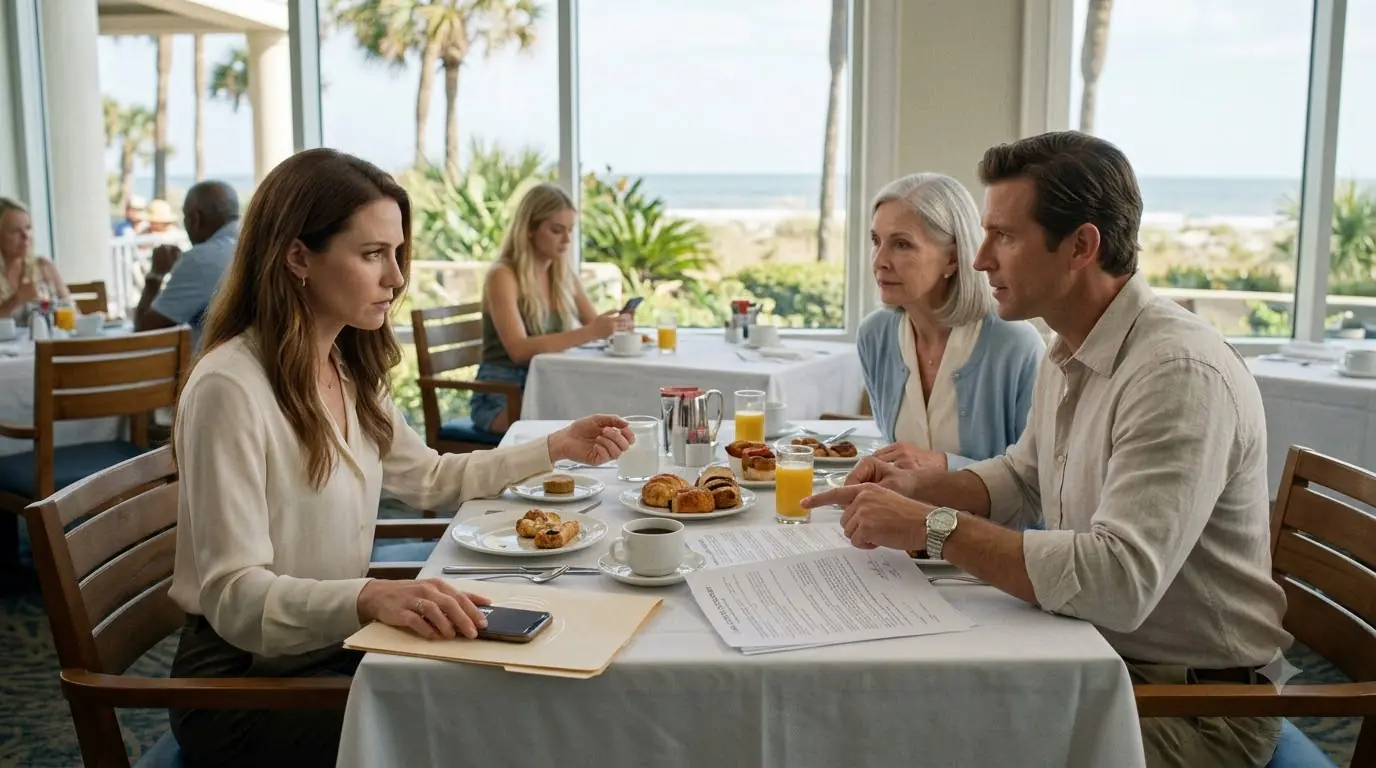
Seven words that turned my stomach to ice. 12 hours later, I was standing in the arrivals hall of Bradley International Airport. A man in a gray suit held a sign with my name. Next to him, two police officers and what they showed me in that conference room.
I don't remember hitting the floor. I just remember waking up to fluorescent lights and a paramedic asking me to count backward from 10. That was 4 months ago. I still don't sleep through the night.
But I need to tell you everything because what my family did and what I did about it changed who I am forever.
My name is Willow Frell. I'm 32 years old and this is the story of how my own mother and brother tried to destroy me and how the truth saved my life. Now, let me take you back to a rainy November night in Glastonbury, Connecticut. The night I stopped being someone's daughter.
I was 11 years old. It was a Tuesday, November 14th. I remember the date because I'd brought home a permission slip for a field trip to the Wadsworth Atheneum, the art museum in Hartford. I needed a parent signature and $3.
That's it. A signature and $3. My mother, Margaret Frell, was sitting at the kitchen table when I walked in. She had the phone pressed to her ear.
Her voice was calm, flat, like she was reading a grocery list. "It's done," she said. "She's leaving tonight." I didn't know who she was talking to.
"I still don't." She hung up and looked at me the way you'd look at a stain on a countertop. Something to wipe clean. "Pack your things," she said.
I thought she meant for the field trip. I actually smiled. "You're leaving tonight." My brother Dean stood at the top of the stairs.
He was 14. He watched the whole thing. Didn't say a word. Didn't move.
Just leaned on the railing like he was watching a show that didn't concern him. My mother opened the front door. Rain was hammering the porch. She handed me a black garbage bag, the kind you use for yard waste, and said four words I will hear for the rest of my life.
Go. Don't come back. No suitcase, no coat, no explanation, no $3. I walked three miles in that rain.
My sneakers filled with water by the second block. The garbage bag ripped at the corner of Hebron Avenue and my library book fell into a puddle. I made it to my grandfather's house on Hubard Street. When he opened the door, he didn't ask what happened.
He didn't call Margaret. He just knelt on the wet porch, wrapped his arms around me, and said, "You're home now, little bird." That was the last time anyone in my family held me for 21 years.
My grandfather, Walter Ashford, was a retired civil engineer who lived like he'd never earned a dollar past his pension. Small Cape Cod house, vegetable garden out back, a workshop in the garage where he fixed clocks, radios, anything with gears. He wore the same three flannel shirts on rotation and drank his coffee black from a mug that said World's Okay Grandpa. My grandmother Rosemary was the warmth in that house.
She taught me how to make pot roast on Sundays. She braided my hair before school. She read to me every night, even when I was 12 and probably too old for it. I never stopped her.
For 7 years, that small house on Hubard Street was the only place I felt real. Margaret never called, not once. Dean didn't write. No birthday card, no Christmas visit, nothing.
It was as if I'd been erased from their lives with the same ease my mother used to wipe the kitchen counter. My grandfather never forced the subject. But once, when I was 13 and crying in the garage because a girl at school asked why my mom didn't come to the parent conference, he set down his wrench and said something I didn't understand until decades later. Someday you'll understand why I'm saving the best for you.
Not now, but someday. I noticed things, small things. A man in a gray suit who visited my grandfather every few months. They'd sit in the study with the door closed.
I'd hear low voices, but never full sentences. When I asked who the man was, Grandpa said, "An old friend helping with paperwork." I didn't push. I was just grateful to have a home.
My grandmother Rosemary passed when I was 16. A stroke, quick and merciful, and the house on Hubard Street got a little quieter, a little colder. But my grandfather kept going for me, I think. He drove me to campus tours.
He proofread my college essays. He kept a locked oak box on the top shelf of his closet that he never opened in front of me. I asked him once what was inside. He smiled and said, "Your future."
My grandfather died in his sleep three weeks before I started college. I found him on a Saturday morning, still in his flannel, one hand resting on a book about covered bridges. He looked peaceful. He looked done.
The funeral was small. Six neighbors, the pastor from the Methodist church on Main Street, a woman who ran the hardware store where grandpa bought his nails, and then Margaret walked in. I hadn't seen my mother in seven years. She wore black from head to toe.
A silver cross hung from her neck. She moved through the church like a widow in a movie, touching pews, dabbing her eyes with a tissue, whispering, "Thank you," to strangers who offered condolences. She never looked at me, not once. But Dean did.
He walked right up to where I was sitting in the front pew, leaned down, and said something so quietly that only I could hear it. Grandpa left everything to mom. There's nothing for you. Then he smiled.
A quick one, the kind that vanishes before anyone else sees it. After the service, a man approached me in the parking lot. Gray suit. I recognized him.
The man who used to visit grandpa's study. Miss Frell, he said. My name is Thomas Mercer. I was your grandfather's attorney for 30 years.