Blackwood House stood 12 miles outside Lexington, where the subdivisions thinned, and the road began to curve between horse farms and low stone walls. The mansion appeared slowly from behind two rows of century-old white oaks. First came the black iron gates, then the long gravel drive. At the end stood three stories of pale Kentucky limestone beneath a steep slate roof with tall windows, four brick chimneys, and a deep front porch supported by square columns. The house had 21 rooms.
It also had a ballroom, a library lined with walnut shelves, a carriage house large enough for six vehicles, and 12 acres of land that rolled toward a narrow creek behind the western field. People in Lexington called it the Whitmore mansion. Charles Martinez never did. To him, it was Blackwood House. The difference mattered.
On most mornings, Charles left before sunrise. He carried a scratched stainless steel thermos in one hand and a black inspection case in the other. His Navy work jacket had faded at the elbows. His Ford F-150 had 147,000 miles on the odometer and a dent above the rear wheel from a parking garage column in Cincinnati. Nothing about him suggested money.
That was exactly what Margaret Whitmore noticed. At sixty-three, Margaret carried herself as if every room had been prepared for her arrival. She wore pearl earrings to breakfast. Her silver blonde hair was always arranged neatly at the base of her neck. Even when she visited the mansion without warning, she entered through the front door without knocking.
"Charles," she called, one Tuesday morning, standing beneath the crystal chandelier in the foyer. The hinge on the music room door is still making that noise. Charles had been kneeling beside an open electrical panel near the library. He looked over his shoulder. I ordered the replacement pin yesterday.
Margaret glanced down at his work clothes. I thought a building inspector would know how to fix a hinge. I do. Then why is it still making noise? The original pin is hand forged.
The wrong size will split the frame. Margaret gave him a thin smile. To everyone else, it sounds like a squeak. Charles closed the panel and stood. To everyone else, the door looks like wood.
He did not say it sharply. That was what made Margaret's expression tighten. Evelyn entered from the dining room before the silence could stretch. At thirty-six, Evelyn Martinez looked at home beneath the chandelier. She wore a cream blouse, tailored gray trousers, and a narrow gold watch Charles had given her on their fifth anniversary.
Her dark hair fell in controlled waves to her shoulders. She was the executive director of the Bluegrass Heritage Foundation, a nonprofit that raised money to preserve historic buildings across central Kentucky. She spent her days speaking about legacy. Charles had once admired that about her. Mom Evelyn said, "I told you Charles already ordered the part."
Margaret turned toward her daughter. "I'm only asking because the Hollis committee is coming Thursday. It would be embarrassing to have them hear that sound. Charles picked up his inspection case. The door will be repaired before Thursday.
Margaret nodded as if approving a contractor. Good. She walked toward the dining room without thanking him. Evelyn remained in the foyer. For a moment, Charles waited for her to say something.
She used to apologize after her mother spoke to him that way. Sometimes she would touch his arm. Sometimes she would roll her eyes after Margaret left the room. That morning, she only checked the time on her watch. You're still coming to dinner tonight, right?
I live here. You know what I mean? Nathan is coming. Charles set the electrical panel key inside his case. What does he want?
Evelyn's mouth changed slightly. Why do you assume he wants something? Because Nathan never drives out here for dinner. He's family. Charles looked toward the dining room where Margaret's heels clicked against the hardwood floor.
So am I. Evelyn did not answer. Nathan Whitmore arrived at 7 in a black Range Rover that still carried temporary plates. He was forty-two, broad-shouldered, clean-shaven and careful about being seen in expensive clothes. His company, Whitmore Development Group, had offices on West Vine Street and a polished website filled with architectural renderings of luxury hotels that had never been built. At dinner, Nathan sat at the head of the table.
Charles noticed it immediately. The chair had always belonged to the person responsible for the house. Margaret had occupied it during the first months after Charles and Evelyn moved in. Then Evelyn began using it when the foundation hosted donors. Nathan had never sat there before.
A map was spread beside his plate. Margaret poured wine. "The west lawn has never been used properly," she said. Charles cut into his roast chicken. Nathan tapped the map with one finger.
"There's enough space for an arrival court and underground service access." Evelyn unfolded a second sheet. The carriage house could become private guest suites. Charles looked at the drawings. Lines had been placed over the property, parking zones, service lanes, a new access road.
No one had asked him. Nathan leaned back. Blackwood needs revenue. Sentiment doesn't pay for slate roofs. Charles took a drink of water.
The roof is paid for. Nathan smiled. For now, Margaret turned to Evelyn. The foundation could host the opening gala. Evelyn nodded.
It would generate attention. Charles placed his fork down. What exactly are you discussing? Margaret looked mildly surprised. The future of the estate.
Whose estate? Nathan gave a soft laugh. Don't start. Charles kept his eyes on the map. I asked a question.
Evelyn lowered her voice. Charles, this is preliminary. Preliminary work usually begins with the owner. Margaret's expression cooled. This house has belonged to my family for generations.
Charles looked at her. That wasn't my question. No one spoke for several seconds. Then Nathan folded the map and moved it away from Charles. We're talking about possibilities.
You don't need to turn everything into an inspection report. Charles resumed eating. Across the table, Evelyn avoided his eyes. 18 months earlier, she had told Charles moving into Blackwood House would make life easier. Margaret needed help managing the property.
She had said the family wanted to preserve it. The mansion had too many repairs for one aging woman to supervise. That was the version repeated at charity dinners and church receptions. Margaret had generously opened the ancestral home to her daughter and son-in-law. Charles never corrected anyone.
He never explained who paid the quarterly property tax bill of $18,640. He never mentioned the $27,000 annual insurance premium. He never told Margaret's friends that the landscaping invoices, security system, utilities, roofing work, masonry repairs, and climate controls were paid through accounts she had never seen. He allowed the Whitmore name to remain attached to the house. At first, silence had seemed like kindness.
Over time, it became permission. By Thursday afternoon, the replacement hinge pin arrived. Charles installed it himself. He removed the door, supported its weight with a padded jack, replaced the damaged pin, and adjusted the frame by less than one-sixteenth of an inch. When Margaret's committee arrived, the door opened without a sound.
No one noticed. That evening, after the final guests left, Charles walked through the foyer, turning off lamps. A white business card rested on the walnut console near the front entrance. Bluegrass Lock and Security. Beneath it lay a folded note in Margaret's handwriting.
Charles opened it. Four words were written across the page. Change all exterior locks, Friday. He read the line twice. Then he looked toward the staircase where Evelyn's bedroom door had just closed.
Charles left the locksmith's card where he found it. He folded Margaret's note once slipped it into his jacket pocket and walked upstairs without turning on another light. The hallway outside the bedroom was dark except for a narrow line beneath the door. Evelyn was awake. He could hear drawers opening then closing.
A zipper moved slowly. When Charles entered, she was standing beside the dresser with her back to him. "Your mother hired a locksmith," he said. Evelyn stopped moving. For half a second, her shoulders tightened.
Then she turned. She mentioned changing a few locks. All exterior locks. The old cylinders are unreliable. Charles placed the card on the dresser.
The front lock was replaced 14 months ago. Evelyn looked at the card instead of him. Then maybe she forgot. Charles watched her face. Evelyn had always been a controlled liar when the lie was small.
Her voice became softer. Her hands became still. She offered explanations before anyone asked for them. That night her hands were flat against the edge of the dresser. "Did she tell you Friday?"
Charles asked. "I don't remember." He nodded once. The note in his pocket pressed against his ribs. He did not show it to her.
The next morning, Margaret's version of the truth reached downtown Lexington before Charles did. At 8:15, he parked his truck beside a 12-story office building on East Main Street. He was scheduled to inspect fire barriers between the sixth and seventh floors after a renovation contractor had cut unauthorized openings through two raided walls. Charles signed in at the security desk. The receptionist studied his identification badge.
"Blackwood House," she said. Charles looked up. She smiled with the curiosity of someone repeating a story that did not belong to her. My sister attended the Hollis committee reception. She said, "The Whitmores are finally turning that place into a hotel."
Charles closed the visitor log. Did she? She said it's been in Mrs. Whitmore's family forever. Charles clipped the badge to his jacket. People say a lot of things at receptions.
The receptionist's smile faded. Charles entered the elevator. By noon, he had documented seven improper wall penetrations, two unsealed cable routes, and one contractor invoice charging for fireproofing that had never been installed. He photographed everything. He measured twice.
He wrote down the exact floor room wall section and time. His work had taught him that false stories grew strongest where details were missing. When every detail was recorded, the story became harder to control. At 12:47, Evelyn called. Are you near the foundation office?
I'm downtown. Can you come by? For what? We're hosting a donor luncheon. One of the board members wants to ask you about the mansion's west drainage.
Charles looked at the exposed wall in front of him. I'm working. It will take 10 minutes. Then she can email me. Evelyn exhaled.
Charles, please don't make this difficult. He said nothing, she continued. Caroline Reeves is there. She's important to the foundation. I know who she is.
Then come by when you finish. Charles ended the call without agreeing. At 2:30, he walked into the Bluegrass Heritage Foundation's offices on North Mill Street. The foundation occupied a restored brick building with white columns, polished oak floors, and framed photographs of Kentucky estates lining the walls. Blackwood House appeared in three of them.
In each photograph, a small brass plate identified it as the Whitmore family estate. Charles stopped in front of the newest frame. The picture had been taken after the eastern facade restoration, his restoration. The brass plate looked recently polished. Voices carried from the conference room.
Caroline Reeves stood near a table covered with empty dessert plates and coffee cups. She was fifty-seven, with short auburn hair and a habit of speaking as though every sentence belonged in official minutes. Evelyn saw Charles first. There he is. Several heads turned.
Margaret stood near the windows. She had not mentioned she would be there. Caroline approached Charles with an extended hand. Mr. Martinez, we've heard so much about you. Charles shook her hand.
Have you? Margaret tells us you've been helping around Blackwood while the family considers its next chapter. Helping around. Charles glanced at Evelyn. She adjusted a stack of brochures.
Caroline continued. The board is fascinated by Nathan's hotel concept. A heritage property that funds its own preservation could become a model for the region. What concept? Charles asked.
Margaret stepped forward. Nothing has been finalized. Caroline looked surprised. I thought the preliminary study had already begun. Evelyn moved quickly.
It has, but only at an exploratory level. Charles looked from Evelyn to Margaret. What preliminary study Margaret's smile remained in place. Nathan is evaluating whether the west lawn and Carriage House could support limited hospitality use. Who authorized him?
The room became quieter. A volunteer began gathering coffee cups at the far end of the table. Caroline lowered her voice. I assumed the family had. Charles met her eyes.
Which family member owns the property? Margaret answered before Caroline could. That question is unnecessarily confrontational. It's a simple question. This is not the place.
Charles glanced again at the framed photograph in the hallway. Apparently, every place was suitable for claiming the mansion. None was suitable for proving it. He turned to Evelyn. Did you authorize a site study?
Evelyn's face hardened. We can discuss this at home. That isn't an answer. Margaret stepped between them. Charles, your tone is making people uncomfortable.
He looked around the room. No one met his eyes except Caroline. Charles nodded. Then I'll leave. As he walked out, he heard Margaret behind him.
This is what I meant. He has become very possessive about a house that isn't his. Charles stopped beside the front desk. He did not turn around. The receptionist lowered her eyes.
Charles continued through the door. By the time he returned to Blackwood House, three wooden survey stakes had appeared along the west lawn. Bright orange ribbon moved in the evening wind. He parked beside the carriage house and walked across the grass. Each stake had been marked with black letters.
Parking edge, service access, utility corridor. A fourth marker stood near one of the oldest white oaks. Charles crouched beside it. The proposed access line passed directly through the tree's root zone. A white pickup was parked beyond the carriage house.
A man in a reflective vest loaded measuring equipment into the bed. Charles approached him. Who hired you? The man looked toward the mansion. Whitmore Development.
Who gave you permission to enter the property? Nathan Whitmore. Did he show you an ownership document? The surveyor hesitated. He said it was family land.
Charles took a photograph of the company name on the truck door. Removed the stakes. The man glanced at the markers. We were paid to complete a site layout. You were not authorized to enter.
The surveyor studied Charles for a moment, then began collecting the equipment. Charles removed the stakes himself. He carried them into the carriage house and locked the door. Inside the mansion, Evelyn was speaking on the phone in the library. She stopped when Charles entered.
I'll call you back, she said. Charles placed one orange stake on the desk. You sent surveyors onto the west lawn. Nathan did. You knew.
He said it was only measurements. He marked an access road through a 100-year-old oak. Evelyn folded her arms. That can be changed. Nothing was supposed to be marked.
You're overreacting. Charles looked at her. Why does everyone keep asking me not to react to things they're doing behind my back? Her expression shifted. We are trying to preserve this house.
Evelyn looked away first. That night, after she went upstairs, Charles opened his laptop at the kitchen island. He searched the Lexington-Fayette Urban County government planning portal. The address appeared immediately. A preliminary development application had been filed 9 days earlier.
Project named The Whitmore at Blackwood proposed use 22 room luxury hotel and private event venue. Applicant Whitmore Development Group. Charles opened the supporting documents. A site plan appeared first. Then a financial impact statement.
Then an affidavit titled beneficial ownership and family control. The affidavit declared that Margaret Whitmore retained equitable authority over Blackwood House despite temporary administrative arrangements involving an outside preservation trust. Charles read the sentence twice. Outside preservation trust. The Martinez Preservation Trust was not outside anything.
It owned every acre beneath the mansion. He scrolled to the signature page. Margaret's name appeared first. Nathan's appeared beneath it. The third signature belonged to Evelyn Martinez.
Her signature had been notarized on September 12th, 3 weeks earlier. Charles downloaded the full application. He saved the file to an encrypted folder. Then he printed the signature page. The kitchen printer moved softly in the dark.
When the paper emerged, Charles lifted it by the edges. Evelyn's name sat beneath a statement declaring that he had no controlling interest in the property he owned. Upstairs, a floorboard creaked. Charles looked toward the ceiling. Then he checked the date one more time.
September 12th was the same night Evelyn had taken him to dinner for his birthday. Charles did not confront Evelyn that night. The printed affidavit remained on the kitchen island long after midnight. He read every line again, not because he doubted what it said, because experience had taught him that the smallest sentence often carried the greatest consequence. At the bottom of the second page, one paragraph stood apart from the others.
It stated that Margaret Whitmore possessed beneficial authority over Blackwood House, and that any preservation trust associated with the property existed solely as an administrative convenience. Administrative convenience. Charles almost smiled. Three years earlier, he had wired $3.8 million from the Martinez Preservation Trust to the closing attorney's escrow account. The bank had not considered the purchase an administrative convenience.
Neither had the county recorder who filed the deed. Neither had the roofing company, the masonry crews, the electricians, the insurance carrier, or Fayette County Tax Office. Every one of them knew exactly who owned Blackwood House. Only the Whitmores pretended otherwise. Charles opened his laptop.
Instead of searching the internet, he logged into Fayette County Clerk's Document Archive. He downloaded another certified copy of the recorded deed. Then he requested the filing history. Every amendment, every transfer, every mortgage release, every tax payment. Nothing had changed since the day Blackwood House entered the Martinez Preservation Trust.
Nothing. He compared the filing date with the affidavit Evelyn had signed. The affidavit had been executed 23 days earlier. Someone had knowingly sworn to facts that the public record disproved. Charles printed the filing history.
Then he labeled a new folder. Blackwood September evidence. His father had once told him that documents should never be mixed together when emotions were involved. People forgot conversations. They remembered folders.
At 6:30 the following morning, Charles drove to downtown Lexington instead of his first inspection site. Rebecca Sloan's office occupied the fourth floor of a restored brick building overlooking West Main Street. Rebecca specialized in complex real estate litigation. She also happened to dislike people who believed expensive suits could replace evidence. Charles had worked with her twice before.
The receptionist smiled when he entered. Mr. Martinez, is Rebecca free? She'll make time. 5 minutes later, Rebecca walked into the conference room carrying coffee and a yellow legal pad. She was forty-eight, practical, and impossible to intimidate.
She closed the door behind her. You look like somebody finally crossed the line. Charles handed her the affidavit. She read without speaking. Then she reached the notarized signature page.
Evelyn signed this. 3 weeks ago. Rebecca looked up. Did she know it was false? I don't know.
Do you think she knew? Charles considered the question. I think she stopped asking questions she didn't want answered. Rebecca nodded. She read the document again.
Then she reached for the certified deed Charles had printed. Within minutes, both documents lay side by side. The language is deliberate, Rebecca said. They're creating a paper trail. Charles remained silent.
Rebecca tapped the affidavit. This isn't about family pride anymore. I know. This document is designed to establish apparent ownership. Charles watched traffic moving below the conference room window.
What comes next? Rebecca leaned back. They're preparing for something bigger. Like what? A loan?
She pointed toward Nathan's signature. Developers don't spend money on surveys unless they're trying to borrow more money. Charles thought about the survey stakes, the proposed access road, the hotel drawings, the appraiser. Everything suddenly aligned. Rebecca continued, "If someone believes Margaret controls the property, they can attempt financing before anyone checks the deed carefully.
They're betting no one verifies ownership. They're betting appearances are enough." Charles looked at the affidavit once more. "They've underestimated paperwork. Rebecca smiled slightly.
People usually do. She opened another folder. I want copies of everything. Charles handed over the printed county records. The survey photographs are on this drive.
Rebecca accepted the flash drive. Good, she paused. But don't confront them. Charles looked at her. Why?
Because they're still building their story. She folded the affidavit carefully. If you interrupt now, they'll destroy evidence. Charles understood immediately. His own investigations worked the same way.
A contractor who believed no one suspected fraud kept creating invoices. A dishonest inspector kept signing reports. People rarely stopped lying until they realized someone was collecting proof. Rebecca slid the documents into separate evidence sleeves. How many people know you own the house?
My accountant? The closing attorney? The trust administrator and the county. What about Margaret? Charles answered quietly.
She has always known. Rebecca's eyebrows lifted. She knew from the beginning. She attended the closing. Rebecca leaned forward.
Then why pretend? Charles remembered the conference room where Margaret had cried 3 years earlier, the foreclosure notice, the unpaid taxes, the bank demanding immediate payment, the contractors threatening liens. She had looked 20 years older that afternoon. I can't lose this house, she had whispered. It belongs to my family.
Charles had answered honestly. It belongs to whoever buys it. She had cried harder. Then Evelyn had taken Charles's hand. My mother will never survive the humiliation.
Charles had believed compassion mattered more than recognition. He had agreed to purchase Blackwood House through the trust. Margaret could continue hosting charity events. Neighbors could believe the Whitmores had privately refinanced. No one needed to know.
At the time it had seemed generous. Now it looked expensive. Rebecca interrupted his thoughts. What are you remembering the closing? And I mistook gratitude for character.
Rebecca wrote something on the legal pad. That's a costly mistake. Charles almost laughed. It usually is. Before leaving, Rebecca handed him a business card with her direct number written on the back.
If anything changes, call me before you speak to anyone else. Charles slipped the card into his wallet. Outside the September air carried the first hint of autumn. He drove directly to Blackwood House. Nathan's Range Rover already sat beside the carriage house.
Charles parked without making noise. The front door stood open. Voices drifted from the dining room. Valuation will be much higher after renovation. Nathan replied.
The lenders only need confidence. Margaret, once Charles is gone. A third voice, Douglas Mercer. Charles remained outside. He did not enter immediately.
Instead, he walked around the side of the mansion. The dining room windows were open a few inches. He could hear them clearly. Douglas spoke again. "The residency acknowledgement solves part of the problem," Margaret answered.
"If he signs, he will." Nathan laughed. If he refuses," Douglas's answer came calmly. "Then we proceed another way." Charles remained perfectly still beneath the window.
Margaret lowered her voice. "The deputies will remove him," Douglas corrected her. "They'll remove whoever appears to have no legal right to remain." "Nathan asked the question Charles had been waiting to hear." "And the appraisal," Douglas replied without hesitation.
9:30 Friday. Charles closed his eyes briefly, exactly as Rebecca had predicted. The police first, the appraiser second, the financing afterward, one operation, one schedule, one carefully prepared lie, a chair scraped across the dining room floor. Charles stepped away from the window before anyone looked outside. He entered through the mudroom instead.
By the time he reached the kitchen, Margaret was already walking toward him. "There you are," she said pleasantly. "We were wondering where you'd been." Charles set his truck keys on the counter. "I had a meeting."
Margaret smiled. "Good." Douglas Mercer appeared behind her holding a leather folder. "I brought a document for you." Charles looked at the folder.
He already knew what was inside. Douglas opened it slowly. I think you'll find this agreement very reasonable. He removed the first page. Across the top in bold letters, Charles read the title.
Temporary residency acknowledgement. Douglas placed a black fountain pen beside the signature line. Whenever you're ready. Charles lowered his eyes to the first paragraph. He did not touch the pen.
Charles read the first page without changing his expression. Douglas Mercer had prepared the document carefully. Every sentence sounded harmless. Every paragraph removed one of Charles's rights. The agreement described him as a temporary resident who occupied Blackwood House only through the generosity of Margaret Whitmore.
It acknowledged that he possessed no ownership interest in the property. It also required him to vacate within 72 hours upon written request. Charles reached the signature page. A blank line waited beside today's date. Douglas slid the fountain pen a little closer.
I had my assistant prepare two originals. Charles looked up. You expected me to sign immediately. Douglas smiled with practiced confidence. I expected a reasonable conversation.
Margaret folded her hands. Charles, this is only paperwork. Nathan leaned against the fireplace. You've always said paperwork matters. Charles looked at him.
It does. Then sign it. Charles returned his attention to the first page. I have one question. Douglas nodded.
Of course. Who drafted the ownership language? I did. Based on what records? Douglas answered without hesitation.
Information provided by my clients. Charles nodded once. So, you never reviewed the recorded deed. A brief silence settled across the room. Douglas chose his words carefully.
My responsibility was to prepare an occupancy agreement. Not verify ownership. My clients represented the relevant facts. Charles closed the folder. Then your clients gave you incomplete information.
Nathan laughed. Still playing games? Charles stood. I'm late for work. Margaret frowned.
So, you're refusing? I I didn't say that. Douglas picked up the agreement. When can we expect an answer? Charles looked directly at him.
When I've reviewed every page. Nathan's patience disappeared. You've lived here for 3 years. I know what exactly needs reviewing. Charles picked up his inspection case.
The truth. He walked toward the front door. No one followed him. Only after he reached his truck did he allow himself a slow breath. Rebecca had been right.
They wanted his signature more than anything else. That meant the document mattered, which meant refusing to rush had already disrupted their plan. Instead of driving to his inspection site, Charles stopped at a branch of Bluegrass Community Bank. Not because he needed money, because he needed information. The trust maintained several accounts there, including the operating account that paid every expense associated with Blackwood House.
Melissa Harper, the senior relationship manager, greeted him personally. Good morning, Charles. Morning. She noticed the seriousness on his face. Conference room.
He nodded. 5 minutes later, she closed the glass door behind them. What happened? Charles placed the residency agreement on the table. I'm not asking you to give me confidential information.
Melissa smiled. I know the difference. I need one answer. Go ahead. Has anyone contacted the bank about financing Blackwood House?
Melissa's expression changed almost immediately. She remained silent for several seconds. I can't discuss another customer's application. Charles nodded. I understand.
He stood. Melissa stopped him. I can answer one thing. Charles waited. If someone attempted to borrow against property held by your trust, she paused carefully.
The title review would become very interesting. Charles understood exactly what she meant. Someone had tried or was about to. He thanked her and left. Outside, he called Rebecca.
They're moving faster. Rebecca listened without interrupting. When Charles described the residency agreement, she sighed. They're trying to manufacture consent. They also may be approaching lenders.
I expected that. What now? Rebecca answered immediately. Don't sign. I won't.
And don't reveal the deed. Charles looked across the parking lot. They're lying under oath. I know. So why wait?
Because attempted fraud is easier to prove when people finish committing it. Charles smiled faintly. You sound like an investigator. I married one. She paused.
Charles. Yes. Do you trust Evelyn at all? The question lingered. He remembered meeting Evelyn 12 years earlier during a preservation conference in Louisville.
She had admired old architecture. She believed history deserved another chance. He had believed people deserved one, too. I don't know anymore. Rebecca's voice softened.
That's probably the most honest answer. After ending the call, Charles drove to the Jefferson Commerce Center. The afternoon inspection involved a newly completed medical office building. Construction superintendent Eric Donovan met him in the lobby. Morning, Charles.
How's the fire suppression system? Eric smiled. Passed every internal check. We'll see. For nearly 4 hours, Charles inspected mechanical rooms, emergency exits, sprinkler risers, electrical closets, smoke barriers, stairwell pressurization fans, and alarm controls.
His concentration never slipped. That was one quality every contractor respected. No matter what happened in his personal life, Charles never guessed. He verified. By the time he completed the inspection, the building passed with only two minor corrections.
Eric walked him to the parking lot. I've got a question. Charles waited. My cousin works for Commonwealth Capital. Charles turned.
The lending company. Yeah. He mentioned something strange yesterday. Charles remained silent. Eric continued, "Apparently, some developer is trying to finance a luxury hotel outside Lexington."
Charles's heartbeat slowed instead of quickening. What was strange? The title company kicked it back. Why? They found ownership inconsistencies.
Charles looked toward his truck. Did your cousin mentioned the property's name? Eric shrugged. Something with black. He snapped his fingers.
Blackwood. Charles thanked him and drove away. So, the title company had already found the first inconsistency. Good. That meant someone would soon become desperate.
When he arrived home, another unfamiliar vehicle occupied the driveway. A black Mercedes sedan, Kentucky license plate, Douglas Mercers. Charles entered through the mudroom. Voices echoed from the library. Uh, the lender only needs clarification.
Douglas, Charles is becoming difficult. Margaret, leave him to me. Nathan. Charles stepped inside. Conversation stopped instantly.
Douglas stood beside the fireplace holding several folders. Nathan held a crystal tumbler. Margaret sat near the window. Only Evelyn looked uncomfortable. "We weren't expecting you yet," Margaret said.
My inspection ended early. Nathan smiled. Perfect timing. Douglas opened one of the folders. I've revised the agreement.
Charles raised an eyebrow. Already? I addressed your concerns. You don't know my concerns. I anticipated them.
Charles accepted the folder. The title had changed. Voluntary occupancy confirmation. Different words, same purpose. He flipped through the pages.
One paragraph caught his attention immediately. Occupant acknowledges that any prior financial contributions toward maintenance or preservation shall not be interpreted as evidence of ownership. Charles almost admired the effort. Someone had spent hours trying to erase 3 years of documented payments with a single sentence. He closed the folder.
No. Douglas blinked. No, I won't sign. Nathan slammed his glass onto the table. This has gone far enough.
Charles remained calm. I agree. Margaret stood. You've become impossible. Charles looked at her quietly.
No. I've become careful. Nathan stepped closer. You think you're smarter than everyone. I think documents should match reality.
Douglas interrupted before Nathan could answer. "Mr. Martinez." Charles turned, "My clients have instructed me to notify you that your continued refusal creates unnecessary conflict." Charles said nothing.
Douglas continued, "If this matter isn't resolved voluntarily," he opened another folder. "Other legal remedies may become necessary." Charles noticed the paper immediately. It was not a lawsuit. Not yet.
It was a formal demand letter. Vacate the premises within five business days. Charles folded it once, then twice. He placed it inside his jacket. I'll keep this.
Nathan smiled coldly. You'll be out before next week. Charles looked at him for a long moment. Then he asked a question that seemed completely unrelated. What time is the appraisal tomorrow?
Nathan's expression froze only for an instant, but Charles saw it. Douglas answered first. I don't know what you're referring to. Charles nodded. I thought so.
He walked upstairs without another word. Behind him, no one spoke until his bedroom door closed. Inside the room, Charles locked the door for the first time since moving into Blackwood House. He opened the closet. On the top shelf sat a black fireproof document case.
He entered a six-digit combination. Inside rested the original trust agreement, the original deed, certified tax records, insurance policies, bank statements, restoration contracts, every invoice, every canceled check, every wire confirmation, 3 years of evidence. Charles removed only one envelope. Its seal remained unbroken. Across the front, Rebecca Sloan's handwriting appeared in blue ink.
Open only if they force the issue. Charles placed the envelope on the desk. He stared at it for several seconds. Then he slid it back into the case without opening it. It was not time.
Not yet. Downstairs, he heard the front door close. Douglas Mercer had finally left. A few seconds later, another sound reached him. The unmistakable click of a deadbolt turning.
Charles walked quietly to the bedroom window. Below Margaret stood at the front entrance speaking to a locksmith wearing a Bluegrass Lock and Security uniform. The locksmith removed a toolbox from his van. Margaret pointed toward the front door. Charles checked his watch.
6:42 p. m. The lock replacement had begun one day earlier than the note had promised. Charles watched from the second floor window until the locksmith disappeared inside the front entrance. Margaret remained beside him, speaking with the confidence of someone giving instructions in her own home. The locksmith carried two hard plastic cases. One contained new deadbolts.
The other contained electronic keypad assemblies. Charles recognized the equipment immediately. Commercial-grade hardware, expensive, permanent. He checked the time again. 6:46 p. m. They were no longer preparing for his removal.
They were preparing to make it impossible for him to return. Charles quietly opened the fireproof case again. This time he removed only three documents. The original recorded deed, the trust certificate, a notarized authorization identifying him as the managing trustee. He placed them into a slim leather portfolio.
Everything else remained inside the safe. He locked it again. Downstairs, the sound of a power drill echoed through the foyer. Metal screws dropped into a tray. Someone laughed.
Nathan. Charles waited another 10 minutes before walking downstairs. The foyer smelled faintly of machine oil and fresh brass. The old front lock lay on a towel. A new electronic deadbolt already occupied the door.
The locksmith turned as Charles approached. Evening. Charles nodded politely. Evening. The man's name tag read Ben Collins.
Ben looked honest, middle-aged, weathered hands, wedding ring scratched from years of work. He didn't look like someone trying to help remove a homeowner. He looked like someone completing another service call. Margaret stepped forward. Ben is almost finished.
Charles looked at the new keypad. Did anyone tell you who owns the property? The room became quiet. Ben answered cautiously. I only install what's ordered.
Charles nodded. Fair enough. Nathan folded his arms, trying to intimidate the contractor. Charles ignored him. Instead, he asked Ben another question.
Did you receive proof of authorization? Ben hesitated. Margaret answered instead. I authorized the work. Charles looked back at Ben.
Did you verify ownership? Ben shifted uncomfortably. For residential work, we normally don't. Charles smiled politely. I thought so.
Margaret's voice sharpened. Charles. He turned toward her. If the wrong person authorizes changes to a property, he gestured toward the lock. The contractor can become liable.
Ben's expression changed instantly. What do you mean? Nathan stepped forward. This is ridiculous. Charles looked directly at Ben.
I'm not accusing you. I'm informing you. If ownership is disputed, Ben interrupted quietly. Is it disputed? Charles answered with perfect calm.
I didn't say that. Margaret crossed the foyer. Ben, finish the installation. Ben looked uncertain. He glanced from Margaret to Charles, then back again.
I'd like to see the work order. Nathan sighed loudly. For heaven's sake. Ben removed a clipboard from his toolbox. Charles noticed the name immediately.
Customer Margaret Whitmore. Owner. The word owner appeared beside her name. Ben noticed Charles reading it. That's what was written when the appointment was scheduled.
Charles nodded. I understand. He removed his phone. Without saying anything else, he photographed the clipboard. Nathan stepped toward him.
You don't have permission to photograph private paperwork. Charles lowered the phone. I photographed the part that concerns me. Ben slowly took the clipboard back. The atmosphere inside the foyer had changed.
A simple lock installation no longer felt routine. Margaret realized it too. Ben. She forced a smile. Please finish.
Ben completed the installation in silence. Before leaving, he handed Margaret two sealed envelopes. Master code. Emergency override keys. Margaret thanked him.
Charles watched carefully. The locksmith left. The front door closed. Nathan immediately entered the security code. The lock beeped.
Green light locked. He turned toward Charles with satisfaction. There. Charles walked to the door. He tested the inside handle.
It opened normally. Then he looked at Nathan. Keep the receipt. Nathan frowned. What?
You'll probably need it. Charles walked away before Nathan could answer. Later that evening, Evelyn knocked softly on the bedroom door. Can we talk? Charles opened it.
She stood alone. No Margaret, no Nathan, only Evelyn. She looked exhausted. I don't want us fighting. Charles remained standing.
I don't either. She entered slowly. I know today was ugly. It wasn't unexpected. She looked around to the room.
The fireproof case sat beneath the desk, closed, locked. I didn't know mom scheduled the locksmith today. Charles studied her face. Did you know she scheduled him tomorrow? Evelyn lowered her eyes.
I She stopped. Charles waited. I knew she wanted new locks. That's not what I asked. Silence stretched between them.
Finally, Evelyn whispered, "I thought she'd wait. Charles nodded again. Not a denial, only another smaller truth. He asked quietly. Did you sign that affidavit because you believed it?
Evelyn closed her eyes. You don't understand. Help me. My mother said. She stopped again.
Charles could almost see the conflict moving across her face. My mother said if the foundation thought the mansion belonged to someone outside the Whitmore family, she swallowed. We'd lose donors. Charles remained silent. The board loves the Whitmore history.
So you lied. It wasn't supposed to matter. Charles looked toward the window. It always matters. Tears formed in Evelyn's eyes.
You think I betrayed you?" Charles answered honestly. "I think you signed something you never should have signed," she stepped closer. "I never thought anyone would use it. There are surveyors on the lawn.
There are development applications. There are demand letters. There are new locks." He looked back at her. Someone used it.
Evelyn's shoulders fell. For several moments, neither spoke. Finally, she whispered, "What are you going to do?" Charles answered without emotion. "I'm going to tell the truth."
She looked frightened. "My mother will lose everything." Charles did not answer. Because he knew something she did not. Margaret had already lost everything.
She simply hadn't accepted it yet. At 9:30, Charles received a text message from Rebecca: "Call me." "Rebecca, call me." He stepped onto the back porch before dialing. What happened?
Rebecca spoke immediately. I have news. I'm listening. I called the title company. And they confirmed someone submitted financing documents yesterday.
Charles leaned against the porch railing. They're moving. They're also using Douglas Mercer as legal counsel. No surprise, Rebecca continued. The title examiner rejected the preliminary file.
Because of the deed? Yes. Charles looked toward the dark pasture behind the mansion. So, it's over. No.
Rebecca's voice remained steady. They requested an expedited ownership clarification. Charles frowned. What does that mean? It means someone is trying to convince the title company the public records are wrong.
Charles almost laughed. The county records. Exactly. They're challenging recorded ownership. Rebecca paused.
And that's incredibly dangerous for them for everyone. She continued, "If they persuade a lender to rely on false information, they're committing fraud, potentially multiple kinds." Charles remained quiet. Rebecca lowered her voice. Tomorrow's appraisal isn't the important part anymore.
What is the police? Charles frowned. What about them? I checked Fayette County civil filings. There aren't any eviction orders.
There aren't even pending possession actions. Charles understood immediately. They're planning to skip court. They can't legally remove you without a judicial process. Charles looked back toward the mansion.
Warm lights glowed through the windows. Inside, Margaret was probably convinced tomorrow would end everything. Rebecca continued, "If officers are called, remain calm. Don't argue. Don't raise your voice.
Let them ask questions." Charles smiled faintly. "That's usually good advice." Rebecca laughed softly. "I know."
Then her voice became serious again. Charles. Yes. Bring the original deed. I will.
And one more thing. What? I found something unusual. Charles waited. The trust didn't only purchase Blackwood House.
His expression changed. What do you mean? I reviewed the original closing package. There was a second transaction. Charles frowned.
I don't remember a second property. It wasn't another property. It was a conservation easement. Charles searched his memory, then suddenly remembered the western pasture, the creek, the protected woodland. Rebecca continued, "That easement gives the trust exclusive authority over future development."
Charles stared into the darkness. Nathan's hotel, the parking lot, the access road, the carriage house expansion. None of it could legally happen. Not without the trust's written approval. Rebecca spoke one final sentence.
I don't think they've discovered that yet. Charles slowly ended the call. He stood on the porch for several minutes. The night air had turned cool.
A breeze moved across the pasture. Somewhere beyond the trees, an owl called once. Inside the mansion, voices drifted faintly from the library. Margaret, Nathan, Douglas speaking through a phone on speaker. Planning tomorrow.
Believing tomorrow belonged to them. Charles looked toward the west field. The orange survey stakes were gone. But the protected land beneath the grass remained exactly where it had always been, just like the truth. Hidden, quiet, waiting for someone to uncover it.
Charles woke before dawn. The digital clock beside the bed read 5:18 a. m. The mansion was silent. For a few moments, he lay still, listening. No footsteps, no voices. Only the distant hum of the climate control system moving warm air through vents hidden behind walnut panels.
He dressed in the same faded navy work jacket he had worn for years. Gray work shirt, dark jeans, scuffed leather boots. Nothing about his appearance suggested that by every legal measure he was responsible for one of the most valuable private estates in Fayette County. He carried only three things downstairs, his inspection case, the leather portfolio, his coffee thermos. When he entered the kitchen, Evelyn was already there.
She stood beside the coffee maker, staring out the window toward the eastern pasture. Neither spoke immediately. Finally, she poured coffee into two mugs. She slid one toward him. Charles accepted it.
Thank you. Her voice sounded tired. I barely slept. I know. You heard me walking.
No, you've always looked exhausted when you don't sleep. She looked down into her cup. I wish things hadn't become like this. Charles stirred his coffee slowly. They didn't become like this overnight.
She nodded. I know. For nearly a minute, they stood in silence. Then Evelyn asked quietly, "If you could go back 3 years." Charles looked at her.
"Would you still buy the house?" He answered without hesitation. Yes. She seemed surprised. Even after everything, I didn't buy it because of your mother.
Then why? Charles looked through the kitchen window. Morning light was beginning to reach the old stone walls surrounding the property. I bought it because it deserved another chance. Evelyn closed her eyes briefly.
You always loved this place. I respected it. There isn't much difference. There is. He set the spoon beside his cup.
Loving something doesn't mean owning it. Owning something means taking responsibility for it. Evelyn said nothing. She understood the difference. Perhaps for the first time.
At precisely 7:00, another vehicle entered the driveway. A white SUV with the logo of Bluegrass Valuation Services. Charles watched through the front window. "So, they're early," he said quietly. Evelyn frowned.
"They weren't supposed to arrive until 9:30. They're not the appraiser." The driver stepped out carrying a camera and measuring wheel. Charles recognized the equipment. "Not an appraiser, a property photographer."
A second vehicle followed less than 2 minutes later. This one belonged to Whitmore Development Group. Nathan climbed out wearing a tailored charcoal suit. He greeted the photographer with a confident handshake. Margaret emerged from the front door before either man reached the porch.
She was dressed as though preparing for a charity gala, cream blazer, pearl necklace, perfect makeup. Appearances mattered, especially today. Charles remained inside the kitchen. Nathan spotted him through the window. He smiled, then deliberately looked away.
The photographer entered first. Nathan followed. Margaret reached the kitchen moments later. Oh. She acted surprised.
You're still here. Charles sipped his coffee. I live here for the moment. Nathan laughed. We have people coming.
I noticed. Margaret gestured toward the photographer. We're documenting the property. Charles looked at the camera bag for financing. The smile disappeared from Nathan's face.
We're documenting it. Charles nodded. That's what I asked. The photographer introduced himself. Morning.
My name's Kyle Benton. Charles shook his hand. Charles Martinez. Kyle smiled politely. I'm just here to photograph existing conditions.
I understand. Charles looked directly at him. Who hired you? Kyle answered without hesitation. Whitmore Development.
And who owns the property? Kyle hesitated. Nathan interrupted immediately. That's irrelevant. Charles ignored Nathan.
Kyle looked uncomfortable. I honestly don't know. Charles smiled faintly. That's the correct answer. Nathan stepped between them.
Can we get started? Kyle nodded quickly. He followed Nathan toward the grand staircase. Margaret lingered. I expect you to stay out of their way.
Charles answered calmly. I expect them not to damage anything. She turned sharply. They're professionals. So am I. Margaret walked away without responding.
Charles remained in the kitchen. He opened his phone. Instead of recording video, he activated a secure note application. 7:12 a. m. Property photographer entered, representing Whitmore Development. No proof of ownership requested.
He documented every arrival, every name, every time, exactly as he documented construction inspections. At 8:15, another vehicle appeared. Black luxury sedan. Douglas Mercer. He carried a slim leather briefcase.
When he entered the foyer, Charles heard him ask immediately. Has the appraiser confirmed? Nathan answered. 9:30. Douglas nodded.
And the deputies, Margaret replied quietly. They've been informed. Charles wrote another note. 8:17. Attorney confirms deputies expected.
No court order observed. No summons served. No eviction filed. The house grew busier throughout the morning. The photographer moved from room to room.
Nathan answered phone calls constantly. Margaret directed furniture to be rearranged. Fresh flowers appeared in the dining room. Silver trays were placed on side tables. Everything resembled preparation for an important visitor.
Because it was, only not the visitor they expected. At 9:04, Charles received a text from Rebecca outside. He walked through this back door instead of the front. Rebecca waited beside her silver Volvo near the carriage house. She remained inside the driver's seat.
Charles entered the passenger side. Without speaking, she handed him a sealed manila envelope. What's this? Insurance. He opened it carefully.
Inside were certified copies, county ownership records, trust registration, conservation easement, property tax history, corporate filings, bank payment confirmations, everything professionally indexed. Rebecca spoke quietly. If officers refuse to look at originals, she tapped the envelope. They'll look at certified copies. Charles nodded.
She handed him another document. This arrived 30 minutes ago. It was an email printed from the title company. Preliminary financing suspended. Reason ownership discrepancy.
Charles smiled. So, the loan is already frozen for now. Rebecca looked toward the mansion. They'll become desperate when they learn that. Charles folded the paper.
They don't know yet. No, they still think today ends with you leaving. She paused. I don't. Charles looked toward Blackwood House.
The photographer stood on the second floor balcony taking exterior photographs. Nathan spoke animatedly into his phone. Margaret arranged flower vases beneath the front entrance. Everything looked peaceful, ordered, prepared. Rebecca followed his gaze.
They're staging prosperity. Charles answered quietly. They've been doing that for years. Before he left the car, Rebecca caught his arm. One more thing.
Charles waited. I spoke with someone at the sheriff's office. His expression sharpened. What did they say? No eviction deputies were assigned.
Charles frowned. So, who did Margaret call? Rebecca answered slowly. They're sending patrol officers for a reported domestic trespassing complaint. Charles immediately understood.
Not deputies serving a court order. Uniformed officers responding to a family dispute, which meant they would arrive with limited information. Exactly the kind of situation where appearances influenced first impressions. Rebecca continued, "They'll expect an argument. They won't expect evidence.
Charles stepped out of the Volvo. I'll be ready. At 9:26, the appraiser finally arrived. His name was Thomas Gallagher. Gray hair, blue blazer, laser measuring device, leather portfolio.
Unlike everyone else that morning, he immediately introduced himself to Charles. Good morning. I'm Tom Gallagher. Charles shook his hand. Charles Martinez.
Tom smiled politely. I understand you're familiar with the property. I am. Excellent. Before Charles could say another word, Nathan appeared.
There you are. Nathan wrapped an arm around Tom's shoulder. Come on inside. Tom looked back toward Charles. I may have a few questions later.
Charles nodded. I'll still be here. Nathan's smile tightened. We'll see. Tom disappeared into the house.
Charles checked his watch. 9:31, almost exactly on schedule. He stood alone beneath the front porch for several moments. The morning breeze carried the smell of cut grass across the estate. Then another sound reached him.
Not one engine. Two. He turned towards the entrance road. Two Fayette County Sheriff's Patrol SUVs rolled slowly through the open gates. Blue lights flashed once before shutting off.
They were not responding to violence, only announcing their arrival. Margaret stepped onto the porch almost immediately. Nathan followed. Douglas Mercer adjusted his tie. From where Charles stood, he could not hear the first words exchanged, but he saw Margaret pointing directly toward him.
One officer nodded while writing on a small notepad. The second officer looked toward the mansion, then toward Charles. The vehicles came to a stop beside the circular driveway. Both officers stepped out. Charles recognized neither face.
One was older. The other looked no older than 30. Margaret walked toward them with complete confidence. Charles remained exactly where he was. His inspection case rested beside his boots.
The leather portfolio remained closed in his left hand. He did not move. He did not speak. He simply waited because after weeks of lies, forged assumptions, staged appearances, new locks, survey stakes, and false affidavit, the truth was finally driving up the driveway. The older officer approached first.
He walked with the measured pace of someone who had spent years separating facts from emotions. The younger deputy stayed half a step behind, carrying a small notebook. Both wore Fayette County Sheriff's Office uniforms. Neither appeared hurried. Neither appeared hostile.
The older officer stopped several feet from Charles. Good morning. Charles nodded. Morning. The officer extended his hand.
Sergeant Daniel Brooks. Charles shook it. Charles Martinez. The younger deputy introduced himself. Deputy Ryan Ellis.
Charles nodded politely. Behind the officers, Margaret was already speaking. Ladies and gentlemen, thank you for coming so quickly. Brooks turned toward her. You reported a trespassing complaint.
Yes. Margaret pointed directly at Charles. That man refuses to leave my property. Charles said nothing. Brooks looked back at him.
Mr. Martinez. Yes. Before we discuss anything, I'd like everyone to remain calm. Charles answered simply. I intend to.
Brooks glanced toward Margaret. I expect the same from everyone. Margaret forced a polite smile. Of course. Nathan stepped forward carrying a leather folder.
We've prepared documentation. Douglas Mercer stood beside him. I'm legal counsel for the Whitmore family. Brooks acknowledged him with a nod. I'll speak with everyone one at a time.
That sentence immediately changed the atmosphere. Douglas had expected to control the conversation. Instead, Sergeant Brooks controlled it. Brooks opened his notebook. Mrs. Whitmore.
Please explain why you called. Margaret sighed dramatically. My son-in-law has refused repeated requests to leave our family residence. Our Brooks clarified my family's residence. When did you ask him to leave?
Several times. When? Margaret hesitated. This week, Brooks continued writing. Does he live here?
Margaret answered carefully. He has been allowed to stay temporarily. Brooks looked toward Charles. Mr. Martinez, how long have you lived here? 3 years.
Brooks looked back at Margaret. You said temporary. Margaret smiled stiffly. Temporary arrangements sometimes last. Brooks nodded without comment.
He turned toward Charles again. Do you receive mail here? Yes. Driver's license. Same address.
Vehicle registration. Same address. Utilities. Charles answered honestly. Some Margaret interrupted.
That doesn't make him an owner. Brooks raised one hand without looking at her. I'll ask the questions. Silence returned. The sergeant continued.
Mr. Martinez, do you claim legal ownership? Yes. Nathan laughed loudly. Douglas did not. Brooks noticed both reactions.
Interesting. Nathan folded his arms. This is absurd. Brooks looked at him. Sir, I haven't asked for commentary.
Nathan looked away. The appraiser, Thomas Gallagher, quietly stepped onto the porch behind them. He carried his laser measuring device, but stopped when he saw the deputies. Kyle Benton, the photographer, also appeared. Within seconds, six adults stood watching.
No one spoke. Brooks addressed Charles. Do you have documentation supporting your claim? I do, Charles lifted the leather portfolio slightly. Margaret immediately stepped forward.
Those papers are meaningless. Douglas added smoothly. My clients have documentation as well. Brooks nodded. Good.
He pointed toward the front porch. We'll review everything. No arguments. No interruptions. Everyone moved towards the porch.
Brooks remained standing while Ellis positioned himself beside him. Douglas acted first. He opened his briefcase. Inside sat neatly organized documents, affidavit, tax printouts, old photographs, historical society brochures, everything designed to support one narrative. Douglas handed over the notarized affidavit Evelyn had signed.
Brooks read carefully. Then he asked, "This states Margaret Whitmore owns Blackwood House." Douglas smiled confidently. "Correct." Brooks continued reading.
Then he accepted another document. The residency acknowledgement, unsigned, demand letters, family correspondence. Douglas explained each one with practiced precision. Finally, he stepped back. My clients simply wish to regain peaceful possession of their home.
Brooks thanked him. Then he turned toward Charles. Mr. Martinez. Charles placed the leather portfolio on a porch table. He opened it.
Unlike Douglas, he removed only one document, the original recorded deed. He handed it over without explanation. Brooks accepted it carefully. He immediately noticed the raised county seal, certified original recording information, book number, page number, recording stamp. He read silently.
His eyes stopped moving. He looked up, then backed down, then read the first page again. Deputy Ellis leaned slightly closer. Brooks quietly handed him the document. Ellis read.
His expression changed exactly the same way. Nathan noticed. So Brooks ignored him. He turned another page. Trust certificate.
Managing trustee Charles Martinez. Blackwood Preservation Trust. Margaret stepped forward. Those papers don't. Brooks interrupted politely.
Please. I'm reading. The porch became completely silent. Even the photographer stopped adjusting his camera strap. Brooks examined every signature, every seal, every notarization.
Finally, he looked directly at Charles. When did this transfer occur? 3 years ago. Brooks checked the recording date. The dates matched.
He looked toward Margaret. Were you aware of this transaction? Margaret answered immediately. The trust was only holding the property. Charles remained silent.
Brooks asked, "Do you have documentation supporting that statement?" Douglas spoke. "We're in the process of clarifying ownership." Brooks slowly lowered the deed in court. Douglas hesitated.
"Not yet." Brooks nodded once. "I see." Then he asked the most important question of the morning. "Is there currently any court order requiring Mr. Martinez to leave this property?"
Silence. Nathan looked toward Douglas. Douglas answered carefully. No. Brooks waited.
No eviction order? No. No writ of possession? No. No judgment.
Douglas adjusted his glasses. No. Brooks closed his notebook. Then this is not a criminal trespassing matter. Margaret's face tightened.
What? Brooks remained calm. If two parties claim legal rights to occupy a property, he held up the deed. And no court has ordered removal. Law enforcement cannot simply remove one party.
Margaret's voice rose. But he's lying. Charles still had not spoken. Brooks answered, "Perhaps. Or perhaps not.
My responsibility is to preserve the peace, not determine ownership on a front porch. Nathan stepped closer. So, you're doing nothing. Brooks looked directly at him. I'm preventing an unlawful removal.
Nathan's jaw tightened. Douglas spoke more carefully. Sergeant, my clients believe these documents require additional review. Brooks nodded. I agree.
He handed the deed back to Charles. They should be reviewed in civil court. Not here. Margaret stared in disbelief. I called because I wanted him removed.
Brooks answered gently. I understand, but that's not a decision I can make. At that moment, Thomas Gallagher cleared his throat. Everyone turned. The appraiser stepped forward slowly.
"I believe I should identify myself. Brooks nodded. Go ahead. I'm Thomas Gallagher, licensed property appraiser. I was retained to conduct evaluation this morning.
Brooks asked, "Who retained you?" Nathan answered. Whitmore Development. Gallagher looked uncomfortable. "I have a question before continuing."
Nathan frowned. "What?" Gallagher looked toward Charles. Mr. Martinez, are you the managing trustee listed on that deed? Yes.
Gallagher slowly closed his portfolio. I'm afraid I cannot continue today's appraisal. Nathan stared at him. What are you talking about? Gallagher remained professional.
If ownership is disputed, I require written authorization from the recorded owner. Nathan's face reddened. You already have authorization. Gallagher shook his head. I have authorization from someone claiming ownership.
He looked toward Charles. The county record appears to identify someone else. Douglas stepped in immediately. The ownership issue will be resolved. Gallagher nodded.
Excellent. When it's resolved, I'll gladly return. He closed the laser measuring case. But today, I cannot legally proceed. Nathan took one angry step forward.
"You drove all the way here to walk away," Gallagher answered calmly. "I drove here to perform a lawful appraisal." He looked toward Brooks. "I don't believe that's possible today." "Brooks nodded once.
I think that's wise." Nathan looked as though he wanted to argue further. Instead, he turned away in frustration. Gallagher walked down the porch steps toward his SUV. Kyle Benton, the photographer, watched him leave.
Then Kyle quietly raised one hand. I probably need to leave, too. Nathan spun around. What? Kyle shrugged uneasily.
My contract says photographs are for financing support. If ownership isn't confirmed, I don't want my work involved. Without waiting for permission, he started packing his camera equipment. One by one, the carefully arranged pieces of Nathan's plan began collapsing. Not because Charles argued, not because he threatened anyone, because professionals kept asking the same simple question.
Who actually owns the mansion? And for the first time since the conspiracy began, no one on Margaret's side could answer it with evidence. No one moved for several long seconds after Kyle Benton packed away his cameras. The silence felt heavier than any argument. Margaret stared toward the driveway where the photographer's SUV disappeared through the front gate.
Thomas Gallagher closed the rear door of his own vehicle, started the engine, and drove away without another word. Two professionals had refused to continue, not because Charles demanded it, because the paperwork no longer matched the story they had been told. Nathan broke the silence first. "This isn't over," Sergeant Brooks answered calmly. "I never said it was."
Nathan pointed toward Charles. "He manipulated the situation." Charles remained still. Brooks looked at him. "Did you threaten anyone today?"
"No." Did you interfere with the appraiser? No. Did you interfere with the photographer? No.
Brooks nodded. They made their own decisions. Douglas Mercer stepped forward. Sergeant, my clients would appreciate a written incident report. You'll receive one, and I would also appreciate copies of any documents presented.
Brooks shook his head. That's a matter for civil discovery. Douglas understood immediately. The deputies would not become part of his strategy. Margaret looked from Brooks to Charles.
"So that's it," Brooks answered politely. "My recommendation is simple." "If ownership is disputed, resolve it in court," he looked directly at everyone standing on the porch. "Until then, no one changes possession by force. No one locks anyone out.
No one destroys property. No one creates a disturbance. Nathan glanced unconsciously towards the new electronic lock. Brooks noticed. So, let me ask another question.
When were those locks installed? Margaret answered. Yesterday, Charles corrected quietly. Last night. Brooks looked at the new keypad.
Who authorized the installation? Margaret raised her hand. I did. Brooks turned toward Charles. Were you notified beforehand?
No. Were you given the new access code? No. Brooks looked back at Margaret. If Mr. Martinez is a lawful resident, denying him access could create another legal issue.
Margaret's expression hardened. He already has access. Brooks nodded once. Good. I recommend keeping it that way.
Nathan looked away. The warning had been unmistakable. Deputy Ellis finished writing the final lines of his report. Brooks closed his notebook. We're finished here.
Before leaving, he handed Charles a business card. If anything changes, call before responding. Charles accepted it. I appreciate that. Brooks nodded.
I've learned something over 27 years. Charles waited. The calmest person at the scene usually has the strongest evidence. Without another word, the deputies returned to their vehicles. The patrol SUVs disappeared down the long driveway.
The moment the gate closed behind them, the atmosphere changed completely. Nathan turned toward Douglas. This is your fault. Douglas stared at him. My fault.
You said the affidavit would be enough. Douglas's voice remained controlled. I said it supported your position. I never guaranteed immediate possession. Margaret interrupted sharply.
Stop. Neither man listened. Nathan pointed toward the road. The appraiser walked. The photographer walked.
The deputies walked. Douglas finally raised his voice. They walked because no one told me there was a recorded deed. Silence. Margaret slowly turned toward Nathan.
Nathan looked genuinely confused. What? Margaret's eyes narrowed. You told Douglas everything had been handled. Nathan answered defensively.
It was Douglas looked between them. What exactly was handled again? Silence. Charles watched without speaking for the first time since this conflict began. The people who had worked together were beginning to question one another, not because Charles accused them, because reality refused to cooperate.
Douglas adjusted his tie. I need complete information. Nathan folded his arms. You have it. No.
Douglas's tone became colder. I clearly don't. He turned toward Margaret. Mrs. Whitmore, have you ever personally reviewed the county recording? She hesitated.
I didn't think I needed to. Douglas slowly closed his briefcase. That would have been useful. Charles quietly picked up his inspection case. He intended to walk back inside.
Nathan blocked the doorway. We're not finished. Charles looked at him. I am. Nathan lowered his voice.
What do you want? Charles answered honestly. The truth. Nathan laughed bitterly. No.
What do you really want? Charles looked toward the western pasture. I already have what I wanted. Nathan frowned. What does that mean?
Charles met his eyes. I protected the property. Then he walked inside. No one followed him immediately. The argument continued outside.
Raised voices echoed across the front lawn. Douglas demanded records. Nathan blamed attorneys. Margaret blamed Charles. Charles heard every word through the open library window.
He did not interrupt. Instead, he sat at the old oak desk inside the library, the same desk where the previous owner, Henry Blackwood, had spent decades managing the estate. Charles unlocked one drawer. Inside rested several restoration journals, maintenance logs, original architectural sketches, and one leatherbound notebook. Henry's handwriting covered every page.
Charles opened to a bookmarked section. One sentence had been underlined years earlier. Never trust the loudest claim. Trust the longest paper trail. Charles smiled faintly.
Henry Blackwood would have appreciated today's events. A knock interrupted his thoughts. Rebecca entered quietly. She had parked behind the carriage house and used the rear entrance. You look calmer than I expected.
Charles closed the journal. I am. She sat opposite him. They're falling apart outside. I noticed.
Rebecca placed a laptop on the desk. I've been working. She opened several county databases, corporate records, tax filings, permit applications. One by one, they appeared on the screen. I think I know their real timetable.
Charles leaned forward. Show me. Rebecca opened a planning commission application. Applicant: Whitmore Development Group. Project Blackwood Heritage Resort.
Submission date 6 weeks earlier. Charles read silently. Hotel, conference center, wedding venue, luxury cottages, parking garage, private event pavilion. Estimated investment $38 million. He reached the final page.
The proposed signature authorizing development had not been completed because authorization from the property owner remained pending. Rebecca tapped the screen. This application expires in 9 days. Charles understood immediately. They're running out of time.
Exactly. If they don't prove ownership, the permits expire and the investors, they'll probably leave. Charles leaned back. So that's why they accelerated everything. Rebecca nodded.
They're not trying to remove you because you're inconvenient. They're trying to save a business deal. Charles looked towards the window. Survey stakes, photographs, financing, appraisal, police. Everything suddenly aligned.
Every action had pointed toward one deadline. 9 days. Rebecca opened another file. This is even more interesting. She displayed a confidential memorandum she had obtained legally through a public records request.
It summarized environmental restrictions affecting Blackwood House. Charles immediately recognized the conservation easement. Rebecca smiled. They still haven't noticed. Charles scanned the report.
Construction prohibited. Protected creek buffer, historic tree preservation, permanent architectural limitations. Nathan's luxury resort could never be built exactly as proposed. Not even if he somehow obtained ownership, the western pasture, the underground utilities, the parking garage, the hotel expansion, every major feature violated the easement. Charles looked up slowly.
So even if they won, Rebecca finished the sentence. They'd still lose. The realization settled between them. Nathan wasn't chasing a profitable project. He was chasing an impossible one.
Someone had promised investors something that legally could not exist. Rebecca closed the laptop. I think today's police visit wasn't the climax. Charles agreed. No.
What is? He looked toward the front lawn where Douglas Mercer was now pacing alone while talking urgently into his phone. The investors. Rebecca followed his gaze. You think they'll come?
Charles nodded. They've already paid for surveys. They've already ordered appraisals. They've already requested financing. When all of that collapses, they'll start asking questions as if answering his prediction.
A black Cadillac Escalade rolled through the front gate, then another, then a third. Each carried dark tinted windows. Each displayed temporary corporate parking permits on the windshield. Rebecca watched them carefully. Who are they?
Charles recognized one of the company logos on the first vehicle, Blue Ridge Equity Partners. He remembered the name from the development proposal, lead investors. Nathan had not called them. They had come on their own, and judging by the speed at which all three SUVs crossed the circular driveway, they were not arriving to celebrate. Three black Escalades rolled to a stop in front of Blackwood House.
The engines shut off almost simultaneously. No one inside the mansion had expected them. Nathan certainly had not. Charles remained seated in the library. He did not hurry toward the front door.
Instead, he watched through the tall leaded glass windows as six men and one woman stepped onto the circular driveway. Every one of them wore business attire. No construction boots, no architects, no surveyors, investors. Rebecca recognized the woman first. That's Linda Carson.
Charles looked at her. You know her. Managing partner at Blue Ridge Equity. Charles nodded slowly. I've read her annual reports.
She doesn't waste time. She also doesn't like surprises. Outside, Nathan forced an enthusiastic smile as he walked towards them. His body language looked confident. His shoulders remained high.
His pace remained steady. Only someone watching carefully would notice that he adjusted his tie twice before reaching the group. Linda shook his hand. She did not smile. Behind her stood Robert Hayes, former commercial banker, current investment director.
Two attorneys followed. Then three financial analysts carrying tablets instead of briefcases. This was not a courtesy visit. This was an inspection. Charles stood.
Rebecca looked at him. Going eventually for now. He glanced towards the window. I'll let them ask their own questions. Outside, Nathan began speaking rapidly.
Charles could not hear the conversation. He did not need to. Linda interrupted twice within the first minute. Robert opened a tablet. One attorney removed several printed documents.
Nathan's confident posture slowly disappeared. Margaret emerged from the front entrance wearing her practiced society smile. She extended both hands warmly. Linda accepted one. Only one, not both.
A tiny gesture. Yet Charles noticed it immediately. People who intended to invest millions rarely wasted movements. Margaret invited everyone inside. The group entered the grand foyer.
Charles waited another 30 seconds before walking from the library. He reached the hallway just as voices echoed from the formal sitting room. Ownership clarification. B. County records. Financing suspension.
The investors were already asking the correct questions. Rebecca remained several steps behind him. Neither interrupted. Linda Carson sat at the head of the long conference table. Nathan occupied one side, Margaret another.
Douglas Mercer arranged legal files between them. Charles quietly entered through the rear doorway. No one noticed him at first. Robert Hayes did. He glanced toward Charles, then back toward Nathan.
"Who is he?" Nathan answered too quickly. "Maintenance." Charles said nothing. Linda looked up.
She studied Charles for several seconds, then returned her attention to Nathan. "Maintenance." Nathan nodded. "He handles the property." Charles remained standing.
Rebecca leaned quietly against the back wall. Douglas resumed speaking as I explained. The ownership matter is procedural. Linda interrupted. No, it isn't.
She opened a folder. Our lender suspended underwriting this morning. She slid a letter across the table. Nathan picked it up. His expression changed immediately.
Charles recognized the document. The same suspension Rebecca had shown him earlier. Only this copy contained additional language. Funding paused pending verification of legal ownership and development authority. Nathan swallowed.
We'll resolve it. Linda folded her hands. When? Douglas answered. Soon.
That's not a date. Margaret spoke smoothly. Our family has owned Blackwood House for generations. Linda looked directly at her. Then why does the county disagree?
Silence. No one answered. Robert Hayes tapped his tablet. We've already invested $680,000. Environmental studies, architectural planning, engineering, legal fees.
He looked toward Nathan. Are you telling us those expenditures were authorized before ownership was confirmed? Nathan shifted slightly. We had every reason to believe," Robert interrupted. I asked a yes or no question.
Another silence. Charles watched Nathan carefully. For months, perhaps years, Nathan had dominated conversations through confidence. Today, confidence had become a liability because facts were replacing assumptions. Linda finally noticed Charles still standing near the doorway.
"And you are," Charles answered calmly. Charles Martinez. Nathan immediately spoke. My estranged brother-in-law. Charles ignored the description.
Linda tilted her head slightly. You've been mentioned several times. I imagine I have. Nathan stood. This meeting concerns investors.
Charles nodded. Then I'll leave. He turned toward the hallway. Linda stopped him. One moment.
Charles paused. She asked one simple question. Do you claim ownership? Yes. Nathan sighed dramatically.
There we go again. Linda ignored him. She looked at Charles. Can you support that claim? Yes.
Douglas immediately objected. This is inappropriate. Linda answered without looking at him. My firm has $38 million at risk. I'll decide what's appropriate.
Charles slowly placed the leather portfolio on the conference table. He opened it again. Only one document, the original deed. Linda accepted it. She examined the recording seal, then passed it to Robert.
Robert adjusted his glasses. He read every page carefully. Unlike the deputies, unlike the appraiser, unlike the photographer, Robert understood commercial real estate law. He recognized exactly what he was holding. He looked toward Linda.
This appears legitimate. Douglas leaned forward. It requires legal interpretation. Robert answered calmly. "No, it requires reading."
Nathan's face lost color. Linda continued reviewing the remaining pages. Trust documents, management authority, notarized certifications, everything organized, everything chronological, nothing exaggerated. Finally, she looked toward Charles. When did you acquire this property?
3 years ago. Purchase price, Charles answered without hesitation. Confidential, but available through public records. Robert typed rapidly into his tablet. Within seconds, he nodded.
It matches. Nathan stared at him. What matches? The recorded transfer. Nathan looked at Douglas.
Douglas slowly removed his glasses. Apparently, he had never independently verified the public record. Linda turned another page, then suddenly stopped. "What is this?" Charles looked.
"The conservation easement." Robert leaned closer. Linda continued reading. No commercial hotel, no multi-level parking structure, no alteration of protected woodland, no creek relocation, no increased impervious surface beyond historical footprint. She looked up slowly.
Nathan. Nathan forced a smile. Yes. Did you know about this? Nathan hesitated.
Charles noticed it immediately. Too long. Just long enough. I Nathan finally answered. Our consultants reviewed everything.
Linda handed the easement to Robert. Robert read silently, his eyebrows lifted. Then he looked directly at Nathan. The master development plan violates nearly every restriction listed here. Douglas reached for the document.
Robert did not hand it over immediately. Instead, he finished reading, then quietly placed it in front of the attorney. Douglas scanned the first page, then the second. His expression changed. For the first time since Charles had met him, Douglas Mercer looked genuinely unsettled.
He read the third page, then the attached survey map, then the recorded signatures. He slowly closed the file. Margaret leaned toward him. What is it?" Douglas answered honestly.
"I've never seen this." Charles watched the room carefully. No one accused him of forging documents. No one laughed. No one interrupted because every signature, every seal, every recording number could be independently verified.
Linda leaned back in her chair. "Our proposed resort," she looked toward Nathan. "It cannot legally be built. Nathan shook his head. That's not true.
Charles spoke for the first time in several minutes. The western meadow, the conference center, the underground parking, the hotel, the event pavilion, the access road, the creek crossing. They're all inside the protected easement. Robert zoomed into the digital survey on his tablet. His face became increasingly serious.
He's correct. Nathan's breathing became noticeably faster. There must be another survey. Charles answered quietly. There isn't.
Douglas finally spoke. I need to verify this independently. Linda nodded. You should. She looked back toward Nathan.
And until then, our funding is suspended. Nathan stood abruptly. You can't do that. Linda remained seated. We just did.
He slammed both hands against the table. We have contracts. You have preliminary agreements. We've already hired people. You hired them.
Margaret tried to intervene. Linda. Linda turned toward her. Mrs. Whitmore. Did you know this conservation easement existed?
Margaret looked toward Douglas. Then Nathan, then Charles. Finally, she whispered the only truthful answer available. No. The room fell completely silent.
Charles looked at these old portrait of Henry Blackwood hanging above the fireplace years ago. Henry had protected the land from future overdevelopment. Most people had probably considered the easement an unnecessary legal formality. Today, it had become the strongest document in the entire room. And Charles realized something important.
The mansion itself was no longer the real prize. The land beneath it had just become the reason an entire $ 38 million project was collapsing. No one spoke after Margaret admitted she had never known about the conservation easement. The confession lingered over the conference table. It was not dramatic.
It was worse. It was undeniable. Linda Carson slowly gathered every document Charles had provided into a neat stack. She looked at Douglas Mercer as legal counsel. When did you first review these restrictions?
Douglas answered with unusual honesty. About 4 minutes ago. Nathan pushed his chair back. This conversation is becoming ridiculous. Linda looked at him without emotion.
No, it is becoming expensive. Robert Hayes tapped several keys on his tablet. The revised exposure estimate is now over $800,000. Nathan frowned. What revised exposure, the appraisal, the engineering, the financing, the permit applications, the consulting fees.
He paused. And whatever penalties exist inside your investment agreement. Nathan looked toward Douglas. Douglas remained silent. That silence answered more than words could.
Charles watched everything carefully. He had spent years inspecting structural failures. A damaged beam rarely collapsed first. The pressure traveled. Connections loosened.
Weight shifted. Then one support failed after another. People were no different. This partnership had begun cracking hours earlier. Now the fractures were spreading.
Linda stood. I'd like a private conversation with my partners. Nathan immediately objected. We're all partners. No.
Linda corrected him. You're the applicant. We are the investors. There is a difference. She gestured toward the adjoining study.
Robert and the attorneys followed her inside. The heavy oak door closed. Nathan began pacing across the conference room. Margaret sank into her chair. Douglas quietly organized his papers again.
Charles remained standing near the fireplace. Rebecca walked beside him. They're calculating losses. Charles nodded.
They're calculating trust which is harder to recover. 5 minutes passed, then 10. No voices escaped the study. Nathan checked his phone repeatedly. He made three calls.
No one answered. Margaret finally looked toward Charles. Her voice lacked its usual confidence. You planned this. Charles met her eyes.
I planned to protect the property. You humiliated us. I answered questions. You brought investors here. No, they came because something stopped making sense.
Margaret looked away. For years, she had controlled every family gathering, every holiday, every decision. Now, strangers sat inside her own house, deciding the future of everything she believed belonged to her. Douglas finally broke the silence. I have a question.
Charles looked toward him. When Henry Blackwood sold the estate, "Why didn't anyone know?" Charles answered calmly. "Because Henry valued privacy," Douglas frowned. "There should have been publicity."
"There wasn't." "Why?" Charles remembered the conversation from 3 years earlier. Henry had been sitting on the same porch where deputies had stood that morning. The old man had looked across the western pasture before speaking.
I've seen what attention does to old places. Charles answered Douglas honestly. Henry didn't want buyers. He wanted a caretaker. Margaret laughed bitterly.
A caretaker? Charles nodded. Yes. You? Yes.
She shook her head. He left a fortune to a maintenance man. Charles corrected her quietly. He sold responsibility. Rebecca smiled faintly.
Margaret scoffed. That doesn't even make sense. Charles looked around the room. Every beam, every window, every stone to him. It did.
The study door opened. Linda returned. Robert followed, carrying a different folder. Not theirs. One of Blue Ridge Equity's internal files.
Linda sat again. We've reached a preliminary decision. Nathan immediately leaned forward. Good. She ignored his optimism.
Our funding is suspended indefinitely. Nathan stared. No, our participation is suspended. You can't withdraw. We can.
Robert slid several papers across the table. This is formal notice. Nathan grabbed the documents. The first page bore Blue Ridge Equity's logo, notice of material misrepresentation. His face turned pale.
Linda continued, "Our agreement required accurate disclosure of ownership status." She looked directly at him. "You certified that requirement." Nathan looked toward Douglas. Douglas quietly removed the last page.
He read it carefully, then closed the document. "It's enforceable." Nathan slammed the papers onto the table. This is because of him," he pointed toward Charles. Linda answered calmly.
"No, this is because of paperwork." Nathan took a step toward Charles. "If you had just walked away," Charles interrupted softly. "Then what?" Nathan stopped.
Charles continued, "You would have borrowed $38 million. You would have built on protected land. You would have violated recorded restrictions. You would have blamed someone else when the project failed. Nathan's breathing grew heavier.
You don't understand business. Charles answered, "No, I understand foundations." Nathan frowned. "What?" Charles looked around the mansion.
"You can decorate weak walls. You can paint over cracks. You can hide water damage. But eventually the structure tells the truth. The room became silent again.
Even Linda watched Charles now. He continued in the same calm voice. People aren't much different. Rebecca smiled. She had heard him say similar words during restoration projects.
Charles never argued loudly. He simply waited until reality spoke louder than everyone else. Linda folded her hands. Mr. Martinez, may I ask something? Of course.
If you knew the resort couldn't legally be built, why didn't you tell anyone months ago? Everyone looked toward Charles, even Nathan. Charles answered after several seconds. Because they never asked. Nathan laughed angrily.
That's ridiculous. Charles shook his head. No, you weren't interested in facts. You were interested in agreement. Robert slowly nodded.
Linda noticed, "So you waited." Charles answered simply. "I documented." He opened the inspection case resting beside his chair. Inside were dozens of binders, color-coded, dated, indexed, maintenance reports, permit correspondence, survey maps, historic preservation letters, environmental inspections, county communications.
Rebecca handed Linda one binder, protected easement correspondence. Linda opened it. The earliest letter was dated almost 2 and 1/2 years earlier, addressed to Charles. Carbon copies to county planning officials. Another letter.
Another. Another. Every restriction had been acknowledged repeatedly. Everything had existed in writing long before Nathan announced his luxury resort. Linda slowly closed the binder.
You kept every record. Charles nodded. That's my job. Nathan stared at the binders. You've been building a case.
Charles answered quietly. No, I've been keeping records. There is a difference. Douglas suddenly spoke. I believe him.
Everyone turned. The attorney looked exhausted. People preparing lawsuits collect arguments. He looked toward the binders. People preserving property collect documents.
He sighed. I should have asked for these months ago. Nathan stared in disbelief. "Whose side are you on?" Douglas answered without hesitation.
"The side supported by evidence." For the first time since arriving at Blackwood House, Nathan stood completely alone. His investors had withdrawn. His attorney no longer defended assumptions. The appraiser had left.
The photographer had left. The deputies had refused to remove Charles. Even Margaret looked uncertain. Not because she suddenly believed Charles, but because every person she depended upon now depended on documents instead of promises. A phone vibrated on the conference table.
Nathan looked down. Unknown number. He answered impatiently. Yes. Everyone heard only his side of the conversation.
What? Now? How much? His face drained of color. No, that's impossible.
I understand. He lowered the phone slowly. Linda asked, "Another problem?" Nathan did not answer immediately. Finally, he whispered, "The bank."
Robert already suspected. "The bridge loan?" Nathan nodded. "They froze it. Effective immediately."
No one celebrated. Charles certainly did not. He simply looked through the tall windows toward the old oak trees lining the driveway. Henry Blackwood had planted those trees nearly 50 years earlier. Strong roots, slow growth, quiet strength, exactly the opposite of the hurried empire Nathan had tried to build.
Then Rebecca's phone buzzed. She glanced at the screen, looked at Charles, and frowned. What is it? She handed him the phone. It's from the county recorder.
Charles read the message only once. His calm expression changed almost imperceptibly. Rebecca noticed. So Charles looked toward the front gate. They've received a new filing.
Linda overheard him. What filing? Charles folded the phone into his pocket. Someone just attempted to record a different deed for Blackwood House. The room froze because everyone understood the implication.
If someone was trying to file a new deed, then the fight over the mansion had just entered an entirely more dangerous stage. Every eye in the room settled on Charles after he mentioned the new deed. Nathan recovered first. What are you talking about? Charles reached into his jacket and removed his phone.
He unlocked the screen and handed it to Rebecca. Read it. Rebecca scanned the message. Her expression hardened. The county recorder's office flagged an emergency filing.
She looked toward Linda Carson there, asking the managing trustee to appear immediately. Douglas Mercer stood so quickly that his chair scraped across the hardwood floor. What kind of filing? Rebecca answered. They didn't specify.
They only said someone attempted to record a new deed affecting Blackwood House. Margaret looked confused. I didn't file anything. Charles believed her. He watched her face carefully.
She was frightened, not calculating. Whoever had submitted the document had acted without telling her. Nathan remained unusually quiet. Charles noticed it immediately. He always noticed silence.
It often revealed more than shouting. Linda folded her arms. I think everyone should remain exactly where they are. Charles looked toward her. Why?
Because whoever filed that document expected confusion. Robert Hayes nodded in agreement. If this is fraudulent. The timing isn't accidental. Douglas took out his phone.
I'm calling the recorder's office. Rebecca raised one hand. They won't discuss a pending filing over the phone. Douglas dialed anyway. 3 minutes later, he ended the call without saying a word.
Linda understood before he spoke. They refused. Douglas nodded once. They requested that interested parties appear in person. Charles checked the time.
11:18 a. m. The recorder's office closed public counters at 4:30. There was time, but not much. Nathan suddenly reached for his car keys. I'll drive. Charles watched him.
No. Nathan looked up. What? I'll meet them separately. Nathan laughed nervously.
Why? Charles answered quietly. Because I don't trust the person who benefits from the filing. Silence returned. Nathan looked toward Douglas, then Margaret.
Neither defended him. Rebecca closed her laptop. I'll go with Charles. Linda stood. So will we.
Nathan frowned. You? Linda nodded. If someone forged ownership documents connected to our investment. We have every reason to observe.
Robert agreed. So do our attorneys. Within 5 minutes, the conference room emptied. The strange procession looked nothing like the confident gathering that had arrived that morning. Charles drove his old Ford pickup.
Rebecca sat beside him. Behind them came Linda's Mercedes, then Robert's SUV. Douglas drove alone. Nathan insisted on taking Margaret. No one objected.
The 20-minute drive into downtown Lexington passed almost entirely in silence. Charles kept both hands on the steering wheel. Rebecca finally spoke. You're thinking. I am about the deed.
Charles shook his head. No, about timing. She waited. The filing happened after the investors suspended funding. Rebecca nodded.
So, so whoever submitted it panicked. They needed ownership immediately before anyone walked away. Rebecca considered that, meaning it wasn't planned weeks ago. It was created today. She slowly smiled.
That makes mistakes more likely. Charles nodded. Hurried paperwork usually leaves fingerprints. The Fayette County Clerk and Recorder building occupied a gray limestone structure near the courthouse. By the time Charles parked, the others had already arrived.
A uniformed security officer greeted them politely. The recorder is expecting Mr. Martinez. Charles looked surprised. They know my name. The officer nodded.
Yes, sir. Please follow me. That alone told Charles something important. The filing had been serious enough to require immediate attention. Inside a second floor conference room waited county recorder Helen Morris.
She was in her early 60s, calm, direct, and surrounded by several thick document folders. She stood as Charles entered. Mr. Martinez, thank you for coming. Charles shook her hand. What's happened?
Helen looked around the room. Mo, I'll explain once everyone is seated. Nathan attempted to sit beside Charles. Instead, Linda deliberately took that chair. Nathan said nothing.
Helen opened a large evidence envelope. This morning at 10:47, our office received an electronically submitted deed. She placed a copy on the table. The heading read, "Warranty deed, Grantor: Martinez Preservation Trust. Grantee: Whitmore Family Holdings LLC." Charles recognized the document instantly, not because it was genuine, because it was impossible.
He had never signed it. Helen continued, "Our automated verification system rejected the filing." Douglas leaned forward. "Why?" Helen pointed towards the signature block.
The electronic signature certificate failed. She turned another page. The notary commission number belongs to someone who retired four years ago. Rebecca quietly nodded. Nathan remained motionless.
Helen continued. More importantly, she slid another document beside it. The signature does not match previous filings. Charles looked carefully. Someone had copied his signature poorly.
The angle was wrong. The pressure inconsistent. The final stroke too short. Rebecca whispered, "It's terrible." Charles almost smiled.
Someone unfamiliar with years of inspection reports had attempted to imitate his handwriting. Douglas removed his glasses. "This document," he looked toward Nathan. Is fraudulent. Nathan answered immediately.
I've never seen it. Charles watched him too fast again. Helen folded her hands. Our office routinely contacts current recorded owners whenever unusual filings occur. She looked toward Charles.
That's why you're here. Charles nodded. I appreciate that. Helen continued. We've already blocked the filing.
It will not become part of the public record. Linda exhaled slowly. Robert looked relieved. One disaster had been prevented. Then Helen asked the question everyone had been avoiding.
Does anyone know who submitted it? Silence. She looked around the table. The electronic account used for submission belongs to Mercer Legal Services. Every head turned toward Douglas.
Douglas looked genuinely shocked. What? Helen slid another printed page across the table. Account holder, Mercer Legal Services. Authorized submitter Emily Carter.
Douglas frowned. My paralegal. Rebecca looked at him carefully. Would she submit a deed without instructions? Douglas answered immediately.
Never. Charles believed him. The response came too naturally, too confidently. Helen continued. She stated she acted under direct authorization.
Douglas stared at the paper. From whom? Helen looked down, then back up. The written authorization attached to the submission bears your signature. Douglas took the document.
His face slowly lost color. I didn't sign this. Charles remained silent. Another forged signature. Another fake document.
Someone had grown reckless. Douglas stood. I need to call Emily. Helen stopped him. You already can't.
He frowned. What? State investigators interviewed her 20 minutes ago. Everyone looked at Helen. She continued calmly.
When we suspected document fraud, we referred the matter immediately. Nathan swallowed. Helen looked toward Charles. Mr. Martinez, because your trust was listed as the grantor, you may become the victim in a criminal investigation. Charles nodded once.
I understand. Margaret slowly lowered her eyes. This has gone too far. No one disagreed. Linda finally spoke.
Our investment is officially terminated. She signed a document. Robert signed beneath her. Then both attorneys. Nathan watched every signature.
Months of negotiations, years of planning, millions in projected revenue. Ended in less than 30 seconds. Helen gathered the forged deed. I'll retain the original evidence. She looked toward Douglas.
I recommend preserving every electronic record in your office. Douglas nodded immediately. It will be done. Rebecca quietly leaned toward Charles. This isn't civil anymore.
Charles answered softly. I know. Just then, Helen's assistant entered the conference room carrying another folder. She whispered something into Helen's ear. Helen's expression changed.
She looked directly at Charles. Mr. Martinez, there's another development. Charles waited. We've identified the computer used to prepare the forged deed. Nathan shifted in his chair barely, but Charles noticed.
Helen opened the final report. The document was created yesterday evening inside Whitmore Development Group's downtown office. The room fell completely silent. Charles did not look at Nathan. He didn't need to.
For the first time since this conflict began, the evidence had stopped pointing toward misunderstandings. It was pointing toward a crime. The conference room remained motionless after Helen Morris announced where the forged deed had been created. Whitmore Development Group, Nathan's office. No one rushed to accuse him.
No one needed to. The evidence had already changed the conversation. Helen carefully returned every page of the forged deed to the evidence envelope. The location alone does not establish criminal responsibility. She looked directly at everyone around the table, but it does establish where the document originated.
Nathan finally found his voice. Anyone could have used that office. Helen nodded. That's true. Douglas spoke quietly.
We have security access records. Nathan turned sharply. What? Our office logs every keycard entry. Nathan stared at him.
Douglas continued. So does the building. Robert Hayes folded his hands. Then this won't take long. Nathan looked towards Margaret as though searching for support.
She avoided his eyes. For the first time in years, Margaret was no longer looking for someone to blame. She simply looked tired. Charles watched her carefully. She had entered this conflict believing she could pressure him into leaving.
She now sat inside a government conference room while investigators discussed forged legal documents. Those were two very different worlds. Helen closed the evidence folder. I've already requested the building access logs. Nathan immediately interrupted.
Without a warrant," Helen answered calmly. The property manager volunteered them. "There," the building owner. Nathan leaned back slowly. Rebecca noticed the change before Charles did.
She whispered, "He's calculating." Charles nodded almost imperceptibly. "People calculated only when options were disappearing." Helen's assistant entered again. She carried a sealed envelope.
These just arrived. Helen opened it immediately. Inside were printed electronic access records from Whitmore Development's office building. She read silently, then looked toward Douglas. Your office suite was entered yesterday evening at 7:18 p. m. Douglas nodded.
That's normal. My staff often works late. Helen continued reading. Your assistant left at 7:41. Douglas nodded again.
Emily usually leaves around then. Helen turned another page. Your office was entered again at 8:12. Douglas frowned. No one should have been there.
Helen looked at the final line. The last person to access the suite. She stopped reading for a moment. Everyone waited. Was Nathan Whitmore.
Silence. Nathan immediately answered. I forgot my laptop. Helen nodded once. Perhaps.
Rebecca quietly asked, "When did the forged deed metadata show it was created?" Helen checked another report. 8:26 p. m. Rebecca looked at Charles. Neither spoke. The timeline had become painfully narrow.
Nathan crossed his arms. "Being in my own office isn't a crime." "No," Helen agreed. It isn't. She placed the reports together.
But creating a forged deed there would be. Nathan stood abruptly. I want an attorney. Douglas looked at him. You have one.
Nathan hesitated. Douglas slowly removed his legal pad from the table. Then, with deliberate care, he closed it. I represent Whitmore Development. Nathan nodded impatiently.
Exactly. Douglas shook his head. Not anymore. The sentence landed harder than anyone expected. Nathan stared.
What? Douglas folded his hands. If document fraud is under criminal investigation. Our interests are no longer aligned. You can't abandon me.
I must. Douglas removed a single sheet of paper from his briefcase. Formal notice of withdrawal prepared earlier that morning. Apparently, he had anticipated this possibility. He signed it, then slid it across the table.
My office will cooperate fully with investigators. Nathan looked around the room. Every face remained calm, professional, detached. No one argued. No one defended him.
Rebecca quietly leaned toward Charles. This is the moment. Charles understood. The structure had finally failed. Not because of one document, because too many unsupported claims had been stacked on top of each other.
Helen gathered her files. The recorder's office has completed its role. She looked toward Charles. Your ownership remains unchanged. She looked toward Nathan.
The fraudulent filing has been rejected. She looked toward Douglas. Our investigators will contact your office. Then she stood. The meeting was over.
People slowly began leaving the conference room. Linda Carson stopped beside Charles. I owe you an apology. Charles looked at her. For what?
I assumed you were the obstacle. She smiled faintly. You were actually the only person protecting the investment from becoming something much worse. Charles answered quietly. I was protecting the property.
Linda nodded. I know. She extended her hand. If you ever decide to develop something. Our firm would like to hear about it.
Charles shook her hand politely. I appreciate that, but Blackwood isn't for sale. I didn't think it was. She smiled. That answer tells me more than any financial statement.
Robert Hayes joined them. I've worked in commercial lending for 30 years. Charles listened. I've never seen someone win an argument without raising his voice. Charles smiled slightly.
I wasn't trying to win. Robert laughed. I know you were trying to finish. Outside the recorder's office, autumn sunlight reflected from the courthouse windows. The crowd slowly dispersed.
Investors left first, then attorneys, then county officials. Only four people remained near the front steps. Charles, Rebecca, Margaret, Evelyn. Nathan had disappeared without speaking to anyone. Margaret stood several yards away.
For several minutes, she simply watched the traffic moving through downtown Lexington. Finally, she walked toward Charles. She looked older than she had that morning. Not physically, emotionally. I was wrong.
Charles remained silent. I thought she searched for the words. I thought if people believed the house still belonged to my family, then maybe it still did. Charles looked toward the courthouse across the street. Belief isn't ownership.
I know. She lowered her eyes. I convinced myself that accepting your help meant admitting failure. Charles remembered the foreclosure notices, the unpaid taxes, the desperate meeting 3 years earlier. You didn't fail because you accepted help.
Margaret looked at him. You failed when you stopped telling the truth. She closed her eyes. A tear escaped despite every effort to stop it. "I don't expect forgiveness," Charles answered honestly.
"I'm not deciding that today." Margaret nodded. "I understand." She turned toward Evelyn. "I'll wait in the car."
For the first time since Charles had known her, Margaret walked away without trying to control the final conversation. Evelyn remained where she stood. Neither spoke immediately. The city noises filled the silence. Passing buses, distant sirens, footsteps.
Finally, Evelyn whispered, "I signed the affidavit." Charles looked at her. "I know. I should have told you. You should have."
I kept believing I could fix it later. Charles nodded. "Most people do." She wiped away tears. "I never wanted the house.
I wanted my family. Charles answered gently. You can't keep a family together by hiding the truth. She looked at him. I know that now.
Rebecca quietly stepped away, giving them privacy. Evelyn reached into her purse. She removed a small brass key. The original front door key, not the electronic replacement. I found this yesterday.
She placed it into Charles's hand. My mother changed the locks, but this always belonged to you. Charles closed his fingers around the key. It wasn't valuable. The new electronic system had already replaced it.
Yet somehow, it meant more than the expensive deadbolts ever could. Evelyn took one slow breath. I'll cooperate with investigators. Charles believed her, not because she promised. Because she had finally stopped protecting appearances.
As she walked toward Margaret's waiting car, Rebecca returned. "You okay?" Charles looked down at the old brass key resting in his palm. "I think so." Rebecca smiled.
"You know this still isn't finished." Charles looked toward her. I know. The criminal investigation, the civil consequences, the trust, the family. He nodded.
There's still work. Rebecca laughed softly. That's probably the most Charles Martinez answer possible. He smiled for the first time all day. Then his phone vibrated.
A message from Sergeant Daniel Brooks. Call me when you have a minute. Charles looked at Rebecca. I think something else happened. He pressed the call button.
Brooks answered immediately. Mr. Martinez. Yes. We just executed a search warrant at Whitmore Development. Charles listened carefully.
Brooks continued. We found something. He paused. That I think belongs to you. Charles ended the call with Sergeant Brooks and stood quietly on the courthouse steps.
Rebecca studied his expression. What did they find? Charles slipped his phone into his pocket. He wouldn't explain over the phone. He only said it belongs to me.
Rebecca frowned. That's unusual. Charles nodded. Very. Across the street, Margaret's car disappeared into afternoon traffic.
Evelyn sat silently in the passenger seat, never looking back. Neither woman noticed Sergeant Brook's unmarked SUV turning into the courthouse parking lot. Within minutes, Brooks climbed the granite steps carrying a sealed cardboard evidence box. Another detective followed behind him. Brooks greeted Charles with the same steady professionalism he had shown outside Blackwood House.
Mr. Martinez. Sergeant Brooks looked toward the others. I'd prefer to discuss this somewhere private. Helen Morris unlocked a smaller conference room adjacent to her office. Everyone entered.
Brooks placed the evidence box on the table, but did not open it immediately. The search warrant at Whitmore Development produced computers, financial records, and storage cabinets. He looked at Charles. This came from a locked filing cabinet inside Nathan Whitmore's private office. Charles waited.
Brooks carefully broke the evidence seal. Inside rested a worn leather portfolio, dark brown, handstitched. Charles recognized it instantly. He stepped forward. I haven't seen that in 3 years.
Brooks noticed the reaction. You recognize it? Yes. Charles gently touched the leather cover. It belonged to Henry Blackwood.
Rebecca looked surprised. The portfolio? Charles nodded. He carried it everywhere. Brooks slowly opened it.
Inside were several documents, old photographs, letters, a fountain pen, then one thick sealed envelope. Across the front, written in Henry Blackwood's unmistakable handwriting were six words. To Charles Martinez. Open only if necessary. Silence filled the room.
Brooks looked at Charles. I believe it's yours. Charles carefully accepted the envelope. The paper had yellowed with age. The wax seal remained intact.
Someone had taken the portfolio. But no one had opened Henry's final letter. Charles broke the seal slowly. Inside rested four handwritten pages. He recognized Henry's handwriting immediately.
He began reading. The room became completely silent. After several minutes, Rebecca finally asked, "What does it say?" Charles lowered the letter. "He knew."
"Knew what?" Charles looked towards the window. He knew someone would eventually challenge the sale. Linda Carson leaned forward. What do you mean?
Charles handed her the first page. Henry's words were simple. If you are reading this, someone has decided that appearances matter more than truth. They will claim I was manipulated. They will say you never deserved this place.
They will invent stories because they cannot accept simple facts. Charles continued reading aloud. I chose you because you repaired things that others replaced. You listened before speaking. You documented before acting.
You respected every board, every tree, every promise attached to this land. Ownership is not inheritance. Ownership is responsibility. Rebecca smiled quietly. That sounds exactly like him.
Charles nodded. It does. Brooks asked. There's more. Charles turned the page.
There was much more. Henry described their first meeting. Charles repairing an old fence after a storm, refusing payment, returning the next weekend simply because unfinished work bothered him. Henry had watched from the porch without introducing himself. Months later, he hired Charles to inspect the estate.
Years later, he trusted him with everything. Linda carefully read over Charles's shoulder. Henry had anticipated nearly every accusation Margaret eventually made. He even wrote one remarkable sentence. If my relatives ever claim they deserved this property because of blood, remind them that blood alone has never repaired a roof.
Brooks quietly laughed. I like him. So did I. Charles answered softly. The final page contained something unexpected. A notarized memorandum signed 6 months before the sale.
Witnessed by Henry's longtime physician. His attorney, his financial adviser, each confirmed Henry's mental competence and voluntary intent. Rebecca looked at Charles. He predicted everything. Charles nodded slowly.
He wanted future arguments answered before they started. Douglas Mercer, who had returned after receiving a call from investigators, examined the memorandum carefully. This document destroys any remaining challenge to capacity or undue influence. Brooks looked toward him in plain English. Douglas smiled for the first time.
It means Henry prepared for exactly this day. Charles carefully returned every page to the envelope. Brooks reached into the evidence box again. There was something else. He removed a small external hard drive.
Found with the letter. Rebecca looked curious. What's on it? Brooks shrugged. We obtained a warrant to review it.
He handed Charles a printed inventory. It contained scanned maintenance records, architectural archives, family correspondence, and security camera backups. Charles looked up immediately. Security backups. Brooks nodded.
Apparently, Henry installed discrete cameras around the estate years before the sale. Rebecca's eyes widened. Are you saying, Brooks answered, "The recordings continue through the month Henry transferred ownership." Charles understood immediately. "If anyone ever claimed coercion, um, the cameras would show otherwise."
Brooks nodded. Our forensic team reviewed only a few files. He looked directly at Charles. You might want to see one. Helen dimmed the lights.
The detective connected the hard drive to a conference room monitor. A recording appeared. Date stamp. 3 years earlier. Blackwood House Library.
Henry sat comfortably in his chair. Charles stood across from him. The old man looked healthy, alert, relaxed. He laughed at one point, pointed toward the restoration plans spread across the table. Then he signed the purchase agreement.
No pressure, no hesitation, no argument. He even shook Charles's hand. Then, smiling directly toward the security camera, Henry said something investigators had enhanced through audio software. If anyone ever questions this, he laughed softly. Tell them I finally found the right caretaker.
The recording ended. No one spoke because no one needed to. The truth had been preserved years before the conflict even began. Brooks switched off the monitor. My investigators also reviewed yesterday's office surveillance.
Nathan's name was never spoken. It didn't have to be. Brooks continued. The footage shows one person entering Whitmore development at 8:11 p. m. He placed another still photograph on the table. Nathan alone holding a document tube.
Another image. Nathan inside Douglas's office suite. Another Nathan using Emily Carter's unattended workstation. Another Nathan leaving 42 minutes later carrying nothing. Rebecca slowly exhaled.
He did it himself. Brooks nodded. It appears that way. Charles remained silent. Not because he felt victorious.
Because he felt something unexpected. Relief. The waiting was finally ending. For months, perhaps years, suspicion had replaced facts. Now facts had replaced suspicion.
Brooks packed the photographs away. The district attorney will decide the criminal charges. Charles nodded. I understand. The civil case, Douglas answered.
I don't believe there will be one. Everyone looked toward him, he continued. There is no legal theory left. The deed stands. The trust stands.
Henry's memorandum stands. The recording stands. He smiled slightly. I've practiced law for 34 years. I've never seen documentation this complete.
Charles looked at the envelope in his hands. Henry had spent his final months protecting a future he would never see. Not through anger, not through revenge, through preparation. Brooks closed the evidence box. I'll return the portfolio after the criminal process concludes.
Charles thanked him. As everyone prepared to leave, Helen received another phone call. She listened quietly, then smiled. "One final update." Charles turned back.
"The fraudulent deed has officially been rejected and permanently flagged." She looked at him. "The public record now contains a notice warning future examiners about the attempted fraud." Rebecca grinned. "So, anyone searching the property?"
Helen nodded. "We'll see exactly what happened." Charles slipped Henry's letter carefully inside his jacket. The mansion had been protected. The land had been protected.
The truth had been protected. Only one final conversation remained before this long chapter could finally close. 3 months later, Blackwood House looked almost exactly as it had before the conflict began. That was precisely how Charles wanted it. The front porch had been repaired where years of rain had weakened the railings.
Fresh cedar shingles covered the west roof. The old fountain in the courtyard flowed again after sitting dry for nearly a decade. Nothing looked extravagant. Nothing announced victory. Everything simply looked cared for.
On a cool October morning, Charles stood beneath the giant white oak overlooking the western meadow. The conservation easement remained untouched. Wild flowers covered the rolling hillside. The creek moved quietly beneath the stone bridge Henry Blackwood had built 40 years earlier. Rebecca walked across the grass carrying two coffee cups.
She handed one to Charles. You've been out here since sunrise. Charles smiled. I wanted to hear the place. Hear it?
He nodded. It sounds different. Rebecca listened. Wind moved through the trees. Birds settled on old fence posts.
Water flowed across smooth limestone. No construction equipment, no generators, no survey stakes, no arguing. I think you're right, she said. Charles took a slow sip of coffee for the first time in a long while. It's quiet.
His phone vibrated. Not an emergency, just another notification. Fayette County District Attorney's Office. Rebecca raised an eyebrow. News.
Charles opened the message. After several seconds, he handed her the phone. She read carefully. The criminal case had concluded. Nathan Whitmore had accepted a plea agreement involving forgery, attempted filing of fraudulent public records, and financial misrepresentation connected to the development project.
Several civil penalties followed. His development company entered receivership. The luxury resort proposal had officially been dissolved. Rebecca handed the phone back. How do you feel?
Charles looked across the property before answering. I don't feel like someone won. No. No. I feel like something unnecessary finally ended.
Rebecca understood. The outcome had never been about defeating Nathan. It had always been about protecting what already existed. Near the front gate, another car slowly entered the driveway. Charles recognized it immediately.
Evelyn. She parked beside the restored barn. This time, she came alone. No expensive clothes, no designer handbag, no audience. She walked slowly toward the porch where Charles waited.
For several moments, neither spoke. Finally, Evelyn looked around the property. It looks beautiful, Charles answered honestly. It always did," she nodded. "I just never noticed."
There was no anger in her voice, only regret. She reached into her coat pocket. I brought something. She handed Charles a small envelope. Inside rested a wedding photograph, not the formal portrait, a candid picture.
Charles and Evelyn laughing together outside a tiny church in Lexington years earlier. Before money, before expectations, before Blackwood House. I found it while packing. She smiled sadly. I thought you should have it.
Charles studied the photograph. Two young people, simple clothes, simple dreams. Neither imagined how complicated life could become. Thank you. Evelyn looked toward the mansion.
I filed for divorce. Charles nodded slowly. I received the paperwork. I'm not asking you to change your mind. I know.
I'm only asking you to know. She searched for the words. That I finally stopped lying. Charles believed her not because she wanted forgiveness, because she no longer asked for it. Sometimes accountability looked quieter than apologies.
She took one deep breath. My mother moved to Florida. Charles looked surprised. She sold the townhouse. Evelyn nodded.
She said she couldn't stay here after everything. Charles simply nodded. People made their own choices. They also lived with them. Evelyn looked toward the western meadow.
I never understood why Henry trusted you. Charles remained silent. I do now. She smiled faintly. You never wanted to own the mansion.
You wanted to protect it. Charles looked toward the old oak tree. Those aren't the same thing. No, they aren't. She extended her hand.
Not as a wife, not even as a friend. Simply as another human being trying to end a painful chapter honestly. Charles shook it. I hope you find peace. You too.
She walked back toward her car. Halfway there, she turned once more. Henry was right. Charles frowned slightly. About what?
She smiled. He chose the right caretaker. Then she drove away. Charles watched until the car disappeared beyond the stone entrance. Rebecca stepped onto the porch.
"You okay?" Charles looked down at the old photograph. "I think we both finally are." Later that afternoon, Linda Carson arrived unexpectedly. She carried no legal documents, no contracts, only a small wooden plaque.
"I wanted to return something." Charles looked confused. She handed him the plaque. It had been removed from the canceled resort presentation. Luxury begins here.
Linda laughed. I figured you might appreciate the irony. Charles smiled. I do. She flipped the plaque over.
The back was blank. Turn it into something useful. Charles carried it into his workshop. Without saying another word, he placed the wooden board on his workbench. An hour later, he returned.
The old slogan had disappeared beneath fresh walnut stain. In its place, carved by hand, were new words. "Some places are worth preserving." Linda stood quietly, reading them. "I like yours better," Charles hung the plaque beside the entrance to the restored barn.
"Visitors would see it before they ever reached the mansion. Not because it advertised the property, because it explained it. As autumn slowly became winter, Blackwood House welcomed local school history groups, university architecture students, historical preservation volunteers. Nothing commercial, nothing exclusive. Children explored the restored gardens.
Retired craftsmen volunteered on weekends. Neighbors attended small community concerts on the lawn. Henry Blackwood had once worried that old places disappeared because people stopped caring about them. Charles believed the opposite. Old places survived when enough ordinary people learned why they mattered.
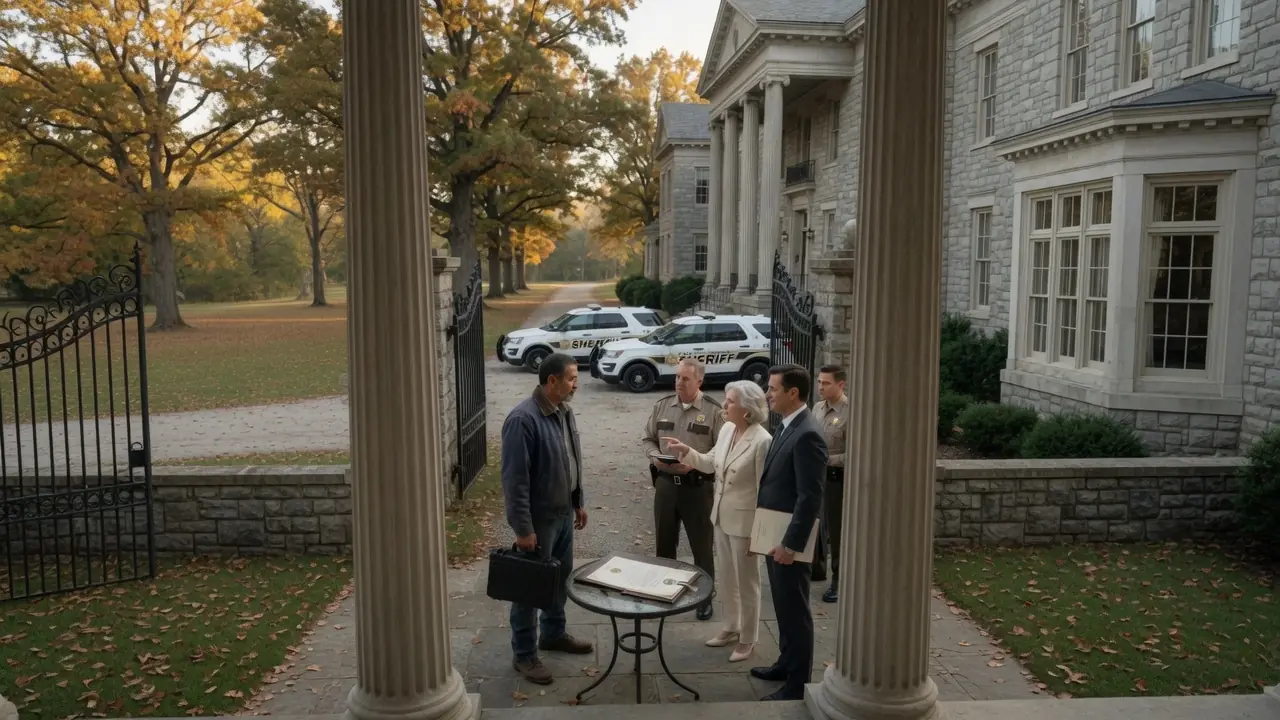
One snowy December evening, Charles climbed into the attic, searching for spare window glass. Instead, he found one final box labeled in Henry's handwriting. Winter projects. Inside rested dozens of unfinished restoration sketches, garden layouts, tree inventories, handwritten notes. At the very bottom lay a folded piece of paper.
Only one sentence appeared. The house never truly belongs to one person. Each owner simply protects it for the next honest pair of hands. Charles smiled. He folded the note carefully.
Outside, snow began falling over Blackwood House. The lights inside every window reflected softly against the white landscape. The mansion no longer represented wealth or status or victory. It represented patience, responsibility, preparation, and the quiet strength of someone who never needed to shout because the truth had already been written down. Charles locked the front door for the night, not to keep people out, but to keep safe everything entrusted to him.
The old brass key Evelyn had returned rested beside Henry's handwritten note inside the library desk. Two simple objects, almost worthless by themselves. Yet together, they reminded Charles of something he would never forget. A house could be purchased. Land could be inherited.
Money could disappear. Reputations could change overnight. But character revealed itself slowly, usually when no one expected it. As the lights dimmed throughout Blackwood House, the restored mansion stood peacefully beneath the winter sky, exactly where it had always been, protected not by wealth, not by pride, not by appearances, but by one quiet man who understood that the strongest foundations were never built from concrete alone. They were built from truth.