The first thing I felt was not pain. It was cold.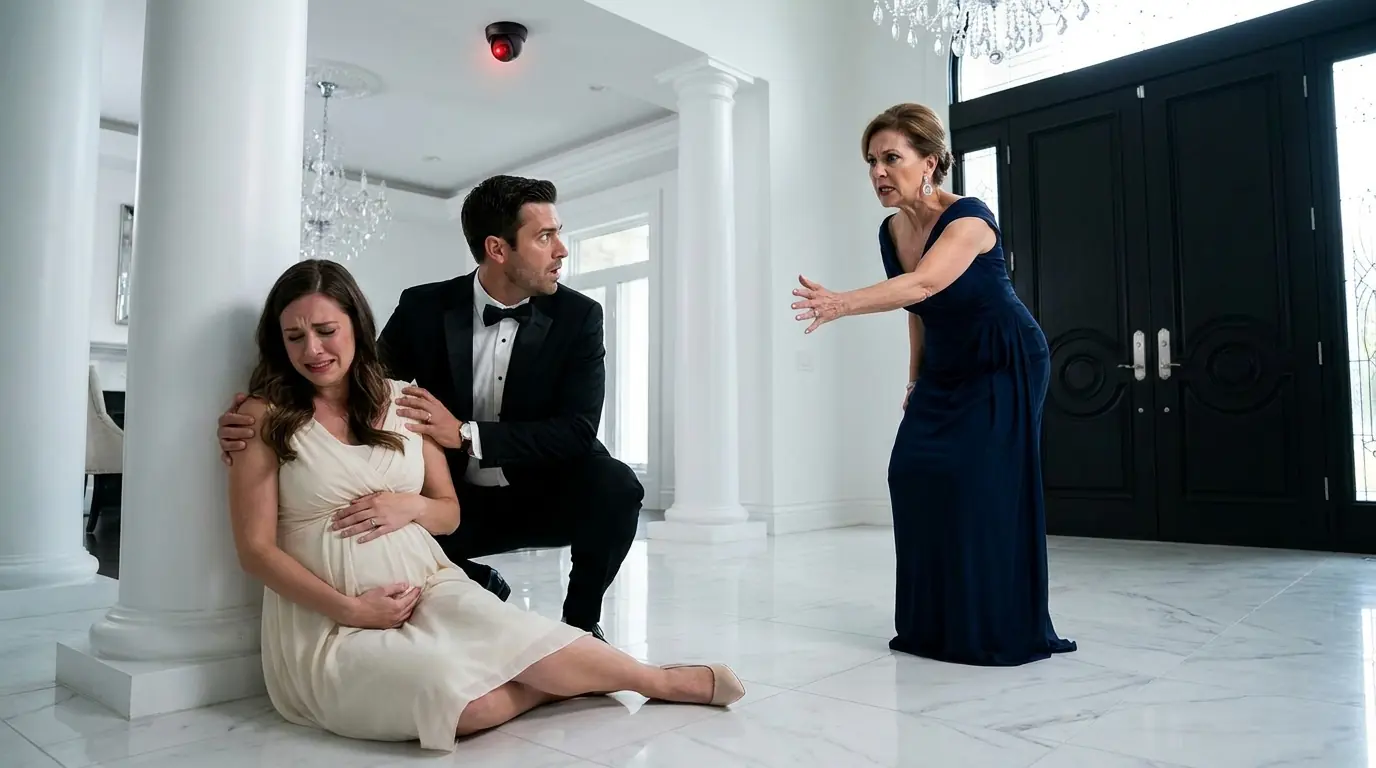
The marble floor beneath me was so polished that it reflected the crystal chandelier above my head, turning every trembling light into a broken star. One hand was pressed beneath my belly. The other was braced against the floor, but my wrist kept slipping because someone had spilled champagne near the edge of the foyer. I could hear my own breathing, fast and shallow, while my mother-in-law stood three feet away in a navy evening gown and stared down at me as if I were an inconvenience she had finally managed to remove.
“You should have taken the money when I offered it,” Victoria Whitmore said.
Her voice was low, almost gentle. That frightened me more than the shove.
I was thirty-two weeks pregnant, barefoot because my ankles had swollen during the charity dinner, and trapped inside the entrance hall of one of the most expensive homes in Westchester County. Beyond the double doors, dozens of wealthy guests were drinking beneath heated tents and praising the Whitmore family for its generosity. Inside, the woman who had spent two years telling everyone that I was unstable had just pushed me hard enough to send me crashing to the floor.
Then the front doors opened.
My husband, Daniel, stepped into the foyer in a black tuxedo, rain shining across his shoulders. He looked first at his mother, then at me, then at the way my dress had gathered around my legs. His face changed so quickly that I could almost see the moment fear took hold of him.
“Claire?”
He crossed the marble in three strides and dropped beside me. His hands hovered for half a second, terrified of hurting me, before one settled behind my shoulders and the other rested carefully against my stomach.
“What happened?” he demanded.
Victoria answered before I could speak.
“She slipped. I tried to catch her.”
Daniel looked at the wet champagne on the floor. Then he looked at the distance between Victoria and me. His jaw tightened.
I tried to tell him the truth, but a sharp cramp moved through my abdomen and stole the breath from my lungs. Daniel pulled out his phone, called the private physician waiting with the event staff, and shouted for someone to bring a wheelchair. Victoria began crying instantly, pressing both hands to her chest as though she were the one who had been harmed.
“I told her not to walk around alone,” she said. “You know how careless she has been lately.”
That sentence was meant for Daniel, but her eyes stayed on me.
A warning.
Stay quiet.
Daniel turned toward her, and for one terrible second I thought he might believe her. Victoria had trained him to believe her since childhood. She knew how to cry without smudging her makeup, how to tremble without losing control, and how to turn cruelty into concern before anyone else entered the room.
But then Daniel’s gaze moved past her shoulder.
He looked upward.
Near the ceiling, tucked between the crown molding and the chandelier medallion, a small black security camera stared down at all three of us. Its red recording light blinked once, calmly and steadily.
Victoria followed his eyes.
The color disappeared from her face.
That was when I knew the camera had captured more than the shove.
It had captured her confession too.
Three years earlier, I had not known what kind of family I was marrying into.
I met Daniel Whitmore in the least glamorous place imaginable: the basement records room of St. Catherine’s Hospital in Manhattan. I was a clinical data specialist, which sounded more impressive than it felt. Most days I worked beneath fluorescent lights, checking patient files, correcting errors, and reminding surgeons that handwriting could still ruin lives. Daniel had arrived to discuss a donation from the Whitmore Medical Foundation, but a power outage trapped us in the basement elevator for forty-three minutes.
He was wearing a tailored gray suit and carrying a watch that probably cost more than my yearly rent. I was holding a paper cup of terrible coffee and a folder stained with printer ink. When the elevator jerked to a stop, he looked at the ceiling and said, “This feels like an expensive metaphor.”
“For what?” I asked.
“Rich people believing money can prevent inconvenience.”
I laughed before I could stop myself.
That was the beginning.
Daniel was not what I expected. He was thoughtful, awkward when complimented, and far more comfortable discussing hospital ventilation systems than yacht clubs. His family owned Whitmore Development, a private real estate company with hotels, medical campuses, luxury residences, and enough political connections to make reporters careful. Yet Daniel had spent most of his twenties trying to build a division focused on affordable housing and community clinics.
He said he wanted to make the Whitmore name useful.
His mother wanted to make it untouchable.
Victoria Whitmore was a widow, a social strategist, and the unofficial ruler of every room she entered. Her husband had died when Daniel was nineteen, leaving her control of the family trust until Daniel turned thirty-five. By the time I met her, she had spent more than a decade protecting the family’s image, its fortune, and, most of all, her place at the center of it.
At our first dinner, she studied me with the polite concentration of someone inspecting a stain.
“You work at a hospital?” she asked.
“Yes.”
“As a doctor?”
“No. Clinical data.”
“How practical.”
She smiled as though practicality were a condition people recovered from.
Daniel reached beneath the table and squeezed my hand. I thought that was enough. I believed love could survive disapproval if two people were honest with each other. I did not understand that Victoria did not attack love directly.
She weakened the ground around it.
Then she began planting doubts.
She told Daniel I seemed exhausted and suggested I was unhappy. She told me Daniel had always needed “a certain kind of woman” beside him in public. She invited his former girlfriend to charity events and claimed the guest list had been prepared by an assistant. She sent me photographs of Daniel standing beside elegant women at business dinners, always with a message that sounded innocent.
He looks so relaxed tonight.
Lovely to see him among old friends.
I kept every message, though I did not know why.
Daniel defended me when the insults were obvious, but Victoria rarely made obvious mistakes. She had raised him alone after his father’s death, and his guilt was a language she spoke fluently. If he challenged her, she reminded him how much she had sacrificed. If he set a boundary, she became ill. If he refused an invitation, she mentioned his father and said the family was disappearing.
There were weeks when I hated her.
There were other weeks when I almost pitied her.
Then I became pregnant.
Daniel cried when the second line appeared on the test. He sat on the bathroom floor in his pajamas, laughing and wiping his face, while I held the plastic stick between us. For two years we had tried quietly, endured one early loss, and stopped talking about how much hope hurt. That morning, he placed both hands against my stomach and promised our child would never have to earn love.
When we told Victoria, she did not cry.
She looked at me, then at Daniel, and asked whether the doctor had confirmed everything was “normal.”
Daniel’s smile vanished.
“Mother.”
“I am only being careful.”
She reached for my hand, but I moved it beneath the table.
After that, her behavior changed. She became attentive in public and controlling in private. She sent nutritionists I had not requested, replaced my obstetrician’s office with a specialist connected to the Whitmore Foundation, and insisted that I stop working because stress could “damage the heir.” She never called the baby her grandchild.
Only the heir.
I refused to leave my job until the third trimester. Victoria told people I was reckless. I declined her specialist and stayed with my own doctor. Victoria told Daniel I did not respect the family’s medical resources. When I would not move into the Whitmore estate for the final months of pregnancy, she began telling relatives I was isolating Daniel.
The more boundaries I set, the more unstable she claimed I had become.
Then small things began happening.
My car keys disappeared before appointments. The alarm system at our apartment activated in the middle of the night even though the security company found no fault. A woman from a gossip website called my office and asked whether I had been treated for “emotional episodes.” A confidential letter from my obstetrician appeared opened on the kitchen counter after Victoria visited.
Daniel wanted to believe these incidents were unrelated.
I wanted to believe he was right.
The first time I truly became afraid was at twenty-six weeks.
I arrived home from work and found Victoria inside our apartment. She was standing in the nursery, surrounded by half-open boxes. The room had been painted pale green, and Daniel had assembled the crib himself after refusing help from three employees. Victoria was holding the knitted blanket my mother had made before she died.
“You should not be here without calling,” I said.
She folded the blanket with slow, exact movements.
“I am Daniel’s mother.”
“This is our home.”
“For now.”
The words were quiet, but they were not accidental.
I asked her what she meant. She placed the blanket in the crib and walked toward me until only the curve of my stomach separated us.
“Men like Daniel confuse rescue with love,” she said. “He found you in a basement and decided your ordinary life made him noble. Eventually he will remember who he is.”
I felt my hands begin to shake.
“You need to leave.”
Victoria smiled.
“You think the baby protects you. It does not. The child belongs to this family, whether you remain part of it or not.”
I reached for my phone. She left before I could unlock it.
That night I told Daniel everything. He listened without interrupting, but I could see the conflict on his face. He believed me, yet part of him still searched for an explanation that would allow his mother to remain the woman he remembered.
“She had no right to enter,” he said. “I’ll change the security codes.”
“That is not the point.”
“I know.”
“Do you?”
He looked away.
It was the first serious argument of our marriage. I told him I was tired of being treated like a temporary guest in my own life. He said he was trying to manage a complicated situation. I told him there was nothing complicated about choosing whether his pregnant wife deserved to feel safe.
Daniel slept in the guest room that night.
The next morning, I found him sitting outside the nursery door with his back against the wall. He had not slept at all. He apologized, changed every code, canceled Victoria’s access to the apartment, and promised he would stop treating her behavior like a family disagreement.
“I am choosing you,” he said.
I wanted to believe the choice was finished.
Victoria made sure it was not.
Two weeks later, the Whitmore Medical Foundation’s chief financial officer called me at work. His name was Samuel Reed, a quiet man in his sixties who had known Daniel since childhood. He asked whether we could speak somewhere private. We met in a small conference room near the hospital cafeteria, and he locked the door behind him.
Samuel placed a folder on the table.
Inside were copies of foundation transfers totaling $8.4 million. The funds had been moved through consulting companies connected to a development project in Connecticut. Each transfer carried Daniel’s electronic authorization.
The problem was that Daniel had not authorized them.
Samuel had checked the access logs. The transactions originated from an administrative account controlled by Victoria’s office. When he questioned her, she ordered him to stop reviewing the project and reminded him that his daughter’s medical care was funded through a Whitmore assistance program.
“Why are you showing me?” I asked.
“Because Daniel won’t look closely if the accusation comes from me,” Samuel said. “He will think I am asking him to choose between an employee and his mother.”
“And you think he will listen to me?”
Samuel’s expression was tired.
“I think she already believes he does.”
There was more.
One of the shell companies belonged to a private investigations firm. Samuel had found invoices for surveillance on me, payments to a freelance reporter, and a draft psychological evaluation prepared by a doctor I had never met. The evaluation described me as paranoid, emotionally volatile, and potentially dangerous to myself and my unborn child.
My mouth went dry.
“She is building a case,” I whispered.
Samuel nodded.
“For what?”
“To remove you from the marriage before Daniel receives control of the trust.”
Daniel’s thirty-fifth birthday was six weeks away. On that date, control of the Whitmore family trust would transfer from Victoria to him. Under the trust’s conditions, Daniel’s legal spouse and children would gain protected beneficiary status. Once that happened, Victoria could no longer change the distribution structure without Daniel’s consent.
She was running out of time.
Samuel gave me a flash drive containing the records. He said the original files might disappear as soon as Victoria realized someone had copied them. I hid the drive inside the lining of my work bag and spent the afternoon trying not to panic.
I wanted to call Daniel immediately.
Then I received a text from his phone.
Mother has had chest pain. I’m taking her to the clinic. Please don’t contact me until I know more.
I stared at the message for a long time.
Daniel never called Victoria “Mother” in texts to me. He called her Mom, even when he was angry.
I called him anyway.
His phone went directly to voicemail.
When he came home four hours later, he knew nothing about chest pain or a clinic. He had been in a meeting where phones were collected at the door. His device had remained with his executive assistant, who later admitted that Victoria’s aide had visited the office.
Daniel read the message twice.
Then I showed him the folder.
He did not defend her.
He sat at the kitchen table until midnight, reviewing every transfer, invoice, and access log. At first he looked stunned. Then he looked ill. Finally, he became very still.
“She used my father’s trust to pay people to follow you,” he said.
“Yes.”
“She created a medical report.”
“Yes.”
His hand closed around the edge of the table.
“I am going to confront her.”
“No.”
Daniel looked up.
“If she knows what we have, the records disappear. Samuel could lose his job. We need copies outside the company, and we need an attorney.”
He stood and began pacing.
“This is my family.”
“That is why we need proof you cannot explain away tomorrow.”
The words hurt him. I saw that. But he did not argue.
For the next ten days, we worked quietly. Daniel contacted an outside forensic accountant through a law firm Victoria had never used. Samuel transferred records to secure storage. I met with a family attorney who explained that Victoria’s fabricated psychological report could be used in a custody petition if anything happened to our marriage.
The attorney asked whether Victoria had ever threatened me directly.
I told her about the nursery.
“Did anyone hear it?”
“No.”
“Was it recorded?”
“No.”
She wrote something on a legal pad.
“That is the problem with people who specialize in private cruelty,” she said. “They understand witnesses.”
Daniel began changing too. Once he stopped excusing his mother, he saw the pattern everywhere. Old employees who had challenged her had been pushed out. Family friends who questioned trust expenses disappeared from invitations. His father’s former attorney had retired unexpectedly after a dispute Victoria claimed was personal.
Daniel blamed himself for not seeing it.
I told him children are trained to survive their parents long before they learn to judge them.
He held me for a long time after that.
The charity dinner at the Whitmore estate had been planned months earlier. It was the foundation’s largest annual event, attended by donors, board members, hospital executives, and several reporters. Canceling it would alert Victoria that Daniel knew something. Attending it meant entering the house where she had controlled him his entire life.
We decided to go.
Daniel arranged for the forensic accountant and two attorneys to meet us the following morning. The plan was simple. We would behave normally at the dinner, leave early, and formally remove Victoria from foundation control at nine the next day.
There was one precaution Daniel did not tell her about.
Six months earlier, several pieces of jewelry had disappeared during renovations at the estate. Victoria blamed the household staff and demanded cameras in the main corridors. She later fired the security company before the system became fully active. Daniel quietly rehired the company after learning about the financial records and asked them to finish the installation.
The foyer camera went live the morning of the gala.
Only Daniel, the security director, and I knew.
At seven that evening, the estate glittered like a palace designed to convince strangers that nothing ugly had ever happened there. Crystal chandeliers burned above white marble. A string quartet played beneath a staircase lined with winter roses. Guests in black tie drifted through the rooms carrying champagne while servers moved silently between them.
Victoria wore navy blue.
She greeted me at the entrance with a kiss that did not touch my skin.
“You look tired,” she said.
“I am eight months pregnant.”
“Some women carry it more gracefully.”
Daniel’s hand tightened around mine.
“Enough,” he said.
Victoria looked at him with wounded surprise, but guests were approaching. Her smile returned before anyone reached us.
For the first hour, she performed perfectly. She introduced me as her beloved daughter-in-law, placed a hand on my stomach for photographs, and told donors how excited she was to welcome “the next Whitmore.” Every time a camera flashed, I felt her fingers press a little too firmly against me.
Daniel never left my side.
That made her nervous.
I noticed it in small ways. She spoke too quickly during her opening remarks. She forgot the name of a hospital director she had known for years. She watched Daniel whenever he whispered to me, as if trying to read our lips.
At eight-thirty, Samuel entered the ballroom.
He was not on the guest list.
Victoria saw him immediately.
Samuel did not approach us. He handed a sealed envelope to Daniel’s attorney, who had arrived as a donor’s guest, then left through the side corridor. Victoria’s face did not change, but the champagne glass in her hand tilted enough to spill over her fingers.
Five minutes later, she asked Daniel to meet her in the library.
He declined.
“I’m staying with Claire.”
“This concerns the trust.”
“Then it can wait until tomorrow.”
The words landed harder than a slap.
Victoria stared at him. For the first time that night, her expression became honest.
She was afraid.
At nine, I went upstairs to remove my shoes and rest in a small sitting room. Daniel wanted to come with me, but a group of hospital trustees surrounded him near the staircase. I promised I would be back in ten minutes. The upstairs corridor was quiet, and the sound of the quartet faded as I walked toward the guest wing.
My shoes had cut into my heels, so I carried them in one hand.
When I reached the sitting room, the lights were off.
I turned them on and found an envelope on the table.
My name was written across the front.
Inside was a legal agreement. It offered me $3 million, a residence in another state, and complete confidentiality in exchange for an immediate separation from Daniel. The final pages required me to surrender any future claim against the Whitmore trust and agree that the child would spend “substantial custodial time” under the supervision of the Whitmore family.
A note had been clipped to the first page.
Sign tonight, and the medical report stays private.
I heard the door close behind me.
Victoria stood with her hand on the lock.
“You should read the entire agreement,” she said. “It is more generous than you deserve.”
I placed the papers back on the table.
“You paid a doctor to lie about me.”
“I paid a doctor to document concerns.”
“He has never met me.”
“He does not need to meet you to understand the risk you present.”
I looked at the locked door.
“You know Daniel has the financial records.”
Her eyes sharpened.
“So Samuel came to you.”
“You threatened him.”
“I reminded him who pays for his daughter’s treatment.”
The admission came easily, almost proudly. Victoria had spent so long controlling consequences that she no longer recognized confession as danger.
I reached into my bag for my phone.
She crossed the room and seized my wrist.
“Do not make this theatrical.”
“Let go of me.”
“You are going to sign.”
“No.”
Her grip tightened.
“You think Daniel will destroy his mother for you?” she asked. “He will rage, he will threaten, and then he will remember that I built his life. You are a temporary obsession. That child is permanent.”
I pulled my wrist free.
“You are not protecting the family. You are stealing from it.”
Her face changed.
For one second, the elegant mask vanished, and I saw something raw beneath it. Not love. Not fear for Daniel. Possession.
“This family was mine before you learned how to pronounce its name,” she said.
“It was never yours.”
She slapped me.
The sound was small inside the room.
I stood frozen, one hand against my cheek. Victoria seemed surprised too, but only for a moment. Then she stepped closer.
“You will sign the agreement,” she whispered. “Tomorrow you will leave. If you refuse, the report goes to the court, the press learns that Daniel’s wife is unstable, and every frightened moment you have had during this pregnancy becomes evidence against you.”
“And the money?”
“What money?”
“The $8.4 million.”
Her mouth curved.
“That money is the reason this family still belongs to someone competent.”
I should have stayed quiet. I should have opened the door and returned to the ballroom. But months of fear had hardened into anger.
“You mean it belongs to you.”
“Yes,” she said. “It has always belonged to me. My husband left a boy in charge of an empire. I kept it alive while Daniel played at building clinics for people who will never remember his name.”
“He will remove you tomorrow.”
Victoria laughed.
“No, he will not.”
“He already signed the emergency board notice.”
That was a lie.
Daniel’s attorneys had prepared the notice, but he had not signed it yet. I said it because I wanted to see whether she knew about the meeting.
The effect was immediate.
Victoria released my wrist and stepped back.
“You have poisoned him.”
“He finally sees you.”
“No. He sees what you have taught him to see.”
She looked toward my stomach.
Then she said the words the camera would later make impossible to deny.
“I tried patience. I tried humiliation. I tried giving the press enough to frighten you away. I even had the medication switched, and still you stayed.”
The room seemed to tilt.
“What medication?”
She knew she had said too much. Her lips parted, but no answer came.
“What medication, Victoria?”
During my second trimester, I had suffered weeks of dizziness and dangerous blood pressure fluctuations. My doctor blamed a reaction to prenatal supplements and changed the prescription. The pharmacy insisted the label had been correct, but no one could explain why the tablets inside the bottle did not match the manufacturer’s description.
I had nearly been hospitalized.
My baby’s heart rate had dropped twice.
Victoria moved toward the door.
I blocked her.
“You changed my medication?”
“Move.”
“You could have killed us.”
“Do not be dramatic.”
“You could have killed your grandchild.”
Her eyes were cold.
“The child was never the target.”
The meaning of that sentence emptied the air from the room.
She had wanted me sick. Weak. Frightened. Perhaps desperate enough to leave. She had been willing to risk the baby because she believed the baby ultimately belonged to her.
I grabbed the legal agreement from the table.
“I am taking this to Daniel.”
Victoria stepped in front of the door.
“You are not leaving this room.”
I shouted his name.
Music and conversation swallowed the sound downstairs.
Victoria reached for the papers. I moved away, but my balance had changed during pregnancy, and the back of my knee struck a chair. I caught the table before I fell. She snatched at the agreement again, tearing the final page.
“Give it to me.”
“No.”
I pushed past her and unlocked the door.
She did not follow immediately.
I walked quickly toward the main staircase, one hand on the wall. My face burned where she had struck me. The papers shook in my grip. I could hear the gala below, bright and civilized, while my mind repeated the same sentence.
I even had the medication switched.
Halfway down the stairs, another cramp tightened across my abdomen.
I stopped and breathed until it passed.
When I reached the foyer, the ballroom doors were open, but Daniel was nowhere in sight. A server told me he had gone outside to speak with one of the trustees. Rain moved against the glass panels beside the front doors.
I took one step toward the ballroom.
Victoria’s voice came from behind me.
“Give me the agreement.”
I turned.
She was descending the stairs slowly, perfectly composed again.
“No.”
“Claire, you are emotional. Sit down before you hurt yourself.”
The performance had returned. Two servers crossed the far corridor, and Victoria raised her voice just enough for them to hear concern.
“Please,” she said. “You have not been yourself lately.”
I understood then. She wanted witnesses to the aftermath, not the cause.
“You switched my medication,” I said clearly.
The servers slowed.
Victoria’s eyes flashed.
“That is absurd.”
“You just admitted it.”
“You are confused.”
“I heard you.”
“You hear many things when you are frightened.”
She walked toward me with both hands extended, the image of maternal patience. I backed away.
“Do not touch me.”
“Claire, calm down.”
“I said do not touch me.”
The front doors opened behind us, letting in a burst of cold rain and evening air. I thought Daniel had returned, but it was only a staff member carrying folded umbrellas. Victoria glanced toward him, calculated the angle, and stepped closer.
Then she lowered her voice.
“You have one final chance.”
“No.”
“You will sign, or I will make sure Daniel raises that child without you.”
I lifted the torn agreement.
“He is going to see this.”
Victoria grabbed my forearm.
I pulled back.
Her other hand struck my shoulder.
It was not an accident. It was not an attempt to steady me. She shoved with both arms, hard and sudden, and my bare feet slid across the champagne someone had spilled minutes earlier.
The papers flew from my hand.
I hit the marble on my left side.
Pain moved through my hip, my wrist, and then my abdomen. The chandelier shattered into reflected light beneath me. Somewhere nearby, a glass fell and broke. I heard one of the servers gasp.
Victoria stood above me, breathing hard.
For three seconds, neither of us spoke.
Then she saw the front doors opening again.
Her entire body changed.
“Claire!” she cried. “Oh my God, you slipped!”
Daniel entered the foyer.
He saw me on the floor and ran.
The rest happened as if I were watching it through water. Daniel dropped beside me. The server shouted for the medical team. Victoria pressed her hands to her chest and said she had tried to catch me. Guests began gathering near the ballroom doors, their faces pale and curious.
A cramp tightened beneath my ribs.
Daniel asked where it hurt.
I tried to answer, but my voice shook.
“Your mother pushed me.”
Victoria made a wounded sound.
“Daniel, she is confused. She slipped. Everyone saw the champagne.”
The servers looked at one another. They had seen the confrontation, but not all of them had seen the shove clearly. One young man opened his mouth, then closed it when Victoria looked at him.
Daniel’s face hardened.
“Step away from her.”
“Daniel, I am trying to help.”
“Step away.”
Victoria moved back as the physician arrived with two nurses and a wheelchair. One nurse checked my pulse while the doctor knelt beside my abdomen and asked whether I felt movement. I did, faintly, then stronger. Relief nearly made me sob.
Daniel kept one hand around mine.
Victoria continued talking.
“She has been under terrible stress. I warned you she should not attend tonight. You know she has had episodes.”
Daniel looked at her.
“What episodes?”
“The doctor’s report.”
The foyer became silent.
Victoria realized her mistake one second too late.
Daniel stood slowly.
“What doctor’s report?”
She glanced toward me.
“I received a private assessment. I was going to discuss it with you tomorrow.”
“From a doctor who has never examined my wife?”
Victoria’s expression collapsed.
Daniel already knew.
The physician asked everyone to give us space. As the nurses prepared to lift me, Daniel looked toward the scattered papers on the floor. The torn agreement lay near Victoria’s shoes.
Then his gaze moved higher.
He saw the camera.
The red light blinked.
Victoria followed his eyes, and every trace of grief disappeared from her face.
Daniel took out his phone and called the security director.
“Lock the recording,” he said. “Now. No one accesses it except me and the police.”
Victoria stepped forward.
“Daniel, this is a family matter.”
He did not look at her.
“You made it a criminal matter when you put your hands on my wife.”
“You do not know what happened.”
“The camera does.”
For the first time since I had met her, Victoria had no response ready.
The medical team moved me into a private guest suite while an ambulance came through the service entrance. The gala dissolved into whispers. Guests were escorted from the estate, though several had already begun sending messages to reporters. Daniel stayed beside me until the paramedics arrived.
I kept asking about the baby.
The doctor said the heartbeat was strong, but I needed monitoring. I had bruising on my hip and shoulder, and the cramps could be caused by stress or the beginning of preterm labor. Every word tightened Daniel’s face.
Before they took me outside, a police officer entered the room.
Daniel looked at me.
“Do you want to make a statement tonight?”
I was exhausted, frightened, and still wearing the dress Victoria had chosen for the foundation photographs. For months, she had turned every reaction into proof that I was unstable. Part of me wanted to wait until I felt stronger.
Then I remembered the medication.
“Yes,” I said. “Tonight.”
At the hospital, the baby’s heart rate remained steady. The doctors found no placental separation and no sign that labor had begun. I had a sprained wrist, deep bruising, and strict instructions to remain under observation.
Daniel sat beside the bed, still in his tuxedo, holding my hand.
At two in the morning, the security director arrived with an encrypted copy of the footage. Two detectives and our attorney watched it in a small consultation room. I did not go with them. I could not bear to hear Victoria’s voice again.
Daniel returned forty minutes later.
He looked ten years older.
“The camera recorded everything from the moment she followed you into the upstairs room,” he said.
I stared at him.
“There is a camera in the sitting room too?”
He nodded.
The security company had installed one near the corridor entrance because the room contained antique paintings. The camera’s microphone had captured our entire conversation through the open transom above the door.
The offer.
The threat.
The stolen money.
The medication.
Everything.
Daniel sat on the edge of the bed and covered his face with both hands.
“She said the child was never the target,” he whispered.
I felt no satisfaction watching him understand. Only grief.
“I am sorry,” I said.
He looked at me, stunned.
“You are sorry?”
“She is still your mother.”
“No.” His voice broke. “A mother protects the people her child loves. She tried to destroy you because she could not control me.”
He bent forward until his forehead rested against my hand.
“I should have stopped her sooner.”
“You stopped believing her. That matters.”
“It almost mattered too late.”
We sat quietly while monitors hummed around us.
At four-thirty, the detectives arrested Victoria at the estate.
She had spent the hours after the gala calling board members and claiming I had suffered a mental breakdown. She ordered staff to remove documents from the upstairs sitting room and told her attorney the security cameras were unauthorized. When officers arrived, they found two employees carrying boxes toward a service vehicle.
The boxes contained foundation records, surveillance invoices, the original false psychological report, and pharmacy communications linked to my prescription.
Victoria did not cry when they placed her under arrest.
She asked whether Daniel knew.
The detective told her he had provided the footage.
Only then did she become silent.
By sunrise, the story had reached the press. The first reports described “an incident” at a Whitmore charity gala. By noon, sources were discussing financial misconduct and an alleged assault. Daniel released one statement through the company.
The board has suspended Victoria Whitmore from all positions and authority. We are cooperating fully with law enforcement. My priority is the safety of my wife and our unborn child.
He did not call her his mother.
The weeks that followed were uglier than the fall.
Victoria’s attorneys claimed the shove had been accidental. Then the foyer footage became part of the evidence. They claimed her comments about medication were metaphorical. Investigators recovered emails between her aide and a pharmacy contractor. They claimed the financial transfers had been approved for confidential family purposes. The forensic audit found three more shell companies and nearly $12 million in additional transactions.
Every lie opened another door.
The false medical report became especially important. The doctor who signed it admitted that he had never met me and had been paid through a consulting firm. Draft emails showed that Victoria had requested specific language describing me as delusional and dangerous. She planned to send the report to Daniel after provoking a public confrontation at the gala.
The spilled champagne had not been accidental either.
Security footage showed Victoria’s aide pouring it across the foyer twenty minutes before our confrontation. The plan had been to make any fall look believable.
That detail haunted me.
She had prepared the floor before she prepared the lie.
Daniel turned thirty-five while I was still on modified bed rest. There was no party. At nine in the morning, he assumed control of the family trust and signed documents permanently removing Victoria from every company, foundation, and property account. He appointed Samuel interim director of the medical foundation and restored the employees she had forced out.
Then he asked the board to return every dollar recovered from the shell companies to community clinics and patient assistance programs.
“It does not erase what she did,” he told me. “But the money should finally serve the people it was taken from.”
My daughter was born five weeks later.
We named her Grace, not because the months before her birth had been graceful, but because she arrived safely after so many people tried to turn her existence into power. Daniel held her against his chest and cried more openly than he had when we saw the pregnancy test. I watched him promise her that love would never be used as a debt.
Victoria was denied permission to visit.
From jail, she sent Daniel six letters. He opened the first one in our kitchen while Grace slept upstairs. The letter did not apologize. It accused me of dividing the family, claimed Daniel had been manipulated, and reminded him that everything she had done was to preserve his inheritance.
He folded it once and placed it back in the envelope.
“What will you do with the others?” I asked.
“Give them to the attorney.”
“You do not want to read them?”
Daniel looked toward the baby monitor.
“I spent my whole life reading between her lines. I am done.”
The criminal case lasted nearly a year. Victoria eventually accepted a plea agreement covering assault, financial fraud, witness intimidation, and conspiracy related to the medication switch. The judge rejected her request for home confinement. During sentencing, she wore navy blue again.
She looked smaller without the estate behind her.
The prosecutor played a portion of the security recording. In the courtroom, her voice sounded even colder than I remembered.
I tried patience. I tried humiliation. I even had the medication switched, and still you stayed.
Victoria kept her eyes forward.
When the judge asked whether she wished to address me, she stood and said, “I regret that private family decisions were misunderstood.”
It was the closest she could come to admitting defeat.
I did not respond.
For a long time after the trial, I hated cameras.
Any red light near a ceiling pulled me back to the marble floor. I remembered the cold beneath my palm, Daniel’s face when he entered, and Victoria’s instant transformation from attacker to victim. Therapy helped. Time helped. Grace’s laughter helped more than anything.
Eventually, the camera became something else in my memory.
Not the thing that saved me.
The truth had already existed before the recording. I had known what Victoria was doing. Samuel had known. The employees she threatened had known. Daniel, somewhere beneath his hope, had known too. The camera did not create the truth.
It simply made denial impossible.
Two years later, Whitmore Development sold the estate.
Daniel did not want Grace growing up in a house built around fear. Before the sale, we returned once to collect his father’s books and several family photographs. The chandeliers had been removed for cleaning, and the foyer looked strangely ordinary without them.
I stood near the place where I had fallen.
Daniel came beside me carrying a box.
“Do you want to leave?” he asked.
“In a minute.”
I looked up at the corner near the ceiling. The security camera was still there, dark now, its red light gone.
For years, Victoria had believed power meant controlling what other people saw. She controlled invitations, stories, doctors, employees, money, and even the emotions her son was permitted to trust. In the end, she lost everything because she forgot that control is not the same as truth.
Daniel took my hand.
From outside, Grace called for us. She was in the garden with Samuel, chasing fallen leaves across the path.
I looked at the marble one final time.
Then I walked out of the house without fear, without permission, and without looking back.