Two weeks before Thanksgiving, my mother called to tell me I was not welcome at the table this year because my sister didn't want any "drama." 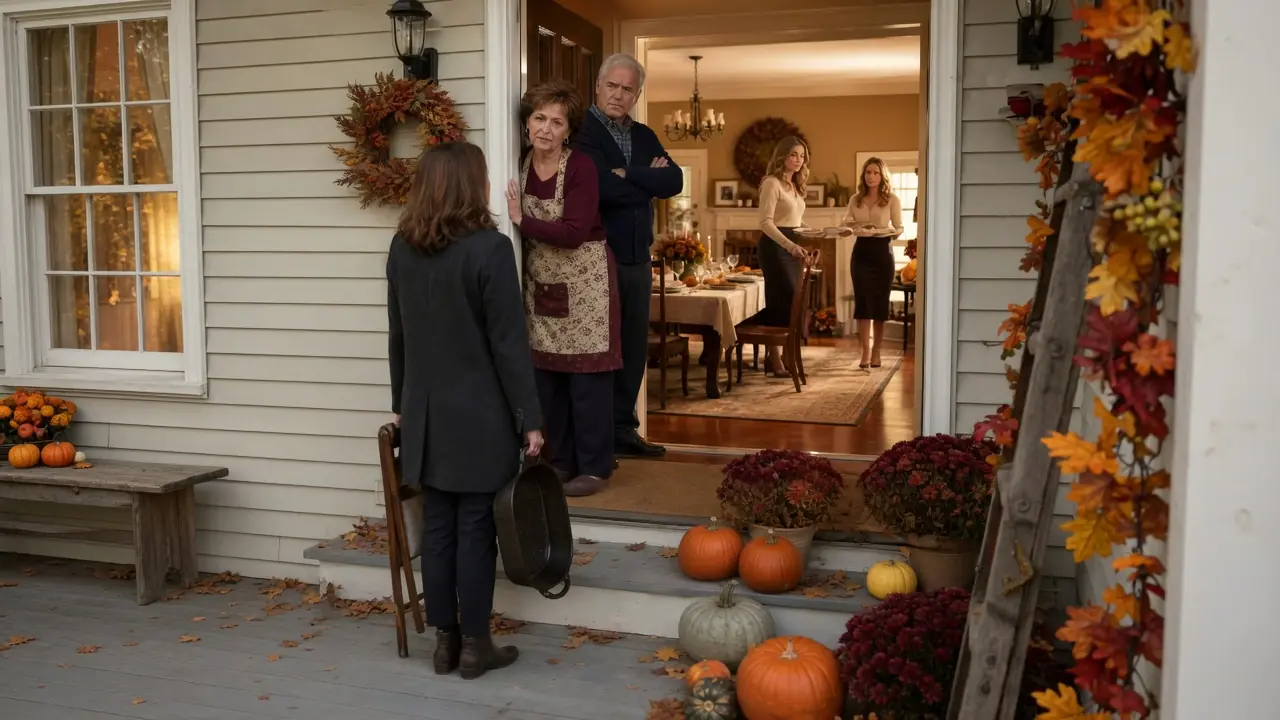
That is the word my family uses for me. Drama. Not the lie that has been hanging off my name for three years. Not the money they still owe me. Just me. The drama. The problem chair at the table.
I didn't argue, and I didn't cry into the phone. But the Monday before Thanksgiving, I stood at a post office counter in my little Ohio town with four flat envelopes and a long line of holiday shippers waiting behind me. What was inside those envelopes set my parents' phones on fire before sundown—sixty-eight missed calls by 9:00 that night. And what I said on my own front porch at midnight, none of them saw coming. Least of all, my sister.
The call came at 7:00 on a Sunday while I was reconciling a client's payroll ledger at my kitchen table. My mother has a specific voice she uses for unpleasant errands—flat, bright, and intensely rehearsed. She used it to tell me the dentist found a cavity when I was nine, and she used it now.
"Honey, about Thursday. Brooke is hosting this year and she's been under so much stress, and she just... she doesn't want any drama at the table. So, we all think it's best if you sit this one out."
I looked down at the spreadsheet in front of me. Numbers are inherently honest; if a column doesn't balance, it tells you straight to your face.
"Sit this one out," I repeated. "Mom, what drama would I bring? Name one thing I've done at a single holiday."
The silence went on so long I could hear their television blaring in the background—some game show, the studio applause rising and falling like bad weather. She didn't name a single incident because there wasn't a thing to name. What she finally muttered was, "Keep it pleasant, Thea. Keep it pleasant."
There it was: my family's entire constitution ratified sometime before I was born. Then, softer, as if she were doing me a massive favor, she added, "And don't make this about the other thing. It's Thanksgiving."
She hung up before I could ask which "other thing" she meant, because in our family, there were two. There was the thing everyone whispered about me, and there was the thing nobody ever said out loud—the small matter of what was written on a notarized piece of paper sitting in my office safe with my father's signature at the bottom of it. One of those things had ruined my name. The other was about to ruin their evening.
Let me tell you who I am, because my family tells the story differently. I'm a CPA. I own a two-person accounting firm on Main Street in Maple Falls, Ohio. My name is on the glass. My office manager, Jess, sits at the front desk. I have fifteen tax seasons in my rearview mirror, and nobody handed any of it to me. I took night classes for my license while working full days, opened the firm at twenty-nine, and paid off my own small house by thirty-four. I round to the nearest dollar; my family rounds to the nearest story.
Four years ago, my father's heart gave out in a parking lot. A triple bypass, eleven days in the hospital, and a massive stack of medical bills landed directly on top of a mortgage they had quietly stopped paying that spring. By October, the bank was using words like *foreclosure*. My parents never explicitly asked me for help; they just talked about losing the house at Sunday dinner, projecting it loudly in my direction until I did what I always did. I drained my savings, opened a line of credit, and wrote them a check for $52,000.
And because I am who I am, I did it properly. I drew up a promissory note—notarized, with a modest interest rate, structured at $400 a month. My family laughed about it for a year. *“Only Thea would make her own parents sign paperwork. Only Thea would treat family like a corporate audit.”* But my dad signed it at my kitchen table with his reading glasses on, and for thirteen months, the payments arrived. Four hundred dollars, the first of the month, steady as a metronome. Thirteen payments totaling $5,200.
Then, three years ago this winter, the checks just stopped coming. And nobody in my family ever mentioned the loan again.
The reason they stopped has a name, and it starts with my grandmother.
Nana Eileen was my mother's mother, and she was the only person in our family who ever looked at me like I was more than an unpaid service department. She lived her last four years at The Birches, an assisted living facility two towns over—a choice she made herself with a completely straight back. *“I raised my girls,”* she told us. *“I'm not auditioning to be anyone's daily chore.”*
Her hands had developed a small tremor by then, so she asked me to hold her power of attorney and manage her accounts. Not my mother, and not my aunt Pam. Me. *“You're the only one in this family who can read a bank statement without moving her lips,”* she said, laughing until she coughed.
Every Thanksgiving of my adult life, I cooked the turkey in Nana's roasting pan—cast iron, heavy as a manhole cover, seasoned by fifty years of her kitchen. She passed it down to me in front of everyone the year her wrists finally gave out. Other people in my family raised the toasts; I raised the oven door. That was the established arrangement, and honestly, I loved my half of it. One November, while I basted the bird and she supervised from a chair with her cane hooked on the counter, she watched my mother reorganize the seating chart for the third time and said quietly, just to me, "You don't owe anyone a seat at your table, honey. Remember that."
I didn't understand her then. I simply filed the advice away the way you file a receipt you don't think you'll ever need. Her personal checkbook lived in a secure safe at The Birches, signed in and out through the front desk because I insisted on that level of accounting. Remember the checkbook; it matters more than anything else in this story.
Three years ago in September, I sat down to reconcile Nana's quarterly statements against the billing from The Birches, just as I did every quarter. The columns didn't balance. I ran the numbers twice, then a third time with a physical printout and a highlighter, and my stomach went cold. Exactly $9,400 had left her account over the course of a single summer—a run of checks drawn from her personal book. Two of them were large, the rest were small, none of them were mine, and none of them matched any legitimate invoice from the facility.
I want you to notice the metrics here: I found the missing money, I reported the missing money, and I was the only one asking questions about the missing money. And at the family meeting that October in my parents' living room, with the good coffee cups set out, I watched every set of eyes in that room slide toward the one person who held the power of attorney.
Then my sister, Brooke, perched neatly on the arm of my mother's chair with her hand resting on Mom's shoulder like a saint in a stained-glass window, said the sentence that would cost me the next three years of my life. Soft as a paper napkin, she said, "Well, Thea handled all of Nana's accounts, didn't she? I'm not accusing anybody, of course."
She never formally accused me; that was the genius of the execution. She just lit the fuse and calmly left the room.
A lie like that doesn't run; it seeps. By Halloween, my aunt Pam had repeated Brooke's little non-accusation to both of my cousins with her own heavy layer of varnish on it. By Christmas, a woman at my parents' church squeezed my mother's hand in the fellowship hall and said she was praying for the family's financial troubles. In January, the State Board of Accountancy received an anonymous email expressing concern about my professional ethics—no name, no evidence, no case. The board dismissed it in three weeks, but the word *investigation* got loose in Maple Falls, and words like that don't die. They hibernate.
Understand what I did that winter, because my family has heavily revised the history since then. I did not sulk. I fought like an accountant. I sent every single relative a complete copy of Nana's financial records with a formal cover letter. I asked our estate attorney, Bill Garvey, to host a family meeting where anyone could cross-examine me with the documents laid flat on the table. My father declined the invitation for everyone.
"This family is not a courtroom, Thea," he said. He said it as if I were the one dragging us into court, when I was the one begging to be cross-examined.
Here's the trap nobody tells you about, the one that sits heavy in your chest: you cannot clear your name if nobody will formally accuse you. There was no charge to answer, no judge to convince, and no court date where the truth got a turn to speak. There was only a whisper with my name inside it, moving from kitchen to kitchen like smoke under a closed door. You can't cross-examine a whisper. You can only stand there holding your folder of bank statements while your family decides, one casserole dish at a time, that the quiet sister with the spreadsheets probably did something untoward with Nana's money.
---
Nana Eileen died in March two years ago at eighty-nine. She went peacefully in her sleep in the quality building I had made sure was paid for down to the penny. I don't have the words for that personal loss, so I'll give you the paperwork instead, because the paperwork is where my vindication went to be entirely ignored.
Her estate went through probate, and Bill Garvey prepared the final accounting. Every transaction I had ever made under that power of attorney was itemized, documented, and matched to an invoice or a physical receipt. The court reviewed it and approved it. On the record, in black ink, my stewardship balanced to the dollar. The missing $9,400 was listed too, written in careful legal language: *Unauthorized withdrawals from the resident's personal checkbook. Source undetermined.*
Copies went directly to the beneficiaries—my mother and my aunt Pam. I know they received them because I watched Pam's husband carry the official envelope in from their mailbox while I sat in my car across the street like a woman staking out her own reputation. Nobody ever opened the exhibits. A probate judge cleared my name, and my family never turned past the cover page, because courts don't know Brooke the way family does.
At the funeral, my sister ran everything—the flowers, the slideshow, the little printed programs with Nana's face soft-focused on the front. People in the receiving line said she was the glue holding us together. I sat in the third pew and did the one thing left that was mine: I quietly kept on paying my parents' homeowners insurance premium, just as I had since the year of Dad's surgery. Nineteen hundred dollars a year, auto-pay from my personal account, protecting the roof my fifty-two thousand dollars had saved from foreclosure. Call it strategy, or call it a habit of the heart I hadn't broken yet. The court had released me; my family hadn't. Neither had I.
You want to know how a family exiles someone without ever saying the word out loud? They do it one place setting at a time.
The first Thanksgiving after the lie, my mother met me at the front door and steered me warmly toward the plastic folding table with the toddlers. "Just to keep things easy this year, honey." I was thirty-three, seated between a booster chair and a bowl of dinner rolls, while my sister held court at the main table over a turkey I had financed.
The second Thanksgiving, my mother called ahead. "Maybe just come over for the dessert shift, Thea. Brooke's doing the whole meal and you know how chaotic it gets." I came for dessert. I lasted exactly forty minutes, and the only person who spoke to me like a human being was my thirteen-year-old niece, Madison, who wanted help with her math homework.
Last year, the invitation shrank again. My mother offered to set a plate aside for me to pick up from the porch like takeout, and I declined with far more grace than the offer deserved.
And yet, every year without fail, the logistical requests still found me. *“Could you order the turkey from the good butcher since you get the business discount? Could you swing by with your folding chairs? Could you drop off Nana's roasting pan, since everyone agrees the bird just doesn't taste right in anything else?”* My seat at that table shrank every single year; my invoice never did.
This year, there was no children's table, no dessert shift, and no forty minutes. There was just my mother's rehearsed telephone voice telling me my sister didn't want drama, a sharp dial tone, and a kitchen that suddenly felt very quiet.
I sat there for a long while, looking at the wall. Then my phone lit up on the table next to my cold coffee—a text from Mom. I remember thinking, before I turned the screen over, that it might be an apology. You'd think thirty-six years would have taught me better than that.
The text simply told me to call her when I had a minute. So I did, that same night. She wanted to discuss the logistics—whether I'd leave my folding chairs on the front porch for them to collect, and whether the butcher discount could still be arranged even though, well, you know. I let her run out of small errands. Then I asked the only question I had left.
"Mom, look, I'll make it simple. Do you honestly believe I took Nana's money?"
I heard her breath catch on the line. I heard the kitchen clock ticking over her stove—the one that has ticked too loudly since 1994, filling the line between us. Six seconds. I counted them the way you count the space between lightning and thunder, waiting to find out how far away the storm actually is.
She didn't say no. Understand that baseline metric. A mother who genuinely believed her daughter was innocent has a short, simple answer available to her, and she left it in the drawer. What she muttered when the six seconds were up was gentle, tired, and completely final: "Keep it pleasant, Thea."
There it was again, the family motto stitched on every pillow in that house. I said goodnight, hung up, and sat very still. Because here's what I understood for the first time sitting in my quiet kitchen: my mother was not a passive bystander who had been fooled by a story. She was the referee, and she had decided the game functioned better with me in the penalty box, whether or not I had ever committed the foul. Peace was the only verdict she cared about, and peace was cheapest if Thea stayed guilty. What she feared wasn't the truth; she feared the noise the truth would make.
I didn't sleep much that night. Some ledgers, once you finally read the entries, simply cannot be unread.
My sister called me two days later, which surprised me until I understood the call was pure brand maintenance. Brooke has a telephone manner like warm frosting. She's a year younger than me, sells kitchen renovations part-time, and runs our family dynamics the way other people run a corporate brand. The group chat, the Christmas card photo in matching plaids, the altar flowers at church—that's all Brooke, and honestly, she's brilliant at the execution.
"I just wanted to check in," she said, her voice smooth. "Because I know Mom's call probably felt hard. It's not personal, Thea. The family just needs one calm holiday. You understand?"
I asked her how it wasn't personal, given that I was the only biological relative banned from the house. She let out a long sigh, and the sigh held deep rehearsal in it.
Then she said the phrase I want engraved somewhere, because it explains my entire childhood better than any therapist ever could: "You're better with numbers than with people, Thea. Let me handle the family."
Let me handle the family. Like the family was a difficult corporate client. Like our parents, our cousins, and our dead grandmother's memory were accounts in her private book of business, and I was a billing error she was smoothing over.
But here's the strange part, the part I didn't expect: underneath all that frosting, she sounded completely exhausted—bone tired, the way you sound when you've been carrying a heavy weight so long you've stopped mentioning the strain. I noted the tone the way I note an odd number in a margin. There was no explanation yet, just an accounting flag. We said polite goodbyes. She thought the account was settled, but sitting there with the dead phone in my hand, I finally saw my sister clearly for the first time in three years. This wasn't active cruelty to her; this was her job, and I was just a line item.
---
That Thursday, a delivery driver left a heavy carton on my porch addressed to *Thea Meyers*, with a return label from *The Birches, Records Department*. I stood over it with packing scissors in my hand, hesitating to make the cut.
The Birches had been sold that summer to a senior living chain that buys up family facilities and repaints the lobbies. When an establishment like that changes hands, the archive files have to go somewhere. By state corporate policy, they go straight to the resident's last responsible party on record. That was me. Power of attorney, emergency contact, the one who signed the intake forms, the care plans, and at the end, the termination forms that nobody frames.
I wasn't ready to bleed again that week. It was quarterly filing season, my corporate clients were stacked to the ceiling, and I had just been uninvited from my family's table. So, the box sat on the end of my kitchen counter for five days—brown, patient, like a witness waiting to be called to the stand. I'd walk past it at night, coffee in hand, and feel it looking at me. On some level, I think I already knew; boxes like that don't arrive empty-handed.
While the box waited, my family got busy online. There's a private group chat called *Meyers Thanksgiving* with a little turkey emoji in the title. It has existed for nine years, and I originally helped set it up on my mother's smartphone. That Monday morning, between a client's quarterly filing and a payroll run, I opened my phone to check the time and saw the notification stacked over my banking app like a small tombstone: *You were removed from the group.*
There was no message, no explanation, no goodbye—just the digital sound of a door being weather-stripped shut. Removed by whom, you ask? The group has one administrator, and she sells kitchen renovations part-time.
That afternoon, my aunt Pam posted publicly on Facebook—publicly, mind you; the woman CCs the entire county. It was a little devotional graphic of autumn leaves with the caption: *“So thankful for a peaceful, drama-free family this year. God is good.”* Forty-one likes by supper. I recognized at least two of those names as commercial clients of my firm, and one as a woman who had hugged me tightly at Nana's funeral. Kyle, my sister's husband, put a laughing emoji on a message I'd sent my niece Madison asking what time she got out of soccer practice, which had nothing to do with anything, but bullies in a herd get sloppy.
I want to be entirely precise about what this felt like, because precision is the only shield I have. It didn't feel like heartbreak. Heartbreak is hot and emotional. This was cold and administrative—like being deactivated, like watching your own name get archived.
That night, I stood at my counter, and the box from the facility was still sitting there, brown and patient. I put down my tea, took the packing scissors out of the drawer, and cut the tape in one long, clean pull. Then I sat down slowly.
Most of the contents were ordinary and holy at the same time: care plans, daily menus Nana had circled in pencil, and a photo from a Fourth of July cookout showing her in a lawn chair wearing sunglasses like an old movie star. I went through the files folder by folder with tax-season discipline, and near the very bottom, I located the copies of the two largest checks—the ones probate had already given me digital images of, the ones that had drained the biggest bite of the missing $9,400.
I had stared at those images for two years. The handwriting leaned heavily to the left. Nana's hand by then trembled strictly to the right in small, sawtooth strokes. These signatures were as smooth as a salesperson's pitch. I knew what I was looking at, but knowing isn't legal proof.
Then, in a manila folder labeled *Resident Services*, I located a single page that stopped my breathing. It was an internal incident report dated June of the year the money vanished. A staff member at the front desk had logged in tidy blue ink that the resident's granddaughter, Brooke Hutchins, had signed out the resident's checkbook from the secure facility safe and returned it on her next visit. There was a mandatory signature line for the family member.
I know my sister's signature the way you know a scar.
The date on that incident log sat exactly eleven days before the date on the first large check. The second check followed five weeks later. Bank statements, check images, and a signed log with a name on it. For the first time in three years, the accounting chain had no missing link.
I sat at my kitchen table for a long time, not triumphant, just quiet, doing the saddest arithmetic of my life. And underneath everything, at the very bottom of the carton, was Nana's handwritten recipe card for her turkey brine, the ink gone pale as a bruise. *Salt, brown sugar, orange peel.* Her handwriting didn't lean left.
---
I was still sitting with that incident report the next morning when my mother's text message arrived. I'm going to give you the text exactly as it appeared on my screen, punctuation and all, because I've read it enough times to have it memorized:
> *“Leave Nanas roasting pan at the back door Wednesday morning. Brooke is hosting. Dont come in. It will just upset everyone. Keep it pleasant.”*
Read that again slowly, the way I did. Not *“How are you?”* Not *“This is hard for us, too.”* My family had banned me from the front door and was now scheduling a drop-off at the back door like I was an anonymous parcel service. They didn't want me at the table; they wanted my dead grandmother's pan on it—the pan she had handed directly to me in that kitchen in front of all of them when her wrists gave out and she chose the granddaughter who actually cooked. And they wanted it left on a concrete step unattended before the family arrived so nobody would suffer the sight of me holding it.
I walked to the cabinet and lifted the pan out with both hands the way you lift a sleeping child. Cast iron doesn't care about neighborhood gossip; it weighs what it weighs. I stood in my kitchen holding fifty years of my grandmother's Thanksgivings, and I looked at the box of records sitting on my table—the incident report resting on top like a verdict nobody had bothered to read into the record.
Something in me finished a calculation it had been running for three years. I set the heavy pan down on the table right beside the box. The two of them sat there together: the evidence and the inheritance. And for the first time in a long time, the math in my house was completely clean.
"The pan stays," I said out loud to the empty room. "And so does everything in that box."
---
The next morning, I called a number I'd had in my desk drawer for a year and had never dialed. Sandra Voss—an estate attorney two counties over, far enough away that nobody in her waiting room would know my aunt. I brought the entire folder.
She read through the documents for forty minutes without saying a single word, flipping pages with one finger. Then she took off her reading glasses and gave me the summary I already knew but badly needed to hear out loud.
The promissory note was alive, valid, and fully enforceable. It was a written contract under a six-year statute of limitations in Ohio, and the default was only three years old. The remaining principal balance: $46,800—thirteen payments of $400 credited against the original $52,000. A demand notice wasn't personal aggression; it was the note working exactly as written, the legal mechanism my own father had signed at my kitchen table.
As for my sister, the false accusation that I had stolen from a dependent elder had measurably damaged a licensed professional's business. A cease-and-desist order was long overdue, and Nana's estate held a clean, actionable claim to its missing $9,400.
Then Sandra leaned back in her chair and asked if I understood who the estate's legal beneficiaries actually were. I did, but she said it anyway, because lawyers appreciate the architecture of irony.
"Your mother and your aunt Pam," Sandra said flatly. "Every single dollar your sister extracted from that safe, she took directly from the two women defending her."
I laughed once—the way you laugh at a joke that costs you everything.
Sandra drafted four letters that week—dense, courteous, and completely devoid of adjectives. I read them at her conference table, my hands perfectly steady, and then I asked her to let me take them home unsigned.
"It's a week before Thanksgiving," I told her, holding the folder. "Give me a few days. They're still my family."
She looked at me the way professionals look at bleeding clients, but she put the letters into a folder, and I drove home with them riding shotgun in the passenger seat. Because here's the truth I'll admit to you before I'd admit it to any of them: I did not want to win this war by certified mail. I wanted my family to read three pages and hug me in a driveway.
So, I made one final attempt off the record. I put together a secure binder: the court-approved accounting with the judge's probate stamp, the check images, and the front-desk incident report bearing my sister's signature. I drove the twenty minutes across town to my parents' house the very afternoon I brought those letters home.
My father came to the front door and spoke to me through the locked wire screen. Through the screen, like I was selling magazines.
I told him I wasn't there to fight. I told him I was asking for exactly ten minutes and a kitchen table, that everything in my hands was stamped by a court or written by a stranger with no personal side to take. He looked down at the binder the way some men look at a storm rolling over the tree line.
"You'll not bring lawyers into this family, Thea," he said, his voice hard. "Your sister cried a whole week because of your accusations."
"Because of me?" I whispered.
I stood on the brick steps my own money had kept out of foreclosure, and I set the binder down gently on the welcome mat. I told him it would still be entirely true whether he chose to read it or not. Then I drove home.
The next afternoon, the binder was waiting inside my mailbox, rubber-banded shut. Every single page was exactly where I had placed it. I had left a single hair of paper misaligned on purpose—an old audit trick—and it hadn't shifted a millimeter. Stuck to the front cover was a square yellow sticky note in my mother's handwriting. One short line and a period: *Keep it pleasant.*
I stood at my mailbox in the cold, holding hard proof that no one would touch, and I finally understood there is no reading list for people who prefer the story over the facts.
---
That same week, the lie sent me an invoice of its own.
The Hendersons—six years my clients, a good retired couple whose business taxes I could do in my sleep—came into the office together, which is never an encouraging sign. They sat in the chairs with their knees pointed directly at the exit door. They were moving their accounts to a firm in Westfield. They had zero complaints about the quality of my work, the wife was quick to clarify. She studied the clasp of her purse and then said kindly, horribly, "We just... we heard things at church, Thea. I'm sure it's nothing, but at our age, we can't have any question marks on our ledger."
Three years of somebody else's whisper, and now it was billing me directly in my own office, under my own name on the glass. I thanked them for their six years of business, walked them out to the sidewalk, and did not defend myself, because a defense would have confirmed there was a trial occurring.
That same evening, my sister posted her Thanksgiving collage on her feed—gold letters over an autumn plaid graphic: *“Grateful for a drama-free table this year.”* Two hundred reactions and climbing. And there in the comments, between the prayer hands and the hearts, a woman from their church wrote the sentence that finally made my decision for me: *“Every family has one, Brooke. Bless you for protecting the peace.”*
*Every family has one.* I sat with my thumb hovering over the screen and felt the words settle into my bones. I did not comment. I have never once fought my sister on her home field, because you cannot out-story a professional storyteller. The crowd is hers, the lighting is hers, and the edit is hers.
But I know an arena she has never played in. It has certified mail, return receipts, and a judge's stamp. And the lighting there is fluorescent and very, very honest.
The final straw, when it arrived, was exactly $1,900.
Saturday night, with the returned binder still sitting by my front door, my mother left a voicemail. I stood at the counter and listened to it twice, because the first time I genuinely thought my ears had misheard the data. She did not ask how I was doing. She did not mention the binder she had sent back like a rejected casserole dish. She reminded me to leave the pan at the back door Wednesday before 10:00 a.m. if possible, because Brooke liked to get the bird into the oven early. And then, in the very next breath, in that bright, pleasant errand voice, she said: "Oh, and honey, the homeowners insurance premium bill came today. Nineteen hundred. Same as always. You'll take care of it like every year, won't you? Okay, love you. Click."
I stood in my kitchen, and I actually smiled, which frightened me a little. Banned from the table and billed for the house in the exact same seven days. They had, without meaning to, finally written the entire matrix down in one place, the way I'd been begging them to for years.
*We do not want you. We want what you carry. The pan out of your hands, the premium out of your account, and the silence out of your mouth.*
It was, in its way, the most honest communication my family had sent me in three years. So, I answered it with equal honesty. I poured a cup of tea I never drank. I sat down at the table between Nana's pan and Nana's records, and I opened Sandra Voss's folder. I read all four letters one more time, start to finish, like a professional. Then I took out my good fountain pen, the one my corporate clients sign their filings with, and I signed each document in turn. My hands did not shake even slightly.
---
Monday morning, I drove to the post office. Let me tell you exactly what was inside those envelopes, because precision is the whole point of me.
Letter one and letter two went separately to my father and my mother. Same street address, two separate names, because when two people co-sign a legal note, formal notice must go to each individual borrower. It was a formal notice of default on a promissory note executed four years ago. Original principal: $52,000. Credited: thirteen payments totaling $5,200. Total remaining balance due immediately: $46,800. It offered plain terms to resume the original $400-a-month schedule through Ms. Voss's office, stating no lawsuit would be filed and the accrued interest to date would be fully waived if a signed schedule was returned within thirty days. Attached was the cover page of the probate court's approved accounting showing the official stamp clearing my name. Finally, it included a formal notice that, effective at the next renewal cycle, I would no longer be financing their homeowners insurance.
Letter three went directly to my sister. It was a formal cease-and-desist notice regarding verbal and digital statements accusing me of theft from a dependent elder—statements that had now measurably damaged a licensed professional's practice. Attached were the bank check images and the signed incident log from the facility, showing her signature logged exactly eleven days before the first asset transfer. It outlined two mandatory requirements: a written correction sent to every single family member who had received the lie by December 1st, and the immediate repayment of $9,400 to her grandmother's estate ledger where the law dictates it belongs—which means, in the end, to our mother and our aunt.
Letter four went straight to Aunt Pam: the full, certified probate court accounting she had refused to open, accompanied by a courteous request to cease repeating claims a probate judge had already retired on the record.
There was not a single line of personal feeling in any of those pages. No references to childhood, no mentions of Christmas, no *“how could you do this to me?”* Feelings had run this family's dynamics for three years, and feelings had lost. It was paper's turn. I asked for what had signatures on it, and not one cent more.
Standing in that post office line on Monday morning, I nearly walked out twice. The Maple Falls Post Office smells of rubber bands and floor wax. That morning, it was packed with holiday shippers—boxes wrapped in brown paper, a toddler crying near the passport photo station. I stood in that queue like a woman holding four small bombs disguised as stationery. Twice I let someone cut ahead of me; twice I looked at the exit doors, because I knew something the rest of the line didn't.
There are two kinds of mail in this country. Regular mail is a message; certified mail is a record. The moment those envelopes crossed the counter, my family's lie and my family's debt would stop being insular family matters and become documented ones—tracked, time-stamped, signed for, and real in the one way my family had never allowed anything to be real.
Dorene at counter 3 has handled my firm's commercial mailings for nine years. She peeled the red-and-white certified stickers, pressed them flat with her thumb, and stamped each envelope with that soft, mechanical thunk. Four thunks, sounding like nails going into wood gently. She slid four green receipts across the counter glass.
"Anything else today, hun?" she asked.
I looked at the receipts. "No, thank you, Dorene. That was everything."
And it was. You cannot un-send the truth once it holds a federal tracking number. I walked out into the cold sunshine, and the town looked exactly the same, and I drove straight to work.
Then came two days of absolute silence, like a held breath.
Wednesday, 11:40 in the morning. My phone buzzed once on my desk: *Delivered, four of four.* I looked at that digital notification the way you look at a wave you can see coming from a long way off. I had a client in the chair—a good man with a landscaping business and a shoebox full of receipts—so I turned the device face down on the wood and kept working.
At 12:15 p.m., the screen lit up with my mother's contact photo. I let it ring. It rang again before the voicemail chime of the first call had even finished its cycle. By the time I walked my client out to the lobby at 1:00 p.m., there were nine missed calls. By 3:00 p.m., twenty-two, and the text messages had started stacking like hail on a windshield.
Aunt Pam, in all capitals: *“HOW DARE YOU? SHE IS YOUR MOTHER.”*
A cousin I hadn't heard from in two years: *“Wow, Thea. At the holidays? Unbelievable.”*
Kyle, my sister's husband, showing his entire hand in a single line: *“This is incredibly low even for you, Thea.”*
*Even for me.* An interesting phrase from a man whose eleven unemployed months I could now account for almost to the exact calendar day.
My father called four times in a row at 4:00 p.m. and left zero messages. By 6:00 in the evening, the interface counter said sixty-eight missed calls. Sixty-eight. My family had not called me sixty-eight times in the previous three years combined.
I sat in my quiet office after Jess went home, watching the phone buzz itself in slow circles on the desk like a dying insect, and I felt completely scoured and calm. Then, at 6:40 p.m., buried deep in that avalanche of text notifications, one arrived that was different from all the rest. It was from Madison, my fifteen-year-old niece, written in all lowercase: *“Aunt Thea, is it true about the checks? I saw the letter on the counter. Is it true?”*
I did not answer her. Not yet.
Jess came back to my house at 8:00 p.m. with takeout and sat with me at my kitchen table, because that's what a real ally does—shows up and doesn't perform an emotional scene. We ate, and I played the voicemails on speakerphone, spaced out like tastings of something bitter.
My father, early in the log, at full boil: *"Lawyers, Thea? Lawyers? Your own mother and father! You call my line tonight!"*
My mother, later in the evening, smaller, crying in that careful, controlled way she has where the tears never smear the syllables: *"Honey, please. Whatever this misunderstanding is about, we can discuss it after the holiday. Just please, honey... keep it pleasant."*
Even then, even at the very bottom of the wreckage, the family motto remained smooth as a river stone. And it was Jess who noticed the discrepancy first, setting her fork down.
"She's not asking if the signature is hers, Thea," Jess said out loud. "Nobody in these messages has actually asked you if the document is true."
Nobody had. Not once in three years.
The final voicemail of the night arrived at 9:40 p.m., and it was Brooke. I sat up straight in my chair, because my sister's voice—the frosting voice, the brand voice—had a visible crack running straight down the middle of it. There was no rehearsal left in it. It was short.
"Thea, call my line before they see the rest of the folders. Please."
*Before they see the rest.* Not *“it isn't true,”* and not *“how could you forge my name?”* Her immediate instinct with the walls coming down was pure inventory tracking: *What else does she have in that office safe?*
I set the device down on the table and looked at Jess. Neither of us said a word.
---
At 11:52 p.m., headlights swept across my front curtains, slowed, and cut out. A car door slammed, then two more, and then my front doorbell—which almost never rings after dark—rang twice.
I walked to the entryway and opened the heavy wooden door, but kept the glass storm door locked. Then, thinking better of the barrier, I pushed the glass open, stepped out onto the concrete porch in my cardigan, and folded my arms tightly against the midnight cold.
Three figures stood under the yellow halogen bulb: my father in his good winter coat, my mother with a tissue already balled into a tight fist, and my sister standing half a step behind them like a campaign manager managing a disastrous press conference. Kyle stayed inside the car with the engine idling, a dark silhouette behind the glass windshield, watching the porch without listening—which, if you think about it, was my entire family structure contained in a single visual image.
Jess slipped past them down the steps to her vehicle with a quiet nod. Nobody returned the gesture.
My father started at full volume, because volume had always been his opening tactical position. "Family! Blood! We raised you in this town! Lawyers at the holidays? What kind of a cold-blooded person executes a default notice on her own parents?"
I let the words land around me like winter weather. When he finally stopped to draw breath, I spoke my first sentence of the night, keeping my pitch perfectly level. "You're standing on my porch at midnight, Dad. I've been standing outside your front door for three years now. We've all stood in the cold."
That statement took the air out of him. Fury requires a screaming partner to maintain its torque, and I wasn't auditing to be his match. He looked at my mother, then down at my welcome mat—the exact mat where I had left the binder he had refused to read three weeks ago. When he spoke again, his voice had a layer of bargaining in it, which in my father is the baseline sound of fear.
"Look, Thea... you tear up those legal letters right now. Tear them up, come over on Thursday for dinner, and we will collectively forget all of this ever happened."
There it was. Not an apology—an offer. They hadn't driven twenty minutes through the county at midnight to say sorry for the whisper; they had come to negotiate a settlement. And my mother stepped forward, her hand reaching out to touch my arm, preparing to put the real emotional price on the table.
But before my mother could speak, Brooke stepped forward into the yellow light. And for the first time in three years, I saw my actual sister, not the polished brand. The porch bulb is exceptionally unkind to plaster; she looked tired, small hairline cracks visible under the makeup.
"You think I wanted Nana's money?" she said quietly, the frosting entirely gone from her tone. "Kyle was out of work for eleven months, Thea. Eleven. We were exactly two missed payments away from losing our house to the bank. And nobody in this town knew, because nobody was ever going to know." She wrapped her winter coat tighter around her ribs, and the next sentence came out like a creed she'd been reciting her entire life. "I keep this family looking like a family, Thea. The cards, the place settings, the photos, the church altar—that's all me. That is my entire job on this block, and nobody pays me a salary for it. You wrote the checks for their mortgage; I wrote the story. And the story required the missing money to have gone nowhere. It required quiet. You were already the sister they wondered about—the independent one with the corporate accounts. It just naturally went to you. You have absolutely no idea what the story costs to maintain."
I stood there in the cold night air, and for one honest moment, I understood my sister completely. The exact same household that had taught me to secure my place with bank checks had taught her to secure hers with appearances, and her ledger ran on fear the exact same way mine did. She stole quietly from a safe for the exact same reason I paid quietly for an insurance premium: because in our family, needing something out loud was the one unforgivable act.
But understanding is not the same thing as legal absolution. She had allowed my professional reputation to burn for thirty-six months just to keep her little fireplace warm. But I finally knew exactly what account I was standing across from—not a monster, just a bookkeeper operating a different ledger.
My mother took my hands then, and her skin was freezing cold. I let her hold them while I said what I had never once articulated out loud, delivering the data in an even, unhurried voice—the exact way I'd deliver an adverse audit finding to a corporate client who wasn't going to like the numbers.
"Let's do the math, since nobody else in this family will," I said. "Fifty-two thousand dollars, four years ago, so you would keep your roof. Signed, notarized, and witnessed. Thirteen payments came back to my account: $5,200. The checks stopped the exact same winter my name went into the dirt at church. And yet, I kept on paying your homeowners insurance premium—$1,900 a year, four years running, auto-pay from my firm's ledger. I paid it while I sat at the kids' folding table, and then the dessert shift, and then nowhere at all."
I turned my head to look at Brooke. "Nine thousand four hundred dollars left Nana's safe account through her personal book. I located the discrepancy, I reported it to the administrators, and I requested an independent audit. And this family looked at me like I had tracked grease onto the carpet. A probate judge stamped every single transaction I ever made under that power of attorney, and none of you turned past the cover page. You told me once I'm better with numbers than with people, Brooke. You were entirely right. Those are the numbers. There is one more line item on this ledger, and it doesn't carry a dollar sign—my name in a town where my commercial clients share a pew with Aunt Pam. That one isn't in the letters, because no one in this circle can pay it back."
Nobody spoke. My father kept his eyes fixed on the wooden porch boards. Somewhere behind me inside the warm house, the kitchen clock ticked rhythmically, filling the gap. My mother squeezed my hands tighter, and I watched her gather her features. I knew by the change in her expression that whatever she articulated next was the real reason they had made the midnight drive.
"Honey," my mother said, her voice warming my fingers. It was the voice from before the lie—the old voice from fevers, skinned knees, and childhood mornings, and it went through my resolve like heat through butter. "Come home on Thursday, Thea. You can have it all back. Your chair is still sitting there at the table, honey; nobody has touched your chair. Brooke will tell everyone at church it was a misunderstanding—a bank processing error, all cleared up by the auditors, nobody's fault. People forget, sweetheart; they really do. By Christmas, it will be like none of this ever happened. All you have to do is tear up the letters tonight. That's all. Family doesn't need paper, Thea."
I want to be completely honest with you about this part of the track, because the easy version of these stories always skips the internal metrics. I wanted to say yes. I wanted it so badly my teeth literally ached. Thirty-six years of wanting her validation stood up inside my chest all at once—the chair, the table steam, the kitchen noise, my mother's hands holding mine exactly like this. I saw myself at seven years old, carrying heavy plates nobody had asked me to carry, glowing every time an adult said, *“What would this household ever do without Thea?”* There it all was, gift-wrapped, one torn envelope away.
And then the terminology did what words do when an accountant finally holds them still against the light. *A bank error.* My name would come back clean, laundered through one more convenient lie—a fresh story invented on my porch at midnight with some blameless institution taking the fall. This time, peace would be purchased again with a lie, and the coin didn't change, only whose face was stamped on it.
And the chair? The chair had only been mine as long as I financed the note, paid the premium, and kept my mouth shut. They weren't offering me my place back at the table; they were offering to sell it back to me.
Over my mother's shoulder, through my front window glass, I could see my kitchen table. Nana's cast-iron pan was sitting on the wood, black and patient. My phone rested beside it, the screen still open to a fifteen-year-old's question that nobody out here had answered: *Is it true?*
I took my hands back out of her grip gently. "No," I said.
The word came out quiet, whole, like a heavy stamp coming down on a clean ledger page. My mother's face began to crumple, and I held up my hand—not hard, just steady—because I wasn't finished. And for once in my life, I was going to finish the audit.
"Here is what happens instead, and I'll say it once slowly because it's simpler than you think," I said, looking at my father. "I am not tearing up the certified letters. The debt is real, so it stays on the record. Four hundred dollars a month, exactly as your own signature promised, payable through Ms. Voss's office starting December 1st. No lawsuit will be filed, and no lien will be placed on the property. I'm not taking your house, Dad. I'm not you; I don't take roofs away from family. I just stopped donating mine."
I turned my eyes back to my mother. "The homeowners insurance premium is your account now. It always should have been."
Finally, I looked at Brooke. My sister lifted her chin, her campaign face slipping back into place, and I almost admired the sheer resilience of the execution.
"Your letter goes out by certified mail to every person who received the other version of the story," I told her. "The true version—not an administrative bank error. The truth written in your own handwriting, or Sandra Voss files the probate documents with the county record, and everything in that safe gets read into a public log instead of a church bulletin. It's your choice, Brooke. It was always your choice."
My mother was crying now, the careful tears gone completely messy at last. "Why are you doing this to us at Thanksgiving, Thea? Why can't you just—" She didn't finish the sentence, because we both heard the next words coming down the track, and neither of us could bear to hear them twice.
"Keep it pleasant," I said. "Pleasant was the most expensive thing this family ever bought, Mom. And I'm the one who kept the receipts."
The porch went completely still. Somewhere down the block, a dog barked twice and gave up in the cold.
"You can have the peace," I told all three of them, looking at each in turn, ending on my mother. My voice was the voice of someone setting down a heavy, precious object after a double shift. "You can have the quiet, the brand, and the drama-free table. Take all of it. I'm keeping my name."
My mother straightened her spine, wiped her eyes with the balled tissue, and instantly transformed back into someone entirely polite. "Well," she said.
She took my father's arm, turned her back to the porch, and chose him, the story, and the car. I stood on my steps and let her walk away. The car doors closed one after another, soft as commas in a long sentence. The engine turned over, but Brooke didn't move immediately. She stood on my bottom step with her arms crossed, looking out at the dark asphalt like it owed her money. We stayed like that for a final moment—two sisters, one yellow porch light, and thirty-odd years of unpaid invoices hanging in the cold air between us.
"You could have just paid the premium quietly, Thea," she said finally, her voice almost curious. "You'd have been back at the main table by Easter. That's how the ledger functions."
"I know," I said. "That's exactly why it had to be certified."
She looked up at me then—really looked at me—and I watched the professional in her do the math. It was the one kind of math she was genuinely exceptional at: the math of social standing, audience, and operational cost. Whatever total she reached in her head, it settled her shoulders half an inch. She delivered a small, sharp nod—the single nod one bookkeeper gives another across a closed, balanced account.
"The letter will go out Monday morning," she said. That was all. Not *“I'm sorry,”* and not *“you were always the strong sister.”* My sister has never once apologized in her entire life, and I would have deeply distrusted the data if she had started on my porch at midnight. But a commitment with a hard deadline—that, from Brooke, was a verified signature.
She got into the passenger seat, and my family backed out of my driveway, driving off into the dark to salvage whatever remained of their pleasant holiday. I stood on the concrete until the red taillights turned the corner at the end of the block. Then I walked inside, turned the heavy brass deadbolt, and the sound it made in the quiet house was small and absolutely enormous.
---
The kitchen clock said 12:47 a.m. I wasn't even slightly tired.
Here is what I did in the very first hour of my new life: I took Nana's cast-iron roasting pan off the table and set it squarely on the stove where it belonged. I took the handwritten recipe card from the bottom of the records box—*salt, brown sugar, orange peel*—her handwriting faded but leaning honestly to the right. And I made the brine at 1:00 in the morning in my quiet kitchen, using the exact pan they had scheduled for a pickup at my back door.
The steam rose toward the ceiling, and within minutes, the house smelled like every single good November of my childhood. Except this time, nobody was going to hand me a winter coat, a casserole dish, and signal for the long drive home.
Then I picked up my phone and answered the one message that had deserved an answer all along.
*“It's true, sweetheart,”* I typed to my niece Madison. *“And you are always welcome at my table. Always.”*
She wrote back in four seconds flat, the way only teenagers can: a single red heart emoji.
I sat down at my table with the steam ghosting up behind me, and I finally let myself understand what I had actually bought that night and what I had actually paid. For thirty-six years, I had believed somewhere beneath the spreadsheets that steady financial payments equaled steady love—that if I just kept every account in this family current, someday the statement would come back from them marked *paid in full*.
Beloved, Brooke believed the exact same thing about her stories. Two frightened bookkeepers, one house, operating different ledgers. Well, she was entirely right about me in the end: I am better with numbers than with people. The numbers had told the truth the entire time. The numbers had never once lied about my character. Tomorrow there would be a turkey and a table—mine—and whoever sat at it would sit there entirely for free.
---
Thanksgiving morning came up clear and cold. I roasted a fourteen-pound bird in Nana's pan for a table of five: Jess and her husband, Mrs. Alvarez from next door who had been alone since the spring, myself, and one empty chair I left open on purpose, because you never know how the columns will shift.
At 2:00 p.m., the front doorbell rang. There on my porch, her cheeks red from the cold, her breath steaming, holding a grocery bag of dinner rolls like contraband, stood Madison.
"Mom thinks I'm over at Hannah's study group," she said, slipping her boots off in the entry. "I brought the rolls."
The empty chair held an owner by 2:05 p.m. She ate two full platefuls, told Mrs. Alvarez about her braces coming off next month, and washed the heavy cast-iron roasting pan afterward without being asked, standing at my sink in her socks. And if you think I made it through that sight without stepping into the pantry once to collect my features, you vastly overestimate the emotional detachment of accountants.
The Monday after the holiday, Brooke's correction letter went out to the family, exactly as promised. I received my certified copy on Wednesday afternoon. Two cold lines, completely devoid of any apology:
> *“The questions regarding Nana's safe accounts were not Thea's doing. I was entirely responsible for the summer withdrawals, and I am currently repaying the estate ledger. Signed, Brooke.”*
As a legal document, it was a masterpiece of minimalism. As a professional correction, it was enough—certified, as it were, in her own hand to every mailbox that had received the original whisper.
The first week of December, an official envelope arrived from Sandra Voss's office. My parents had signed the debt schedule, and enclosed was the first check in three years: $400. The memo line was left completely blank. My father used to write the word *“house”* on every single check back when he still wrote them. The blank line was its own small message, and I chose to read it as a clean baseline.
In mid-December, the Hendersons came back into the office, looking sheepish, carrying their shoebox of tax receipts like a physical peace offering. The wife said only, "We heard the news, Thea. We're glad the audit cleared." That's how it goes in a town like mine; the wind doesn't apologize, it simply changes direction.
Aunt Pam has said absolutely nothing to me since the envelopes arrived—not so much as a hello in the grocery aisle. Though I'm told by Jess she has stopped discussing my accounts at church, which from Pam is practically a sonnet of restraint.
My mother sent a standard Christmas card—*“Mom and Dad”* printed at the bottom, signed by hand, with no personal note inside. It is the politest surface in the world, with nothing underneath it that either of us is ready to say out loud. I put it on the mantle anyway; she's still my mother. The truth is still the truth. Those two facts simply live in entirely different houses now, and I have finally, at thirty-six, stopped trying to force them to split the rent.
Some Sundays the phone doesn't ring at all, and I won't dress the data up for you—the quiet costs something heavy. I paid for my name with my mother's telephone voice, and there are evenings I stand at the stove and feel the exact dimensions of that bill.
But here's what I notice more: nobody sitting at my table this year was paying a premium to be there. Nobody was performing a family brand. Madison texts me her algebra grades every Friday and her complete outrage about the high school cafeteria, and in the spring, she wants to intern at the firm to learn how the books work. Because as she put it, somebody in this family should actually know where the money goes.
The cast-iron pan lives at my house permanently. The debt is being paid on schedule through the attorney's office. And my name—my quiet, boring, notarized name—is entirely mine, free and clear, with no co-signers required.
Here is what three years of a whisper and four certified envelopes taught me: peace that has to be continuously purchased with your own silence isn't peace at all. It's a debt collecting compounding interest in somebody else's name. And the family ledger only balanced on the night I stood on my own porch in the cold and said quietly to the people I love most: "You can have the peace. I'm keeping my name."
Four green receipts, sixty-eight missed calls, and a turkey brining in Nana's pan at 1:00 in the morning. That was the price of my name, and it was worth every single cent.