My name is Caroline Johansson. I'm 28 years old, and for three years, my parents called every single employer I applied to and told them I had a criminal record.
I didn't.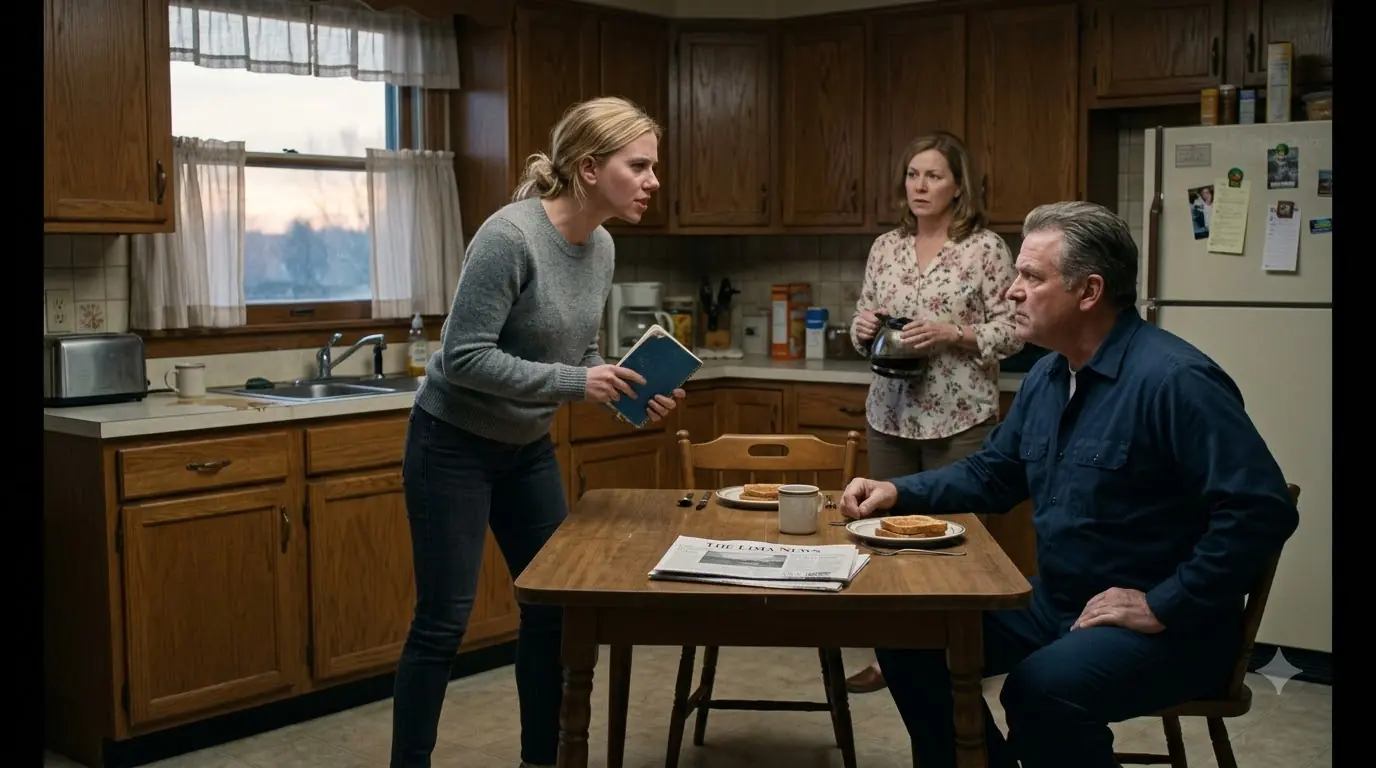
I've never been arrested. I've never even had a parking ticket.
But by the time I was 27, I was living in a homeless shelter, washing my hair in a gas station sink, and eating one meal a day because no one within a 50-mile radius would hire me.
My dad would text me once a week. His same message every time.
"Come home and apologize and maybe I'll stop."
Then one Tuesday morning, a woman knocked on the shelter door and said seven words that changed everything.
"Your grandma hired me to find you."
My name is Caroline Johansson, and this is how I discovered that the person who saved me had been planning my escape for ten years.
Before I tell you what was inside that briefcase, let me take you back to Harlan, Ohio, the week after my 25th birthday, the day I decided I was done asking permission to have a life.
Harlan, Ohio.
Population 4,000 and change.
One grocery store, one high school, one diner that had been serving the same meatloaf since 1987.
The kind of place where everyone waved from their porch and knew whose truck was parked where it shouldn't be.
The Johanssons were considered decent folks.
My dad, Gerald, worked as a plant manager at the Harlan manufacturing facility for 19 years before it shut down.
My mom, Denise, volunteered at the food drive every Thanksgiving.
On paper, we were the family people pointed to and said, "See, that's how you raise a daughter."
Behind the front door, things ran on a different set of rules.
I didn't have my own house key until I was 20.
I wasn't allowed to drive more than 10 miles without calling ahead.
When I was 14, I started bussing tables at the Route 30 Diner after school.
Minimum wage. Nothing glamorous.
My paychecks went straight into a joint bank account my mom opened for "safekeeping."
I never saw a statement.
I never asked.
That's how things worked.
I graduated valedictorian, top of my class.
I had a guidance counselor who pulled me aside during my senior year and said:
"Caroline, you could get scholarships. Real ones."
I brought the brochures home.
My dad didn't even open them.
He set them on the counter and said:
"College is for people who can't work with their hands."
So I stayed.
I cleaned. I cooked. I mowed the lawn. I helped my mom with the garden and listened to my dad talk about how the world was falling apart every night at dinner.
And every night, he'd look at me across that table and say the same thing.
"You've got a roof, food, and family. What else does a girl your age need?"
For a long time, I didn't have an answer.
The week after I turned 25, something shifted.
It wasn't dramatic.
There was no fight. No breaking point.
I was standing in the kitchen, scrubbing the same cast iron skillet I'd been scrubbing since I was 12, and a thought landed in my head like a rock through a window.
"I'm going to be 40 years old, standing in this exact spot, doing this exact thing."
That scared me more than anything my dad had ever said.
The next morning, I walked to the Harlan Public Library.
I sat down at one of the public computers in the back row. The ones with sticky keyboards and 15-minute time limits.
And I created a new email address.
Not the family one my mom monitored.
A new one.
Just mine.
I found a listing for a hardware store in Millfield, 20 minutes east.
They needed a sales associate.
Full-time. 9:00 to 5:00. Benefits after 90 days.
I typed up my application with two fingers and hit send before I could talk myself out of it.
Two days later, an email came back.
They wanted to interview me.
Thursday at 10:00.
I read that email three times.
I closed the browser.
I walked home with my hands shaking.
Not from fear.
From something I hadn't felt in years.
I think it was hope.
That night at dinner, something was off.
My dad sat at the head of the table, fork in one hand, newspaper folded beside his plate.
He looked at me once.
Just once.
With an expression I couldn't name.
My mom stood at the sink with her back to both of us, washing dishes that were already clean.
Nobody said a word.
The next morning, I drove to Millfield for that interview.
The manager shook my hand at the door.
He smiled.
Then he sat me down, and his smile disappeared.
His name was Bill.
Mid-50s, reading glasses hanging from a chain around his neck.
He had my application printed out on the desk between us.
"Caroline," he said, "I'm going to be straight with you. Is there anything in your background we should know about?"
I blinked.
"No, sir. Nothing."
He removed his glasses and rubbed the bridge of his nose.
"We received a phone call yesterday. Someone, I'm not going to say who, mentioned a felony theft charge."
The room tilted.
I gripped the armrest of my chair.
"That's not true. I've never been arrested. I've never stolen anything in my life."
Bill looked at me, and I could see it.
He wanted to believe me.
But he also had a business to run and a phone call sitting in his ear.
"I'm sorry," he said. "We can't move forward."
I drove home in silence.
No radio.
No crying.
Just the white lines on Route 30 blurring past.
When I pulled into the driveway, my dad was sitting on the porch, newspaper open across his lap.
He didn't look up.
"How was your day, sweetheart?"
I stood there, keys in my hand, staring at the back of his newspaper.
He turned a page slowly.
"Fine," I said.
"Good."
He folded the paper.
"Your mom made pot roast."
I sat through dinner.
Pot roast.
Green beans.
Iced tea.
My mom talked about the neighbor's new fence.
My dad nodded along like it was the most interesting thing he'd ever heard.
And somewhere between the pot roast and the iced tea, a thought started forming.
Small.
Ugly.
Impossible.
Did they know?
I pushed it down.
They were my parents.
Parents don't do that.
I wouldn't push it down for long.
Over the next six weeks, I applied to three more places.
A grocery store in Ridgeway.
A warehouse on the county line.
A diner in Cooperton that was hiring morning shifts.
All three called me in for interviews.
All three canceled within 48 hours.
The grocery store said they filled the position.
The warehouse never called back.
But the diner was different.
The owner, a woman named Pat, was honest with me.
She leaned across the counter and lowered her voice.
"Honey, someone called here about you."
My chest tightened.
"What did they say?"
"Said you had a criminal record. Theft and fraud."
My hands went cold.
"Was it a woman?"
Pat nodded.
"Said she was a concerned neighbor."
Concerned neighbor.
That night, I waited until my parents went to bed.
I crept down the hallway to my mom's sewing room.
The one room in the house that was hers alone.
I opened the desk drawer.
I pushed aside fabric scraps and pin cushions.
And there it was.
A small blue notebook.
I opened it.
My mom's handwriting.
Careful.
Neat.
The same cursive she used for birthday cards.
Down the left column were names.
Millfield Hardware.
Ridgeway Freshmart.
County Line Logistics.
Cooperton Family Diner.
Down the right column were red check marks.
Every single place I'd applied.
Checked off one by one.
I stood there in the dark holding that notebook, and the floor felt like it disappeared beneath me.
This wasn't paranoia.
This wasn't coincidence.
My mother had a list.
She was tracking me.
I put the notebook back.
Closed the drawer.
Walked to my room.
I didn't sleep that night.
I just stared at the ceiling, turning one question over and over.
How do you fight the people who are supposed to protect you?
The next morning, I placed the blue notebook on the kitchen table.
My mom was pouring coffee.
My dad was buttering toast.
The radio was playing some old country station.
Everything normal.
Everything ordinary.
"Mom."
She looked up.
"Explain this."
Her eyes dropped to the notebook.
Her hand stopped mid-pour.
Coffee spilled onto the counter.
Then the tears came.
"But you went through my things?"
Her voice cracked instantly.
"Is this how I raised you? Going through your mother's private belongings?"
"You called my employers. Every single one of them. You told them I'm a criminal."
"I did it because I love you."
She pressed a hand against her chest.