A jet worth more than $200 million sat on the runway. Its engines were silent. Its cabin was dark. Its future was uncertain. More than 30 of the finest engineers the company could hire had spent three straight days trying to bring it back to life and every single one of them had failed.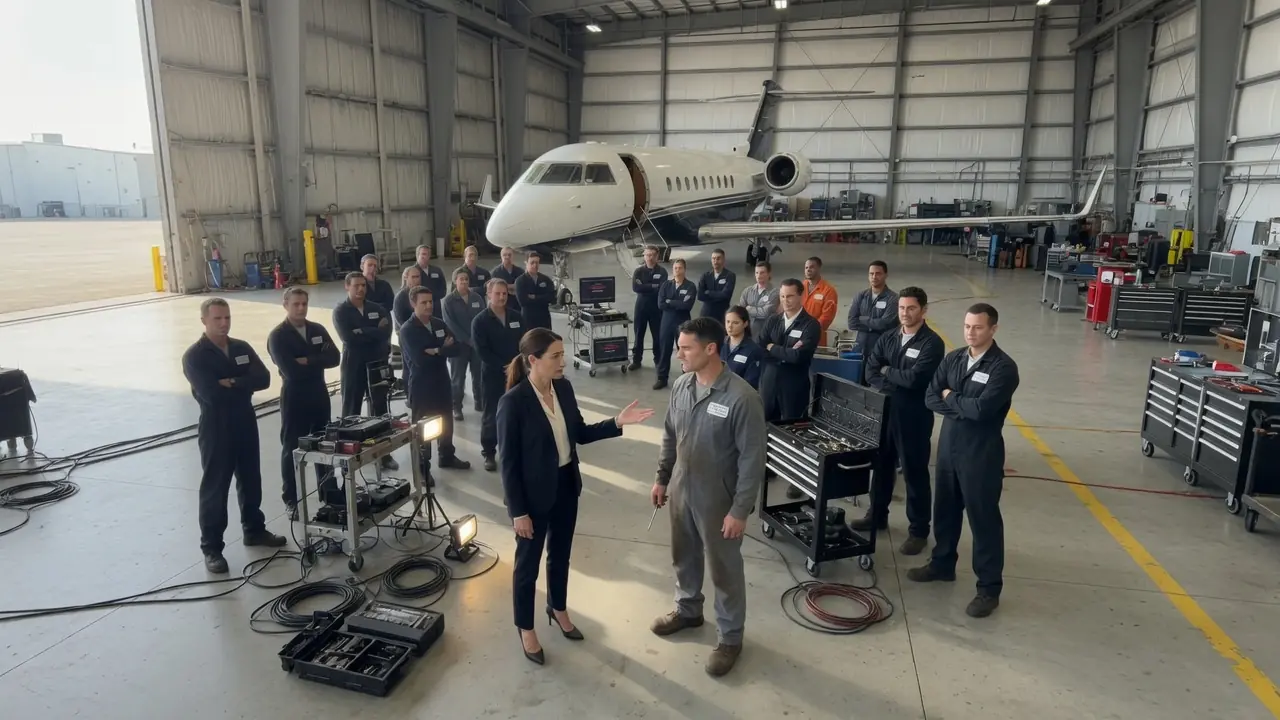
Every hour that passed drained nearly $200,000 from the company's accounts, and somewhere above the hangar, the largest contract of the year was slipping quietly through their fingers. In the middle of that unbearable tension, the CEO walked across the tarmac in her sharp navy suit, stopped in front of a man wearing a faded maintenance uniform, and said the words that would change everything. "If you can fix this aircraft," she told him, "I will hand you my entire monthly salary." Nobody expected the quiet, tired-looking man to smile the way he did. Nobody expected him to ask for nothing more than a single screwdriver.
And nobody, not one person in that hangar, expected what would happen in the next 10 minutes. The morning had begun like any other morning at Hayes Aviation Group, except that nothing about it was ordinary at all. Victoria Hayes had built her company from a small charter service into one of the most respected private aviation firms on the Eastern Seaboard, and she had done it by refusing to accept excuses. She was 38 years old, sharp-eyed, and known throughout the industry as a woman who trusted numbers more than feelings and results more than promises. That morning, she stood inside the largest hangar on the property, staring at the aircraft that was supposed to carry the company's most important client to a signing ceremony worth over $4 billion.
The plane had not moved in three days. It sat there like a wounded animal, silent and useless, while a small army of engineers crawled beneath its wings searching for an answer that refused to reveal itself. The client was a shipping conglomerate based overseas, a family-run empire that had spent 18 months negotiating this partnership, and the final signature depended entirely on a demonstration flight scheduled for that very afternoon. If the aircraft could not fly, the deal would collapse, and with it would collapse two years of careful planning, endless meetings, and promises Victoria had made to her own board of directors. She had flown in specialists from three different countries.
She had authorized emergency shipments of replacement parts. She had approved overtime pay that alone cost more than most of her employees earned in a month. None of it had worked. The aircraft's automated systems kept flashing the same cryptic warning, a fault code that no manual could explain and that no diagnostic tool could isolate. Marcus Reed, the company's technical director, stood at the center of the chaos with his tablet in hand, barking instructions at engineers who were already exhausted beyond reason.
Marcus had built his reputation on confidence, on the kind of swagger that made boardrooms trust him even when his answers were incomplete. He had personally assured Victoria, twice, that the problem would be solved by morning. Morning had come and gone twice now, and his assurances had started to sound less like promises and more like excuses. Victoria watched him pace back and forth across the hangar floor, watched the engineers avoid his eyes, and felt something cold settle in her chest. This was not simply a mechanical failure anymore.
This was a failure of leadership, and she was the one who would answer for it. Victoria had not slept properly in three nights, and it showed faintly beneath her eyes, though nothing in her posture betrayed the exhaustion she carried. She had built her entire career on the belief that composure under pressure was not a talent, but a discipline, something practiced daily until it became indistinguishable from instinct, and she refused to let this crisis be the exception that broke that discipline in front of her own employees. Standing in that hangar, surrounded by failure after failure, she felt the walls of her own certainty beginning to crack in ways she had never experienced before, not even during the leanest years, when the company had nearly folded twice before finding its footing. Her phone buzzed for the fourth time that hour, and she already knew who it was before she looked.
The frustration in the room had turned physical, with engineers slamming toolboxes shut and voices rising over one another, while the entire hangar hummed with the particular anxiety of people who knew they were running out of time and ideas. Victoria stood in the doorway for a long moment, watching all of it, and she understood with sudden clarity that yelling louder was not going to solve this problem. Somebody in this building had the answer. She simply had not found the right person yet. She raised her voice, cutting through the noise with the kind of authority that came naturally to her after years of running meetings where hesitation meant losing.
"Anyone," she announced, "anyone in this hangar who can find the cause of this failure and get that aircraft airborne again will receive a reward unlike anything this company has ever offered." The words landed strangely in the tense air, half promise and half desperation. And dozens of exhausted eyes turned toward her, unsure whether to feel hope or suspicion. Marcus opened his mouth to object, to remind her that his team was the best in the region and did not need outside incentives to work harder than they already were. But Victoria was no longer looking at him.
She was scanning the room, searching for something she could not yet name. And for reasons she could not explain, her gaze drifted toward the far end of the hangar, where a man in a faded gray uniform was quietly wiping down a toolbox that nobody had asked him to touch. His name was Daniel Carter. And almost nobody at Hayes Aviation Group knew the first thing about him beyond the fact that he showed up for the night shift, did his work without complaint, and left before most of the office staff arrived in the morning. He was 40 years old with the kind of quiet, weathered face that suggested a life full of things he chose not to discuss.
He wore the same gray contractor's uniform every day, its fabric soft from years of washing, and he moved through the hangar with a calm efficiency that made him almost invisible among the louder, more ambitious personalities around him. Nobody bothered to ask him questions, and he never volunteered answers. To most of the staff, he was simply the maintenance contractor who kept the floors clean and the tools organized, a man doing an unremarkable job in an unremarkable corner of an extraordinary industry. He kept to himself, not out of unfriendliness, but out of a quiet preference for simplicity. He arrived early enough to grab a cup of coffee from the break room before anyone else and left each night with the same unhurried nod to the security guard at the gate.
Colleagues occasionally speculated about his past over lunch, the way people do about anyone whose life seems just a little too composed for someone doing manual labor, but the speculation never went further than idle curiosity. And Daniel had never given them a reason to. What none of them knew, what Daniel had never mentioned to a single co-worker in the 8 months he had worked there, was that he had once been one of the most promising aerospace engineers of his generation. He had graduated at the top of his class, taken a position at a major aircraft manufacturer straight out of school, and within a decade had his name attached to several patents involving engine efficiency systems that were still in use across the industry today. He had led design teams.
He had solved problems that stumped entire departments. He had, for a brief and shining period of his life, been exactly the kind of person that companies like Hayes Aviation now paid enormous sums to fly in from overseas. Then life had happened, the way it does to everyone eventually, though it rarely happens gently. His wife had passed away suddenly 4 years earlier, leaving him alone to raise their young daughter, and the demands of a high-pressure engineering career had become impossible to reconcile with the demands of fatherhood. He had walked away from a six-figure salary without a second thought.
He had taken smaller contract jobs that allowed him flexible hours and quietly rebuilt his life around the person who mattered most to him. Nobody at his new jobs ever asked about his past, and he never offered it. He had made peace with being underestimated. It was, in its own strange way, a kind of freedom. There were nights, though, when the old instincts still surfaced without warning, when he would catch himself glancing at a piece of machinery and instantly understanding its flaws, the way a musician hears a single wrong note buried inside an otherwise perfect symphony.
He never acted on those instincts at work, never volunteered opinions where they were not invited, because he had learned that unsolicited expertise from a man in a maintenance uniform was rarely welcomed and often resented. He kept that part of himself folded away, the same way he kept his old engineering awards folded away in a box at the back of his closet. It was not out of shame, but because that chapter of his life belonged to a version of himself that no longer needed proving. Marcus, in particular, had never bothered to hide his contempt for the maintenance staff, and Daniel had borne the brunt of it more than once. Just days before the crisis began, Marcus had walked past Daniel in the hangar and offered one of his usual dismissive remarks, telling him that his job was to wipe down grease and stay out of the way of people who actually understood aircraft systems.
Daniel had said nothing in response, had simply nodded and continued his work, because arguing with a man like Marcus had never been worth his time or energy. He had learned, long ago, that the loudest person in the room is rarely the one who solves the problem. But on this particular afternoon, as the tension in the hangar reached its breaking point, Daniel found himself standing near the nose of the crippled aircraft, close enough to hear the low hum of its auxiliary power unit, and the frustrated chatter of engineers who had exhausted every idea in their playbook. He was not there to interfere. He had simply walked over to retrieve a set of cleaning supplies stored near the landing gear, and something, some instinct buried deep beneath years of quiet discipline, made him pause.
He tilted his head slightly, listening to a sound most people in that hangar had long since tuned out as background noise. His brow furrowed. Something about the rhythm of that hum did not sit right with him. He stood there for nearly two full minutes, perfectly still, while engineers rushed past him without a glance. He placed his palm gently against the fuselage near the forward avionics bay, feeling for a vibration that the instruments apparently were not detecting, or perhaps were detecting and simply misinterpreting.
A faint smile crossed his face. It was not a smile of arrogance, but one of quiet recognition. It was the look of a man who had just remembered where he left his keys after searching for an hour. He straightened up, glanced toward the crowd of engineers still arguing over their tablets, and made a decision that would upend the rest of his day entirely. "Perhaps I know what's causing this," he said, his voice calm and unhurried, cutting through the noise just enough for the nearest engineers to hear him.
For a moment, nobody responded at all, as if his words had simply failed to register in a room too consumed by its own panic. Then, slowly, the reaction began to spread. And it was not the reaction Daniel had expected. Laughter rippled through the small crowd, sharp and disbelieving, the kind of laughter that comes from people who cannot imagine the janitor knowing more than the specialists they flew in from three continents. Marcus turned around, incredulous, a smirk already forming on his face before Daniel had even finished his sentence.
"Thirty engineers can't figure this out," Marcus said, loud enough for the whole hangar to hear. "And you think you know?" Daniel did not flinch, did not raise his voice, did not attempt to defend himself against the mockery. He simply stood there with the same calm expression he always wore. It was the expression of a man who had long ago stopped needing other people's approval to know what he knew.
Victoria, standing several yards away, turned at the sound of the commotion. Her curiosity was piqued despite the exhaustion written across her face. She studied Daniel for a long moment, uncertain whether she was looking at a fool or at something else entirely. Daniel did not argue with Marcus, did not try to prove his credentials or explain the years of experience hidden beneath his faded uniform. He simply asked for 10 minutes, nothing more.
He wanted 10 minutes to look at the aircraft the way he wanted to look at it, without a tablet, without a diagnostic printout, and without 30 other voices shouting theories over one another. It was such a small request, almost absurdly small given the stakes involved, that for a moment nobody quite knew how to respond to it. Marcus scoffed and looked to Victoria, clearly expecting her to dismiss the idea outright and send the maintenance contractor back to his cleaning supplies where he belonged. Victoria, however, said nothing for a long time. She studied Daniel's face, the steadiness in his eyes, the complete absence of the desperation or bravado she had seen in every other person who had approached her that day with a theory about the aircraft.
There was something in his stillness that unsettled her, though not in a threatening way, more in the way that a familiar melody unsettles you before you remember its name. Three days of failure had taught her that confidence alone meant nothing, that she had already trusted a dozen confident men who had delivered nothing but delays. But something about this man's quiet certainty felt different from all of that. Against every instinct that told her to send him away, she found herself nodding instead. "Fine," she said.
"Ten minutes." The words hung in the air like a challenge nobody had quite expected. And Marcus threw up his hands in frustration, muttering something about wasted time as he stalked off toward the diagnostic terminal. The other engineers exchanged uncertain glances, unsure whether to watch or return to their own failed theories. And Victoria remained standing near the nose of the aircraft, her arms crossed, her eyes fixed on the man in the gray uniform, who was about to either embarrass himself completely or turn her entire day upside down.
Word of the strange scene spread through the hangar faster than anyone could have predicted. And within minutes, nearly every engineer, technician, and support staff member on the property had gathered to watch what was unfolding. Victoria walked toward the center of the crowd, aware that every eye in the building was now on her. And she understood that whatever happened next would be remembered by everyone present for a very long time. She looked directly at Daniel, who stood calmly beside the aircraft's landing gear, waiting without impatience for whatever she intended to say.
"If you can fix this," she announced, her voice carrying clearly across the silent hangar. "I will give you my entire salary for this month." The declaration landed like a thunderclap, and for a moment, nobody breathed. Executives glanced at one another in disbelief. Engineers who had spent three sleepless days chasing an impossible fault code suddenly found themselves staring at a maintenance contractor as though seeing him for the first time.
Marcus let out a short, incredulous laugh, muttering something about not needing to bring cash to work today. And a few nervous chuckles rippled through the crowd in response. Daniel did not react the way anyone expected. He did not smile at the mention of money, did not seem tempted or excited by the enormous sum being offered so publicly. Instead, he looked at Victoria with the same steady calm he had carried since the beginning of the encounter, and said simply that he did not need her money.
The response caught Victoria off guard in a way she had not felt in years because in her experience, everyone wanted something, and money was almost always the fastest way to secure cooperation. She studied his face carefully, searching for sarcasm or a hidden motive, and found neither. "If not money," she asked, "then what do you want?" Daniel considered the question for a moment, glancing briefly at the nervous faces of the younger engineers standing near the edge of the crowd. These were men and women who had been working around the clock for 3 days straight, terrified of losing their jobs if the contract fell through because of a mistake that was never truly theirs to begin with.
He looked back at Victoria and told her plainly that he simply did not want people losing their positions over a failure that was not their fault. It was such a strange thing to hear from a man in a maintenance uniform standing in front of a CEO who had just offered him more money than he likely earned in 6 months that the entire hangar seemed to hold its breath for a second time that day. Something shifted behind Victoria's eyes as she absorbed his answer. It was a quiet recalibration of everything she had assumed about the man standing in front of her. She had built her career reading people quickly and accurately, sorting them into categories of ambition and self-interest almost instinctively, and Daniel Carter refused to fit neatly into any of the categories she knew.
She gave him a slow nod, the kind of nod that suggested she was reserving judgment rather than offering approval, and stepped back to give him the space he had asked for. Whatever happened in the next 10 minutes, she intended to watch every second of it. Daniel crouched near the aircraft's forward landing gear and began his inspection in a manner that immediately drew confused stares from the engineers surrounding him. He did not open a laptop. He did not request access to the diagnostic terminal that Marcus and his team had been staring at for three straight days.
Instead, he pressed his palm flat against the fuselage, closing his eyes briefly as though listening for something buried beneath the metal skin of the aircraft. He moved along the length of the plane slowly, pausing every few feet to touch a panel, to lean his ear close to a seam, to feel for temperature differences with the back of his hand, the way a doctor might check a patient's fever without needing a thermometer. Marcus watched from a distance, arms folded, a look of open contempt on his face as he muttered to the engineer beside him that this was nothing more than theater, a desperate man trying to look impressive in front of the boss. Several of the younger engineers laughed nervously, uncertain whether to agree with Marcus or to keep watching the strange, methodical ritual unfolding in front of them. Daniel ignored all of it entirely, moving with the unhurried patience of a man who had done this kind of work a thousand times before in a different life, in a different uniform, under a different name that once appeared on official patent filings.
He knelt near the underside of the wing, running his fingers along a line of rivets, then stood and walked toward the avionics bay near the nose of the aircraft, his expression unreadable. He tapped gently against a section of paneling, listened to the hollow sound it produced, and tapped again a few inches to the left, where the sound changed almost imperceptibly. A faint furrow appeared between his brows, the first outward sign of concentration he had shown since the 10 minutes began, and Victoria, still watching closely, felt her pulse quicken without entirely understanding why. "Excuse me," Daniel said finally, breaking the tense silence that had settled over the hangar. "Could someone hand me a screwdriver?"
The request was almost comically simple given the scale of the crisis surrounding them, and for a moment, nobody moved as though the sheer ordinariness of the tool being requested had confused everyone into stillness. Then, one of the younger engineers, a woman named Sarah, who had been quietly observing Daniel's methodical inspection with growing curiosity rather than the skepticism of her colleagues, stepped forward and handed him a screwdriver from the nearest toolbox without a word. Daniel knelt beside the small access panel he had identified. Working the screwdriver with the practiced, unhurried movements of someone who had spent years disassembling far more complicated machinery than this, the panel came loose after a few careful turns, and he set it aside gently. As he peered into the narrow compartment behind it with the focused attention of a surgeon opening an incision, the crowd went almost completely silent.
Even Marcus, who had crossed his arms tighter and stopped muttering his dismissive comments, was unable to look away from what was happening in front of him. Inside the compartment, nestled among a cluster of wiring and small mechanical components, Daniel found what he had suspected he might find, though he had not been entirely certain until that exact moment. A tiny sensor bracket, no larger than a thumbnail, had been reinstalled slightly out of alignment during the aircraft's last scheduled maintenance cycle, a mistake so small and so easy to overlook that none of the diagnostic software had been designed to catch it. The misalignment was causing a minor but persistent interference in the signal feeding back to the aircraft's central computer, and that tiny corrupted signal was being misread by the system as a catastrophic engine fault, triggering the exact cascade of warnings that had grounded the aircraft for three entire days. He reached into the compartment with careful, practiced fingers, gently repositioning the small bracket back into its correct alignment, checking the connection twice to ensure it had seated properly before withdrawing his hand.
He replaced the access panel, tightened the screws with the same unhurried patience he had shown throughout the entire process, and stood up, brushing his palms against his uniform as though he had simply finished changing a light bulb rather than solved a problem that had defeated an army of specialists. "Try starting it now," he said quietly. And though his voice was calm, something in his tone carried an unmistakable certainty that made even the most skeptical engineers in the crowd fall silent. Nobody moved for a moment, as though half of them expected the request to result in nothing at all. They expected another failed attempt to add to the growing pile of disappointments from the past 3 days.
Marcus opened his mouth to say something dismissive, then closed it again, some instinct telling him that arguing further would only make him look worse if, by some impossible chance, the maintenance contractor turned out to be right. One of the test pilots, a veteran named Robert, who had flown for the company for over a decade, climbed into the cockpit and began the startup sequence with the practiced efficiency of a man who had done it thousands of times before. The auxiliary power unit hummed to life first, followed by the low, building whine of the engines beginning their startup cycle, and every single person in that hangar found themselves holding their breath without quite realizing they were doing it. Several engineers instinctively took a step backward as though bracing themselves for the same sharp whine of failure they had heard dozens of times over the past 3 days. It was the sound that always preceded another round of shutdowns and another round of disappointment.
The seconds stretched unbearably as the engines climbed through their startup range. And then, almost anticlimactically, the sound smoothed out into a steady, healthy roar that echoed cleanly off the hangar walls. The warning lights that had plagued the aircraft's control panel for three consecutive days did not appear. Robert stared at the instrument panel for a long moment, running through the diagnostic checklist twice just to be certain his eyes were not deceiving him, and then leaned out of the cockpit window with an expression of pure disbelief on his face. "All systems normal," he called out, his voice carrying across the silent hangar like a verdict from a courtroom.
For a moment, nobody in the crowd reacted at all. It was as though the news needed time to travel from their ears to their understanding. Then the silence broke all at once, engineers turning to one another in stunned confusion, murmurs rising into disbelieving conversation, someone letting out a short, incredulous laugh that had nothing to do with mockery this time. Marcus stood frozen near the edge of the crowd, his face drained of color, staring at the aircraft as though it had somehow betrayed him personally by choosing to start on the word of a maintenance contractor after refusing to cooperate with his entire team for three straight days. He said nothing.
There was nothing left for him to say. Victoria remained perfectly still throughout all of it. She watched the aircraft, her engineers, and the quiet man in the gray uniform who had just solved a problem that had threatened to destroy her company's most important deal of the year. She felt something complicated rise in her chest, relief tangled together with disbelief, and beneath both of those feelings, a growing sense of shame that she had walked past this man in her own hangar for 8 months without once wondering who he really was. She turned to look at him directly.
And for the first time since the crisis began, she allowed herself to feel something close to hope. That evening, once the aircraft had been cleared by every safety inspection the company's protocols required and the demonstration flight had been rescheduled for the following morning with full confidence, Victoria retreated to her office and pulled up Daniel Carter's personnel file. What she found on her screen stopped her mid-breath. Buried beneath a thin folder of routine contractor paperwork was a name that, once cross-referenced against public engineering records, revealed an entire career she never could have imagined standing behind that quiet, unassuming face. Daniel Carter had once led a design team at one of the largest aerospace manufacturers in the country, credited on multiple patents related to engine efficiency systems that were still cited in modern aviation literature.
He had been recruited by three separate Fortune-listed companies during the peak of his career, each offering him compensation packages that dwarfed anything Hayes Aviation currently paid its senior executives. He had walked away from all of it 4 years earlier, and the records offered no explanation beyond a brief, formal note about a family circumstance requiring his full attention. Victoria sat back in her chair, staring at the screen, feeling the shape of an entirely different story begin to form in her mind. She scrolled through old project summaries that still carried his name in the credits, technical papers referencing systems he had helped design more than a decade earlier, and a handful of industry award nominations that had apparently gone unclaimed after he quietly withdrew from public professional life. It was strange, she thought, how thoroughly a person could disappear simply by choosing not to remind the world of who they had once been.
She closed the laptop, sat in the silence of her office for several long minutes, and found herself, for the first time in years, questioning how many other remarkable people might be walking past her every single day, unnoticed and unasked. She found him the following morning near the same hangar, quietly organizing a toolbox before his shift technically even began. And she asked him directly why he had never mentioned any of it. Daniel looked up at her with the same calm, unhurried expression he seemed to carry into every conversation and told her simply that he had never hidden anything. Nobody had ever asked.
It was such a plain, honest answer that Victoria found herself unable to respond immediately, struck by the quiet truth of it. It was the realization that an entire company full of intelligent people had walked past a remarkable man every single day and never once wondered what his story might be. She learned, over the course of that conversation and several that followed in the days after, that Daniel's wife had passed away suddenly when their daughter was barely 5 years old, leaving him to navigate grief and fatherhood entirely alone while still trying to hold together a demanding engineering career that required constant travel and late nights he could no longer justify. He had made the decision, without regret, to step away from the industry that had once defined him, choosing instead work that allowed him to pick his daughter up from school every afternoon and be present for the ordinary, irreplaceable moments of her childhood. He had never once looked back with bitterness.
He simply looked back, when he looked back at all, with quiet gratitude that he had been able to choose his daughter over his career and still find a way to keep both intact. Victoria listened to all of it with a growing sense of humility she had not expected to feel that week. And when their conversation ended, she understood something she would carry with her for the rest of her career. The most capable people in any organization are not always the loudest, and the value of a person is rarely visible on the surface of a job title or the fabric of a uniform. She thanked him sincerely and told him she intended to keep her promise in full, whether or not he wanted the reward attached to it.
Two days later, Victoria called every employee at Hayes Aviation Group into the largest hangar on the property, the same hangar where the crisis had unfolded, now cleared of tools and equipment and arranged instead with rows of chairs facing a small platform near the nose of the very aircraft Daniel had repaired. She stood at the front of the room, addressing the entire staff with a formality she rarely used, and recounted publicly what had happened 3 days earlier, sparing no detail about how close the company had come to losing its most important contract and how one quiet contractor had solved in 10 minutes what 30 specialists could not solve in 3 days. She called Daniel forward and in front of the entire assembled staff presented him with a check equal to her full monthly salary, exactly as she had promised in front of everyone during the crisis. The room erupted into applause. Engineers who had mocked him days earlier now watched with something closer to reverence.
And for a moment Daniel simply stood there holding the check, looking at it the way a man looks at something he genuinely did not expect to receive. Then, calmly, he did something nobody in that hangar expected either. He declined it. He told Victoria, in front of the entire staff, that he did not want the money for himself and asked instead that the company use those funds to build a proper training program for its younger engineers, the kind of mentorship and hands-on education that might help prevent small errors like the one that had grounded the aircraft in the first place. The room fell silent again.
But this silence felt entirely different from the tense, disbelieving silence of 3 days earlier. This silence carried weight, the particular stillness of people witnessing something they knew they would remember for years to come. Slowly, someone in the back of the room began to clap. And within seconds the entire hangar rose to its feet in a wave of applause that seemed to shake the walls themselves. Marcus, who had positioned himself near the back of the crowd, stood frozen for a long moment before finally walking forward through the parting crowd, his expression stripped of its usual arrogance.
He stopped in front of Daniel and, in a voice far quieter than anyone had ever heard him use, apologized for the way he had treated him. He apologized for the dismissive comments and for assuming a uniform could tell him everything he needed to know about a person's worth. Daniel simply nodded and extended his hand. And the two men shook. The handshake closed a chapter that had begun with contempt and ended unexpectedly with respect.
In the weeks that followed, Victoria found herself returning to that moment again and again, replaying it in her mind during board meetings and quiet evenings alone in her office. She eventually called Daniel into her office privately and offered him a position that would have seemed unthinkable to him just weeks earlier. It was the role of technical director for the entire company, along with a salary several times what he currently earned as a contractor. Daniel considered the offer carefully, not out of hesitation about his own abilities, but out of genuine concern for what kind of company he would be stepping into if he accepted it. He told Victoria he would take the position on one condition, and the condition he named was not about money or title or authority.
He asked that she help him build a culture within the company where people were evaluated by their competence and character, rather than by the titles printed on their badges or the uniforms they happen to wear to work. Victoria, who had spent the last 3 weeks reflecting on exactly how close the company had come to disaster because talented people had been overlooked or dismissed, agreed without a moment of hesitation. Sarah, the young engineer who had quietly handed Daniel the screwdriver during those tense 10 minutes, became one of the first participants in the new training program, and within a year, she had been promoted twice, eventually leading a small team of her own. She often told newer hires the story of that afternoon, not to glorify the drama of it, but to remind them that the willingness to listen, rather than the need to be heard, was often the difference between solving a problem and simply arguing about one. Her account of the day became something of a quiet legend within the company, passed from senior staff to newcomers during their first week of orientation.
Months passed, and the changes at Hayes Aviation Group became impossible to ignore. The shipping conglomerate's contract, once nearly lost, was signed and expanded within the year, becoming the largest and most profitable partnership in the company's history. The culture within the engineering department shifted noticeably. Younger staff members no longer hesitated to speak up with unconventional ideas, senior engineers took the time to mentor new hires rather than dismiss them, and an entirely new training program, funded in part by the very check Daniel had once refused, produced a wave of confident, well-trained young engineers who carried themselves with a different kind of pride. Daniel settled into his new role with the same quiet steadiness that had defined him from the very beginning.
He never sought credit or reminded anyone of the day he had solved a crisis that 30 specialists could not solve, content instead to walk the hangar floor each morning and answer questions from young engineers who had once laughed at the idea that a maintenance contractor might know more than they did. He continued picking his daughter up from school every afternoon whenever his schedule allowed. And those who worked closely with him began to understand that the calm, unhurried confidence he brought into every difficult situation had never come from arrogance at all. It had come from having already survived the hardest thing life could throw at him and finding, on the other side of that grief, a kind of clarity most people never discover. On a quiet afternoon nearly a year after the crisis that had almost destroyed everything Victoria had built, she stood at the edge of the same hangar, watching Daniel patiently walk a group of young engineers through the disassembly of a small aircraft component and explain not just what to do, but why each piece mattered and why patience and attention often revealed answers that panic and pressure never could.
With a small, genuine smile, she told the members of her executive team that the day she had wagered her entire monthly salary on a man in a faded gray uniform had turned out to be the single best decision of her entire career. The story of that afternoon spread quietly through the company over the following months, told and retold by the people who had witnessed it firsthand, evolving slightly with each telling but always circling back to the same simple truth at its center. The simple truth was this: never judge a person by the uniform they happen to be wearing, because sometimes the quietest person in the room is the only one capable of saving everything everyone else has already given up on. Somewhere in that hangar, long after the applause had faded and the cameras had gone home, a single father who had once walked away from a brilliant career to raise his daughter alone had proven, without ever raising his voice, that competence does not announce itself and that the truest kind of strength rarely needs an audience to be real.