It was nearly dusk when the phone rang, slicing through the quiet rhythm of my evening. I was folding towels in the laundry room, the soft hum of the dryer masking the first few rings. When I saw Caleb's name light up the screen, I smiled despite everything. I still did.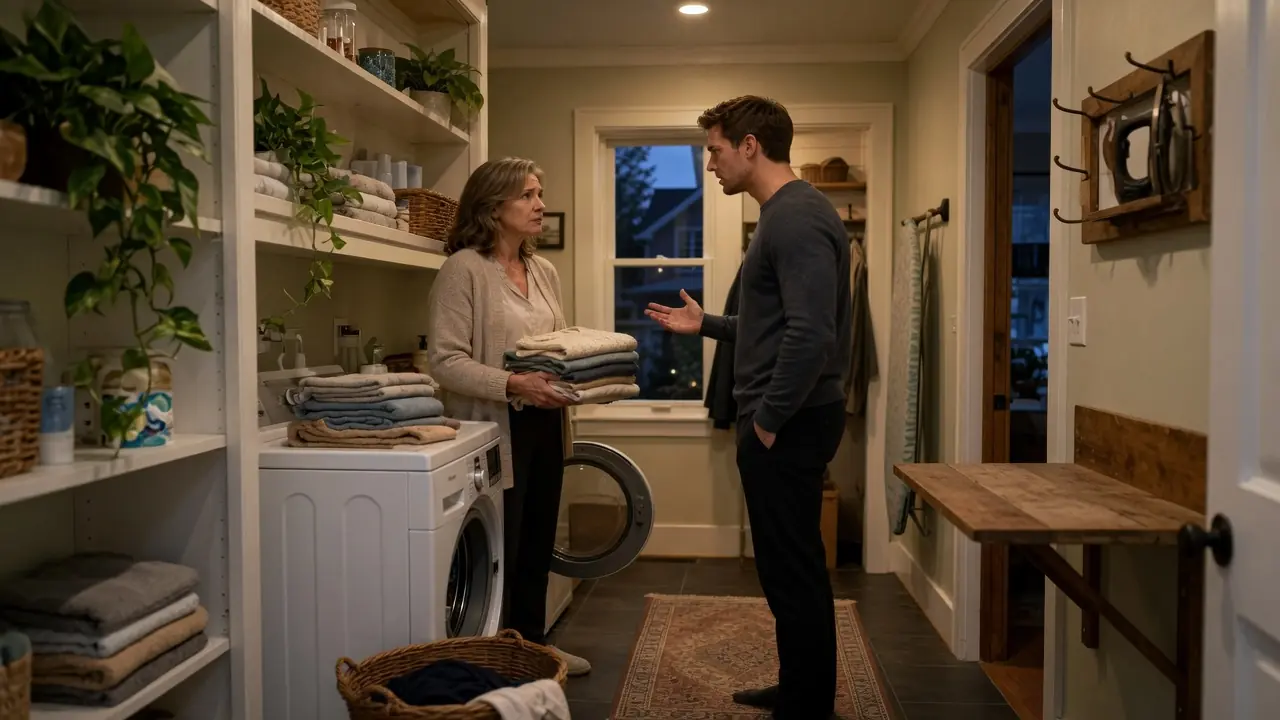
“Hey, sweetheart,” I answered, tucking the phone between my shoulder and ear.
“Hey, Mom,” he said, sounding distracted. “Just checking in. Molina and I are heading out for dinner. Some bistro her cousin recommended. Paris is expensive, but she's happy.”
I asked about the weather, whether the hotel was nice, and if he had seen the Seine yet. He gave short, polite answers. I didn't mind. I was used to being the one who asked.
After a few minutes, he said, “Anyway, we'll talk more soon, okay? Love you.”
“Love you, too,” I replied, then waited for the line to go dead.
But it didn't. There was a pause, followed by the sound of Caleb shifting the phone, perhaps into his coat pocket. Molina's voice came next, low and close.
“Who was that?”
“Mom,” he muttered. “Something about the house again. Probably that leak in the guest bathroom.”
I held my breath, one hand still resting on the edge of the dryer. Molina laughed.
“Well, it is technically hers.”
“For now,” Caleb said, his voice suddenly sharp. “She's a burden. We'll talk her into signing the deed eventually. Guilt works every time.”
Grief, when it first arrives, moves like water: quiet, invasive, unstoppable. I was forty-two when it drowned the life I knew. Paul died in an accident no one saw coming, leaving behind a tired wife, a teenage son, and just enough insurance to keep our lives from falling completely apart.
I remembered the day I signed the final paperwork for the payout. The man across the desk kept calling it a benefit, as if money could ever replace the steady patience of Paul's hands or the way he always made our son laugh, even on bad days. I didn't touch a cent of it for a year. Then, slowly, I began reshaping our lives around the hollow space he had left behind.
The house came first. It was a modest, white-painted Craftsman at the edge of Asheville, with old bones and a good soul. I chose it because Paul would have loved the porch and the oak tree in the yard. I made it ours with careful hands—painted walls, weekend landscaping, secondhand furniture, and repairs I completed myself. It was the only thing I had ever owned that felt entirely mine.
The house was supposed to be the foundation that made Caleb feel safe again. I didn't date. I worked two jobs most years, sometimes three during the summers when Caleb needed camp, books, or braces. I told myself that was enough, that mothering well was its own kind of love story.
When he got into Columbia, I cried in the parking lot of the diner where I waitressed. The scholarship wasn't full, but we figured it out. I sold my grandmother's ring, dipped into the insurance money, and picked up an overnight shift. I told him not to worry about anything except studying. He promised he would never forget what I had done for him.
After graduation, he and Molina moved back to North Carolina for a few months. There had been a layoff, and rent was high. It was only temporary, they said. I didn't hesitate. I gave them the upstairs and repainted the guest room myself. Molina said she liked the pale gray.
I said nothing when she replaced the curtains. I said nothing when Caleb rerouted the mail into their names, or when they began referring to the place as “the house,” never “Mom's house.” I let it slide. Maybe I wanted to believe we had become a family again under one roof. Maybe I was tired of eating dinner alone.
I never imagined the hands I had raised would turn and reach for what I had bled to keep standing. Now, hearing those words—she's a burden—I couldn't stop the memories from rolling in, one after another, each more bitter than the last. The mortgage I had carried alone. The years I had gone without holidays because I was covering shifts. The back pain I had ignored and the small joys I had shelved.
Yet it wasn't the betrayal that stunned me most. It was how unsurprised a part of me felt. I folded the last towel, slowly pressed it flat, and set it on the pile. Then I walked to my room and pulled the fireproof box from beneath my bed, the one that held the deed.
It hadn't happened all at once. If it had, I might have stopped it. But erosion is quiet. It wears you down grain by grain until one day you look around and realize the shoreline is gone.
They began calling it “our house” about three months after they moved in. At first, I thought it was careless phrasing.
“We should do something about the porch,” Molina would say.
Or, “We've been thinking about a new stove.”
Then Caleb chimed in. “I'll take care of the bills from now on. It's easier if everything is automated.”
I told myself it was kindness, a grown son trying to share the load. I didn't ask why the electric bill suddenly went to his email or why the gas company started calling me Mrs. Hargrave Jr. instead of Lena. I simply smiled and told myself not to make a fuss.
Molina painted the hallway one weekend while I was at church. “It needed freshening up,” she said cheerfully. The soft blue I had chosen years earlier was gone, replaced by a sterile shade of cream that matched their furniture. I stood there blinking, trying not to let my hurt show.
She hugged me from behind and said, “We're building something beautiful here.”
I nodded and let her believe I agreed.
Then came the conversation about the nursery. Molina sat across from me at the kitchen table, one hand curled around a mug and the other resting on her belly.
“We've been thinking,” she said, smiling. “If this works out, we'd love to turn your room into the nursery. You would still have the guest room, of course. It's cozier.”
Caleb didn't look up from his phone when she said it, as though the decision had already been made.
That night, I lay awake in the room they wanted to repurpose, listening to the wind rattle the old windows Paul had once sealed with his bare hands. I realized how small I had become in my own home. Every wall whispered someone else's name now.
I reached over, turned on the lamp, and opened the drawer beside my bed. Inside was a letter Caleb had written from college, the one that ended with, “I'll always take care of you, Mom.” I folded it neatly and placed it beside the deed.
I told myself not to listen again. I had already heard enough. The words were burned into my memory, sharp as broken glass: She's a burden.
But some small, wounded part of me was still waiting for it all to be a misunderstanding. I pressed play again. The recording crackled softly, and Caleb's voice came through, faint at first.
“She'll give in if we remind her how much she owes us.”
Molina laughed. “Just mention the college loans and the fact that she hasn't paid rent since we moved in.”
I paused the playback, my thumb hovering over the screen. I hadn't paid rent in my own home. I pressed play again.
“She's emotionally dependent,” Caleb said. “We don't have to be cruel about it. We just need to make her feel like we're her only real family. She's easy to guilt.”
“And once we're on the deed, we can finally start renovating properly,” Molina agreed.
There was a brief rustling, followed by the sound of silverware and glasses clinking. Then Molina spoke again, more casually this time.
“We'll take the master bedroom when we get back. It makes no sense for her to have the largest room when she barely does anything anymore.”
That one hurt more than the rest. I paused the recording, closed my eyes, and let the silence fill the room. They had been sitting in some Paris café, dining on food I had paid for while planning how to edge me out of the life I had built for all of us.
I pressed play once more.
“She doesn't even realize how close we are to taking over everything,” Caleb said. “If she pushes back, we remind her about retirement homes and healthcare. The woman isn't getting any younger.”
“Possession is nine-tenths of the law,” Molina said lightly. “We've been living there for years. If we had to fight it, I'm sure some judge would sympathize.”
They laughed. It was the sound I used to love, the one I had strained to hear from the kitchen as a young mother trying to make dinner and keep her son smiling. Now it made my stomach turn.
I recorded and saved everything. That night, I didn't sleep. I sat at the kitchen table with every light off, my hands wrapped around a cold mug of tea I had forgotten to drink. Every corner of the house echoed something I had given: birthday parties in the living room, Paul's handprints in the back garden, and late nights folding laundry so Caleb would have clean clothes for school.
I had given everything, and still it wasn't enough to make me safe from their plans. By morning, something inside me had settled—not peace, not yet, but a quiet certainty. I would not plead for space in my own home. I would not let them decide what I was worth.
I opened the drawer again, took out the deed, and began making calls.
Joanna didn't ask why I appeared unannounced at her office that morning. She simply waved me in, closed the door, and poured coffee into the chipped mug she always kept on the corner of her desk.
“You look like someone who has come to set something straight,” she said.
I slid the deed across the desk. “Can you confirm that I still hold sole ownership?”
She picked it up, scanned it with her usual efficiency, then nodded. “There are no co-signers, no liens, and no additions. The house is entirely in your name, Lena.”
That was all I needed to hear. I told her what I had overheard—not every word, only enough. Her face didn't change much, but her eyes hardened.
Joanna had known Caleb since he was in diapers. She had danced at my wedding and held my hand at Paul's funeral. Now she said nothing as she reached for a legal pad and began writing. Over the next hour, we mapped out the legal protections, the timeline, and the contingencies.
I didn't cry. I didn't raise my voice. I signed what needed signing, made copies, and thanked her on my way out.
By the end of that day, I had a private meeting scheduled with a realtor two towns over. Marcus had worked with me once before on an estate matter. He was discreet, professional, and no-nonsense.
When I told him I needed a quiet sale and a fast turnaround, he didn't flinch. “We'll price it to move. I know several buyers who will jump at it.”
I packed only what belonged to me: photographs, linens, a worn leather chair Paul had loved, and the books I had collected over three decades. Everything else I cataloged. Caleb and Molina's belongings went into clearly marked boxes and were loaded into a moving truck I arranged myself.
I prepaid for a storage unit and left the access code with Joanna in case they came looking. I told no one I was leaving. I found a furnished rental in Charlottesville, a place with light floors and neutral walls that held no memories.
On my final night in the house, I stood alone in the kitchen and placed a note on the counter where Caleb and Molina would see it when they returned.
“Surprise. A burden did this.”
I set the keys beside it, locked the door from the inside, and exited through the garage one last time. As I drove down those familiar streets, the town blurred behind me like a painting washed in rain. Ahead, the road began to open.
They returned on a Wednesday. I knew the day not because they told me, but because the calls began shortly after noon and didn't stop for hours. First Caleb, then Molina, then Caleb again. Missed call, voicemail, text, another call—each one more frantic than the last.
“Mom,” Caleb's voice crackled through the first voicemail. “The key isn't working. Did you change the locks? What's going on?”
The second message was shorter and harsher. “Lena, this isn't funny. Where is everything? Where are you?”
I listened to none of it in real time. I let the messages accumulate while I sat in the small kitchen of my new rental, stirring sugar into a cup of coffee I didn't really want. I stared out the window at nothing in particular and let the silence answer for me.
By early evening, their panic had changed tone. Molina's voice filled one message, syrupy and sweet, but sharp underneath.
“We're really worried, okay? Please call us. Just let us know you're safe.”
Safe. I smiled at that. For the first time in years, I was.
Later that night, Caleb left one final message, his voice strained. “We found the note. I don't know what you think you heard, but you've made a huge mistake. This is our home, too, and you had no right—none—to sell it. We're talking to a lawyer. You've really done it this time.”
I saved that message, too. I didn't respond, explain, or offer comfort or a defense. Let them shout into the void. Let them wonder where the line between control and love had finally snapped. I had no interest in pulling them across it.
The house was gone. Its door no longer opened for them, and my silence was finally speaking louder than anything I had ever said.
They demanded a meeting. Caleb's message was short and sharp: “Tomorrow, 10:00 a.m., café on Main Street. If you don't show, we're coming to your office.”
So I went. I arrived at 10:05, not out of rudeness, but by intention. Caleb and Molina were already seated, postured in practiced indignation, their hands curled around untouched mugs.
I didn't greet them. I simply sat, placed my phone screen-up on the table, and pressed play.
Their own voices spilled out, familiar and cruel. I watched their faces change as each sentence echoed back at them.
“She's a burden.”
“We'll take the master bedroom.”
“Guilt works every time.”
Molina paled. Caleb's mouth tightened into something between anger and denial.
“You misunderstood,” he said flatly.
“No,” I answered. “I finally understood.”
Molina leaned forward, her voice soft and cutting. “You blindsided us. You sold our home out from under us.”
“It was never yours,” I said calmly. “It was mine. I paid for it, maintained it, and protected it.”
Caleb scoffed. “After everything we've done for you—”
I met his eyes and didn't look away. “Yes. And you taught me exactly what not to become.”
They didn't know what to do with that. I gave them no time to recover.
“There will be no money, no access to my accounts, no forwarding address, and no second chances.”
Molina opened her mouth, then closed it again. Caleb's fists clenched on the table until his knuckles turned white.
“I'm your son,” he said finally, as though the title alone should mean something.
“And I was your mother,” I said quietly. “Not your asset.”
For a long moment, we sat inside the kind of silence neither of them had ever learned to endure. Then I stood, slid a small envelope containing the storage unit details across the table, and turned to leave.
Neither of them called my name.
The quiet in my new apartment felt different. It wasn't the aching kind I used to fill with other people's needs. It was soft and whole. I wasn't waiting for someone to knock, call, or ask for something they had already decided I owed them.
I made tea in the mornings—real tea, not the half-cold cups I used to forget on the counter. I sat by the window, watched the birds on the ledge, and read entire chapters without interruption. Some days, I didn't speak to anyone, and I liked it that way.
But I didn't disappear. After a few weeks, I found a small community center nearby that hosted weekly grief and boundary-setting groups. It felt strange at first, sitting in a circle of strangers and saying my name aloud as though I were starting over. But that was exactly what I was doing.
I wasn't there to talk about Caleb, not directly. I was there to talk about the quiet ways we lose ourselves when we are too busy caring for everyone else. I met women who had survived worse, and others who were only beginning to say no for the first time. We didn't fix one another. We listened, and that was enough.
One evening after the group, a woman named Sabria pulled me aside. She ran a shelter for single mothers on the edge of town.
“We could use someone like you,” she said. “Not to preach. Just to sit with them and tell the truth.”
So I started showing up, once a week at first, then more often. I sat on worn couches beside young mothers who had no one left to believe in them. I listened to their stories and told them some of mine—not the bitter parts, only the parts that reminded them they weren't alone.
I didn't tell them what to do. I let them decide that for themselves.
One afternoon, while walking home with the chill of early fall in the air, I realized I hadn't thought about Caleb in days. Not with pain or anger, only distance. Not every loss is a wound. Some losses are the first step toward something that finally feels like your own.
A year passed in the quietest way. There were no dramatic changes or declarations, only steady, honest, unspectacular days that belonged to me. The date crept up without warning. I only realized it was the anniversary when I saw the first yellow leaf fall outside my window.
Autumn had always been Paul's favorite season. It had been Caleb's, too, when he was little. I used to rake leaves into piles just so he could jump into them laughing.
I made tea and sat at the kitchen table with my journal. No one expected anything from me that day. There were no calls and no demands.
I opened to a blank page and wrote a letter—not to Caleb or anyone else, but to myself.
You were never a burden. You were the foundation.
You were the one who kept everything from falling apart.
You carried what no one saw and gave more than anyone ever gave back.
When they tried to reduce you to your usefulness, you chose to walk away.
That wasn't cruelty. It was clarity.
I signed it without flourish or apology.
Later, I went for a walk. I didn't intend to go near the old neighborhood, but my feet found their way without asking. When I reached the street, I slowed—not to look back, but simply to pass through.
The house stood there, familiar yet distant. Someone had painted the door, and the porch was clean. It didn't hurt the way I thought it might. I didn't linger or hope anyone would look out the window. I simply kept walking.
I hadn't lost my son. That truth settled inside me slowly, without bitterness. I had lost the version of him I wanted to believe in: the boy who would never turn away from me, the man who would remember the hands that had built his world.
What I let go of wasn't a child. It was the illusion that he saw me.
And what I found in the space he left behind was myself.