The first time my stepsister accused me of trying to attack her, my father was downstairs cutting his birthday cake. Forty people were in our house, a photographer was positioning the family for a picture, and the evening had been arranged to make us look happier than we were.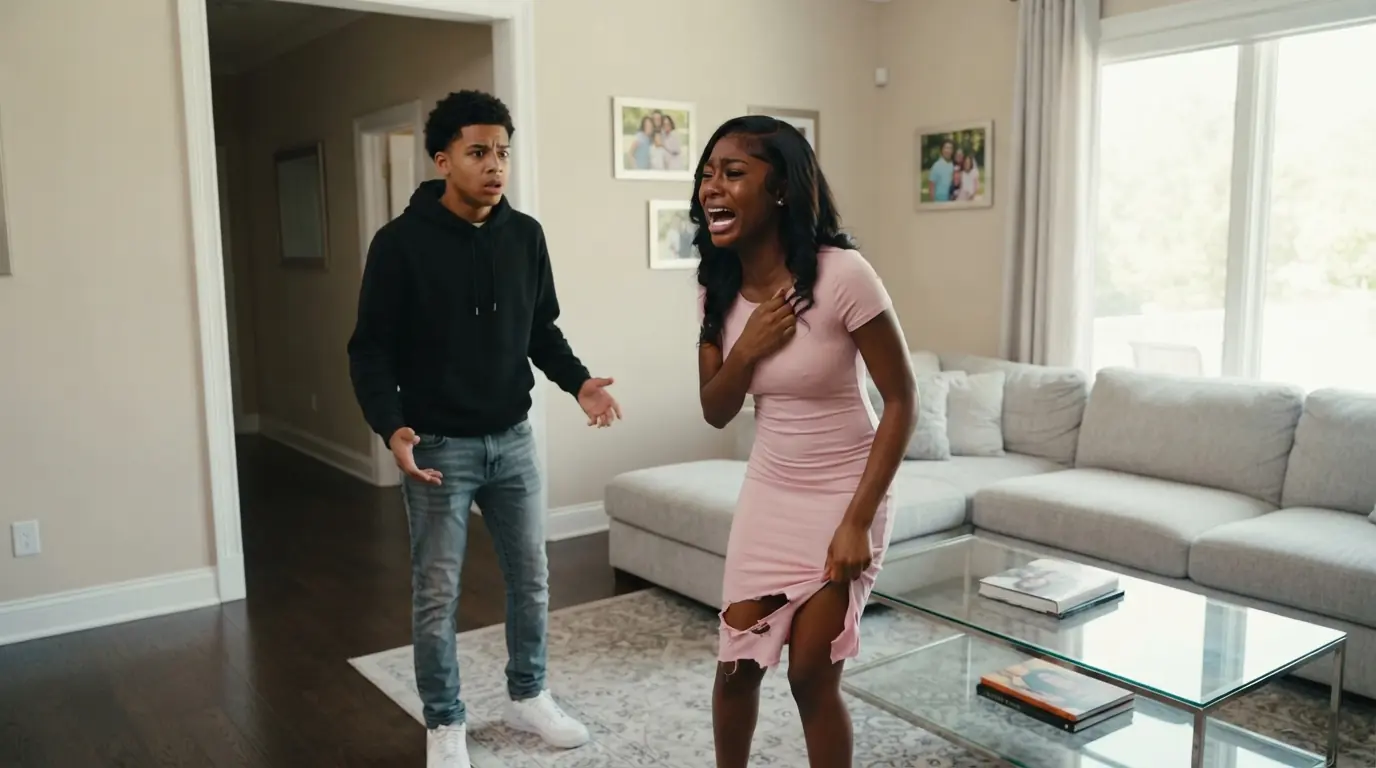
I heard Sophie scream before I heard the crash. By the time my father reached the second-floor landing, she was sitting against the wall, one sleeve torn, both hands trembling as she pointed toward me.
“He cornered me,” she whispered. Then she raised her voice so that everyone coming up the stairs could hear: “Ethan tried to hurt me.”
I stood twelve feet away from her. My hands were empty, and the envelope of invoices I had carried upstairs lay scattered across the carpet between us.
My father looked at her, then at me. He didn't ask why we were in his office, why his desk drawers stood open, or why Sophie had been holding documents that did not belong to her.
“Get away from my daughter,” he said.
“Dad, I haven't touched her.”
“I said get away.”
The word daughter hurt more than the order. I'd been his son for thirty-two years, but in that moment he appeared to have forgotten the entire length of my life.
Someone called the police. Someone else raised a phone to record, while downstairs the string quartet stopped playing halfway through a song.
Sophie buried her face against her mother's shoulder. Diane looked across the landing at me with an expression I would remember for a long time: not surprise, not horror, but something dangerously close to satisfaction.
To explain how my father's birthday became the night he banished me from our family home, I have to tell you about my mother, the company she helped build, and the people who entered our lives after she died.
My mother, June Reed, measured everything twice. She believed in showing up early, doing what you promised, and never destroying something simply because it needed repair.
She and my father started Reed & Son Restoration in Asheville, North Carolina, when I was six. In those days the business was a rusty pickup, a rented shed, and my mother keeping books at the kitchen table while my father repaired porches.
The company's name included me before I knew how to hold a hammer. My mother said it was an investment in my future, although she also told me I could grow up to be anything I wanted.
I chose the workshop. I liked old wood, difficult measurements, and the satisfaction of turning something damaged into something people could trust again.
By my late twenties, we employed fifteen craftspeople and restored historic homes throughout the region. My father handled the clients he had known for decades, while I managed crews, contracts, estimates, and payroll.
When my mother died suddenly of an aneurysm, the center of our family vanished. My father spent months staring out the kitchen window, and I kept the business running because somebody had to.
Then he met Diane at a charity auction. She was gracious, confident, and patient with the grief that followed him everywhere.
I wanted him to be happy. When he told me they planned to marry, I embraced him and meant every word of my congratulations.