The devastation wasn't in the discovery itself. It was in the hollow quiet that came after. When I pushed open that hotel room door, finding my wife tangled in sheets with the man I'd called my closest friend for two decades, something inside me didn't shatter. It crystallized. I stood in the doorway while they scrambled and stammered, their faces draining of color, and I felt the strangest sensation.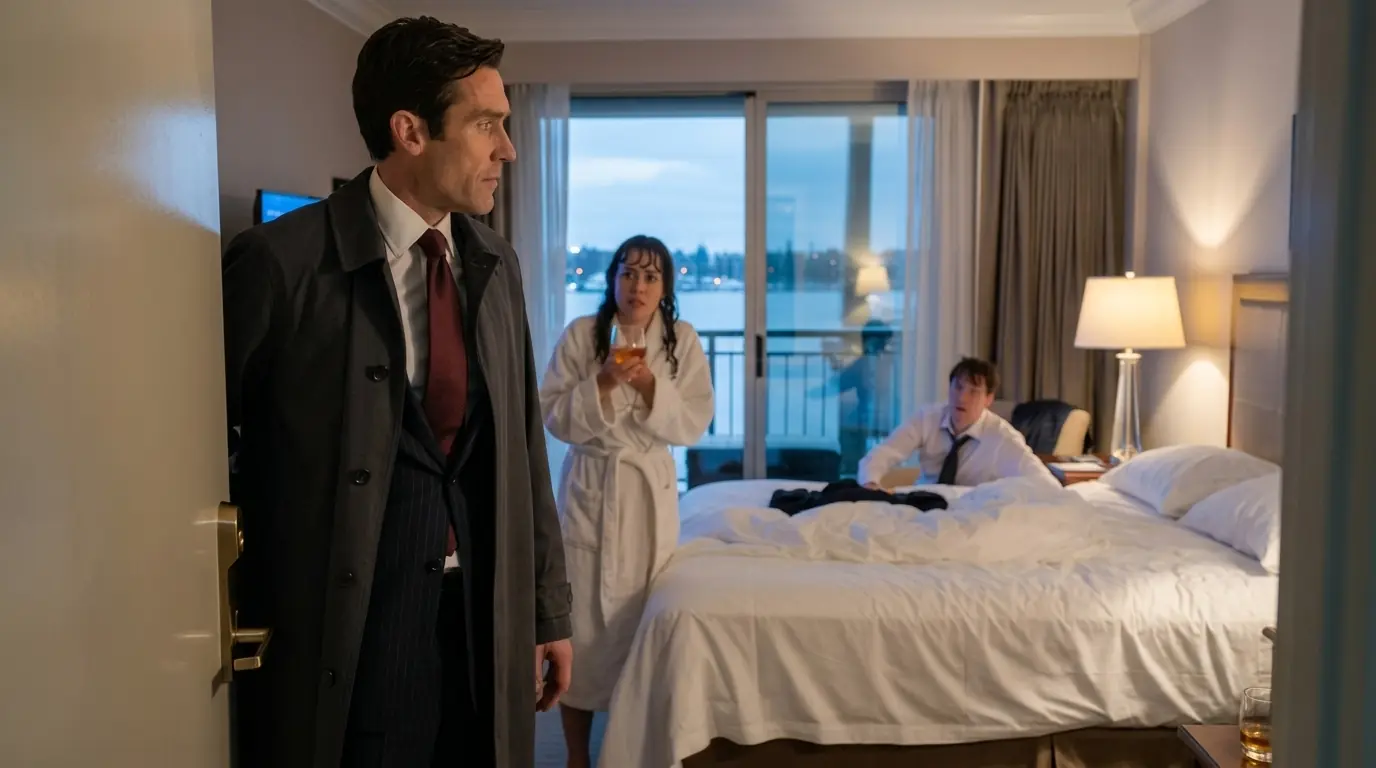
Relief. Not pain, not rage, just the sudden lightness of a burden I hadn't known I'd been carrying. I looked at them both, managed a small smile, and walked away without a single word. That smile, that inexplicable expression of calm, would haunt them far more than any scream ever could. My name is Oliver Brennan, and this is how my marriage ended, not with fury, but with mathematics.
Seattle's rain has a particular quality in November. Relentless, gray, and somehow purifying. From my office on the 42nd floor of the Brennan and Associates Tower, I watched the downpour transform the city into a watercolor painting, all bleeding edges and muted colors. Below the streets were rivers of red tail lights, umbrellas bobbing like black mushrooms through the evening rush. Inside my glass-walled sanctuary, everything was precision and order.
My assistant, Monica, knocked softly before entering, her heels clicking on the polished hardwood. She was efficient, discreet, the kind of employee who anticipated needs before they were voiced. "Your evening agenda, Mr. Brennan," she said, placing the leather portfolio on my desk with practiced care. She hesitated, a tell I'd learned to recognize over 3 years of working together.
"Also, Mrs. Brennan called. She mentioned she'd be delayed, something about the symposium running late at the university. I didn't turn from the window. The rain was hypnotic. each drop a tiny messenger of change.
"Which symposium was that?" "The sustainable architecture panel," she said. The visiting professor from Copenhagen had extended the Q&A session. "Right," I said, my voice perfectly level, devoid of any jagged edge. "Thank you, Monica."
The door whispered shut with the kind of expensive silence that came from German engineering and careful installation. I remained at the window for another moment, watching my reflection superimposed over the city. 41 years old with the kind of sharp angular features that aged well, good bone structure my mother used to say. But the eyes staring back were different now. Not tired, weary.
There's a distinction. I knew the professor she'd referenced was currently in Stockholm, not Seattle. I'd reviewed his speaking schedule myself last week during a moment of what I told myself was professional curiosity. Henrik Larson, celebrated for his work on carbon neutral high-rises, was delivering the keynote at the Nordic Sustainability Conference. I checked the conference website three times, noting the dates, the location, the impossibility of him being in two cities simultaneously.
The lie was lazy. That's what bothered me most. Not the betrayal itself, but the lack of effort put into concealing it. It suggested they thought I was stupid, or perhaps that they'd grown so comfortable in their deception that caution had become unnecessary. I walked to my desk, unlocked the bottom drawer with the small brass key I kept on my key ring, and removed what I'd been collecting for the past 4 months.
The folder was thick now, a growing testament to infidelity cataloged with the same meticulous attention I applied to architectural plans. Receipts first, wine purchases from boutique shops I'd never visited, restaurant charges to her credit card from establishments across town when she'd claimed to be at gallery events nearby. Then the mileage logs I'd been tracking since August. Linda's Tesla, the white Model S given her for her 35th birthday, had a convenient digital odometer that recorded every journey. 340 miles over three days when her supposed destinations totaled maybe 60.
The math didn't work. Math never lied. Hotel charges came next. Discrete line items on statements she thought I didn't review. The Riverside Hotel specifically, always the same location.
Sometimes the charges appeared under our firm's corporate account which added a layer of professional betrayal to the personal one. Graham had been billing our assignations to company expenses, writing them off as client entertainment. I spread the documents across my desk like a forensic accountant preparing for trial. Four months of evidence. Four months of late evenings when she'd come home smelling of wine and offering elaborate explanations about networking events and artist receptions. four months of watching my best friend maintain eye contact during business meetings while knowing he was sleeping with my wife.
And I'm an architect. I build things. I don't burn them down without a plan. So, the anger had cooled, crystallized into something harder and clearer. Strategy.
I picked up my phone and dialed the number I knew by heart. Graham Whitfield answered on the second ring, his voice carrying that smooth baritone that had charmed juries and clients for 15 years. Brennan speaking, he said. The slight emphasis on the last name a habit from his litigation days. It's Oliver, I said, keeping my tone collegial warm.
Even burning the midnight oil on the Patterson merger. You know it might be here until past midnight. These contracts are absolutely brutal. The liability clauses alone are giving me a headache. He sounded convincing.
He'd always been a good liar. I realized now. It was what made him effective in depositions. I pictured him clearly not hunched over documents in his corner office three floors below mine, but reclining on the king-sized bed in the Emerald Suite at the Riverside Hotel, room 804, the same room he'd been billing to our firm's entertainment budget for the past 6 months. The charges carefully disguised among legitimate client dinners and consultation fees.
"Don't overdo it," I told him, injecting just the right amount of friendly concern into my voice. "Some things aren't worth the all-nighter. Your health is more important than any contract. I appreciate the concern, Oliver. Truly, but you know me.
Dedicated to a fault. This merger could define our Q4 revenue. A practiced pause. Then give my regards to Linda. Tell her Veronica and I are looking forward to the gallery opening next month.
The casual mention of his wife, my wife's supposed friend, another victim in this expanding circle of deception, nearly made me laugh. I will, I said quietly, if I see her tonight. The silence on the other end lasted exactly two seconds. Not long enough to be obvious, but enough for me to know he'd caught the implication. Everything all right?
Graham asked, his lawyer's instinct, sensing something offkey. Perfect, I said. Enjoy your evening, Graham. I ended the call and sat in the dimming light of my office. The city's lights were beginning to glow against the darkness, creating a constellation of human activity below.
Somewhere in that grid, Linda was with Graham. Thursday evening, their pattern was consistent. Tuesdays and Thursdays with the occasional Sunday afternoon when Linda claimed to be curating exhibitions. The anger I'd felt months ago had completely evaporated now, replaced by something colder and infinitely more powerful. Clarity.
I understood exactly what was happening. I knew the timeline, the patterns, the psychology. And I'd realized something crucial. I didn't want to save this marriage. I wanted to end it. but not in a way that left me as the emotional, irrational husband.
Not in a way that cost me anything I wasn't willing to lose. I stood, pulled on my charcoal overcoat, Burberry, a gift from Linda three Christmases ago, and headed for the elevator. The weight of the evidence folder remained in my desk drawer. I didn't need it tonight. Tonight was about confirmation, about moving from suspicion to certainty, about capturing the final piece of proof that would make everything that followed legally airtight.
I wasn't going as a betrayed husband seeking confrontation. I was going as an architect surveying a condemned structure before demolition, clipboard in hand, documenting every crack in the foundation. And for the first time in 4 months, as the elevator descended toward the underground garage, I felt my face relax into something approaching peace. The waiting was almost over. The drive from the financial district to the Riverside Hotel traced a familiar route through Seattle's evening traffic.
I'd made this journey hundreds of times. For client dinners, for professional conferences held in the hotel's event spaces, for the occasional drink at their rooftop bar with colleagues celebrating closed deals. Tonight, the Mercedes's wipers beat a steady rhythm against the rain, and the city blurred into streaks of neon and shadow. The Riverside Hotel sat along the waterfront, all glass and modern minimalism, a 12-story testament to contemporary design. Ironically, I'd consulted on the lobby renovation 3 years ago, suggesting the marble selection and the lighting design that now bathed arriving guests in warm, welcoming amber tones.
The architecture firm that won the primary contract had credited me in their press release. Linda had been proud, I remembered. She'd thrown a small celebration dinner, inviting Graham and Veronica, toasting to my success. Another irony to file away in the growing collection. I pulled up to the valet stand.
The young attendant, perhaps 25, rushed over with an umbrella despite the covered entrance. His name tag read Jeremy. Mr. Brennan, "Good evening." Recognition lit his face.
"I was a regular enough presence here that the staff knew me. Shall I park your car, sir?" "Just visiting a colleague," I replied smoothly, handing him the keys to my Audi. "Won't be long." "Of course, sir.
Enjoy your evening." The lobby enveloped me in warmth and the subtle scent of the hotel's signature fragrance, something expensive involving cedar and bergamot. The front desk staff glanced up, ready to offer assistance, but I walked past with the confident stride of someone who knew exactly where they were going, which I did. The elevator to the eighth floor was empty, allowing me a moment alone with my reflection in the mirrored walls. I studied myself with clinical detachment.
Charcoal overcoat over a Tom Ford suit, navy blue with subtle pinstripes, white shirt, silk tie in a deep burgundy. I looked like exactly what I was, a successful architect, someone in control, someone who belonged in spaces like this. I didn't look like a man whose world was ending. That was important. The elevator chimed softly at the eighth floor.
The hallway stretched before me, carpeted in deep hunter green. The walls adorned with photographs of the Seattle waterfront through the decades. Soft lighting created pools of illumination every few feet. Classical music played at barely audible volume through hidden speakers. Debussy, I thought.
Clair de Lune. Room 804 was at the far end of the corridor, away from the elevator, away from the ice machine and vending area. Privacy. The room door stood slightly ajar perhaps an inch no more. Careless arrogant.
They were so drunk on their own secrecy, so confident in the narrative they'd constructed about working late in symposiums running over that they'd forgotten basic security. I stood outside the door for a moment, my hand hovering near the handle. This was the threshold. Once I crossed it, there would be no ambiguity left, no possibility that I'd misread the evidence, no chance for my suspicions to be paranoia. Part of me, a small fading part, almost hoped I was wrong.
That I'd open the door to find the room empty or Graham on a legitimate business call or some innocent explanation that would make the past 4 months of evidence collecting a monument to my own insecurity. But I knew better. The math had already told me the truth. I pushed the door open slowly. It swung inward on well-oiled hinges, revealing the scene piece by piece, like a slow motion photograph developing.
The room was warm, almost humid, with a cloying scent of expensive perfume. Chanel number five, Linda's signature fragrance mingled with single malt scotch and something else. Intimacy. The unique scent of two people who'd been close, who'd forgotten the world outside existed. The television was on but muted, casting flickering blue shadows across the far wall.
A news channel, images of politicians and weather maps cycling silently. The bed was a tangle of high thread count sheets. The hotel's signature white linens rumpled and pulled free from their military corners. Graham was sitting on the edge of the bed, shirt unbuttoned to reveal his undershirt, his suit jacket discarded on a nearby chair. He held a crystal tumbler of amber liquid, the scotch I'd smelled, probably the Macallan 18 he favored.
His tie was loosened, his usually perfect hair disheveled. He looked relaxed, unguarded in a way I rarely saw him in professional settings. Linda stood by the floor to ceiling window overlooking the waterfront, wrapped in the hotel's white terry cloth robe, the Riverside's monogram visible on the breast pocket. Her dark hair was loose around her shoulders, damp from a recent shower. She held a wine glass, white wine, probably the sincere she preferred, and was laughing at something Graham had just said.
It was a real laugh, uninhibited and genuine, the kind of laugh I hadn't heard from her in years, maybe ever. The tableau was almost artistic in its composition. The warm lighting, the intimate poses, the obvious comfort they shared in this space. If I'd been a photographer instead of an architect, I might have appreciated the aesthetics. Then the door clicked shut behind me.
The sound was soft, barely more than a whisper of metal meeting wood. But in the intimate quiet of the room, it cracked like a gunshot. Both of them froze. Linda's laugh cut off midbreath. Graham's hand tightened around his glass, the tendons in his wrist standing out sharply.
Linda spun toward me, the wine in her glass sloshing dangerously close to the rim. Her face cycled through expressions faster than I could catalog them. Surprise, confusion, fear, and finally something approaching terror. Her free hand flew to her throat, clutching the lapels of the robe closed despite it being already secured. Oliver, her voice was barely a whisper, my name emerging as half question, half plea.
Graham scrambled to his feet, the movement graceless and panicked. His glass tumbled from his hand, hitting the carpet with a muffled thud. The scotch spilled across the pale green fibers, but the heavy crystal didn't break. Another testament to the hotel's quality furnishings. Oliver Jesus, listen, I can explain.
This isn't what it Graham's face had gone from relaxed and ruddy to a sickly gray white, the color of old newsprint. I held up one hand, palm out, a simple gesture that silenced him immediately. I didn't speak. I didn't step further into the room. I simply stood there perfectly still, my raincoat dripping water onto the entryway tile in a slow, rhythmic pattern.
Drip, drip, drip. I waited for the anger to hit. I'd anticipated it, prepared for the adrenaline spike, the roar of blood in my ears, the primitive urge to violence that every betrayed man supposedly experiences. I'd wondered during my drive here whether I'd lose control, whether I'd cross the room and drive my fist into Graham's perfectly straight nose, whether I'd shout accusations at Linda until my throat was raw. But there was nothing.
The anger I'd felt in the car, even the cold strategic clarity that had carried me through the past weeks, all of it had vanished the moment I saw them. It was replaced by something vast and empty, like stepping into a cathedral stripped of all its furnishings. a hollow space that had once held something meaningful but now contained only echoes. I looked at Linda, really looked at her. She was trembling now, the wine glass shaking in her hand, waiting for the explosion. She wanted me to scream.
She needed me to scream. If I screamed, she could cry and play the victim of my rage. If I shouted accusations, she could respond with her own grievances about neglect or emotional distance. If I crossed the room in anger, she could make this about my loss of control rather than her betrayal. Any reaction would give her a script to follow, a role to play in the drama.
But I gave her nothing. I shifted my gaze to Graham, my friend of 20 years. We'd met in graduate school, young and ambitious, dreaming about the futures we'd build. He'd been the best man at my wedding, had hoisted a glass of vintage champagne, and delivered a toast about eternal friendship and unbreakable bonds. I'd stood at his wedding to Veronica 2 years later, returning the favor.
We'd built a firm together, navigated business crisis, celebrated victories, and now here he was, small and frightened, a middle-aged man who needed to steal another man's life to feel important. The absurdity of it struck me then. Not the betrayal itself, but the sheer cliche of it, the wife and the best friend, the hotel room, the lies about working late. It was so pedestrian, so utterly ordinary. For months, I'd been treating this as some grand tragedy, a unique catastrophe that had befallen my life.
But it wasn't. It was just human weakness playing out in the most predictable way possible. And in that recognition, something fundamental shifted. I realized with sudden crystalline clarity that I didn't have to carry the weight of this marriage anymore. I didn't have to try to fix what was broken.
I didn't have to be the architect of Linda's happiness. The structure had already collapsed. I was just the last person to leave the rubble. The corners of my mouth twitched. I felt my lips part and then to my own surprise, I smiled.
It wasn't a smirk of superiority or a grimace of pain masked as amusement. It was a genuine soft smile, the expression of a man who just set down a burden he hadn't realized he'd been carrying for years. It was relief made visible. Oliver. Linda's voice cracked high and terrified.
Why? Why are you looking at us like that? Say something. I didn't answer. I held the smile for one more beat, watching their confusion deepen, burning the image into their minds.
Then, with the fluid grace of someone concluding an ordinary business meeting, I turned my back on them. Wait, Oliver, stop. Graham's voice rang out behind me louder now, almost desperate. I heard him move, his footsteps on the carpet, but he stopped short of actually touching me. Even now, some instinct warned him against that.
I opened the door. The cool hallway air hit my face like a blessing, washing away the close humidity of the room. I stepped through, pulling the door closed behind me with deliberate gentleness. No slam, no dramatic exit, just the quiet click of a door shutting on a chapter that had already ended. I walked down the plush corridor past the elevator and took the stairs instead.
Eight flights down, my footsteps echoing in the concrete stairwell, and with each descending step, I felt lighter. By the time I reached the lobby, I felt almost weightless, as if I might float away entirely. The valet brought my car around quickly. Jeremy held the door open, his young face showing mild concern at my expression. Whatever he saw there.
Everything all right, sir? Perfect, I told him, sliding into the driver's seat. Absolutely perfect. As I drove away from the Riverside Hotel, merging into the flow of evening traffic, I glanced once in the rearview mirror. The hotel was already receding, becoming just another building in the city's landscape.
I knew exactly what was happening in room 804. I could picture Graham and Linda's panic, their frantic attempts to understand what my silence meant, their growing fear of what I might do next. They'd been prepared for anger. They'd expected confrontation. What they got was something far worse.
Complete devastating indifference wrapped in an enigmatic smile. The real torture I knew was just beginning, and I hadn't even started yet. Linda must have broken every traffic law getting home. I heard her car screech into our driveway 40 minutes after I'd left the hotel. I was in my study, calmly reviewing blueprints for the harbor project when she burst through the door.
Oliver. Her voice carried through the house, shrill, desperate. Oliver, where are you? I didn't respond. I circled a structural issue on the drawing and made a note in the margin.
She found me 3 minutes later breathless and disheveled. We need to talk. You have to let me explain. I looked up from my work. About what?
The question stopped her cold. She'd prepared for anger for accusations. She hadn't prepared for casual indifference. About about what you saw at the hotel. Oh, that I returned to my blueprints.
Yes, I saw. Is there something you needed? Her confusion was almost comical. Is there something I Oliver, I was with Graham. You walked in on us.
You're not even going to ask me why. I set down my pen and looked at her properly. She was trembling, tears streaming down her face, desperate for any reaction. I felt oddly sorry for her. I know why, I said gently.
You were unhappy. Graham was available. These things happen. But Linda, I have the Peterson presentation tomorrow, and these calculations won't finish themselves. If you need to talk about logistics, the house, assets, that sort of thing, we can schedule time this weekend.
Logistics? She looked like I'd slapped her. Our marriage is ending and you want to schedule a meeting about logistics? Well, it seems the most efficient approach. I picked up my pen again.
I assume you'll want the gallery space. I'm fine with that. I've never understood abstract expressionism anyway. She stood there, mouth opening and closing, trying to find purchase in a conversation that refused to give her any emotional footing. Finally, she turned and ran upstairs.
I heard our bedroom door slam. I finished my work by midnight, then retired to the guest room. I slept remarkably well. The next morning, I arrived at Brennan and Associates at 7:30. Graham stumbled in at 8:45, looking like he'd spent the night in a bourbon bottle.
His eyes were bloodshot, his suit rumpled. He made straight for my office. I was on a conference call with the Singapore team but gestured for him to wait. When I disconnected, he launched immediately. Oliver, we need to talk about last night about everything.
Of course. I pulled up a file on my screen. I've been meaning to discuss the Henderson contract. Your liability assessment has some gaps that could expose us. Can you review section 9 today?
He stared at me. The Henderson contract. Oliver, I slept with your wife for months. You can't just ignore that. I'm not ignoring it, I said calmly.
I'm compartmentalizing. You're still our lead counsel. The Henderson deal closes Friday. Personal issues shouldn't affect professional obligations. Don't you agree?
His face went from red to white. You're you're serious entirely. And Graham? I looked at him over my reading glasses. Fix your tie.
You look unprofessional. He left my office walking like a ghost. Through my window, I watched him collapse into his chair, head in hands. My phone buzzed. Linda's 16th call that morning.
I let it go to voicemail. This was the torture I designed. Not rage, not violence, just the complete devastating indifference of a man who'd already moved on. 2 days later, I met with Graham in my office again. This time, I had documents.
I need to discuss your partnership status. I began sliding a folder across my desk. His hands shook as he opened it. Inside were months of evidence, expense reports showing hotel charges, calendar conflicts between his claimed location and actual whereabouts, even excerpts from the partnership agreement he'd signed 5 years ago. Page 17, I instructed the ethics clause.
Specifically, subsection C regarding conduct detrimental to the firm's reputation. Graham's face drained of all color. You're you're terminating me because yes, which means unfortunately no severance, no equity payout. The restructuring we completed last quarter, the one you approved, set the buyout value at current market assessment. Given our recent operating losses, that's functionally zero.
You planned this. His voice was barely a whisper. The restructuring, the timing, you knew. How long have you known? I suspected in June, I confirmed in August.
But the fiscal year needed to close first. I leaned back in my chair. If I'd acted in August, your equity stake would have been worth 3.2 million. By waiting until after the restructuring and accumulating sufficient cause for termination, I saved the firm that expense. It was simply good business.
Graham looked like he might vomit. The smile at the hotel. You weren't in shock. You were calculating. I was relieved.
I corrected. Catching you both was the final piece of evidence I needed. The smile was satisfaction at a project well executed. We were friends, Oliver, 20 years. We were colleagues who shared a history, I said.
There's a difference. Now you have 15 minutes to clear your personal items before security escorts you out. He sat frozen for several seconds, then stood on shaking legs and walked out. I returned to my work. The harbor project wouldn't design itself.
Linda signed the divorce papers. 3 weeks later in a conference room overlooking Puget Sound. Her lawyer had advised her to fight for more, but she'd seen the documentation I'd compiled. The affair, the financial records showing I'd subsidized her gallery for 4 years. The evidence was airtight.
The condo in Belltown is ready, I told her as she initialed the final page. All your things have been moved. The gallery lease is paid through June. After that, you'll need to sustain it independently. She looked at me with red rimmed eyes.
Why are you being so generous? You could have destroyed me. I considered the question seriously. Because I did love you once and because cruelty would suggest I still care enough to want revenge. I just want peace.
Linda, what about Graham? Graham made his choices. He'll live with the consequences. She signed the last page with a trembling hand. I never meant to hurt you.
I know, I said, and I meant it. You meant to be happy. You just chose the wrong method. I stood, buttoned my jacket, and walked toward the door. She called after me one last time.
Oliver, the smile at the hotel. What did it really mean? I paused, hand on the door knob. This was the question that had haunted her for weeks. I could see it in her eyes.
The desperate need to understand. For 7 years, I tried to be everything you needed. I built my entire life around making you happy. I became someone I barely recognized. I turned to face her fully.
When I opened that hotel room door and saw you with Graham, I realized I didn't have to try anymore. The structure had collapsed, but I was still standing. The smile, I opened the door. That was freedom, Linda. Pure, simple freedom.
I left her sitting alone in that conference room. By the time I reached my car, she was already becoming a memory. 6 months later, I stood in the completed harbor development, watching evening light play across the glass and steel I designed. The project had won three architectural awards. Brennan and Associates had expanded into Portland and Vancouver.
Life had moved forward. I heard Linda had closed the gallery and moved to Portland herself. Graham was working insurance defense in Spokane. His legal career permanently diminished. They tried to maintain their relationship for 2 months before it collapsed under the weight of guilt and resentment.
My phone buzzed. A text from Monica. Dinner reservation confirmed for 7. She seems lovely, by the way. I smiled, a real smile this time.
Not the calculated expression of that hotel room, but genuine warmth. I'd started seeing someone new, a structural engineer I'd met at a conference. She understood loadbearing calculations and the importance of solid foundations. She made me laugh. The rain had stopped.
Seattle was washing itself clean again, and I stood in the building I had created, finally understanding what I should have known years ago. The strongest structures aren't built to hold others up. They're built to stand on their own. I walked toward my car, toward dinner, toward whatever came next. Behind me, the building rose into the twilight sky.
Steel and glass and mathematics. Beautiful in its precision. Sometimes the most powerful revenge isn't destruction, it's reconstruction. And sometimes the quietest response speaks louder than any scream ever could. The weight was gone.
I was free. And I'd never felt lighter in my life. Thank you for watching the video to the end. YouTube may no longer suggest my channel to you, so subscribe to it to receive new interesting stories. You will also help the channel grow and improve the quality of its content.
A playlist with other interesting stories that you can listen to is now displayed on the screen. You can also write in the comments what stories you would like to see on the