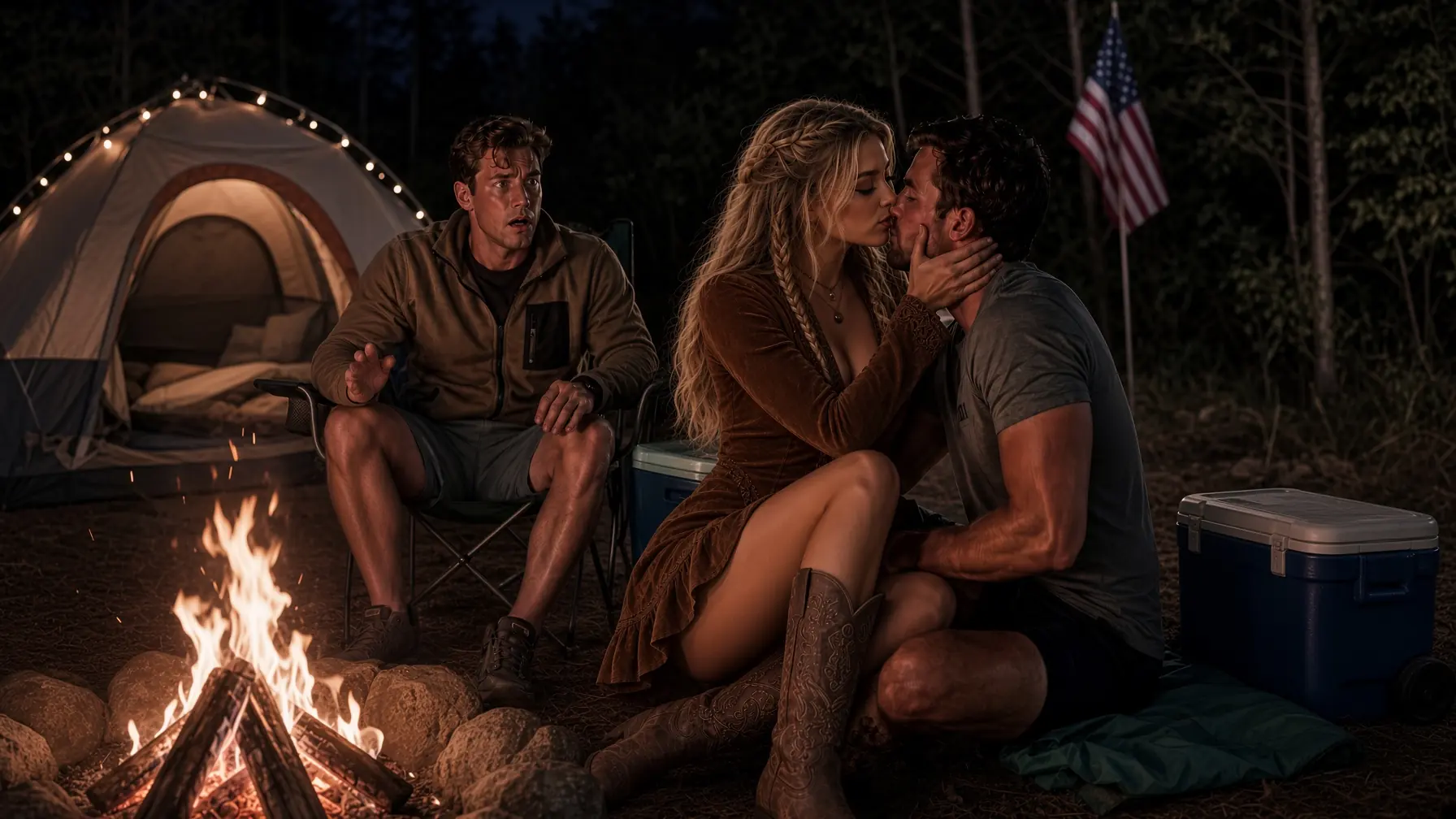
I still cannot decide which part hurt more that night. Maybe it was watching my wife kiss another man beside a campfire while I sat six feet away, or maybe it was the little smile she gave me afterward, as though humiliating her husband had become something clever. What stayed with me longest, however, was the look on Trevor Knox’s face while he waited for me to react. He was not looking at a jealous husband; he was watching a fuse he expected to burn.
We were camping at Cedar Ridge Campground in western North Carolina, tucked beside a narrow mountain lake about forty minutes from Asheville. The place had tall pines, gravel pull-through sites, old wooden picnic tables, fire rings darkened by years of smoke, and a ranger station with a faded American flag beside the entrance. Cell service came and went depending on where you stood, which my wife had described as one of the campground’s best features. “No work, no interruptions, just space to breathe,” Hannah told me when she booked it.
Then she added, “And Trevor’s coming with us.” That sentence changed the meaning of everything. Our eleventh wedding anniversary was less than two months away, and somehow my wife believed the perfect way to reconnect with me was to spend three nights in the woods with the man whose name had been showing up on her phone after midnight. When I objected, Hannah accused me of trying to control who she was allowed to be friends with.
Trevor had been her closest male friend since college. That was the explanation I heard whenever I asked why he knew the details of arguments that had happened inside our bedroom, why he dropped by our house without calling, or why Hannah’s voice became lighter whenever he phoned. “He’s basically family,” she would say. Trevor never looked at me like family.
He looked at me like competition. He stood too close to Hannah, found reasons to touch her shoulder when she laughed, and had a way of asking questions about my business that sounded casual until I thought about them later. For years, I convinced myself disliking him was simply insecurity. Hannah helped with that.
“Jealousy isn’t attractive, Owen,” she once told me after I asked why Trevor had called at twelve-thirty in the morning. I remember apologizing even though she was the one discussing our marriage with another man after midnight. That became a pattern between us: I would notice something, Hannah would make my noticing the real problem, and I would work harder to become the kind of husband who did not ask uncomfortable questions. By the time she suggested the camping trip, I had gotten very good at distrusting myself.
My name is Owen Callahan, and I was forty-three when all of this happened. I owned a company called Callahan Response Systems, which manufactured rugged lighting, charging equipment, and emergency field gear used by utility crews, volunteer fire departments, and municipal rescue teams. The company began in my garage fourteen years earlier with one rechargeable floodlight, a borrowed drill press, and a business loan everybody advised me not to take. By the time of the camping trip, we employed seventy-two people and had distribution contracts across six states.
One of our newer products looked almost exactly like an oversized camping flashlight. The prototype contained an eighteen-hour voice recorder designed for accident investigations involving emergency crews, and its microphone could isolate conversation surprisingly well even in wind. Hannah had seen me bring prototypes home often enough that she barely looked at this one. She had no idea I had turned the recorder on the moment we arrived.
I became suspicious three weeks before the trip. Hannah and I shared an old tablet in the kitchen for grocery lists, calendars, and travel reservations, and one evening I found a recently deleted calendar entry that contained only a time and two initials: T.K. The initials belonged to Trevor Knox. Hannah told me it must have been an old reminder she deleted because the meeting was canceled.
That same night, Trevor called me. He spent several minutes talking about camping equipment before casually asking whether Callahan Response Systems carried key-person life insurance on senior leadership. Trevor worked in commercial lending, not insurance, and there was no natural reason for him to care about my executive coverage. I gave him a vague answer and wrote down the exact time of the call after we hung up.
Over the following week, Hannah began asking strange legal and financial questions. She wanted to know whether a spouse could force the sale of privately held business shares during a divorce, whether a temporary restraining order could stop somebody from entering a jointly owned home, and how quickly a board could remove a founder if he became “unstable.” Every question came disguised as something she had heard on a podcast or read online. I pretended to believe her.
Then I hired Raymond Ellis. Ray had spent twelve years as a sheriff’s investigator before leaving law enforcement to care for his father, and now he handled corporate background work, missing-property cases, and infidelity investigations for attorneys around Raleigh. He had a quiet voice, a bad knee, and absolutely no interest in making clients feel better. The first thing he told me was, “If you want reassurance instead of facts, I’m the wrong man.”
I gave him Hannah’s recent behavior, Trevor’s name, our driveway-camera history, and dates when both of them claimed to be elsewhere. Two days later, Ray called from a prepaid number. “They’re preparing something for this weekend,” he said. I stepped outside my office before asking what he meant.
Trevor had purchased two prepaid phones, a small body camera, and a canister of animal deterrent spray. Hannah had met him twice at a coffee shop outside Hendersonville despite telling me both afternoons she was shopping with her sister. Ray could not tell me what they intended to do, but he said something that stayed with me all the way to North Carolina. “I don’t think they’re planning to hurt you directly, Owen; I think they’re planning to make it look like you hurt him.”
That possibility changed the entire trip. I stopped thinking like a husband trying to catch an affair and started thinking like the owner of a company somebody might be trying to manipulate. I told Ray where we were camping, gave him the reservation information, and arranged two check-in times each day. If I missed both, he would come looking.
Trevor followed us to the campground in a black Range Rover and parked behind my truck even though three better spaces were available. His position meant I could not drive out without asking him to move. He laughed when I pointed it out and said the other ground looked softer. It did not.
While I unloaded the cooler, I saw Hannah glance at Trevor over the roof of his SUV. She looked toward me first, then back at him. Trevor gave one small nod. It lasted less than a second and told me more than ten minutes of conversation probably could have.
I set the prototype flashlight on the picnic table and pressed the hidden switch beneath its rubberized grip. A tiny green indicator blinked once, then disappeared. Hannah was arguing with a tent pole and never looked my way. Trevor watched me, but only because he seemed to be watching everything I did.
He had arranged the campsite like a man blocking out a scene. His chair faced mine from across the fire ring, his phone rested against a metal thermos with the camera lens aimed in my direction, and he volunteered to gather our folding knives and camp hatchet “so nobody accidentally gets hurt after drinking.” He locked them in his Range Rover and made sure I saw exactly where they went. It was so deliberate that I almost wanted to congratulate him.
Hannah began building the emotional record before dinner. She complained that I had been distant for months and told Trevor, within easy range of his phone camera, that my silence sometimes made her nervous. Trevor asked whether I had ever frightened her when angry. Hannah lowered her eyes before answering, “Not physically, but sometimes I don’t know what he’s thinking.”
The performance was good. Not dramatic enough to look staged, just serious enough to be useful later. If somebody watched only selected clips, I could already imagine the story taking shape: troubled wife, withdrawn husband, concerned friend, remote campground. They did not need me to actually be dangerous if they could make ordinary irritation look like evidence.
I spent the afternoon acting distracted. I walked down to the lake, returned to collect sunscreen, wandered toward the ranger station, and deliberately gave them periods when they believed they were alone. The flashlight stayed on the picnic table through all of it. By sunset, it held nearly five hours of audio.
Most of the recording was meaningless. Hannah complained about mosquitoes, Trevor discussed football, and both of them debated whether the firewood from the camp office was overpriced. Then, during one stretch when I had been near the lake, their voices dropped. What they said next changed the purpose of the entire weekend.
“He’s calmer than you said,” Trevor whispered. Hannah answered, “He’s been suspicious lately.” Trevor told her, “Then push harder tonight.”
“I already mentioned you might sleep near my tent,” Hannah said. Trevor laughed quietly and replied, “Tell him I kissed you before.” There was a pause before Hannah asked, “What if he just leaves?”
“He won’t,” Trevor said. “Owen always needs to feel like the reasonable one.” I remember sitting inside my tent later, listening to that sentence through headphones and feeling something inside me become cold. They knew my personality well enough to design a trap around it.
A third voice joined them through Trevor’s phone. It belonged to a woman whose tone was calm and professional. “Keep everything verbal until the cameras are running,” she instructed. “Neither of you touches him first.”
Hannah asked what would happen if I refused to engage. The woman answered, “Use the emergency beacon at one-thirty, and when the ranger arrives, Hannah needs to be crying.” She told Trevor to have the deterrent spray visible and say he had feared for Hannah’s safety. Then she said, “We only need one believable incident to support the emergency filing Monday morning.”
Trevor lowered his voice further. “And the financial package?” The woman answered, “Prepared.” She continued, “Once the temporary order is entered, move immediately before his attorney can freeze anything.”
I was returning from the lake when they changed topics. Hannah asked whether I had seen deer. Trevor smiled at me like somebody greeting an old friend. I looked down at the flashlight sitting between them and finally understood that the affair was only part of what they were doing.
The kiss would be bait. My reaction would become evidence. The ranger would become an independent witness. By Monday morning, Hannah intended to appear in court claiming she needed emergency protection from an unstable husband.
A temporary restraining order could keep me away from our Franklin house. More importantly, depending on how the order was written and what story followed it, my board could be pressured into placing me on temporary leave while “personal circumstances” were evaluated. Trevor’s bank held our primary operating credit line. Hannah owned nine percent of Callahan Response Systems through a marital trust created years earlier for estate planning.
I stopped asking whether Trevor wanted my wife. That suddenly felt like the smaller question. I needed to know whether he wanted my company.
Dinner started around eight. Hannah grilled vegetables while Trevor handled the steaks, and the two of them moved around one another with the effortless coordination of people who had spent more private time together than I knew. She handed him seasoning before he requested it. He opened her drink without asking.
Ray had warned me not to consume anything I did not personally open. When Hannah handed me a metal cup containing bourbon and soda, I thanked her and pretended to drink. Whenever she turned away, I poured a little into the dirt beside my chair.
Twenty minutes later, Trevor asked whether I felt tired. Hannah studied my face carefully. “You look pale,” she said.
“Long drive,” I answered. Trevor and Hannah exchanged the smallest glance. I had begun noticing those looks everywhere.
As the night deepened, Trevor became louder. He told stories about the years he and Hannah spent together before she met me, carefully choosing memories that emphasized how much history they shared. There was a winter formal, an accidental shared hotel room during a college trip, a summer beach weekend, and a concert where Hannah supposedly fell asleep against his shoulder. Every story seemed designed less to entertain and more to measure how much pressure I could absorb.
Hannah laughed and touched his wrist. “You promised you’d never tell the hotel story.” Trevor looked directly at me and said, “Relax, Owen, nothing happened.”
“You were twenty-five,” I replied. Trevor’s smile narrowed. Hannah leaned back and said, “There’s that tone.”
“What tone?” I asked. Hannah looked toward Trevor. “The one that makes everything sound like an accusation.”
Trevor raised both palms theatrically. “Nobody is attacking you, man.” His phone remained pointed toward me beside the thermos. They needed anger, and I gave them none.
The fire cracked between us. Sparks disappeared into the pine branches overhead. Somewhere near the lake, another camper’s dog barked twice and then stopped.
Hannah moved her chair closer to Trevor. He draped a blanket over her shoulders. She looked directly at me and said, “You could actually learn something from him.”
“Such as?” I asked. Hannah smiled. “How to make a woman feel noticed.”
Trevor drank from his cup without hiding his satisfaction. The insult was not accidental. Hannah knew that I had spent years worrying that work consumed too much of me, and Trevor knew I hated being compared with him. Together, they were pressing exactly where they expected me to break.
I stood. Trevor straightened immediately, his right foot sliding backward as though preparing for confrontation. I walked to the cooler, opened a sealed bottle of water, and returned to my chair.
The disappointment on Hannah’s face lasted less than a second. Trevor covered his by taking another drink. Their plan needed movement toward him, not away.
Ten minutes later, Hannah leaned close and whispered something into Trevor’s ear. He laughed, placed one hand behind her neck, and kissed her. It was not quick.
Her fingers curled into his jacket. She kissed him back. There was no surprise in either of them.
When they finally separated, Hannah turned toward me. A smile spread across her face that I did not recognize. “It’s just a close friendship, Owen.”
Trevor laughed. Hannah added, “Surely you’re not going to take it personally.” My pulse hammered so hard I could feel it in my throat.
Every instinct I possessed wanted to move. Part of me wanted to pull Trevor from the chair, and another part wanted to ask Hannah when she had stopped being the woman I married. Neither impulse belonged to me anymore because the phone camera beside the thermos was waiting for exactly that.
I reached down and picked up the flashlight. “Go ahead,” I said. “Make yourselves comfortable.”
Hannah’s smile slipped. Trevor’s eyes narrowed slightly.
My calm was not part of their script. Hannah recovered first and told Trevor, “See? He doesn’t care.” I looked at her.
“I care,” I said. “I’m just learning who I’m sitting with.”
Trevor leaned forward. “What is that supposed to mean?” I looked toward the fire.
“It means the night isn’t finished.” His eyes flicked toward the flashlight in my hand.
I set it down again. Hannah laughed, but the sound had become thinner. Trevor kissed her forehead as if trying to restart the performance.
At eleven, I announced I was going to sleep. Hannah asked whether I wanted her to come to our tent. Her tone was deliberately generous, as though she was still the wife offering reconciliation.
I looked toward Trevor. “Stay wherever you feel noticed.” His jaw tightened.
The line gave them nothing useful. No threat. No profanity. No movement.
Inside the tent, I zipped the entrance and connected a short-range transmitter to the flashlight’s data port. The prototype could send compressed audio to a paired receiver within half a mile, originally designed so accident investigators could remove recordings from unsafe sites. Ray’s receiver was hidden inside a maintenance shed near the campground service road. I pressed transfer twice and watched the green light blink.
The recording was no longer mine alone. If Trevor grabbed the flashlight or smashed it, the evidence already existed elsewhere. For the first time all evening, I felt like I could breathe.
Outside, their voices dropped to whispers. The tent fabric softened the words, but a second recorder clipped inside my jacket caught enough. Hannah said, “He isn’t reacting.”
Trevor answered, “He will when I go into your tent.” Hannah asked, “What if he knows?”
“He doesn’t know about the business.” My breathing stopped.
Hannah lowered her voice. “Did Cynthia finish the transfer documents?” Trevor replied, “Everything is ready once the emergency order hits.”
“And the board?”
“Two votes are already lined up.” Trevor paused. “Your shares make three.”
My company. Not some vague divorce advantage. Callahan Response Systems.
Trevor’s bank had spent almost a year pushing me toward a refinancing package I repeatedly rejected because it would give outside investors too much control. With me temporarily removed from management and Hannah voting her trust shares alongside two directors Trevor had cultivated, the board could approve emergency financing. The new financing would convert into equity under certain triggers.
It was not just an affair. They were planning a hostile takeover using my marriage as the entry point.
I typed a message to Ray. Company confirmed. Start phase two. The phone showed no service.
Outside, Trevor opened the cooler. Bottles clinked. Then I heard Hannah ask, “How much did you put in his drink?”
“Enough to make him confused,” Trevor said. “Not enough to knock him out.”
“He barely touched it.”
“Then we do this without it.”
Whatever remained of my denial disappeared. Hannah had watched me hold a drink containing something meant to impair me. She had studied my face afterward and asked whether I felt tired.
Until that moment, one part of me had still been trying to save some version of her. Maybe Trevor manipulated her, maybe financial fear pushed her farther than she intended, or maybe she did not fully understand the plan. Hearing her calmly discuss how much medication had been placed in my drink ended those excuses.
At 12:09, my phone found one bar. The message went through. Ray answered less than a minute later.
Ready.
I removed my boots, stretched out on the sleeping pad, and slowed my breathing. At twelve-thirty, Hannah opened the tent zipper several inches. “Owen?”
I did not move. She waited, then whispered my name again.
I turned toward the wall and let out a rough breath. Hannah closed the tent. Her footsteps moved away.
“He’s asleep,” she whispered outside. Trevor told her to check again at one.
They wanted me groggy enough to be confused but awake enough to participate in their final scene. The thought made my stomach turn.
At 1:03, Trevor approached the tent. His hand pressed against the fabric near my head. “Owen, Hannah wants to talk.”
I remained still.
He tapped the tent twice. Then he walked toward the road.
Ten minutes later, I saw a faint red flash through the nylon. Trevor had activated the emergency beacon. Ranger response time from the office was usually fifteen to twenty minutes.
Exactly as the woman on the phone had planned.
At 1:26, Hannah called my name. Her voice was steady. “Owen, come outside.”
I put on my boots. The recorder inside my jacket was running, and the flashlight remained beside the tent flap. I picked it up and checked the hidden indicator.
Green.
I stepped outside.
The fire had collapsed into glowing coals. Hannah stood near the picnic table with both arms folded. Trevor was positioned several feet to her right with one hand hidden behind his leg.
The thermos camera faced me. Another camera had appeared on a nearby tree.
They had built a stage.
I walked to the table and placed the flashlight between us. Hannah stared at it.
Trevor asked, “Why’d you bring that out?” I looked at him.
“Because I thought we should listen to something.”
I pressed playback.
Wind hissed through the flashlight speaker. Hannah went pale before her own voice appeared.
“He’s calmer than you said.”
Trevor moved one step toward the table. I raised my hand. “Stay where you are.”
Then the woman’s voice came through clearly. “Keep everything verbal until the camera is running.”
Nobody moved.
“No physical contact unless he moves first.”
Hannah whispered, “Turn it off.”
I increased the volume.
“Use the emergency beacon at one-thirty. When the ranger arrives, Hannah needs to be crying.” The voice continued. “Trevor should have the spray visible and say he feared for your safety.”
Trevor looked toward the road. Hannah’s face had gone nearly gray.
Then his own recorded voice asked about the financial documents. The woman answered, “Those are ready. We only need an incident that makes immediate filing reasonable.”
Trevor lunged.
I grabbed the flashlight and stepped backward.
His concealed hand came forward.
Animal deterrent spray.
“Give me that,” he said.
The friendly-mask version of Trevor was gone. His voice sounded low and frightened.
Hannah grabbed his sleeve. “Not yet.”
He jerked away from her. “He sent it somewhere.”
I smiled.
That frightened him.
“You’re right.”
Trevor froze.
“The recording isn’t only on this flashlight.”