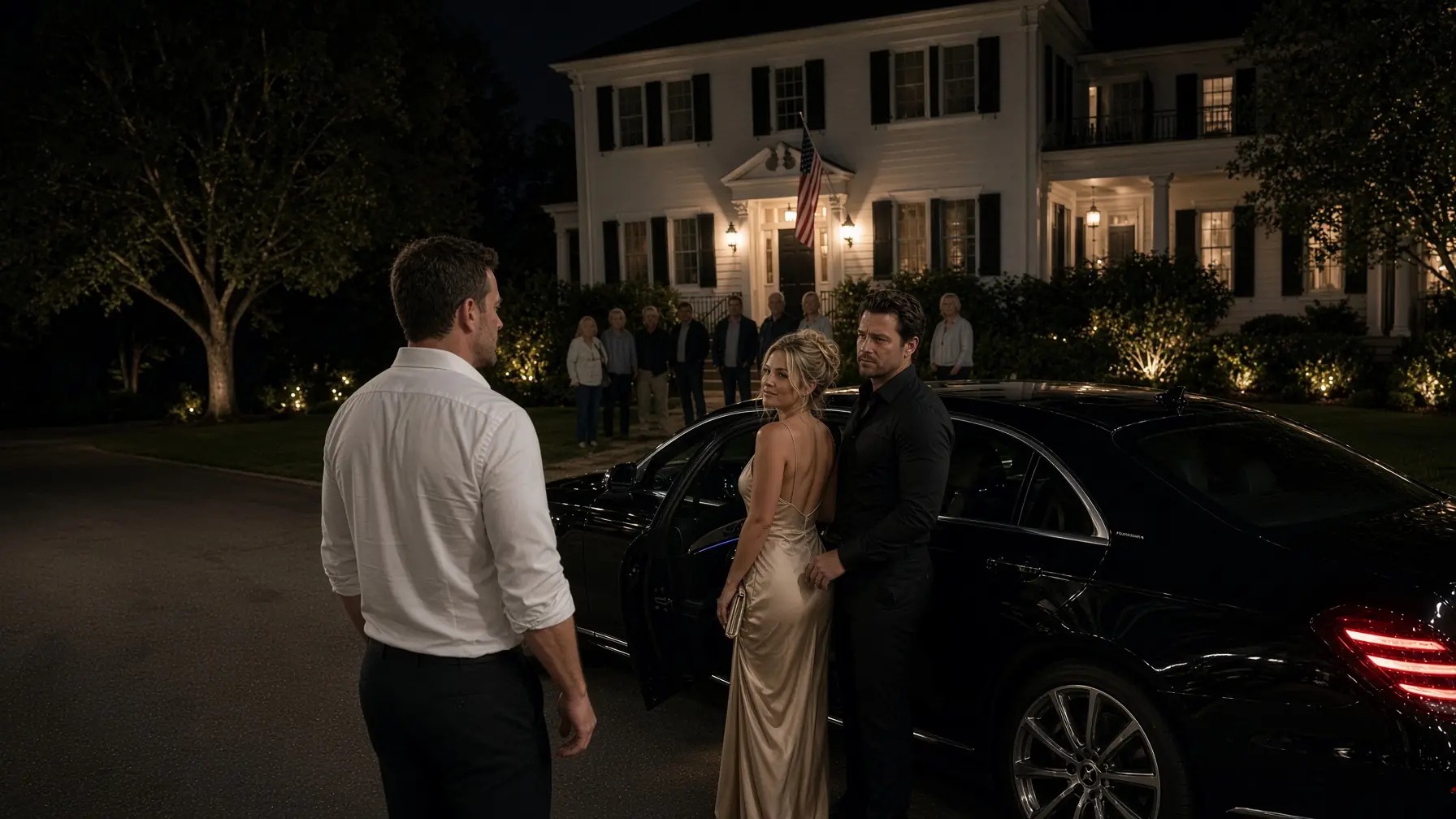
The photograph was taken seventeen months before my wife left our house with her former boyfriend. I knew the exact day without checking the timestamp because February 8 was the day my father died, and grief has a way of turning certain dates into permanent addresses inside your head. At 3:26 that afternoon, while I believed my wife Lauren was sitting in the hospital chapel waiting for me, the picture showed her thirty miles away outside a private document-storage facility in Trenton. Standing beside her was the same man whose Mercedes had just disappeared from the end of my driveway.
His name was Adrian Cole, and he had been Lauren’s boyfriend before she met me. In the photograph he carried a leather portfolio under one arm, while Lauren held a narrow mahogany box with an old brass plate attached to the lid. The plate read R-27, and although the image was grainy, there was no mistaking the cream wool coat Lauren wore that day or the pearl earrings I had given her the previous Christmas. Above the photograph, Adrian’s wife had written five words that changed the direction of my anger: Ask what was inside the box.
My name is Matthew Hale, and I was thirty-nine years old when all of this happened. Lauren and I had been married eleven years and lived in a renovated colonial outside Princeton, New Jersey, close enough to Philadelphia and New York that most conversations about distance required a discussion of traffic. I ran Hale Heritage Works, the architectural restoration company my father, Robert Hale, had built from a three-man masonry crew into a regional business restoring courthouses, universities, historic hotels, and old churches. Lauren was an interior designer who had joined the company after our marriage but eventually opened her own studio because neither of us wanted every breakfast disagreement turning into a board meeting.
Until that final year, ours had been what I considered a strong marriage. We had no children after years of trying, a disappointment that nearly broke us for a while but eventually became something we learned to carry without turning it against each other. We traveled when work allowed, hosted holidays for both families, and spent more Sunday mornings drinking coffee in bed than either of us would admit to friends who believed we were productive adults. When my father developed pancreatic cancer, Lauren became the person I leaned on more than anyone.
Dad declined quickly. Six months after diagnosis, I was sitting beside his hospital bed listening to a respiratory machine make a sound I still occasionally hear in dreams. Lauren brought me food, handled calls from employees, spoke with funeral directors when I could not form complete sentences, and told me repeatedly that I had not been alone for a single hour of his final day. I believed her because I remembered her hand in mine that evening and because there are some memories you do not think to audit.
The woman who sent the photograph was named Cassandra Cole. I had met Cassandra only twice, both times at charity events where Adrian seemed to spend more time networking than speaking to his own wife. She was forty-one, worked in trust administration for a private bank in Manhattan, and possessed the unnerving stillness of someone who had learned that silence usually made other people reveal more. Until that Friday night, I had never had a private conversation with her.
Her first message arrived forty minutes before Lauren left the house. Your wife is going to the Langford Hotel with my husband tonight. I know because I reserved the suite Adrian thinks is private. Beneath that was another line: Do not stop them. If you want to know what this is actually about, let them go.
I read it three times. My first thought was that Cassandra wanted revenge and had selected me because our spouses were apparently giving her the necessary material. Then she sent the photograph from my father’s final day, followed by an image of an old brass key lying beside a ruler. Find the matching key in Robert Hale’s desk. Meet me at the Langford at 9:30. Come alone.
Before I could answer, Lauren came downstairs carrying an overnight bag. She had changed into a navy dress beneath a camel coat and wore perfume I recognized because I had bought it for our anniversary. She placed the bag near the front door, looked at me with exhausted determination, and said, “I need you to let me do something tonight without turning it into a scene.” I asked what exactly I was being asked to allow, and she answered, “One final night with Adrian.”
There are sentences you spend years believing only happen to other people. I stared at my wife until the kitchen clock became louder than her breathing, then asked whether she understood what she had just said. Lauren folded her arms and told me Adrian represented a part of her life she had never properly closed, that she needed to know what remained between them, and that if our marriage was strong enough it would survive one night of honesty. The word honesty almost made me laugh.
“So you’re asking your husband for permission to spend the night with your ex,” I said, and Lauren immediately told me I was making it sound uglier than it was. I asked whether they intended to share a room, and she answered that sleeping arrangements were not the point. When I told her they sounded like an important point to me, she sighed and said, “Matthew, for once, don’t make everything about ownership.” That sentence convinced me Cassandra’s message deserved an answer.
I typed Agreed while Lauren went upstairs for her phone charger. Then I walked into my father’s old study, opened the lower drawer of his walnut desk, and felt underneath exactly where Cassandra’s photograph indicated. A small brass key had been taped to the wood. My father had been dead seventeen months, and somehow another man’s wife knew his desk better than I did.
Lauren returned to the foyer while I was still processing that. I put the key into my pocket and asked whether Adrian was waiting outside. She said yes, then added, “I know you’re hurt, but you’ll understand later.” I looked at the woman I had loved for thirteen years and answered, “That sentence is becoming very expensive.”
She opened the door anyway. Adrian’s silver Mercedes waited at the curb, its headlights washing across the wet pavement. Lauren paused as though expecting me to stop her, beg her, demand the bag, or create some dramatic proof that she still had power over my emotions. When I simply said, “If you leave tonight, don’t pretend tomorrow that nobody warned you,” disappointment flickered across her face before she stepped outside.
Ten minutes later, Cassandra sent the photograph from my father’s final day again. This time she added a second image showing the rear of the mahogany box and a partial inventory label from Keystone Archival Services. The account name belonged to Hale Heritage Works, but the authorization initials beside it were not my father’s. They were A.C.
Adrian Cole.
I went upstairs and opened the closet where Dad’s old files had lived since I cleared his office. Most concerned projects, insurance policies, equipment, trusts, and property records. I had assumed death turned every unanswered question into history. Apparently some questions had simply been waiting for the correct key.
The Langford Hotel sat beside Lake Carnegie in an old stone building Hale Heritage Works had restored fifteen years earlier. My father loved the place because the original structure dated to the 1920s, and he once told me preservation was really the business of deciding what deserved to survive after the people who built it were gone. At nine-twenty that night, I drove beneath the porte cochere with his brass key in my pocket and wondered whether he had understood how cruel that sentence might eventually become.
Cassandra waited in a private sitting room beside the hotel conservatory. She wore a charcoal coat and her wedding ring but no other jewelry, and when I entered, her eyes moved immediately toward my coat pocket. “You found it,” she said. I told her that did not mean I trusted her.
“Good,” she answered, and pointed toward the chair opposite her. I remained standing and told her to start with the photograph. Cassandra explained that Adrian and Lauren had gone to Keystone Archival Services on the afternoon Dad died because my father kept a private deposit there that was separate from the company’s ordinary records. She knew because Adrian had charged an investigator to one of their joint credit cards, and she had spent the previous year quietly following the trail after discovering he lied about the expense.
“What was in the box?” I asked. Cassandra said she had never physically seen the contents, but Adrian believed it contained an original codicil to my father’s estate, an old stock certificate, and a recorded statement made years before his death. I asked why my father would hide estate documents in a private records facility instead of with his lawyers. Cassandra answered, “Because the documents concerned someone his lawyers were never supposed to discuss with you.”
Then she told me Adrian did not want my money. That sounded ridiculous because Hale Heritage Works was worth enough money to inspire almost any family dispute. Cassandra corrected herself and said, “He wants money too, but money is not what made him spend eighteen years collecting evidence.” I asked what he really wanted, and she looked directly at me.
“Your father’s name.”
I thought she meant ownership of the company. She shook her head. “Not at first.” Then she stood and led me through a side corridor toward a private dining room overlooking the hotel’s winter terrace.
Lauren and Adrian appeared outside twenty minutes later. They did not look romantic. Lauren’s arms were folded tightly across her chest, and Adrian carried a black document case while speaking to her with the impatient expression of someone whose evening was not going according to plan.
“I came,” Lauren said. “Now give me the originals.”
Adrian smiled. “You always were impatient.”
“This isn’t nostalgia.”
“You told Matthew it was.”
I felt something inside me tighten.
Lauren answered, “I told Matthew what I needed to tell him to get here without him following me.”
That hurt worse than I expected.
Not because she wanted Adrian.
Because once again I was apparently the person whose reality could be rearranged for convenience.
Adrian opened the case and placed several documents on the terrace table. “Sign this statement and you get the recording.” Lauren read the first page and immediately shook her head. “It says Matthew knew about the codicil before Robert died.”
“He should have.”
“He didn’t.”
“Then sign that he did.”
“No.”
Adrian’s expression hardened. “You spent six months making me think you finally understood.”
“I spent six months making you think I trusted you.”
Even from across the courtyard, I saw the shift in his face.
Lauren continued. “You wanted me close because you believed I still cared about whatever happened between us twenty years ago.” Adrian leaned toward her and said, “You did care once,” but she answered, “Once is not tonight.” For a moment, the betrayal I thought I understood changed shape.
It did not disappear. Lauren had still lied to me repeatedly, met Adrian without telling me, and apparently reconstructed an old relationship convincingly enough to make him trust her. A noble motive would not magically make months of deception healthy. Still, she was not standing on that terrace because she wanted one final night with an ex.
Adrian pulled a yellowed envelope from his case. My father’s handwriting covered the front. Lauren moved forward, but Adrian held it away and told her the original stock certificate would remain hidden until she signed the statement.
“You’re trying to manufacture evidence,” Lauren said.
“I’m correcting history.”
“By lying about Matthew?”
“History lied about me first.”
That sentence changed his voice.
The polished confidence disappeared.
In its place was something much older.
Adrian tapped the document with one finger. “Matthew inherited the company, the house, the board seat, the photographs, Christmas mornings, summer trips, and every obituary that called him Robert Hale’s only son.” Lauren lowered her voice and told him none of that justified creating false evidence.
I stopped breathing.
Cassandra looked toward me.
I did not look back.
Adrian continued. “Robert Hale was my father before he was Matthew’s.”
The room seemed to narrow.
My entire childhood rearranged itself around one impossible sentence.
I remembered Dad teaching me to sand old woodwork in our garage. Dad screaming from the sidelines at Little League games. Dad standing beside me before my wedding, correcting my tie and telling me Lauren was the first person who had ever made me less stubborn.
Somewhere outside those memories was another child.
Adrian.
Cassandra whispered, “I’m sorry.”
I barely heard her.
On the terrace, Lauren said, “He doesn’t know.”
“I’m aware.”
“You promised Robert you would not tell him like this.”
Adrian laughed. “Robert made a career out of promises that benefited Robert.”
Lauren stared.
Then Adrian said the thing that turned grief into anger.
“He left me checks.”
No birthdays.
No school plays.
No Christmas mornings.
Checks.
“Tuition through a trust.”
“Summer camp paid anonymously.”
“A car at twenty-one.”
“A watch when I graduated law school.”
He looked toward the hotel.
“But Matthew got a father.”
My knees felt weak.
Cassandra reached for my arm.
I moved away.
Not because I blamed her.
Because touch suddenly felt unbearable.
Lauren said, “Then be angry at Robert.”
“I am.”
“Matthew didn’t choose any of this.”
“He benefited from it.”
“That is not the same thing.”
“It feels the same when you are the child nobody admits exists.”
Adrian pushed the statement toward her again.
Lauren picked up the pen.
My chest tightened.
She placed the tip near the signature line.
Then stopped.
“You made one mistake.”
Adrian frowned.
“What?”
“You thought I came for the recording.”
Before he could react, Lauren grabbed the yellow envelope from his hand.
It tore.
Several photographs and one folded document fell onto the terrace.
Adrian lunged toward them.
Lauren stepped back.
Cassandra immediately moved for the door.
“Stay here.”
“No.”
She looked at me.
“This has gone far enough.”
For the first time that night, I agreed with her.
We crossed the courtyard.
Adrian saw Cassandra first.
His expression changed from anger to disbelief.
Then he saw me.
Everything stopped.
Lauren’s face lost color.
“Matthew.”
I looked at her.
“We’ll get to us.”
Then I turned toward Adrian.
He seemed to search for the correct version of himself.
Lawyer.
Rival.
Former boyfriend.
Secret son.
Brother.
None fit quickly enough.
“So,” I said. “You’re Adrian Cole.”
He gave a bitter laugh. “You know who I am now.”
“I know what you’re claiming.”
“Claiming?”
I looked at the photograph on the ground.
A much younger version of my father stood beside a woman I did not recognize, holding a dark-haired toddler.