I can tell you almost exactly when my wife stopped protecting our marriage, although I did not understand it while it was happening. Betrayal rarely announces itself with one dramatic moment, because most of the time it arrives quietly and starts rearranging ordinary things before you recognize the pattern. By the time I finally saw another man in our bedroom, the important decisions had already been made months earlier. 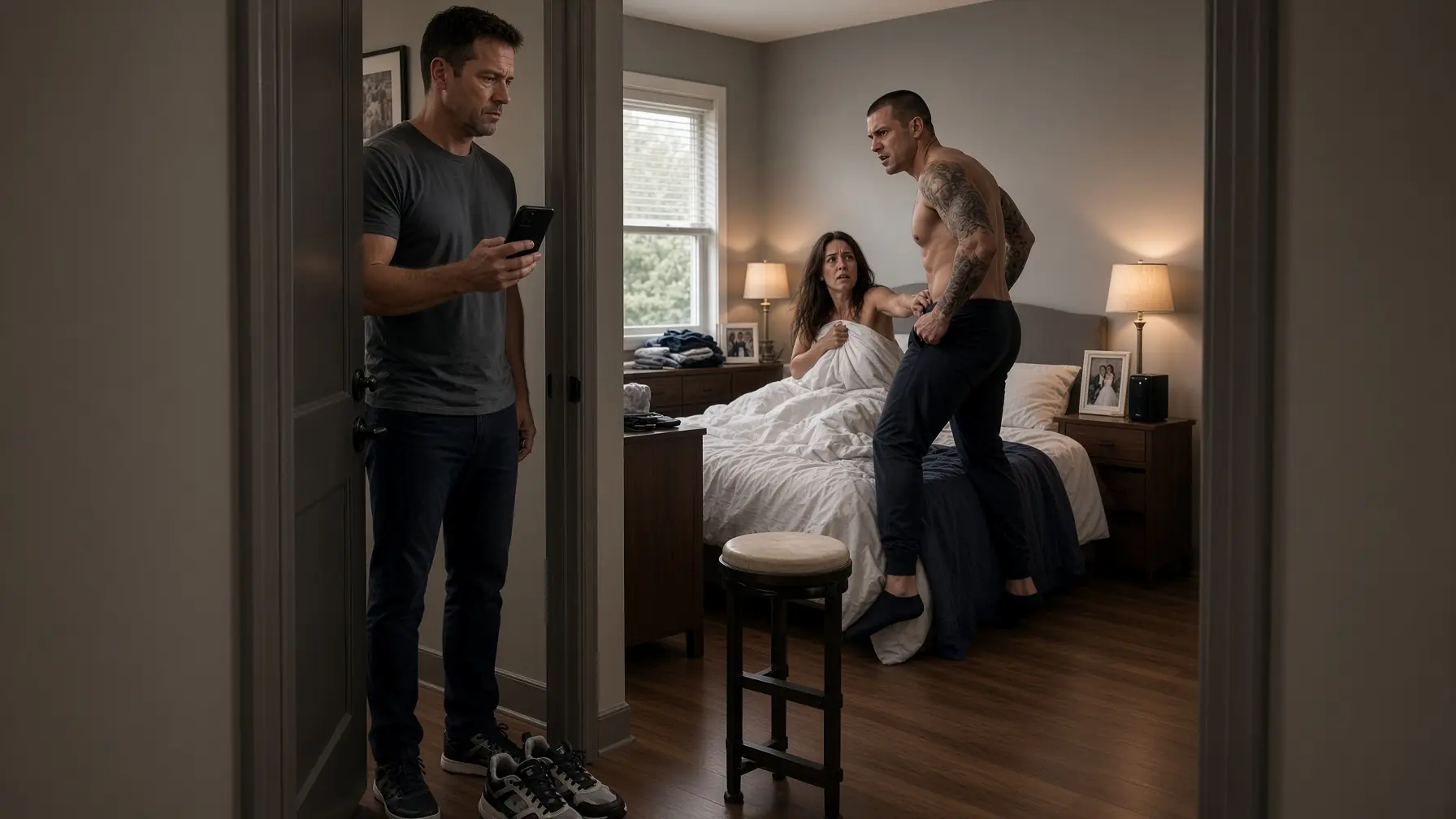
My name is Caleb Morgan, and I was forty-three when I realized the life I thought I had been living no longer existed.
My wife, Rachel, was thirty-nine, and we had been married for twelve years. We never had children, partly by circumstance and partly because every time we seriously discussed it, life seemed to move the conversation six months farther away. We owned a two-bedroom condo in Brighton Harbor, North Carolina, shared one bank account for household expenses, and spent Friday nights ordering food from the same Italian place downstairs. Nothing about us looked unstable from the outside.
Two years before everything collapsed, I had a health scare that frightened me more than I admitted. I weighed 264 pounds, my blood pressure was high enough that my doctor stopped joking with me, and my bloodwork showed I was moving quickly toward diabetes. Rachel was heavier too, though she had always carried her weight in a way strangers called pretty before remembering that compliment was supposed to be about her face. We left the doctor’s office that afternoon and decided we were finished pretending our habits were harmless.
We changed together, which was what made the beginning feel hopeful. First we stopped buying soda, then we started walking around the marina after dinner, then we learned how to prepare meals that did not arrive in cardboard boxes. After four months, we joined a gym called Summit Forge Athletic Club in a renovated warehouse near downtown Brighton Harbor. We hated the first two weeks and laughed about how unfair stairs felt after leg day.
Slowly, everything changed. I went from 264 pounds to 191, and Rachel dropped from 187 to 146 over roughly eighteen months. I became healthier, but Rachel became someone the world suddenly reacted to in a different way. Men held eye contact longer, cashiers became friendlier, and strangers found reasons to tell her she looked amazing.
At first, I loved seeing her confidence return. Rachel had spent years avoiding photographs and covering herself with loose sweaters, so watching her buy fitted jeans without apologizing for her body made me proud. She carried herself differently, and I thought that change belonged to both of us because we had done the work together. I did not understand that she was beginning to associate attention with freedom.
That was where Derek Sloan entered our lives. Derek was a trainer at Summit Forge, maybe thirty-two, with close-cropped hair, tattoos on both arms, and the kind of body that clearly required more discipline than modesty. He was always touching somebody’s shoulder, correcting somebody’s stance, or leaning close enough during conversations to make boundaries feel old-fashioned. I disliked him almost immediately.
I did not dislike him because he was more muscular than me, although that was how Rachel later described it. I disliked the way he watched women through mirrors when he believed nobody noticed. I disliked how he seemed to know exactly which husbands would ignore his flirting because confronting it might make them look insecure. Most of all, I disliked how quickly he noticed Rachel noticing him.
The first moment that stayed with me happened near the cardio machines. Rachel and I were finishing twenty minutes on the ellipticals when Derek started doing cable work directly in front of the mirror, wearing a tank top cut so low that it barely qualified as clothing. Rachel looked over once, then again, and the second look lasted long enough for Derek to catch her eyes in the mirror. He smiled, and she smiled back.
I said nothing at the gym. On the drive home, I mentioned that Derek seemed to enjoy performing for an audience. Rachel looked through the passenger window and asked who I meant, even though I knew perfectly well she had been watching him. When I told her, she shrugged and said, “I barely noticed him.”
The lie was small enough that I let it go. That became a habit. Every time something made me uncomfortable, I found a way to explain it more generously because I believed trust meant giving your spouse the least suspicious interpretation available. Looking back, I think trust becomes dangerous when it requires you to repeatedly argue against your own eyes.
Derek gradually found reasons to speak with Rachel. He complimented her progress, asked about her goals, suggested small changes to her routine, and occasionally wandered over while we were training together. Rachel began asking me whether certain tops looked too tight before wearing them anyway, and she started fixing her hair in the car before we entered the gym. None of those things proved anything by themselves.
The first real argument happened beside a squat rack. I went to refill my water bottle and returned to find Derek standing directly behind Rachel with both hands around her waist while she lowered the bar. His face was close to her ear, and whatever he was saying made her laugh. I walked over and told him, “I’ve got her from here.”
Derek stepped away and smiled. “Relax, man, I’m just helping with form.” Rachel racked the bar harder than necessary and stared at me as though I had embarrassed her. We left the gym ten minutes later and argued all the way home.
She called me insecure. I told her another man had his hands around her waist while whispering into her ear. Rachel said trainers touched clients all the time and accused me of turning something innocent into proof of betrayal because I could not handle other men finding her attractive. I asked whether protecting Derek from awkwardness mattered more than protecting our marriage from disrespect.
That argument lasted almost two hours. Rachel eventually said she understood why I was uncomfortable and promised nothing inappropriate was happening. I apologized for becoming angry in public, because I had raised my voice more than I liked. We agreed to cancel our Summit Forge memberships and join another gym across town.
For several weeks, I felt relieved. The new place was quieter, cleaner, and did not have Derek wandering through our workouts. Rachel seemed less enthusiastic, but I told myself she simply missed the convenience of the old gym. I did not realize she blamed me for removing something she had already become emotionally attached to.
Three months later, I received a promotion at the logistics company where I worked. The money was better and the position finally gave me a path toward regional management, but the schedule shifted me into afternoons and early evenings. Rachel encouraged me to accept it and told me we could work out separately. She would train after work while I went early in the morning.
That was when the distance became harder to ignore. Rachel still kissed me goodbye, but the kiss became a habit rather than a moment. She answered texts with one or two words and stopped sending photographs of random things she saw during the day. At night, she often said she was too tired for intimacy and rolled toward her side of the bed.
I asked whether something was wrong. Rachel said she was approaching forty and felt disconnected from herself, then told me I was making ordinary changes feel suspicious because I had never gotten over Derek. I suggested couples counseling, and she laughed bitterly. “You’re the one with trust issues, Caleb.”
So I went to therapy alone. That detail still embarrasses me sometimes, although my therapist later told me it should not. I spent almost ten months discussing jealousy, insecurity, childhood self-esteem, and why losing weight had not automatically made me feel confident. All the while, Rachel was using my willingness to question myself as cover for something I had been right to notice.
I checked her phone twice during that year. There was nothing. I looked through her car once because I hated myself enough to wonder if she kept another phone somewhere. There was nothing there either.
I even checked location history. Her phone moved from home to work, then to the gym, then home again. It looked so boring and predictable that I felt ashamed for doubting her. The technology became another witness telling me my instincts were the problem.
The first real clue came from our condo doorman. His name was Victor Mendoza, a sixty-eight-year-old widower who had worked the front desk at Harbor Point Residences since before Rachel and I bought our unit. Victor knew everyone’s dog, every delivery driver, and which residents had grandchildren visiting on weekends. He also noticed things management systems did not.
One Thursday afternoon, a server outage shut my department down early. I reached the condo shortly after three and found Victor sitting behind the front desk rubbing his shoulder. I asked if he had hurt himself, and he joked that helping his daughter move furniture had finally reminded him he was no longer thirty.
Then he said, “You should ask Mrs. Morgan for her therapist’s number.” I stopped. “What therapist?”
Victor’s smile disappeared almost immediately. He said he might have misunderstood and started looking toward his monitor. I asked him to explain what he meant.
He told me a muscular man had visited Rachel several times and signed in as a private stretch therapist. My body went completely cold before my mind finished understanding the sentence. I asked Victor to show me the visitor log.
He hesitated. Then he rotated the monitor. There was Derek Sloan walking into my building with a gym bag over one shoulder.
He signed in under the name “D. Saunders, mobility therapy.” The footage showed him smiling at Victor like a man who had done this enough times to become comfortable. I asked how often he had been there. Victor said four times for certain, possibly six.
I thanked him and rode the elevator upstairs. The condo looked exactly the same. That was almost offensive. Our couch, kitchen island, framed wedding photograph, and the hallway toward our bedroom all appeared perfectly ordinary while I stood there wondering which parts of my own home had become props in someone else’s secret life.
The following day, I borrowed a coworker’s SUV. Rachel left work at four and drove toward the shopping district where Summit Forge was located. She parked near the old gym but did not go inside. Five minutes later, Derek appeared from behind the building.
Rachel got out of the car. They kissed before they reached each other. There was no hesitation in it, no awkwardness, and no uncertainty about where hands belonged.
I watched from across the lot and felt something collapse quietly inside me. They walked together toward a private townhome community two blocks away. I followed at a distance until a security gate forced me to stop.
The guard asked whether I was visiting someone. I told him I was just looking at the property because I could not think of a better lie quickly enough. He gave me the polite expression professionals use when they know a stranger is trying to learn something they should not reveal. I drove away.
I called Rachel. No answer. I called again and heard her phone ringing from inside her parked car when I returned to the shopping center.
That was how the location history stayed innocent. Rachel did not take the phone with her. The map never lied because the device never went where she did.
I sat in my coworker’s vehicle and cried harder than I had cried since my mother died. There was no dignity in it. I could barely breathe, and part of my mind kept insisting I should stop because somebody might see me. Then I called my father.
My father, Paul Morgan, had been an accountant for most of his life and approached emotional disasters like damaged financial statements. He listened until I finished. Then he said, “Your marriage may already be over, but do not let anger destroy the evidence you will need to leave cleanly.”
The advice sounded cold. It was also exactly what I needed. He contacted a divorce attorney before I even reached home.
Rachel called around six. She said she had missed my calls because she had been exercising. I nearly asked which gym but caught myself.
Instead, I told her I had come home early because I felt sick. She asked whether I needed anything and sounded so convincingly concerned that I almost lost control. I told her I thought I had the flu and planned to sleep in the guest room.
That night, I heard her laughing softly behind our bedroom door. I knew she was messaging him. I still did not have enough evidence to prove what I knew.
The next morning, while Rachel showered, I unlocked her phone. We had always known each other’s passcodes, which once felt like evidence of trust. I linked her messaging account to my laptop, returned the phone exactly where it had been, and waited.
Most conversations had been deleted. One active thread caught my attention because the contact name was Megan Office even though the profile icon was a small kettlebell. The messages were written like workplace conversation.
One said, “Can you bring those reports upstairs later?” Another said, “Supervisor leaves early Friday.” A reply from Megan Office read, “Then I can finally use the conference room properly.”