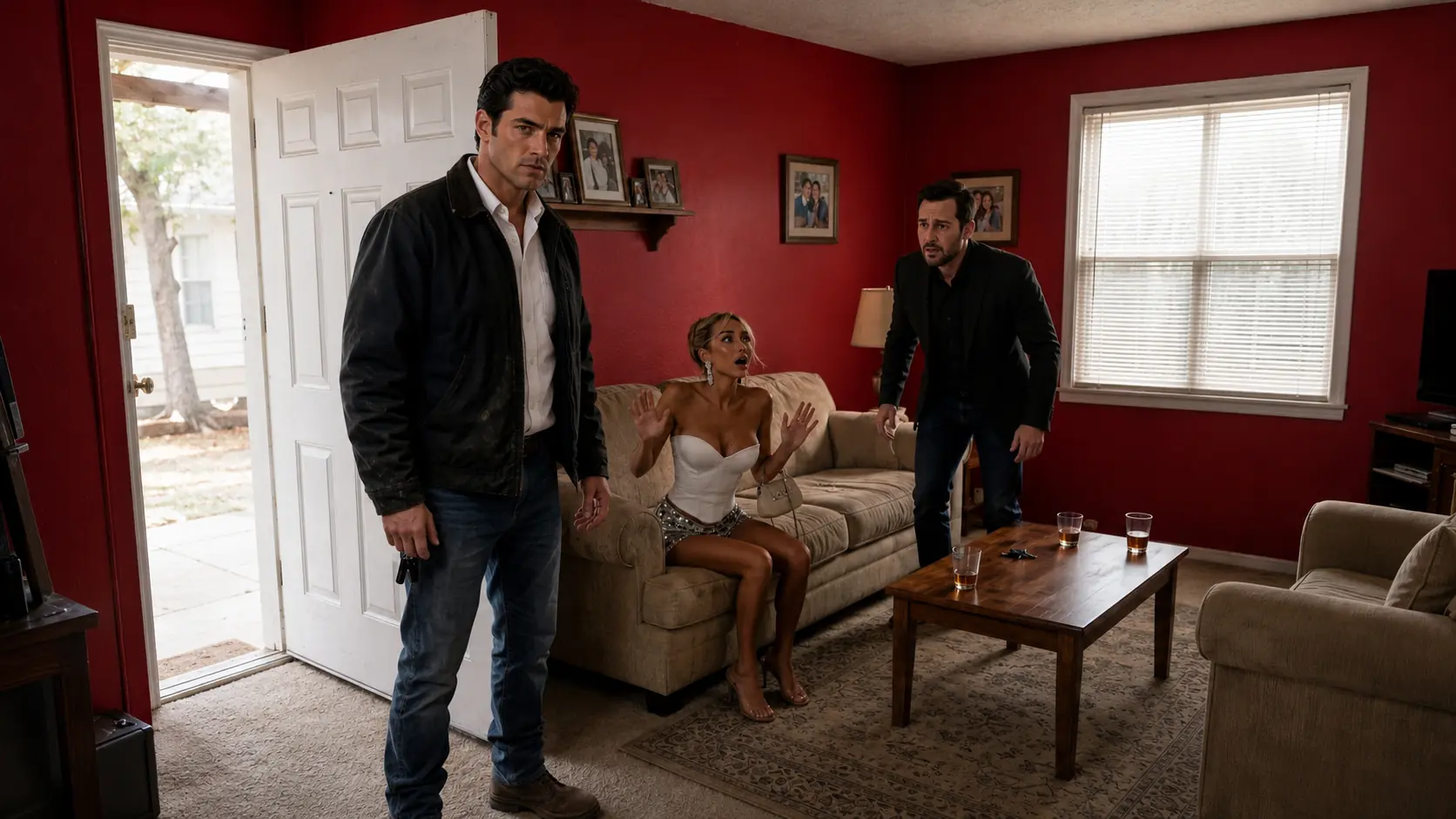
The sentence came out so cleanly that I knew it had been waiting somewhere inside her long before that night. “You know what, Aaron? I’m in love with somebody else,” Melissa said from the other side of our kitchen, arms folded, eyes bright with anger. I had just come home from a thirteen-hour maintenance shift outside Columbus, Ohio, and my boots were still dirty from the boiler room. For a few seconds, the only sound in our house was the refrigerator humming against the wall.
My name is Aaron Whitaker, and I was forty-five years old when my marriage finally showed me what it had become. I worked industrial HVAC and boiler maintenance for a regional utility contractor, the kind of job where you learned very quickly that panic did not fix pressure problems. You found the fault, isolated the source, documented what happened, and only then started turning valves. It was a useful way to think at work, though it took me far too long to realize it was also the reason I had kept trying to repair a marriage my wife had already stopped maintaining.
Melissa and I had been married twelve years. We did not have children, a fact that hurt both of us deeply for a long time and later became something we stopped discussing because the subject had exhausted every softer part of us. We owned a three-bedroom house in north Columbus, had two cars, retirement accounts, one mortgage, and enough shared history to make leaving feel almost more complicated than staying. That complexity became one of the reasons I ignored what I should have seen sooner.
The argument began over something stupid. Melissa said I had left a coffee cup in the sink again, then somehow turned the cup into evidence that she carried the entire emotional weight of our marriage while I treated home like a service station. I told her I had been awake since four in the morning repairing a failed heat exchanger and was not interested in arguing about a mug. That answer did not calm her.
“You never want to talk about anything real,” she snapped. I dropped my work jacket over the back of a chair and said, “Then talk about something real.” She stared at me for maybe two seconds, and that was when she said it. “Fine. I’m in love with somebody else.”
I did not yell. I did not ask who, and I did not demand her phone because something in her face told me the answer mattered less than the fact that the sentence existed. Melissa looked almost startled by my silence, as if she had thrown something heavy and expected the impact to make noise. I walked to the sink, washed the grease from my hands, and dried them carefully.
“Aaron,” she said behind me. I kept drying my hands. “Say something.” I set the towel down and headed toward the guest room.
That was when she followed me. “I didn’t mean it,” she said as she came down the hallway, then repeated it louder when I did not stop. “I was angry, okay? People say stupid things when they’re angry.” I turned around at the guest-room door and looked at her.
“That one was pretty specific,” I said.
Melissa shook her head quickly. “I made it up because I needed you to react.” She took a step closer and tried to soften her voice. “You never react anymore, Aaron. I needed to know you still cared.”
I studied her for a long moment. Then I said, “You chose a strange way to find out.” I went inside the guest room and closed the door.
I did not sleep much that night. I stared at the ceiling and kept thinking about one word: somebody. Not “I don’t love you anymore,” not “I wish I were somewhere else,” but somebody. People sometimes say cruel things in anger, but specificity usually comes from somewhere.
By the time dawn appeared between the blinds, I had stopped asking whether Melissa meant what she said. I had started asking what else in the previous year might make sense if she did. That distinction changed everything. For the first time, I was not trying to repair the argument.
I was trying to understand the system.
Melissa was making eggs when I entered the kitchen the next morning. She had prepared my coffee the way I liked it and even put toast on a plate beside my usual chair. The normalcy was so deliberate that it felt less comforting than anything she could have done. She smiled and said, “Can we reset?”
I sat down. “Sure.” Then I picked up the salt.
She blinked. “That’s it?”
“What do you want me to say?”
“I don’t know.”
I looked at her. “Then we’re both caught up.”
For the next several days, our house ran like a business operating under temporary management. I went to work, came home, ate, slept in the guest room, and responded politely whenever Melissa spoke to me. I did not ignore her, but I stopped volunteering emotion. The change unsettled her more than anger would have.
Melissa was good at arguments. She knew how to push, retreat, reframe, and eventually find some compromise where both of us could pretend the original issue had been solved. My calm gave her nothing to work with. I watched her move from apology to irritation to nervousness as she realized I was no longer participating in the usual cycle.
On Friday evening, her friend Karen came over with a bottle of wine. I was in the den watching basketball with the volume low, and the women were talking in the kitchen loudly enough that I heard more than either of them probably realized. I was not deliberately listening until Karen lowered her voice and said, “You still haven’t told him it was Mason.” After that, pretending not to listen would have been ridiculous.
Melissa answered too quietly for me to catch the full sentence. Karen said, “I’m just telling you, if Aaron hears it from someone else first, it’ll be worse.” Melissa snapped back, “He won’t. Drop it.” Then the kitchen became quiet.
Mason.
I sat there looking at the television without seeing it.
Mason Reed was not some anonymous coworker. He was my second cousin through my mother’s side, the kind of relative close enough to attend holidays but distant enough that we did not grow up together. He had eaten Thanksgiving dinner at my table, borrowed my trailer when he moved apartments, and once called me at midnight when his car died outside Newark because he knew I would come.
I had come.
That was the part that stayed with me.
After Karen left, Melissa came into the den carrying her wineglass. She sat at the far end of the couch and asked what I was watching. I told her, and we sat through ten minutes of basketball neither of us cared about.
Then I said, “You heard from Mason lately?”
Melissa went still.
Not dramatically. Just enough that anyone who had spent twelve years beside her would notice.
“He’s fine, I think,” she said. “Why?”
“No reason.”
“You talk to him?”
“Not recently.”
She nodded too quickly. “Me neither.”
I looked toward the television again. “Good.”
That single pause told me more than a confession would have because Melissa had not prepared for the question. Her body answered before her mouth did. She held the wineglass tighter and stared at the television for the rest of the quarter.
When she went to bed, I sat at the dining-room table with a legal pad. At the top of the first page, I wrote three headings: Facts, Assumptions, Questions. That was how I diagnosed equipment failures at work, and it seemed better than letting anger decide what was true. By two in the morning, one year of memories had begun rearranging itself.
February: Melissa started taking a Wednesday evening photography class but never showed me photographs. April: she began staying later at work twice a month. June: Mason showed up nearly an hour late to a family cookout, and Melissa arrived ten minutes after him even though they came from opposite sides of town. August: she changed the passcode on her phone.
September brought another detail. Melissa volunteered to drive Mason home after my aunt’s retirement dinner because he had been drinking and “lived roughly in our direction.” He did not. I knew because I had helped him move into that apartment.
Then October. The argument. The sentence.
A year of isolated details suddenly formed a shape.
I did not know whether Melissa had physically cheated. I did know she had lied about enough small things that asking her directly would only tell her what I knew. So instead of confronting her, I called my oldest friend the next morning.
His name was Andre Bennett. We met twenty-three years earlier when both of us worked summer maintenance at a plastics plant and discovered we could spend an entire lunch break saying six words. Andre was the kind of friend who never confused giving advice with proving he was useful. When I told him what happened, he listened until I finished.
Then he asked, “What do you want?”
Not “How do you feel?” He already knew.
“I want to understand where I stand before she knows I’m moving.”
Andre nodded. “Then lawyer first.”
He gave me the name of an attorney who had represented one of his supervisors two years earlier. Her name was Kathleen Monroe, and according to Andre, she had no interest in revenge stories. “She’ll tell you when you’re being stupid,” he said. “That’s why you want her.”
I called Monday. Kathleen scheduled me for Thursday afternoon.
Until then, I behaved normally.
That did not mean pretending affection.
It meant routine.
Same work hours.
Same grocery stop.
Same payments.
Same habit of taking the trash out Wednesday night.
Melissa seemed to relax slightly when she decided the worst of the argument had passed. She made my favorite chili one evening and sent me a picture of the dog we had discussed adopting months earlier. I responded with a thumbs-up and kept documenting.
On Tuesday night, I reviewed only records I had a legal right to access. Joint bank statements. Mortgage documents. Tax returns. Insurance. Retirement statements that included marital beneficiary information.
I did not hack accounts. I did not secretly track her phone. I did not read private messages I was not authorized to see.
Kathleen would later tell me that restraint mattered.
At the bottom of a refinance packet from two years earlier, I found provisions concerning ownership percentages, existing equity, and how separate contributions had been documented when we restructured the loan. I did not pretend to understand what those clauses meant legally. I photographed the pages and added them to the folder for Kathleen. The rest I copied at a shipping store before work.
One set stayed with me.
Another went to Andre.
Thursday afternoon, I sat across from Kathleen Monroe in a modest office overlooking Broad Street. She was fifty-eight, wore dark-framed glasses, and had the patient expression of someone who had seen people burn down their own cases by doing emotional things at precisely the wrong time. I gave her the timeline.
She asked direct questions.
Any threats?
No.
Any money moved?
No.
Any shared account drained?
No.
Any unauthorized access to private devices?
No.
Kathleen nodded. “Good. Keep it that way.”
She explained that infidelity did not magically hand one spouse every asset. Property rules depended on documents, contributions, ownership, and state law, not moral outrage. She told me not to lock Melissa out, dispose of property, hide money, or do anything designed merely to punish. Then she said something I remember clearly.
“Build your exit so cleanly that you never have to defend the way you left.”
That became the plan.
A week later, Andre called me from his truck. “You know Mason is married, right?” he asked. I knew he had been seeing someone, but I did not know they had married quietly three years earlier. Her name was Rachel.
Andre had learned through a mutual family acquaintance. He did not dig through private databases or do anything complicated. Mason’s marriage simply was not a secret in the part of the family that still followed his life closely.
“Does she know?” I asked.
Andre paused. “Apparently she knows he wanders.”
That sentence stayed with me.
I asked for Rachel’s public contact information. Andre warned me not to turn it into revenge. I told him I did not want anything from her.
I called Rachel the following Sunday.
She answered cautiously.
“My name is Aaron Whitaker. I’m related to Mason Reed.”
There was a long silence.
Then she said, “I know who you are.”
That told me enough.
“I think we should talk about Melissa.”
Rachel exhaled.
“I was wondering when you’d find out.”
I closed my eyes.
“How long have you known?”
“About seven months.”
“And how long did Mason tell you it had been going on?”
“Since summer.”
I looked toward the hardware store parking lot where I had parked before making the call.
“It goes back at least earlier than that.”
Rachel laughed once, without humor.
“Of course it does.”
I told her I was not asking her to leave him, confront him, help me, or choose a side. I only believed she had a right to information that affected her own marriage. Rachel thanked me and said nothing else about what she intended to do.
That was enough.
Within three days, something changed at home.
Melissa received two evening calls she clearly did not want to take in front of me. She started checking her phone more often and went outside once despite the cold. Then at dinner, she casually asked, “You heard from Mason recently?”
I looked up. “No.”
“Oh.”
“Why?”
“No reason.”
I nodded.
“Okay.”
She pushed food around her plate.
I ate mine.
There is a certain quiet that appears when two people know a subject exists but only one knows how much the other understands. Melissa was beginning to feel it. I had been living inside it for weeks.
Three weeks after the first argument, I finally lost some of my restraint.
Not because I planned to.
Because pressure eventually escapes somewhere.
I came home after another long shift and heard Melissa laughing on the phone in the kitchen. It was a relaxed, warm laugh I had not heard directed toward me in months.
She did not hear me enter.
“I know,” she said into the phone. “He’s in this weird quiet phase. Honestly, it’s been easier.”
Then she turned.
The smile vanished.
“Hey.”
I put my keys on the counter.
She ended the call.
“Long day?”
“Yes.”
“I made pasta.”
I opened the refrigerator.
“Aaron, we need to stop making everything so difficult.”
I stopped.
Slowly turned around.
“What did you say?”
She looked startled.
“I said we need to stop making everything difficult.”
“We?”
She frowned.
“Aaron.”
“No, explain the ‘we.’”
Her posture changed.
“I’m not doing this if you’re going to raise your voice.”
“I have spent three weeks barely raising it above normal.”
“You’re being hostile.”
“I’m being awake.”
That stopped her.
I stepped away from the refrigerator.
“You told me you were in love with someone else.”
“Aaron—”
“Then you chased me through this house saying you invented it.”
“I explained that.”
“No.”
I shook my head.
“You changed it.”