My wife laughed when I asked where she was really going.
Not loudly.
Not cruelly, exactly.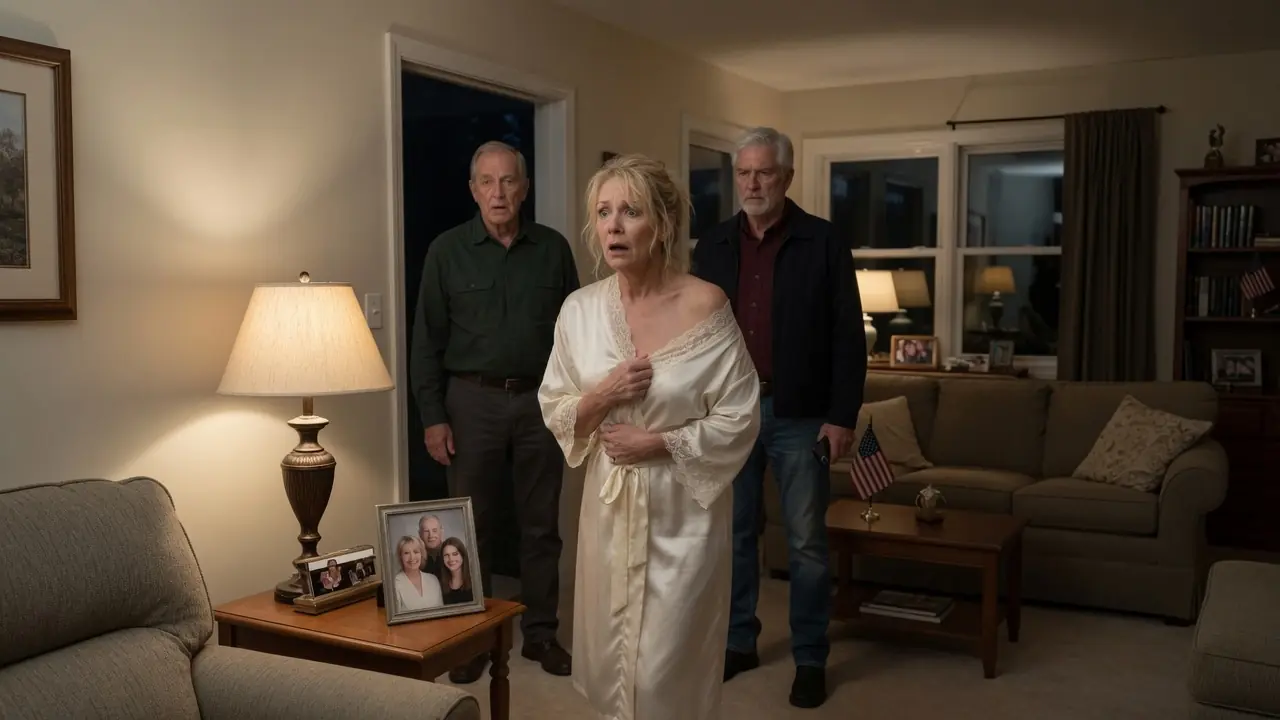
But with that tired little smile people use when they want you to feel foolish for noticing what they hoped you would ignore.
“Harold,” she said, pulling her gray coat from the hall closet, “aren’t you getting a little old to be this suspicious?”
I was sixty-one years old.
Old enough to know when a woman was lying.
Old enough to know when my own wife had begun smelling faintly of someone else’s house.
She told me she was going to see our daughter, like she did every Thursday evening. She said Emily had been lonely since the divorce, that she liked having her mother stop by, that a woman needed her mother even when she pretended she didn’t.
I wanted to believe that.
For thirty-four years, I had believed most of what Ellen told me.
I had believed her when she said she loved me.
Believed her when she said our life was enough.
Believed her when she cried in a hospital room in 1995 and told me our baby girl had not survived.
So I watched her button her coat, kiss my cheek, and step out into a February night in central Ohio with a casserole dish wrapped in blue towels.
Five minutes after her taillights disappeared down Miller Road, my phone buzzed.
It was Emily.
Dad, why did Mom just text me saying not to answer if you ask where she is?
I stared at the message.
Then another one came through.
She hasn’t visited me on Thursdays since before Thanksgiving. What’s going on?
For a while, I just stood in the kitchen with the phone in my hand.
The dishwasher hummed.
The old clock above the pantry ticked with the same stubborn rhythm it had kept since Emily was in grade school.
Outside, the porch light shone over the empty driveway.
I could have called Ellen.
I could have waited.
I could have accepted one more explanation, one more tired smile, one more sentence designed to make me ashamed of my own instincts.
Instead, I walked to the garage.
Ellen’s car was gone, but the old SUV she used for errands still sat beside my workbench. We had bought it used years ago, and she had never bothered learning how to clear the GPS history.
I turned the ignition halfway, opened the navigation screen, and found the saved places.
Grocery.
Church.
Emily apartment.
Dentist.
Then one address with no name.
Maple Hollow Lane.
A subdivision in the next county.
Twenty-seven miles from our house.
I wrote it down on the back of an oil change receipt.
Then I drove.
I did not speed.
That surprised me later.
I drove through the familiar dark roads past shuttered diners, gas stations, a county park sign, a Methodist church, and fields black under patches of old snow. The closer I got to Maple Hollow Lane, the calmer I became.
Not peaceful.
Something colder than peace.
The kind of calm a man feels when a roof beam cracks and he finally understands the house has been failing for years.
The address belonged to a beige two-story house with white shutters and a porch swing.
A pickup sat in the driveway.
A small American flag hung by the door.
There were warm lights in the windows, and on the porch railing sat a clay pot filled with dead winter mums.
The house looked normal.
That was the first thing that hurt.
It did not look like betrayal.
It looked like someone’s Tuesday.
I parked two houses down and sat for a minute, watching.
Ellen’s car was in the garage.
I could see the bumper through the window.
The front door was not fully closed.
A strip of yellow light showed along the frame.
Then I heard Ellen’s voice.
Muffled through the walls.
Not the voice she used at church.
Not the voice she used with me.
Softer.
Younger somehow.
I walked to the porch.
I did not knock.
Maybe I should have.
But after thirty-four years of marriage, after all the Thursdays, after the text from my daughter, I was done asking permission to enter the truth.
The door opened under my hand.
Ellen stood in the living room wearing a blue robe I had never seen before.
She froze.
The casserole dish sat on a coffee table beside two wineglasses and a half-finished puzzle.
A man stood behind her near the fireplace.
He was about my age, maybe a little older, with silver hair, a trimmed beard, and the straight-backed posture of someone used to being listened to. He wore a flannel shirt and house slippers.
Not a young lover.
Not some reckless mistake.
That made it worse.
Ellen whispered, “Harold.”
I looked at the man.
Then at the walls.
There were photographs everywhere.
Christmas mornings.
Graduations.
A little girl with dark curls sitting on a bicycle.
Ellen standing beside the man at a lake.
Ellen holding a birthday cake in a kitchen that was not ours.
My eyes moved to a photo above the mantel.
A young woman in a white graduation gown stood between Ellen and the man, smiling as if she belonged exactly there.
Ellen stepped toward me.
“You need to leave.”
I did not move.
The man’s face tightened, but he said nothing.
That bothered me.
A guilty man usually explains too fast.
This one looked like he had expected me eventually.
“You just destroyed this family,” Ellen said.
Her voice cracked on family.
I looked again at the picture over the mantel.
“No,” I said quietly. “I just found the other one.”
Ellen closed her eyes.
The man finally spoke.
“Ellen, tell him.”
She shook her head.
“Not here.”
“Where else?” I asked. “Our house? This house? The cemetery where I stood over an empty lie?”
Her eyes snapped open.
That told me I had hit something before I even knew what.
A floorboard creaked above us.
All three of us looked toward the staircase.
A young woman appeared at the top.
She was maybe twenty-eight.
Long dark hair, bare feet, oversized Ohio State sweatshirt. Her face was pale with confusion, but not fear. She looked from Ellen to the man, then to me.
“Mom?” she asked. “Who is that?”
Mom.
One word.
That was all it took to split the room in half.
Ellen put a hand to her mouth.
The young woman took one step down.
Her eyes were hazel.
Emily’s eyes were hazel too.
Not exactly the same.
Close enough to make my chest ache.
The man looked at her gently.
“Anna, stay upstairs for a minute.”
Anna.
The name struck me strangely.
Not because I knew it.
Because I should have.
Anna ignored him.
“Why is he here?”
Ellen’s mouth trembled.
I reached for the closest picture frame on the side table.
Ellen moved quickly.
“Don’t.”
That one word carried thirty years of fear inside it.
I picked up the frame anyway.
It showed Ellen in a hospital bed, younger and exhausted, holding a newborn wrapped in a pale yellow blanket.
A man’s hand rested on the bed rail.
The man in the living room.
Under the photo, in neat black ink, someone had written:
Anna Claire — March 9, 1995.
I stopped breathing.
March 9, 1995.
That date had lived inside me like a closed room.
It was the day Ellen told me our second daughter had died before we ever brought her home.
It was the day I stood at Riverside Memorial with a cup of vending-machine coffee going cold in my hand, listening to a doctor speak gently about complications and loss.
It was the day Ellen turned her face to the wall and said, “Please don’t make me name her.”
So we buried “Baby Carter.”
No first name.
No lullaby.
No birthdays.
No Christmas stocking.
No school picture.
No chance.
But the photograph in my hand showed Ellen smiling at a living baby.
Anna Claire.
March 9, 1995.
The room tilted.
The carpet, the lamp, the puzzle, the man by the fireplace, the grown woman on the stairs.
All of it became one long scream I somehow did not make.
I looked at Ellen.
“Who is she?”
Ellen’s lips parted.
No sound came.
Anna came down another step.
“Mom?”
The man’s voice was low.
“Anna, this is Harold Carter.”
She frowned.
“Carter?”
Then her expression changed.
Recognition, but not understanding.
“I know that name.”
Ellen whispered, “Please, Anna.”
Anna came down the rest of the stairs slowly.
“When I was little, you said Carter was your maiden family name.”
I stared at Ellen.
“She told you my name was dead too?”
Anna looked from me to Ellen.
“What does that mean?”
The man exhaled.
“Ellen.”
She snapped at him.
“Don’t say my name like you’re innocent.”
He went silent.
I set the frame back on the table because my hand had begun shaking.
“Who are you?” I asked him.
He met my eyes.
“Martin Hale.”
The name stirred something.
A church picnic.
Years ago.
A man shaking my hand beside a folding table of potato salad.
Ellen introducing him as an old friend from before college.
He had said, “You have a beautiful family.”
I remembered Ellen dropping a plastic fork.
Now I knew why.
Anna looked at me.
“Am I supposed to know you?”
I had no answer for her.
That was the cruelest thing.
A man can prepare himself for betrayal.
Not for a grown woman asking whether she belongs to him.
“I don’t know yet,” I said.
Ellen let out a sob.
Anna flinched at the sound but did not go to her.
That told me she knew more than she had ever been told.
Children raised inside secrets grow sensitive to walls.
They know where not to touch.
I stepped back toward the door.
Ellen reached for me.
“Harold, wait.”
I moved away.
“For what?”
She looked helpless.
For the first time in our marriage, I did not feel responsible for that.
“You have had thirty years of Thursdays,” I said. “I’m done waiting in the rooms you keep me out of.”
Anna’s voice followed me.
“Are you my father?”
I stopped with my hand on the door.
Ellen made a small broken sound behind me.
I turned.
Anna stood near the bottom of the stairs, one hand gripping the railing. She looked young suddenly. Not twenty-eight. Not a woman with a job and bills and her own memories.
Young.
A daughter waiting for the adult world to stop shifting beneath her.
“I don’t know,” I said. “But somebody in this room does.”
Then I walked out.
The night air smelled like wet grass and chimney smoke.
Somewhere down the street, a dog barked once.
I stood beside my truck and looked back at the house.
Ellen stood in the doorway now, robe tied tightly around her waist.
Behind her, Anna stood in the hall with the photograph in her hand.
Martin stayed in shadow.
I got into my truck before I did something foolish like beg my own wife to explain what should never have needed explaining.
My phone buzzed again.
Emily.
Dad, answer me. I’m scared.
I started the engine but did not drive.
For the first time since she was born, I did not know how to be honest with my daughter without hurting her.
Then I realized the hurt had already happened.
It had simply been waiting for language.
I called.
Emily answered instantly.
“Dad?”
Her voice was sharp with panic.
“Are you okay?”
“I’m safe.”
“Where are you?”
I looked through the windshield at the beige house.
“At the place your mother goes on Thursdays.”
Silence.
Then, very quietly, “Is she having an affair?”
I thought of Martin.
Of the robe.
Of the wineglasses.
Of the graduation photo.
“Yes,” I said. “But that is not the whole of it.”
“What does that mean?”
“It means she has another family.”
Emily’s breathing changed.
“Dad.”
“There is a woman here named Anna. She calls your mother Mom.”
Emily did not speak for several seconds.
When she did, her voice sounded like it had traveled a long distance.
“How old?”
“Twenty-eight.”
“My age.”
“No,” I said. “You’re thirty-one.”
“Close enough to hurt.”
I closed my eyes.
“There is more, Emily.”
“I don’t want there to be more.”
“I know.”
“Tell me anyway.”
I opened my eyes.
Ellen had stepped onto the porch.
She was watching my truck like she could hold me there by regret alone.
“I think Anna may be the baby your mother told us died.”
Emily made a sound I had never heard from her before.
A wounded, disbelieving breath.
“No.”
“I found a photograph.”
“No.”
“Same date.”
“No, Dad.”
“I’m coming home. Can you come in the morning?”
“I’m coming now.”
“It’s late.”
“I don’t care.”
“Emily.”
“No,” she said, and suddenly she sounded exactly like her mother at twenty-five, all steel under tears. “I am not sitting in my apartment all night wondering whether I had a sister living twenty-seven miles away while Mom brought me soup and lied to my face.”
I could not argue with that.
“Drive carefully.”
“I will.”
I pulled away from Maple Hollow Lane.
I did not turn on the radio.
The roads home looked the same as always, which felt almost insulting. Gas stations still glowed. A diner sign still flickered. A church billboard still said God Heals Broken Families.
I laughed once when I saw it.
Just once.
By the time I reached our house, my body felt hollow.
The porch light was on because Ellen had left it on for herself.
On the kitchen counter sat two soup bowls from dinner.
Her reading glasses rested beside the newspaper.
A sweater hung over the back of a chair.
Nothing in our house looked guilty.
That enraged me more than shattered glass would have.
I went to the hallway closet and pulled down the fireproof box.
Every family has one.
Birth certificates.
Tax papers.
Insurance documents.
Marriage license.
The paper evidence that a life occurred in proper order.
I unlocked it with the key Ellen kept hidden under the junk drawer.
Then I spread thirty-four years across the kitchen table.
Emily’s birth certificate.
Our mortgage.
Old insurance forms.
Hospital bills from 1995.
A thin folder labeled in Ellen’s handwriting:
March — Riverside.
My hand paused over it.
For three decades, I had not opened that folder.
Grief has borders.
You learn where not to walk.
Inside were discharge papers, sympathy cards, hospital bracelets, and a folded church program from the tiny memorial service.
Baby Carter.
No name.
No birth certificate.
No death certificate.
I searched the folder again.
Then the whole box.
There was no official record proving the baby died.
At two in the morning, I found a parking receipt tucked behind a sympathy card.
March 10, 1995.
It was from a hospital across town.
Saint Agnes Women’s Center.
Not Riverside.
I stared at it for a long time.
Saint Agnes was where Martin Hale had worked then.
Not as a doctor.
I remembered now.
Radiology department.
Ellen had once mentioned it years before, in passing, the way people mention weather.
A receipt is not proof.
But sometimes a small paper asks the question the large lie cannot survive.
Emily arrived at 2:40 a.m.
She let herself in with her key and found me at the kitchen table surrounded by documents.
She was still wearing work pants and a sweatshirt, hair pulled into a messy knot, face pale.
She looked like the girl who once came home from college after breaking off an engagement, trying hard not to cry until she saw me.
Then she hugged me.
I held her too tightly.
“I’m sorry,” I whispered.
She pulled back.
“You didn’t do this.”
I wanted to believe her.
She sat beside me, and I told her what I had found.
The missing death certificate.
The parking receipt.
The name Anna Claire.
Martin Hale.
By the time I finished, Emily’s face had gone strangely still.
“I remember Anna,” she said.
I looked at her.
“What?”
“Not as a person. A name.”
She took out her phone and scrolled through old messages.
“Mom said something weird at Christmas. I thought she was just depressed.”
She turned the screen toward me.
There were texts from Ellen.
Do you believe family is always blood?
If someone had to lie to protect a child, would that make them evil?
Has your father ever talked about the baby?
Then one from January:
If a woman named Anna ever contacts you, please call me before answering.
Emily’s hand trembled.
“I thought she was worried about one of those ancestry scams.”
I read the messages twice.
Then placed the phone down carefully.
Emily wiped her face with her sleeve.
“I used to feel guilty,” she said.
“For what?”
“For not grieving the baby enough.”
The sentence broke me quietly.
She stared at the kitchen table.
“I was three. I don’t remember her. But every March, Mom would get strange and you’d get quiet. I always felt like there was a ghost in the house I was supposed to miss properly.”
I closed my eyes.
“I’m sorry.”
“Dad.”
She reached for my hand.
“We were both living with a ghost she invented.”
At 8:12 that morning, Ellen came home.
She opened the front door softly, like volume was the problem.
Emily and I were still at the kitchen table.
The papers had not moved.
Neither had the anger.
Ellen stepped into the kitchen and stopped when she saw Emily.
“Oh, honey.”
Emily stood.
“Don’t.”
Ellen flinched as if struck.
That single word cut deeper than shouting would have.
Her eyes moved to the table.
“You went through the box.”
I looked at her.
“You went through another life for thirty years. I went through a box.”
She lowered her head.
Emily’s voice shook.
“Who is Anna?”
Ellen looked at our daughter.
For a moment, the mother in her surfaced. The woman who baked cupcakes for school. The woman who cried when Emily graduated nursing school. The woman who drove through an ice storm because Emily’s furnace went out.
Then that woman sank under the weight of what she had done.
“Anna is my daughter,” Ellen said.
Emily grabbed the back of the chair.
My chest tightened even though I had expected the words.
There is a difference between knowing and hearing.
Emily whispered, “Your daughter with him?”
Ellen closed her eyes.
“I thought so.”
I stood slowly.
Ellen knew at once she had said too much.
“You thought so?” I asked.
Her lips trembled.
“I was confused. Afraid. I had made a terrible mistake.”
Emily laughed once, sharp and broken.
“A mistake does not grow into a whole adult woman unless you feed it every Thursday.”
Ellen’s face crumpled.
“I know.”
“No,” Emily said. “You don’t get to say that like knowing makes it smaller.”
Ellen sat down because her legs seemed to fail her.
“I was lonely after Emily was born,” she said, looking at the table instead of us. “Your father was working nights. My mother was constantly telling me I had wasted my life. Martin and I had known each other before I married Harold. We started talking again.”
I listened.
Not because I wanted to.
Because the truth had become a surgery, and I needed it finished no matter how much it cut.
“It became an affair,” Ellen said.
Emily turned away.
“When I got pregnant, I panicked. I didn’t know if the baby was Harold’s or Martin’s.”
“Baby?” I said. “Singular?”
Ellen looked at me, confused.
“Yes.”
I slid the parking receipt toward her.
“Why Saint Agnes?”
Her face lost color.
“Where did you find that?”
“In the folder that was supposed to prove our child died.”
She covered her mouth.
I leaned forward.
“What happened after delivery?”
Ellen shook her head.
“I was sedated. There were complications. I remember blood, nurses, someone telling me not to fight the mask. When I woke up, my mother told me the baby had died.”
“Then how did Anna end up in Martin’s house?”
Ellen’s eyes filled.
“Two days later, my mother told me the baby was alive. She said Martin had claimed her. She said if Harold found out, I would lose my marriage, Emily would lose her father, and the scandal would destroy everyone.”
Emily’s voice was ice.
“So Grandma arranged a kidnapping and called it family management.”
Ellen broke down.
“She said I could still see Anna. She said Martin wanted her. She said it was better than destroying two homes.”
I stared at the woman I had slept beside for most of my adult life.
“You let me mourn a living child.”
“I was weak.”
“No,” I said. “Weakness is crying in a hospital hallway. What you did required maintenance.”
She looked at me.
I saw the words land.
Good.
Some truths deserve to hurt.
“For thirty years,” I said, “you packed casseroles, bought birthday gifts, attended graduations, probably sat beside her bed when she was sick.”
Ellen sobbed quietly.
“And I stood at a grave with no body in it.”
The doorbell rang.
All three of us turned.
Through the front window, I saw Martin Hale on the porch.
He was holding a large manila envelope.
Ellen stood too quickly.
“No.”
Emily looked between us.
Martin rang again.
I walked to the door and opened it.
He looked as if he had aged ten years since the night before.
“I’m not here to excuse myself,” he said.
“Good. You’d fail.”
He nodded once.
“I need to tell you what Ellen won’t.”
From behind me, Ellen said, “Martin, please.”
He looked past me at her.
“Ellen, it’s over. It should have been over before it started.”
I let him in.
He stood in our kitchen like a man entering a house he had robbed.
The envelope stayed in his hands.
Emily sat beside me.
Ellen remained near the sink, arms wrapped around herself.
Martin placed the envelope on the table.
“I raised Anna,” he said. “Whatever else is true, she is my daughter in every way that required getting up at night, paying school fees, teaching her to drive, sitting beside her when she had pneumonia.”
I did not speak.
“But blood,” he continued, “blood is another matter.”
Ellen stared at him.
“What did you do?”
Martin opened the envelope.
“Anna got sick three years ago. Nothing dangerous, but the doctors needed family history. I did a private paternity test because there were markers they wanted clarified.”
Ellen stepped back.
“You told me you never wanted to know.”
“I didn’t,” he said. “Until medicine needed the truth.”
He slid a paper toward me.
My eyes went to the bottom first.
Probability of paternity: 0.00%.
Martin Hale was not Anna’s biological father.
Emily made a sound beside me.
Ellen whispered, “No.”
Martin looked at her.
“You lied so long you started thinking uncertainty was innocence.”
I could not feel my hands.
The paper sat in front of me, simple and devastating.
If Martin was not Anna’s father, then I might be.
Not certainly.
But possibly.
After thirty years.
Possibility itself felt violent.
“There is more,” Martin said.
I looked up.
“There is always more,” Emily said bitterly.
Martin’s face tightened.
“Yes.”
He reached into the envelope and removed a sealed packet, yellowed with age.
“My wife—” He stopped. “Ellen’s mother gave this to me before she died. She said if the truth ever reached Harold, I was to give it to him. I kept it hidden. I told myself I was protecting Anna.”
Ellen stared at the packet.
“That’s my mother’s handwriting.”
Across the front were four words:
For Harold Carter only.
I opened it with fingers that did not feel like mine.
Inside was a folded letter, an old hospital bracelet, and a photograph.
The photograph showed Ellen lying in a hospital bed.
She looked pale, exhausted, half-conscious.
In each arm was a newborn.
Two babies.
One wearing a yellow cap.
One wearing a white cap.
On the back, in Ellen’s mother’s neat handwriting, was written:
Twin girls. March 9, 1995. One stayed hidden. One was sent farther.
Under that were two names.
Anna Claire.
Lucy Mae.
Emily whispered, “Dad.”
The room disappeared.
There had not been one baby.
There had been two.
Two daughters.
One raised by Martin.
One sent somewhere else.
One lie had not replaced a child.
It had swallowed two.
I looked at Ellen.
She had collapsed into the chair, shaking her head over and over.
“No. No. She told me there was only Anna. She told me only one survived.”
Martin stared at the photograph, horror spreading slowly across his face.
“I never saw this.”
Emily took the hospital bracelet from the packet.
It was tiny.
Faded.
The printed name had blurred with time, but the last name was still visible.
Carter.
She held it as if it might break.
“Who is Lucy?”
No one answered.
Then my phone rang.
Unknown number.
The sound cut through the kitchen like an alarm.
Ellen looked at the phone.
Martin looked at the phone.
Emily whispered, “Answer it.”
I pressed accept.
For a moment, there was only breathing.
Then a woman’s voice said, “Mr. Carter?”
My throat closed.
“Yes.”
“My name is Lucy.”
Ellen began to cry.
The woman on the phone inhaled shakily.
“I was told not to call unless your wife’s secret finally reached you.”
I looked at the photograph of the twins.
“Who told you that?”
“My adoptive mother,” she said. “Before she died. She said a woman named Ruth Mercer arranged everything in 1995. She said I had a father who believed I was dead.”
Ruth Mercer.
Ellen’s mother.
I closed my eyes.
Lucy continued, her voice breaking now.
“I don’t know what you’ve been told. I don’t know if you want to hear from me. But I was given your name, and last night a woman named Anna Hale called me crying and said the house had finally opened.”
Anna.
So she knew Lucy.
Or had found her.
The secrets were moving faster than the people who made them.
Emily leaned close enough to hear.
Lucy said, “Please don’t let Ellen tell the story first. She had one daughter hidden across town, but I was the one sent away completely.”
I gripped the edge of the table.
“Where are you?”
“Cleveland,” she said. “I’m thirty years old. I have two boys. I’ve looked at your name on a paper since I was sixteen and never knew whether calling would ruin your life.”
I almost laughed.
My life was already in pieces across the kitchen table.
But somewhere in those pieces was a living daughter.
Two living daughters.
Maybe mine.
Maybe not legally.
Maybe not in any way the world would recognize without tests and lawyers and official language.
But grief does not wait for paperwork.
“Lucy,” I said, and her name felt impossible in my mouth. “I don’t know what happens next.”
“That makes two of us.”
“I want to know the truth.”
She cried then.
Quietly, like someone who had spent years making sure no one heard.
“So do I,” she said.
We agreed to meet the next day.
At a diner halfway between Columbus and Cleveland, because none of us were ready for anyone’s home.
When I hung up, the kitchen was silent.
Ellen looked destroyed.
Emily looked furious.
Martin looked like a man realizing the child he raised had been standing inside a larger theft than even he understood.
I picked up the photograph again.
Two newborns.
Anna and Lucy.
I had mourned one unnamed baby for thirty years, while two women grew up under the shadow of decisions made by Ellen and her mother and Martin and fear and pride.
My wife reached across the table.
“Harold.”
I looked at her hand.
For thirty-four years, I had taken that hand at funerals, weddings, hospitals, grocery stores, church pews, and movie theaters. I had believed we were two people inside one life.
Now I saw the truth.
We had been one life with locked doors.
And she had held the keys.
“Don’t,” I said.
She pulled her hand back.
Emily stood.
“I want to meet them.”
I looked at her.
Her face was wet, but her chin was high.
“Anna and Lucy,” she said. “If they’re my sisters, I want to know them. If they’re not, I still want to know what Mom did to them.”
Ellen sobbed.
Emily turned on her.
“And don’t you dare make that sound like you’re the only one hurting.”
Martin spoke quietly.
“Anna wants answers too.”
“Then bring her,” Emily said.
He looked at me.
I nodded.
The next afternoon, we met at a diner off Interstate 71.
The kind of place with vinyl booths, burnt coffee, and pies rotating in a glass case.
I arrived with Emily.
Martin arrived with Anna.
Lucy arrived last.
I knew her before she opened the door.
Not because she looked like Ellen.
She did, a little.
But because she looked at the room the way I had looked at Maple Hollow Lane.
Like she was afraid the truth might vanish if she blinked.
She was thirty, with dark hair cut to her shoulders, brown eyes, and a winter coat buttoned wrong from nerves. Two small boys waited in a minivan outside with a woman who must have been a friend.
She saw me.
Stopped.
Then looked at Anna.
The two women stared at each other like mirrors that had spent their lives in different houses.
Anna stood first.
Lucy covered her mouth.
“Oh my God,” Emily whispered beside me.
It was not perfect.
It was not a movie.
No one ran into anyone’s arms.
We sat.
We ordered coffee nobody drank.
We opened the packet again.
Lucy brought adoption papers, a copy of the letter Ruth Mercer had left, and a photograph of herself as a toddler holding a stuffed rabbit.
Anna brought her birth certificate listing Martin as father.
Emily brought the texts from Ellen.
I brought the missing space where truth should have been.
We talked for three hours.
Sometimes calmly.
Sometimes not.
Lucy had been adopted privately by a couple in Cleveland who were told her mother had died and her father could not be found. They loved her well, she said. That mattered. It did not erase the theft.
Anna had grown up calling Ellen Mom and Martin Dad, always knowing something about her family story did not sit straight. Ellen came every Thursday, every holiday that could be split without suspicion, every important school event where she could stand slightly apart and still be present.
Emily listened to all of this with her arms crossed tight over her chest.
“I was the daughter in the open,” she said once.
Anna looked at her gently.
“That doesn’t mean you weren’t lied to.”
Emily’s mouth trembled.
“I know.”
Lucy wiped her face.
“So what are we to each other?”
No one answered at first.
Then I said, “We start with names. The rest can come after.”
Anna.
Lucy.
Emily.
Three women sitting at a diner booth because adults had tried to manage shame by distributing children like secrets.
A week later, the DNA tests began.
Not because the heart needed them.
Because courts, medical files, inheritance, and history do.
The results came back in twelve days.
Anna and Lucy were identical twins.
Both were my biological daughters.
I read the report alone in my truck outside the testing center.
Then I cried so hard I could not drive for half an hour.
Not graceful crying.
Not dignified.
The kind that makes the body bend.
I cried for babies I never held.
For birthdays I missed.
For Anna learning to ride a bike with another man’s hand on the seat.
For Lucy calling another father Dad while carrying my last name in a sealed envelope.
For Emily growing up under a ghost that was not a ghost.
For the man I had been, obedient in grief, trusting in marriage, blind because love told him blindness was loyalty.
When I finally went home, Ellen was sitting on the porch.
She had moved to her sister’s house after the diner meeting, but she came by that day because she knew the results were due.
I handed her a copy.
She read it.
Her face folded inward.
“They were yours,” she whispered.
“Yes.”
She pressed the paper to her chest and rocked once.
“I destroyed everything.”
“No,” I said.
She looked up, hope flickering stupidly in her eyes.
I let it die.
“You destroyed everyone differently.”
She closed her eyes.
We did not divorce immediately.
Stories like this do not end neatly because one document arrives.
We separated.
There were lawyers.
There were medical records to unseal, if any still existed.
Ruth Mercer was dead, but her handwriting remained in enough places to damn her.
Martin cooperated.
Not because he was innocent.
Because Anna demanded it.
Ellen tried to explain herself many times.
Some of it was true.
She had been young.
She had been afraid.
Her mother had controlled too much.
Martin had wanted Anna.
The hospital system had failed.
Shame had built the first wall.
But Ellen had maintained the house.
Thirty years of Thursday nights were not panic.
They were choices.
That was where forgiveness, if it ever came, would have to begin.
Not at the affair.
Not at the birth.
At every ordinary week she chose the lie again.
Emily struggled the hardest at first.
She loved her mother.
That made anger more complicated, not less.
She met Anna for coffee. Then Lucy. Then both. The first few meetings were awkward, full of pauses and accidental comparisons.
Anna liked black coffee.
Lucy hated coffee and drank hot chocolate.
Emily said she did not trust adults who hated coffee.
Lucy said she had spent thirty years surviving without her opinion.
They laughed.
That laugh opened something.
Anna came to my house one Sunday afternoon.
She stood in the living room looking at family photos, at Emily’s school pictures, at vacations she had not been part of. I watched her absorb the life she had been denied without trying to apologize for having lived it.
“I used to wonder why Mom always looked sad on my birthdays,” she said.
I nodded.
“I used to think March made your mother sad because of you.”
Anna looked at me.
“Because of the baby who died?”
“Yes.”
She looked down.
“I was the baby who lived.”
I could not speak.
She reached into her purse and pulled out the silver-framed baby photo from Martin’s house.
“I brought this,” she said. “I think you should have a copy.”
I took it.
My hand shook.
“Thank you.”
“Can I ask something?”
“Anything.”
“Would you have wanted me?”
That question nearly brought me to my knees.
I set the photo down and faced her fully.
“Yes,” I said. “Before I knew your name. Before I knew your face. I wanted you so much I mourned you for thirty years.”
Anna covered her mouth.
I did not touch her until she stepped forward.
When she did, I held my daughter for the first time.
She was twenty-eight years late.
She was still my daughter.
Lucy came two weeks later with her boys.
Caleb was six.
Owen was four.
They ran through my backyard like they had always known it existed. Emily brought sidewalk chalk. Anna brought cookies. Martin came too, because Anna asked him to, and because family after a lie is not built by pretending some bonds do not exist.
That was difficult.
But necessary.
Martin had raised Anna.
He had lied by silence.
He had also loved her through fevers, homework, heartbreak, and college applications.
Truth did not erase him.
It simply removed his ownership over the story.
Ellen came only after Lucy agreed.
She stood at the edge of the yard with her hands clasped, watching three daughters exist in one place.
Emily did not hug her.
Anna did.
Lucy did not.
Not that day.
Ellen accepted both responses.
That was the beginning of whatever accountability looked like.
Months passed.
The house changed.
Not structurally.
The walls remained.
The kitchen table remained.
Diane—no, Ellen—no longer lived there, but her absence became another kind of furniture.
I took down our wedding portrait from the hallway.
I did not smash it.
I put it in a box.
The space it left on the wall stayed empty for a long time.
Then one afternoon, Emily arrived with a framed photograph.
It had been taken in my backyard.
Emily, Anna, and Lucy stood side by side, awkward but smiling. Lucy’s boys sat in front holding melting popsicles. I stood behind them, looking overwhelmed and older than I wanted to admit.
At the bottom, Emily had written:
Found, not replaced.
I hung it where the wedding portrait had been.
That felt right.
Not clean.
Right.
The next March 9, we did something none of us knew how to name.
Not a birthday party.
Not a memorial.
Something in between.
Anna and Lucy turned thirty-one.
Emily baked a cake because she said no sister of hers was having a birthday without frosting. Martin came with flowers. Ellen came with two small wrapped boxes and a letter for each twin.
She did not ask them to read the letters in front of her.
Good.
Anna opened her gift first.
A tiny yellow hospital cap preserved in tissue paper.
Lucy opened hers.
A white one.
The room went silent.
Ellen whispered, “I kept them.”
Lucy looked at the cap in her hand.
“Why?”
Ellen’s face crumpled.
“Because even when I lied, I remembered.”
Lucy nodded slowly.
“That’s not enough.”
“I know.”
“But it’s something.”
Ellen cried then.
This time, nobody comforted her quickly.
Sometimes a person needs to sit inside the full weight of what they have done.
Later that evening, I stood on the porch while the family moved inside behind me.
Family.
The word had become wider.
Stranger.
More painful.
More alive.
Anna joined me first.
Then Lucy.
Then Emily.
The three of them stood beside me without speaking.
Across the yard, winter grass lay flat and brown.
The sky above Ohio was pale, ordinary, endless.
Emily leaned her head briefly against my shoulder.
Lucy folded her arms against the cold.
Anna looked toward the road.
“I keep thinking about all the years,” Anna said.
“Me too.”
“Do we get them back?”
“No.”
Lucy closed her eyes.
“Then what do we get?”
I thought about the missing birthdays.
The false grave.
The Thursday nights.
The photo of two newborns.
The phone call that began with a stranger saying my name.
Then I looked at my daughters.
All three of them.
“We get the truth,” I said. “And whatever we build with it.”
Emily took my hand.
Anna took the other.
Lucy hesitated, then hooked her arm through mine.
Inside, one of Lucy’s boys shouted that the cake was being attacked by Uncle Martin, which made no sense and somehow made everyone laugh.
The sound came through the open door.
Messy.
Uneven.
Human.
For thirty years, I thought grief was the room I could never reopen.
I was wrong.
The room had been locked from the outside.
When it finally opened, it did not give me back the babies I missed.
It gave me women.
Grown daughters with questions, wounds, humor, children, jobs, memories, and lives that had gone on without me.
That hurt.
It also saved me.
Because the truth, however late, did what lies never could.
It let us stand in the same room and begin.