My wife walked through our front door at 4:07 in the morning, smelling like whiskey and someone else's cologne.
When I asked her where she'd been, she just smiled this slow, lazy smile and said, "Don't ask, Roland."
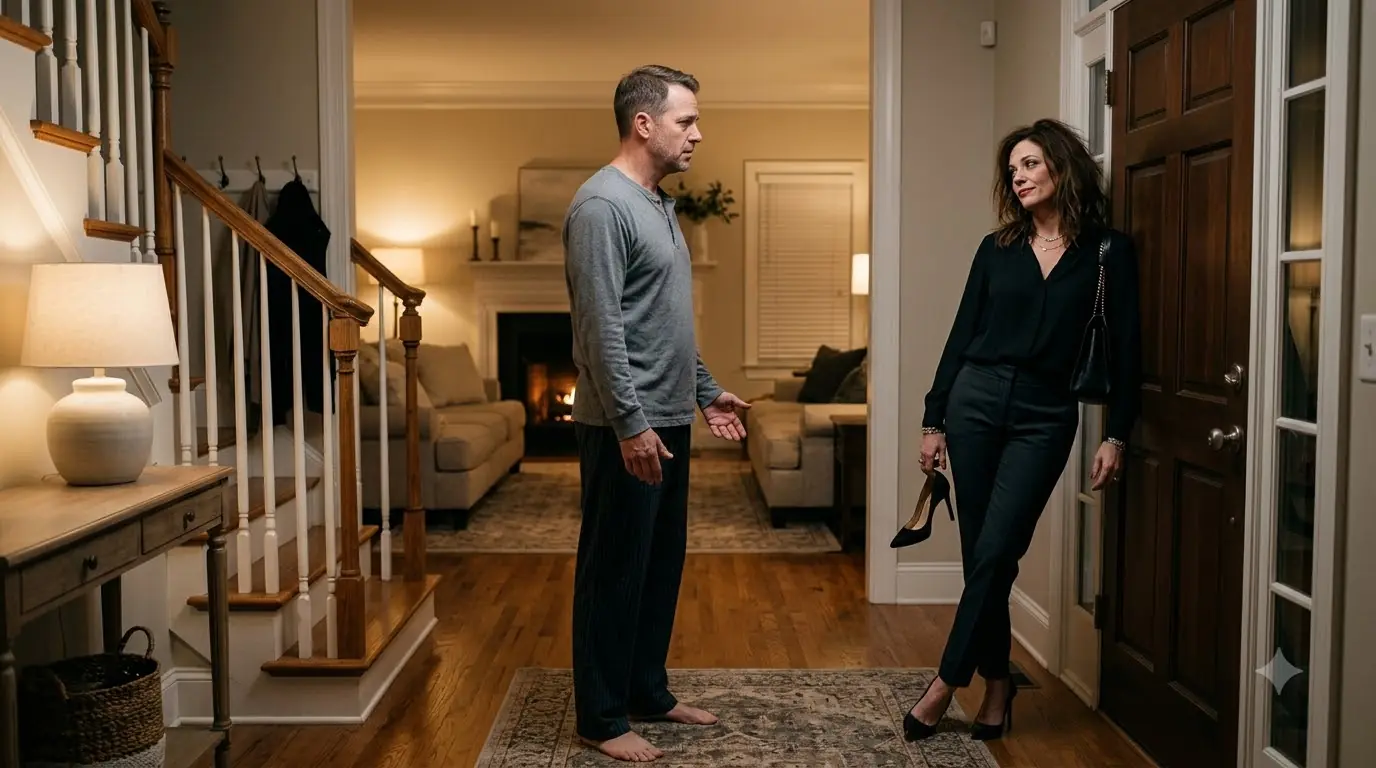
So I didn't. I went back to bed. I let her think she'd won. But the next morning, when she walked into our living room and saw who was sitting in my armchair, and saw her own mother standing beside him crying without making a sound, my wife didn't scream.
She didn't argue. She just collapsed onto the floor like her legs had turned to water. And that was only the beginning of the longest day of her life.
My name is Roland Ashford. I'm 49 years old, and I've spent the last 19 years working as a licensed family therapist here in Franklin, Tennessee, just south of Nashville. People pay me $180 an hour to help them save their marriages. Couples sit on my couch every single day crying, screaming, sometimes just sitting in silence because they don't have words left. I've heard every kind of betrayal you can imagine.
I've helped hundreds of people rebuild trust after affairs, after lies, after the kind of damage that most people think is unfixable. I was good at my job. I want you to understand that before I tell you the rest of this story, because the irony of what happened to me isn't lost on me. I spent two decades teaching other people how to read the signs of a marriage falling apart, how to notice the small changes before they become the big ones. And somehow, I missed every single sign in my own house.
I met my wife, Simone, 14 years ago at a continuing education conference in Memphis. I was 35, freshly divorced from my first wife, and not particularly interested in meeting anyone. Simone was 31, working as a pharmaceutical sales rep, sharp-tongued, quick to laugh, the kind of woman who commanded a room without raising her voice. She wore red lipstick and told a joke about a malpractice lawyer that made half the ballroom laugh so hard people were wiping their eyes. I was done for within 20 minutes.
We dated for 18 months before I proposed at a restaurant overlooking the Cumberland River. Simone cried, said yes before I'd even finished the sentence, and for the first several years of our marriage, I genuinely believed I'd found something rare. She was ambitious. She was funny. And she seemed to love me in a way my first marriage had never come close to.
We built a life together in a four-bedroom colonial on a quiet street in Franklin, the kind of neighborhood with mature oak trees and neighbors who waved from their porches. Simone's career took off. She moved from sales into regional management, then into a director position with a pharmaceutical company headquartered out of Nashville. My private practice grew steadily. We weren't wealthy, but we were comfortable.
We took a trip to Italy for our fifth anniversary. We talked about having kids, though it never happened, and eventually we both stopped bringing it up, filling the space instead with careers, with dinner parties, with the particular rhythm that childless couples in their 40s settle into. Simone's mother, Dolores, lived 20 minutes away in Brentwood, and she'd become as much a fixture in our lives as any parent could be. Dolores was 68, sharp as a tack, widowed for almost a decade after Simone's father passed from a heart attack.
She adored me, or at least I thought she did. She called me her son more often than she called me her son-in-law. Sunday dinners at Dolores' house had been a ritual for over a decade, the kind of tradition that felt as permanent as the walls of the house itself. I tell you all of this so you understand what I thought I had. I thought I had a wife who loved me, a mother-in-law who trusted me, and a marriage that, while not perfect, was solid enough to survive whatever came at it.
I was wrong about almost all of it. And the unraveling started so quietly that I nearly missed it entirely. It began about eight months before that 4:00 a.m. night with what I can only describe as small absences. Simone started staying late at the office, which wasn't unusual given her position, except the calls started coming at strange hours and she'd take them in the garage with the door shut, her voice dropping to something just below a whisper.
When I asked who it was, she'd say a client, a difficult account, corporate drama that I wouldn't find interesting. I believed her. That's the thing about spending your career teaching other people to trust their gut instincts. Somehow, you forget to use your own.
Then came the new gym membership, a boutique fitness studio downtown that cost more per month than our car payment. And with it came new clothes, new makeup, a haircut that took years off her appearance. I told myself I was happy for her. Forty-five is a hard age for anyone, and if working out and feeling good about herself made her happy, who was I to question it?
The weekend trips started around month five, a girls' trip to Charleston with women from her office, a conference in Atlanta that ran two days longer than any conference I'd ever heard of, a spa weekend in Gatlinburg with her cousin, whom I later learned hadn't spoken to Simone in almost three years. Each individual lie was small enough to swallow. It was only when I lined them all up later, sitting alone at my kitchen table with a legal pad, the way I might for a client, that I saw the pattern for what it actually was.
The turning point, the thing that finally cracked my denial wide open, happened on a Tuesday in late September. I'd had a light afternoon, only one client, a young couple working through infidelity of their own, and I remember sitting across from them thinking about how strange it was that I could diagnose the exact behavioral signature of an affair in someone else's marriage while refusing to look directly at my own.
I came home early that day, around 4:00 p.m., planning to surprise Simone with dinner reservations at the restaurant where I'd proposed. Her car wasn't in the driveway, which wasn't unusual, but her work laptop was sitting open on the kitchen counter, still logged in, screen glowing. I wasn't trying to snoop. I want to be honest about that.
I walked past it to get a glass of water, and a notification popped up on the corner of the screen from a messaging app I didn't recognize. The preview text was enough: "Can't wait for Thursday. Same room as last time."
I stood there in my own kitchen holding a glass of water I never drank, staring at those words that unraveled 14 years of marriage in about half a second. I didn't open the laptop further. I didn't need to. Something in my chest went cold and still in a way I recognized from clients who described the exact moment their world tilted sideways.
I'd sat across from dozens of people describing this precise sensation, and now I understood it wasn't a metaphor. It was physical. It felt like the floor dropping six inches beneath your feet while you're still standing perfectly upright. I closed the laptop, walked to my study, and sat down for almost two hours doing absolutely nothing.
Not crying, not raging, just sitting in the particular silence of a man who has just discovered that the last several months of his life have been a performance staged for an audience of one. I want to tell you something about myself that matters here. I don't do things impulsively. Nineteen years of sitting across from broken marriages has taught me that the people who react in the moment almost always regret the way they handled it.