Olivia had worked the base canteen for 2 years. Nobody asked her anything. Nobody ever does. For 3 months, the handlers had been eating breakfast at her counter and complaining about the same dog, a Belgian Malinois who failed every drill, wouldn't track, wouldn't hold, flinched at gunfire, and froze in the middle of the yard like he'd forgotten why he was standing there.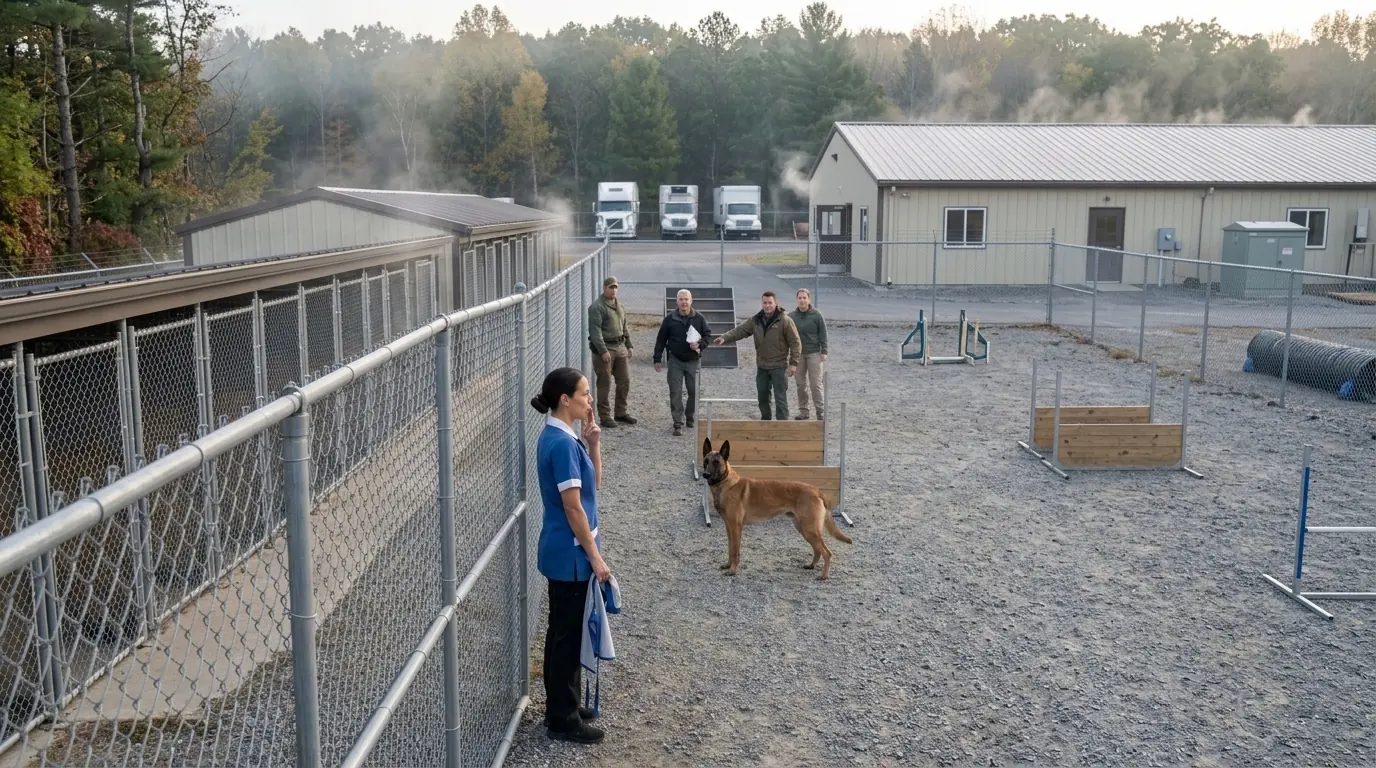
They'd started calling him a washout. That Thursday, one of them said the dog's name out loud for the first time. Bishop.
Olivia's hands stopped moving on the coffee pot. She set it down, untied her apron, walked out of the canteen and across the yard in the middle of her shift, past four handlers and a commander, who all turned to watch a waitress walk onto a restricted training range. Somebody shouted at her to stop. She didn't.
She stopped 20 ft from the dog, put two fingers to her lips, and whistled. Two short notes, one long. Bishop's head came up. And a dog who hadn't obeyed a single command in 3 months came across that yard like the last 2 years had never happened.
The base canteen opened at 5:00 in the morning, and Olivia had been unlocking the door herself for 2 years. She made the coffee before anyone arrived, wiped down the counter, set out the trays, and by 5:30, the first shift started filtering in. Mechanics, instructors, supply staff, handlers coming off overnight kennel duty with sand still on their boots. She knew all their orders by heart.
She knew which ones wanted to talk and which ones wanted to be left alone with the newspaper. In 2 years of pouring coffee for the same faces, not one of them had ever asked her a single question about herself. Olivia had built her entire life around making sure the question never occurred to anyone. She had been a Navy combat medic for 9 years.
Not a hospital corpsman rotating through a clinic. Not support staff attached to a forward base. Operational, embedded, assigned to a joint program whose name she was still legally barred from saying out loud in a room with unclassified ears. The work had put her on ground she could not describe and in situations she could not reference.
When it ended, it did not end the way careers usually end. There was no ceremony. There was no plaque. There was a separation packet, a non-disclosure briefing that ran 40 minutes longer than the separation itself, and a sealed file that meant if anyone ever tried to look her up, they would find a woman who appeared to have simply never served at all.
His K9 was a Belgian Malinois named Bishop, and Bishop was not a patrol dog or a detection dog or any of the categories most people knew about. He was trained for protective hold, trained to position himself over a downed operator and refuse the world access until the right person arrived. It was rare work. It required a dog with enormous discipline and almost no interest in praise, and Bishop had both.
The problem with a dog trained to refuse the world access was that a medic was part of the world. On their first deployment together, Dean went down with a leg wound that was not serious, but bled convincingly, and Bishop planted himself over him and would not let Olivia within 8 ft. She had a tourniquet in her hand and a dog between her and a man who needed it, and Dean, half laughing and half gray in the face, said they needed to fix that before it killed him properly. So, they built a signal.
Not doctrine, not anything from a manual. Just two of them behind a shipping container on a bad afternoon, working out something Bishop would learn to mean one thing only. Two short notes, one long. It did not mean sit or stay or heel.
It meant, "Let her in. She's the one who fixes things." Bishop learned it in three days and never once got it wrong afterward. She used it four times over two deployments. The fifth time was the last one.
Dean went down in a courtyard outside a village that was not on any map anyone would ever be allowed to look at. It was not a leg wound, and it was not something a tourniquet was going to solve. Bishop was over him before the dust had settled, facing outward, holding, doing precisely what 900 hours of training had built him to do, while the man underneath him was already past saving. Olivia got to the edge of the courtyard, saw the shape of it, and understood in one second exactly what she was looking at.
She put two fingers to her lips and whistled anyway. Two short, one long. Bishop stepped aside and let her in, and she knelt down and did everything she knew how to do for eleven minutes, with a dog standing over both of them, still holding a perimeter that no longer had a reason to exist. She left the Navy 14 months later.
Not from guilt, exactly. The review found nothing she could have done differently, and she believed it most days. It was something harder to name. She had built a working life around two things, a man and a dog, and one of them was gone, and the other one had vanished into a transfer system she had no legal standing to ask about.
Bishop was a classified program asset. She was a medic who had never been officially attached to his handling record. Every request she filed came back the same way, no releasable information. She filed six of them over eight months.
Then she stopped filing and started thinking. The base canteen job came up in the spring. It paid poorly and the hours were bad and it sat directly across the road from a canine training complex that received transfer dogs from programs all over the country. Olivia took it in under a day.
She did not tell her mother why. She did not tell the friend who helped her move. She simply understood that the only tool she had left was proximity. That if a dog like Bishop ever came through a facility like this one, somebody would eventually sit at her counter and say something about him over eggs at 6:00 in the morning.
So she poured coffee and wiped counters and listened every shift for two years to men who had no idea she was doing anything but working. For the last three months they had been talking about the same dog, a Malinois transferred in from a program nobody would name, failing everything they put in front of him. Wouldn't track, wouldn't hold a bite, froze in the middle of the yard mid-drill like he had forgotten why he was standing there. One of them said the dog spooked at gunfire, which made no sense for an animal with obvious operational conditioning.
Another said he'd been caught at night clearing corners in the kennel run, checking sightlines like he was working a building, then going right back to failing basic recalls the next morning. They had started calling him a washout. Sergeant Vance kept defending him and getting laughed at for it. Olivia listened to every word of it for 12 weeks and never once looked up from the counter because there were dozens of Malinois in the system and hundreds of failed transfers and she had learned the hard way what hope costs when you spend it on the wrong thing.
Then on a Thursday morning in October with the coffee pot in her hand and three handlers halfway through their eggs, Sergeant Vance said the dog's name out loud for the first time. Bishop. The word landed in the canteen the way a name lands when you have been listening for it across 700 mornings without once allowing yourself to believe it would come. Olivia's hand stopped on the coffee pot, not dramatically.
She did not drop it or spill it or do any of the things a person does in a film. She simply stopped pouring mid-cup and stood there for perhaps two full seconds with her arm frozen at an angle that Sergeant Vance would later say he noticed and thought nothing of at the time. Then she set the pot down on the warmer, said nothing to anyone, and reached behind her back to untie her apron. Vance was still talking.
He was saying something about the washout paperwork and a deadline and how nobody had actually tested the dog for anything other than standard patrol work, and one of the other handlers was already telling him to let it go, that some dogs just come back wrong and it isn't anybody's fault. Olivia folded the apron once and laid it on the counter next to the register. She walked out from behind the service line, past the coffee urns, past the table where three men were eating eggs and arguing about a dog she had spent two years looking for, and out through the canteen door into the October morning without a single word to anyone in the building. The training complex sat across the road and 200 yd down behind a chain-link perimeter with a gate that was propped open at that hour for the morning drill rotation.
Olivia walked toward it at a pace that was neither hurried nor casual, the specific unhurried directness of someone who has known exactly where she was going for a very long time and is finally being permitted to go there. She crossed the road. She went through the open gate. She walked past a supply shed and a row of parked transport vehicles and out onto the edge of the training yard in a blue and white canteen uniform with her name tag still pinned to her chest at 7:15 in the morning on a restricted range in front of 11 people who all turned to look at her at approximately the same moment.
The yard held four handlers, two instructors, a kennel tech, and Commander Ellis Hollis, who had been standing at the fence line with a clipboard reviewing a washout evaluation that was already 11 days into its administrative process. It took Hollis about four seconds to register that a civilian food service employee had just walked onto his range without authorization, and another two to start moving toward her. One of the instructors shouted at her to stop. Olivia did not stop.
She did not look at the instructor, or at Hollis, or at any of the men now converging toward her from three directions. She was looking at the middle of the yard, where a Belgian Malinois stood motionless 20 ft from a set of hurdles he had refused to approach in the exact frozen posture the handlers had been describing over breakfast for 3 months. He was thinner than she remembered. His coat had lost some of its density, and there was a scar along his left flank she did not recognize.
From something that had happened to him somewhere in the 18 months she had spent filing requests that came back with nothing on them. But it was Bishop. She had known it was Bishop from the moment Vance said the name, and standing 40 ft away from him now with three men closing in on her from behind, she knew it with the specific and total certainty of a person recognizing something they had helped build. Somebody grabbed her arm.
She did not pull away, and she did not fight it. She simply stopped where she was, which was as far as she needed to go anyway, and put two fingers to her lips. The whistle cut across that yard the way it had cut across a dozen other places in two deployments. Two short notes, clean and precise, and then one long one that held for a full second and a half in the cold morning air.
It was not loud. It was not a command whistle, or a recall whistle, or anything that resembled the tonal patterns every handler standing in that yard had been trained on. It was two people behind a shipping container on a bad afternoon in a country that did not officially exist, working out a signal that meant one thing and had only ever meant one thing. Bishop's head came up.
The change in him was not gradual. It was not a dog slowly recognizing something and working out how to respond. His ears came forward. His weight shifted onto all four paws in a single motion and the distant unfocused quality that had been in his eyes for 3 months cleared out of them completely, the way fog clears off glass when a door opens.
He turned his head toward the fence line and found her. Not scanning, not searching, just finding immediately, the way you find something you already knew the location of. And then he came across that yard at a dead run past the hurdles he had refused for 12 weeks, past two instructors who both stepped backward without meaning to, and stopped hard in front of Olivia and pressed the full weight of his body against her legs and stood there without moving. The yard went completely silent, not gradually, all at once.
The specific total silence of a group of professionals who have just watched something happen that none of their training accounts for. The instructor holding Olivia's arm let go without appearing to decide to. Sergeant Vance, who had followed her from the canteen and arrived at the gate about 10 seconds too late to stop her, stood there with his mouth slightly open and did not say anything at all. Olivia put one hand down on the back of Bishop's neck and the dog leaned into it and closed his eyes.
And for a moment, nobody in that yard did anything except watch. Commander Hollis reached her about eight seconds later. He was 54 years old and had been running K9 operations for 19 of them and had never in his career watched an unauthorized civilian walk onto his range and recall a failing asset with a whistle he had never heard before. He asked her who she was, not unkindly.
He asked it the way a man asks a question when he has genuinely no framework available for what he is looking at and needs one immediately. Olivia straightened up, kept her hand on Bishop's neck and gave him the only four words she had that were both true and hers to say. "I was his medic." Hollis absorbed that for a moment. Then he asked the obvious follow-up, the one any commander in that position would ask, the one that was going to become the entire problem within the next 90 seconds.
He asked her which unit, which program, which handler. And Olivia stood in the middle of a restricted training yard with her hand on a dog she had spent 2 years looking for and understood with complete clarity that she could not legally answer a single one of those three questions. She gave him one name: Marcus Dean. It was the only piece of the whole thing she was permitted to hand over because Dean's death was a matter of record even if everything surrounding it was not.
And a name attached to a casualty was not the same category of information as a program designation or a unit assignment. She said it plainly and then she stopped talking. And Hollis waited for the rest of it the way commanders wait when they have asked a direct question and received a partial answer and the rest of it did not come. Olivia stood there with her hand still resting on Bishop's neck and gave him nothing else.
Not because she was being difficult, but because there was nothing else in her possession that belonged to her to give away. Hollis sent a runner to pull the file. It took eleven minutes and in those 11 minutes the yard rearranged itself into the specific uncomfortable configuration of people who do not know whether they are witnessing something remarkable or something they should be reporting. The instructors drifted back toward the equipment shed and pretended to check gear.
Two of the handlers stood at a distance and talked quietly to each other in the way people talk when the subject of the conversation is standing 40 ft away. Sergeant Vance stayed close, which Olivia noticed and filed away because in her experience the person who stays close during the uncertain part is usually the only one who matters later. The file came back with nothing usable in it. Marcus Dean existed, date of birth, service entry, rank, and a date of death 18 months prior with a location field that had been replaced by a control number rather than a place name.
Everything else was sealed. His unit assignment was sealed, his operational history was sealed, and when Hollis had the tech run Olivia's name through every database his clearance gave him access to, the result was worse than a wall. It was an absence. There was no service record.
There was no separation date. There was no indication anywhere in any system available to a base commander that the woman standing in his training yard had ever worn a uniform in her life. Hollis was not a cruel man and he did not accuse her of anything. He simply stated the position as it existed which was that a civilian employee with no verifiable military history had entered a restricted range without authorization, produced a whistle nobody recognized, and gotten a response from an animal that had been failing evaluations for 3 months.
He said he could not build an official decision on that. He was, from where he was standing, entirely correct. One of the younger handlers, a man named Reeves who had been the loudest of the group at Olivia's counter for 12 weeks, said what several of them were already thinking. Dogs respond to whistles.
That is not proof of anything. Malinois are sound reactive by breed and a novel tone in a familiar environment produces exactly the kind of alert response they had all just watched. It was, he pointed out, a coincidence dressed up as a miracle. He did not say it maliciously.
He said it the way people say things when the alternative explanation requires them to accept that they have all been wrong about something for 3 months and that a canteen worker knew it before they did. Then Hollis delivered the part that mattered more than any of it. Bishop's washout paperwork had been filed eleven days ago. It carried a deadline.
Administrative removal from the program was not a decision anyone in that yard could reverse by being impressed on a Thursday morning and one unexplained recall did not undo a documented pattern of failure across 12 weeks of evaluation. The administrative process was already moving. Unless something changed materially and quickly, the dog standing against Olivia's legs would be pulled from the program and disposed through civilian rehoming or, given his behavioral flags, something considerably less pleasant than that. He asked her to leave the range.
Olivia did not argue. She had spent 8 months arguing with paperwork after Dean died and had learned precisely how much good it did. She knelt down, put both hands on either side of Bishop's face, and said something to him too quietly for anyone else in the yard to hear. Then she stood up, walked back across the road to the canteen, put her apron back on, and finished her shift.
Bishop stood at the fence line watching her go for the entire length of that walk and did not move until she was through the canteen door. Sergeant Vance found her at the counter at 4:00 that afternoon after the lunch rush and before the evening shift when the canteen was empty enough to talk. He was 38 and had been handling working dogs for 11 years and had spent the last 3 months being laughed at for defending an animal everyone else had written off. He did not open with an apology or an accusation.
He sat down on a stool, put his hands flat on the counter, and asked her one question. "What is he?" Olivia looked at him for a long moment. Then she poured him a coffee he had not ordered and told him the part she was allowed to tell, which was not the program or the missions or the locations, but the thing itself. Bishop was not a patrol dog.
He was not a detection dog. He had never been trained for either of those things and had almost certainly never been evaluated on them before arriving at this facility. He was a protective hold asset conditioned to identify a downed operator, position himself over that operator, face outward, and refuse the world access until the correct person arrived. Not until commanded to stand down until the correct person arrived.
Vance sat with that for a moment. Then he said the thing that Olivia had been waiting 3 months of overheard breakfast conversations for somebody to say. He said that Bishop froze in the middle of the yard mid-drill. Not at the start.
Not at the obstacle. In the middle, in open ground, and he would stand there and not move and the handlers would call it a failure to complete and mark it down and move on to the next dog. "He was not failing," Olivia said. "He was holding." She explained it the way she had understood it the moment she watched him from the fence line that morning.
A dog conditioned for protective hold does not stop working when his operator is gone. He stops having something to hold over. Put him in an open yard with no downed man, no signal, and no context, and the conditioning still fires. He takes a position.
He faces outward, and he waits. He had been waiting in the middle of that training yard for 12 weeks for somebody to come to him because that is what the work was, and every single person evaluating him had been grading him on his failure to move. Vance put his hand over his mouth and left it there for a while. Then he asked how she could possibly prove that to Hollis with the deadline where it was, and her file returning nothing, and Reeves in his ear about coincidences.
And Olivia turned the coffee cup slowly on the counter and told him there was exactly one way to demonstrate it. One thing that would leave no room for any other explanation in front of every person in that yard. Doing it would mean deliberately putting Bishop back into the precise scenario that had broken him. Vance took it to Hollis that evening, and Hollis said no twice before he said yes.
His objections were reasonable ones. A civilian designing a test protocol on his range. An animal with documented behavioral flags being deliberately placed into a stress scenario. And a commander whose signature would be on the incident report if any part of it went wrong.
What changed his mind was not Vance's argument. It was the file. Hollis had gone back to Marcus Dean's record that afternoon and looked at it properly rather than scanning it. And he had noticed that a man whose entire operational history was sealed behind a control number had a canine handling certification listed under a specialty designation Hollis had seen exactly twice in 19 years.
He knew what protective hold was. He had simply never had a reason to imagine it walking into his facility mislabeled as a patrol prospect. They ran it the following morning at 7:00 in the same yard with the same people present. Hollis wanted witnesses.
Olivia had asked for two things only, that nobody signal Bishop in any way, and that she stand at the fence line rather than in the yard, far enough back that no reasonable person could later claim she had queued him. Reeves was there. So were both instructors and the kennel tech and three handlers who had come specifically because word had gotten around the base overnight, the way word does. Nobody was laughing that morning.
Whatever this was going to be, everyone standing at that fence understood they were going to be talking about it for a long time afterward. Vance walked out into the middle of the yard, laid down on his back on the concrete and went still. That was the entire setup. No commands, no leash, no handler within 30 ft of the dog.
Bishop was released at the far end of the yard and given nothing at all. No signal, no name, no instruction. Just an open range and a man on the ground 80 ft away. He was moving before the release gate had finished swinging.
Not running. The specific low, fast, economical movement of an animal covering ground it has covered a thousand times in far worse conditions than a training yard on a cold morning. He reached Vance in under four seconds. And what he did when he got there was not what any patrol dog in that facility would have done.
He did not sniff him. He did not bark or circle or alert. He positioned himself directly over Vance's torso, planted his weight, turned his head outward, and stopped moving entirely. His body formed a shape over the man on the ground that every person watching recognized immediately, even if none of them had ever seen it performed live before.
He was not standing near Vance. He was standing over him, between him and the entire rest of the world. He had done it without a single word from anyone. One of the instructors, a man named Kessler who had been at that facility 11 years, started walking toward them.
He got to about 15 ft before Bishop's head came around and tracked him. At 10 ft, Bishop shifted his weight forward. No growl, no bared teeth, no aggression of any kind. Just a small and absolutely unmistakable adjustment of position that put more of himself between Kessler and the man on the ground.
Kessler stopped at 8 ft. He said later that he had not consciously decided to stop, that his legs had simply worked out something his brain was still catching up to. He backed away with both hands visible and Bishop settled again and went back to facing outward, holding, unmoved. The yard was completely silent.
Reeves had both hands on the top rail of the fence and was not saying anything about coincidences. Then Olivia whistled. Two short notes, one long. Bishop's ears came forward.
He stepped off Vance's torso, cleanly, without hesitation. It was the transition of an animal executing the second half of something it had done before. Bishop moved to one side, stood there, and waited. Access granted.
The correct person had arrived. Olivia walked out into the yard past a dozen people who did not make a sound, knelt down beside Vance and put her hand on Bishop's shoulder, and the demonstration was over. Hollis stopped the washout paperwork himself that afternoon. He did not need a discussion about it.
What he had watched was not a dog that had been failing evaluations. It was a specialist who had been graded for 12 weeks on an exam written for a completely different animal by people who had never been told what they were actually looking at because the paperwork that would have told them had been sealed behind a control number by a program that no longer existed to explain itself. What happened in that yard was not a dog proving himself. It was a room full of professionals finally discovering they had been asking the wrong question the entire time.
Vance found her afterward sitting on the low wall outside the kennel building with Bishop lying across her feet. He asked her the thing that had been bothering him since the previous afternoon, which was why she had waited 2 years, why she had poured coffee for every handler on that base for 700 mornings without once saying a word about what she was and what she was looking for. Olivia thought about it for a while before she answered. She told him that when Dean died, she had filed six formal requests for information about Bishop's placement, and every one of them had come back with no releasable information printed across the top, and that after the sixth one, she had understood something about the specific shape of her situation.
She had no proof. She had no standing. And she had no legal right to explain either of those things to anybody who might have been able to help. "Some things you carry quietly," she said, "because carrying them loudly is not one of the options available to you." Hollis made a phone call the following week to somebody several levels above his own clearance, and whatever that conversation contained, it produced a result.
It took nineteen days. What came back was not a public acknowledgment or a ceremony or anything with photographs attached to it. It was a corrected service record, unsealed to the minimum degree necessary, and a letter on official stationery confirming Olivia's operational attachment to a joint program between specified dates, alongside a second document confirming her role as attending medic to Petty Officer Marcus Dean on the date of his death. Dean's name and her name on the same page, officially, for the first time in 18 months.
She read it twice at her kitchen table and then put it in a drawer because it had never actually been about the paper. Bishop was redesignated within the month for the work he had been built for with Vance as his handler and a training protocol Olivia helped write from scratch because nobody at that facility had one, and it turned out nobody in the region did either. Six weeks later the base brought her on as a contracted consultant for specialized transfer intake, the specific job of looking at dogs arriving from sealed programs with incomplete paperwork and working out what they had actually been trained to do before somebody graded them on the wrong thing and wrote them off. In the first four months she identified two more.
Neither of them had been failing either. She kept working mornings at the canteen for a while out of habit more than need and the handlers who had sat at her counter for two years never quite got used to it. Reeves apologized to her properly twice, the second time without being prompted. But the image that stayed with everyone on that base was a simpler one.
A woman crossing the yard at 7:00 in the morning without an apron on and a Belgian Malinois who had not obeyed a command in three months rising to his feet before she reached the gate every single day because the correct person had finally arrived and he had never once stopped waiting for her.