"You people don't get to turn this street into a zoo."
"Ma'am, it's my mother's seventieth birthday."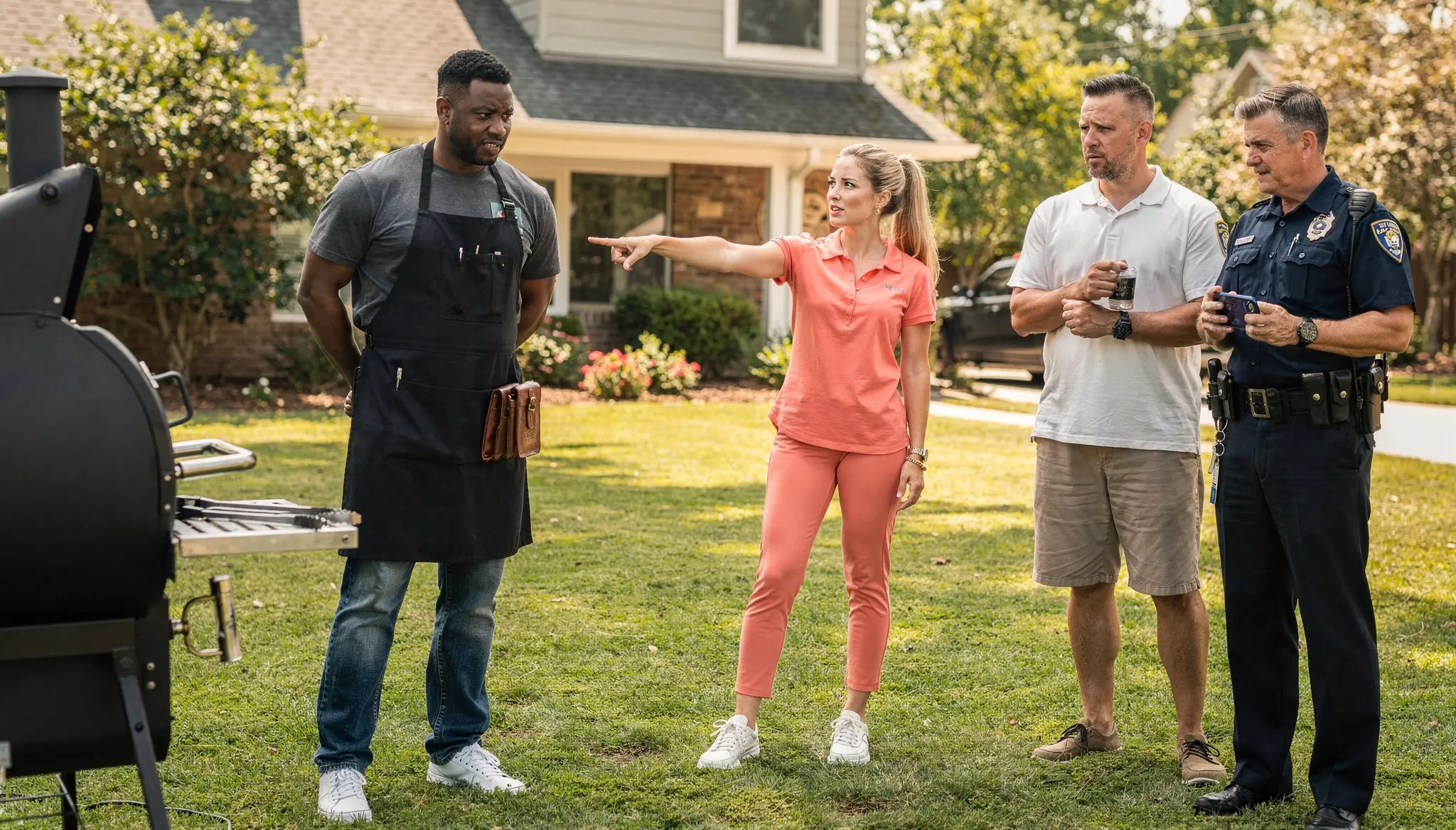
"Get the smoke in the shot too, baby. All of it."
"Oh, I've got better than smoke, sweetheart. I already called the real police."
"Officers, thank God. This man threatened me. This whole thing is out of control. What are you waiting for? Grab him right now."
"Careful what you wish for, ma'am."
The woman had just ordered two officers to arrest their own boss. In the next few minutes, one sentence would begin costing her a career, a marriage, and the respect of an entire street. Three hours before the badge came out from behind his back, Anthony Freeman was standing in his own driveway at seven in the morning, arguing with his older brother about charcoal.
To understand what happened on that lawn, one had to understand the man in the apron. Anthony Freeman was forty-five years old, tall and broad through the shoulders, with the kind of easy, handsome face that made rookies relax and criminals confess. He had spent twenty-one years earning a badge the slow way: foot patrol in the rain, nights in a detective bureau that smelled like burned coffee and cold cases, and years as a deputy chief in another city where he cut response times and complaints at the same time, something many people considered impossible.
Three months earlier, after a national search and a unanimous city council vote, the city had sworn him in as its police chief. He was the first Black man ever to hold the job there. His face had appeared in the newspaper exactly twice, both times in dress uniform and beneath headlines most people skimmed.
In real life, Anthony drove a sixteen-year-old pickup truck he refused to give up, mowed his own lawn in a floppy hat, and had been too busy rebuilding the department to attend a single neighborhood social. The Freeman family had moved onto Dogwood Lane in the middle of January, during that gray stretch of winter when streets tended to keep to themselves. To most of his neighbors, Anthony was simply the tall new man in the corner house with the well-kept grass and the beautiful family.
His wife, Regina, was a pediatric surgeon with fourteen years of steady hands. She was elegant, composed, and so breathtakingly beautiful that Anthony still watched her cross a room like a man who could not believe his luck. Their daughter, Zuri, was six years old, gap-toothed, and currently obsessed with two things: ladybugs and her grandmother.
That grandmother, Mama Ernestine, was turning seventy that day. Seventy years, thirty of them spent cleaning office buildings at night so her sons could have lives in the daylight. Anthony had planned the cookout for a month, the same way he planned operations, with lists, backup lists, and exact times for everything.
Uncle Levi, Anthony's older brother, had driven four hours with his own smoker hitched to his truck because Levi did not trust anyone else's ribs, including Anthony's and especially Anthony's.
"I bought the charcoal Daddy used."
"Daddy had flavor, and it wasn't from this charcoal."
By noon, Dogwood Lane smelled like heaven with a side of cornbread. Two folding tables stood beneath the trees, covered in red-checkered cloths. Sweet tea filled a glass dispenser crowded with lemon wheels, cousins and church friends moved in and out of the yard, Regina's sorority sisters claimed one end of the patio, and a domino game aged like wine beneath the oak tree.
The playlist had already traveled from gospel to Frankie Beverly, the destination toward which every good family cookout eventually moved. Three doors down, behind a spotless bay window, Lindsay Whitley watched the cars park.
Lindsay was thirty-eight and genuinely beautiful, the polished, catalog kind of beautiful that photographed well on bus bench advertisements. That was convenient because her face appeared on four of them. She had been the area's top-selling real estate agent for three years running, served as social chair of the neighborhood association, and was married to Todd, a mortgage broker with brilliant white teeth and a ski boat.
She wore sunrise-colored athletic clothes, drank celery juice, and patrolled Dogwood Lane's property values the way some people patrolled borders. She also kept a log, a real one, in her phone. It included the jogger she had reported for looking unfamiliar, the mail carrier she had reported for lingering, and the basketball hoop she had gotten removed for being an eyesore.
Every entry was filed beneath a folder she had actually named Neighborhood Standards. The Freemans had been on her radar since January, when the moving truck arrived. She had watched from her window as a tall Black man carried a television into his own house and, for one full second, considered calling someone.
The neat lawn confused her. The beautiful wife confused her. The old pickup truck offended her on a level she could not articulate. Now, on a golden Saturday afternoon, smoke drifted across her fence line, bass drifted across her patio, and thirty happy Black guests laughed three doors down from her open-house signs.
Lindsay Whitley put down her celery juice and picked up her phone.
"Todd, baby," she called toward the garage. "Get your shoes. It's finally happening."
The first approach came at one o'clock, and it came smiling. Lindsay crossed the street in white sneakers that had never touched dirt. Todd followed with his phone already out, holding it low near his hip like a holstered weapon.
She stopped at the edge of the Freeman yard, exactly where one strip of grass met another, and clasped her hands like a kindergarten teacher preparing to manage a difficult child.
"Hi. Sorry to interrupt. Who's in charge of all this?"
"That would be me."
Anthony came around the grill, wiping his hands on his apron, his smile easy and welcoming.
"Anthony. We're the corner house. Can I help you?"
"Lindsay Whitley. Three doors down. The white colonial."
She did not offer her hand. Instead, her eyes moved past him and made a slow circuit of the yard: tables, coolers, dominoes, guests. When her gaze returned, it carried an inventory's worth of judgment.
"So, this is a lot."
"It's my mother's seventieth birthday."
Anthony gestured warmly toward the tables.
"Mama Ernestine. That's her in the sun hat holding court. Can we fix you two a plate? Levi's ribs are almost criminal."
For one second, the smell of the smoker reached across the property line and nearly saved the entire afternoon. Then Lindsay's nostrils flared, and her sense of superiority won.
"We don't eat this," she said, making a small gesture that seemed to include the food, the music, the people, and everything around them. "Look, I'll be direct. The neighborhood association has standards about gatherings, noise, cars, and smoke. I'm going to need you to start wrapping this up."
She said smoke the way other people said mold.
"Ma'am, it's one o'clock in the afternoon on a Saturday," Regina said as she came up beside her husband.
Regina Freeman in the sunlight was almost unfair, tall, serene, and strikingly beautiful. Lindsay's jaw tightened at the sight of her in exactly the same way it had tightened at the sight of the lawn.
"The music is at neighbor volume," Regina continued. "The cars are parked legally. You're welcome to stay, and you're welcome to go home. Those are the two options."
Lindsay blinked. She was not accustomed to another beautiful woman standing on the opposite side of an argument.
"Cute," she said. "Real cute. You should know I have the mayor's cell number."
"Tell him to bring a chair," Mama Ernestine called from the table without looking up from her dominoes.
The entire yard laughed. That was the moment Lindsay Whitley declared war.
For the next hour, she conducted surveillance from her porch. She held up her phone with a decibel-meter app open and walked the fence line like an inspector, announcing numbers to Todd. She photographed every license plate, crouching slightly as though the church van were a getaway vehicle.
She used an actual tape measure to calculate the distance between Levi's smoker and her fence. Todd wrote the number on a legal pad, and the two of them nodded at one another like scientists.
"Baby, get the tape measure in the shot," she directed. "Evidence has to be thorough."
"You're so good at this," Todd said, kissing her temple before filming her measurements.
Between measurements, Lindsay operated the neighborhood text chain like a switchboard.
"Is everyone seeing what's happening on Dogwood?" she typed. "Cars everywhere. Smoke. This is a property-values issue, people."
A woman from the cul-de-sac sent three siren emojis in solidarity. Most of the street left Lindsay's message marked as read. The actual president of the neighborhood association, a retired schoolteacher of thirty years, responded with one sentence.
"A birthday party is not a violation, Lindsay."
Lindsay took a screenshot and filed it in Neighborhood Standards under the label obstruction.
At one forty, she called the city's non-emergency line. She listed the smoke, the bass, the cars, and the number of guests, in that order. A bored clerk informed her that a Saturday afternoon barbecue on private property was not a code violation anywhere in America.
She hung up before he finished.
"Unbelievable," she told Todd. "The system is broken."
"You're the only one holding this street together, baby," Todd replied.
At two o'clock, Lindsay made her second approach. This one did not bother smiling.
"I asked you nicely," she announced from the sidewalk, arms crossed. "Music off. Grills out. Guests gone by three, or I make a call. And trust me, sweetheart, my calls get answered."
Uncle Levi put down his tongs. Levi was bigger than his brother, twice as loud, and possessed a much lower opinion of patience.
"Lady, whose lawn do you think you're hollering at?"
"It's fine, Levi."
Anthony's voice remained level, but something inside it had become quiet and exact. It was a tone Levi had not heard since their father's funeral, the tone of a man carefully filing away facts.
"Not today," Anthony said. "Today is Mama's day."
"Listen to your brother, big man," Todd called from behind his phone with a grin. "Wouldn't want an incident on camera."
"This is not that kind of neighborhood," Lindsay said, lifting her chin and speaking loudly enough for every guest to hear.
She was also loud enough for the children's table, though by grace the children were deeply occupied with a popsicle negotiation and heard none of it.
"You people can take this cookout back to whatever part of town does this. Final warning."
She turned sharply and marched home, with Todd jogging to keep her in the frame.
Anthony Freeman remained at the grill, wearing an apron on his own lawn at his mother's seventieth birthday, and made a decision that would later be discussed in rookie training classes throughout the city. He decided to do absolutely nothing.
He flipped the burgers. He refreshed his mother's tea. He waited because Anthony understood something Lindsay Whitley did not. Some people, if given enough room, would build the entire case against themselves, brick by brick, on camera, in daylight.
At two forty, on her back patio, while Todd filmed what she called documentation, Lindsay dialed 911.
"What is your emergency?"
"Yes, hi. I need officers at Dogwood Lane immediately. There is a large, aggressive gathering. Dozens of individuals. Men drinking in the open."
Her voice transformed into something breathy and fragile. She pressed one hand to her chest for an audience of no one.
"I went over very politely just to talk about the noise, and one of the men threatened me at his smoker."
Four properties away, the man who had offered her ribs sprinkled brown sugar over them.
"Threatened you how, ma'am?" the dispatcher asked in a flat voice.
"He, the big one, came toward me aggressively. I'm shaking. I can barely hold the phone."
She held the phone perfectly steady. Todd gave her a thumbs-up.
"There are so many of them. I feel very unsafe in my own home."
"How many individuals, ma'am?"
"Fifty. Sixty. They keep multiplying. There's a van."
She said van with genuine dread, as though the Second Baptist Church had ever harmed anyone with a casserole.
"I have photographs of every license plate. I have decibel readings. I've been documenting everything all afternoon."
"Are any of them armed, ma'am?"
A pause.
"They're barbecuing," Lindsay said. "Probably."
The dispatcher was a twenty-year veteran of the console and had heard every variation of this call. She read the address back without any change in tone because professionals kept their opinions off recorded lines.
"Units are en route, ma'am."
Across the street, Regina found her husband at the grill and stood beside him, watching the woman in the coral top pace her patio with a phone pressed to her ear.
"You know she just called the police on us."
"I know."
Anthony turned a rack of ribs with surgical calm.
"Baby," Regina said, lowering her voice, "you could end this in one sentence. Are you going to tell them who you are?"
"No. Not first."
He closed the grill lid, and the quiet, precise quality returned to his voice.
"If my name is the only thing standing between this family and a pair of handcuffs, then this street isn't safe. I'd rather find that out today, in daylight, on my own lawn, than find out some night when it's another family standing here."
Regina looked at her husband for a long moment. Then she kissed his cheek and went to refill her mother-in-law's tea because she had married exactly this man on purpose.
Eight minutes passed. No sirens appeared, so Lindsay called again.
"911. What is your emergency?"
"It's me again. Dogwood Lane. I called about the gathering. Nobody has come, and it's getting worse. The bass is like a war zone. Do you want a tragedy on the news? Is that what this city is waiting for? Because I vote, and I know people, and I'm documenting everything."
"Units are two minutes away, ma'am."
Lindsay disconnected the call and turned toward Todd, cheeks flushed, beautiful and incandescent with righteousness.
"Camera ready?"
"Battery's full, baby," Todd said tenderly. "Go end that barbecue."
She crossed the street ahead of the patrol SUV like a majorette leading a parade, her coral top blazing in the golden light and her pointing finger already prepared. The Freeman family's music was mid-song, the dominoes were mid-slam, and Mama Ernestine was mid-story when Lindsay planted her white sneakers at the edge of that green lawn and delivered the opening line of the rest of her life.
"You people don't get to turn this street into a zoo."
Officer Grady had nineteen years on the job, silver hair, and instincts that told him things dispatch notes could not. The call on the screen had read: Large aggressive gathering. Possible threats. Caller feels unsafe.
What came into view on Dogwood Lane was a red-checkered tablecloth, a glass jug of sweet tea catching the sun, a domino game beneath an oak tree, and a grandmother in a sun hat wearing a paper crown that read BIRTHDAY QUEEN.
Grady spoke to the rookie beside him as he put the patrol SUV in park.
"I want you to watch how this kind of call usually goes, and I want you to remember it. Rule one: the caller will do all the narrating, and none of it will match the scene. Rule two: there is always a husband with a phone. Rule three: the actual danger level runs opposite to the caller's volume. Are you with me?"
"Yes, sir."
"Then smile, rookie. We're about to get yelled at by a homeowner."
The woman in the coral top was already crossing the street toward them at a fast walk, waving as though the officers were late to one of her open houses. Behind her came a husband holding a phone sideways.
"Officers, thank God. This man threatened me. This whole thing is out of control."
Anthony Freeman stood beside his grill, apron on and hands loose, watching two of his own patrol officers cross his own grass toward him. Neither had ever met him. He had been sworn in with the command staff and had spent his first three months buried in buildings, budgets, and department reform. Most patrol officers knew their new chief only as a signature and a rumor about response times.
Grady had stood honor guard at the swearing-in ceremony, four rows back, overheated and squinting. Anthony said nothing about any of that. Instead, he slipped two fingers into the front pocket of his apron, where a worn leather badge case had rested all afternoon between a meat thermometer and a pack of gum.
He drew it into his right hand, then let that hand drift casually behind his back.
"Sir," Grady said, stopping at a respectful distance and taking in the tables, the birthday crown, and the complete absence of anything resembling danger. "Afternoon. We received a call about this address. May I get your name?"
"Anthony Freeman. This is my home. That's my mother, Ernestine, the birthday queen. My wife, Regina. My brother, Levi, who is responsible for whatever that smoker is doing to your willpower right now."
Grady's mustache twitched. The smell truly was doing things to his willpower.
"He's lying," Lindsay announced as she pushed into the middle of the conversation, breathless, with one hand pressed to her chest, presenting herself as the picture of a terrified homeowner.