"Put those down, right now. I said put them down."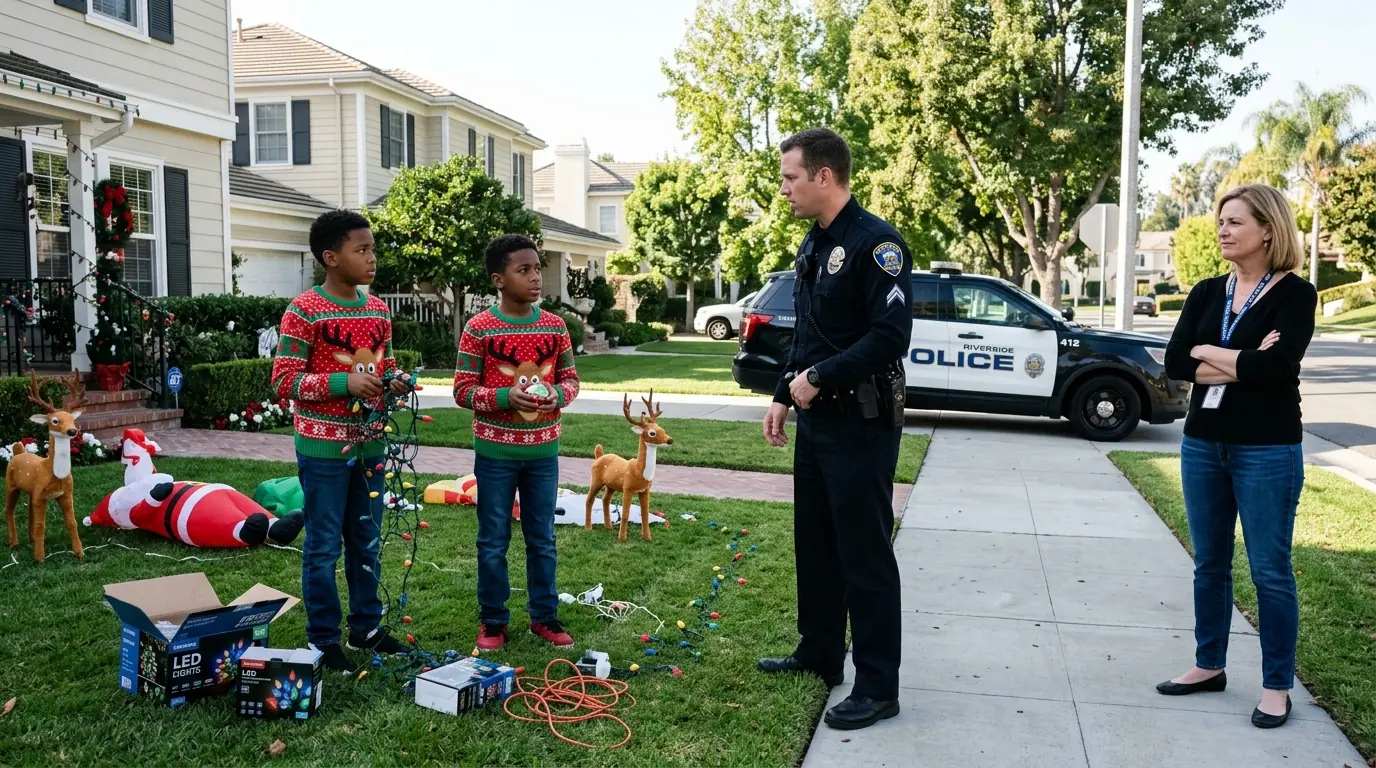
Patricia Brennan's voice cuts like glass. She marches across her lawn toward two 10-year-old boys. She rips a string of Christmas lights from Jordan's hands.
"You think I'm stupid? I know theft when I see it. Little thugs like you come into nice neighborhoods, scout houses, steal whatever you can carry."
"Ma'am, please—" Jordan starts.
"Shut your mouth! Don't you dare talk back to me. I don't know what kind of parents let their kids run around unsupervised stealing from people's yards, but this ends now."
Julian is crying. "This is our house! We live here!"
Patricia laughs. It's cold. Mean.
"Your house? In Riverside Oaks? Do you know what homes cost here? Your people can't afford a mailbox in this zip code. I've called the police. They know me. My husband writes checks that pay their salaries. So you sit down, shut up, and wait."
Their mother is three minutes away. Patricia Brennan has no idea what's about to walk through that door.
Three days earlier, Tanya Davis sits in a conference room on the fourth floor of the Riverside County Administration Building. Budget reports spread across the table in front of her. Line item 23 catches her eye: Police Overtime. Third month in a row, they're over budget. She circles it with a red pen.
As county administrator, Tanya oversees $82 million—every department, every contract, every paycheck. The police department answers to her office: every badge they wear, every squad car they drive, every dollar of overtime they claim. She reviews it. She approves of it. Or she doesn't.
She's been in this role for six years, elected by 62% of voters in a county that's 48% white. People respect her work. She's fair, thorough. She pushes for reform, but stays pragmatic. When she speaks at county board meetings, people listen.
But right now, she's not thinking about budgets. She checks her watch: 3:15. Jordan and Julian get home from school at 3:30. She wants to be there when they arrive.
Her sons are 10 years old, twins, both honor students, both on the youth basketball team, both obsessed with Christmas. They've been planning their yard decorations since Halloween: Jordan drew diagrams, Julian made lists, they saved their allowance to buy extra lights. This Saturday, they finally get to decorate. It's their favorite tradition. It's been their favorite tradition since they were six.
Tanya moved to Riverside Oaks two years ago. The neighborhood is exactly what she worked her whole life to afford: tree-lined streets, well-maintained homes, good schools within walking distance, an HOA that keeps everything pristine. Mailbox colors are regulated. Lawn height is measured. Holiday decorations require approval.
She knew moving here would be different. She knew some neighbors would notice. Five Black families have moved into Riverside Oaks in the past three years. She's watched how certain people react.
Patricia Brennan noticed.
Patricia is the HOA president, a retired real estate agent, 54 years old, married to Gerald Brennan, who runs a property management company. They've lived in Riverside Oaks for eighteen years. Patricia treats the neighborhood like her personal kingdom.
Last October, Tanya received an email from the HOA: noise complaint. Patricia reported excessive noise from Tanya's backyard; the timestamp said 4:30 on a Saturday afternoon. The excessive noise was Jordan and Julian playing basketball—two kids laughing in their own yard in the middle of the afternoon. Tanya responded politely, explained her sons were just playing, kept it professional.
Patricia responded within an hour: "HOA rules apply to everyone equally. Riverside Oaks has standards."
Two weeks later, another email. Patricia attached a photo: Tanya's car is parked in her own driveway. "The vehicle extends six inches past the property line. Please correct it immediately." Tanya measured; the car was fully on her property. She replied with her own photo, measurements included. Patricia didn't respond to that one.
Then came Halloween. Jordan and Julian went trick-or-treating with five friends from school—all 10 years old, all Black kids. They walked down Riverside Oaks Drive in their costumes: Spider-Man, Black Panther, a vampire, a zombie, a witch. Two police cars showed up. Someone called about a "suspicious group of juveniles." Tanya found out later: Patricia made the call.
Nothing happened; the officers realized immediately it was just kids with candy bags. But Tanya remembers the look on Jordan's face when he came home: confused, a little scared. He asked her why the police came. She didn't have a good answer—not one a 10-year-old would understand.
Now, it's December, the first Saturday of the month. Tanya finishes her budget review, closes her laptop. She texts Jordan: "On my way home. Wait for me before you start decorating."
Jordan replies with three Christmas tree emojis. She has no idea what's waiting for her.
Saturday afternoon, December 7th, 2:45.
Jordan and Julian burst out the front door, arms full of Christmas decorations: a box of LED lights, an inflatable Santa, three plastic reindeer, a tangled mess of extension cords. Jordan plugs his phone into a portable speaker. "Jingle Bells" starts playing; he turns it up. Julian laughs and starts singing along—off-key, loud, the way 10-year-olds sing when they're happy and nobody's watching.
Except someone is watching.
Patricia Brennan stands at her living room window, two houses down. She sees two Black boys on the Davis lawn. She doesn't see children excited about Christmas; she sees something else entirely.
She watches them unroll the lights, watches Jordan try to untangle an extension cord while Julian holds up the inflatable Santa, trying to figure out where it should go. They're wearing matching Christmas sweaters—red and green, Rudolph on the front.
Patricia watches for five minutes, then ten, then fifteen. She picks up her phone, puts it down, picks it up again.
At 3:15, she dials.
"911, what's your emergency?"
"I need to report a theft in progress." Patricia's voice is calm, controlled. She's done this before. "Two Black juveniles are stealing Christmas decorations from a residence on Riverside Oaks Drive."
"Can you describe what you're seeing, ma'am?"
"Two boys, maybe 12 or 13 years old. They're taking items from the front yard: lights, decorations. They've been there for thirty minutes. They're being very bold about it, just loading everything up."
"Are they putting items into a vehicle?"
"No, they're just rummaging through everything. I think they're scouting the house, seeing what they can take. This is a very nice neighborhood. We've had problems with break-ins."
The lie comes easy. There haven't been any break-ins.
"What's the address?"
Patricia gives the address—her own neighbor's house. She's reporting activity at Tanya Davis's home, a home she's walked past a hundred times, a home with a welcome mat and a mailbox that says Davis Family in neat letters.
"And you're certain these juveniles don't live there?"
"Absolutely certain. I know every family on this street. These boys don't belong here. This neighborhood doesn't have those types of families."
The dispatcher pauses, just for a second. "Officers are en route."
Patricia hangs up, walks to her front door, opens it, steps onto her porch. She wants to watch this.