The year 1818 drew its final ragged breaths in a shroud of Northumbrian mist.
At Ravensdale, the autumn had not been a season of mellow fruitfulness, but one of slow, encroaching chill. The stone of the great house seemed to have absorbed the gray of the sky, the damp of the fells, and the silence of its master. It was a place that felt less like a home and more like a monument, holding its breath against the coming winter.
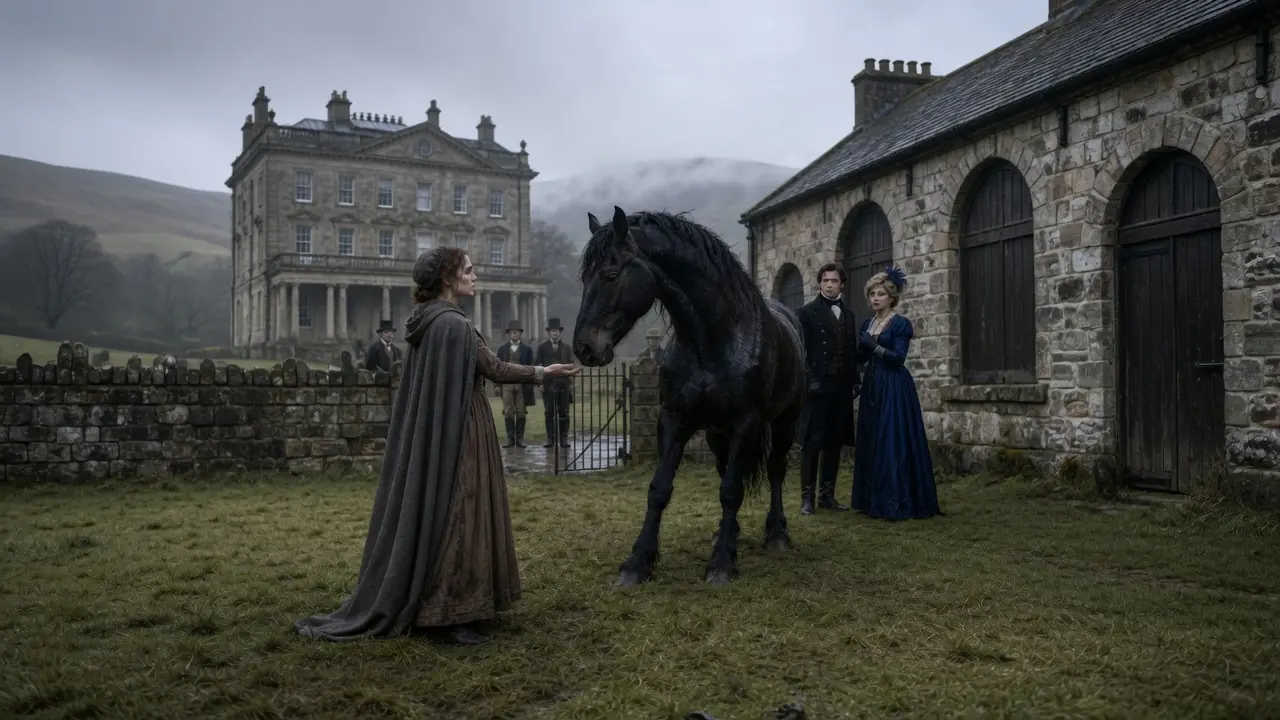
The woods that clung to the estate’s edges were skeletal, their leaves long since surrendered to the wind, leaving a tangled lattice of black branches against a pewter sky. The air itself was thin and sharp, carrying the scent of wet earth and cold stone.
It was a landscape of muted colors: the deep, bruised purple of the distant moors, the tired olive of the parkland grass, and the slick dark gray of the carriage drive.
Ravensdale was not a house that sat upon the land. It was a house that had been wrestled from it, and the land had never quite forgiven the intrusion.
Into this silence and stillness, a carriage arrived, its wheels crunching on the gravel with a sound that felt like a violation.
It was not a grand carriage, but a sturdy, serviceable thing, its paint faded and its leather worn. It carried Miss Helena Withorp with the entirety of her worldly possessions packed into two modest trunks.
Helena looked out of the window as the house resolved itself from the mist. It was immense, a severe block of Palladian architecture that offered no welcome. Its many windows were like vacant eyes, dark and unblinking.
She felt a tremor of something cold and heavy settle deep in her stomach.
It was not fear, precisely. She had lived with fear for so long it had become a dull, familiar ache.
This was something else.
The feeling of arriving at the end of a long, final road.
The contract had been signed three weeks prior in her father’s solicitor’s office in York, a cramped, dusty room that smelled of paper and despair. The Duke of Blackwood had not been present. His man of business, a Mr. Harrow, had handled the particulars with a brisk, bloodless efficiency.
The terms were simple. In exchange for the hand of Miss Helena Withorp in marriage, the Duke would settle her father’s catastrophic debts, ensuring he and her mother would not see the inside of a debtor’s prison.
It was a transaction.
A life for a life.
Her freedom for theirs.
Her father had wept.
Her mother had not.
Her mother had looked at her with a kind of desperate, hungry gratitude that was far worse than tears.
Helena had felt nothing at all.
She had learned over the past year of mounting panic and quiet privations to build a wall inside herself. Behind it, she kept the girl who had once dreamed of a love match, of a small manor with a rose garden, of a life chosen rather than dictated.