No one showed up for the Duke's birthday.
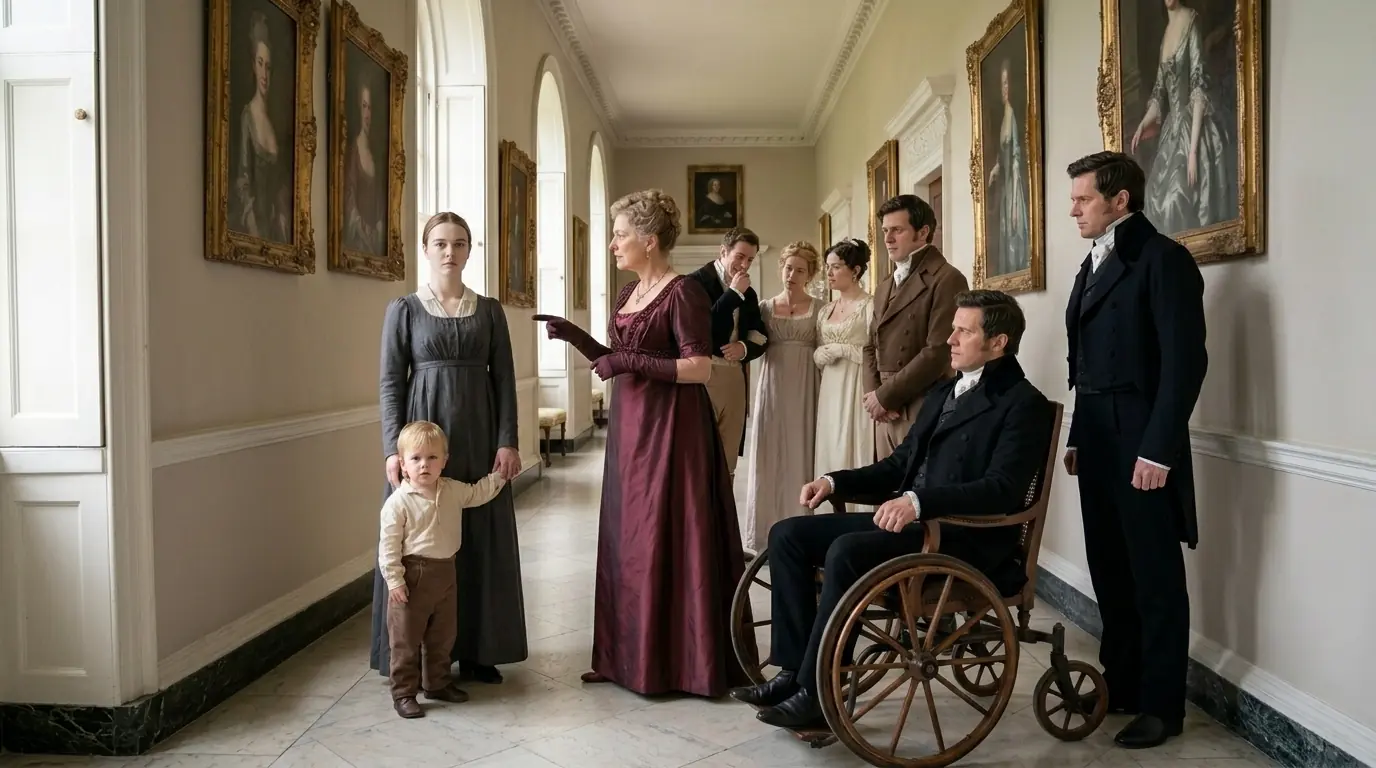
Iris knew it before she knew the hour, because the house told her first. The kitchen fires burned low instead of high. The good silver stayed in its cloths. Kestwick Hall smelled of beeswax and cold stone, and faintly of the bread going stale in the larder that no one had thought to serve because no one had come to eat it.
She was not important enough to be told anything directly. She learned it the way she learned most things, by standing near enough with a basket of linen and letting the housekeeper's worry spill over her like water over a low wall. Mrs. Hatch had said it plainly, twice, as if saying it twice might change the answer.
"Not one carriage. Not one card. Five o'clock, and the drive empty as a held breath."
Iris Barlow was no one in that house, and she had made her peace with it. She was the maid who came before dawn and left the parlors better than she found them. She had a boy of two years asleep in a drawer bed by the scullery fire because she had nowhere else safe to put him while she worked, and a dead husband's name she still wore like a coat too thin for winter.
She did not expect to be remembered by anyone upstairs. She expected the work to be there, and it was, and that was enough most days.
Tonight was going to be different. She did not know that yet. She only knew there was a cake in the larder with one candle in it, made by a scullery girl who had cried while making it, and a duke in a chair by a cold window who had not asked anyone to celebrate anything because he had learned, the way Iris had learned, not to ask for things that would not come.
The Duke of Farrow had not walked in eleven months. He had been thrown from a young stallion on a wet road in autumn and had not felt his legs since. He was three-and-thirty, and he had inherited a dukedom, a fortune, a fine gray house, and a body that no longer answered him below the waist all in the same terrible season.
He did not speak of it. He had stopped speaking of most things.
He sat that evening where he sat most evenings, in the long window of the library that looked down the drive, in a wheeled chair his physician had ordered and he had hated on sight and used every day since because hating a thing and needing it were not, he had learned, mutually exclusive.
He was watching the drive because it was a fact of nature that he watched it on the evening of his birthday the way a man watches a door he knows will not open, unable to stop himself from watching it anyway.
No one came.
His aunt, Lady Honoria Vail, had sent her regrets from a house party forty miles distant, along with a note that mentioned twice in the same short paragraph that a man in his condition ought not to overtax himself with company. His cousin Roderick, whom Honoria had put forward with increasing frequency as a man capable of managing what the Duke, in her careful phrasing, might find burdensome, had sent nothing at all.
His former betrothed, who had wept very prettily at his bedside in the first week after the accident and had married a baronet with working legs by Christmas, had of course sent nothing. He had stopped expecting her to.
He had told the household there would be no fuss. He had said it first because he believed it, and he had gone on saying it because no one had tested whether he meant it.
He did not know, sitting there in the failing light, that a maid two floors below was about to test it without meaning to at all.
Iris had put Toby down for the night in his drawer bed, or thought she had. He was too quick on his feet, quicker than any bolt she had ever tried to fix to a low door, and he had a way of vanishing between one candle and the next that had already cost her four gray hairs she could name individually.
She found the drawer bed empty by the time the last of the linens were folded.
She did not panic. She had learned not to. Panic wasted seconds a search could not spare.
She followed the only sound in a silent house, which was a small voice singing badly and with great confidence somewhere above her.
She found him in the library on the Duke's lap.
She stood in the doorway with her hand still on the frame and did not breathe for a moment that felt much longer than a moment. The Duke of Farrow, whom she had spoken to perhaps four times in a year of service, whom the housemaids called grave behind his back and worse things when they thought no one listened, sat with her son perched on his knees holding a wooden button Toby had produced from some pocket of his own, turning it over with great seriousness as though it were the only object of value in the house.
Toby was singing the tune Iris sang him at bedtime, the words all wrong, the notes worse. The Duke was not smiling. He was watching the boy's face the way a man watches something he has forgotten the shape of.
"Your Grace," Iris said. "I am so sorry. I will take him."
"Don't," the Duke said.
She did not move.
"He isn't afraid," the Duke said, as if that explained something.
And perhaps it did.
She should have taken her son and gone. She knew the rule of the house, even if it had never been written down for her specifically. Servants' children did not sit on dukes.
She had a hundred reasons to cross that floor and lift him away, and every one of them was good. And she did not use any of them.
Because the Duke's face in the low light looked like the face of a man who had not been touched by anyone who did not want something from him in longer than he could say. Her son's small weight on his knee was the first undemanding thing that had happened to him in eleven months.
She stayed.