She was 14, homeless, and hadn't eaten since yesterday morning. But the moment she saw that scroll behind the glass, something ancient and electric moved through her like a current.
The most powerful scholars in the room had already failed. The corporations had already made their deals, and nobody—not one person in that gilded museum—thought to worry about the quiet girl in the worn-out hoodie standing at the edge of the crowd. That was their first mistake.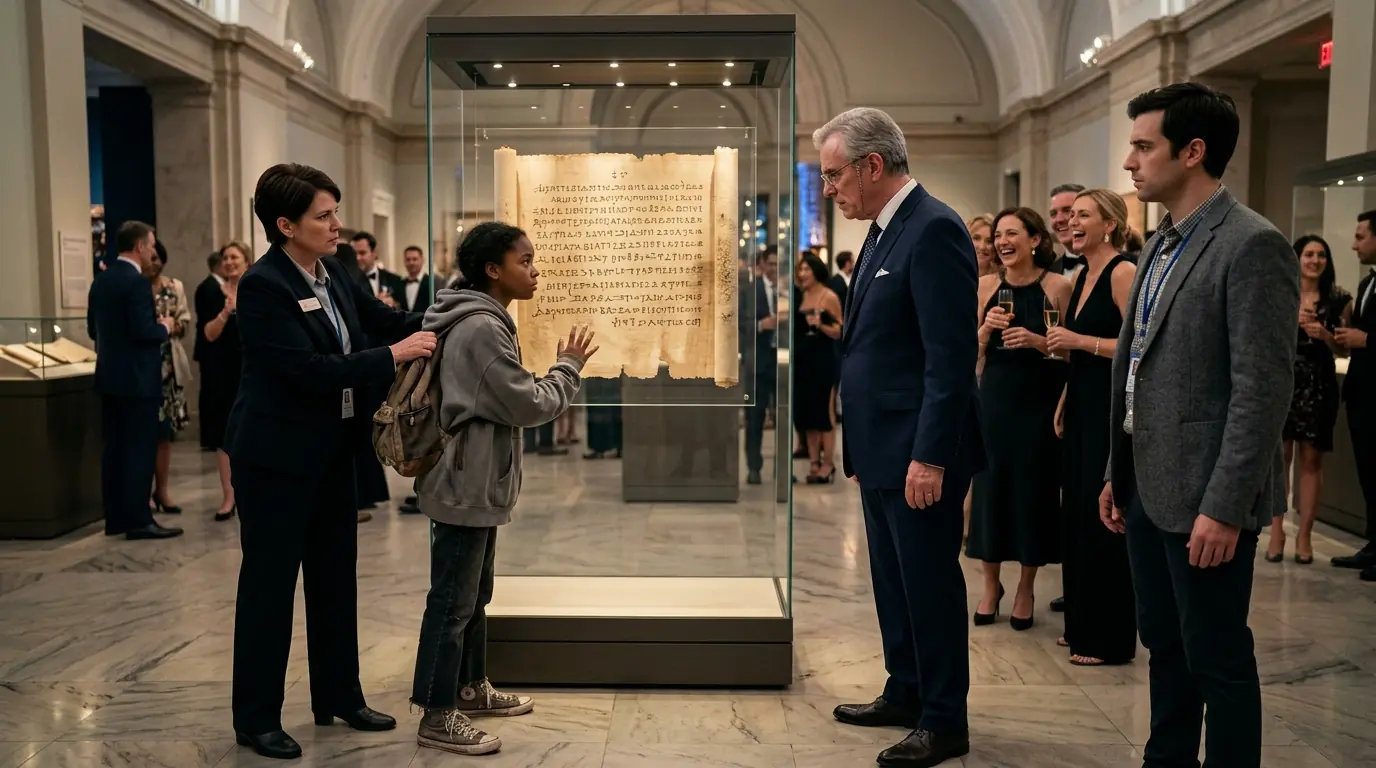
And it would not be their last.
The Hargrove Museum of Cultural Heritage had never looked so full of itself. Banners stretched across the stone facade announcing the evening's event in gold lettering: Discovery Unveiled: The Aldrin Scroll. Camera crews jostled for position at the base of the wide marble steps. Private cars idled in a line that curved around the block, each one carrying someone who believed tonight would confirm something they already assumed to be true.
Inside, the marble floors caught every footstep and threw the sound back twice as loud. The vaulted ceilings were draped in soft amber lighting, and the air smelled faintly of old paper and expensive cologne. Champagne flutes clinked. Laughter echoed.
The city's most respected names in archaeology, linguistics, law, and corporate finance had gathered to witness what was being called the most significant document discovery of the decade.
At the center of it all, out and behind a curved wall of climate-controlled glass, lay the scroll.
It rested on a gently angled display platform, its surface a pale tan color that had deepened in places to the shade of dark honey. It was roughly the length of a man's arm and about as wide as two open hands placed side by side. The edges had frayed slightly with time, and sections of it were stained with the faint ghost shapes of whatever soil and moisture had surrounded it for centuries.
But the text itself was remarkably preserved: every symbol clear, every line deliberate. Whatever hand had set those marks down had not been careless.
Most of the guests ignored it entirely. They circulated the room with drinks and conversation, pausing at the glass only long enough to nod appreciatively and move on. The scroll was a means to an end. They were not there to understand it; they were there for what owning it would mean.
Standing near the podium and surrounded by museum staff and legal representatives was Victor Hale, the corporate developer whose foundation had co-funded the dig that recovered the scroll. He was tall, silver-haired, dressed in a navy suit that had been cut very precisely. He spoke in the measured tone of a man who was accustomed to rooms listening when he entered them.
His company, Hale Development Group, had quietly tied the scroll's discovery to a land dispute involving a tract of mineral-rich terrain on the outer edge of the city. If the scroll could be properly translated and shown to confirm historical ownership claims his lawyers were already building, it would unlock a development deal worth well over three billion dollars. He had been patient. He had been careful. Tonight, he expected confirmation.
The museum's lead curator, Dr. Leonard Ashby, took the podium to polite applause. He was a compact, gray-bearded man with the careful speech of someone who chose every word with the awareness that someone was always recording. He explained the discovery in broad terms: the scroll had been unearthed during an excavation in the eastern perimeter of the disputed land, apparently sealed inside a stone cavity that had gone undisturbed for an indeterminate, but significant period of time. Preliminary carbon analysis placed it at an age that was, he said, profoundly ancient.
The language in which it was written had not yet been identified.
That admission quieted the room for a moment. Victor's jaw tightened almost imperceptibly.
Dr. Ashby gestured to the three linguists seated on a raised platform to the right of the podium. They were introduced with great ceremony: Professor William Greer from the university's classical languages department; Dr. Sandra Hollins, who had spent 15 years studying proto-written systems of the ancient world; and a visiting scholar from overseas whose credentials filled half a paragraph in the printed program. They were, Dr. Ashby assured the room, the best available minds for this task.
Professor Greer went first. He approached the case with a handheld magnifier and a small lamp, studying the scroll in silence for two full minutes. Then he straightened, returned to the platform, and began speaking in the careful tone of someone who had already decided that confidence was more important than accuracy. He noted similarities to known pre-alphabetic systems, suggested a possible derivative link to certain early Mesopotamian forms, and proposed that with time—weeks, perhaps a few months—a working framework could be assembled.
No translation, no reading. A "framework."
The murmur in the room was not enthusiastic.
Dr. Hollins approached next. She was more honest, which made her less useful to the people who had organized the evening. She stood at the glass for a long time, moved from one end of the scroll to the other twice, and then turned back to the room with an expression that was more fascinated than frustrated. She said the language showed structural patterns unlike anything in the known catalog of proto-written systems. The symbols appeared to operate on multiple levels simultaneously. She had never seen anything like it. She needed time to study it properly. A real translation would require deep research, cross-referencing, and potentially new analytical tools.
This was not what anyone had paid to hear.
The visiting scholar offered little beyond a murmured agreement with Dr. Hollins and an apology for the limitations of existing scholarship. The applause when the three of them returned to their seats was polite in the way that disappointment tries to be gracious.
Victor Hale was already on his phone.
Outside the museum, on the far side of the rear service road, a girl crouched behind a row of black plastic utility bins and ate the last third of a granola bar she had found tucked beneath a trash bag that someone had not quite closed all the way. She ate it slowly and without self-pity, the way a person eats when they have learned not to rush what might be the last meal for a while.
Her name was Nyla Carter. She was 14 years old. She was small for her age and wore a faded gray hoodie two sizes too large, canvas sneakers that had cracked at the toes, and dark jeans that had been hemmed at the bottom by someone who used whatever thread was available. She had a small backpack that contained most of what she owned: a change of clothes, a worn spiral notebook, a pencil case with four pencils and a stub of eraser, and a library card she still carried even though she had not had a fixed address for almost a year.
Nyla was not a sad girl, or at least she did not think of herself as one. She was a careful girl, a watching girl. She had learned that the world rewarded attention—the kind of attention most people did not bother with. She noticed exits before she noticed entrances. She noticed which security guards made their rounds at what intervals. She noticed how many cars were parked with their lights on, which meant drivers waiting, which meant activity, which sometimes meant leftover food if you were patient and stayed small.