Abigail Whittaker pressed her back against the kitchen wall and listened to the music rising from the ballroom above her. Music paid for with money her father did not have in a house she alone had kept from falling. Upstairs, her sister was being offered to the wealthiest man in the county like a gift wrapped in silk. And no one, not one soul had thought to tell Abigail to come upstairs. The summer of 1815 arrived in Virginia like a verdict. The heat had not broken in three weeks. The fields at Whittaker House lay still and pale under a punishing sky and the gardens which Abigail had trimmed herself the previous morning already sagged in the afternoon glare. Inside the house, the situation was worse.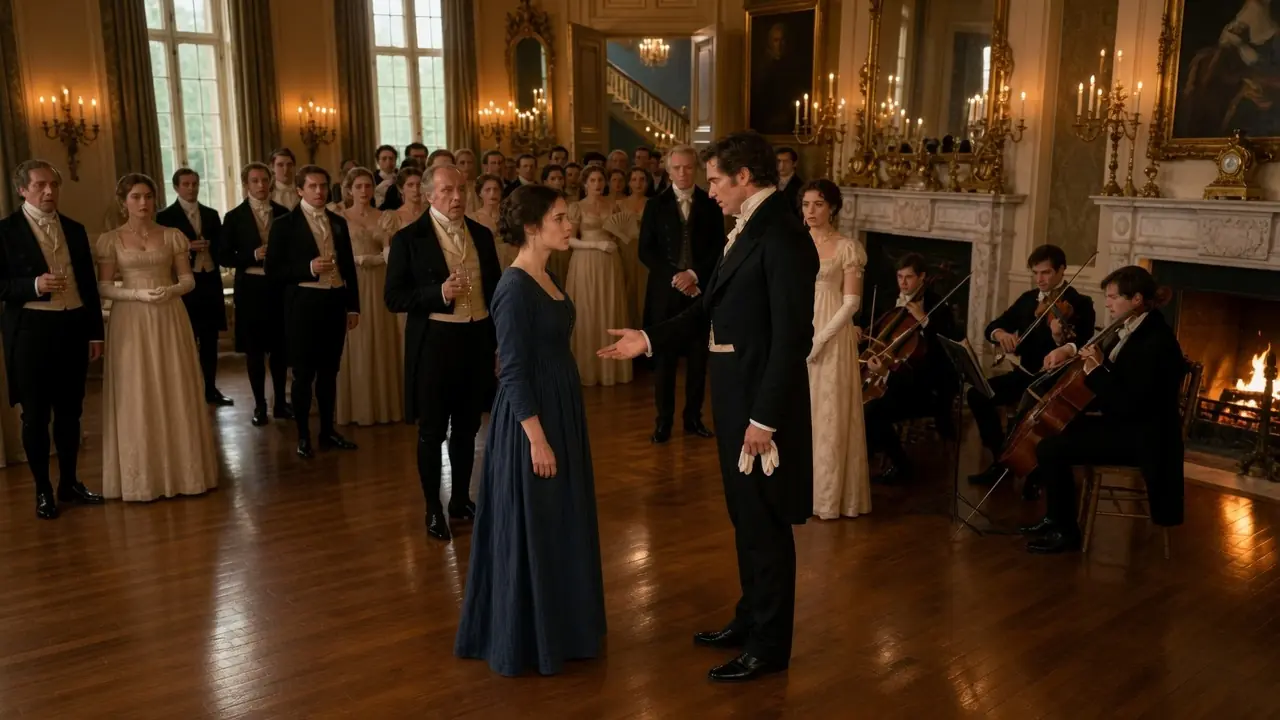
Silas Whittaker stood at the foot of the main staircase and bellowed up at no one in particular. Where are those candles? I ordered forty candles, and I see perhaps twelve. Abigail was already coming through the side corridor with a crate in her arms.
Thirty-six candles, Papa. I could not source more than that on two days' notice. The chandler in Hanover is expecting payment from last autumn before he extends further credit. Silas's jaw tightened.
Don't speak to me about credit tonight. Someone has to. She set the crate down and straightened. Nathaniel Ashford arrives at half past seven.
I suggest we have the candles lit before then. He looked at her. Really looked for only a moment before his eyes slid away. They always slid away.
Toward the staircase, toward the sound of Charlotte's laughter floating down from the upper landing. Make sure your sister is ready. He said and walked away. Abigail watched him go.
She did not sigh. She had learned long ago that sighing cost energy she could not afford. Charlotte Whittaker descended the staircase at twenty past seven in a gown the color of winter cream. Her dark hair arranged in careful curls, her expression arranged with equal care.
She was 24 years old and beautiful in the way their mother had been beautiful openly, effortlessly, like sunlight through clean glass. Do I look right? Charlotte asked, pausing on the third step. You look perfect.
Abigail said because it was true. Charlotte smoothed her gloves. Papa says Mr. Ashford is a widower, forty years old, no children, very serious.
He is 38. Abigail said. And serious is how people describe men who have learned not to trust the people around them. Charlotte blinked.
How do you know that? I read his business correspondence when Papa left it on the desk. Abigail adjusted one of the candelabras near the entry. He has been cheated by three separate land agents in the past two years.
He will be looking for honesty more than charm tonight. Charlotte was quiet for a moment. Then she said, That sounds like he will not like me very much. I did not say that.
You implied it. Abigail turned to face her. I implied that he is not a simple man. That is different.
Charlotte looked at her with an expression Abigail had never quite been able to read something between affection and the faint permanent resentment of someone who has been given everything and suspects she deserves none of it. Well, Charlotte said finally, try to stay out of sight tonight. Papa does not want him confused about which of us he came to meet. She descended the last three steps and moved toward the ballroom.
Abigail stood where she was. Stay out of sight. She turned back to the candles.
Nathaniel Ashford arrived at seven-thirty-three, which told Abigail two things. Immediately, he was not a man who ran early to impress people, and he was not a man who ran late out of carelessness. He arrived at precisely the moment that suited him and no other. She did not see him come through the front door.
She was in the kitchen at that moment, arguing quietly with the wine merchant's delivery boy, who was insisting he could not leave the bottles without some form of payment against the outstanding account. I understand your position. Abigail said evenly. But it is half past seven on a Thursday evening, and your employer's ledger will not change between now and Monday morning.
Leave the bottles. I will send a bank note by end of week. Miss, I cannot. You can.
She said. Because if you take those bottles back up that road, your employer loses not only the debt, but the future business of Whittaker House. And I will personally write to Hanover myself to explain exactly why we were forced to source our wine elsewhere. The boy stared at her.
She looked back at him with perfect calm. He left the bottles. Abigail exhaled, carried the first case toward the preparation table, and went back to work.
By nine, the ballroom was crowded and loud and hot. The music from the hired quartet bounced off the walls of a room that had been designed for exactly this kind of evening. High ceilings, tall windows, candlelight pooling in the mirrors. Abigail moved along the outer edges of it all, adjusting, correcting, watching.
She caught a wine glass before it tipped from a servant's tray. She redirected a guest who had wandered toward the private study. She whispered to Martha Bell, the housekeeper, that the cold supper needed to come out twenty minutes early because the heat was turning the cream sauces. She did not dance.
She was not asked. She was wearing her working dress, dark blue cotton practical, and she had arranged her hair quickly in the kitchen between tasks. She was not invisible exactly. People saw her.
They simply saw through her to whatever task she appeared to be moving toward, and then they looked away. That was fine. She preferred it. What she did not prefer was standing still, which she was forced to do for one brief moment near the east window when her feet absolutely refused to carry her another step without rest.
She had been awake since four that morning. She leaned one shoulder against the wall and closed her eyes for three seconds. When she opened them, a man was watching her from across the room. She noticed him not because he was handsome, though he was in a severe unsmiling way, but because he was standing in the center of a crowd that was actively performing for him, and he was not watching any of it.
He was watching her. Nathaniel Ashford was tall and dark-haired, dressed in a coat that was expensive without being showy. He had the posture of a man who owned things not aggressively, but with the settled confidence of someone who had stopped needing to prove it. His father, Judge Caleb Ashford, stood at his shoulder speaking to Silas Whittaker with the tone of a man conducting business.
Charlotte was two feet away from Nathaniel, radiant and composed, saying something that made several nearby guests laugh. Nathaniel was not laughing. He was still watching Abigail. She looked away first.
She pushed off the wall and went back to work. At half past nine, Silas found her near the kitchen corridor. There you are. He gripped her elbow and steered her back toward the wall.
What are you doing skulking about back here? Go stand somewhere else, somewhere he cannot see you. Who? Don't be obtuse.
Ashford keeps looking toward this side of the room, and I will not have him distracted. Abigail looked at her father. You mean distracted from Charlotte? I mean distracted from the purpose of this evening.
He released her arm and straightened his coat. Which is not your concern. Take yourself to the kitchen and stay there until the guests begin to leave. The Henderson's carriage arrived with a broken wheel axle.
I have asked Thomas Reed to see to it. Good. Stay with Thomas. The cold supper needs to come out in— I do not care about the supper, Abigail.
You will when it spoils. He gave her the look she had grown up with, the one that was not quite contempt and not quite guilt, but lived in the uncomfortable territory between them, and walked away. Abigail went to check on the supper. It was Elias Mercer, Nathaniel's adviser, who found her first.
He came into the preparation room at a quarter past ten with the easy manner of a man accustomed to moving through back corridors of other people's houses, and he stopped when he saw her elbow deep in the arrangement of cold dishes. Miss Whittaker, he said. She looked up. You are lost.
Possibly. He glanced around the room. You've been managing this entire evening. Someone has to.
Your father does not seem to notice. My father notices what he needs to notice, she said carefully. Is there something I can help you with, Mr. Mercer?
He studied her for a moment. Mr. Ashford would like to speak with you. Abigail set down the serving cloth in her hand.
I beg your pardon. He asked me to find you. Mercer's expression was neutral, but there was something careful in it. The practiced calm of a man relaying a message he finds interesting.
He has been watching you work for the better part of two hours. He has some questions. About what? About the house, the estate, how it is managed.
A pause. About you. Abigail was quiet for a moment. She looked at her hands flour-dusted at the knuckles, ink-stained at the right forefinger from the ledger work she had done before the guests arrived.
Tell him I will come in five minutes, she said. She washed her hands. She did not change her dress. She was not going to pretend to be something she was not for a man who had apparently spent two hours watching what she actually was.
Mr. Ashford. She stopped a few feet inside the door and looked at him directly. I understand you wanted to speak with me.
I did. He gestured toward the chair near the desk. Please. I will stand, thank you.
I have been standing all evening. Something shifted in his expression. Not offense. Something closer to attention.
Your father tells me the estate runs smoothly. He said. My father is optimistic. And you are not?
I am accurate. Abigail said. The estate runs. Whether it runs smoothly depends on your definition of the word.
Nathaniel looked at her for a long moment. The wine at this evening's supper, good vintage, well chilled despite the heat. That was your doing. The wine merchant was reluctant.
I persuaded him. The carriage in the yard, I am told the wheel was repaired in under an hour. Thomas Reed is very capable when given clear instruction. The cold supper came out early.
The heat was turning the sauces. It would have been a disaster otherwise. Your father was unaware of all of this. It was not a question.
Abigail did not treat it as one. Yes, she said simply. Nathaniel nodded slowly. He moved toward the window, then turned back to face her.
May I ask you something direct, Miss Whittaker? I would prefer it to the alternative. A very brief, very controlled expression crossed his face that might have been the beginning of a smile. How long have you been running this household?
Abigail considered the question honestly. Since I was sixteen, when my mother died. And your father? My father manages relationships, social obligations, the public face of Whittaker House.
She met his eyes. I manage everything else. Nathaniel was quiet. Outside the study door, the music rose and fell.
Somewhere in the ballroom, Charlotte was laughing at something clever. The evening was proceeding exactly as Silas had planned it. The Whittaker accounts, Nathaniel said, are they as healthy as your father suggests? Abigail looked at him steadily.
No. How bad? Bad enough that this evening's entertainment was funded by credit that cannot be repaid before the end of the fiscal quarter. She paused.
I am telling you this because you asked me a direct question, and you seem like a man who has been lied to enough times to recognize the difference. The silence stretched. You are not going to soften that. He asked.
Would you like me to No. He looked at her as though he was resolving something. No, Miss Whittaker, I would not. She left the study at twenty past ten and went straight back to the kitchen.
Martha Bell caught her at the corridor. Your father is looking for you. He is always looking for me. Abigail said.
He just does not usually want to find me. Miss Abigail. Martha's voice dropped. He is standing with Mr. Ashford now, by the fireplace. He is trying to draw him toward Miss Charlotte. Abigail nodded. That is the plan for the evening.
I know, I just thought you should Martha hesitated. Never mind. Go on. Abigail went on.
At eleven, Silas Whittaker positioned himself between Nathaniel Ashford and his most eligible daughter with the precision of a man who had been rehearsing the moment for weeks. Charlotte smiled. She was very good at smiling. She said the right things.
She laughed at the right moments. She was everything she had been raised to be. Abigail watched from near the corridor entrance. She was not jealous.
She had stopped being jealous of Charlotte years ago, somewhere around the time she had realized that what Charlotte had been given, the gowns, the lessons, the presentation had been taken from somewhere. And she had a very clear sense of where. She turned to go back to the kitchen. She heard footsteps behind her.
Miss Whittaker. She stopped. Nathaniel Ashford's voice was quiet enough that only she could hear it over the music. She turned.
He was standing five feet from her, and the expression on his face was not the polite attention of a man making social obligation. It was something more deliberate than that. The evening is nearly finished. he said.
Yes. I have made my decision. Abigail felt something very careful begin to build in her chest. She kept her face even.
That is your prerogative, Mr. Ashford. I would like to speak to your father. He is near the fireplace.
I know where he is. He looked at her. I wanted to speak to you first. The music stopped between one piece and the next.
The room breathed. Walk with me, he said. Mr. Ashford, please.
He walked back into the ballroom. He did not take her arm. He simply moved through the crowd with the expectation that she would follow, and because Abigail had spent enough of her life doing what was expected of her, she followed. She saw Silas see them from across the room.
She saw the color change in his face. She saw Charlotte's smile flicker just slightly when Nathaniel passed her without stopping. She saw Judge Caleb Ashford, who had been conversing near the window, turn with sharp eyes as his son moved through the center of the room. Everyone was watching.
Nathaniel stopped in the middle of the ballroom floor. He turned to face Abigail. The quartet had not yet resumed. The room was very, very quiet.
He reached up and removed his right glove. He held out his hand, and he said in a voice clear enough to carry across thirty feet of stunned silence, If I am to bind my name to this house, I will choose the woman who kept it standing. Charlotte made a small sound. It was barely audible.
It was the sound of someone who had been waiting at a door for years and just heard a lock click shut. Silas Whittaker's wine glass tilted in his hand. He caught it. Barely.
Judge Caleb Ashford said nothing. His face was a closed door. The guests, thirty-odd men and women who had come to Whittaker House on a hot July evening to witness exactly this kind of announcement, turned as one toward Abigail Whittaker in her working dress, and her ink-stained fingers, and her hair arranged in the kitchen between supper preparations. Abigail looked at the hand in front of her.
She had run this house for eight years. She had paid its debts, calmed its creditors, managed its servants, and kept its cracks hidden behind careful arrangements of flowers and candlelight. She had done it without being asked. She had done it because someone had to.
She had done it while standing out of sight as her father had instructed so as not to confuse anyone about which daughter was the important one. She looked at Nathaniel Ashford's face. He was not performing. There was no performance left in the room at all.
Every polished surface had been stripped away by four words, and what was underneath was simply one man looking at one woman and waiting. Waiting for her. For the first time in her life, someone had crossed a room for her. Not for what she could produce.
Not for what she could manage or arrange or salvage. Not because she was useful, because he had watched her for two hours and seen actually seen what was there. Abigail took a breath. She reached out and took his hand.
The room erupted. She did not look at her father. She did not look at Charlotte. She did not look at the guests or at Judge Caleb or at Vivian Harrow in her imported silk, who had just pressed her fan flat against her mouth in rigid astonishment.
She looked at Nathaniel Ashford. You understand, she said quietly beneath the noise, that this will cause significant difficulty. I expect it will, he said. My father will not accept it quietly.
I do not require his quiet, Nathaniel said. I require his daughter. Which one? His hand tightened around hers.
The one standing in front of me. Abigail held his gaze. Eight years of invisible labor. Eight years of staying out of sight.
Eight years of her father's eyes sliding past her toward whatever Charlotte was doing. All right, she said. And that was how it began.
The carriage ride to Ashford Hall took forty minutes in silence. Not the silence of comfort. The silence of two people who had just done something irreversible and were both too honest to pretend otherwise. Abigail sat with her hands folded in her lap, watching the dark Virginia countryside move past the window without actually seeing it.
Nathaniel sat across from her, one arm resting along the frame, watching her the way he had watched her all evening steadily without apology. She spoke first. You should know I have nothing. I am aware.
No dowry, no property, no social standing that would benefit your family name. She met his eyes. Whatever my father told you about Whittaker House, the reality is three outstanding loans, two disputed land boundaries, and a wine merchant who will be writing a very unpleasant letter sometime next week. I know about the loans.
Nathaniel said. Elias looked into it before we came. Abigail was quiet for a moment. Then you knew before you arrived?
Yes. And you came anyway? I came to see if the person managing the damage was worth knowing. He said it plainly, without flourish.
She was. Abigail looked at him. Mr. Ashford, I need you to understand something about me.
I am not a woman who will be romanticized into something manageable. I ask direct questions. I keep accounts. I will tell you when you are wrong, and I will expect the same courtesy in return.
Good, he said. I have had enough people tell me I am right. She studied his face in the darkness of the carriage. He did not look away.
All right, she said again. It seemed to be becoming her answer to him. Silas Whittaker did not sleep that night. Abigail knew this because when she returned to Whittaker House the following morning to collect her belongings, a modest task as she owned very little that was not already part of the household.
She found him in the study with the ledgers open on the desk and an expression she had never seen on his face before. It took her a moment to identify it. He was frightened. Abigail.
He stood when she entered. We need to discuss last evening. There's nothing to discuss, Papa. There is everything to discuss.
He came around the desk. You humiliated this family. You humiliated your sister. Charlotte has not come out of her room.
Charlotte is disappointed, Abigail said evenly. That is not the same as humiliated. You had no right. He chose me.
She said it quietly without triumph. I did not ask him to. I did not arrange it. I did not perform for him or present myself or do anything other than manage your household the way I have been managing it for eight years.
She paused. He noticed. That is all. Silas' face went through several things at once.
You are going to stand there and tell me. I am going to stand here and give you something more useful than an argument. She set her bag down, opened it, and removed a ledger, the small one she kept herself separate from the official household accounts. She placed it on the desk in front of him.
The Hanover debt comes due in September. The boundary dispute with the Caldwell estate needs a solicitor before the October term. The wine merchant. Stop.
Silas's voice cracked. Stop talking to me about accounts. Someone has to. You are leaving this house.
Yes. You are leaving me with nothing. I am leaving you with information, Abigail said. Which is more than you ever gave me.
She closed her bag. Martha Bell knows every supplier. Thomas Reed knows every tenant. The systems are in place.
They always were. You simply never needed to know that because I was here. Silas stared at her. For one brief moment something real moved across his face.
Not anger, not pride, but the raw edge of a man realizing too late the exact weight of what he had taken for granted. Then he straightened and the moment passed. If you walk out of this house, he said, do not expect to walk back in. Abigail picked up her bag.
I will send the solicitor's name for the Caldwell dispute by Friday. She moved toward the door. Goodbye, Papa. She did not look back.
Ashford Hall was everything Whittaker House pretended to be. Where her father's estate performed wealth from behind a crumbling facade, Nathaniel's home simply was what it was, solid, old, well maintained, and entirely indifferent to impressing anyone. Abigail walked through it the first morning with Martha, who had without any discussion simply packed her own bag and followed, and felt the particular discomfort of someone who cleaned other people's houses suddenly being expected to live in one. Mrs. Holt runs the domestic staff, Martha murmured as they moved through the east corridor. She has been here twenty years. She will not be pleased. She does not have to be pleased, Abigail said.
She has to be professional. And Judge Ashford. Abigail had met Judge Caleb Ashford briefly that morning at breakfast. He had looked at her across the table with the particular expression of a man who has spent sixty years deciding the worth of other people and has never once been asked to reconsider his methods.
He will say what he has to say, Abigail said. So will I. He said it that afternoon. She was in the estate office Nathaniel had given her access to without being asked, which she respected him for, reviewing the tenant rent ledgers when Judge Caleb came in and closed the door behind him with the careful click of a man who intends to conduct a private conversation.
Miss Whittaker. He did not sit. I will be direct with you. Please.
My son is a good man. He is also a man who has spent the past three years grieving his wife and trusting the wrong people with his estate. He is at present not making decisions from his best judgment. You believe choosing me was an error.
Abigail said. I believe choosing you was an impulse. He folded his hands behind his back. A well-intentioned one perhaps but an impulse nonetheless.
You are a capable young woman from a bankrupt family with no social standing and no Judge Ashford, her voice was level. I have spent the past eight years keeping a household from collapse while being told in various ways that my competence was either invisible or inconvenient. I am not going to sit in your son's office and hear that argument again from a different man in a better coat. Silence.
He looked at her the way men looked at her when they had expected submission and received something else entirely. You have spirit. he said finally. I have work to do, she replied.
Was there something else? He left without answering but at the door he paused just briefly and she had the distinct impression he was revising something internally. She did not know what. She returned to the ledgers.
The rumors arrived before the week was out. Vivian Harrow was by all accounts a woman of considerable social energy, and she directed that energy with the precision of someone who understood that a story told first is a story told best. By Thursday, half the county had heard that Abigail Whittaker had maneuvered herself into Nathaniel Ashford's attention through pity manipulation or worse. By Friday, a version had emerged in which Abigail had deliberately humiliated Charlotte at the family's own expense.
By the following Monday, Vivian herself appeared at Ashford Hall under the pretext of returning a borrowed book. Abigail received her in the front sitting room. Vivian was thirty-one, handsome in the way of women who have always been told so and possessed of the particular social fluency of someone who has never needed any other kind of intelligence. She sat across from Abigail with a smile that did not reach her eyes and said, How remarkable all of this.
We are all so surprised. Are you? Abigail said. Well, naturally.
Nathaniel Ashford is He is very particular. Everyone expected a small careful pause. Well, Charlotte is such a lovely girl. She is.
Abigail agreed. It must be so strange for her. I imagine it is. And for you?
Vivian tilted her head. Managing a house of this size after well, after Whittaker House. Whittaker House ran adequately. Abigail said.
Of course it did. The smile widened. It is only people are talking, you understand. They wonder how it happened so quickly, whether Mr. Ashford was perhaps influenced by what? By Vivian's hands moved in a small expressive gesture. Circumstance, emotion, the evening. Abigail looked at her steadily.
Mrs. Harrow, is there something specific you'd like to ask me? Vivian blinked. I am only because if you are asking whether I deceived Nathaniel Ashford, the answer is no.
If you are asking whether I used pity or manipulation, the answer is also no. If you are asking what I did do, Abigail folded her hands in her lap. I answered his questions honestly. I find that is either very effective or entirely useless depending on the man.
Vivian was quiet for one long recalculating moment. Then she stood, retrieved her gloves, and said with perfect composure, How refreshing you are, Miss Whittaker. Mrs. Harrow, Abigail corrected.
Another beat. Of course. Vivian smiled one last time. Do give my regards to Mr. Ashford. She left. Abigail sat where she was for a moment and then went back to the accounts.
The accounts were as she had suspected a disaster. Not Nathaniel's doing precisely. He was not a careless man, but he had been grieving. In grief, She knew this from her own experience, from the years after her mother died.
Grief made you trust the wrong people because you did not have the energy to distrust anyone. Elias Mercer was honest enough, but the trade contracts he had negotiated over the past two years had been handled through intermediaries who had very clearly been skimming. She found the first discrepancy on a Tuesday morning three weeks after arriving at Ashford Hall. She found the second before noon.
By afternoon, she had six pages of notes and a very clear picture of where several thousand dollars had gone over the preceding eighteen months. She brought it to Nathaniel that evening. He was in the library when she came in. He looked up from the correspondence he was reading and something in her expression made him set it down.
Show me, he said. She laid the pages on the desk between them. She walked him through it methodically. The contract dates, the inflated costs, the names of the intermediaries, the pattern of payments that revealed the arrangement clearly once you knew where to look.
He listened without interrupting which she appreciated. Most men interrupted. When she finished, he was quiet for a long moment. Elias did not see this, he said.
It was not a defense of Elias. It was a statement of fact. Elias was not looking for it. Abigail said.
He trusted the intermediaries because you did. Nathaniel looked at the pages. How long has this been happening? The earliest discrepancy I can confirm is March of last year.
She paused. It may go back further. I would need access to the previous year's contracts. You will have it.
He stood, moved to the window, stood there with his back to her. She waited. He turned. You found this in three weeks?
I was looking. Why? She considered the question honestly. Because this is my house now.
She said. And I do not let my houses fall apart. Something moved across his face, not the polished attention he had shown at Whittaker House, but something raw, more unguarded. Abigail.
He said. It was the first time he had used her given name. She looked at him. Thank you, he said simply, without qualification.
She nodded once, gathered her pages and said, I will have a full report ready by Friday. She was at the door when he spoke again. You do not have to keep working this hard. She stopped, turned halfway.
Yes, she said quietly. I do, but not for the reasons you think. She left him standing there with the weight of that.
The Friday report led to a confrontation with Cornelius Pike. Pike was a heavy-set man in his fifties who had made his money early and spent the years since making sure everyone knew it. He was also, as it turned out, the primary beneficiary of the inflated trade contracts, not directly, but through a second party that Abigail had traced through three layers of correspondence and two sets of duplicate ledger entries. He arrived at Ashford Hall uninvited on a Saturday morning with his hat in his hand and a smile on his face and the relaxed confidence of someone who was accustomed to situations resolving themselves in his favor.
Nathaniel met him in the front hall. Abigail stood to the side. Pike barely looked at her. Nathaniel.
He extended his hand. I heard there's been some review of the trade arrangements. Thought we might discuss it directly man-to-man. My wife has reviewed the arrangements, Nathaniel said.
A brief pause. Pike's smile adjusted slightly. Of course. Well, he looked toward Abigail, then the way men look at furniture they are obligated to acknowledge.
Mrs. Ashford, I understand you've had questions about the contracts. Several, Abigail said. These things can look complicated on paper.
The accounting is clear, she said. It is very clear actually, once you account for the secondary payments routed through the Mercer Valley Trading Company, which I believe you have an undisclosed interest in. The smile went out entirely. I do not know what you think you found.
I know what I found, Abigail said. I would be happy to show you the specific entries, or I can forward them to the county solicitor and let him ask the questions instead. She looked at him evenly. Your preference, Mr.
Pike. Pike's face had gone through red and was approaching something closer to the color of old brick. He turned to Nathaniel. You are going to let her?
She speaks for this estate, Nathaniel said. His voice was quiet. It was the quietness of someone who does not need to raise it. Whatever she is found is what I have found.
Whatever she decides is what I have decided. He looked at Pike without expression. I suggest you answer her questions. Pike looked between them.
He looked at Abigail, really looked for the first time the way he might look at an opponent rather than an inconvenience. I will need to review my own records, he said tightly. Of course, Abigail said. I will expect your response by Wednesday.
He left without another word. Elias Mercer, who had been standing quietly in the doorway throughout, exhaled when the front door closed. He is not going to let this rest, he said. No, Abigail agreed.
He will not. He has Judge Caleb's ear. She had suspected this. She did not say so.
She simply nodded and turned back toward the office, already constructing in her mind what she would need to prepare. What she would need to document, what evidence would need to be airtight before this came to a head. Because it would come to a head. She knew that with the certainty of someone who had grown up watching powerful men absorb inconvenient truths and redirect them toward softer targets, she was going to need to be more than right.
She was going to need to be undeniable. That evening she found Nathaniel in the kitchen. It startled her. She had come down late, unable to sleep, intending to review the prior year's contracts she had pulled from the archive.
He was sitting at the table with a cup of cold coffee and the look of a man who had been awake for several hours. You are not sleeping, she said. Neither are you. She sat across from him, set her papers down.
Pike will not come quietly. she said. I know. And your father?
My father believes Pike is a necessary relationship. Nathaniel looked at his coffee. He has for years. He is going to hear Pike's version of this before he hears mine.
Then we need to make sure our version is the one that holds up. Abigail said. Abigail. He looked up.
Are you afraid? She thought about it honestly. Of Pike, no. She paused.
Of what happens if this goes wrong, if your father uses it to challenge the estate arrangement. Yes. Somewhat. Another pause.
But I have been afraid before. It does not change what needs to be done. Nathaniel looked at her for a long moment. My wife.
he said. Before she died, she was afraid of everything in this house. The size of it, the expectations, the weight of it all. He turned his cup in his hands.
I thought I needed someone different. Someone stronger. And now, now I think I was wrong about what strength looks like. He met her eyes.
I was watching for the loud kind, the visible kind. His voice was quiet. I did not know it could look like someone going over the accounts at midnight because the house needed it. Abigail looked at him steadily.
Nathaniel. Yes. Don't romanticize me. she said.
You will be disappointed. I am not romanticizing you, he said. I am describing you. A beat.
There's a difference. She picked up her papers, held them without looking at them. Wednesday, she said. We will see what Pike sends.
And if he does not send anything? Then we take it to the solicitor ourselves. She looked up. I told you I do not let my houses fall apart.
He almost smiled. So you did. She went back to her papers. He went back to his cold coffee.
The night pressed in around the kitchen, and neither of them felt the particular need to fill it with anything more than the quiet, careful work of two people who had just decided, without quite saying so, that they were in this together. Outside the Virginia summer settled warm and thick over Ashford Hall. And somewhere across the county, Cornelius Pike was already making his next move.
Pike's response arrived on Tuesday, one day early. It was not the letter Abigail had expected. It was not a rebuttal, not a counter argument, not even a denial. It was a single page, formally worded, requesting that a county council be convened at the Hanover Courthouse to review the Ashford estate's trade arrangements, and to examine, as it phrased it, certain irregularities in recent management decisions that may constitute a breach of fiduciary responsibility.
Elias Mercer read it twice and set it on the desk with the careful precision of a man handling something unpleasant. He is not defending himself, Elias said. He is attacking. Of course he is, Abigail said.
It is the only move he has left. Nathaniel picked up the letter, read it once, set it down. He is questioning your authority to manage the estate. He is questioning whether a woman with no prior legal standing in this county has the right to accuse him of anything.
She looked at the letter without touching it. He thinks if he makes the council about me, they will never get to him. Will it work? It might, she said honestly, if we let him set the terms.
She pulled her chair out and sat. We will not.
The council was set for the following Thursday, nine days away. Abigail used all nine of them. She rose before dawn every morning and worked until the candles burned low. She organized the Ashford trade contracts by date, by intermediary, by payment discrepancy.
She wrote out three separate summaries, one for the council members who would understand accounting, one for those who would not, and one that was simply a timeline of events clear enough that even a man who had already decided against her would have difficulty publicly ignoring it. Nathaniel brought her coffee at odd hours and did not ask questions she had not already answered. That was its own kind of support, and she was grateful for it. On the fourth night, Judge Caleb came to the office door.
She had been expecting him. She had not known when he would come, but she had known he would. Men like Caleb Ashford did not leave the field to younger players without at least one private conversation first. Mrs. Ashford? He entered without being invited, which she expected. He looked at the papers covering every surface of the desk. His expression was controlled, but she caught something in his eyes.
Not hostility exactly, but the particular discomfort of a man encountering a situation he cannot categorize. Judge Ashford, she said without looking up from the page she was writing. I want to speak plainly. You always do.
She set her pen down and looked at him. Please. He remained standing. Pike is a difficult man.
I will not defend his methods. That is a careful way of not defending his methods. His jaw tightened. I am trying to tell you that I understand more clearly now that something has gone wrong with the trade arrangements.
That is not in dispute. Good, she said. Then we agree on the facts. What I am saying, he continued, and his voice took on the measured cadence of a man who had spent forty years on a bench, is that the council will not be friendly to you.
These are men who knew my son's first wife. They know the Whittaker name, what it means now, what it owes. They will walk into that room with a conclusion already written, and you will need more than correct numbers to change it. Abigail looked at him steadily.
What will I need? Standing, he said. Credibility. Someone in that room who can speak to your character before you speak for yourself.
A silence. She understood what he was offering. She was not certain yet what it would cost. Why?
she asked. He looked at her for a moment that stretched long enough to be honest. Because Pike has been skimming from this estate for two years, and I did not see it. Something moved across his face, not shame exactly, but it is more dignified cousin.
I should have. She held his gaze. I will need you in that room, Judge Ashford. Not just willing to speak, willing to speak first.
He nodded once, short, final. I will be there. He left. Abigail picked up her pen.
Her hand was perfectly steady.
On the morning of the sixth day, Charlotte arrived. Abigail heard the carriage from the office window and went to the front hall. Charlotte stood in the doorway in a gray traveling dress, looking like someone who had rehearsed what she intended to say and lost every version of it somewhere on the road over. Charlotte, Abigail said, I am not here to make trouble.
Charlotte's voice was tight. I want you to know that first. All right. Papa sent me.
She stopped, corrected herself. No. Papa tried to send me. What he wanted me to do was come here and I do not know, appeal to your sense of family obligation, convince you to withdraw from the council, give him some kind of public concession.
She pressed her lips together. I told him I would not. Abigail waited. Charlotte looked around the front hall at the solid walls, the clean floors, the quiet order of a house that ran the way houses were supposed to run.
You always made everything work, she said. At home. I knew that. I knew it, and I let myself not know it because it was easier.
Charlotte, I am not asking for forgiveness. She said it quickly before Abigail could offer something she had not earned. I am not here for that. I just She met her sister's eyes.
I came because Papa is going to that council. He is going with Pike. The air in the hall changed. He is going to testify, Charlotte said, against you.
Pike got to him. I do not know what he said or promised, but Papa went to dinner with him Thursday last and came home with his mind made up. Abigail stood very still. He is going to tell them you were never educated formally, that you have no legal standing, that he never authorized you to review Whittaker accounts on Ashford's behalf.
Charlotte's voice dropped. He is going to say you fabricated the relationship with Nathaniel. That you used, I do not know, improper means. He will say that under oath?
Abigail asked. He will say it. Charlotte said, whether it is under oath or not. The silence between them was not comfortable, but it was honest, and honest was more than they had managed in years.
Thank you for telling me. Abigail said finally. Charlotte looked at her. Are you going to be all right?
I am going to be ready. Abigail said. That is the better question. She told Nathaniel that night.
She told him all of it. Pike's strategy, Charlotte's warning, Silas's planned testimony. She told him plainly without softening any of it the way she had learned was the only method worth using with him. He listened with his arms crossed and his face very still.
When she finished, he said, Your father is going to walk into that council room and lie. He is going to tell the version of events that protects him. Abigail said. Men like my father do not think of it as lying.
They think of it as management. We could He stopped. What? I could speak to him before Thursday.
No. She said it immediately. If you go to him now, he will read it as weakness. He will think we are frightened and he will push harder.
She shook her head. We let him come. We let him say what he plans to say, and then we answer it. Nathaniel looked at her.
You are not afraid. I told you I am somewhat afraid. I am also prepared. She met his eyes.
Those two things can exist at the same time. He uncrossed his arms, moved toward her, stopped at a respectful distance. Whatever happens in that room, he said, you are not walking in alone. She looked at him.
Something inside her, something that had been very tightly held for a very long time, shifted slightly. I know. she said. Thank you.
Thursday came the way important days always do, with ordinary light, ordinary air, and the particular calm of a morning that has no idea what it is carrying. The Hanover Courthouse was a low brick building with tall windows and hard wooden benches. By the time Abigail arrived with Nathaniel and Elias Mercer, the room was already half filled. She recognized faces from the ballroom at Whittaker House.
She recognized the quality of attention in the room, the bright careful attention of people who had come to watch something. Vivian Harrow was in the third row. Her fan closed on her lap, her expression precisely calibrated to suggest neutral interest. She met Abigail's eyes when she entered and did not look away first.
Abigail looked away first. She had more important things to watch. Pike sat at the front with his solicitor, a thin man named Graves, who had the look of someone permanently prepared to disagree with everything. Pike himself looked settled, comfortable.
He glanced at Abigail when she entered and offered a small controlled smile that said he expected this to be over quickly. Silas Whittaker came in four minutes later. He did not look at Abigail. He walked to the far end of the front row with the rigid posture of a man holding himself together by will alone, sat down and stared at the front wall.
Charlotte had been right. He was here. He was with Pike's people. And he had not looked at his daughter.
Abigail set her leather case on the table. She opened it. She lined up her documents in the order she intended to use them. The council opened with Pike's solicitor presenting the formal complaint that Ashford Estate resources had been subject to unauthorized review by a person lacking legal standing that trade agreements had been improperly challenged and that this action had caused material damage to established business relationships in the county.
It was presented crisply, professionally. It sounded completely reasonable. Three of the five council members were already nodding. Then Graves said, We further submit that Mrs. Ashford's role in this estate has not been formalized through proper legal documentation and that her access to estate records was itself irregular. On what basis? Nathaniel said from his chair. On the basis that the marriage arrangement was The marriage is documented, Abigail said clearly.
The estate access was granted by the property owner in writing. Both documents are in front of you. She had anticipated this. The documents were already at each council member's seat before the session opened.
She had arranged it that morning early while most of the building was still empty. Graves blinked, recovered. Nevertheless, additionally She said, I would like to enter into the record seventeen months of Ashford trade contracts annotated to show the discrepancy between the stated contract cost and the amount ultimately received by the trading partners. She stood and distributed the summaries, one to each council member, one to Graves, one to Pike himself.
She watched Pike's face as he took his copy. She watched the smile not quite leave his face, but lose its certainty the way a candle loses its shape before it goes out. The first council member, a heavy-set man named Garrison, who had the look of someone accustomed to making decisions, opened the summary and began reading. The room was quiet.
Then Silas Whittaker stood up. If I may address the council. The chairman nodded. Silas straightened his coat.
He looked exactly like what he was, a man who had prepared a speech, believed in it on the way here, and was beginning now, standing in this room, to feel the first small fractures in his conviction. My daughter, he began, has always been capable. I do not dispute that. But capable is not the same as authorized.
She was not formally educated. She has no training in law or finance. What she believes she found in those ledgers may simply be the misreading of someone who Mr. Whittaker?
Abigail's voice was level. May I ask you a question? The chairman looked between them. Mrs. Ashford, this is I will ask it plainly, she said. Mr. Whittaker, who paid the Hanover wine debt in August of 1813? Silas stopped.
Who negotiated the terms of the Caldwell boundary dispute in the spring of 1814? she continued. Who managed the harvest accounts for three consecutive years when your estate manager left? Who wrote to your creditors every quarter to maintain the relationships that kept Whittaker House solvent?
She looked at her father directly. You can tell these men I have no formal training. That is true. You can tell them I was not authorized.
That is a matter for Nathaniel to address. But you cannot stand in this room and tell them I do not understand accounts because they know and I know and you know that understanding accounts is what I have done every day of the past eight years while you told the county your estate ran smoothly. The room was very, very quiet. Silas Whittaker's mouth opened, closed.
He sat down. That was the first twist. The second came twelve minutes later, and it came from Judge Caleb Ashford. He rose from the back of the room when Graves began presenting a new line of argument that the inflated contracts had been in fact verbally authorized by Nathaniel himself during a period of personal difficulty following his wife's death, which would place the legal responsibility squarely on the Ashford estate and render Abigail's accusation against Pike not only unfounded but potentially libelous.
It was a good argument. Abigail had not entirely anticipated it. She felt the room shift, felt three of the five council members recalibrate, felt Nathaniel's stillness beside her go a degree colder. Then Judge Caleb Ashford said, I need to correct the record.
Every head in the room turned. Caleb walked forward from the back row with the unhurried pace of a man who had commanded rooms for forty years and had not forgotten how. He stopped in front of the council table. I have known Cornelius Pike for fifteen years, he said.
I have considered him a business associate. I recommended him to my son as a reliable trading partner. He paused. I was wrong to do so, and I want this council to understand that I say that not because of any document presented today.
He glanced toward Abigail's case. Although those documents are correct, I say it because I have spent the past two weeks reviewing what my daughter-in-law found and she is right. The contracts were manipulated, the payments were diverted, and the suggestion that my son verbally authorized any of it is not only false, it is an insult to a grieving man's memory of the worst year of his life. Graves began to speak.
Caleb turned to him with the quiet finality of a man who has spent a career not being interrupted. I am not finished, he said. Graves closed his mouth. My daughter-in-law came to this house three weeks ago, Caleb continued.
He did not look at Abigail. He looked at the council members. She came without fanfare, without staff, without social standing this county would recognize. She brought what she had, which was her intelligence, her discipline, and her willingness to look at things other people had been paid not to look at.
Now he looked at Abigail. I told her she did not belong in this house. I want this council to note that I was wrong about that as well. The room held its breath.
Abigail held hers. I will take questions. Caleb said and sat down.
What followed was not dramatic in the way she had expected. It was quieter than that and somehow more complete. Garrison, the heavy-set council member, asked Pike's solicitor to address specific line items in the trade summaries. Graves answered three questions and declined to answer a fourth.
Pike, who had maintained his composed expression through everything else, made the mistake of speaking directly to the council without his solicitor's preparation. And what came out of his mouth was the visible shape of a man improvising. It was enough. It was more than enough.
The council did not rule immediately. They recessed for forty minutes to review the documentation. Abigail sat with Nathaniel in the corridor outside. She did not speak.
She did not need to. He sat close enough that their shoulders were nearly touching and the solid quiet weight of his presence next to her was the most ordinary thing in the world and she was startled to realize she had become accustomed to it. When they reconvened, the chairman read a short statement. The trade contract discrepancies would be referred to the county solicitor for formal investigation.
All business arrangements between the Ashford estate and Cornelius Pike were suspended pending that investigation. The challenge to Abigail's management authority was dismissed. She heard the words. She wrote them down in her own hand in the small notebook she had brought.
She needed them written because she needed to be certain she had heard them correctly. Then, Nathaniel stood. The chairman looked at him. Mr. Ashford, the council has I know. He was not looking at the chairman. He was looking at Abigail. He crossed the floor to where she sat.
He stood in front of her and then in front of every man who had come to this council expecting to watch her fail in front of her father who had tried to undo her in front of Pike who had attempted to erase her in front of Vivian Harrow who had been spreading her story through the county like a warning to other women. Nathaniel Ashford lowered himself to one knee, not in the manner of a proposal. They were already married. This was something else.
This was the gesture of a man who had made a private decision and was now making it public. You held this estate together, he said. In three weeks, you found what 2 years had hidden. His voice was quiet enough that the words were almost only for her, but the room was silent enough that everyone heard them anyway.
I want them to know, he said. All of them. What you did. Abigail looked at him.
She had run households. She had managed accounts, creditors, merchants, servants, and the slow grinding machinery of other people's pride. She had done it without recognition, without assistance, and without complaint for more years than she cared to count. She had never, not once, had anyone kneel for her.
She stood. She offered him her hand. He took it and rose. Let's go home, she said quietly.
Behind them, the room began to breathe again. And somewhere in the third row, Vivian Harrow quietly closed her fan and did not reopen it.
The ride home from the courthouse was nothing like the ride to it. Nathaniel sat beside her this time, instead of across from her, which was a small thing and also not small at all. Elias Mercer rode ahead with the second carriage. The road back to Ashford Hall was quiet in the late afternoon heat, and Abigail sat with her leather case on her lap and let herself for the first time in nine days stop thinking about what came next.
It lasted approximately four minutes. Pike will appeal, she said. Probably. Nathaniel agreed.
He has enough money to make the investigation slow. Graves is good at slow. She looked at the road ahead. We will need to keep the documentation clean.
Nothing loose. Nothing that can be reinterpreted. Abigail. The county solicitor is a reasonable man.
I read two of his prior rulings on trade disputes last week. He favors clear chains of evidence over Abigail. His voice was not impatient. It was the voice of a man asking for something specific.
Could you stop for perhaps twenty minutes and let today be what it was? She looked at him. What was it? she asked.
A victory, he said. Yours. She was quiet for a moment. Outside the Virginia fields moved past gold and green and heavy with late summer.
She had not allowed herself to feel it, yet had not given herself permission because in her experience, the moment you believe something was over was precisely the moment it found a new direction to come at you from. But he was watching her with that particular steadiness he had, the kind that did not require anything from her in return, and she thought, twenty minutes. All right, she said. She leaned back against the seat, closed her eyes.
twenty minutes.
Judge Caleb Ashford was waiting for them when they arrived home. He was standing in the front hall, not seated, not relaxed, but standing in the manner of a man who has made a decision and intends to carry it through before his nerve fails him. He looked older than he had that morning, or perhaps simply more honest. Nathaniel looked at him.
Father? I would like a word with your wife, Caleb said. If she will permit it. Nathaniel looked at Abigail.
She nodded once. He went upstairs. Caleb waited until his footsteps reached the upper landing before he spoke. I owe you an apology, he said.
He delivered it the way he delivered everything, directly, without ornamentation. I told you that you did not belong in this house. I said it because I believed it, and I believed it because I had decided what you were before I had any evidence for the conclusion. He paused.
That is not a standard I would accept in any courtroom I have ever sat in. I should not have accepted it here. Abigail looked at him. No, you shouldn't have.
He absorbed that without flinching. I also want you to know that what I said today in that council room, it was not strategy. It was not said to benefit the estate or protect my son's reputation. It was said because it was true.
He met her eyes. I wanted you to know that distinction. She studied his face. There was no performance in it.
There was the specific discomfort of a proud man in unfamiliar territory, and there was the specific dignity of a proud man who had decided that unfamiliar territory was where he needed to be. Thank you, she said simply. He nodded. Then after a pause that carried the weight of everything neither of them would say, you run a good office.
It was the highest compliment he was capable of giving. She understood that. I learned from good records, she said. Yours were organized well.
Whatever else Pike managed to obscure, the underlying estate documentation was sound. Something shifted in his face, surprised relief almost. As if he had not expected to be given anything in return. The solicitor will want quarterly reports going forward.
He said moving toward familiar ground. I can draft the framework if I already drafted it, Abigail said. I will leave it on your desk in the morning. He stopped, looked at her, and for the first time, Judge Caleb Ashford smiled at his daughter-in-law.
It was not a large smile. It was the size of a man who had not smiled easily in years, but it was real. Good night, Mrs. Ashford, he said.
Good night, Judge.
The letter from Charlotte arrived six days later. Abigail recognized the handwriting before she opened it, the careful rounded script of a woman who had been taught penmanship as a social skill rather than a practical one. She sat with it for a full minute before she broke the seal. It was two pages long.
She read it twice. Charlotte had not written what Abigail expected, no justification, no request, no careful framing designed to arrive at something she wanted. She had written instead the thing she most clearly found hardest to write, the truth. I knew, the letter said, not the details.
I did not understand the accounts or the creditor letters or what it meant when the harvest was short, but I knew that the house worked because of you. I knew it the way you know something you've decided not to look at directly because looking at it directly would require you to change. I am sorry that I let Papa hand me your labor as though it were my achievement. I am sorry that I stood in the dress in the room and the candlelight and accepted what you had built as though it were simply the world being arranged correctly.
I am not asking you to forgive me. I am not certain I deserve it yet. But I needed you to know that I see it now, that I see you. Abigail set the letter down on the desk.
She sat with it for a moment. She had spent a great deal of her life being unseen. She had made peace with it. The kind of peace you make with a condition that will not change the functional acceptance of someone who has decided to build something real rather than wait for something comfortable.
She had not expected Charlotte to be the person who finally put it into words. She picked up her pen. She wrote back. Not a long letter.
Not a forgiving one precisely. Forgiveness was a process and she was honest enough to know they were only at the beginning of it, but an honest one. A door cracked open rather than swung wide. Come when you are ready, she wrote.
Not to perform anything. Not for Papa's sake or social obligation. Come when you want to talk and I will talk with you. She sealed it, sent it with the morning post, then she went back to work.
The work these days was different from what it had been. At Whittaker House, she had worked in the spaces other people left empty, filling gaps, correcting errors, preventing disasters that no one else could see coming. The labor had been real, but the authority had never been. She had operated in the margins of a house that technically belonged to someone else.
Ashford Hall was different. Nathaniel had made it different deliberately and without announcement. He included her in every meeting with the estate's trading partners. He consulted her before any financial decision above a certain threshold.
When investors came to discuss new arrangements, he introduced her fully not as my wife in the social sense, but as a participant in the conversation. The first time he did it, a merchant named Aldridge from Fredericksburg looked at Abigail with the specific surprise of someone who has been handed something they did not order and is not sure whether to complain. Mrs. Ashford, Aldridge said carefully, reviews the contracts.
Mrs. Ashford writes the contracts, Nathaniel said. Aldridge looked at the papers in front of him. He looked at Abigail.
He made a rapid internal calculation. I see, he said. And then more carefully, Then perhaps I should direct my questions to Please, Abigail said, and picked up her pen. It became over the weeks that followed the standard arrangement.
Some men accepted it quickly. Some accepted it slowly. Some required a particular kind of patience that Abigail had been developing since she was sixteen, and she applied it without visible effort. What she had not expected was the women.
It started with Martha Bell, which perhaps she should have anticipated. Martha had been watching Abigail manage things for years and had her own well-developed opinions about how things ought to be done. Three weeks after the council, she appeared at the office door one morning with a list. The tenant rents, Martha said, setting the paper on the desk without preamble.
The South Quarter hasn't had a proper review in seven years. There are three families paying rates from before the last drought. They cannot make it, Miss Abigail, Mrs. Ashford.
They've been behind for two years running and too proud to say so. Abigail looked at the list. How do you know this? Because I talk to people, Martha said simply, and people talk to me.
That afternoon Abigail rode out to the South Quarter with Thomas Reed and spent four hours listening. Not to formal complaints or prepared statements, just listening. A farmer named Hale told her about the soil yield. A woman named Priscilla Boone, whose husband was ill, told her about the gap between what they owed and what they had.
An older man named Garrett said three words and went quiet, and she understood from the three words everything he was not saying. She came home and rewrote the South Quarter rent schedule from the ground up. When she showed Nathaniel, he read it twice. This is a significant reduction for four of the parcels.
Temporarily, she said. Until the yield recovers. If we hold the current rate, we lose the tenants. If we lose the tenants, we lose the land production entirely.
A reduced payment is better than no payment. He looked at her. You've done this before. I tried to do it at Whittaker House, she said.
Papa would not allow it. He needed the income to look better than it was on paper. And now? Now I am telling you that honesty on paper is worth more than good optics.
She held his gaze. Trust me. I do, he said, and signed the revised schedule.
The twist she had not prepared for came on a Tuesday morning in late September when Cornelius Pike's formal appeal arrived, not through the solicitor's office as she had expected, but through Judge Caleb's chambers. Caleb brought it to her himself. He set it on her desk without a word and stood back. She read it.
Her face did not change. The appeal alleged that the evidence presented at the council had been selectively compiled to obscure Nathaniel's own prior authorization of the disputed arrangements, and it included as supporting documentation a letter. A letter in Nathaniel's handwriting dated fourteen months ago, addressed to Pike. She read the letter twice.
Her chest felt very tight and very controlled at the same time. Is it genuine? she asked. It appears to be.
Caleb said carefully. The handwriting is consistent with I know the handwriting is consistent. She set the letter down. I am asking whether the content reflects what Nathaniel actually said.
Caleb was quiet for a moment. I do not know. She stood up. Where is he?
The north stable. She walked to the north stable. She found Nathaniel with Thomas Reed going over a fencing repair. She waited until Thomas moved away before she spoke.
Pike filed his appeal. Nathaniel straightened, read her face. How bad? He has a letter.
she said. Your letter, dated last August. He is using it to argue that you verbally and in writing authorized the payment arrangements. She watched his face.
She watched it move through recognition, then something she could not name, then a controlled stillness that was not the stillness of guilt, but of a man working backward through memory. August. he said. Yes.
He came to me in August. Nathaniel said slowly. After the harvest reports. I was He stopped.
I was in a bad period, after the anniversary of He stopped again. After the anniversary of your wife's death. Abigail said quietly. He nodded.
He brought papers. He said it was a routine trade agreement extension. I did not read it the way I should have. He met her eyes.
I signed something. I do not know exactly what. The silence stretched. This was the real vulnerability.
Not the manufactured argument Graves had made in the council room, the actual real vulnerability. Nathaniel had signed a document during a period when he was not in a position to review it properly, and Pike had built his entire escape around that fact. Can you reconstruct what you believed you were signing? she asked.
I can try. Then we need a written account from you today before anyone else sees that letter. Your recollection of the meeting, what Pike told you, what he said the document was, whether he had a solicitor present. She thought fast.
If your understanding of what you signed differs materially from what the document actually contained, that is misrepresentation. That is a separate charge against Pike, not a defense for him. Nathaniel looked at her. You thought of that in thirty seconds.
I thought of it while I was walking here. she said. Which was approximately the same thing. He almost laughed.
Not quite. What do you need from me? Your memory, she said. As accurate as you can make it.
Nothing shaped, nothing smoothed, just what you actually remember. She held his gaze. I will build the argument around the facts. Don't give me anything but the facts.
All right. he said. And Nathaniel? She paused.
Yes. This is going to get harder before it gets easier. she said. Pike is not going to stop.
He has enough money and enough pride to make this as costly as possible. She looked at him steadily. I want you to know that before we go further. I want you to choose this with your eyes open.
He looked at her for a long moment. Abigail. he said. I crossed a ballroom full of people for you four months ago.
In front of my father and your father and 30 witnesses who were expecting something else entirely. He held her gaze. My eyes have been opened. She nodded once.
Good. They worked through the afternoon and into the evening. Nathaniel dictated, Abigail wrote. She asked questions when his memory went soft around the edges, not to shape his account, but to sharpen it to pull out the specific details that a general recollection might smooth over.
What had Pike been wearing? Where in the room had he stood? What exact words had he used to describe the document? Caleb came in at some point and sat down without being invited, and for the first time the three of them worked together in the same room without the weight of unresolved distance between them.
It was not comfortable exactly. It was functional, and functional was its own kind of intimacy. At nine, Martha brought food that no one had asked for. She set it on the desk corner and left without comment, which was Martha's way of participating in things she had decided were important.
At half past ten, Abigail set her pen down. It is enough, she said. The account is clear. The misrepresentation case is viable.
She looked at Caleb. Will the solicitor take it seriously? If I deliver it personally, Caleb said yes. She looked at him.
You'd do that. I have already done more embarrassing things this month, he said dryly. Delivering a document is not beyond me. Nathaniel made a sound that was the closest thing to a laugh the room had produced all evening.
Abigail gathered the pages, organized them, clipped them together with the precision of someone who understood that the difference between a strong argument and a losing one was sometimes only the order in which facts appeared. We send it Friday, she said. That gives us time to review it once more in the morning. She stood.
Her back ached. Her hand was stiff from hours of writing. Nathaniel was watching her the way he had watched her at the ballroom four months ago. That particular quality of attention that had nothing performed in it.
Just honesty. You did not have to do this, he said quietly. Any of this. Pike's case, the appeal, my letter.
You could have stepped back, let the solicitor handle it. Could I, she said. A reasonable person might have. Then it is fortunate, Abigail said, picking up her papers, that I was never particularly reasonable.
She looked at him. This is my house. I told you that on the first night. I meant it.
She walked toward the door. Abigail. She stopped. Thank you, he said.
Again. The same two words he had said three weeks ago in the same room over a different set of papers. But the weight of them was different now. Deeper.
As if they had accumulated something in the intervening weeks, all the late nights and early mornings, the difficult conversations and the quiet ones, the work that had no audience and no applause and no ending. She turned halfway. Get some sleep, she said. We review it in the morning.
She went upstairs. The house settled around her, solid, old, full of the particular silence of a building that has been properly maintained. Her house. Earned.
Not given. And for the first time since she had walked through its front door, she went to sleep without going over the accounts in her head first.
The solicitor's ruling on Pike's appeal came on a Wednesday morning in October, six weeks after Caleb had delivered the misrepresentation case by hand. Abigail was in the south quarter when the messenger arrived at Ashford Hall. She was standing in Hale's field listening to him describe the yield progress on the revised rent arrangement, when Thomas Reed rode up with the news that a letter had come from the county offices marked urgent. She did not run back.
She thanked Hale, noted two things in her ledger, and rode at a measured pace. Running was for people who had not learned that panic changed nothing except your composure. The letter was on her desk when she arrived. Nathaniel was already there, standing with it in his hand, not yet opened.
I waited, he said. She looked at him, took off her riding gloves. Open it. He broke the seal, read it.
His face did not change for a long moment, the particular stillness of someone processing something larger than a single expression can hold. Then he set it down and turned it toward her. The appeal was denied. Pike's misrepresentation case had been referred to the county circuit court for formal prosecution.
All trade contracts under dispute were voided. Restitution proceedings would begin in the new year. Abigail read it twice. Then she sat down in her chair, placed both hands flat on the desk, and breathed.
It is done, Nathaniel said. The restitution will take time, she said. The circuit court moves slowly, and Graves will file every delay available to him. Abigail, the voided contracts need to be replaced by spring, or we will lose three trading relationships that are genuinely valuable, separate from Pike entirely.
I will need to. Abigail. He came around the desk, crouched to her eye level, and looked at her directly. It is done.
She looked at him, and something inside her, something that had been braced and ready and standing at the door for months, finally quietly sat down. Yes, she said. It is.
The county understood before she said a word. That was the thing about small societies. News moved faster than messengers, and conclusions moved faster than news. By the following Sunday, three separate families had approached Nathaniel at the Hanover church to ask whether Mrs. Ashford would be willing to review their own trade arrangements. By Tuesday, a merchant from the next county had sent a letter inquiring whether she consulted independently. By Thursday, Vivian Harrow appeared at Ashford Hall for the second time, and this visit was nothing like the first. Abigail received her in the same sitting room.
Vivian sat with her hands folded and her fan closed and an expression that was doing considerable work. I owe you an honest conversation, Vivian said. Do you? Abigail said.
I said things. Vivian's jaw tightened slightly. After the ballroom. About how you secured Nathaniel's attention.
I said things I presented as speculation that were designed to damage you. She looked at Abigail with the particular courage of someone doing something genuinely difficult. I was frightened. Abigail waited.
I was frightened, Vivian repeated. Because you did something I have never seen a woman do in this county. You walked into a room full of people who had decided what you were, and you made them revise. She paused.
And I did not know what to do with that except to try to put you back where everyone had already decided you belonged. Mrs. Harrow, Abigail said. Why are you telling me this?
Vivian looked at her directly. Because my husband's business manager has been handling our accounts for eleven years, and I have never once been permitted to see them. And three weeks ago, I asked to see them, and he told my husband I was being hysterical. A beat.
And my husband agreed with him. Abigail was quiet for a moment. Leave the account manager's name on your way out, she said. I will have Elias look into his references.
Vivian blinked. You'd do that? You came here and told me the truth, Abigail said. That is worth something.
She looked at her steadily. Also, if someone has been managing your household finances for eleven years without oversight, there is a reasonable probability that you have the same problem we had. Vivian left the name. Three weeks later, Elias confirmed that the account manager had been drawing a ghost salary for a position that had not existed since 1811.
Vivian Harrow did not spread rumors about anyone in the county for a very long time afterward.
Charlotte came in November. Not by letter this time, in person on a gray Tuesday morning with a bag and a question. Abigail found her in the front hall. Martha was already taking her coat with the efficiency of a woman who had decided to like Charlotte before Charlotte had done anything to deserve it, which was Abigail reflected Martha's particular gift.
I did not know if I should write first, Charlotte said. You did not have to, Abigail said. Charlotte looked around the hall the same look she had given it in the summer, but different now. Less comparing, more simply seeing.
Papa's worse, she said. Abigail went still. Worse how? The Caldwell boundary dispute went against him.
He lost the north pasture. Charlotte's hands clasped in front of her. The Hanover debt came due and he had nothing liquid to meet it. He is He is managed to arrange a short extension, but by spring she stopped.
He will not ask you for help, you know that. I know that, but he is going to need it. Charlotte looked at her sister with the specific honesty of someone who has stopped trying to manage the impression they are making. I am not here to ask you to rescue him.
I do not think you should rescue him. I think he made choices and should understand the weight of them. She paused. I am here because I did not want you to hear about it from someone else and think that I was protecting him by staying quiet.
Abigail considered her sister for a long moment. Eight months ago Charlotte had told her to stay out of sight at her own father's party. Four months ago Charlotte had written a letter that began, I knew. And now she was standing in Abigail's front hall, choosing honesty over family loyalty, which was the harder choice and the rarer one.
Stay for dinner, Abigail said. Charlotte blinked. Ah, yes. All right.
And we will talk about Papa after. She turned toward the corridor. Not to rescue him, to understand what the actual situation is and what if anything can be done about it that does not require anyone to pretend the last thirty years happened differently than they did. That is a very narrow door, Charlotte said quietly.
It is the only door worth walking through. Abigail said and meant it.
Dinner was the first meal Abigail and Charlotte had shared without their father managing the distance between them and the thing that surprised Abigail most was how little performance either of them needed. They talked about the estate. They talked about Charlotte's situation. She had been quietly managing the household in Silas's deteriorating condition and had become without entirely meaning to more competent than she had ever suspected herself of being.
She said this with something between pride and bewilderment and Abigail recognized both. Nathaniel said almost nothing for the first hour. He listened. He asked Charlotte one question about the Caldwell disputes timeline and then went back to listening.
Abigail watched him across the table and thought, This is what it looks like when someone is genuinely present. Not managing, not performing, just there. After dinner, Charlotte stood to leave and then did not. Can I ask you something?
she said to Abigail. Yes. Was it very hard those years, doing everything and being seen as nothing? The question sat in the air between them, honest, overdue.
Yes, Abigail said. It was very hard. Charlotte absorbed that without deflecting it. I am sorry.
I know you are. Abigail said. That is why you are still here. Charlotte left an hour later with the address of a reliable solicitor for the Caldwell situation and a list of three things to watch in the Whittaker accounts that would tell her early if the position was worsening.
She stood at the door for a moment before she went out. Abigail, she said. Yes. You were always the remarkable one.
She said it plainly without drama. I just had better lighting. She went out before Abigail could answer, which was perhaps for the best because Abigail was not certain she had an answer ready, and for once in her life, she did not mind the uncertainty.
The twist nobody had predicted came in December. Not from Pike, whose circuit court proceedings were grinding forward at precisely the glacial pace Graves had intended. Not from Silas, who had written one stiff letter acknowledging receipt of the solicitor's address and nothing else. Not from any external source at all.
It came from Caleb. He came to her office on a Thursday morning with a leather folder she did not recognize and set it on the desk with the same deliberate care he had brought to everything since the council. I need to show you something, he said. She looked at the folder.
What is it? My will, he said. Or rather the revision to it. She did not reach for it.
Judge Ashford, the previous version, he said sitting down across from her, was written four years ago before Nathaniel's first wife died, before the estate difficulties, and before he paused, before I had any understanding of what was actually holding this family's finances together. He looked at her directly. It excluded you from any direct standing in estate decisions in the event of my death or incapacity. It placed all authority in a trustee structure that Nathaniel would have had to fight through a solicitor to override.
Abigail was very still. I have revised it, he said. Your standing is now fully codified, not as Nathaniel's wife with attendant social assumptions about what that means, as estate co-manager with specific enumerated authority over financial operations. He tapped the folder.
It cannot be challenged after my death on the grounds that it was made under pressure or in haste because I am having it witnessed by three justices of the circuit court who are personal acquaintances. She stared at him. Why? she said.
The same question she had asked him months ago. The one that had always mattered most. Because I spent forty years on a bench, he said, deciding the weight of evidence, and the evidence of the past eight months is unambiguous. He met her eyes.
You have earned this, not as a courtesy, not as an extension of my son's trust. You have earned it in your own name. He paused. I want that to be a legal fact before I am no longer here to say it.
Abigail looked at the folder on her desk for a long moment. She had worked for eight years in her father's house and received nothing. No acknowledgement, no authority, no standing that outlasted his next decision. She had come to Ashford Hall and worked for eight months and received gradually something she had not known how to ask for, to be seen not as an appendage or an asset, but as a person documented and real.
Thank you, she said. The same two words. But they meant something she had no other language for. Caleb nodded.
He stood. He picked up the folder and set it in her hands directly not on the desk, but in her hands with a formality that was also somehow the most human gesture he had made since she had known him. The witnesses come Friday, he said. I will need you there.
I will be there, she said.
The county meeting in January was the last thing anyone expected Abigail to attend. It was a trade commission gathering, the kind of quarterly event that had historically been attended exclusively by the men who ran the county's commercial affairs. Women did not go. This was not a rule anyone had written down because it had never needed to be written down.
Nathaniel told her about it three days before. I am going, she said. He did not hesitate. I know.
Some of them will object. Some of them can object, he said. It will not change the outcome. She went.
She walked into that room with Nathaniel on one side and Elias Mercer on the other and her leather case in her hand and she sat down at the table as if she had always sat there. Because in every way that mattered, in every hour of work and every page of documentation and every conversation conducted in good faith with people who had not always extended the same courtesy, she had already earned her place at every table in that building. Garrison, the heavy-set council member from the courthouse, looked up when she entered. He looked at her for a moment.
then he nodded. Short, respectful, the nod of a man who has revised his position and is not ashamed to show it. Three other men in the room did the same. Two did not.
She noted which two and turned her attention to the agenda. The first item was a proposed modification to river transport tariffs that had been drafted without input from the inland estates. She had read the proposal the night before. She had three specific objections and two alternative structures that would accomplish the same revenue goal without penalizing smaller landholders who had no river access.
The commission chair, a man named Whitfield, who had the polished manner of someone accustomed to running these proceedings without interference, opened the discussion and looked around the table. He looked for a moment past Abigail. Then he corrected himself. Mrs. Ashford, he said, you've reviewed the proposal. I have, she said. I have some concerns about the tariff structure as written. The room was quiet.
Not the hostile quiet of a room that did not want her there. The working quiet of a room that had decided to listen. She opened her case. She presented her first objection clearly in specific terms with the particular precision of someone who had spent months learning that the difference between being heard and being dismissed was the difference between vague principle and documented fact.
When she finished, Garrison said, That is a fair point. And the meeting continued. Afterward, Nathaniel walked beside her to the carriage and said nothing for a full minute. She had come to understand that his silences were their own form of communication.
This one was the silence of a man holding something he was trying to find the right size for. You were the smartest person in that room, he said finally. I was the most prepared person in that room, she said. Those are different things.
Are they? She thought about it honestly. Preparation is something you choose every morning, every hour. She looked at the road ahead.
Intelligence without preparation is just potential. I stopped trusting potential a long time ago. He looked at her sidelong. When?
When I was sixteen, she said. When my mother died and my father looked at his household and looked at his two daughters and chose which one to invest in. She paused. He made the wrong choice.
But the choice he made about Charlotte taught me something he did not intend to teach. What? That if you wait for someone to choose you, she said, you will wait a very long time and while you are waiting, the work still needs doing. She met his eyes.
So you do the work and eventually someone notices. I noticed, he said quietly. You did. She agreed.
Earlier than most. He reached over and took her hand. She let him. They rode the rest of the way back to Ashford Hall in the particular silence of two people who do not need to fill every moment with words because the words they have already said are still doing their work behind it.
By the following spring, Ashford Hall had become something it had not been under any previous management. It was not a monument. It was not a performance of wealth or a demonstration of status. It was a working home one where the tenants paid fair rents and therefore paid them reliably, where the trade contracts had been rewritten with terms that did not depend on anyone's inattention, where the accounts were clean and the records were current and the people who depended on the estate for their livelihoods could do so without the quiet dread of an arrangement that might collapse at any moment.
Women in the county began to seek Abigail out. Not always openly. The world was not yet built for openness, but quietly in the way that people seek out someone they have heard can be trusted. A merchant's wife with questions about her household accounts.
A young woman whose father was negotiating her marriage settlement and who wanted to understand what she was agreeing to. A widow whose late husband's business partner was suggesting arrangements that did not feel right. Abigail spoke with all of them. She gave them what she had always given specific information, honest assessment, and the particular respect of someone who believed that understanding your own situation was not a luxury, but a right.
Thomas Reed told Martha Bell, who did not tell anyone directly, but ensured that the information moved through the household in the efficient, invisible way that Martha ensured everything moved. Judge Caleb, who heard about it indirectly through three separate sources, said nothing. But he stopped referring to her as my daughter-in-law in public company and started saying Mrs. Ashford in the tone he reserved for people whose names carried their own weight.
Nathaniel noticed all of it. He noticed with the quiet attention that had first caught her eye across a crowded ballroom, that particular quality of seeing things other people decided not to look at.
One evening late in April, he came into the office where she was reviewing the spring contracts and sat down across from her without a specific reason. She looked up. What is it? she asked.
Nothing. he said. I just wanted to be in the same room. She looked at him for a moment.
Then she went back to her contracts. He stayed where he was and the room held both of them, the quiet, the lamplight, the papers, the particular peace of two people who had chosen each other with their eyes open and had not once in all the months since found reason to regret it.
The story of Abigail Whittaker does not end with a ceremony or a declaration or a single triumphant moment that can be framed and pointed to. It ends the way most true stories end, not with an arrival, but with a life in motion. It ends with a woman at a desk doing the work she had always done in a house that was finally legally undeniably hers. It ends with a man who had spent years surrounded by people who told him what he wanted to hear, sitting across from the one person who had never told him anything but the truth.
It ends with a judge who had spent forty years deciding the worth of people learning in the last chapter of his life to revise one of his oldest verdicts. It ends with a sister who had lived her whole life in the light someone else produced, finally learning to make her own. The person everyone had looked past was the person holding everything together. Abigail Whittaker had always known this.
She had not needed anyone to confirm it. But she had needed in the way all human beings need to be seen. She was seen. Not because she changed herself to fit the world that had been built without her in mind.
Not because she softened or waited or made herself smaller or performed the patience of someone who had accepted that invisibility was simply the cost of being who she was. She was seen because she kept working, kept building, kept refusing to let the house fall until one man had the courage to cross a room and tell the truth in front of everyone who had decided not to notice. She took his hand. She built a life.
And every room she walked into for the rest of her days, she walked into as herself fully without apology, without performance, and without ever again waiting for permission to take up the space she had always already earned.