She was standing in the most elegant room she had ever entered wearing the simplest dress in it. And the most powerful man in London had just heard her stepmother tell an entire circle of society's finest that nobody would ever want her. He could have looked away. Every rule of that world gave him permission to look away. He didn't.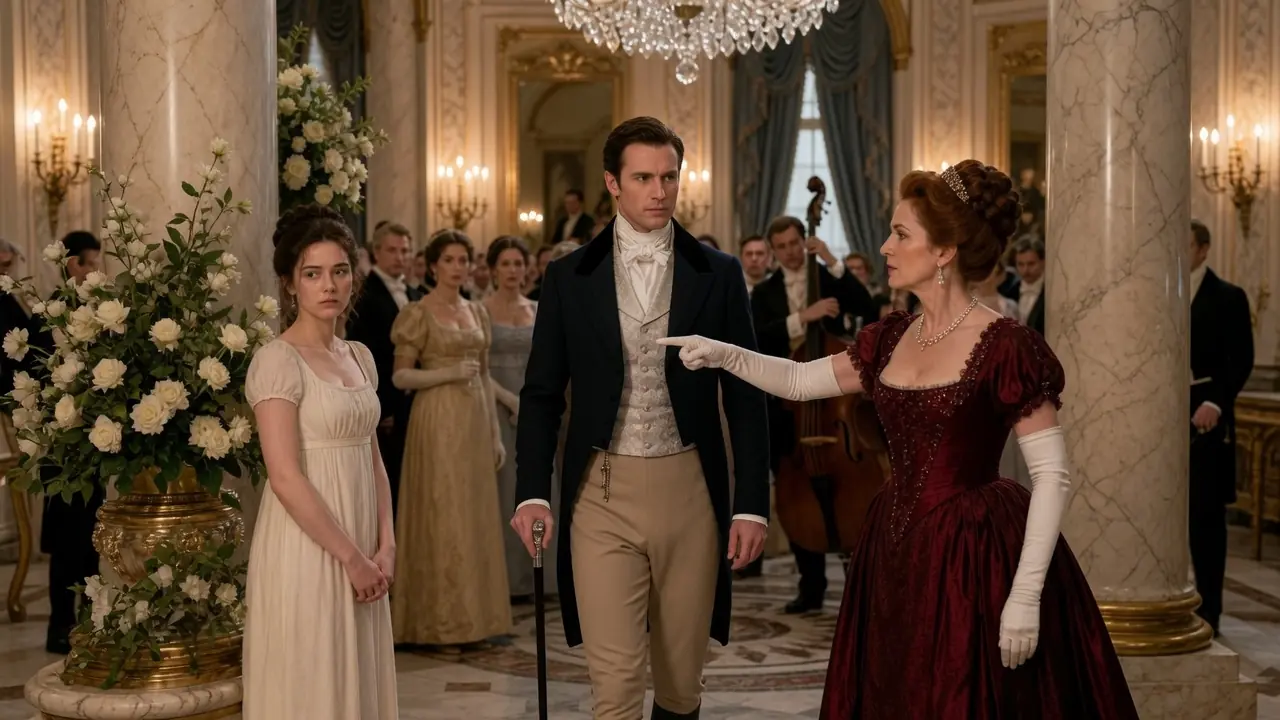
Before what he did next can be understood, it matters to know who she was, what she had already survived, and why the woman her stepmother dismissed in thirty seconds would become the one woman that season nobody could stop talking about. This is Harriet's story and it begins the way the best ones always do. With someone being completely, catastrophically underestimated.
The ballroom of Ashford Manor was alive with candlelight and whispered ambitions. Silk gowns swept across marble floors. Crystal glasses caught the glow of a hundred flames. And the air carried the weight of carefully rehearsed smiles. It was the kind of evening where fortunes were made and reputations were destroyed.
Sometimes before the second waltz. Standing near the far corner of the room, half hidden behind a column of white roses, was Harriet. She had not wanted to come. She had pressed her hands together in the carriage and told herself that one evening of endurance was survivable. Her gown was simple, pale ivory, no embroidery, no jewels at the collar.
And she had arranged her dark hair herself without a maid, without a mirror that told her anything kind. She was the stepdaughter. That was how everyone in that house referred to her. Not by name, not by any warmth, just the stepdaughter as though the word itself explained everything that needed to be said about her place in the world. Then it happened.
Her stepmother, Lady Beatrice, was standing near the center of the room surrounded by her usual circle of admiring acquaintances. Her voice carried with the ease of a woman who had never once feared being overheard. She gestured toward Harriet with a gloved hand and said it plainly without cruelty in her tone which somehow made it worse.
"Nobody will want her," she said as though commenting on the weather.
"She has nothing to offer and even less to recommend her." The room did not go silent. That was the cruelest part. Most people simply continued their conversations, their laughter, their performances, but one man stopped.
Lady Beatrice had married Harriet's father seven years ago, arriving at Thornfield House with two trunks of French dresses and a smile that convinced everyone she was exactly what a grieving widower needed. Harriet had been sixteen. She remembered standing at the top of the stairs the morning after the wedding watching Beatrice rearrange the portrait of her mother in the front hall, moving it from the central wall to a narrow corridor near the servants' quarters, explaining to no one in particular that the colors clashed with the new curtains. In the years that followed Beatrice was never violent, never openly cruel. She was something far more precise.
She forgot to mention Harriet's name during introductions. She arranged dinner seating so that Harriet was always beside the least significant guest. She complimented her stepdaughters, her own daughters, Cecily and Margot within Harriet's earshot in ways that required no comparison because the omission spoke loudly enough. Harriet had learned, slowly and painfully, that being ignored by someone who lived in the same house was its own particular kind of wound. What Beatrice had never understood, or perhaps had understood perfectly and found convenient, was that Harriet's father had left a modest inheritance tied specifically to Harriet's name.
Not a fortune. Not enough to make her desirable in the eyes of a calculating society, but enough to keep her present. Enough to require her at events. Enough to make her impossible to simply discard. So, Beatrice kept her close the way one keeps an uncomfortable piece of furniture.
His name was spoken before he entered the room. That was always the way with the Duke of Crestholm. Someone near the door would catch a glimpse of the dark coat, the unhurried posture, the complete absence of effort to be seen, and the name would travel across the room in a ripple of hushed voices. Crestholm is here. And then everyone would adjust.
The mothers would straighten. The young women would recalculate. The men would remember old favors owed and old offenses best forgotten.
Lawrence Voss, Duke of Crestholm, had attended perhaps four social events in the past two years. He was not a recluse. He simply found no compelling reason to perform. He had wealth that required no display, a title that needed no announcement, and a reputation built not on charm, but on judgment. People said he was cold.
People said he observed more than he spoke. People said that when he did speak, it was worth hearing. What fewer people said, though many suspected, was that he had been betrayed once, deeply, carefully, by someone he had trusted. And that experience had left him with a particular alertness to pretense. He had come to Ashford Manor that evening because Lord Ashford was an old friend who had asked him as a personal favor, and Lawrence Voss honored personal favors.
He had intended to stay one hour. He had been in the room for perhaps twelve minutes when he heard Lady Beatrice's voice carry across the marble floor, and he turned, not with urgency, not with visible reaction, simply turned, the way a man turns when something genuine has cut through the noise of an evening built entirely on performance. He had heard worse things said in ballrooms. He had heard women's futures dismissed over port and cigars. He had heard titles traded like property.
He had sat through dinners where a person's worth was calculated to the last acre of land and the last drop of bloodline. None of it had moved him the way this did. Perhaps because Lady Beatrice had said it so casually. Perhaps because the young woman by the column of white roses had not flinched, not outwardly, but he had seen the way her fingers tightened against the fabric of her gown. The single controlled breath she drew through her nose.
The way her chin lifted by a fraction that most people would never notice. He noticed.
He crossed the room without haste, without the performance of rescue, without the dramatic pause that would have drawn every eye before he arrived. He simply walked toward her, past Lady Beatrice, past the circle of observers, past the architecture of that moment that everyone assumed had already been decided. And he stopped beside Harriet. Not in front of her, not ahead of her, but beside her, as though he had intended to be there all along. He did not look at Beatrice.
He looked at Harriet. And when she turned to meet his gaze, uncertain and unguarded, he said quietly, "I believe we have not been introduced. I would very much like to change that." The words he spoke when he reached her side were simple. But here is what nobody in that ballroom knew. Not Beatrice, not the whispering circles, not even Harriet herself.
The Duke of Crestholm had arrived that evening intending to stay exactly one hour. He had stayed for three. And before the night was over, he had done something he had not done in two years. He had asked about someone by name. The question is, why her?
Why that evening? Why, after years of deliberate distance from every woman society had placed in front of him, did a girl in a plain ivory gown standing beside a column of white roses stop a man that nothing had ever visibly stopped before? The answer lay in what he had been carrying long before he ever walked into that room.
The introduction lasted four minutes. Harriet would remember this later, the precise, strange detail of it, because she had counted the seconds without meaning to, the way a person counts when they are trying to hold themselves together by measuring small and manageable things. His name registered slowly. Duke of Crestholm. She had heard it before, attached to a distant, powerful figure she had never expected to be standing beside, and yet there he was, asking her name with the attentiveness of a man who intended to remember it.
They spoke briefly about the roses arranged near the column. She had admired them genuinely, and he had asked why, and she had answered honestly rather than cleverly, which seemed to interest him more than cleverness would have. When the music shifted and a pair of guests moved past them, he did not step away. He remained where he was at an angle that, to anyone watching from across the room, suggested a conversation of deliberate choosing, which it was. He simply chose not to announce his reasons.
What nobody in that room understood, not Beatrice, not the whispering circles, not even Harriet herself in that moment, was that Lawrence Voss had not crossed the room out of pity. Pity was a thing he dispensed rarely and never in public and never as a performance. He had crossed the room because something in the way she had held herself in the aftermath of humiliation had struck him as the most honest thing he had seen all season. And honesty, in his experience, was almost impossible to find in a ballroom. Almost.
Harriet had spent most of her life becoming comfortable with being overlooked. Not happy. Comfortable. There was a difference she had learned to recognize the way one learns to recognize the difference between rain and storm. Being overlooked was a steady, manageable condition.
It did not surprise her anymore. It did not arrive with the shock of a door slammed in her face. It simply settled around her like weather, and she had built her days accordingly. Reading in rooms nobody else used, walking in gardens at hours nobody else chose, finding pleasure in things that required no audience. She had been presented in society two seasons ago.
Beatrice had arranged it with the minimum of effort and the maximum of visibility for her own daughters. And Harriet had stood through the required events wearing a dress that had been made too quickly by a seamstress given insufficient time, smiling at men who looked past her shoulder while talking to her, answering questions about her prospects with the careful vagueness of someone who understood that honesty would only accelerate the dismissal. No offer had come. No serious attention had followed. One gentleman had danced with her twice in a single evening, and she had allowed herself, briefly, to wonder.
By the following week he had announced his engagement to Margot, Beatrice's youngest daughter. She had not cried. She had gone to the garden that evening and sat on the stone bench beside the old rose bush her mother had planted years before, and she had simply stayed there until the feeling passed. That was the method she had developed. Not suppression, not performance, just waiting.
Feelings, she had discovered, did pass. What they left behind was a kind of quiet knowledge, and the knowledge she carried from that particular evening was simple and final. She was not the woman men chose. She was the woman men practiced consideration on before choosing someone else. That belief had settled into her bones long before the Duke of Crestholm crossed a ballroom and asked to know her name.
Lawrence had built his ability to read people the way other men built fortunes. Through patience, through accumulated loss, through the slow and costly education of being wrong about someone he should have seen clearly. He did not consider himself particularly gifted. He considered himself experienced in the specific way that only disappointment produces. And what experience had taught him was that the most revealing moment in any social gathering was not what people said, but what they did in the three seconds after something unexpected happened to them.
He had watched Harriet in those three seconds after her stepmother's words reached the open air. Most women in her position would have done one of several predictable things. Colored visibly, looked for an exit, manufactured a smile, or dropped their gaze to the floor in the universal language of wanting to disappear. Harriet had done none of these. She had gone very still.
Then she had lifted her chin by that fraction he had noticed, drawn that single quiet breath, and returned her gaze to the roses as though she were deciding in real time that the roses deserved her attention more than the humiliation did. It was not performance. It was not bravery manufactured for an audience. It was something older and quieter than bravery. It was a woman who had survived this feeling before and knew with painful certainty exactly how to carry it.
That was what the others had missed. They had heard Beatrice's words and cataloged them as unremarkable social arithmetic. A stepdaughter without prospects. A stepmother stating an obvious fact. Nothing requiring further attention.
Lawrence had heard the same words and seen something else entirely. He had seen a woman being erased in real time and refusing, in the smallest and most private way, to be completely erased. That refusal interested him more than anything else that had happened in that ballroom all evening.
By the following morning, the story had already traveled through three drawing rooms and one breakfast table. The Duke of Crestholm had approached the Thornfield stepdaughter at the Ashford ball. He had spoken to her for, and here the accounts varied wildly, anywhere between four minutes and half an hour, depending on the narrator's relationship to drama. He had stood beside her. He had not danced with her.
He had not escorted her anywhere. He had not done anything that could be formally noted and recorded, but he had chosen to be beside her publicly after Lady Beatrice's remark. And in the architecture of society that season, the gesture was impossible to interpret as accidental.
The speculation divided itself neatly into two camps. The first held that the Duke had acted out of social correction. They believed he found Beatrice's public commentary distasteful and had responded with the particular authority of a man whose disapproval carries consequences. This interpretation was favored by those who preferred their Duke logical and unmoved. The second camp, smaller, more quietly excited, suggested something else entirely.
They believed he had looked at the girl. They believed he had remained beside her, not as a statement about Beatrice, but as a statement about Harriet herself. This interpretation made people uncomfortable in the way that unexpected possibilities always do.
Beatrice heard the rumors at eleven and spent the following two hours reconstructing her composure. She had not anticipated this. She had said what she believed to be an unremarkable truth in the company of unremarkable witnesses and somehow it had become a story. She looked at Harriet across the breakfast table that morning with an expression that had not been there before. Not quite respect, not quite fear, but something hovering uneasily between recognition and recalculation.
Harriet, for her part, buttered her toast and said nothing, which Beatrice found, for the first time, deeply unsettling.
Beatrice was not a foolish woman. That was the important thing to understand about her. She had navigated society's expectations with precision for two decades, had secured one advantageous marriage and managed its aftermath with considerable skill, and had positioned her own daughters well enough that their futures were no longer a source of anxiety. She operated by calculation, not cruelty, and she had always maintained that her treatment of Harriet was simply realistic. The girl had modest prospects and a quiet temperament.
Announcing this to the world, Beatrice had reasoned, was not unkindness. It was efficiency. What she had failed to account for was the Duke of Crestholm. Not because she hadn't known he was in the room. She had known, had even positioned herself advantageously near the center of the hall, aware that visibility to powerful men was never wasted.
She simply had not considered that her words about Harriet would reach him, and more critically, that they would move him. Men like Lawrence Voss were not supposed to be moved by stepdaughters in ivory gowns with no fortune and no titles. They were supposed to be moved by strategic introductions, well-managed reputations, and the correct combination of beauty and bloodline. That was the formula. That had always been the formula.
She called on Lady Ashford the following afternoon under the pretense of thanking her for the evening, and within six careful minutes had extracted the confirmation she needed. The Duke had asked Lord Ashford about Harriet by name. Not about her family. Not about her prospects. About her.
Beatrice rode home in her carriage with her gloved hands folded in her lap and the quiet, cold awareness that she had made an error. She did not yet know how large the error was, but she had lived long enough in society to recognize the particular feeling of a door swinging open that you had assumed was permanently closed, and the complicated fear of not knowing who might walk through it.
Harriet's mother had died in the spring when Harriet was nine years old. Not dramatically, not with the sudden violence of accident, but slowly. A long illness that moved through the house like a tide coming in, taking things gradually, leaving the rooms quieter week by week until one morning there was simply silence where there had once been a voice. Her father had grieved in the particular way of men who do not know what to do with grief, by filling the house with activity, with guests, with new furniture, with eventually a new wife. Harriet had grieved by going very still and staying that way for a long time.
What she remembered most about her mother was not her face, which had grown soft at the edges in memory, but her hands. The way she held a teacup, the way she pressed dried flowers between the pages of books, the way she would touch Harriet's hair in the evenings without saying anything, as though presence itself was a complete language. The rose bush in the garden had been her mother's. Harriet had tended it every season without being asked, without telling anyone why, trimming it in autumn and watching it return each spring with the specific, private relief of someone who needed proof that some things survived. She had never spoken about any of this at Thornfield House.
Beatrice had arrived with new curtains and new arrangements, and the implicit understanding that sentiment about the previous occupant of the house was not a welcome feature of the new household. Harriet had complied, not out of cowardice, but out of the careful protection of things too important to risk in hostile air. She kept her mother's memory the way she kept most things that mattered, quietly, privately, in spaces nobody else thought to look. It had made her appear cold to some, unfeeling to others. The truth was the opposite.
She felt everything. She had simply learned, very young, that not every feeling was safe to show.
Harriet carried the silence, the rose bush, and the mother she had protected inside herself for years in a house that had no room for her grief. Meanwhile, somewhere across the city, a duke who had spent two years keeping everything at a careful distance was making a decision.
An anonymous letter had just been delivered to three of the season's most dangerous gossips. It named Harriet. It was precise. It was devastating. And the man who received a summary of it the following morning had exactly one choice to make.
It was the kind of choice that reveals with complete clarity what a person is actually made of. What he did next changed everything, but not in the way anyone expected.
Lady Lavinia Whitmore had been considered the most strategically positioned woman of the season for reasons she had cultivated with considerable effort. She was beautiful in the way that society found reassuring, fair, composed, expensive. And she had spent two years constructing a reputation for elegance that left very little room for accident. She had decided with the quiet certainty of someone accustomed to getting what she planned for that the Duke of Crestholm would eventually turn his attention toward her. It was simply a matter of patience and correct positioning.
She had been patient. She had positioned herself correctly at every significant event. And then he had crossed a ballroom to stand beside a girl in a plain ivory gown. And Lavinia had felt the specific disorienting sensation of a calculation failing in real time. She did not panic.
Panicking was for women who had no other resources, and Lavinia had resources. She began, with characteristic precision, to gather information. She spoke to the right people at the right teas, asked questions framed as casual curiosity, and assembled within four days a complete picture of Harriet's situation. The modest inheritance, the stepmother's management of it, the two unsuccessful seasons, the father who had retreated into quiet irrelevance. It was, by every measurable standard, an unimpressive picture.
And yet the Duke had asked about her by name. That detail refused to fit the picture, which meant either Lavinia was missing something or the Duke had temporarily lost his judgment. She preferred the second explanation. It was more manageable.
She arranged to encounter Harriet at a morning call three days after the Ashford ball at the home of a mutual acquaintance who could be relied upon to invite both of them without recognizing the tension such an invitation created. Lavinia arrived composed and gracious, greeted Harriet with the particular warmth of a woman who has decided that open hostility is a tactical error, and spent the hour being precisely kind enough to be above reproach and precisely pointed enough to be understood. She mentioned the Duke twice, once as a passing reference, once with a small sympathetic smile directed at Harriet, as though the whole situation were slightly pitiable in a way that couldn't quite be named. Harriet smiled back and said very little, which Lavinia realized on the carriage ride home, was somehow more unsettling than if she had said a great deal.
The invitation arrived on a Tuesday, delivered by a footman in Crestholm livery, who waited at the door with the particular stillness of someone trained to show nothing. It was an invitation to a private gathering at the Duke's London residence. Not a ball, not a formal dinner, but an evening of music and conversation. The kind of event that carried its own distinct weight in the social calendar, precisely because it was selective.
Harriet read it twice standing in the hallway, then carried it to the window and read it a third time, as though the light might reveal some error she had missed. Beatrice appeared at the end of the corridor before Harriet had decided what she felt about it. The invitation was noted, assessed, and processed in the space of approximately four seconds, after which Beatrice's expression settled into something carefully neutral that cost her visible effort to maintain. She said that of course Harriet should attend, that it would be impolite to decline, that proper arrangements would need to be made regarding dress and transport, and that she herself would naturally require notice of the timing so that the household schedule could be adjusted accordingly. She said all of this without once acknowledging the obvious, which was that an invitation from the Duke of Crestholm to a stepdaughter she had publicly dismissed was the most direct social correction she had ever received, delivered without a single word.
Harriet stood in her room that evening with the invitation on the writing desk beside her, and allowed herself carefully to feel something she had not permitted in a long time. Not hope, exactly. Hope was too large and too dangerous a word for what she could afford. Something smaller. A quiet, tentative opening.
The way a window allows air before you have decided whether to push it all the way up. She did not trust it. She had been wrong about the window before and knew precisely how cold the air could become when it slammed back shut. But she left the feeling where it was, untouched, and went to sleep without pushing it away. That for Harriet was as close to believing as she had come in years.
The evening at Crestholm House was exactly what the invitation had promised. Understated, elegant, and carefully assembled. Harriet arrived with a borrowed confidence she wore like a coat, slightly too large, aware of its edges, but determined not to show it. The Duke received his guests in a room lined with books and low candlelight. And when he saw her, he crossed toward her with the same unhurried certainty she remembered from the Ashford Ballroom, as though her presence was expected and welcome, and not in any way remarkable, which she was beginning to understand was his particular way of making a person feel that they belonged.
They spoke for longer that evening, about books first. She had read more widely than he expected, and she could see that it surprised him, which pleased her more than it should have. About the city, about music, about the kind of small and honest observations that only happen between people who have quietly decided to stop performing for each other. At some point in the evening, she realized that she had stopped monitoring herself, stopped counting the exits, stopped waiting for the moment when the conversation would reveal itself as something other than what it appeared to be. That realization arrived with warmth and almost immediately afterward with fear.
The fear proved prescient. Three days after the evening at Crestholm House a letter appeared. Anonymous. Delivered to three of the season's most reliable gossips simultaneously, with the efficiency of someone who understood exactly how information traveled. The letter claimed that Harriet had pursued the Duke deliberately, had manufactured the encounter at the Ashford Ball, had used knowledge of his attendance to position herself near him and engineer his sympathy.
It named her inheritance as her only motive. It described her as calculating in the precise language of someone who wanted the accusation to feel like obvious truth. By the afternoon the story had found its legs. And Harriet, who had allowed herself one quiet window of something close to belief, found the air outside it very cold indeed.
Lawrence heard about the letter before noon. His secretary placed the information before him with the careful neutrality of a man who understood that his employer's response to social matters was rarely predictable and always final. Lawrence read the summary, set it down and spent a long moment at his window looking at the street below with the particular stillness of someone making a decision that had already been made and was simply being confirmed.
He knew who had written it. Not with the certainty of evidence, not yet. But with the deeper certainty of pattern recognition. The kind that comes from years of watching people protect their interests in the specific language of their fear. The letter had Lavinia Whitmore's precision and none of her fingerprints, which was itself a kind of signature.
What mattered more to him than the author, however, was the effect. Harriet would have heard by now. She would be sitting somewhere, probably somewhere quiet, probably alone, absorbing this with that terrible, practiced stillness he had recognized from the very beginning, adding it to the collection of things she had learned to carry without letting anyone see the weight.
He could do nothing. That was the choice that required the least of him. Say nothing. Make no public gesture. Allow the letter to settle into the general noise of seasonal gossip and trust that it would fade.
His silence would protect his own reputation from the appearance of entanglement in a social drama. It would also confirm everything the letter implied about Harriet. That she was not someone a man of his standing chose deliberately. That the Ashford encounter had been anomalous. That Lady Beatrice's assessment was, after all, correct.
He stood at his window for four minutes. Then he called for his coat.
He came to Thornfield House that afternoon without prior notice, which was itself a statement. Harriet received him in the front sitting room because Beatrice had arranged it that way, intercepting the visit with the speed of a woman recalibrating her position, and then remained in the room under the pretense of propriety until Lawrence looked at her with a single, quiet patience that communicated, without rudeness, that her presence was not required. Beatrice left. The door remained open, as decorum required. The house went very still.
He told her plainly that he had heard about the letter. He told her that he did not believe it, and that he intended to make his position clear in whatever manner she felt was appropriate. He said it without theater, without the performance of chivalry, with the same directness she had come to recognize as the truest thing about him. And she listened.
She sat with her hands folded and her expression composed, and she listened to all of it. And when he finished, she was quiet for a long moment before she looked at him with something in her eyes that was not gratitude and not warmth, but something more complicated and more honest than either.
She told him that she appreciated what he was offering. Then she told him she would not accept it. Not in the form he was proposing. She was not a reputation to be rehabilitated. She was not a wrong to be corrected.
She was not a problem that his name could solve by being attached to hers in the right rooms at the right volume. If people believed the letter, his defense would read as obligation. If she was to be seen clearly, if she was to be seen at all, it could not be because a powerful man had decided to see her on her behalf. She had to be seen as herself on terms that were hers. She said this quietly, without anger, with the firmness of someone who had thought about dignity for a very long time and knew exactly where its edges were.
He looked at her for a moment that lasted longer than most silences. Then, very quietly, he said, "Tell me what your terms are." She had just refused the Duke of Crestholm. Not out of pride, not out of fear, but out of something far more difficult and far more rare, a clear and unshakable understanding of her own worth. He had left Thornfield House that afternoon with her terms ringing in the air between them.
"Tell me what your terms are," he had said. And now he had two days to decide whether he was the kind of man those terms deserved. What he chose to do next, what he said, what he admitted, and what he finally allowed himself to feel out loud for the first time in years became the part of this story nobody who heard it ever forgot.
He came back two days later, not with a plan, not with a strategy, not with the architecture of a man managing a social situation. He came with a question, one he had been carrying since the afternoon she had told him her terms and he had left Thornfield House with the unfamiliar sensation of having been both refused and respected simultaneously. He asked if she would walk with him in the park adjacent to the house in full visibility of whoever wished to observe, with no pretense about the purpose of the visit. She considered this for a moment, then reached for her coat.
They walked for some time before he spoke. The park was quiet at that hour, late afternoon, the light going golden and long across the grass. The kind of afternoon that makes cities feel briefly like something gentler than they are.
He told her about the betrayal, not dramatically, not with the practiced economy of a man who had told the story before, but haltingly, in the way of someone excavating something that had not been touched in years. A woman he had trusted completely, an engagement he had believed in, a discovery made not through confrontation, but through the accumulation of small, undeniable evidence that the affection had been performed from the beginning. That his title and his fortune had been the object of the entire arrangement. And that the person he had believed he knew had never existed outside his own willingness to be convinced. He did not tell her this to explain himself, he said.
He was not asking for her sympathy or her reassurance. He told her because she had asked him two days ago to operate on her terms. And her terms required honesty. And honesty for him meant she should know why he had spent years treating sincerity as a risk rather than a gift.
He stopped walking and turned to look at her in the long afternoon light and said that from the moment he had watched her refuse to be diminished in that ballroom something he had kept very closed had opened without his permission. He had not known what to do with that. He was still not entirely certain. But he was, for the first time in a long time, unwilling to pretend it wasn't happening.
The walk in the park lasted forty minutes. This was noted. The Duke of Crestholm and the Thornfield stepdaughter, in plain view of the afternoon promenade, unhurried, speaking with the ease of people who had passed the stage of performance, three separate accounts reached three separate drawing rooms by early evening. And by the following morning, the story had clarified itself into something the season had not expected and could not easily dismiss.
The anonymous letter, which had seemed so decisive four days earlier, now looked different in the new light. Not because anyone had formally discredited it. No one had needed to. The Duke's behavior had rendered it irrelevant in the most efficient way possible, which was simply to continue as though it had not changed his thinking by a single degree. Society understood power, and it understood that a man of Lawrence Voss's standing did not walk publicly with a woman for forty minutes unless he had made a decision.
The question that remained, the question that ran through every carefully worded conversation that week, was what kind of decision it was.
Lavinia Whitmore attended a Thursday luncheon and was asked twice for her opinion on the matter. She gave it with perfect composure, saying that she wished Miss Thornfield every happiness, that the Duke was of course free to spend his time as he chose, and that she herself had always found the stepdaughter to be a perfectly agreeable young woman. She said all of this without a tremor, without a visible crack, with the full technical performance of gracious defeat. Nobody in the room was entirely convinced, but nobody said so, because Lavinia had given them nothing they could point to, and in society that particular skill, the ability to lose without appearing to, was its own form of power, even when it was all that remained.
He did not propose in the manner of men who considered a proposal a transaction. He did not arrive with a ring presented at a calculated moment, or with a speech constructed to be difficult to refuse, or with the weight of social expectation arranged behind him like a stage set.
He came on a quiet morning when the house was still and Beatrice was out, and he asked Harriet if they could sit in the garden. She had mentioned her mother's rose bush once briefly, and he had remembered, which she noticed and did not comment on, because some things are received in silence precisely because words would make them smaller. He told her he was not asking her to rescue him from loneliness or to complete the social picture of a duke requiring a duchess or to be the resolution to a season's worth of gossip. He told her he was asking because he had spent two years before this one moving through rooms full of people and feeling consistently that he was alone in them. And he had not felt that way once in her company, not once. Not even in the silences, which with her were a different kind of silence than the ones he was accustomed to.
He said that if she chose him, he wanted it to be because she was choosing something for herself, something she wanted on terms that were genuinely hers, and not because the offer was convenient or because refusing it would create difficulties. He would rather be refused honestly, he said, than accepted out of anything less than real choosing.
Harriet sat with that for a long moment. The rosebush beside the stone bench was an early bloom, pale pink, unruly at the edges, returning as it did every spring with the stubborn persistence of things that survived. She thought about the girl who had sat on this bench years ago and waited for a feeling to pass, who had learned that survival and living were not the same thing, who had built her days so carefully around absence that she had almost forgotten what it felt like to want something for herself rather than simply endure the wanting. Then she looked at him, at the man who had crossed a ballroom not to rescue her, but because he had recognized something real. And she said yes, not quickly, not with relief, not with the exhale of someone who has been waiting to be saved. She said it the way she did most things that mattered. Quietly. Deliberately. With the full weight of her own choosing behind it.
The wedding was small by the standards that society would have preferred. Lawrence had asked her what she wanted. And she had said with the directness he had come to love specifically because it never performed itself. She wanted only the people who had actually seen her. It turned out to be a short list.
And neither of them found that sad.
The ceremony took place on a morning in late spring in a chapel at the edge of the Crestholm estate, with light coming through old glass and landing in colors across the stone floor. The rose bush from her mother's garden, carefully transplanted in the weeks before by a gardener Lawrence had arranged without telling her and then admitted to with the slight awkwardness of a man unaccustomed to being caught in tenderness, bloomed in a clay pot beside the entrance.
There was a moment just before the ceremony began when Harriet stood in the small anteroom and looked at her own reflection in the narrow mirror on the wall. She was wearing ivory again. She had chosen it deliberately. The same color as the gown from the Ashford ball. Because she had decided that the color belonged to her and not to that evening.
And she was taking it back. She looked at herself for a long time. Not checking. Not correcting. Not performing the ritual of finding fault before anyone else could.
Simply looking. Seeing. She thought of her mother. And of the pressed flowers in the pages of old books. And of the language of presence that needed no words.
She thought that her mother would have liked him. Not for his title or his fortune, but for the specific quality of his attention. The way he listened as though what she said was the most important thing in the room.
The life that followed was not without difficulty, because no honest life is. There were seasons of adjustment and moments of old fear returning, the way old fears do, quietly, at unexpected hours. And there were times when Harriet had to remind herself, consciously, that she was allowed to take up space and make noise and be imperfect in front of someone who had chosen her, knowing she was all of those things. But there was also this.
Every morning in the house that was now hers by choice and not by tolerance, she woke up beside a man who had first seen her in the worst moment of a difficult evening, and decided, without drama and without rescue, simply to stand beside her. And she had learned, slowly and with the particular grace of someone who had carried silence for a very long time, that being truly seen by one person who means it is worth more than being admired by an entire room that doesn't.
That was the truth Lady Beatrice had never understood.
That was the truth the season had tried, in its careless way, to bury. And that was the truth that had found its way home. Not because someone powerful had declared it, but because a woman who had almost stopped believing in it had decided, in a garden in spring, that she was finally ready to choose it for herself.
Harriet walked into that ballroom as someone her stepmother had already decided the world would never want. She left it, not that night, but by the end of her story, as a woman who had stopped waiting for the world's permission to take up space.
The Duke did not save her. She saved herself by refusing to be less than she was, even when everything around her insisted that less was all she deserved.