The first thing Officer Travis Reed knocked over was Marcus Hale’s coffee.
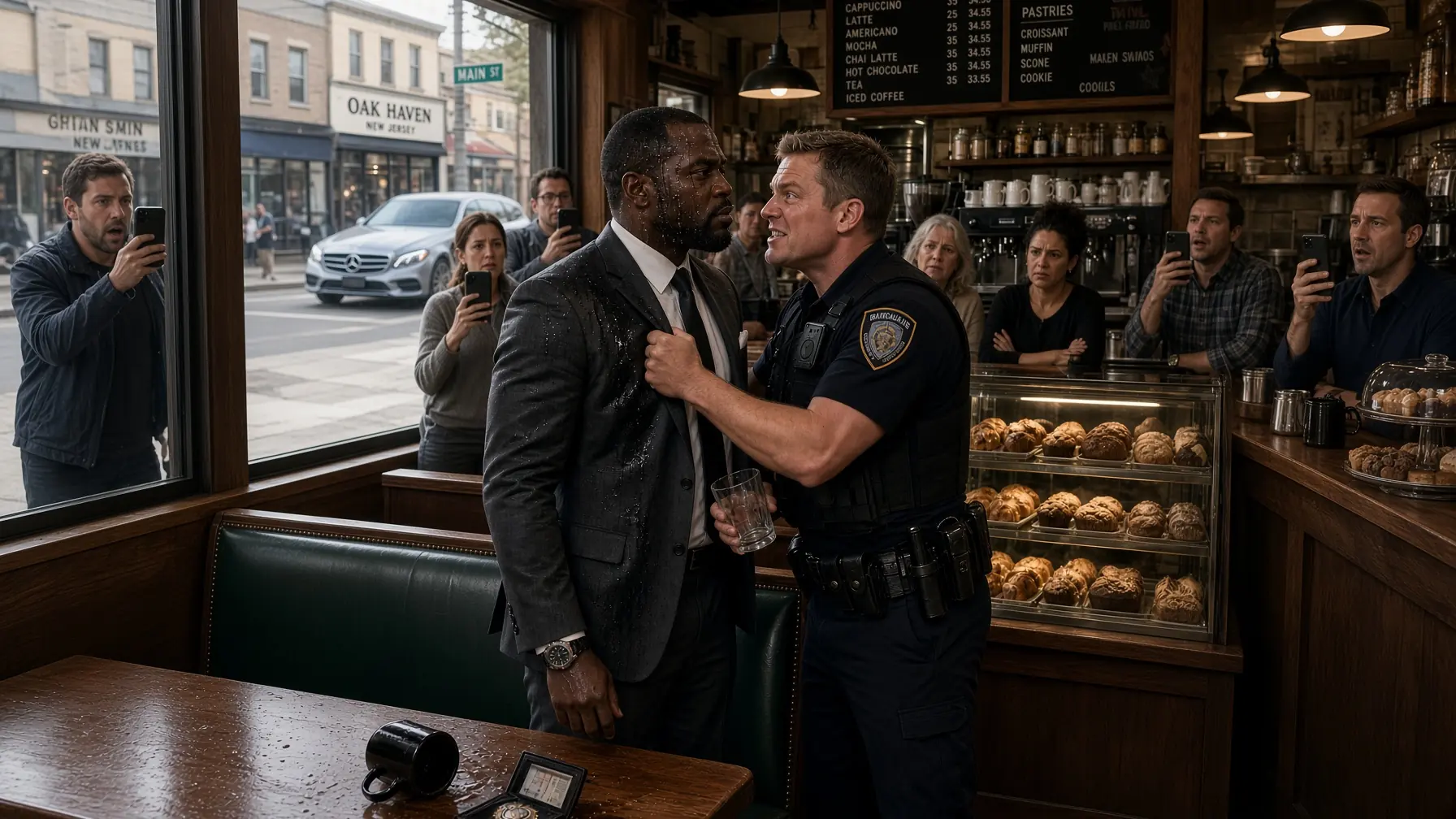
The paper cup tipped when Reed pulled Marcus abruptly from the café chair, sending black coffee across the little walnut table and into the plate holding half a blueberry scone. A woman at the next table sucked in a breath. Someone farther back whispered, “What is he doing?” Marcus did not pull away. He did not raise his voice. He simply looked down at Reed’s hand wrapped around his left forearm, then toward the security camera mounted above the pastry case. “Officer,” he said evenly, “I have not threatened you, I have not tried to leave, and I have not committed a crime. If you are detaining me, state the reason.”
Reed tightened his grip.
“Stand up.”
“I am standing.”
“Hands behind your back.”
Marcus glanced toward the front window of the Bean and Leaf Café. The black sedan he had driven that morning sat legally along the curb beneath a row of red October maples. Beyond it, Oak Haven, New Jersey, looked exactly like the kind of town its real-estate brochures promised: polished storefronts, brick sidewalks, expensive SUVs, decorative lampposts, and enough carefully planted trees to make affluence feel organic. Nothing outside suggested danger. Nothing inside did either. Yet Reed had somehow transformed a Black man drinking coffee at 7:38 on a Tuesday morning into something requiring handcuffs.
Marcus moved his hands slowly behind him.
Metal closed around his right wrist.
Several customers raised their phones.
Reed noticed.
That made his movements sharper.
“Everybody stay back,” he said without looking around.
Nobody had moved toward him.
Marcus felt the second cuff close and immediately tested the pressure with his fingers. Too tight, but not dangerously so. He had worn handcuffs in training, during controlled exercises, and once during an undercover operation almost fifteen years earlier. He understood exactly how little dignity they left a person when everyone nearby had already decided the restraints must mean something.
“Is this because I asked why you wanted identification?” Marcus asked.
Reed turned him toward the front window.
“This is because you’re being evasive.”
“I answered every question you asked.”
“You refused to tell me where you live.”
“I asked whether I was legally required to.”
“There. That right there.”
Marcus almost smiled.
Not because anything was funny.
Because he had heard those words before.
Not from Reed.
From people describing Reed.
Three months earlier, the New Jersey Attorney General’s Office had quietly asked the FBI’s Newark Field Office for assistance reviewing a cluster of civil-rights complaints involving several municipal departments in northern New Jersey. Oak Haven had not been the largest target. It was barely a target at all when the review began. A handful of complaints involved pedestrians stopped for “looking into cars,” contractors questioned in affluent neighborhoods, delivery drivers detained after residents reported “suspicious vehicles,” and several Black motorists whose encounters had expanded after they asked officers why they had been stopped.
No single complaint had proved corruption.
No single video had shown dramatic violence.
What investigators noticed was language.
Evasive.
Uncooperative.
Argumentative.
Refused simple questions.
Could not provide satisfactory explanation for presence.
Officer Travis Reed’s name appeared repeatedly.
Marcus Hale had read his reports.
He had not expected to meet the man over coffee.
That morning Marcus was supposed to meet Essex County District Attorney Lena Harper at 8:30 in a secure conference room two blocks from Oak Haven municipal headquarters. They were scheduled to review witness-protection logistics for a broader public-corruption investigation involving municipal contracting, towing referrals, and potential manipulation of police incident records. Marcus had arrived early and stopped for coffee because after twenty-seven years in federal law enforcement, he had learned that arriving thirty minutes early made everyone believe you were disciplined when sometimes you simply wanted a quiet table.
He had not been conducting surveillance.
He was not trying to bait Reed.
He had not even known Reed was outside until the patrol car stopped across the street.
Now Reed stood behind him, one hand on Marcus’s cuffed wrists.
“What are you doing in Oak Haven?” he asked again.
Marcus looked at his reflection in the window.
“Having breakfast before a meeting.”
“With who?”
“That isn’t relevant to whether I committed a crime.”
Reed gave a short laugh. “You people always think questions are optional.”
Marcus’s eyes shifted toward the glass.
He did not turn.
“What does ‘you people’ mean?”
Reed went quiet for a fraction of a second.
“People who think they know the law.”
Marcus nodded once.
Good.
Words preserved themselves.
Behind the counter, café owner Beatrice Lawson stepped forward. She was sixty-one, Black, had operated the Bean and Leaf for fourteen years, and had known enough police officers to recognize when a routine contact had stopped being routine. “Officer Reed,” she said, “he came in, ordered coffee, paid, and sat down. He hasn’t bothered anybody.”
Reed looked over his shoulder.
“Did I ask you?”
“It’s my café.”
“Then let me do my job.”
Beatrice’s expression hardened. “Your job started because he drank coffee near a window?”
Reed turned fully toward her. “We received a suspicious-person concern.”
Marcus looked toward him.
That was new.
When Reed first entered, he had said he was “checking something out.”
Now there was a concern.
“Who called?” Marcus asked.
Reed ignored him.
Beatrice said, “Nobody here.”
Reed snapped, “Ma’am, behind the counter.”
The room tightened further.
A white man in a navy quarter-zip sitting near the pastry display looked down at his laptop. A young Black woman near the door began recording openly. An older couple stopped eating altogether.
Marcus watched everyone through the reflection in the window.
This was why he kept his voice low.
When authority became performative, matching its volume often gave it exactly the story it needed.
“Officer Reed,” Marcus said, “there is a leather credential wallet inside the left interior pocket of my jacket. Before you continue, I recommend you look at it.”
Reed stared at him.
“What credential?”
“You’ll see.”
“Trying to tell me there’s a weapon?”
“No.”
“You carrying one?”
Marcus paused.
He was.
A Glock 19 issued through the FBI, holstered at his right hip beneath the suit jacket.
Now the question became safety-critical.
“Yes,” Marcus said. “I am lawfully armed. The firearm is on my right hip. I am not reaching for it. My identification is in my left interior jacket pocket. Please retrieve the identification first.”
The room became completely silent.
Reed’s hand went instantly toward his pistol.
“Gun!”
Marcus did not move.
“I just told you exactly where it is.”
“Don't move!”
“I’m not.”
Reed stepped sideways, drew his weapon, and pointed it toward Marcus’s back from several feet away.
The woman recording gasped.
Beatrice whispered, “Jesus.”
Marcus focused on breathing.
The physical facts mattered now.
Hands cuffed behind him.
Firearm holstered.
Officer armed and excited.
Customers close.
One reckless correction could become the last argument Marcus ever won.
“Officer Reed,” Marcus said carefully, “my credential wallet is in the left inside breast pocket. Retrieve it. Do not remove the firearm until you have verified the credential.”
Reed approached cautiously.
His left hand opened Marcus’s jacket.
He found the leather wallet.
Pulled it out.
Opened it.
For a second, the entire encounter had a clean exit.
The gold federal badge caught the café lights.
Above it sat Marcus’s photograph and credential.
FEDERAL BUREAU OF INVESTIGATION
MARCUS HALE
ASSISTANT SPECIAL AGENT IN CHARGE
Reed stared.
Marcus could not see his face directly, but he could see the reflection in the window.
Recognition did not arrive.
Resistance did.
“This is fake.”
Marcus closed his eyes for half a second.
“Run the credential number.”
Reed turned the wallet over.
“Anybody can buy this stuff online.”
“You cannot buy that credential number and have it verify through federal law-enforcement channels.”
“Shut up.”
“Call your dispatcher.”
“I said shut up.”
Reed tossed the credential wallet onto Marcus’s coffee-soaked table.
It landed beside the overturned cup.
Beatrice stared at it.
The young woman recording zoomed in.
Marcus heard her whisper, “Oh my God, that’s FBI.”
Reed stepped back toward him.
“You’re carrying a gun while impersonating federal law enforcement.”
Marcus’s voice remained flat.
“That would be an extraordinarily serious offense.”
“Glad we agree.”
“So verify before you accuse me of it.”
Reed holstered his own weapon only long enough to remove Marcus’s Glock from the holster. He held it awkwardly, then placed it on the roof of the patrol car after escorting Marcus outside. A couple on the sidewalk stopped and stared. Reed removed the magazine, cleared the chamber, and set the ammunition beside it.
Marcus watched.
“The firearm serial is registered to the United States government.”
“You're really committed to this.”
“You have everything necessary to verify me.”
Reed opened Marcus’s jacket farther and searched the remaining pockets.
Marcus said clearly, “I do not consent to a search beyond whatever lawful safety frisk you believe is necessary.”
Reed removed a set of keys.
An FBI-issued secure phone.
A personal phone.
A folded envelope.
Then a black access card.
He looked at the secure phone.
“What’s the code?”
“No.”
Reed smiled.
“That’s obstruction.”
“No. That is a locked phone.”
“You want me to believe you’re federal but won’t unlock your phone?”
“The people who issued that device would be very unhappy if I unlocked it for an unverified local officer on a sidewalk.”
Reed’s face reddened.
“You're not in a position to negotiate.”
“I’m not negotiating.”
Marcus looked toward the café windows, where nearly every customer had become a witness.
“I’m documenting.”
That word bothered Reed.
“Get against the hood.”
Marcus complied.
Reed searched his trousers.
Nothing.
Wallet.
Federal vehicle-access card.
A second set of credentials related to secure facilities.
Then Reed found a folded business card inside the jacket.
LENA HARPER
DISTRICT ATTORNEY
He looked at it.
“You collecting official names now?”
“She’s who I’m meeting.”
“Sure.”
Marcus almost said the obvious thing.