Danielle Mercer’s coffee was still hot when she heard the cruiser door slam.
It was 7:41 on a Tuesday morning in Fairfax County, Virginia, and Danielle had been outside for less than six minutes. She stood near the low brick wall beside her front walkway wearing a deep-purple Georgetown sweatshirt, loose sage-gray sweatpants, and soft lavender house slippers, one hand wrapped around a pale-purple ceramic mug while she looked at a landscaping invoice on her phone. Behind her stood the two-story brick house she had purchased five years earlier after spending most of her adult life moving between apartments, temporary assignments, and government housing that never quite felt permanent.
The morning had been ordinary until the police car stopped.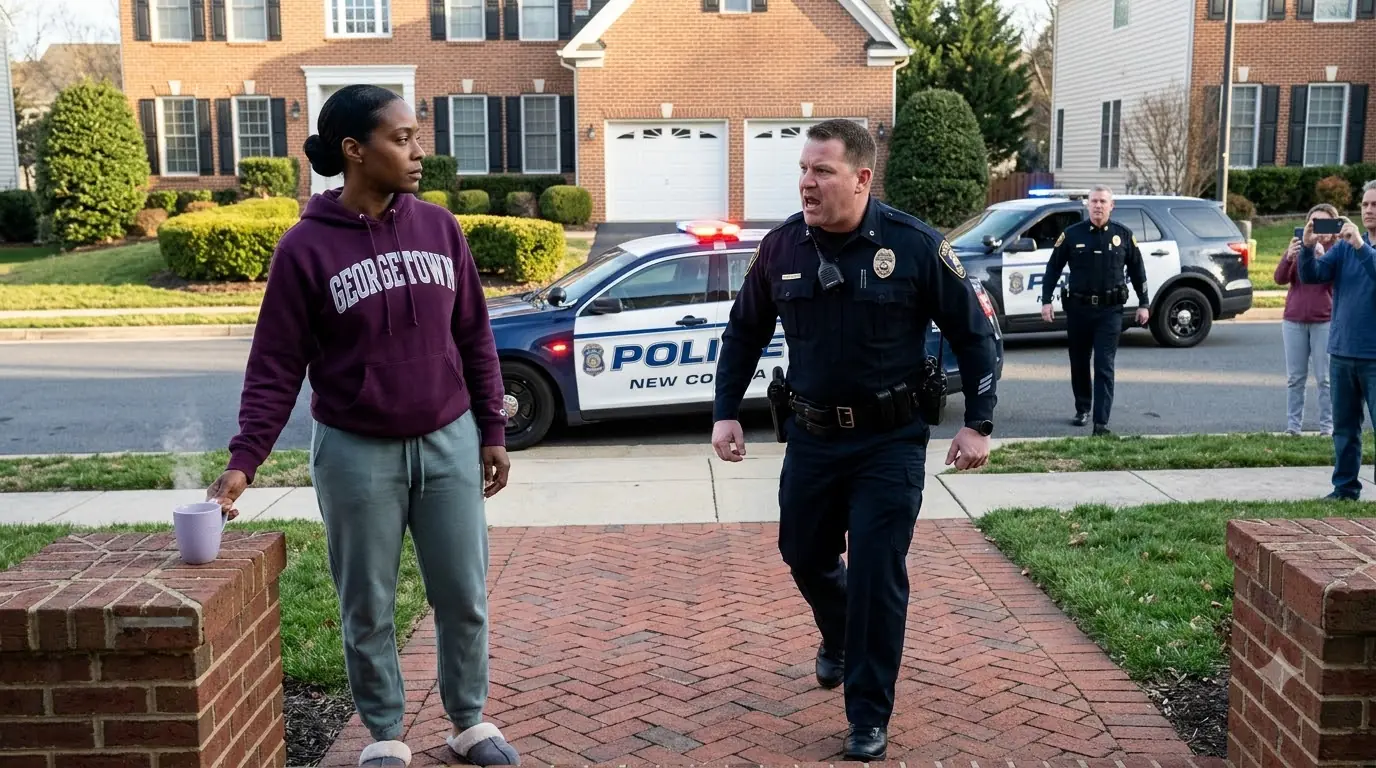
Danielle noticed it first through the reflection in one of the front windows.
Dark SUV.
Red and blue lights.
A man stepping out quickly.
She lowered her phone.
Officer Brent Callahan came through the open edge of the driveway with the posture of someone who had already decided he was entering a problem rather than investigating one. He was forty-five, broad through the chest, short brown hair carefully trimmed, and wore a dark navy patrol uniform with a gold badge, radio microphone, utility belt, and the tight expression of someone irritated before the conversation had even begun.
“Ma’am.”
Danielle waited.
“Put the cup down.”
She looked at the mug.
Then at him.
“Excuse me?”
“Put it down and show me your hands.”
Danielle slowly lowered the mug away from her face.
“My hands are visible.”
“Set it down.”
There was no reasonable safety concern she could identify, but she did not argue.
She placed the mug on the brick ledge.
Steam continued curling from the top.
Brent moved closer.
“Identification.”
Danielle looked toward her front door.
“My wallet is inside.”
“Don’t move.”
She stopped.
For a second she simply stared at him.
“You just asked me for identification.”
“I said don’t move toward the house.”
“Then how would you like me to get it?”
His jaw tightened.
“We’ll get to that.”
Danielle’s professional instincts activated before her anger did.
Contradictory commands.
No explanation.
No articulation of why she was being detained.
No apparent attempt to verify the property address.
She had spent sixteen years as a federal prosecutor. She knew exactly how quickly a seemingly minor encounter could become complicated once pride replaced procedure.
So she kept her voice controlled.
“Officer, may I ask why you’re here?”
Brent looked toward the house.
Then back at her.
“We received a call about a suspicious person.”
Danielle waited.
“Okay.”
“You fit the description.”
“What description?”
He did not answer immediately.
Instead he looked at her clothing.
Her slippers.
The expensive brick home behind her.
The black SUV parked inside the garage.
Something in his expression shifted.
Danielle recognized it.
Not certainty based on evidence.
Certainty looking for evidence.
She folded her arms loosely.
“What did the caller say the suspicious person was doing?”
“Walking around the property.”
Danielle almost laughed.
“This property?”
“Yes.”
“My property.”
Brent gave a short, skeptical breath.
“Sure.”
That one word changed the entire temperature of the morning.
Danielle had moved to Willow Crest after becoming United States Attorney for the Eastern District’s regional office.
Her appointment had followed years of work in financial crimes, public corruption, civil-rights enforcement, and organized fraud cases. She had spent most of her career making people uncomfortable in conference rooms, depositions, courtrooms, and grand-jury proceedings, not because she enjoyed intimidation but because facts became useful only when someone was willing to pursue them beyond the point where they stopped being convenient.
At forty-two, Danielle was known for three things.
Preparation.
Patience.
And an almost pathological dislike of people pretending assumptions were evidence.
Her younger brother Marcus once told her that she could cross-examine a grocery list.
She had answered:
“Only if the milk starts lying.”
Marcus had laughed for ten minutes.
Danielle’s neighbors knew none of that in detail.
To them she was simply Danielle from number twenty-seven.
She watered plants badly.
Forgot trash pickup twice a month.
Worked too much.
Ordered Ethiopian food every Friday.
And occasionally stood outside in sweatpants drinking coffee before the neighborhood woke fully.
That morning, one person apparently thought she looked suspicious.
Brent reached toward his radio.
Danielle asked:
“Did you verify the address before approaching me?”
“I’m verifying it now.”
“How?”
“By asking you questions.”
“That is not address verification.”
His eyes narrowed.
“You seem very interested in telling me how to do my job.”
Danielle remained calm.
“I am interested in knowing why I am being detained on my own property.”
“You’re not detained yet.”
“Then I’m free to go inside?”
“No.”
Danielle stared at him.
Brent seemed to hear the contradiction after saying it.
He compensated by becoming more forceful.
“Listen, ma’am. We can make this very easy.”
“Good.”
“Show me identification.”
“I told you it’s inside.”
“Then tell me who owns this house.”
“I do.”
He glanced toward the front door.
“Name?”
“Danielle Mercer.”
Brent’s expression remained unchanged.
“And what do you do?”
Danielle almost answered automatically.
Then stopped.
That question bothered her.
Not because her profession was secret.
Because it was irrelevant.
“What does my employment have to do with whether I live here?”
His mouth tightened.
“That sounds like you don’t want to answer.”
“It sounds like I know what information you actually need.”
Brent stepped closer.
“You’re making this harder than it has to be.”
Danielle looked past him toward the cruiser.
“Run the address.”
“What?”
“Run the property record.”
“Or the vehicle in my garage.”
“Or let me retrieve my wallet.”
“Any one of those solves the question.”
Brent pointed toward her.
“Do not tell me what solves the question.”
Danielle’s voice chilled.
“Then solve it yourself.”
Across the street, a curtain moved.
Someone was watching.
The original call had come from Linda Carver, a woman who lived three houses away but had never formally met Danielle.
Linda was sixty-eight and had moved into Willow Crest less than a year earlier. She knew several neighbors by name, others by vehicle, and a few only through the stories people told at community meetings.
At 7:34 that morning, Linda looked through her upstairs bedroom window and saw Danielle outside.
Purple hoodie.
Sweatpants.
Coffee mug.
Walking from the side yard toward the front porch.
Linda did not recognize her.
She called the non-emergency number.
Her exact words would later matter.
“There’s a woman walking around a house on Channing Court.”
The dispatcher asked:
“Is she trying doors or windows?”
“No.”
“Carrying anything?”
“A cup.”
“Has she entered the residence?”
“I don’t know.”
“Do you know who lives there?”
“Some federal lawyer, I think.”
“Do you know what the homeowner looks like?”
“No.”
The dispatcher classified it as a welfare/suspicious-circumstances check.
Not burglary.
Not trespassing.
No emergency.
Brent Callahan was three blocks away finishing a report.
He volunteered.
By the time he arrived, the uncertainty inside Linda’s call had somehow hardened into something more definite inside his mind.
Someone who did not belong.
Brent looked toward the side yard.
“Where were you before I got here?”
Danielle blinked.
“My backyard.”
“Doing what?”
“Checking whether the landscaper fixed a broken sprinkler head.”
“Why this early?”
Danielle almost smiled.
That question was so absurd it briefly cut through her anger.
“Because I live here.”
Brent did not smile.
“Anyone else inside?”
“No.”
“You alone?”
“That is none of your business.”
His voice rose.
“It becomes my business when I’m investigating suspicious activity.”
“What suspicious activity?”
“Walking around my own yard?”
“You keep saying it’s yours.”
“Because it is.”
“Prove it.”
Danielle pointed toward the house with an open hand.
“My identification is thirty feet away.”
“Do not move.”
She lowered her hand.
Then said:
“You’re creating a problem that does not exist.”
Brent stepped directly between her and the front walkway.
“That attitude is exactly why you’re not going anywhere.”
Danielle’s eyes sharpened.
“You need to be very careful now.”
He almost laughed.
“Is that a threat?”
“No.”
“It is advice.”
Brent’s hand moved toward the handcuffs on his belt.
Danielle watched.
Her pulse accelerated.
She had prosecuted cases involving police misconduct.
She had represented the government in civil-rights litigation.
She had sat across from officers who were excellent.