Clara Bennett rose from the wheelchair on two perfectly steady legs, and for the first time that afternoon Officer Daniel Barnes looked genuinely afraid. Neon-blue powder covered his face, collar, hands, and the front of his uniform, clinging to the fabric in a fine fluorescent layer that would remain visible under ultraviolet light long after he tried washing it away. Barnes stared at the wheelchair, then at Clara, as though the impossible part of the scene was not that he had forced his way into a private home without a warrant, dragged a sixty-five-year-old woman onto the lawn, kicked what he believed was heart medication out of her hands, and drawn his service weapon when she resisted. The impossible part, to him, was that she had never been helpless. “What the hell are you?” he demanded, coughing as he wiped uselessly at the powder.
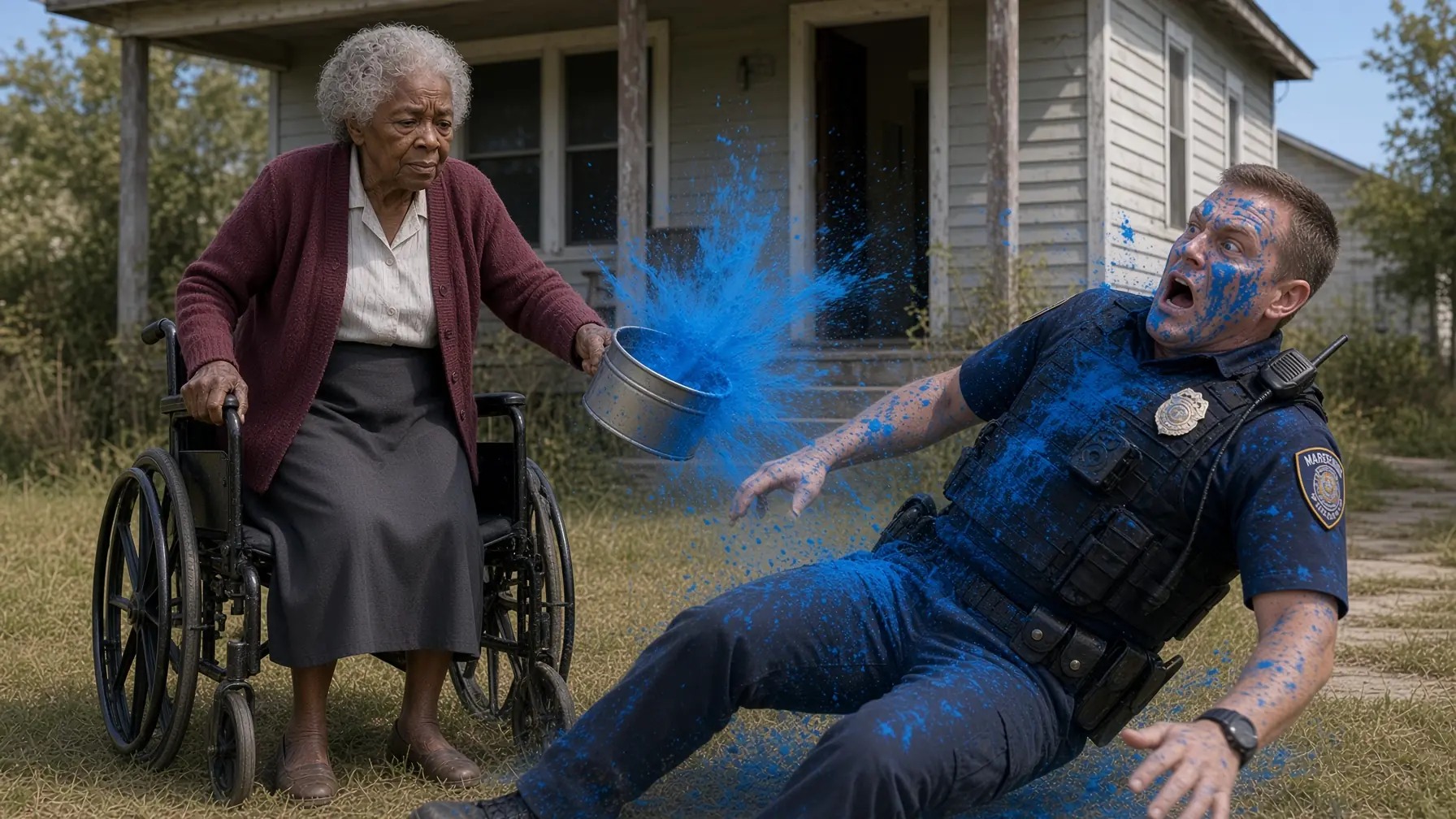
Clara did not move toward him. The small metal container remained in her right hand, its spring chamber now empty. “Put the gun down,” she said. Her voice was nothing like the trembling voice Barnes had heard five minutes earlier. The weakness was gone. So was the confusion. “The powder is inert forensic marker. It won’t hurt you.” Barnes looked at the brilliant blue coating on his hands and then toward the bungalow. His eyes returned immediately to the dark hallway inside, exactly where they had been going all morning. Clara saw that too. “And before you ask,” she added, “yes, it gets into the seams of gloves. Yes, it fluoresces under UV. And yes, there are cameras.”
Barnes raised the pistol higher. “You set me up.”
Clara’s expression barely changed. “You came here voluntarily.”
“You lied about who you were.”
“You never asked who I was.”
“You were pretending to be disabled.”
“I was sitting in a wheelchair.”
Barnes’s jaw tightened. “Same thing.”
“No,” Clara said. “It isn’t.”
The distinction seemed to infuriate him. He took one step forward, gun still angled toward her. Clara held both hands away from her body. The metal tin remained visible. She knew better than to reach into a pocket while an armed man was panicking. “Daniel,” she said quietly, using his first name for the first time, “you need to stop thinking about the hallway.”
Barnes froze.
That frightened him more than the powder.
“What hallway?”
Clara looked toward the open front door.
“The one you’ve checked six times since you arrived.”
Barnes’s face changed.
The trapdoor beneath the hallway rug was invisible from the lawn. Anyone entering the bungalow casually would walk over it without knowing there was a narrow storage cavity beneath the floorboards. Yet Barnes had looked toward that exact section of hallway almost from the moment he entered. He had been careful not to walk directly to it. Careful enough to believe caution looked innocent.
It had not.
Clara glanced toward the small flip phone clipped to the side of the wheelchair. “I’m going to touch the phone now.”
Barnes jerked the pistol toward it.
“Don’t.”
Clara stopped.
Neither of them moved.
Rain clouds were gathering over the suburban street, making the afternoon light strangely flat. A dog barked two houses away. Somewhere beyond the bungalow, a lawn mower started and then stopped. Barnes looked toward the street as though calculating whether anyone had seen him.
“Who’s listening?” he asked.
Clara said nothing.
“Who?”
“You should put the gun down.”
“Answer me.”
“No.”
Barnes laughed once, but there was fear beneath it now. “You think because you threw some paint on me you’re in control?”
Clara looked at the blue powder covering his uniform.
“No.”
Her eyes moved toward the open doorway behind him.
“The people who already have the warrant are.”
Barnes turned.
Three figures appeared inside the bungalow.
They did not burst dramatically through the front door. They had entered from the rear under a federal arrest plan already approved hours earlier, moving through the kitchen after a surveillance team gave the signal that Barnes had drawn his weapon. Dark ballistic vests identified them in large yellow letters.
U.S. MARSHAL.
Deputy U.S. Marshal Victor Hale stood in the center with his pistol trained downward but ready. Two other deputies covered separate angles without crossing one another’s lines of fire.
“Officer Barnes,” Hale said, “put the firearm on the ground.”
Barnes stared.
For half a second his brain appeared unable to reconcile the scene.
Then he swung toward Clara again.
The deputies moved immediately.
“Gun down!”
Barnes did not fire.
He did something almost worse for himself.
He tried to run.
He shoved the pistol into his holster, turned toward the side yard, and made it four steps before Deputy Marshal Erica Sloan came through the gate from the neighboring driveway. Barnes stopped so abruptly his boots tore into the dry grass.
“Hands,” Sloan ordered.
Barnes looked toward the street.
Another unmarked federal vehicle was blocking the far end.
His shoulders dropped.
Slowly, he raised both powder-covered hands.
Hale approached, removed Barnes’s service weapon, and handcuffed him. The fluorescent blue coating transferred instantly onto the steel cuffs.
Barnes twisted his head toward Clara.
“You’re dead.”
Every marshal heard it.
Clara did not respond.
Hale looked at Barnes. “That was a poor choice of words.”
Barnes immediately tried to correct himself. “I meant legally. She’s dead legally. This whole setup is entrapment.”
Hale secured the cuffs.
“Save it for counsel.”
“You can’t arrest me.”
Hale looked almost puzzled.
“I’m holding a federal arrest warrant with your name on it.”
“For what?”
“Conspiracy, obstruction, theft from interstate shipments, evidence tampering, and alleged deprivation of rights under color of law.”
Barnes stared at him.
“You’re lying.”
Hale did not argue.
He simply nodded toward the bungalow.
“Warrant’s inside.”
That was when Barnes finally understood the trapdoor was no longer his secret.
Clara walked back to the wheelchair and retrieved the flip phone. The device was intentionally simple. No apps. No cloud backups. No social media. Just a secured calling plan and one preprogrammed number. She pressed it.
A woman answered immediately.
“Clara?”
“It’s over.”
“Are you hurt?”
“No.”
“Did he touch you?”
“Yes.”
“How?”
“Dragged the chair backward. Kicked the marker tin. Drew his weapon after activation.”
A pause.
Then the woman said, “Do not discuss anything else until we document it.”
“I know.”
“You’re still impossible.”
Clara smiled slightly.
“So I’ve been told.”
The woman on the phone was Assistant United States Attorney Renee Washington, one of the prosecutors supervising a corruption investigation that had been quietly unfolding for eleven months.
Clara Bennett was not a federal agent.
She had no secret badge.
No law-enforcement commission.
No authority to arrest anyone.
She was something that had turned out to be far more dangerous to Barnes.
She was a witness who kept records.
For thirty-seven years, Clara had worked as an accountant for property-management companies across three counties. She had handled probate properties, foreclosures, rental escrow accounts, abandoned homes, insurance repairs, and enough dishonest contractors to understand that wrongdoing rarely began with dramatic crimes. It usually began with paperwork nobody expected another person to examine.
Her involvement with Daniel Barnes started after her older brother died.
Raymond Bennett had been seventy-one and lived alone in the little bungalow on Willow Street for almost twenty years. He had been a retired mechanic who distrusted banks, distrusted contractors, distrusted government mail, and trusted Clara with everything else.
When Raymond died after a stroke, Clara became executor of his estate.
She found the first irregularity three weeks later.
A police incident report claimed officers had responded to Raymond’s property for an “unsecured abandoned residence” and removed several items for safekeeping.
The date was wrong.
Raymond had still been alive.
In rehabilitation.
And Clara had been checking the house every other day.
The report listed Officer Daniel Barnes as the responding officer.
The items supposedly removed included two firearms, several power tools, and “miscellaneous documents.”
None had been entered into the department’s property system.
Clara asked questions.
The police department told her there might have been a clerical error.
She asked where the guns were.
Nobody knew.
She asked where the tools were.
Nobody knew.
She asked who declared the house abandoned.
Nobody could explain that either.
Then she found something Raymond had hidden.
Beneath the hallway rug was a narrow trapdoor he built years earlier when he still repaired motorcycles from home. Inside the storage cavity sat an old metal cash box, three envelopes, a ledger, and a cheap USB drive.
The cash box held only $1,400.
The ledger was worth far more.
Raymond had spent the final eighteen months of his life renting storage space behind the bungalow to a local repossession company. Drivers paid him in cash for overnight parking when they did not want tow trucks sitting visibly at their own yard.
Raymond wrote down everything.
Dates.
Truck numbers.
License plates.