The sound of the handcuffs clicking shut echoed like a gunshot through the silent hallway of Oak Creek High.
Malik Banks, seventeen and terrified, felt his face slammed against the cold lockers, his cheekbone throbbing with sharp pain.
“Please check my bag. I didn’t do anything,” he pleaded, his voice cracking under the weight of fear and confusion.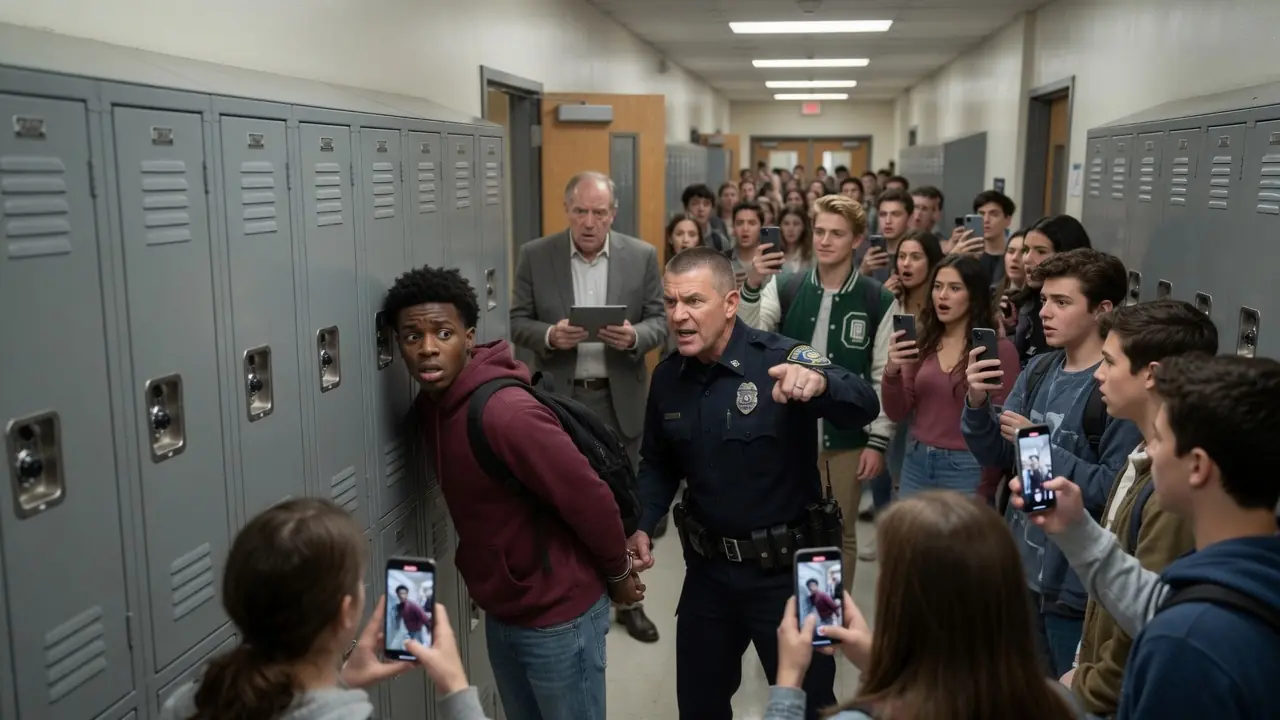
Officer Drexler didn’t listen. He just shoved the boy forward, parading him past gawking classmates who were already filming on their phones. Drexler smirked, convinced he had just bagged another thug.
He had no idea that the man he was about to dismiss as an absentee father was currently presiding over federal district court downtown, and he was already on his way.
The day had started with the kind of ordinary calm that usually precedes disaster. Malik Banks sat in the back of AP European History, tapping his pen against his notebook.
He was worrying about his track meet on Saturday and whether he would have enough time to finish his calculus problem set before his shift at the community center. He wasn’t worrying about going to jail.
He was seventeen, dressed in a maroon hoodie and faded jeans, with a backpack full of textbooks and a future so bright it almost hurt to look at directly.
“Malik Banks.”
The voice didn’t belong to his history teacher, Mrs. Whitaker. It was deep, authoritative, and laced with a preemptive boredom that suggested whatever was happening had already been decided.
Malik looked up.
Standing in the doorway were two uniformed officers and Vice Principal Hargrove. Hargrove looked pale, wiping sweat from his upper lip with a handkerchief.
The officers, however, looked ready for a riot. The lead officer, a man with a buzz cut and a nameplate that read Drexler, had his hand resting too casually on his belt near his taser.
“Malik, you need to come with us,” Hargrove said, his voice tight.
“Why?” Malik asked, freezing.
The room went dead silent. Twenty heads turned to look at him.
“Just get your bag, son,” Drexler said.
He didn’t say it like a request. He said it like a command to a dog.
Malik stood up slowly.
“Did something happen to my mom? Is she okay?”
Drexler stepped into the room, crossing the threshold that usually separated the sanctuary of education from the streets. He grabbed Malik’s upper arm, the grip hard enough to pinch the skin.
“She’s fine. You, on the other hand, have some explaining to do.”
“I don’t understand.”
“Move,” Drexler barked, shoving Malik toward the door.
Malik stumbled, catching himself on a desk.
“Hey, you don’t have to shove me.”
“Resisting?”
Drexler’s eyes lit up. It was the excuse he needed. He spun Malik around, slamming him chest-first into the whiteboard. The dry-erase markers clattered to the floor.
“Hands behind your back. Now.”
“I’m not resisting. I’m just asking what’s going on,” Malik cried out.
“Stop talking,” the second officer, a younger man named Lang, shouted, stepping in to assist.
They wrenched Malik’s arms behind his back. The metal cuffs bit into his wrists tight enough to bruise.
Mrs. Whitaker stood up, her hands trembling.
“Officer, is this necessary? Malik is one of my best students. He’s—”
“Stay out of it, lady,” Drexler snapped. “Unless you want an obstruction charge.”
They dragged him out of the classroom.
It wasn’t a walk. It was a spectacle.
They marched him down the main hallway right as the bell rang for lunch. Hundreds of students poured out, creating a sea of witnesses.
Phones went up instantly. The flashes were blinding.
“Look at that,” a voice sneered from the crowd.
It was Bryce Langford, the wealthy son of a local developer. Bryce was grinning, holding his phone high.
“Told you he was sketchy.”
Malik kept his head down, burning with shame. He tried to walk with dignity, but Drexler kept shoving him forward, making him stumble every few feet.
“Pick up the pace,” Drexler hissed in his ear. “You weren’t so slow when you were breaking into lockers, were you?”
“I didn’t break into anything,” Malik shouted, desperation rising in his throat. “Check the cameras. I’ve been in class all morning.”
“We found the evidence, kid. Don’t embarrass yourself,” Drexler laughed darkly.
They reached the front entrance. Vice Principal Hargrove was trailing behind them, looking at his tablet.
“Officer Drexler, are you sure we shouldn’t call his parents first? The district policy states—”
Drexler spun around, stopping the procession. He looked at Hargrove with utter contempt.
“We found a stolen Rolex worth fifteen grand in his gym locker, Hargrove. Felony theft. We don’t need a permission slip to arrest a felon. We’ll call his parents when we get to the station, if he even has a dad who answers the phone.”
The Rolex.
Bryce Langford’s Rolex.
He had seen Bryce flashing it around in the locker room earlier that morning, bragging about how it cost more than most people’s cars.
“I didn’t take it,” Malik whispered. “Someone put it there.”
“Save it for the judge,” Drexler scoffed.
He pushed Malik through the double doors and out into the bright, harsh sunlight where the squad car waited. He shoved Malik’s head down unnecessarily hard as he forced him into the backseat.
As the door slammed shut, separating Malik from his school, his friends, and his future, he saw Hargrove standing on the sidewalk, looking relieved that the problem was now off school property.
Malik leaned his head against the Plexiglas divider, fighting back tears. He knew how this looked. He knew the statistics.
He knew that once you were in the system, the truth didn’t matter as much as the paperwork.
But Drexler had made a mistake. A massive, career-ending mistake.
He had assumed Malik was just another statistic. He had assumed Malik’s father was absent.
He didn’t know that Malik’s father was currently sitting in courtroom 4B of the federal district courthouse, sentencing a cartel boss to life in prison.
The precinct smelled of stale coffee, industrial cleaner, and despair. Malik was processed with humiliating efficiency.
Fingerprints. Mugshot. His shoelaces were taken. His hoodie was confiscated because of the drawstring.
He was left in a thin white T-shirt, shivering in a holding cell that looked like a concrete box.
Officer Drexler sat on the other side of the desk, filling out paperwork with a bored expression. He was eating a bagel, crumbs falling onto the arrest report.
“Name?” Drexler asked, not looking up.
“Malik Nathaniel Banks.”
“Address?”
Malik gave it. It was an address in the affluent suburb of Oak Ridge, a detail that made Drexler pause for a second.
He looked up, his eyes narrowing.
“Oak Ridge? Who do you live with? Aunt? Grandma?”
“My parents,” Malik said, his voice steadying.
The initial shock was wearing off, replaced by a cold, sharp anger he had learned from his father.
“Right. Parents.” Drexler rolled his eyes. “Okay, Malik, here’s the deal. We have the watch. We have it in your locker. We have a witness, Bryce Langford, who saw you eyeing it.”
“You give me a confession. Tell me you fenced it or were planning to, and maybe I talk to the DA about leniency. First offense, maybe you get probation.”
“I want my phone call,” Malik said.
Drexler slammed his pen down.
“You listen to me, you little punk. You aren’t in a position to make demands. You’re looking at grand larceny. That’s five to ten. You want to go to state prison? You think you’re tough enough for that?”
“I want my phone call,” Malik repeated. “It is my constitutional right.”
Drexler laughed. It was a harsh, barking sound.
“A lawyer? You got a lawyer on retainer, kid?”
“I don’t need a lawyer yet. I need to call my mother.”
Drexler sighed, seemingly disappointed that the intimidation wasn’t working. He pointed to a landline on the wall near the booking cage.
“Make it quick. If she doesn’t pick up, you’re out of luck.”
Malik’s fingers trembled as he dialed the number. He knew her schedule by heart. She was at St. Jude’s Medical Center. She would be on her break right now.
Ring.
Ring.
Ring.
“St. Jude’s Trauma Center,” a brisk, professional voice answered.
“Mom.”
Malik’s voice broke. He couldn’t help it. Hearing her voice made the walls close in.
“Malik?” The tone shifted instantly from nurse to mother. “Honey, what’s wrong? Why are you calling from this strange number? Are you at school?”
“Mom, I’m arrested.”
There was a silence on the other end so profound it felt like the line had been cut. Then a sharp intake of breath.
“Say that again.”
“I’m at the Fourth Precinct. They said I stole Bryce Langford’s watch. They dragged me out of AP History in handcuffs. Mom, they slammed me against the lockers.”
“Are you hurt?” Her voice was suddenly ice cold. Not at him, but for him. It was the voice she used when a patient was coding.
“My face hurts. And my wrists.”
“Officer Drexler. He was rough?”
“Drexler. Fourth Precinct,” she repeated, memorizing the details. “Malik, listen to me. Do not say another word. Do not sign anything. Do not answer any questions. Do you understand?”
“Yes.”
“I’m leaving the hospital right now. I’m going to call your father.”
Malik glanced at Drexler, who was watching him with a smug grin.
“Mom? Drexler thinks Dad isn’t... He thinks he’s not around.”
“Oh,” Nadia said, and Malik could practically hear the dangerous smile in her voice. “He thinks that, does he? Sit tight, baby. We’re coming.”
The line clicked dead.
Malik hung up the phone.
He turned back to Drexler.
“Mommy coming to save you?” Drexler sneered. “She going to bring her boyfriend?”
Malik sat down on the metal bench. He looked Drexler dead in the eye.
“She’s calling my father.”
Drexler snorted.
“Yeah, sure. I bet he’s a real big shot.”
Five miles away, Nadia Banks tore off her scrubs in the locker room, revealing a smart blouse and slacks underneath. She didn’t bother changing her shoes. She kept her running sneakers on.
She needed speed.
She grabbed her phone and dialed a number labeled Desmond, emergency only.
It rang once.
Inside the judge’s chambers, the private line buzzed. It was a sound that bypassed all secretaries and clerks.
Judge Desmond Banks, a man of imposing stature and even more imposing intellect, paused mid-sentence. He was reviewing a motion to dismiss with his two law clerks.
He held up a hand. The room went silent.
He picked up the phone.
“Desmond, they have him. Malik.”
Judge Desmond Banks didn’t ask who. He didn’t ask where. He knew the tone of his wife’s voice.
It was the tone of a woman whose cub was in a trap.
“Who has him?” Desmond asked, his voice dropping an octave, becoming a low rumble that terrified prosecutors.
“Police. Fourth Precinct. Officer Drexler. They pulled him out of class. Handcuffed him. Accused him of stealing a watch. Malik said they slammed his face into a locker.”
Desmond stood up.
He was six-foot-four, a former linebacker before he became a legal scholar. His chair fell backward, hitting the floor with a loud clatter.
His clerks jumped.
“Did they read him his rights?”
“I don’t know. But Drexler mocked him. Implied his father wasn’t in the picture.”
Desmond’s jaw tightened. A vein pulsed in his temple.
He reached for his black judicial robe, not to put it on, but to grab the keys to his personal car from the pocket beneath it.
“I’m on my way,” Desmond said. “Meet me there.”
“Desmond,” Nadia warned. “Don’t kill him.”
“I won’t kill him, Nadia,” Desmond said, grabbing his briefcase.
He walked to the door, his movements precise and terrifyingly calm.
“I’m going to end his entire world.”
He threw the door open. His lead clerk, a young woman named Sophia, looked up in alarm.
“Judge Banks? You have the sentencing hearing in twenty minutes.”
“Cancel it,” Desmond said, not breaking stride.
“Cancel it? But sir, the press is there. The district attorney is there. What do I tell them?”
Desmond stopped. He turned slowly to look at her.
His eyes were burning with a fire she had never seen before.
“Tell them,” he said, his voice echoing down the marble hallway, “that the federal government has a personal emergency.”
The interrogation room was a study in sensory deprivation. It was a box of cinder blocks painted a shade of beige that hadn’t been fashionable since the Cold War.
There were no windows. The only light came from a buzzing fluorescent tube that flickered intermittently, casting a strobe-like effect on the scratched metal table.
Malik sat with his hands cuffed to the table’s central ring. The metal bit into his skin every time he shifted his weight.
His cheek, where Drexler had introduced him to the locker, was beginning to swell, throbbing in time with his heartbeat. But the physical pain was distant, muffled by the overwhelming noise of his own anxiety.
He stared at the two-way mirror. He knew someone was behind it. Or maybe no one was.
That was the trick, wasn’t it? The uncertainty.
The door creaked open.
It wasn’t the young, hesitant Officer Lang. It was Drexler.
Drexler didn’t sit down immediately. He walked around the perimeter of the small room, his heavy boots scuffing the linoleum.
He was holding a Styrofoam cup of coffee in one hand and a thick manila folder in the other. He placed the folder on the table with a heavy thud, then took a slow, loud sip of his coffee.
“You know, Malik,” Drexler began, his voice deceptively conversational, “I looked up your record. Clean. Spotless, actually. Honor roll. Track team captain. Volunteer work at the soup kitchen.”
Drexler pulled out the chair opposite Malik and sat down, leaning forward so his face was inches from Malik’s. The smell of stale tobacco and cheap coffee was suffocating.
“That makes this tragic,” Drexler whispered. “A kid with so much potential throwing it all away for a piece of jewelry. Why? To impress a girl? To pay off a debt? Or just for the thrill?”
“I told you,” Malik said, his voice raspy. “I didn’t take it.”
Drexler sighed, a long, exaggerated sound of disappointment. He opened the folder.
Inside wasn’t a case file, but a photo. It was a grainy printout from a hallway security camera. It showed Malik walking past the locker room.
“This is you heading toward the gym. Class was in session. Why were you in the hallway, Malik?”
“I had a hall pass. I went to the nurse for ibuprofen because I had a headache,” Malik protested.
“Uh-huh. The nurse. Convenient.”
Drexler tapped the photo.
“See? Here’s how this plays out in court. We have the stolen property in your possession. We have opportunity. And we have the victim, a pillar of the community’s son, identifying you as the primary suspect.”
“You go to trial. You lose. Guaranteed.”
Drexler leaned back, clasping his hands behind his head.
“But,” he continued, “I’m a reasonable man. I know how the world works. Kids make mistakes. If you write down a statement right now, just a simple apology admitting you took it and you’re sorry, I can make the felony disappear.”
“We knock it down to a misdemeanor. No jail time. Just community service. You go home to your mom tonight.”
Malik looked at the pen Drexler slid across the table. It was tempting.
So incredibly tempting.
Just sign the paper and the nightmare ends. He could go home. He could sleep in his own bed.
Then his father’s voice echoed in his head, clearer than Drexler’s. It was from a dinner table conversation two years ago, when they were discussing the Central Park Five.
“The truth,” Desmond Banks had said, cutting his steak with precision, “is the first casualty of fear. When you are in that room, Malik, they will promise you heaven to get you to sign your name to hell.”
“Silence is your shield. Never trade your silence for a promise from a man who holds handcuffs.”
Malik pulled his hand away from the pen. He sat up straighter, wincing as his ribs protested.
“I want my lawyer,” Malik said. “And I want my parents.”
Drexler’s face hardened. The false sympathy evaporated, replaced by a cold, predatory glare.
He stood up, kicking his chair back.
“You think you’re smart?” Drexler spat. “You think because you read a book, you know the law? You’re in my house now, boy. And in my house, the only way out is through me.”
He leaned down, his voice a low growl.
“Your daddy isn’t coming. He’s probably halfway to the next state, glad to be rid of a burden like you. And your mom? Wondering where she went wrong. You’re breaking her heart, Malik. Sign the paper.”
Malik closed his eyes.
“No.”
Drexler slammed his hand on the table, making Malik jump.
“Fine. Have it your way. We’ll let you sit here and rot for a few hours. Let’s see how tough you are when the hunger sets in and the lights stay on.”
Drexler snatched the folder and stormed out, slamming the heavy steel door.
The lock clicked.
A sound of finality.
Malik was alone again. He put his head on the table, trying to stop the tears.
He prayed his mother was on her way. He prayed his father was real.
For the first time in his life, he wasn’t sure if his father’s power could reach this deep into the dark.
The lobby of the Fourth Precinct was a chaotic purgatory. It was filled with people having the worst day of their lives.
A woman weeping into a tissue. A man arguing about a towing fee. A homeless man shouting at a vending machine.
The automatic door slid open, and Nadia Banks walked in.
She didn’t run. She didn’t scream. She moved with the efficient, terrifying purpose of a trauma nurse entering a code blue.
She walked straight to the front desk, bypassing the line of three people.
“Hey, wait your turn,” a man in a grease-stained shirt yelled.
Nadia didn’t even look at him. She locked eyes with the desk sergeant, a heavyset man named Morales, who was lazily typing on a computer.
“I’m here for my son,” Nadia said.
Her voice wasn’t loud, but it cut through the lobby like a scalpel.
“Malik Banks. He was brought in a short while ago.”
Sergeant Morales didn’t look up from his screen.
“Take a seat, ma’am. Processing takes time. If he’s in the system, he gets a call.”
“He already called,” Nadia said, placing her hands on the high counter. “He told me he was assaulted by the arresting officer. He told me his face was slammed into a locker.”
“I’m a registered nurse at St. Jude’s, and I’m demanding to see my son to assess his medical condition immediately.”
Morales finally looked up. He saw a well-dressed Black woman with fire in her eyes, but to him she was just another angry mother.
He’d seen a thousand of them.
“Look, lady,” Morales sighed, leaning back. “Everyone says they were assaulted. It’s standard procedure. He’s in holding. You can’t see him until the detectives are done with him.”
“That could be an hour. Could be tomorrow morning. Sit down.”
“I’m not sitting down,” Nadia said, her voice rising slightly. “You are holding a minor. You are questioning him without a guardian present. That is illegal.”
“He’s seventeen. In this state, that’s old enough for us to ask a few questions about a felony,” Morales shot back. “Now, step back from the desk or I’ll have you removed for disturbance.”
Nadia’s hand shook. Not from fear, but from the effort it took not to climb over the counter.
She pulled out her phone.
“I’m calling his father.”
Morales chuckled.
“Yeah. You do that. Maybe he can post bail whenever we decide to set it.”
The air in the lobby seemed to shift.
The automatic doors hissed open again. It wasn’t a noise that commanded attention. It was the sudden absence of it.
Judge Desmond Banks stepped into the precinct.
He was wearing a charcoal three-piece suit that cost more than Sergeant Morales’s annual salary. His tie was a deep crimson silk.
He carried a leather briefcase in one hand, and his posture was so upright, so rigidly perfect, that he looked like a statue brought to life.
He was six-foot-four, broad-shouldered, and radiated an aura of absolute, unchecked authority.
He didn’t look at the people in the waiting area. He walked straight to Nadia and placed a hand on her shoulder.
She turned, and for a second the mask of the warrior mother slipped, revealing the terrified wife.
“Is he okay?” Desmond asked quietly.
“They won’t let me see him.” She gestured to the sergeant. “Morales here says to sit down and wait.”
Desmond turned his head slowly to face the desk sergeant.
He didn’t blink. His expression was unreadable, which made it terrifying.
He approached the desk. He didn’t raise his voice. He dropped it to a baritone rumble that vibrated in the Plexiglas.
“Sergeant,” Desmond said, “I am Judge Desmond Banks. You have my son, Malik Banks, in custody.”
Morales, sensing that this was a different class of person than he usually dealt with, sat up straighter, but tried to maintain his dominance.
“Like I told the lady, sir, he’s being processed. You’ll have to wait.”
Desmond placed his briefcase on the counter. He opened it with a sharp snap. He pulled out a business card, heavy cream-colored stock with raised gold lettering, and slid it across the counter.
“I don’t think you heard me,” Desmond said. “I’m not asking for a visitation. I’m informing you that I am counsel of record for the minor in your custody.”
“Furthermore, I’m a sitting federal judge for the district court of this state. You are currently holding a minor without counsel, interrogating him without a guardian, and according to my wife, you have inflicted bodily harm upon him.”
Morales picked up the card.
He read it.
His face went from flushed to pale in the span of a second.
United States District Judge.
“I... uh...”
“I want the watch commander,” Desmond said, checking his watch. “You have thirty seconds before I make a phone call to the chief of police, and another to the FBI regarding a civil rights violation in your precinct.”
“And Sergeant?”
“Yes. Yes, sir.”
Desmond leaned in, his eyes dark and abyssal.
“If my son has so much as a scratch on him that wasn’t there this morning, I will personally ensure that this precinct is turned upside down, shaken out, and audited until you are all working as mall security guards. Do you understand?”
The silence in the lobby was absolute. Even the drunk man in the corner had stopped shouting.
“I’ll... I’ll get Lieutenant Voss,” Morales squeaked.
He scrambled off his chair, knocking over his coffee cup in his haste to get to the back office.
Desmond turned back to Nadia. He didn’t smile. He adjusted his cufflinks.
“Now,” he said softly, “we go to work.”
Nadia took a deep breath, smoothing her blouse.
“Drexler is the one who took him. Malik said Drexler hurt him.”
“Drexler?” Desmond repeated the name, tasting it like poison. “I’ll remember that.”
From the back hallway, a heavy door swung open. A lieutenant looking flustered and tucking in his shirt came rushing out, followed by a pale-looking Morales.
“Judge Banks?” Lieutenant Voss said, extending a hand that Desmond ignored. “I had no idea. There must be some misunderstanding. We were just following standard procedure for a felony theft.”
“Theft?” Desmond interrupted, his voice sharp. “My son has a trust fund that could buy this building. Why would he steal a watch?”
“Well, kids, you know, peer pressure,” Voss stammered.
“Take me to him,” Desmond commanded. “Now.”
“Of course. Right this way.”
Voss swiped his keycard at the secure door.
As they walked through the threshold, leaving the public lobby and entering the belly of the beast, Judge Desmond Banks felt a cold fury settling in his chest.
He wasn’t just a father anymore.
He was the law.
And he was about to bring the hammer down.
The hallway leading to the interrogation rooms was a corridor of lost souls. The fluorescent lights hummed with a headache-inducing frequency, and the floor was a checkerboard of scuffed linoleum that had absorbed decades of misery.
Lieutenant Voss walked briskly, his heels clicking nervously. He was a man who had spent thirty years climbing the ladder by avoiding controversy.
And now controversy was walking two steps behind him in a three-thousand-dollar suit.
“Right through here, Judge Banks,” Voss said, his voice pitching slightly higher than normal. “Room two. Again, I want to assure you my officers are trained to handle—”
Desmond didn’t acknowledge him. He didn’t look at the peeling paint or the wanted posters taped to the walls. He looked straight ahead at the steel door marked Interrogation Two.
Nadia walked beside him, her hand gripping the strap of her purse so tightly her knuckles were white. She was no longer just a mother. She was a medical professional entering a trauma zone.
Her eyes were scanning for threats, for blood, for signs of concussion.
As they reached the door, it swung open. Officer Drexler stepped out, almost colliding with Voss.
Drexler was holding his Styrofoam cup, a smirk still playing on his lips. He looked like a man who had just won a bet.
“Lieutenant,” Drexler said, chuckling. “Kid’s a stonewall. Give me another hour. I’ll get him to crack. He’s about to cry for his—”
Drexler stopped.
He saw the woman first. Nadia Banks standing tall, her eyes burning with a mixture of hatred and clinical assessment.
And then he saw the man.
Desmond Banks didn’t look like the fathers Drexler was used to seeing in this hallway. He didn’t look defeated. He didn’t look scared.
He looked like a natural disaster that had paused to take a breath.
“Who is this?” Drexler asked, his brow furrowing. He looked at Voss. “Lou, why are civilians back here?”
“Officer Drexler,” Voss said, his voice tight. “This is Judge Desmond Banks. The boy’s father.”
The color drained from Drexler’s face. It wasn’t a gradual fade. It was instant.
The smirk vanished, replaced by a slack-jawed realization.
He looked from the towering man in the suit to the memory of the boy in the room. The boy he had called fatherless. The boy he had mocked.
Desmond stepped forward. He didn’t crowd Drexler. He didn’t need to. His presence filled the corridor.
“Open the door,” Desmond said.
It wasn’t a question.
Drexler hesitated, his hand twitching toward his belt instinctively before falling to his side.
“Sir, he’s a suspect in a felony investigation. We have protocol.”
“Open the door.”
Desmond’s voice dropped to a register that vibrated in the floorboards.
Voss shoved Drexler aside.
“Open it, Drexler. Now.”
Drexler fumbled with the keys, his hands suddenly clumsy. He unlocked the heavy steel door and pushed it open.
The sight that greeted them stopped Nadia’s heart for a beat.
Malik was slumped over the metal table, his forehead resting on the cool surface. His hands were still cuffed to the central ring, stretching his arms out in an uncomfortable, vulnerable position.
At the sound of the door, he flinched, jerking his head up.
One side of his face was swollen, the skin purple and tight around his cheekbone. His eyes were red-rimmed and wide with fear.
“Dad?” Malik whispered, his voice cracking. “Mom.”
Nadia moved past Drexler like he was a ghost. She rushed to the table, dropping her bag.
“Oh, baby,” she breathed, her hands immediately going to his face.
She didn’t hug him yet. She assessed him. She gently tilted his chin, checking his pupils.
“Look at me, Malik. Follow my finger. Does your head hurt? Do you feel nauseous?”
“I’m okay, Mom. It just... it hurts when I talk,” Malik said, tears finally spilling over now that safety had arrived.
Desmond stood in the doorway.
He didn’t rush in. He took in the scene with a cold, panoramic vision of a man who had seen thousands of crime scene photos.
He saw the handcuffs cutting into his son’s wrists. He saw the bruise blooming on his cheek. He saw the terror in his son’s eyes.
Terror that he, a man of the law, had spent his life trying to eradicate from the innocent.
He turned slowly to face Drexler, who was standing in the hall, looking like he wanted to dissolve into the floor.
“Did you do that?” Desmond asked.
He pointed a manicured finger at Malik’s face.
“He resisted arrest,” Drexler blurted out, the excuse sounding flimsy even to his own ears. “He was thrashing. We had to restrain him against the lockers. It was standard procedure.”
“Standard procedure involves slamming a minor’s face into a metal locker?” Desmond asked.
He walked into the room, effectively trapping Drexler in the doorway between him and the lieutenant.
“He was being combative,” Drexler stammered.
“Malik?” Desmond said, not looking away from Drexler. “Did you resist?”
“No, Dad. I swear,” Malik sobbed. “I asked why they were taking me. I asked to call you. He shoved me. He said... he said I didn’t have a dad.”
Desmond’s eyes narrowed. The air in the room seemed to drop ten degrees.
“Unlock him,” Desmond said to Drexler.
“Sir? I can’t.”
“Lieutenant Voss?” Desmond said, his voice dangerously soft. “If those cuffs are not off my son’s wrists in five seconds, I will have you deposed in front of the Senate Judiciary Committee regarding the systemic abuse of minors in your precinct. One. Two.”
“Unlock him, Drexler. Jesus Christ!” Voss shouted, stepping into the room.
Drexler pulled out his key. His hands were shaking so badly he couldn’t find the hole. He scratched the metal twice before finally sliding the key in.
The mechanism clicked. Malik pulled his hands back, rubbing his raw wrists.
Nadia immediately took them, inspecting the skin.
“Deep abrasions,” she announced, her voice trembling with rage. “Potential nerve damage. We need to document this. And now.”
She pulled out her phone and began taking close-up photos of the wrists and the cheek.
Drexler tried to back away, but Desmond stepped into his path.
“You didn’t read him his rights, did you?” Desmond asked.
“I... We were going to once we started the formal interview,” Drexler lied.
“Formal interview?” Desmond laughed, a dry, humorless sound. “You had him chained to a table. You were soliciting a confession. That is the interview.”
“And since you failed to Mirandize him, anything he said and anything you think he said is fruit of the poisonous tree. It’s inadmissible. You know that, don’t you, officer?”
Drexler remained silent, his jaw clenched.
“And the witness?” Desmond continued relentlessly. “Bryce Langford. The boy who reported the watch stolen. Did you interview him?”
“He gave a statement at the scene,” Drexler said defensively.
“Did you search his locker?”
“Why would I search the victim’s locker?” Drexler scoffed, trying to regain some ground.
“Because,” Desmond said, leaning in close, smelling the fear on the officer, “in my courtroom, we call that due diligence. Something you seem to have skipped in your hurry to arrest a Black honor student.”
Desmond turned to Voss.
“I want the incident report. I want the body cam footage from Officer Drexler and his partner. And I want the security footage from the school hallway immediately.”
“Judge, the body cam footage has to be downloaded. It takes time,” Voss started.
“Then I suggest you start downloading,” Desmond cut him off. “Because until I see exactly how my son’s face met a locker, nobody in this building is going home.”
He turned to Malik, his face softening instantly. He placed a large, warm hand on Malik’s shoulder.
“You did good, son,” Desmond whispered. “You stayed quiet. You did exactly what I told you. I’ve got it from here.”
Thirty minutes later, the dynamic of the Fourth Precinct had fundamentally shifted. What was usually a police station run by Lieutenant Voss was now a temporary command post for Judge Desmond Banks.
They were in the lieutenant’s office, a glass-walled room that offered a view of the bullpen. Malik was sitting on a leather couch, holding an ice pack to his cheek that Nadia had demanded from a terrified rookie officer.
Nadia sat next to him, holding his hand, whispering reassurances.
Desmond sat at the conference table. He had removed his suit jacket, draping it over the chair. He rolled up his sleeves, revealing thick forearms.
He wasn’t sitting back. He was leaning forward, reviewing the arrest report Voss had printed out.
Voss and Drexler stood on the other side of the table. Drexler looked like a schoolboy called to the principal’s office, stripped of his bravado.
“Suspect was observed behaving suspiciously near the gym lockers,” Desmond read aloud from Drexler’s report.
He looked up over his reading glasses.
“Define suspiciously, Officer Drexler.”
“He was loitering, looking around, nervous-like,” Drexler grunted.
“My son was returning from the nurse’s office. He had a hall pass.”
Desmond tapped a piece of paper: a photo of the hall pass Nadia had retrieved from Malik’s backpack, which had been unceremoniously dumped in the evidence pile.
“This pass is timestamped. The nurse’s log shows he left at the appropriate time. The lockers are a two-minute walk. That puts him there exactly when you say he was loitering. He was walking to class.”
“He stopped,” Drexler insisted. “The witness Langford said he saw him stop and check the combination.”
“Ah, yes, Bryce Langford.”
Desmond picked up the witness statement.
“Mr. Langford claims he saw Malik open his locker. Tell me, officer, how did Malik know the combination to Bryce Langford’s locker?”
Drexler blinked.
“Maybe he looked over his shoulder. Maybe he guessed it.”
“Guessed a three-digit combination? The odds of that are one in 64,000,” Desmond said dryly. “Or perhaps the locker was left open.”
“It was forced,” Drexler said quickly. “The latch was bent.”
Desmond paused. He looked at Voss.
“Lieutenant, was a crowbar found on my son? A screwdriver? Any tools?”
“No, sir,” Voss admitted, wiping sweat from his forehead.
“So my son, an AP history student and track captain, managed to bend a steel locker latch with his bare hands, steal a Rolex, and then gently place the watch in his own locker, which I might add is secured with a heavy-duty padlock, all within the span of ninety seconds before the bell rang.”
The room went silent. The logic was tightening like a noose.
“It’s possible,” Drexler muttered.
“Let’s go to the video,” Desmond said.
Voss turned the monitor on his desk so everyone could see. He clicked a file labeled Drexler_bodycam_1.
The video sprang to life. The shaky, wide-angle view of a police vest moving through a high school hallway. The sound was muffled at first, then cleared up.
“There he is,” Drexler’s voice on the recording said. “Back of the room. Let’s make a show of it.”
Desmond froze the video. He looked at Drexler.
“Let’s make a show of it. Is that standard police terminology for an arrest, officer?”
Drexler didn’t answer. He was staring at his shoes.
Desmond pressed play.
The video showed the classroom. Mrs. Whitaker’s shocked face. Malik looking up, confused.
And then the violence.
The camera jerked as Drexler grabbed Malik. The audio picked up the sickening thud of Malik being slammed into the whiteboard, then the walk down the hall.
“You weren’t so slow when you were breaking into lockers, were you?” Drexler’s voice sneered on the tape.
“I didn’t break into anything,” Malik’s voice came through high and panicked.
And then the exit. The shove. The camera angle dipped as Drexler forced Malik’s head down toward the car door frame, but missed, hitting the frame itself.
Crack.
“Stop,” Nadia said, her voice trembling. “Turn it off.”
Desmond didn’t turn it off. He watched it again. He watched the moment of impact. He watched Drexler smirk at the vice principal.
“That,” Desmond said, pointing at the frozen screen, “is assault in the second degree. It is false imprisonment. And it is a deprivation of rights under color of law.”
He stood up and walked over to the evidence box on the table. He put on a pair of latex gloves Voss had provided.
He reached in and pulled out the watch. It was a flashy gold Rolex Submariner. Expensive.
“Beautiful watch,” Desmond said. He turned it over. “Did you run the serial number, Lieutenant?”
“We... we assumed it belonged to the Langford boy. He identified it,” Voss said.
“Assumption is the mother of all screw-ups, Lieutenant,” Desmond said. “If you had run the serial number, or perhaps looked closely at the clasp...”
Desmond held the watch up to the light.
“It’s a fake,” Desmond said.
“What?” Drexler’s head snapped up.
“It’s a knockoff. A good one. Maybe worth two hundred bucks on Canal Street, but look at the second hand. It ticks. Rolexes sweep. And the weight is wrong.”
Desmond tossed the watch onto the table. It made a hollow clack, not the heavy thud of gold.
“You arrested my son for grand larceny over a counterfeit toy,” Desmond said, his voice rising in volume for the first time. “And you did it on the word of a boy who claims he owns a fifteen-thousand-dollar watch, but apparently walks around with a fake.”
Desmond leaned over the table, his face inches from Voss’s.
“This wasn’t a theft, Lieutenant. This was a prank. A setup. Bryce Langford planted a fake watch in my son’s locker, probably through the vents, which is a common trick in that school, as any competent school resource officer knows, and then called you to humiliate him.”
He turned to Drexler.
“And you?” Desmond growled. “You were the weapon. You were the hammer Bryce Langford used to smash my son’s life. You didn’t investigate. You didn’t think. You just saw a Black kid and a rich white accuser, and you decided the case was closed before you even put the car in park.”
Drexler looked trapped.
“I... I didn’t know it was fake. The kid said—”
“I don’t care what the kid said,” Desmond roared, slamming his hand on the table.
The sound echoed through the entire precinct. Outside in the bullpen, officers stopped typing and looked at the glass office.
“I want Bryce Langford brought in. I want his parents brought in. And I want the district attorney on the phone now.”
“Judge, we can’t just drag the Langford kid in without—” Voss started.
“Lieutenant?” Desmond interrupted, pulling his phone from his pocket. “I’m currently texting the United States Attorney for this district. I’m drafting a Title 42, Section 1983 civil rights lawsuit against this precinct, the city, and Officer Drexler personally.”
“I’m about to make this the only story on the 6:00 news.”
He held up the phone.
“Do you want to arrest the real criminal, or do you want to be the lead story in a corruption scandal?”
Voss looked at Drexler. He looked at the fake watch. He looked at the furious federal judge.
Voss picked up his radio.
“Dispatch, send a unit to the Langford residence. Bring in Bryce Langford for questioning regarding filing a false police report and planting evidence. And get his father on the line.”
Desmond sat back down. He exhaled slowly. He looked over at Malik.
Malik wasn’t looking at the floor anymore. He was looking at his father. For the first time that day, the fear was gone from his eyes, replaced by a look of awe.
“It’s not over yet,” Desmond said to his son, his voice gentle again. “But the tide just turned.”
The arrival of the Langfords was exactly as loud and entitled as Desmond had anticipated. Garrett Langford, a local real estate magnate accustomed to getting his way, stormed into the precinct with a lawyer in tow.
His son, Bryce, trailed behind him like a prince inconvenienced by the peasantry.
“This is harassment,” Garrett bellowed, ignoring the desk sergeant and barging straight toward Lieutenant Voss’s office. “My son is the victim here. You have the thief in custody. Why are we being dragged down here?”
Bryce, wearing a varsity jacket and a look of practiced boredom, spotted Malik sitting on the couch. He offered a quick, sneering smirk, a look that said, You’re done.
He didn’t see Desmond standing in the shadow of the door frame.
“Mr. Langford,” Voss said, stepping out, looking exhausted. “Please calm down. We have new evidence.”
“Evidence? You found the watch on him,” Garrett shouted. “Case closed. I want that kid expelled and charged.”
“The watch,” a deep voice rumbled from the corner, “is a counterfeit.”
Garrett and Bryce spun around.
Desmond stepped into the light. He wasn’t wearing his robe, but he wore the authority of the federal bench like a suit of armor.
He held the plastic evidence bag up to the light. The gold paint on the fake Rolex was already chipping near the clasp.
“Who the hell are you?” Garrett demanded.
“I am Judge Desmond Banks,” he said, his voice deadly calm. “And that thief you’re screaming about is my son.”
The blood drained from Garrett Langford’s face. He knew the name. Everyone in the city’s legal and business circles knew the name.
Judge Banks was the man you prayed you never saw across a courtroom.
Bryce, however, wasn’t smart enough to be scared yet.
“It’s not fake. My dad bought it for me in Switzerland.”
“Switzerland?” Desmond raised an eyebrow.
He tossed the bag onto the desk.
“This watch has a movement mechanism made in Shenzhen, China. It retails for forty dollars online. I had an expert verify it ten minutes ago via photos. So, Bryce, here’s the question.”
“Did your father lie to you about buying a fifteen-thousand-dollar watch, or did you buy a prop to frame my son because he beat you out for the state track final spot last week?”
The room went dead silent. The specific detail about the track finals hit Bryce like a physical blow.
His arrogance crumbled instantly, replaced by the terrified look of a child caught in a lie he couldn’t talk his way out of.
“I... I lost it,” Bryce stammered, looking at his dad. “I lost the real one. I didn’t want you to get mad, so I... I just wanted to scare him. I didn’t think you’d arrest him.”
“You filed a police report,” Desmond said, stepping closer. “You signed a sworn statement. That is a crime, Bryce. It’s called filing a false instrument. It’s a Class A misdemeanor, and since you’re seventeen, in the eyes of the law, you’re an adult.”
Garrett Langford sputtered.
“Now, look, Judge Banks. Let’s not be hasty. Boys will be boys. We can drop the charges against your son if you just—”
“If I just what?” Desmond cut him off, his eyes blazing. “Forget that my son was handcuffed? Forget that Officer Drexler slammed his face into a locker?”
Desmond turned to Drexler, who was standing by the wall, looking like a ghost.
“Lieutenant Voss,” Desmond said, not looking away from Drexler, “I want to press charges against Bryce Langford for filing a false report and defamation of character. And I’m formally requesting the immediate suspension of Officer Drexler pending an internal affairs investigation for excessive force and civil rights violations.”
“Done,” Voss said immediately.
He turned to Drexler.
“Badge and gun. Now.”
Drexler looked at Voss, betrayed.
“Lou, come on. It was a mistake.”
“You didn’t verify the evidence, Drexler. You assaulted a minor. You’re a liability.”
Voss held out his hand.
“Give it up.”
With trembling hands, Officer Drexler unholstered his weapon and unpinned his shield. He placed them on the desk next to the fake watch.
The sound of the metal hitting the wood was the sound of a career ending.
Desmond turned back to his son. Malik was standing now, Nadia by his side. The swelling on his cheek was bad, but his head was high.
“Malik?” Desmond said softly. “Do you want to say anything to them?”
Malik looked at Bryce. He didn’t look angry anymore. He just looked disappointed.
“You have everything, Bryce,” Malik said quietly. “Why did you have to try and take the little bit I have?”
Bryce couldn’t meet his eyes. He looked at the floor, shame burning his face.
Desmond put his arm around Malik.
“Let’s go home.”
They walked out of the office past a stunned Garrett Langford, past a defeated Officer Drexler, and through the bullpen.
As they reached the lobby, the press had indeed arrived, tipped off by the police scanner chatter about a federal judge storming the precinct.
Flashes went off. Microphones were thrust forward.
“Judge Banks, is it true your son was falsely accused? Judge, are you suing the department?”
Desmond stopped. He shielded Malik with his body, but he looked directly into the cameras.
“My son,” Desmond said, his voice projecting to the back of the room, “is an honor student and a citizen of this country. Today, the system failed him. It assumed his guilt based on his appearance and the word of someone with more privilege.”
“I was able to intervene because I know the law. But most fathers cannot. Most mothers cannot.”
He squeezed Nadia’s hand and looked at Malik.
“We are not leaving here as victims. We are leaving as survivors. And tomorrow, the work begins to ensure that no other child has to wait for a judge to walk through that door to get justice.”
He turned and guided his family through the doors, out of the sterile, cold air of the precinct and into the warm, golden light of the afternoon sun.
Malik took a deep breath. It hurt his ribs, but it felt good.
It felt like freedom.
This story isn’t just a drama. It’s a reflection of a terrifying reality that plays out in precincts and schools every single day.
Malik Banks was lucky. He had a mother who knew the medical protocol and a father who knew the legal code.
But for every Malik Banks who walks out of that station, there are thousands of young men who don’t have a federal judge on speed dial. They’re the ones who get processed, plea-bargained, and lost in a system that often values efficiency over truth.
The tragedy of this story isn’t just the assault on Malik. It’s the assumption of guilt by Officer Drexler, a bias so deep that he didn’t even check to see if the watch was real.
It serves as a powerful reminder that justice shouldn’t depend on who your father is. It should be a right, not a privilege.