Lorraine Brooks had carried a full diner tray for so many years that she no longer thought about the weight of it.
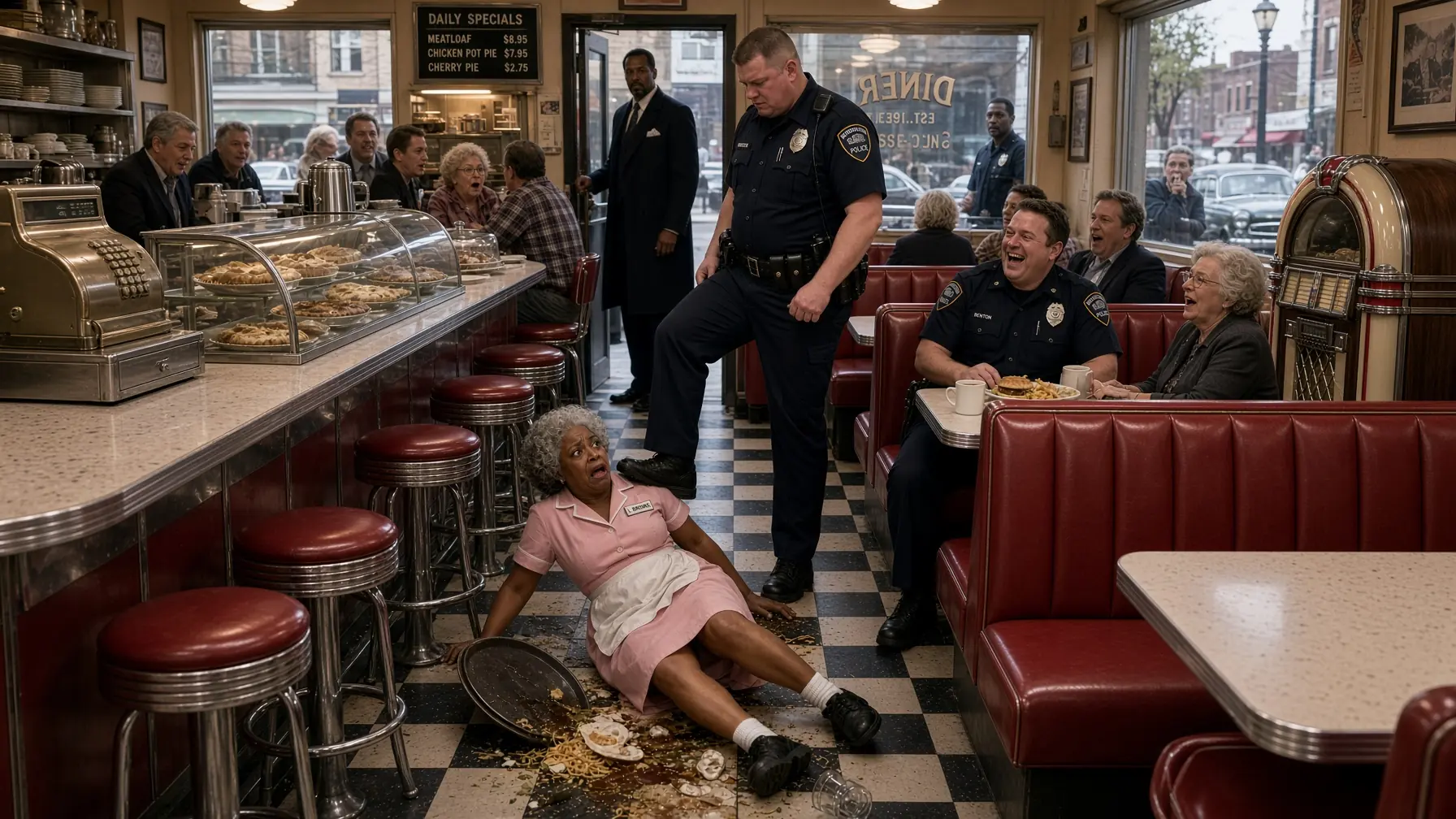
At sixty-three, she could still balance four coffee mugs, three plates, a basket of fries, and a bowl of coleslaw with the same steady hands that had once packed school lunches, buttoned church shirts, and bandaged scraped knees. People in town trusted Lorraine with hot coffee the way they trusted old churches to stay standing. She had been at Bellamy’s Diner for twenty-two years, and in all that time, nobody remembered seeing her drop a tray.
That was why the whole room noticed when Officer Dean Mercer stood up before she even reached the booth.
It was lunchtime in the middle of a workday, and Bellamy’s was full. The red vinyl booths were packed. The chrome counter reflected the pie case lights. The scent of bacon grease, coffee, and hot burger buns sat heavy in the air. Local farmers filled one side of the room. Two teachers from the elementary school were sharing a slice of lemon meringue at the counter. A couple of road-crew workers still had orange dust on their boots.
Lorraine moved through the diner in her pale pink uniform and white apron, tray lifted high and level.
Officer Kyle Benton sat in the booth by the window, grinning before anything had even happened.
Officer Dean Mercer was just sliding one leg out from the booth.
Lorraine saw that grin.
And something in her tightened.
Mercer was forty-two years old, broad-shouldered, crew cut, heavy in the chest and arms, the kind of man who used his size the same way other people used a raised voice. He was in full navy uniform, his duty belt heavy at his waist, his black boots polished hard enough to reflect the floor light.
Benton, ten years younger and stockier, sat beside him with that lazy, smug expression Lorraine had come to hate.
Those two had been coming into Bellamy’s for nearly a year.
They never tipped.
They never said thank you.
And every time Lorraine served them, Mercer found some small way to make the job harder.
Sometimes it was a joke about how slow she walked.
Sometimes it was a comment about how women her age ought to be home instead of “hobbling around with coffee.”
Once, when she brought Benton extra napkins, Mercer had looked her up and down and said, “Still moving, huh? Must be all that waitress cardio.”
The whole booth had laughed.
Lorraine had said nothing.
Not because she was weak.
Not because she was afraid.
But because women like Lorraine Brooks had spent a lifetime learning which humiliations were worth answering and which ones were only waiting for a reaction to become worse.
Still, that morning had already been hard.
Her feet hurt.
Her left knee had started burning before ten.
And the phone call she had gotten before her shift sat like a stone in her chest.
Her son, Elijah, was back in town.
He had told her not to make a fuss, but mothers make fusses in their hearts even when they keep their mouths shut.
Elijah Brooks had not lived in town in years. He had left at eighteen with a duffel bag and a stubborn look that reminded Lorraine painfully of his late father. He had worked, studied, and climbed his way into law enforcement the hard way. Not by swagger. Not by shortcuts. By discipline.
Lorraine didn’t use his name for anything.
Not discounts.
Not favors.
Not intimidation.
Most people in town barely knew what he did now, because Lorraine preferred it that way.
But he had called that morning and told her he might stop by Bellamy’s around lunch.
“I’ve got a meeting nearby,” he said.
“You eating?”
“If you let me.”
“You come in, I’ll feed you.”
That had made her smile for the first time all day.
Now she was carrying burgers and coffee toward Mercer’s booth when she saw him shift his weight in exactly the wrong way.
She knew before it happened.
Mercer rose just as she passed.
Not straight up.
Sideways.
Directly into her path.
His shoulder slammed hard into her upper arm.
The tray exploded out of her hands.
Coffee flew first.
Then plates.
Then fries.
A burger struck the edge of the booth and flipped onto the checkered floor. A mug shattered under the table. Silverware skidded beneath a counter stool.
Lorraine lost her balance instantly.
Her hip struck the floor.
One knee folded awkwardly underneath her.
For one stunned second, the whole diner went silent except for the last spinning clatter of dishes.
Then Mercer laughed.
Not surprised.
Not apologetic.
Laughing.
“Damn, grandma,” he said, looking down at her, “too old to carry a tray now?”
Benton barked out a laugh from the booth.
“Maybe it’s time she retired.”
Lorraine sat on the floor, one hand braced against the tile, the other still half-curled from where the tray had been. Pain shot through her knee and up into her lower back.
But worse than the pain was the heat in her face.
Not from anger at first.
From humiliation.