Danielle Brooks heard the eggs crack before she felt the fence hit her shoulder.
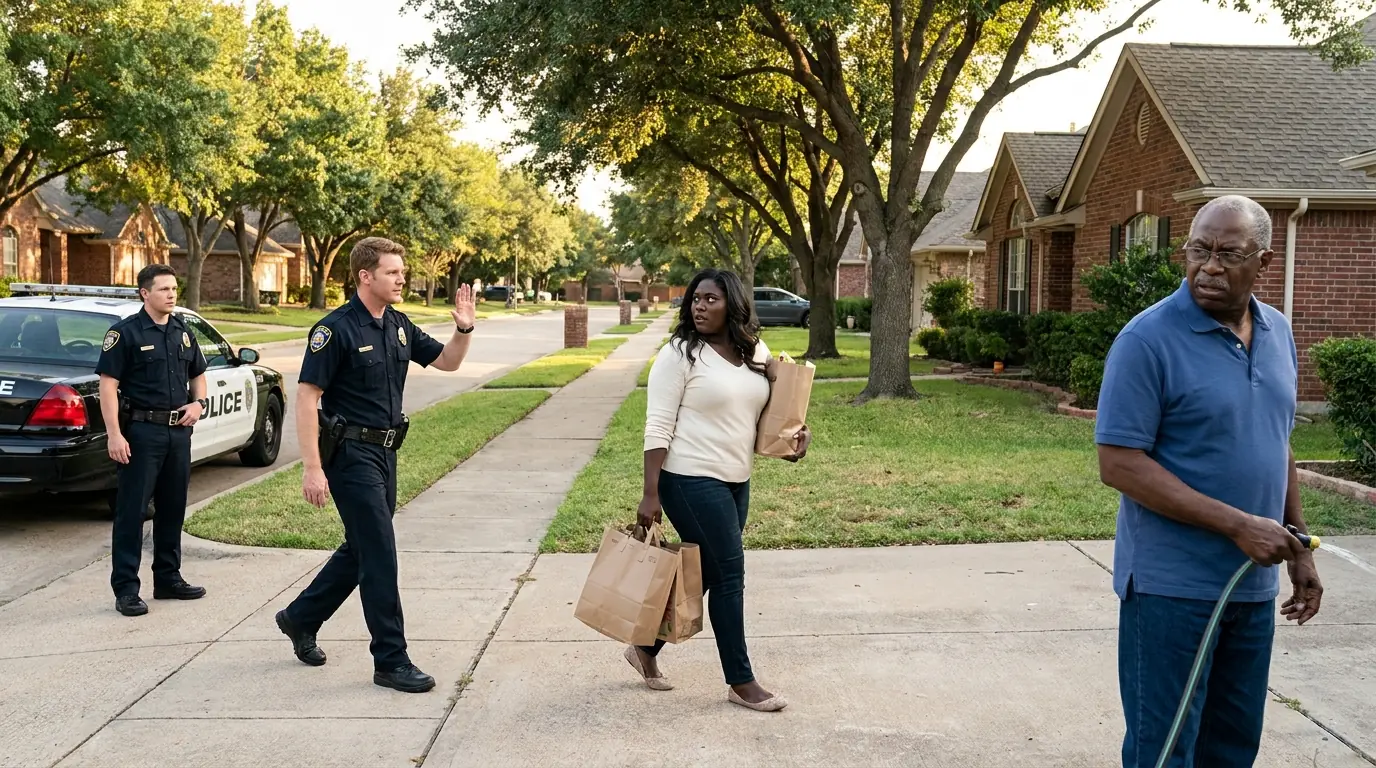
One second she had both grocery bags balanced against her hip, keys looped around two fingers, and the familiar relief of finally being home after a long day. The next, her wrist was twisted sharply behind her back, oranges were bouncing across the driveway, and a carton of eggs had burst open on the sidewalk beside her own front yard.
“Hands behind your back,” the officer barked. “You can explain yourself downtown.”
Danielle’s breath caught, not because she was panicking, but because pain had a way of interrupting thought for half a second. She planted her feet, controlled her breathing, and turned her head just enough to look at the man pressing her toward the low wooden fence that bordered the short walkway to her front door.
He was tall, broad-shouldered, white, late thirties maybe, in a dark navy uniform with a body camera clipped squarely to his chest. Officer Ryan Keller, according to the badge and nameplate. His expression held the same irritated half-smirk men wore when they had already decided the story before anyone else spoke.
A second officer, Mason Reed, stood a few feet away near the spilled groceries. He didn’t touch her. He didn’t stop his partner either. He simply watched with one hand near his belt, as if a woman in a cream top and white sneakers carrying bread and canned soup might at any second reveal herself to be a violent threat.
Danielle’s voice came out even.
“You’re standing in front of my house.”
Keller’s grip tightened.
“Sure it is.”
That was the part that lit the anger in her chest.
Not just the pain. Not the humiliation of being shoved into a fence in broad daylight while a loaf of bread lay in the grass and apples rolled toward the curb. It was that tone. That casual certainty. The assumption that she was the lie and he was the truth.
Across the narrow strip of grass that separated the two driveways, Walter Hayes dropped his garden hose.
Water sprayed sideways into the petunias for a moment before falling uselessly into the dirt. Walter had been watering along the edge of his lawn, wearing a light-blue polo shirt, khaki pants, and the rectangular glasses he was always pushing back up his nose. He was sixty-four, solidly built, gray-haired, and one of the first people on the street to introduce himself when Danielle moved in.
Now he was no longer the calm retired man tending his yard.
He was moving fast.
“Hey!” he shouted, throwing one hand into the air. “Stop!”
Keller glanced over, annoyed, but didn’t release Danielle.
Walter crossed the grass in long, angry strides. His eyes flicked to Danielle pinned against the fence, then to the groceries scattered across the driveway, then to the officer’s body camera.
His whole expression changed.
Shock gave way to fury.
“Get your hands off her!” Walter snapped. “Do you even know who she is?”
Keller looked back at Danielle, then at Walter, unimpressed.
“You might want to mind your business, sir.”
Walter jabbed a finger toward the blinking red light on Keller’s chest.
“No,” he said. “You might want to check before that body camera ruins your career.”
For the first time, the smirk on Keller’s face faltered.
It did not disappear.
Not yet.
But something in his eyes flickered.
Danielle felt it.
And in that single suspended moment, with fruit rolling through the gutter and her shoulder pressed into the fence, she realized how much of what happened next would depend on whether this man chose pride or sense.
Unfortunately, pride was still winning.
Nine days earlier, Danielle Brooks had stood in the living room of that same house surrounded by unopened boxes and the smell of fresh paint and old wood.
It wasn’t the biggest house on Briarwood Lane. Not even close. But it was hers.
A neat two-story brick place with a trimmed lawn, a white mailbox, a short front walkway, and enough room for a study in the back where the afternoon light came in golden through the windows. After years of apartment leases, city noise, and government travel, the quiet almost felt unreal.
She had not told many people she was coming back to Oakridge.
Not because she was ashamed of it.
Because she was tired.
Tired of introductions that became conversations about her job. Tired of people deciding what they thought of her before they ever knew her. Tired of being photographed, quoted, invited, congratulated, and publicly welcomed before she’d even had time to unpack her kitchen.
Three months earlier, the U.S. Attorney’s Office for the district had announced a new appointment: Danielle Brooks, thirty-two years old, attorney, former federal litigator, returning home to lead the office’s newly expanded civil rights enforcement team.
The local paper had loved the story.
Oakridge Native Returns Home to Lead Federal Civil Rights Unit.
There had been a photo of her in a navy blazer, calm-eyed and composed, standing in front of the federal courthouse.
Walter Hayes had seen that article.
Most of the neighborhood probably had.
Danielle had hoped the attention would die before she actually moved in.
For the most part, it had.
She spent her first week quietly settling into the house. She met Walter on her second day when he walked over with a plate of peach cobbler and introduced himself as the unofficial mayor of the block.
“You need anything,” he had said, “you holler over the fence. If I don’t hear you, my wife Shirley will.”
Danielle laughed, thanked him, and felt some of the tension leave her shoulders for the first time since closing.
Not everyone had been so warm.
Two houses down, a woman named Patricia Givens smiled too brightly and asked if Danielle was renting.
Across the street, another neighbor watched moving boxes come in but never waved.
Danielle noticed those things the way Black people in quiet neighborhoods often notice things. Not dramatically. Not suspiciously. Just accurately.