The fluorescent lights of O’Hare Terminal 3 felt like interrogation spotlights as I stood on the blue carpet of the priority boarding lane.
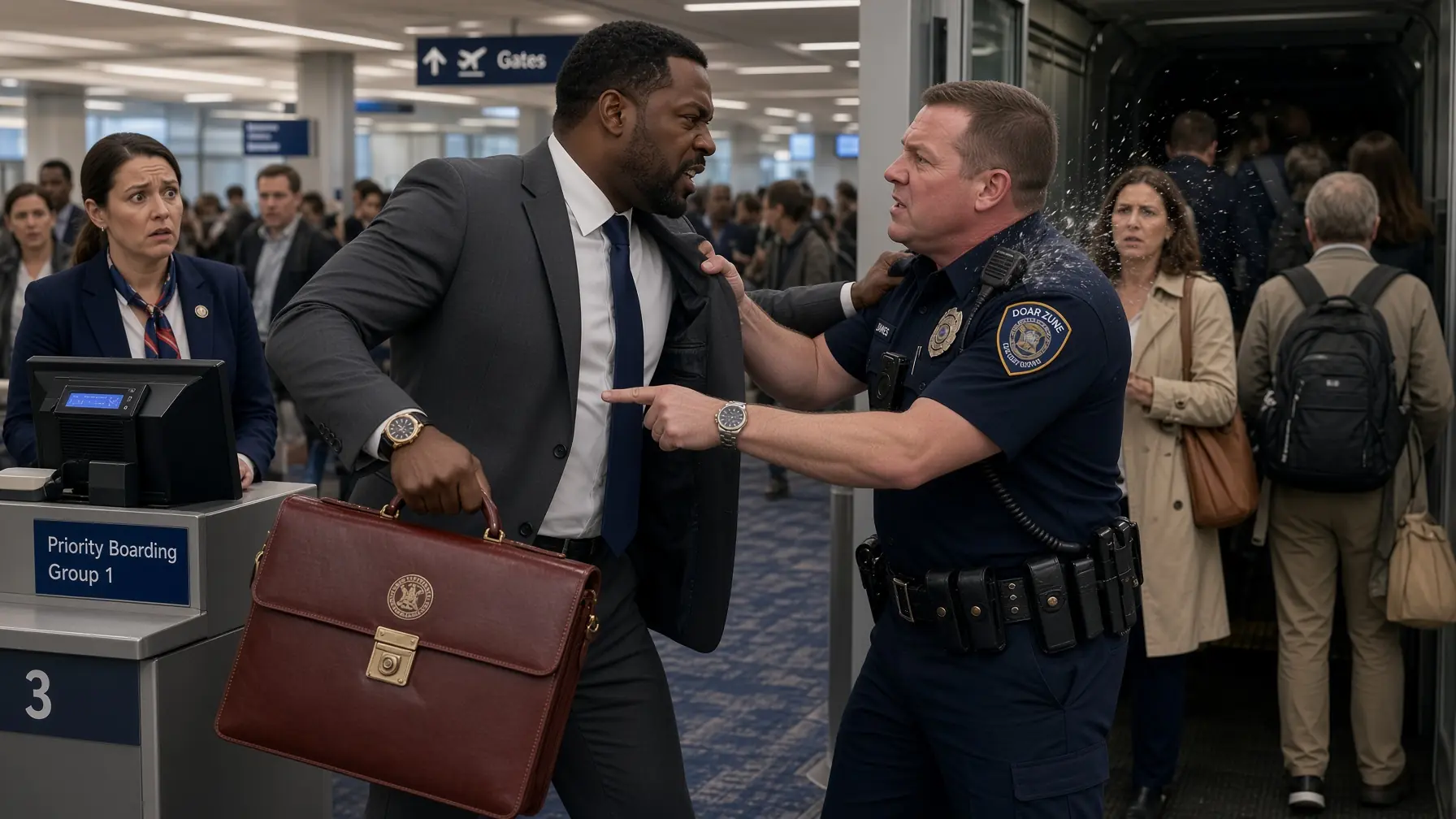
My flight to San Francisco was already boarding.
Inside my locked, cedar-lined briefcase was the proprietary source code needed to save my company from a hostile takeover by eight o’clock that night.
I just needed to scan my ticket.
That was all.
Then a thick arm in a navy-blue sleeve slammed down over the podium.
“Hold it right there.”
The gate agent froze.
I looked up.
Officer Daniel Davies stepped directly into my path.
He did not look at the boarding pass on my phone.
Did not look at the gate agent.
Did not ask whether there was an issue with my reservation.
His eyes went straight to me.
Cold.
Assessing.
Decided.
“Step out of the line, sir.”
I was forty-two years old.
Black.
CEO of Vanguard Logistics Systems.
I wore a charcoal suit tailored in New York and a vintage gold watch that had belonged to my grandfather, Samuel Hayes.
He had worked three jobs in the 1970s to buy a little brick house on Chicago’s South Side in a neighborhood that did not want him.
He kept that watch through every insult, every extra shift, every bank manager who spoke to him as though homeownership were a favor.
When he died, my mother gave it to me.
“Wear it when you need to remember what calm costs,” she said.
That morning, I needed it.
Because in Officer Davies’s eyes, none of my credentials existed yet.
I was simply a Black man in an expensive suit carrying a briefcase he wanted opened.
Passengers in the priority lane moved around me.
Some stared.
Most pretended not to.
The gate agent—a young woman named Emily—looked uncomfortable.
“Officer,” she began, “Mr. Hayes is confirmed on—”
Davies held up one hand.
“I’ll handle it.”
Then he looked back at me.
“ID.”
I gave him my driver’s license.
He read it slowly.
“Marcus Hayes.”
“Yes.”
His eyes moved over the card.
Then toward my suit.
“CEO.”
I looked at him.
“My license doesn’t say that.”
He nodded toward my boarding profile on Emily’s screen.
“Company travel account.”
He smiled slightly.
“Right.”
There was something in that word.
Right.
Not acknowledgment.
Dismissal.
Then he pointed at the briefcase.
“What’s in the bag?”
“Confidential corporate material.”
“What kind?”
“I’m not at liberty to discuss the contents in a public terminal.”
His smile widened.
“That’s convenient.”
I took a slow breath.
“Officer, if this is a security screening issue, I’m happy to speak with TSA or airport security in the appropriate area.”
“I am airport police.”
“I understand.”
“Then open the case.”
“No.”
The word changed everything.
Davies stepped closer.
“What did you say?”
“I said no.”
A few passengers slowed down.
Emily looked at me.
I kept my voice quiet.
“The case contains encrypted materials subject to restricted handling protocols.”
Davies glanced at the briefcase.
“Looks like a fancy suitcase.”
“It isn’t.”
“Open it.”
“I cannot consent to that.”
His face hardened.
“Cannot?”
“Will not.”
That correction was risky.
I knew it the second I said it.
Davies leaned closer.
I smelled stale coffee and peppermint gum.
“Last warning, Hayes.”
My name sounded different in his mouth now.
Not Mr. Hayes.
Just Hayes.
“Open the bag, or you’re not getting on Flight 427.”
I looked toward the gate.
Boarding Group 2 had started.
My pulse rose.
In San Francisco, Vanguard’s board counsel, outside investors, and representatives from NorthStar Capital were waiting.
NorthStar had spent six months buying enough minority shares to launch a hostile takeover.
They claimed Vanguard’s routing platform could not survive without their capital.
They were wrong.
My engineering team had completed something three weeks earlier that would change the entire negotiation.
A new routing engine.
Faster.
Cheaper.
Protected under a provisional patent filing.
The only complete, isolated production build was stored on the encrypted drive inside my briefcase.
Not because we were paranoid.
Because two months earlier, someone attempted to breach Vanguard’s servers.
Since then, our cyber-security team required certain core assets to travel offline.
The case itself contained an anti-tamper system.
If someone mechanically forced the lock without the proper biometric sequence, the storage module would trigger a secure wipe.
The design was extreme.
So was the situation.
The case also contained something Davies could not see.
A red tamper-control label placed by our legal team.
AUTHORIZED ACCESS ONLY — SEALED DIGITAL EVIDENCE / TRADE SECRET MATERIAL
I pointed at it.
“Officer, the case cannot be opened casually.”
Davies looked down.
Then laughed.
“Digital evidence?”
“Corporate litigation hold material.”
“You a lawyer now?”
“No.”
“Then quit talking like one.”
I checked the time.
10:06 a.m.
Our flight closed doors in twenty-two minutes.
If I missed it, the next nonstop would get me to San Francisco too late.
Private aviation was not immediately available.
Remote transmission was impossible by design.
This briefcase had to get on that plane.
Davies saw me check the time.
“Got somewhere important to be?”
“Yes.”
He smiled.
“Then you should cooperate.”
That sentence made my stomach turn.
I had heard versions of it before.
Not in airports.
Traffic stops.
Building lobbies.
Security checkpoints.
The idea that compliance was not about lawfulness but convenience.
Do what I want and your day can continue.
I looked at him.
“Am I being detained?”
His smile disappeared.
Emily stopped typing.
Davies stared at me.
“Why?”
“I’m asking whether I am free to board.”
“You’re not going anywhere until I know what’s inside that bag.”
“Then am I detained?”
“Do you want to be?”
“That isn’t an answer.”
His jaw tightened.
He unclipped his radio.
“Last chance.”
I looked at the case.
Then at him.
“I do not consent to a search.”
He pressed the radio button.
“Need another unit at Gate K18. Male subject refusing inspection of suspicious container.”
Suspicious container.
That was what my company had become.
A suspicious container.
Emily quietly said:
“Officer, he cleared standard screening.”
Davies turned.
“Did I ask?”
“No.”
“Then please continue boarding.”
She went pale.
I looked toward her.
“Emily, it’s okay.”
Davies snapped:
“Don’t talk to staff.”
That surprised even me.
“I’m speaking to the airline employee handling my ticket.”
“You’re interfering with my investigation.”
“What investigation?”
“The bag.”
“What specific fact made it suspicious?”
He stared.
“That attitude.”
There it was.
Not the bag.
Not a threat.
Not a report.
My refusal.
I felt my grandfather’s watch against my wrist.
Calm costs.
I lowered my voice.
“I’m going to ask once more. What legal basis do you have to open this case?”
Davies stepped closer.
“You really want to do this?”
“I’m already doing it.”
For a second, neither of us moved.
Then another officer arrived.
Officer Rebecca Sloan.
Early forties.
Dark hair pulled back.
More tired than aggressive.
She looked from Davies to me.
“Problem?”
Davies answered immediately.
“Subject refusing to open suspicious luggage.”
Sloan looked at my briefcase.
“Was it flagged by TSA?”
“No.”
“Airline?”
“No.”
“Threat report?”
“No.”
She frowned.
“Then what happened?”
Davies looked irritated.
“He’s acting evasive.”
I said:
“I answered every question except the contents of protected corporate material, and I declined consent to a search.”
Sloan looked at me.