Blue lights flickered against the pristine suburban darkness, reflecting off the polished hood of a midnight-black Mercedes.
For Officer Dax Ramsey, this was no ordinary traffic stop. It was a hunt.
He saw the expensive suit, the calm demeanor, and the dark skin of the driver, and he made a calculation that would cost him his badge, his freedom, and $28 million.
He thought he was pinning a felony on a common thug. He didn’t realize he was planting evidence on the one man in the state who had the power to sign his arrest warrant.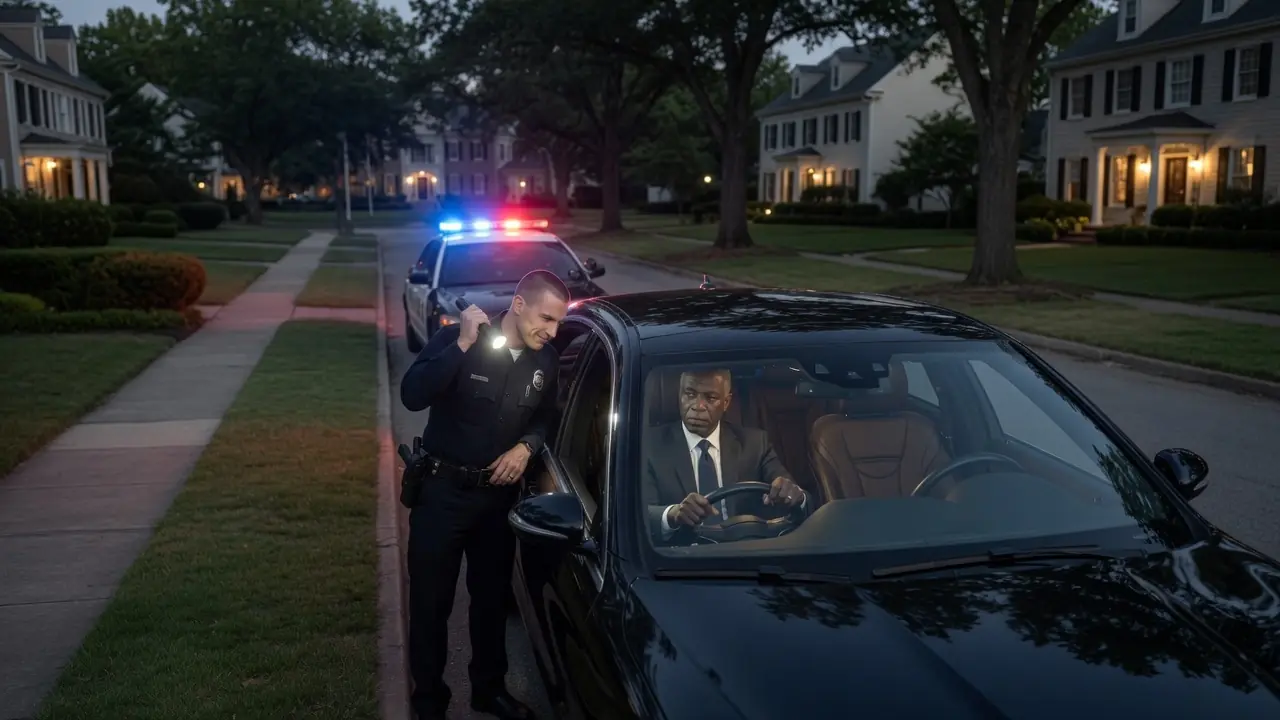
This is the story of how arrogance met absolute justice.
He drummed his fingers on the steering wheel, his eyes scanning the affluent streets of North Fairview. This was old-money territory: huge colonial houses set back from the road, manicured lawns, and a silence so heavy you could hear a pin drop.
Ramsey hated this beat. It was too quiet.
He thrived on the chaos of the downtown districts, where he could flex his authority without too many questions asked. But the chief had rotated him here after a complaint regarding excessive force the previous month.
A slap on the wrist.
Ramsey took a sip of his lukewarm coffee and narrowed his eyes.
A sleek Mercedes-Benz S-Class swept past him, heading toward the gated community of Pineview Estates.
“Well, well,” Ramsey muttered, shifting the cruiser into gear. “What do we have here?”
He pulled out behind the luxury sedan. He didn’t turn his lights on immediately.
He paced the car, running the plates. Registered to a leasing company. Common for high-end executives, or, in Ramsey’s twisted worldview, high-level dealers trying to look legitimate.
He peered through the darkness.
The driver was a Black male, alone.
That was all Ramsey needed. In his mind, the narrative was already written. A car that expensive in a neighborhood this white at this hour simply didn’t fit.
He didn’t care about probable cause. He cared about the thrill.
He flipped the switch.
The red and blue strobe lights erupted, cutting through the shadows of the oak trees.
Inside the Mercedes, Judge Corbin Vale sighed. He was exhausted.
It had been a grueling week at the federal courthouse. He had just finished presiding over a complex racketeering trial that had dragged on for six weeks, and all he wanted was to get home to his wife, Mara, and a glass of scotch.
He checked his speedometer. He was doing thirty-five in a thirty-five zone.
He signaled, pulled over smoothly to the curb, and lowered all four windows, a habit born of necessity and survival, even for a man of his stature.
Ramsey swaggered up to the window, his hand resting casually, yet threateningly, on the butt of his service weapon.
He didn’t shine his flashlight into the car. He shone it directly into Judge Vale’s eyes.
“License and registration,” Ramsey barked, skipping the courtesy of a greeting.
“Good evening, officer,” Judge Vale said, his voice a deep, resonant baritone. He kept his hands at ten and two on the steering wheel. “May I ask the reason for the stop?”
“I’ll ask the questions,” Ramsey snapped. “License, registration, now.”
“My wallet is in my breast pocket. My registration is in the glove box. I’m going to reach for them slowly.”
Ramsey sneered. He hated it when they were calm. It felt like defiance.
“Just get it.”
As Judge Vale moved, Ramsey leaned in, taking a theatrical sniff of the air. There was no smell of anything but new leather and expensive cologne.
But Ramsey wrinkled his nose as if he had caught the scent of a skunk.
“Smell a little weed in here, buddy,” Ramsey lied.
It was his go-to line, the magic words that bypassed the Fourth Amendment.
Judge Vale paused, his hand halfway to the glove box. He turned his head slowly, his eyes locking onto the officer’s.
“I assure you, officer, there is no marijuana in this vehicle. I do not smoke, and I am a federal—”
“I don’t care if you’re the prince of Zamunda,” Ramsey interrupted, chuckling at his own joke. “Step out of the vehicle now.”
Judge Vale didn’t argue. He knew the law better than Ramsey ever would.
He knew that resisting on the side of the road was a losing battle, often a fatal one.
He unbuckled his seatbelt and stepped out, standing a full head taller than the officer.
“Face the car. Hands on the hood.”
Ramsey patted him down roughly. He found nothing but a fountain pen and a phone.
Frustrated, Ramsey spun him around.
“Wait here. Don’t move.”
Ramsey moved to the driver’s side of the Mercedes.
He knew his body cam was on, but he also knew the blind spots. He angled his body, blocking the camera’s view of his right hand as he reached into his own tactical vest.
He pulled out a small, clear plastic baggie filled with white powder cocaine he had confiscated from a low-level bust three days earlier and never logged into evidence.
He kept it for moments exactly like this.
Insurance.
He leaned into the car, pretending to search under the driver’s seat. With a quick flick of his wrist, he wedged the baggie between the center console and the seatbelt buckle.
“Gotcha,” Ramsey whispered.
He stood up, holding the baggie aloft in the glare of the flashlight, making sure the body cam caught it clearly.
“Now, look at this,” Ramsey shouted, feigning shock. “A federal dealer? What, you said? A federal dealer?”
Judge Vale watched from the rear of the car. His face remained impassive, but his stomach tightened.
He wasn’t scared. He was filled with a cold, calculating fury.
“That is not mine,” Judge Vale said, his voice dropping an octave, becoming the voice that commanded courtrooms. “And you know it.”
“Tell it to the judge,” Ramsey smirked, grabbing his handcuffs.
“Oh,” Judge Vale said softly, as the cold steel clicked around his wrists. “I intend to.”
The ride to the station was silent. Ramsey tried to goad Judge Vale into saying something incriminating, playing loud rock music and making snide comments about affirmative-action cars.
But Judge Vale sat in the back of the cage like a statue. He was meditating on case law, specifically Brady v. Maryland and Giglio v. United States.
He was mentally drafting the subpoena for the officer’s disciplinary records.
When they arrived at the precinct, Ramsey dragged Judge Vale out of the car, parading him through the booking area.
The station was buzzing with the usual late-night activity: drunks, petty thieves, and exhausted officers.
“Got a big one tonight, boys,” Ramsey announced to the room, shoving Judge Vale toward the booking desk. “Possession with intent, maybe driving under the influence. Found him rolling in a Mercedes S-Class.”
The booking sergeant, an older man named Walsh, looked up from his computer. He adjusted his glasses, squinting at the tall man in the pristine suit.
Walsh had been on the force for thirty years. He knew the faces of the regulars.
He also knew the faces of the city’s elite.
He frowned.
The man in cuffs looked familiar.
“Name?” Ramsey barked at Judge Vale.
“Corbin Augustus Vale,” Judge Vale enunciated clearly.
Walsh stopped typing. His fingers hovered over the keyboard.
He looked at Judge Vale, then at the TV screen in the corner of the room that was playing the late-night news recap. The news was covering the RICO trial that had just ended.
There was a sketch of the judge on the screen.
Walsh’s blood ran cold.
“Ramsey,” Walsh said, his voice trembling slightly. “Can I see you in the back for a second?”
“Book him first, Sarge. I want this locked in,” Ramsey said, pumping with adrenaline. “I want to weigh that powder.”
“Ramsey, now.”
Walsh stood up.
The room went quiet. It wasn’t often a desk sergeant barked at a patrol officer like that.
Ramsey rolled his eyes, leaving Judge Vale standing by the counter, handcuffed to the bench rail.
He followed Walsh into the break room.
“What’s the problem, Sarge?” Ramsey asked. “I caught a guy riding dirty. Open and shut.”
Walsh turned on him, his face pale.
“Do you know who that is out there?”
“Yeah, Corbin Vale. Some rich guy who thinks he’s above the law.”
“That is the Honorable Corbin Vale,” Walsh hissed, leaning in close. “He’s a United States federal district court judge. He was appointed by the president. He just put the entire Salado crime family away for life last week.”
Ramsey blinked.
A flicker of doubt crossed his face, but his ego stomped it out immediately.
“So judges can be junkies, too? I found coke in his car, Sarge. Under the seat. He’s dirty.”
Walsh stared at him.
He knew Ramsey. He knew the rumors. He knew about the complaints regarding planted evidence that always seemed to disappear.
“Are you sure, Dax? Are you 100% sure that the drugs were his? Because if you are wrong, if you messed with a federal judge, God help us all.”
Ramsey crossed his arms. He was committed now. There was no going back.
If he admitted he planted it, he was done. If he stuck to the lie, it was his word against the driver’s.
Cops usually won that fight, even against judges.
Or so he thought.
“I found what I found,” Ramsey said, his jaw tight. “Book him.”
Walsh shook his head slowly.
“You’re digging your own grave, son.”
Back out at the desk, Judge Vale watched the interaction. He saw the color drain from Walsh’s face. He saw the stubborn set of Ramsey’s jaw.
When Ramsey came back out, he grabbed Judge Vale’s arm.
“Fingerprints. Let’s go.”
“Officer Ramsey,” Judge Vale said calmly. “I would like to make my phone call now. I am asserting my right to counsel, and I suggest you call your union representative. You are going to need him.”
Ramsey shoved him toward the scanner.
“Shut up.”
Judge Vale spent the night in a holding cell. He hadn’t slept.
He sat on the concrete bench, his suit jacket folded neatly beside him, staring at the wall.
He had refused to answer any questions. He simply stated his name and his title, then invoked the Fifth.
By morning, the station was in chaos.
Sergeant Walsh had made a phone call early to the chief of police, Chief Donovan. Chief Donovan had driven to the station in his pajamas.
When he saw the arrest report, he nearly threw up.
Now, Chief Donovan stood in the observation room looking through the one-way glass at Judge Vale.
Standing next to him was the district attorney, Lila Cole.
“Tell me this is a joke, Donovan,” Lila said, her voice like ice. “Tell me your officer didn’t arrest a federal judge for possession of a dime bag of cocaine.”
“The officer swears he found it,” Donovan said, sweating. “Body cam footage shows him pulling it from under the seat.”
“And what does the judge say?”
“He hasn’t said a word since he asked for his lawyer.”
“Who’s his lawyer?”
At that moment, the heavy steel door of the interrogation room opened.
A man walked in.
He wasn’t a public defender. He was Arthur Sinclair, the most expensive, vicious criminal defense attorney in the state.
He was also Judge Vale’s college roommate.
Sinclair sat down opposite Judge Vale. He didn’t look at the mirror. He looked at his friend.
“You okay, Corbin?”
“I’m fine, Arthur. How’s Mara taking it?”
“She’s ready to burn this building down. I told her to wait.”
Sinclair opened his briefcase.
“So, let’s hear it. Did you develop a sudden coke habit in your fifties?”
Judge Vale smiled, a cold, dangerous smile.
“Officer Ramsey planted it. Left hand. He blocked the body cam with his torso, but he forgot about the mirror angles. The side-view mirror of the Mercedes.”
Judge Vale explained.
“The door was open. The mirror was angled inward for parking. If you look at the body cam footage and catch the reflection in the side mirror, you will see him pull the bag from his vest, not from under the seat.”
Sinclair’s eyes widened.
“You saw that?”
“I was watching,” Judge Vale said. “But that’s not all. My car has sentry mode. It records 360-degree video when the alarm is triggered or when it senses proximity intrusion. It has internal cameras, too.”
Sinclair started to laugh. It was a low rumble of a laugh.
“You have him on 4K video planting the drugs.”
“I believe I do,” Judge Vale said. “But don’t release it yet. Let him write his report. Let him sign the sworn affidavit. Let him perjure himself on official federal documents.”
“I want him to bury himself so deep that no shovel on earth can dig him out.”
Sinclair slammed his hand on the table, grinning.
“This is going to be fun.”
Meanwhile, in the squad room, Ramsey was typing up his report. He felt the eyes of every other cop on him.
They knew the blue wall of silence was a real thing. Cops protecting cops.
But there were limits.
Arresting a federal judge was way past the limit. It was radioactive.
Ramsey’s partner, a rookie named Ellis, walked by.
“Hey, Dax. Chief wants to see you.”
“Yeah, yeah. Just finishing up the narrative.”
Ramsey typed the final sentence.
Suspect appeared nervous and erratic. Officer observed contraband in plain view.
He hit submit. The system logged the report.
The lie was official.
Ramsey stood up, stretched, and walked toward the chief’s office.
He convinced himself he could brazen it out. It was his word against the judge’s, and he had the baggie.
Physical evidence didn’t lie.
He knocked on the chief’s door.
“Enter.”
Ramsey walked in.
Chief Donovan was there. So was DA Lila Cole, and two men in suits Ramsey didn’t recognize.
They had earpieces.
FBI.
“Sit down, Ramsey,” the chief said.
His voice wasn’t angry. It was defeated.
“What’s going on, Chief? The DA here to charge him?” Ramsey asked, sitting confidently.
One of the FBI agents stepped forward.
“Officer Ramsey, my name is Special Agent Cain. We are taking jurisdiction over this case.”
“Jurisdiction? It’s a traffic stop. Local PD.”
“Not when the victim is a federal officer,” Agent Cain said. “And not when there are allegations of civil rights violations under color of law.”
“Victim?” Ramsey scoffed. “He’s the perp.”
“We’ll see,” the DA said. “Did you submit your report?”
“Just did.”
“And you swear everything in it is the truth, the whole truth, and nothing but?”
The DA looked at the chief. The chief looked away.
“Badge and gun on the desk, Ramsey,” the chief whispered.
“Excuse me?”
“Administrative leave, pending investigation,” the chief said, but he wouldn’t meet Ramsey’s eyes.
Ramsey felt a knot of fear tighten in his stomach. He slowly unholstered his weapon and placed it on the mahogany desk.
He unclipped his badge. It clattered loudly in the silence.
“You guys are making a mistake,” Ramsey said, his voice rising. “I’m a good cop. I took a criminal off the street.”
“Get out,” the chief said.
Ramsey stormed out. He thought he was being persecuted.
He didn’t know that Arthur Sinclair was currently walking into the FBI field office with a USB drive containing the internal cabin footage from the Mercedes-Benz.
The trap was set, and Ramsey had just walked right into the middle of it.
Suspended with pay.
That was the official status. But to Officer Dax Ramsey, it felt like a paid vacation to prepare for war.
He sat in a dark corner booth of the Blue Haven, a dive bar frequented exclusively by cops who thought the rules were merely suggestions.
Across from him sat Frank Delaney, the union representative known as the fixer. Delaney was a man made of cigarette smoke and cheap suits, with a reputation for burying scandals that would make politicians blush.
“You’re in a tight spot, kid,” Delaney grunted, nursing a whiskey. “The feds are sniffing around. They took the dashcam footage.”
“The dashcam shows nothing,” Ramsey insisted, leaning in. “It shows me pulling him over. It shows me searching the car. It doesn’t show the plant. I told you, I blocked the angle.”
“And Judge Vale?”
“He’s bluffing,” Ramsey said, though his voice lacked the conviction it had days ago. “He’s trying to scare the department into dropping the charges. If we fold now, I look like a liar. And he walks away laughing.”
“We have to double down.”
Delaney nodded slowly.
“If you want to survive this, we have to make him look dirty before this hits a courtroom. We need to taint the jury pool. We need the narrative to be corrupt judge caught with stash, not hero cop frames judge.”
“How do we do that?”
“Leave it to me,” Delaney smiled, revealing yellowed teeth. “I know a reporter at the City Chronicle. We leak a story. Not about the stop, but about Vale. Maybe we find an anonymous source who says the judge has been seen at wild parties.”
“Maybe we hint that he’s been soft on dealers because he’s a user himself. Mud sticks, Dax. Even if he’s innocent, the doubt will save your badge.”
By the next morning, the smear campaign was live.
Headline: Federal Judge Under Investigation: Drug Arrest Linked To Private Habits.
The article was vague, citing sources close to the investigation, but the damage was immediate.
Social media exploded. Half the city was calling for Judge Vale’s resignation. The other half was screaming racism.
Inside the Vale residence, the mood was funereal.
Mara Vale, a woman of immense grace and steel, threw the newspaper onto the kitchen island.
“They are destroying your name, Corbin,” she said, her voice trembling with rage. “They are dragging thirty years of service through the mud to protect one bad apple.”
Judge Vale sat at the table sipping tea. He was impeccably dressed even at home.
He looked at the paper, read the headline, and calmly folded it.
“Let them talk, Mara,” Judge Vale said softly. “A lie can run a sprint, but the truth runs a marathon. Delaney and Ramsey are playing checkers. They’re making noise.”
“They don’t realize we are playing chess.”
“Arthur called,” Mara said. “The FBI has finished analyzing the car’s data. They have the video.”
“Good.”
“He wants to release it to the press to stop this smear campaign.”
“No,” Judge Vale said, his eyes hardening. “Not yet. Ramsey has a preliminary hearing regarding his employment status on Friday. He has to testify under oath about the arrest to keep his job.”
“If we release the video now, he’ll plead the Fifth. He’ll resign and disappear. I want him on the stand. I want him to lie to a judge on the record while the cameras are rolling.”
“I don’t just want his badge, Mara. I want his life.”
It was a gamble.
Judge Vale was allowing his reputation to take a beating for the sake of a total crushing victory.
He was applying the same merciless logic he used on the bench. He wasn’t looking for a settlement.
He was looking for a verdict.
The hearing to determine the status of Officer Ramsey was supposed to be a formality.
Usually, these hearings were closed-door, but because of the high-profile nature of the victim, the press had successfully petitioned for access.
The room was packed. Reporters, community activists, and a wall of uniformed officers supporting Ramsey filled every seat.
Ramsey sat at the defense table wearing his dress uniform, looking every bit the all-American hero.
Delaney whispered in his ear.
“Stick to the script. You saw the drugs. You seized them. End of story.”
The hearing officer, a retired magistrate named Judge Whittaker, banged the gavel.
“We are here to review the suspension of Officer Dax Ramsey following the arrest of Judge Corbin Vale. Officer Ramsey, please take the stand.”
Ramsey walked up, placed his hand on the Bible, and swore to tell the truth.
He looked confident. He looked at the cameras.
For twenty minutes, he recounted the lie.
He described the erratic driving. He described the smell of marijuana. He described with vivid detail how he knelt down and found the baggie of cocaine wedged under the seat.
“I knew it was a difficult situation,” Ramsey said, feigning humility. “Arresting a judge, nobody wants to do that. But the law is the law. Nobody is above it.”
The room murmured in approval. He was good.
He was selling it.
Then it was time for the cross-examination.
But it wasn’t a department lawyer who stood up. It was Arthur Sinclair, acting as special counsel for the inquiry.
Sinclair walked to the podium holding a small remote control.
“Officer Ramsey,” Sinclair began, his voice friendly, almost bored. “You are absolutely certain you found that baggie under the seat?”
“Yes, sir. One hundred percent.”
“And you did not place it there yourself?”
“Absolutely not. That’s offensive.”
“And you didn’t have that baggie in your vest prior to the stop?”
“No, sir.”
“Officer, are you familiar with the 2024 Mercedes-Benz S-Class interior sentinel feature?”
Ramsey frowned.
“The what?”
“It’s a security feature,” Sinclair explained, tapping the remote.
A large screen behind the witness stand flickered to life.
“It uses infrared and high-definition cameras to monitor the interior of the vehicle for driver safety and theft prevention. It records in 4K resolution.”
Ramsey’s face went slack.
The blood drained from his cheeks so fast he looked like a ghost.
“Let’s watch the tape, shall we?”
Sinclair pressed play.
The room went deathly silent.
On the screen, the interior of the car was bright and clear. The audience watched Judge Vale exit the car.
They saw the empty car.
Then they saw Ramsey lean in.
The angle was perfect. It looked down from the rearview mirror cluster.
It showed Ramsey’s hand going into his tactical vest. It showed him pulling out the baggie.
It showed him looking around furtively. It showed him wedging it between the console and the seat.
“Gotcha,” the Ramsey on the screen whispered.
The audio was crisp. The whisper echoed through the hearing room like a thunderclap.
Sinclair paused the video on the frame where Ramsey was holding the baggie, his face illuminated by the interior light, a smirk of malicious triumph on his lips.
“Officer Ramsey,” Sinclair said, his voice dropping to a terrifying growl, “is that you planting evidence on a federal judge?”
Ramsey couldn’t breathe. He looked at Delaney, but Delaney was staring at the floor, knowing the game was over.
He looked at the other cops in the room. They were looking at him with a mixture of shock and disgust.
The blue wall had just been nuked.
“I... I...”
Ramsey stammered.
“You lied in your police report,” Sinclair listed, ticking off fingers. “You lied in your sworn affidavit, and you just lied to this commission under oath. That is perjury. That is filing a false instrument. That is deprivation of rights under color of law.”
Two men in suits walked into the room from the back.
They were the FBI agents. They weren’t there to watch this time.
They were holding handcuffs.
“Officer Ramsey,” Judge Whittaker said, his voice dripping with disdain. “You’re dismissed from the stand, and I believe these gentlemen would like a word.”
Ramsey stood up, his legs shaking.
The cameras flashed blindingly as the FBI agents spun him around, cuffing him in his dress uniform.
The hero-cop narrative was dead.
The predator had become the prey.
The fall of Dax Ramsey was swift, brutal, and public.
Because he had targeted a federal official, the case went federal. The charges were not just drug planting. They were federal civil rights violations, which carried mandatory minimums.
The prosecutor was United States Attorney Loretta Blake. She was known as the hammer.
They charged him with one count of deprivation of rights under color of law, 18 U.S.C. Section 242, obstruction of justice, perjury, and possession of a controlled substance, the drugs he planted.
Ramsey’s lawyer tried to cut a deal. He offered five years.
Loretta Blake laughed in his face.
He tried to frame a federal district judge. If he had succeeded, Judge Vale would have lost his pension, his reputation, and his freedom.
Ramsey wanted to ruin a life. He could pay with his own.
No deal.
They would go to trial.
The trial was a massacre.
The video evidence was incontrovertible. But the worst part for Ramsey wasn’t the evidence.
It was the testimony of his fellow officers.
Once the video came out, the floodgates opened. Other people Ramsey had arrested came forward.
A pattern emerged. He had done this before to young kids in poor neighborhoods, people who didn’t have 4K cameras or high-powered lawyers.
Ramsey sat alone at the defense table. Delaney had abandoned him.
His wife, Brooke, had filed for divorce the week prior, humiliated by the national news coverage.
The jury deliberated for less than two hours.
Guilty on all counts.
At the sentencing hearing, Judge Vale finally spoke.
He didn’t speak as a judge. He spoke as a victim.
He stood at the podium, looking down at Ramsey, who was now wearing an orange jumpsuit.
“Mr. Ramsey,” Vale said, his voice filling the courtroom. “You viewed your badge not as a shield to protect, but as a sword to strike down those you deemed lesser.”
“You saw a Black man in a nice car and decided he didn’t belong. You tried to steal my life because of your own prejudice. You failed because I had the means to fight back.”
“But what haunts me is the thought of those who did not have my resources. For them, and for the integrity of the law you disgraced, justice must be absolute.”
The presiding judge sentenced Dax Ramsey to twenty-five years in federal prison without the possibility of parole.
Ramsey wept.
He was dragged out of the courtroom kicking and screaming, a broken man.
But Judge Vale wasn’t done.
Arthur Sinclair filed the civil lawsuit: Vale v. the City of Fairview, the police department, and Dax Ramsey.
The lawsuit argued that the city knew Ramsey was a bad apple, citing the previous complaints Sergeant Walsh had mentioned, and failed to discipline him.
It was a Monell claim, proving a pattern and practice of negligence.
The city council was terrified. They knew a jury would hate them. They knew a jury would look at Judge Vale, a man of unimpeachable character, and give him whatever he asked for.
They tried to settle for $5 million.
Sinclair rejected it.
They offered $10 million.
Sinclair didn’t even return the call.
They went to trial on damages.
The jury was shown the smear campaign, the stress placed on Mara Vale, and the damage to the judge’s reputation.
The verdict came back in four hours.
Three million in compensatory damages. Twenty-five million in punitive damages.
Total: $28 million.
It was a record-breaking sum. The city of Fairview would be paying for the sins of Officer Ramsey for a generation.
Ramsey, sitting in his cell at a maximum-security federal penitentiary, heard the news on a small radio.
He had nothing. His assets were frozen, his pension stripped, his family gone.
He was twenty-nine years old, and his life was effectively over.
However, as the money cleared and the headlines faded, Judge Vale sat in his study.
The victory was complete.
But there was one final loose end.
The money.
He didn’t want it.
To keep it felt like profiting from a tragedy. He had a different plan for the $28 million, a plan that would ensure Dax Ramsey’s name was remembered forever, but not in the way the ex-cop would have wanted.
The air in the room was stale, recycled, and thick with defeat. It was the kind of room where careers were made, but today it was where a city’s arrogance was coming to die.
The long mahogany table was littered with legal pads, water bottles, and the debris of a twelve-hour negotiation session that had finally whimpered to a halt.
On one side sat the city of Fairview’s legal team, six lawyers in varying shades of gray suits, looking exhausted.
In the center sat Mayor Everett, a man whose political aspirations were currently being suffocated by the scandal.
On the other side sat just two men: Arthur Sinclair and Judge Corbin Vale.
Sinclair pushed a single piece of paper across the polished wood.
It wasn’t a motion or a subpoena.
It was the settlement agreement.
“Twenty-eight million,” the city attorney said, his voice raspy. “Payable within thirty days, and in exchange, the civil suit is dismissed with prejudice.”
“Correct,” Sinclair said, capping his fountain pen with a decisive click.
“There is one final stipulation,” the mayor interjected, leaning forward.
He looked desperate.
“The non-disclosure agreement. We need a clause stating that Judge Vale will not discuss the specific terms of the settlement or disparage the department further publicly. We need to heal the city, Judge. We can’t do that if you’re on a victory lap.”
Judge Vale, who had been silent for the hour, finally looked up.
He adjusted his cufflinks, his movements slow and deliberate. He looked at the mayor, not with anger, but with the pity one might feel for a slow child.
“Mr. Mayor,” Judge Vale’s voice was low, rolling across the table like thunder, “you seem to be operating under a misunderstanding.”
“You’re not paying $28 million to buy my silence. You’re paying it as a penalty for your incompetence.”
“But there will be no NDA,” Judge Vale continued, his voice hardening. “I will speak about this case to whomever I choose. I will discuss Officer Ramsey. I will discuss the chief’s negligence, and I will discuss the check you are about to sign.”
“If you want an NDA, we can tear this agreement up right now and let the jury decide the damages next week. I am quite confident they will find a number north of $50 million.”
The room went dead silent.
The city attorney looked at the mayor and gave a barely perceptible shake of his head.
Don’t push him.
The mayor swallowed hard. He picked up the heavy pen.
His hand trembled slightly as he signed the document that would decimate the city’s budget for the next fiscal year.
Judge Vale watched the ink dry. He felt no elation. He felt only the heavy, crushing weight of responsibility.
This wasn’t lottery money. It was blood money.
It was the price tag of a man’s life that Ramsey had tried to steal.
“Gentlemen,” Judge Vale said, standing up. “We are done here.”
As they walked out into the cool December air, Sinclair let out a long breath.
“You know, Corbin, you could have bought a small island with that NDA money.”
“I don’t need an island, Arthur,” Judge Vale said, checking his watch. “I need a weapon.”
For Dax Ramsey, time had ceased to be linear.
It was a loop of gray concrete, fluorescent buzzing, and the smell of industrial disinfectant mixed with old sweat.
He was currently housed in the administrative segregation unit of the county jail, awaiting transfer to the Federal Bureau of Prisons.
He was protected, which meant he was buried alive.
He had twenty-three hours a day in a cell the size of a parking space.
The heavy steel door clanked open. A guard, one Ramsey didn’t know, tossed a manila envelope onto the thin cot.
“Mail call, Ramsey.”
Dax scrambled off the floor.
Mail was rare. He hoped it was Delaney. Maybe there was an appeal strategy. Maybe the union had found a loophole.
He tore open the envelope.
There was no letterhead from a law firm. Instead, it was a petition for dissolution of marriage.
He stared at the words irreconcilable differences.
His eyes scanned the document. His wife, Brooke, wasn’t just leaving him.
She was taking the house, what was left of the equity, the cars, and she was petitioning for full custody of their two daughters.
“The petitioner requests that the respondent’s visitation rights be suspended indefinitely, citing the respondent’s criminal conviction and the potential psychological harm to the minors, given the high-profile nature of his crimes.”
She wasn’t just divorcing him.
She was erasing him.
Dax sat on the edge of the bed. His hands started to shake, a tremor that traveled up his arms and into his chest.
He looked at the photo of his girls he had taped to the wall with toothpaste. They were smiling at a beach trip two years ago.
“Brooke,” he whispered to the empty room. “Don’t do this.”
He scrambled to the door, pressing his face against the small reinforced-glass window.
“Guard, hey, I need to make a call. I need to call my wife.”
“Phone privileges are at 1600 hours, Ramsey,” a voice shouted back from the control booth. “Sit down, please.”
“It’s an emergency.”
“Sit down, or I’ll lose your rec time.”
Dax slid down the door until he hit the floor. He pulled his knees to his chest.
The reality of his situation crashed down on him with the force of a physical blow.
He wasn’t just going to prison for twenty-five years.
He was going to prison as a man with nothing waiting for him on the outside.
He thought about the Mercedes. He thought about that split-second decision to pull the baggie out of his vest.
Why had he done it?
Because I could, a voice in his head whispered.
Because I was a god.
Now, he was just a number, and the silence of the cell was louder than any scream.
The check lay on the kitchen island. It was a cashier’s check from the city of Fairview.
The zeros seemed to stretch on forever.
$28 million.
Mara Vale walked into the kitchen, tying the belt of her silk robe. She saw Judge Vale staring at the check, a cup of tea untouched beside him.
“It looks like a Monopoly prop,” she said softly, resting her hand on his shoulder.
“It’s the budget of a small country,” Judge Vale muttered. “Or the cost of a fighter jet. It’s too much power for one piece of paper.”
“It’s your reputation, Corbin. It’s the price they put on your integrity.”
Judge Vale turned to her.
“If I keep this, Mara, they win. If I buy a villa or a new car or invest it, then Ramsey was right. He was right that everyone has a price. I become just another rich man who benefited from the system’s dysfunction.”
“So, what do you do? Burn it?”
“No,” Judge Vale said, his eyes gleaming with a sudden sharp intensity. “I use it to burn them.”
He stood up and walked to the window, looking out at the dark street.
“I’ve been thinking about the kids I sentenced when I was on the bench,” he said. “The ones who had public defenders who were overworked and underpaid. The ones who took plea deals because they were scared, not because they were guilty.”
“The system is designed to crush the poor, Mara. It’s an assembly line of convictions.”
“And you want to stop the assembly line?”
“I want to break the machine,” Judge Vale corrected. “I want to create a firm, a defense fund, but not just lawyers. Investigators. Forensics experts. Tech specialists.”
“I want to give the kid from the projects the same defense as a CEO. I want to make it so expensive, so difficult, and so painful for the city to prosecute bogus charges that they stop doing it.”
Mara smiled.
It was the first time she had seen him look truly alive since the arrest.
“You’re going to war?”
“Yes,” Judge Vale said. “But I need a name. Something that sends a message.”
“The Vale Foundation,” she suggested.
“No,” Judge Vale shook his head. “It shouldn’t be about me. It should be a reminder. A scar.”
He looked back at the check.
A dark, ironic thought began to form in his mind. A way to ensure that Dax Ramsey’s punishment didn’t end when he went to prison.
A way to attach Ramsey’s name to the one thing he hated most: the empowerment of the people he targeted.
“I have an idea,” Judge Vale said, a cold smile touching his lips. “And the city is going to hate it.”
The Sentinel Project Gala was the event of the decade.
The ballroom was draped in black and gold. The guest list was a who’s who of the state.
Senators, civil rights leaders, Hollywood actors, and the entire legal elite.
Even the people who secretly hated Judge Vale were there because not being there was political suicide.
The atmosphere was electric. Rumors were flying about what Vale was going to do with the money.
Was he running for governor? Was he starting a think tank?
The lights dimmed. A hush fell over the thousand guests.
Judge Vale walked onto the stage. He didn’t use a teleprompter.
He stood at the podium, gripping the sides, and looked out into the darkness.
“Good evening,” he began.
“A year ago, I was handcuffed on the side of a road, accused of a crime I did not commit. I was stripped of my dignity. I was presumed guilty because of the color of my skin and the car I drove.”
He paused.
“But I was lucky. I had resources. I had knowledge. I had cameras. Most people do not have those luxuries. Most people, when the blue lights flash, are alone.”
He gestured to the screen behind him.
A photo appeared. Not of him, but of a young, terrified teenager being pressed against a hood by a police officer.
“We tell ourselves that justice is blind. But we know that justice has a price tag. In this city, innocence costs about $500 an hour. That is the rate of a good defense attorney.”
“If you don’t have it, you don’t get justice. You get processed.”
He reached into his pocket and pulled out the check. He held it up.
“The city of Fairview gave me this. $28 million. They hoped I would retire. They hoped I would go away.”
He ripped the check in half.
The sound was amplified by the microphone. The audience gasped audibly.
“I have already deposited the funds electronically,” he reassured them with a dry chuckle, breaking the tension. “But the physical symbol means nothing. What matters is what it builds.”
“Tonight, I am announcing the formation of the Sentinel Project. We have hired thirty of the top criminal defense attorneys in the country. We have hired former FBI forensics experts. We have a war chest that will never run dry.”
“We will represent the indigent, the marginalized, and the accused. And we will not just defend. We will counter-sue. We will make corruption too expensive to sustain.”
The applause started tentative at first, then grew.
But Judge Vale raised a hand.
“But we must never forget where this money came from. It came from the actions of one man. A man who sought to destroy, but who inadvertently provided the capital for liberation.”
He signaled to the tech booth.
The screen behind him changed. Giant letters appeared in bold white font against a black background.
The Dax Ramsey Legal Aid Center.
The silence in the room was absolute.
It took a moment for the irony to land.
Then a ripple of shock went through the crowd.
“You read that correctly,” Judge Vale said, his voice hard as stone. “We are naming our headquarters after the man who tried to frame me.”
“Why? Because I want his name to live forever. Not as a symbol of police brutality, but as the source of its defeat.”
“Every time a young Black man walks out of court a free man, he will walk out through the doors of the Dax Ramsey Center. Every time a corrupt officer is cross-examined, the subpoena will come from the Dax Ramsey Center.”
Judge Vale leaned in close to the mic.
“Dax Ramsey wanted to be famous. He wanted to be a big fish. Well, tonight we grant his wish. He is now the biggest patron of civil rights this city has ever seen.”
The crowd erupted.
It wasn’t polite applause. It was a roar.
It was a mix of laughter, shock, and fierce, vindictive joy.
It was the sound of karma being weaponized.
Five years later, in the federal penitentiary at Coleman, in the Special Housing Unit, the SHU, the days were marked not by the sun, but by the changing of the guard shifts.
Inmate 8940-22 sat on his bunk.
Dax Ramsey was thirty-four years old, but he looked fifty. His hair had thinned to a gray wisp.
His skin was pasty and scarred from a fight in the shower two years ago, a fight he had lost badly.
He was reading a magazine that had been left in the recreation cage. It was a copy of Time magazine.
He flipped the page and froze.
There was a full-page spread. The headline read, “The House That Hate Built: How The Dax Ramsey Center Is Changing American Law.”
There was a picture of the building. It was a sleek glass structure in downtown Fairview.
Above the entrance, in polished steel letters, was his name.
Dax Ramsey Legal Aid Center.
Beneath the name, there was a smaller plaque dedicated to the pursuit of justice against those who abuse their power.
Dax felt his stomach lurch.
He read the article.
Since its opening, the Ramsey Center has secured the exoneration of over 200 wrongfully accused defendants. It has filed over fifty civil rights lawsuits against police departments, resulting in major policy changes.
“We owe it all to Dax,” says lead attorney Arthur Sinclair with a smile. “Without his egregious misconduct, none of this would be possible.”
Dax threw the magazine across the cell.
It hit the wall and fluttered to the floor, face up. His own name stared back at him.
He stood up and paced.
Three steps, turn.
Three steps, turn.
“It’s not right,” he muttered, his voice cracking. “It’s my name. They can’t do that. It’s my name.”
He grabbed the bars of his cell and shook them.
“Guard! Guard!”
A few moments later, a correction officer strolled up. It was Officer Reed, a man who had been working the unit for six months.
He was calm, professional, and took no nonsense.
“What is it, Ramsey?”
“You have to get me a lawyer,” Ramsey spat, pointing at the magazine on the floor. “They’re using my name. They’re mocking me. That judge, he is mocking me.”
“I can sue for defamation. I can sue for appropriation of likeness.”
Officer Reed looked through the bars at the magazine. He looked at the headline.
A slow, genuine smile spread across his face.
“You want a lawyer?” Reed asked.
“Yes. I have rights.”
“Well,” Reed chuckled, checking his clipboard, “I hear there’s a fantastic place in Fairview that takes pro bono cases for people who claim their rights are being violated. It’s called the Dax Ramsey Legal Aid Center. You should write to them. I bet they’d love to hear from you.”
Ramsey stared at him, his mouth agape.
The mockery was total.
The loop was closed.
“You think this is funny?” Ramsey whispered.
“I think it’s justice,” Reed said, turning to walk away. “Lights out in ten, Ramsey.”
The lights clanked off, plunging the cell into semi-darkness.
Dax Ramsey sat on his cot, the magazine lying in the shaft of light coming from the corridor.
He realized then that his sentence wasn’t twenty-five years.
It was eternal.
Long after he was dead, his name would be working for the enemy.
He was the architect of his own destruction, and every good deed the center did was another shovel of dirt on his grave.
He pulled the thin blanket over his head and wept.
The sun was setting over North Fairview.
A beat-up Honda Civic rolled through a stop sign.
It was a minor infraction, a rolling stop.
A patrol car was sitting in a speed trap nearby. Officer Reed saw the infraction.
He flipped on his lights.
The Honda pulled over.
The driver was a young Black kid, maybe nineteen, wearing a hoodie.
He looked terrified. He kept his hands on the wheel.
Officer Reed walked up to the window. He was an older cop, a transfer from another district.
He was tired and irritable.
“License and registration,” Reed barked.
The kid handed over his license. His hands were shaking.
“You know you rolled that stop sign, kid?” Reed asked, shining his flashlight into the backseat. “You got anything in here I should know about? Guns? Drugs?”
“No, sir,” the kid said. “Just my gym bag.”
“Mind if I take a look?” Reed asked, his hand drifting to the door handle.
It was a pressure tactic. He didn’t have probable cause, but he was fishing.
The kid took a deep breath. He reached into his sun visor and pulled out a small laminated card.
It was black with gold lettering.
He held it out the window.
“Officer,” the kid said, his voice trembling, but firm. “I do not consent to any searches. If you have further questions, please contact my counsel at the Dax Ramsey Legal Aid Center. Their twenty-four-hour hotline is on this card.”
Officer Reed froze.
He looked at the card. He saw the name Dax Ramsey.
The name was radioactive.
Every cop in the state knew what happened if you tangled with that center. They knew that within twenty minutes, a lawyer would be on the scene with a camera crew.
They knew that if they stepped one inch out of line, they would be the next headline.
Reed looked at the kid. He looked at the card. He looked at his body cam.
He sighed, stepping back.
“All right,” Reed said, his tone shifting instantly. “Just come to a complete stop next time. Okay? Drive safe.”
“Thank you, officer,” the kid said.
Reed walked back to his cruiser. He sat down and turned off his lights.
“Not worth it,” he muttered to his partner. “Kid’s got the Ramsey card.”
As the Honda pulled away, safe and unharmed, the ghost of Judge Vale’s victory rippled through the air.
The trap that Ramsey had set for a judge had been dismantled and reassembled into a shield for the innocent.
Judge Vale sat in his study, surrounded by books.
He was retired now. His hair was completely white.
On his desk sat a framed photograph of the gala. He was shaking hands with Arthur, the sign for the center glowing in the background.
He picked up a glass of scotch and swirled the amber liquid.
He thought about Dax Ramsey.
He didn’t hate the man anymore. Hate required energy.
Ramsey was simply a lesson, a chapter in a book that was still being written.
He took a sip of the scotch and looked out the window at the city lights.
“Here’s to you, Dax,” Judge Vale whispered to the empty room. “You finally did your job. You’re protecting and serving whether you like it or not.”
He set the glass down and turned off the lamp.
The room went dark, but outside, the city was a little bit brighter.
That is the full, unvarnished story of how arrogance met its match in absolute integrity.
It’s a story that reminds us that while the wheels of justice grind slowly, they grind exceedingly fine, especially when you have a federal judge in the driver’s seat.
Dax Ramsey tried to weaponize the law against an innocent man.
But in the end, he became the very tool that dismantled the system of corruption he relied on.
He lost his freedom, his fortune, and even his name.
This story serves as a powerful reminder.
In the age of information, the truth is watching.
And sometimes karma doesn’t just hit back. It builds a legacy on your grave.