A cold steel bench. The sterile, unforgiving scent of disinfectant.
For 19-year-old Leo Nash, this was the end of a night that had begun with charcoal sketches and dreams of art school.
Handcuffed and processed like a common criminal, his pleas of innocence had been met with mocking laughter.
The officers saw a young Black man in a worn-out car and built their own narrative of guilt.
They did not know that the boy sitting inside their holding cell, the one they had targeted and humiliated, was about to make a single phone call that would detonate their careers, their department, and the world they thought they controlled.
They locked him up believing they were untouchable.
They were wrong.
The night was cool and quiet, the kind of stillness that settles over the suburbs long after the last commuter train has pulled away.
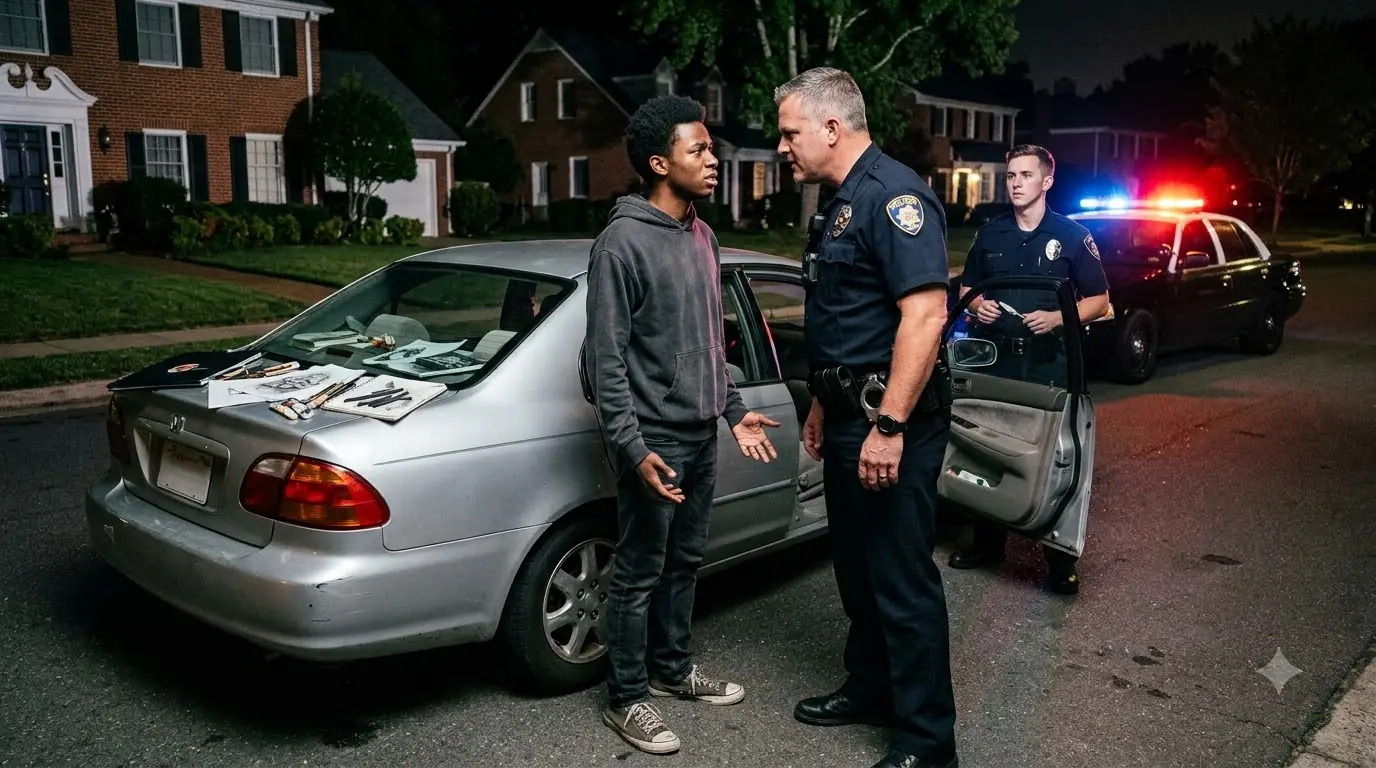
Leo Nash drove his mother's 10-year-old sedan, the engine humming a familiar, comforting rhythm. The passenger seat was littered with art supplies, sticks of willow charcoal, a portfolio of sketches, and a brand-new set of oil paints he had saved up to buy.
He was heading home from a late-night session at a friend's makeshift studio. His mind was buzzing with color theory and composition, not with the possibility that authority was about to turn against him.
He was humming along to a song on the radio, thinking about the texture of a canvas he had stretched earlier, when the world behind him suddenly exploded into a silent kaleidoscope of red and blue.
His heart hammered against his ribs.
It was a fear his father had warned him about since before Leo was old enough to drive.
He checked his speedometer.
Exactly the speed limit.
He signaled, pulled smoothly to the curb, and placed his hands at ten and two on the steering wheel, exactly the way his father had drilled into him a hundred times.
Two officers stepped out of the patrol car.
Their silhouettes were stark against the blinding headlights.
The older officer was a man with a thick neck and a swagger that spoke of unquestioned confidence. He approached the driver's side.
His name tag read MILLER.
The younger officer, Carter, remained near the passenger side, his hand resting close to his duty belt as he scanned the interior of the car with nervous energy.
"Evening," Officer Cade Miller said.
His voice carried a bored kind of condescension.
He bent slightly and peered into the car.
"You know why I pulled you over?"
"No, Officer, I don't," Leo replied.
He kept his voice calm and respectful.
"Your left taillight is out," Miller said flatly.
Leo knew for a fact that it wasn't.
He and his father had checked all the lights the previous weekend.
But Leo also knew this was not the moment to argue.
"I'm sorry to hear that, Officer. I wasn't aware."
"License and registration."
Miller paused.
"License, registration, and proof of insurance. Keep your hands where I can see them."
His flashlight beam crossed Leo's face, then moved through the interior of the car before lingering over the art supplies on the passenger seat.
Leo moved slowly.
Deliberately.
He retrieved the documents from the glove compartment and handed them over.
Miller took them and barely looked at the name before returning his attention to the car's interior.
"What's all this junk?" Miller asked, directing the flashlight toward Leo's portfolio.
"They're my art supplies, sir. I'm coming from a friend's house."
"Art supplies?"
Miller scoffed and glanced toward Carter with a smirk.
"Right. What's your real business out here tonight, son?"
The word son did not sound affectionate.
It sounded like a warning.
"I'm a student. I was just heading home," Leo said.
Frustration had begun to rise beneath his calm exterior.
"We'll see about that."
Miller handed the documents toward Carter.
"Run his name."
Then he turned back to Leo.
"Step out of the car."
Leo felt his stomach tighten.
"Officer, am I being detained? What for?"
"For a broken taillight and because I'm telling you to. Now get out of the vehicle slowly."
Leo complied.
His body was rigid with a mixture of fear and indignation.
The moment he stood beside the car, Miller pushed him against the side panel.
"Spread your feet."
"You have no reason to do this," Leo said.
His voice trembled slightly.
"I'll be the judge of that," Miller replied.
He searched Leo aggressively but found nothing except a wallet and a phone.
While Miller searched him, Carter began looking through the passenger side.
"Hey, Cade. Look at this."
Carter held up a palette knife.
Its metal edge reflected the flashing patrol lights.
"Could be a weapon."
Miller's expression changed.
A hint of satisfaction appeared.
"Well, well, well. Looks like our little artist came prepared for more than painting."
"That's a palette knife," Leo said in disbelief. "It's for mixing paint. You can't be serious."
"I'm very serious."
Miller pulled Leo's arms behind his back.
"You're carrying a concealed weapon, and you fit the description of someone involved in recent break-ins in this area."
There was no specific description.
No clear connection to Leo.
Only the assumptions Miller had already made.
"This is insane," Leo said.
He looked desperately toward Carter.
"Tell him you know what that is."
Carter looked away.
His expression was unreadable.
He said nothing.
The handcuffs closed around Leo's wrists.
The sound felt final.
It was as though his identity had been replaced in seconds by a profile someone else had invented.
Miller guided him toward the back of the patrol car.
"You have the right to remain silent," he began.
The familiar words sounded empty to Leo now.
As the rear door closed and trapped him in the molded plastic seat, Leo looked out toward his mother's sedan.
Its supposedly broken taillight glowed a steady red in the darkness.
In that moment, he was not the governor's son.
He was not an artist.
He was not a student.
He was simply another young man being processed by a system that had already decided who he was.
The Northwood precinct was a monument to bureaucratic indifference.
The air smelled of stale coffee, industrial disinfectant, and long hours.
Officer Miller walked Leo through the main bullpen as though he were presenting a successful arrest, one hand gripping Leo's shoulder.
The few officers still on duty barely looked away from their paperwork.
"Got another one," Miller announced to the desk sergeant.
Sergeant Peterson was a portly, gray-haired man with the tired expression of someone who had spent too many years on night shift.
"Caught him prowling. Armed with this."
Miller dropped the palette knife into a plastic evidence bag with theatrical importance.
Peterson looked at the tool, then at Leo.
"An artist, huh?"
He gave a dry laugh.
"What was he going to do, paint a masterpiece on the side of a house?"
"Something like that," Miller said.
Then he pushed Leo toward booking.
"Let's get him processed."
The next hour became a blur of humiliation.
Leo was ordered to remove his shoes and belt.
His pockets were emptied.
A tube of lip balm.
A few dollars.
A house key.
Everything was cataloged and sealed away.
He was fingerprinted.
The process felt especially bitter because his hands were the same hands he used to draw and paint.
Then came the booking photograph.
Flash.
Straight ahead.
Profile.
The camera captured a suspect rather than the person Leo knew himself to be.
Through all of it, he tried to remain composed.
"You have the wrong person," Leo told Sergeant Peterson. "My name is Leo Nash. My father is..."
Peterson waved him off.