"Ma'am, please—just till morning." The voice came through the door at midnight, deep, shaking from the cold. Florence Brooks was 72, alone, three weeks from losing her house. Outside, four soaked bikers stood in a Georgia storm.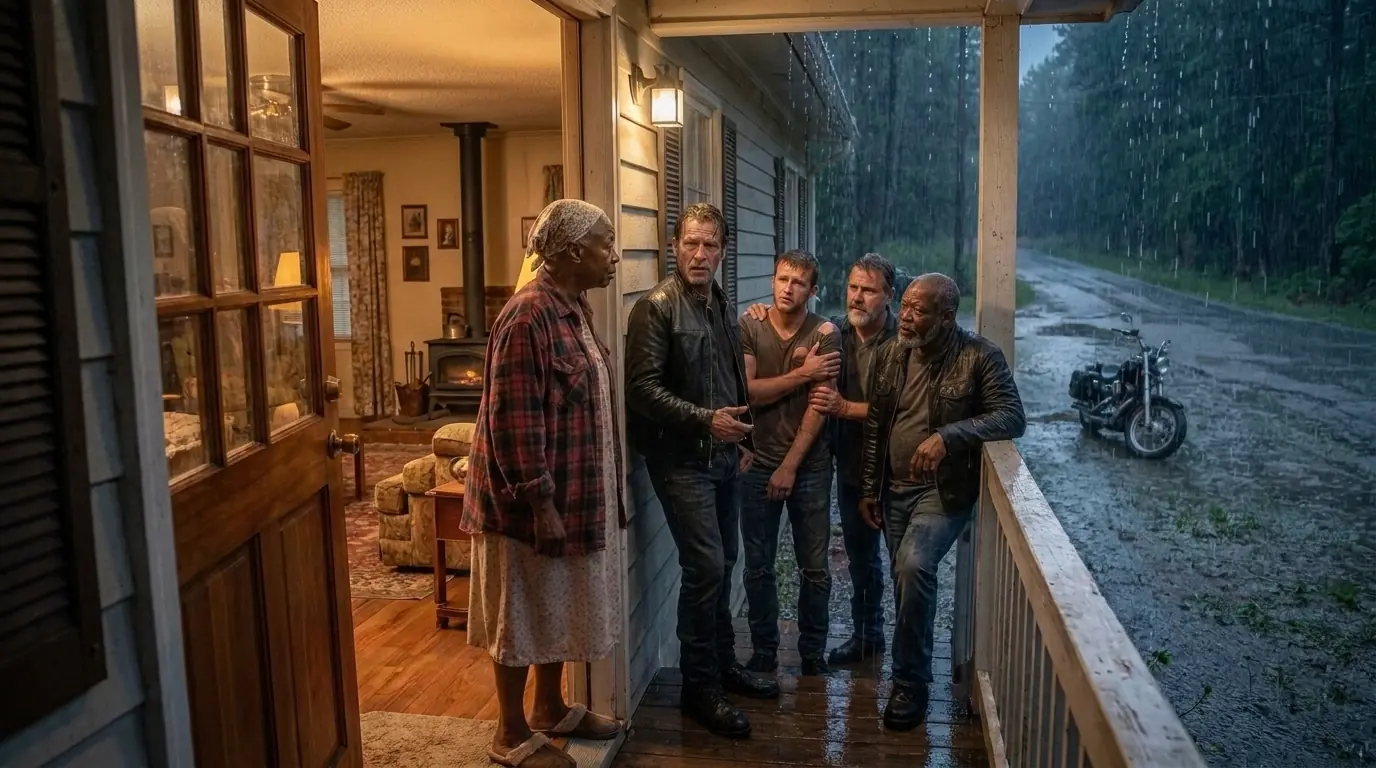
She should have stayed behind the lock, but she slid it open. "Come in, sons, before the rain takes you." She fed them soup, gave them her own bed, sat up all night feeding the wood stove so four strangers could sleep warm. She never asked who they were.
She never thought about the foreclosure letter in her drawer. She just opened the door. She had no idea. But one act of kindness was about to rewrite the rest of her life.
Two weeks before the storm, the days at mile 162 began the same way they had begun for forty-one years. Florence Brooks woke at 4:30. She did it without a clock. The Georgia dark outside her bedroom window had a particular weight she could read with her eyes closed.
She sat on the edge of the bed for a full minute, hands on her bad knee and waited for the joint to forgive her. Then she rose, pulled on Eli's old flannel over her nightgown, and walked into the kitchen. The kitchen was small, a propane stove, a chipped enamel sink, a single bulb above the table. On the table sat the cast iron skillet she had used every morning since Reagan was in the White House.
She greased it, poured cornbread batter into it, and slid it into the oven. Then she started the coffee, not from a bag. Eli had taught her to roast green beans on the back porch in a popcorn pan, and she still did it that way every Sunday. He used to say, "Store-bought coffee tastes like apology."
Florence would smile and say, "Then yours tastes like forgiveness," and Eli would shake his head and grin into his mug. She poured the first cup at 5:15, and that was when Tucker Mallister's Peterbilt grunted into the gravel out front. Tucker was 63, half bald, and had been stopping at her porch every weekday for 11 years. He climbed down stiff, tipped his cap, and dropped a $10 bill into the tin can by the napkin holder.
"Storm's going to be a mean one this week, Miss Florence." "I heard. You got everything tied down?" "Tucker, my whole life has been tied down. One more storm won't undo me."
She slid eight singles back into his hand. He pretended to argue. She pretended not to notice. He took his cornbread, kissed the top of her head, and climbed back into the Peterbilt before the sun could clear the pines.
She watched him go. That was the part nobody knew about Florence Brooks. She watched every truck go. She had been doing it for eight years.
Every time a set of taillights faded toward the on-ramp, she said the same thing under her breath. "Get home safe," because Eli hadn't. Eli Brooks had driven long-haul for thirty years. Atlanta to Boston, Boston to Houston, Houston to wherever a paycheck waited.
He died on the shoulder of U.S. 441 in a November rainstorm, slumped over the wheel of a rig he had named after her. Cardiac arrest. The trucker who found him at dawn said the engine was still running and the heater was still warm. Florence had built her whole quiet life around the question nobody asked.
What if someone had opened a door for him that night? The little hand-painted sign at the foot of her porch was her answer. Mama Brooks coffee stop. $2 a cup. Cornbread free.
Below it in smaller script, everybody welcome. The everybody was not decoration. It was a promise. Inside the house, above the coffee can on the framed photograph.
Daisy Brooks, twenty-four, in a white nursing coat, a stethoscope around her neck, the Spelman College seal on her lapel. Daisy had been three weeks from graduation when the 18-wheeler crossed the median on I-85 at mile marker 154. The semi driver had not slept in 19 hours. Florence learned that from a hearing she could not bring herself to attend.
Every time she walked past the photograph, Florence touched the bottom corner of the frame with two fingers. She did not know she was doing it. She had been doing it for fourteen years. On her wrist, she wore a thin gold bracelet, Daisy's last birthday gift to her.
Daisy had clasped it on the day she drove back to Atlanta for finals. Florence had not taken it off since. That afternoon, the mail brought a thicker envelope than usual. Florence already knew what it was.
Outstanding balance $128,500. Final notice. Foreclosure proceedings to commence December 15. The signature at the bottom read Dolores Sutton, assistant vice president.
Florence read it twice. Then she folded it neatly and slid it into the drawer beside the napkins. She did not tell anyone. Not Tucker, not Reverend Pike, not Eli's cross on the wall.
She poured a second cup of coffee and watched the light change on the porch boards. That Sunday at Macedonia Baptist Church, Reverend Ezra Pike preached on Hebrews 13:2. "Do not forget to show hospitality to strangers," he said, "for by so doing some people have entertained angels without knowing it." Florence sat in the second pew and nodded the way she always nodded, small, polite, certain.
She thought of Eli. She thought of the door that had not opened for him. She did not yet know that within twelve days, four strangers would knock on hers in the rain after dark. And what Florence did not know, could not know, was that the same storm tearing through the Georgia pines that week was already pushing those four strangers toward her porch.
The storm came on a Tuesday. By 6:00 in the evening, Florence had already locked the screen and pulled the porch sign inside. The rain came not in drops, but in sheets, slapping the tin roof so hard it sounded like a man clapping the wrong rhythm. She lit two candles and an oil lamp.
She had grown up without electricity in a sharecropper's house in rural Georgia. The dark didn't scare her. At 9:40, the power went. Florence didn't flinch.
She turned the lamp's wick up half an inch, set the kettle on the propane burner, and sat down at the kitchen table with Daisy's old nursing textbook open on her lap. She read the same paragraph three times. She wasn't really reading. At 10:15, she heard the engines, four of them, low and uneven, throttling down hard somewhere out on the highway.
Florence lifted her head. The kettle hissed. Then a sound she would remember for the rest of her life. Crack.
A gunshot. That was her first thought. Then a long splintering groan and the heavy shudder of something enormous hitting the ground. Florence stood up so fast her knee buckled.
She gripped the table. The old white oak. The one Eli had loved. the one he used to lean against to drink coffee and tell her, "Florence, baby, that tree will outlive us all." The tree had just fallen across her road.
She knew it without looking. She felt it in the floorboards, the engines outside cut off one by one. For a long minute, there was only the rain. Then, boots on her gravel.
Florence moved without thinking. She picked up Eli's hickory cane from beside the door, killed the lamp, and crouched behind the curtain by the front window. Four shapes in the flood light. Big shapes.
Leather jackets shining black. Beards. One of them limped. Her stomach went cold. twenty-six miles from town.
No power. Phone line down. Seventy-two years old. Alone.
The knock came softly, almost apologetically. She did not answer. A voice deep close to the wood. "Ma'am, we saw the lamp."
Florence held her breath. "We're not going to hurt you." A second knock a little firmer. "Roads are flooded south. Trees are down north. Phones are out. We just need anywhere—a porch, a shed."
Florence parted the curtain a half inch. The man in front had his hood back, pale eyes, wet hair flat against his forehead, maybe 48. Behind him, a younger one, twenty-something, was cradling his left arm against his ribs. Florence could see dark fabric over a darker stain.
Blood. The third man was coughing into his fist. A deep wet cough she recognized from Eli's last winter. The fourth was old, stout, and stood with his weight on one leg like a knee was giving out.
They didn't look like a threat. They looked like Eli. That was the part that broke her. Four tired men on a roadside in a storm.
She had spent eight years asking God to send someone, anyone, to a man slumped over a wheel on U.S. 441. She had asked and asked and asked. No one had come. Florence set the cane against the wall.
She put her hand on the latch. Her fingers shook. She closed her eyes. "Lord," she prayed silently, "if this is wrong, forgive me. If this is right, give me strength."
She turned the latch. Wind slammed the door open, and a curtain of rain whipped across the four men's faces. The lead one, the pale-eyed one, flinched, then steadied. He looked up at the small black woman in the doorway in a flannel two sizes too big with a gold bracelet shining on her wrist.
For a second, something passed across his face. Not relief, not gratitude, recognition. It was gone before Florence could read it. "Ma'am," he said very quietly.
"Thank you." She stepped back from the threshold. "Come in," she said, "before the rain takes the rug." One by one, four soaked men crossed into Florence Brooks's kitchen.
They left wet bootprints across her linoleum. The youngest, the one with the bleeding arm, stopped in the doorway and stared at the photograph above the coffee can. He did not know why he stared. He just did.
Florence closed the door behind them. She slid the latch home. She turned the lamp back up. She thought she was letting in four cold, hungry strangers.
She had no way of knowing that one of them had been searching for her on every back road of three states for the last fourteen years. Inside, the four men stood dripping on her floor like prisoners awaiting sentencing. None of them moved without permission. Florence pointed to the row of hooks behind the door.
"Coats there. Boots by the stove. There are towels in the basket." The leader nodded once and stepped back to let the others go first.
Florence noted that. She noted everything. The youngest one, perhaps twenty-eight, peeled off a leather jacket the color of wet asphalt. Underneath his left sleeve was dark to the elbow.
The big man with the bad knee, Florence guessed, fifty-two or fifty-three, lowered himself onto the kitchen bench in three slow movements like a man parking a truck. His knee crackled in three places. Florence winced for him. She turned the lamp up another notch and crossed to the wood stove.
The kindling was already laid. She struck a long match and held it to the curl of pine until it caught. "Mister," she said without looking back. "You with the arm. Sit at the table. Light's better there."
The youngest blinked at her, then at the leader. The leader nodded. The young man sat. The stout one with the cough had a salt-and-pepper beard and kind eyes. He set down a small canvas bag and unzipped it. "Ma'am, I was an Army medic for eighteen years. If you've got peroxide and gauze, I can have him patched in five minutes." Florence pointed to a tin box on the high shelf by the stove.
"Top shelf. Eli's old kit. I keep it stocked for the truckers." The medic, his name she would learn was Owen, pulled the box down with a quiet, "Thank you, ma'am," and went to work on the boy's arm.
The boy hissed once, then bit it back. "What's your name, son?" Florence asked. "Caleb, ma'am."
"Caleb Reed." "Caleb, how did you cut yourself?" "A tree branch came off the bike." "How bad?"
Owen answered for him. "A four-inch cut. Clean." "He'll keep the arm."
Florence almost laughed. "He'll keep the arm." The way Owen said it told her this man had stitched together a lot worse on hilltops she would never see. She turned to the stove.
The chicken stock had been simmering since lunchtime. She always kept a pot going on storm days. She added carrots, a handful of cornmeal dumplings, and the last of the okra from the back garden. She slid the cornbread pan into the warming drawer and put the percolator on.
The man with the bad knee, Wade Carter, closed his eyes and inhaled. "Ma'am," he said, "that smells like my grandma's kitchen." "Then your grandma knew what she was doing." Wade laughed—a real laugh, the kind that surprised him.
The leader looked up at the sound and almost smiled. Almost. The leader had not spoken since the door. He stood with his back near the front window, hands clasped in front of him like a man at a wake.
Florence's eyes flicked to him every minute or so, the way they had once flicked to Eli when he was thinking too hard. He was looking at the wall, specifically at the photograph above the coffee can, the one of Daisy in her white nursing coat. He held the look for one second. 2.
Three. Then he turned his face away, sharp, deliberate, and put one hand flat against his own chest just below the collar of his shirt. He took a breath that was a little too long. Florence saw it.
She filed it away. She ladled four bowls. She set down four spoons. She cut the cornbread into thick yellow wedges and slid a square of butter onto each.
"Sit," she said. "All of you. Eat it hot or eat it cold." They sat.
Caleb stared at his bowl like it was an artifact. Wade said grace under his breath. Owen looked at Florence and said quietly, "Ma'am, this is the kindest thing anyone has done for me in a long time." Florence patted his shoulder and moved past.
The leader took the seat at the end of the table. He folded his hands. He did not pick up his spoon. He looked at Florence.
"Ma'am," he said, "may I ask your name?" "Florence Brooks." Something moved behind his eyes that Florence could not name. He nodded very slowly and finally picked up his spoon.
"Logan Hayes," he said. "And I'm honored to be at your table, Mrs. Brooks." They ate. Caleb went back for seconds.
Wade asked if she'd consider selling him a tin of the coffee. Owen slipped a folded $40 bill under the rim of his bowl when he thought no one was looking. Florence would find it later, smooth it flat, and tuck it into the envelope marked Spellman Daisy Fund in her drawer. By 11:30, the men were nodding off where they sat.
"I've got one bed," Florence said. "Mr. Carter, you take it. That knee can't sleep on the floor." Wade started to argue.
Florence cut him off with a look she had used on Daisy at age four. "It is not a request, sir." Wade went. Logan took the sofa without being asked.
Owen and Caleb spread blankets on the rag rug by the stove. Florence brought down the spare quilt, the one Eli's mother had stitched, and laid it over Caleb's legs. "Sleep," she said. The storm's almost done.
She turned the lamp down. She did not sleep. She got up twice in the night to feed the stove. She set a kettle on so they could have warm water in the morning.
She wiped down the kitchen counter the way she had wiped it down for forty-one years. The third time she rose around 3:15, she came around the corner from the kitchen and stopped. Logan was awake. He was sitting on the sofa, the quilt pulled to his lap, staring across the room at the photograph above the coffee can.
His shoulders were shaking. He was not making a sound. His right hand was over his mouth. His left hand, Florence saw it in the lamp glow, was open, palm up on his knee, as if waiting for someone to take it.
Florence stood very still. She did not understand what she was seeing. She only understood that she was seeing it. She walked soft as she could to the chair by the door and lifted the second quilt down.
She crossed the room without speaking and laid it over Logan's shoulders. Logan did not look up. He whispered just barely, "Thank you, ma'am." Florence rested one hand on the back of his neck, the way she had once rested her hand on Eli's neck on bad nights, and let it stay there for a count of three.
Then she went back to the stove. She fed it one more piece of the old oak that Eli had loved. By dawn, the storm had passed. But what came through Florence Brooks's door at first light was a truth no storm could have prepared her for.
By 6, the sun came up the color of weak tea. Florence found Logan in her kitchen, sleeves rolled, washing the soup pot in the sink. He had folded the quilt at the end of the sofa, stacked the dishes, and put the percolator back on the propane. He did not look at her when she walked in.
He just said very quietly, "Coffee's hot, ma'am." It was the smallest, most domestic thing. Florence almost cried. Outside, Wade was already in the yard with a flashlight tucked under his armpit, crouched over the bikes.
Three of the four Harleys had started on the first kick. The fourth, Caleb's, had taken water through the air intake. Wade wiped the spark plug on a shirt tail and grinned. "She'll dry," he said.
"Bikes are like women. They forgive, but they make you wait." Florence heard him through the kitchen window and shook her head. She fed them all again. biscuits, honey from a jar she had kept since Easter, a second pot of coffee.
They sat around her table the way Eli used to sit at the end of a run, slumped and grateful, and for the first time in eight years, her kitchen had four chairs filled. Caleb finished his second biscuit and set down his cup very gently. "Mrs. Brooks," he said. That's the first time I slept whole through a night in two years.
Florence reached over and squeezed his good wrist. "Then you come back anytime you cannot sleep, son. I do not lock my door." When they stood to leave, Logan reached into his back pocket and pulled out a folded leather billfold.
He counted twenty hundred-dollar bills onto the kitchen table without looking at her. Florence picked them up. She walked around the table. She slid the bills back into the front pocket of his jacket.
"No, sir," she said. "Ma'am, no." Logan looked at her. He tried gently one more time.
"Mrs. Brooks, you fed four grown men and gave up your own bed." Florence's voice was soft, but it had a floor under it. "Nobody pays. I did not open my door for money. I opened it because somebody once should have opened theirs for my husband. He died on a roadside in a storm. Nobody came. So I open mine."
That is all." The kitchen went very quiet. Logan closed his eyes for a second. He nodded. He put the billfold away while the others gathered their packs. Wade lingered at the counter near the coffee can with no ceremony at all. He set a single card next to the napkin holder. Black background, a silver winged wheel."
Below it, in small block letters, Iron Saints Foundation. Beneath that, almost too small to read, Founder: L. Hayes. Wade looked at Florence. He held a finger to his lips.
He winked and went out. Florence saw the card. She did not touch it. The men walked their bikes single file to the road.
The fallen oak had already been chainsawed in half by some neighbor she would never meet. Caleb climbed on behind Owen. Wade tested his knee, mounted, kicked over. The engines came up one by one.
Logan stopped at her gate. He turned back. "Ma'am," he said across the yard. "Your daughter, Daisy, may I ask, when did she pass?"
Florence's hand closed around the gold bracelet on her wrist. She had not said the word passed. She had not said anything about Daisy at all. She walked to the gate.
"How did you know she passed?" Logan looked down at his boots, then up at her. "Just the way you said her name, ma'am. Past tense."
Florence searched his face. There was something in it she could not name. "March 14," she said finally. "Fourteen years ago. Mile marker 154."
Logan nodded once. slow. He did not say he was sorry. He said something else. "I'll be back, ma'am."
And by the way, Florence knew he meant it. After the engines faded down the highway, Florence turned the business card over twice in her hand. The front was matte black, a silver winged wheel. below it in clean letters, Iron Saints Foundation, Long-Haul Aid and Roadside Relief. On the back, smaller, founder and CEO, L. Hayes.
Florence had never heard of Iron Saints. She tucked the card under the napkin holder. That afternoon, Tucker Mallister pulled in with his lunch flask. Florence poured him a cup and slid the card across the counter.
Tucker glanced at it. Then he looked again. His eyes went wide. "Florence, where did you get this?"
"A man left it on the counter this morning." "What man?" "Quiet one. Pale eyes. Came out of the rain last night."
Tucker stared at her like she had told him she'd hosted a president. "Florence, you do not know who the Iron Saints are." "No, sir." "Every long-haul driver east of the Mississippi knows them."
They paid for my buddy Hank's funeral. They built the truck stop chapel at exit 60. They put my cousin's boy through trade school. "A charity? Florence, Iron Saints is not just a charity. It is a force."
Somewhere north of $200 million, the founder, Hayes, won't do interviews, won't show his face. Truckers call him a ghost. Florence sat down very slowly. After Tucker left, she carried the card into the living room and set it beside the photograph of Daisy.
She opened the drawer of the side table. Inside, beside the foreclosure letter from Dolores Sutton, lay a thin spiral notebook the state troopers had returned fourteen years ago. Daisy's school journal. Florence had never been able to open it.
She opened it now. On the first page in Daisy's tilted handwriting were ten words. "Today, I want to be the kind of person who helps strangers on the road." Florence sat down on the rug and wept for the first time in eleven months.
The phone rang an hour later. Wade asked if they could come back. He said Logan needed to talk to her. He said, "Please do not say no."
Florence hung up. She did not know what she felt. She only knew that somewhere in the kitchen, Eli's voice was saying, "Open the door, baby. Open it again."
At 8 the next morning, Florence Brooks was on her porch when she heard the engines. Not four, dozens. She set her coffee down very carefully and walked to the railing. Down on I-85 coming up the long flat stretch from the south.
A column of Harleys was riding two abreast at parade speed, headlights on against the morning gray. Florence counted to twenty and stopped counting. Across the highway, the woman who ran the bait shop stepped out into her parking lot with a cigarette half lit and just watched. The column slowed, then it turned.
It turned onto her gravel road. Iron Saints rolled into Florence Brooks's front yard like a slow tide. thirty men, maybe more. They cut their engines in unison, and the silence that came after was louder than the noise had been. Logan dismounted at the gate.
He walked alone up the porch steps. Behind him in the yard, Wade and Owen and Caleb stood with their helmets in their hands, the way men stand at a graveside. "Ma'am," Logan said. "May I sit?"
Florence nodded. Logan set a small canvas pack on her porch table. He unzipped it slowly. He did not look at her face.
He looked at his own hands. From the pack, he lifted three things. A small enamel name pin. Daisy M. Brooks, student nurse, Spelman College.
A folded prayer card worn soft at the edges. A Polaroid. Florence and Eli, twenty years younger, on a porch swing somewhere Florence almost didn't recognize. Florence stopped breathing.
Logan finally looked up. "Mrs. Brooks," he said, "fourteen years ago, on March 14 at 11:42 at night, I was a volunteer EMT working the night shift out of LaGrange. I was the first man on the scene at mile marker 154 on I-85." Florence's hands went to her mouth.
"The semi driver had been awake for nineteen hours," Logan said. "Your daughter's car flipped twice and came to rest on the embankment. By the time I cut the door, she was already fading, but she was awake." "She was lucid, and she held my hand."
Florence sank into the porch chair behind her. "She gave me these three things." Logan touched the pin, the card, the Polaroid in order. "She said the pin was so her mama would know she had finished. She said the prayer card was her daddy's and that her mama should have it back. And the photograph—" His voice caught.
He cleared it. "She said the photograph was so I would know who to look for." Florence whispered, "Oh, my baby." "She gave me a message."
"Mrs. Brooks"—twice. "She wanted to make sure I had it." She said, "Tell Mama I love her. Tell Mama I'm not scared."
Florence pressed the heel of her hand against her mouth and did not make a sound. Tears ran down her face fast and silent, the way they had on the day the troopers came to the door. Logan kept going. He had to.
He had carried this for fourteen years. "She stopped breathing at 12:04. I stayed with her until the coroner came. I had her hand the whole time."
"Ma'am, I never let go." In the yard, Caleb Reed turned his face away into Wade's shoulder. "I tried to find you," Logan said. I went to the hospital records.
They had a mistaken address. I drove down two days later. The house was empty. The mailbox said someone named Whitfield.
I asked the neighbors. They said you'd moved north. Nobody knew where. He swallowed.
So, I started looking. I quit my EMT job because I couldn't sleep on the calls anymore. Every red flashing light was your daughter. I cashed out my pension.
I started the foundation so that whatever happened to Daisy would not happen to somebody else's child on a road in the dark. And every March 14, I rode every exit on I-85 from Atlanta to Greenville, looking for a woman who matched the woman in this picture. He set the Polaroid down on the porch table. "Fourteen years, ma'am. Last night, when I knocked on your door, I had no idea. I just needed shelter."
He looked at the framed photograph he could see through her screen door. "Daisy in the white coat. Then I saw her face on your wall." Florence reached for the gold bracelet on her wrist, the one Daisy had fastened on her the morning of the drive.
The clasp was warm under her thumb. "Mr. Hayes," she said, her voice splintering. "Was she scared? Please tell me she wasn't scared."
Logan put his face in his hands for a count of three. When he lifted it, his eyes were red. "Ma'am," he said. "She was not scared. Not for a second. She was thinking of you."
The last words she said on this earth were about you. She said, "My mama prayed me into this world, and she'll pray me out." Florence let out a sound that was not a sob. It was something older than a sob.
She slid out of the porch chair and onto her knees on the boards. Logan came down with her. He did not hug her. He did not touch her.
He simply knelt in front of her on his own porch boards and bowed his head while she cried. In the yard, thirty grown men took off their hats. The man Florence Brooks had fed soup to in the dark had been carrying her daughter's last words for fourteen years, and he had not come back just to deliver them. Florence cried for a long time.
Logan did not rush her. The thirty men in the yard did not move. When her breathing came down to a slow shudder, Logan reached behind him and pulled the leather portfolio from a saddlebag. A younger rider had carried it to the foot of the porch steps.
He set it on the porch table beside the pen and the Polaroid. "Ma'am," he said quietly, "before I show you anything in this folder, I need to say one thing." Florence wiped her face on the sleeve of Eli's flannel. "All right."
"After that night on the embankment, I could not go back to my old life. I quit my job. I sold my house. I cashed out a pension I had been building for seventeen years. I did not do any of it because I wanted to be a good man. I did it because I could not close my eyes without seeing your daughter's face. I started a small charity out of a rented garage in LaGrange. Three of us, a phone, and a checkbook."
We paid one widow's mortgage that first year. "We were broke by Christmas." He paused. Then truckers started calling.
Then bikers, then companies. Iron Saints today holds just over $200 million in our long-haul relief fund. Every dollar of it. Every single dollar, ma'am, started with your daughter's hand in mine." Florence looked at him. She did not speak. "I'm not telling you that to brag, Mrs. Brooks.
I'm telling you so you understand what I'm about to ask of you." He opened the folder. Florence saw thick stacks of paper, official seals, blue ink signatures. "This morning, before sunrise," Logan said, "While you were in your kitchen making us biscuits, my attorneys filed five documents.
I would like to walk you through them. You may say no to any of them. You may say no to all of them. Nothing happens unless you sign." He laid the first sheet in front of her. "One: your medical debt to Coastal Plains Federal—$128,500.
As of 9:42 yesterday morning, that account was closed and paid in full. The foreclosure proceedings have been withdrawn." Florence's hand went over her heart. "Two." He laid the second sheet in front of her. "The deed to this house and the twelve acres around it was purchased outright in cash.
As of this morning, the owner of record is Mrs. Florence J. Brooks—free and clear forever." Florence shook her head slowly. "Logan, I—" "Three," he continued gently, the way a doctor reads results. "A trust paying $500,000 a year for as long as you live, through a fund called the Florence Brooks Foundation.
You are the sole director. You decide whom it helps. Iron Saints does not touch one dollar of it." The handwritten name at the top of the page was 'Daisy's.' Florence saw it. She covered her mouth. "Four.
Five coffee stops between Atlanta and Greenville along I-85. Same name as your porch. Mama Brooks Coffee Stop. Same prices, same rules: everybody welcome.
Hot meals free to any long-haul driver who walks in. The first one breaks ground in February. You are listed as honorary chairwoman. You draw a salary of one dollar a year, ma'am, because Wade told me you would not take more, and I respect that." Wade called softly from the yard, "I did tell him, ma'am." Florence laughed through her tears. "And five." Logan slid the last document forward, and this one he handled like glass."
"This one I need you to read with your own eyes." Florence wiped her face. She bent over the page. The Daisy M. Brooks Memorial Scholarship.
Spelman College School of Nursing. Full tuition, books, and a stipend for five black women pursuing the Bachelor of Science in Nursing awarded annually in perpetuity. $25,000 per student per year. Endowment $10 million fully funded. At the bottom of the page, in italic print, were the words: In loving memory of Daisy M. Brooks, who held the hand of a stranger on the worst night of his life, and gave him a reason to live the next fourteen years.
Florence read it three times. Then she set the paper down on the table very gently, like she was afraid of waking it. "Mrs. Brooks," Logan said, and his own voice broke at last. "You do not have to take a dollar of the first four."
"But please, ma'am, please take the scholarship. Let your daughter save the lives she always wanted to save." Florence reached across the table and took Logan Hayes's hand the way her daughter had taken his hand fourteen years before on an embankment in the dark. "Son," she said, "on one condition."
"Anything, ma'am." "The coffee stays two dollars. The cornbread stays free." For the first time in fourteen years, Logan Hayes smiled.
"Ma'am," he said, "that's a contract." They shook hands. In the yard, thirty Iron Saints riders cheered, a low, deep, broken cheer that sounded more like a benediction than a celebration. Caleb Reed put his hat back on.
Owen Bennett climbed the porch steps, unpinned the small silver wheel from his own jacket, and handed it to Florence. "You're family now, Mama Brooks," he said. "Forever." Caleb came up behind him, eyes still wet.
"We ride for you next year, ma'am." "Every year. March 14. Atlanta to Greenville. The whole road."
Florence Brooks went from foreclosure to the founder of a memorial in ninety minutes. But what she would give the world over the next six months would dwarf every dollar Logan Hayes had ever earned. By spring, the porch sign at mile 162 had been repainted by a Spellman undergraduate who had driven down on her own dime to do it. The lettering was the same.
The colors were the same. Mama Brooks Coffee Stop, $2 a cup, cornbread free. Everybody welcome. Only the word everybody was a touch larger now and underlined in red.
Sheriff Harlon Whitlock stopped every morning at 6:20 and left exactly a $5 bill in the tin can. Florence still slid him three singles back. Tucker Mallister kept his Wednesday route, but on Fridays he came out an hour early to help her wash the urn. He refused a paycheck.
He said his pay was getting to call her mama in front of his grandkids. The first new stop opened in LaGrange in February, the second in Anderson in March, the third in Greenville in April, the fourth in a converted service station on the south side of Atlanta in May. Each one had the same hand-painted sign over the door. Each one had the same framed photograph behind the counter.
A young woman in a white coat with a Spellman seal at her lapel, smiling like she meant it. In late April, a producer from CBS Atlanta drove down to mile 162 with a camera crew. The segment ran on a Sunday evening. They called it the coffee stop that started with an open door.
The clip went around the country in twelve hours. Florence got two thousand handwritten letters in the first week. She answered seventy-three of them before the foundation hired a small team to help her keep up. In May, the Daisy M. Brooks Memorial Scholarship held its first awards ceremony in the Sisters Chapel at Spelman College.
Dean Naomi Cole introduced the inaugural cohort, five black women ranging in age from nineteen to thirty-four, all admitted to the nursing program for the fall. Florence wore a long red dress that Tucker's wife had altered for her. She walked to the lectern on a knee that had been repaired by a surgeon, paid for by a foundation she had never asked for. Her speech was ninety seconds long.
Her last line was the one the room would remember. "My daughter Daisy wanted to help strangers," she said. "I'm just keeping her shift." The chapel stood up before she finished.
On the anniversary itself, March 14, one year on, Iron Saints rolled the largest charity ride in the foundation's history. Eight hundred Harleys rode two abreast from the courthouse steps in Atlanta to the cemetery gates in Greenville. They stopped at mile 162 for exactly twelve minutes. Florence stood on her porch in Eli's flannel and waved them through.
Logan rode point. He did not look at her. He did not have to. That spring, Reverend Ezra Pike preached again on Hebrews 13:2.
He did not name Florence. He did not have to. "Sister Brooks taught us what hospitality looks like in this county," he said. "It looks like a porch light left on. That is all. That is the whole sermon."
Even Dolores Sutton, the assistant vice president who had signed the foreclosure letter, was let go by Coastal Plains Federal that February. She wrote Florence a four-page apology on yellow legal paper. Florence read it twice, baked a fresh pan of cornbread, and mailed both with a short note. "Mrs. Sutton, the coffee is on me. Come anytime."
Dolores came in June. She wept at the kitchen table. Florence patted her hand and gave her a refill. By the time the dogwoods came in, Florence had a new ritual.
After the last truck of the night, she sat on her porch in Eli's flannel with the gold bracelet warm on her wrist and read one page of Daisy's journal aloud to the dark. She did not believe in ghosts. She believed in voices that didn't quite leave. Some nights she thought she heard the screen door creak behind her.
She never turned around. She did not want to know. Six months, five coffee stops, twenty-two scholarships, one stretch of I-85 where on a bad night you could pull off at almost any exit and find someone who would pour you a hot cup, ask after your wife, and refuse to take your money. And all of it began because one old woman on one bad night refused to lock her door against a storm.