The fifth mechanic had the hood off when Walter Hayes walked into Miller Equipment.
It was a gray Tuesday morning in late October, cold enough that the big roll-up doors had been pulled almost shut and the propane heaters were already ticking overhead.
In the center service bay sat a freshly restored 1948 Farmall M.
From twenty feet away, it looked nearly perfect.
Bright red paint.
Cream-colored wheel rims.
New rear tires.
Fresh decals laid straight along the hood.
Polished steering wheel center.
Even the old steel seat spring had been cleaned and painted.
Somebody had spent a great deal of money making seventy-five-year-old iron look young again.
The only thing the tractor would not do was work.
“Try it again,” said Carl Benton, Miller Equipment’s head mechanic.
A younger technician named Aaron climbed onto the seat and pressed the starter.
The old four-cylinder engine turned twice.
Caught.
Settled into a rough idle.
For perhaps five seconds, it sounded almost normal.
Then Aaron moved the throttle forward.
The engine stumbled.
Coughed.
Recovered.
He gave it more throttle.
The Farmall made a dull, strangled sound, shook against its mounts, and began losing RPM.
Black smoke rolled briefly from the exhaust.
Aaron pulled the throttle back before the engine quit.
Carl swore under his breath.
“There. Same thing.”
Walter stopped beside a display rack of hydraulic hose fittings.
He said nothing.
Carl looked over.
Walter Hayes was seventy-nine years old.
Six feet tall once, perhaps an inch shorter now.
Lean in the way old farmers often become, not weak but pared down.
Weathered face.
White hair beneath a faded seed-company cap.
Canvas coat.
Work boots with dried mud in the seams.
His hands looked like they had been built from fence wire and oak roots.
Carl knew him.
Everybody around Jefferson County knew Walter Hayes.
He had farmed seven hundred acres at his peak, raised cattle, corn, soybeans, and four children, then gradually rented most of the ground out after his wife died.
He still kept sixty acres around the home place because, as he told people, a man needed enough chores to justify breakfast.
Carl wiped his hands on a rag.
“Morning, Walter.”
Walter nodded toward the tractor.
“Been listening to that thing from the parts counter.”
Aaron smiled.
Carl did not.
“Been listening, huh?”
“Hard not to.”
Carl glanced at the other mechanics.
Five men had been through the Farmall in three weeks.
Not five amateurs.
Five trained mechanics.
Compression tested.
Valves adjusted.
Ignition rebuilt.
Carburetor rebuilt twice.
Fuel tank flushed.
Sediment bowl replaced.
Timing verified.
Governor linkage checked.
Manifold inspected.
Spark plugs changed.
Points changed.
Coil changed.
They had even borrowed another carburetor from a running Farmall M just to eliminate the original one as the cause.
Same problem.
Idle reasonably well.
Put the engine under throttle or load, and it fell on its face.
The tractor’s owner had already spent nearly three thousand dollars after the restoration, not counting the original restoration itself.
Carl was tired of the machine.
More than that, he was tired of not knowing.
Walter stepped closer.
“What’s she doing?”
Carl gave him a look.
“You heard it.”
“Heard part of it.”
Aaron climbed down.
“Dies when you open her up.”
Walter shook his head.
“No.”
Carl folded his arms.
“No?”
“She doesn’t die.”
One of the younger mechanics at the next bench glanced over.
Walter walked around the tractor once.
He did not touch anything.
He stopped beside the left side of the hood.
“Start it again.”
Carl smiled faintly.
“Walter, we’ve run this tractor thirty times.”
“Then thirty-one won’t wear it out.”
A mechanic near the workbench laughed.
Carl looked at Walter’s old cap, old coat, and deeply lined face.
Then he gave the room a grin.
“All right. Let’s hear what the barnyard ears think.”
A couple of men chuckled.
Walter heard them.
He had been hearing men laugh at old farmers since before most of those mechanics were born.
It had rarely improved their machinery.
“Go ahead,” he said.
Aaron started the Farmall.
Walter closed his eyes.
That made Carl smile again.
The engine idled.
Uneven but steady enough.
Walter stood with his head tilted slightly.
Aaron advanced the throttle.
The governor called for power.
The engine coughed.
RPM dropped.
The exhaust note became heavy.
Walter opened his eyes.
“Again.”
Aaron pulled back.
Waited.
Then opened it faster.
The tractor stumbled immediately.
Walter held up one hand.
“Shut her down.”
Aaron killed the ignition.
The fan coasted to a stop.
Walter looked at Carl.
“You’re fixing the wrong end.”
The grin left Carl’s face.
“What?”
“Engine’s trying to run.”
“We know that.”
“No.”
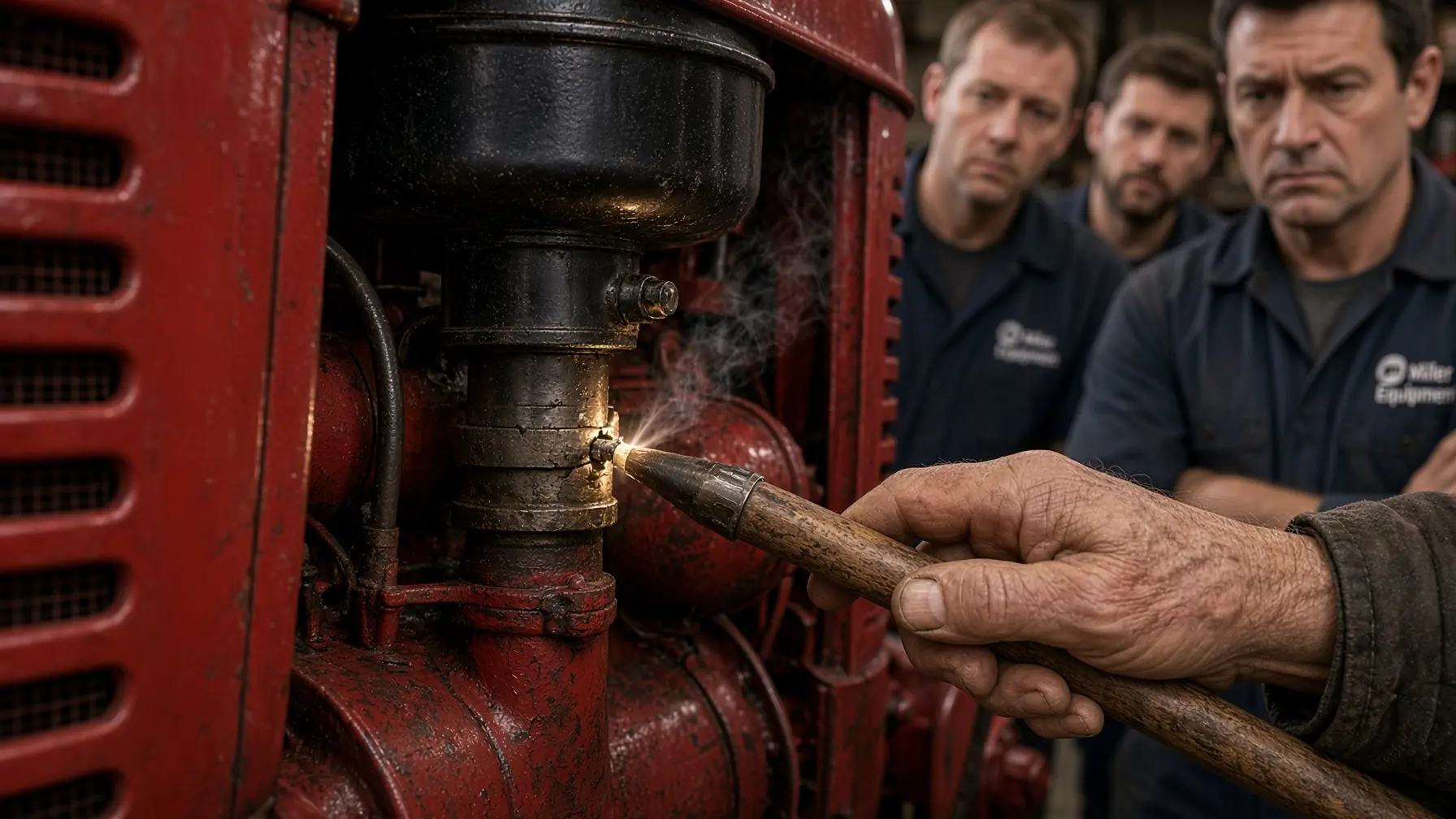
Walter pointed toward the Farmall’s air cleaner.
“You know it’s getting fuel. You know it’s got spark. You know compression’s decent.”
Carl said nothing.
Walter continued.
“But she’s missing a breath.”
Aaron frowned.
“A what?”
Walter tapped his own chest.
“When you open the throttle on one of these under no load, you ought to hear the intake draw change before the exhaust catches up.”
He pointed again.
“That tractor isn’t breathing harder when you ask for more.”
Carl stared at him.
Walter said:
“You boys keep treating her like she’s dying.”
He stepped closer to the old oil-bath air cleaner.
“She’s choking.”
For the first time that morning, nobody laughed.
The Farmall belonged to a man named Dennis Rourke.
Dennis was fifty-eight and owned a small construction company outside town.
The tractor had belonged to his father.
Before that, his grandfather.
It had arrived on the Rourke farm new in the spring of 1948 and spent thirty-five years pulling plows, manure spreaders, hay wagons, and grain drills.
Dennis learned to drive on it.
At nine years old, he could barely reach the clutch.
His father would stand beside the left rear wheel and shout instructions.
“Ease it!”
“Don’t ride that clutch!”
“Watch the furrow!”
By the late 1980s, the Farmall had been replaced by larger machinery and parked inside an open-sided shed.
Dennis’s father never sold it.
“Worth more sitting there than somebody else’s money,” he used to say.
After his father died, Dennis hauled the tractor home.
The engine still turned.