Eleanor Bramwell did not scream. She did not weep. She did not look away from the churchyard full of silk and lace, or from the particular hush that falls over people who have just witnessed something they will discuss for a decade.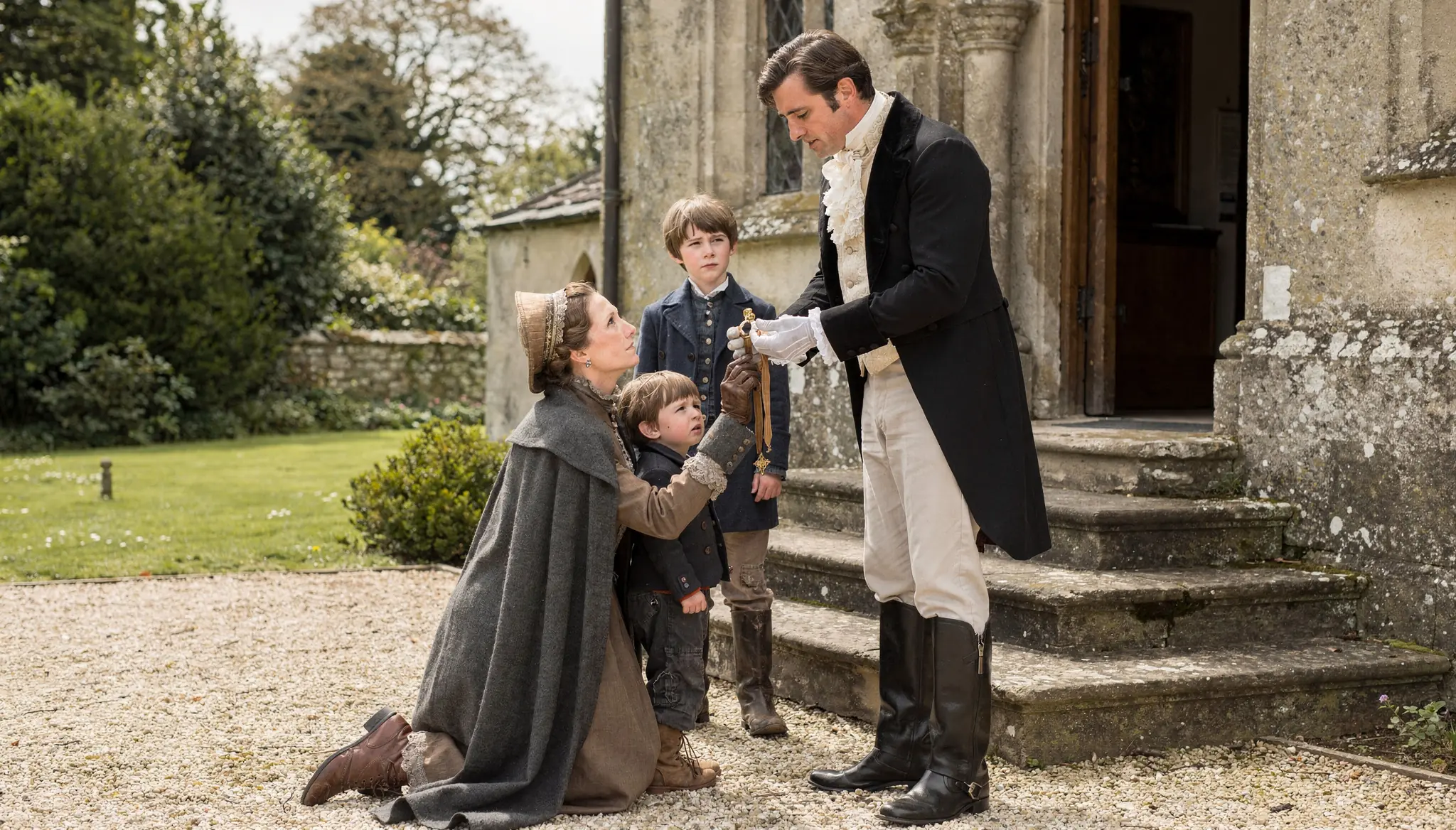
Instead, she knelt in the gravel before the chapel steps and buttoned the collar of the smallest boy's coat with hands that did not shake, though the boy himself trembled from the cold and from the two hundred pairs of eyes now fixed on the six of them. She had walked three miles that morning with five boys behind her like a line of small soldiers, and she had meant, God help her, only to ask for help. Not this.
Not the Duke of Rexford turning from his own bride at the altar rail, his face gone the color of old paper, staring down at a child who wore his own eyes in a stranger's face, and then at four more boys behind him wearing the same. Eleanor reached into her cloak and drew out a ring on a length of ribbon. She pressed it into the Duke's gloved palm and closed his fingers over it herself because the boy who had carried it had become too frightened to lift his own hand.
"His father's," she said. "It is not mine to keep any longer."
By nightfall, there would be no wedding at Rexford Hall, though not for the reasons the county would spend the winter believing.
Three years earlier, summer had come to Halladine the way it always did, heavy and indifferent, ripening the wheat and doing nothing at all for the people beneath it who were not landed. On a stretch of the north road slick with rain, a carriage carrying Edmund Ashcombe and his wife, Alice, had gone into a ditch at speed, and neither of them had risen from it.
They left behind five sons under the age of ten, a cottage with more debts than furniture, and a sister-in-law who had come for what she believed would be a fortnight's visit and had simply never left. Eleanor Bramwell had been six-and-twenty that summer, unmarried, with a curate's modest education and a spine that had never once been tested past the point of bending.
It was tested now. She learned to stretch a joint of mutton across four days. She learned which of the five boys woke screaming and which woke silent, which needed to be held and which needed to be left alone until the storm inside him passed on its own.
She kept a ledger, an actual ledger bound in oilcloth, its columns ruled by her own hand. Her father, the curate, had taught her that a woman with numbers on her side could not be lied to nearly so easily as a woman with only her memory.
She had never once, in three years, written to Rexford Hall. Alice had told her enough in the last months before the accident about the family Edmund had left behind: a mother who ran the correspondence, the household, and, it seemed, the weather itself, and a father who had died believing his heir a stranger.
Alice had not wanted charity from people who had let her husband go without a backward glance. She had wanted, she said once, only to raise five boys who knew their own worth without needing anyone's permission to possess it.
"A closed door," Alice used to say while folding linens with the briskness of a woman who refused to be pitied, "is not the same as a closed heart. It is only shut for the moment."
Eleanor had believed her for three years, right up until the rent came due on Farrow Cottage and Mr. Griome, the landlord, stood in her doorway with his hat in his hands. He would not meet her eyes while he told her he was sorry, truly, but a widow's promise did not pay a mortgage, and she had until Michaelmas.
The notice announcing the Duke of Rexford's marriage to Lady Cordelia Fenwick arrived in the village that same week, printed in the newspaper used to wrap the fishmonger's parcels. Eleanor read it standing in the street with a herring going cold in brown paper and thought with the flat clarity of a woman doing arithmetic she did not want to do twice.
Five boys. No income. A family at Rexford Hall large enough to spare a corner of it. A wedding that would gather every person of consequence in the county into one place on one day.
If she was ever going to be received at all, it had better be now, before pride made her wait until it was too late to matter.
She had not gone to disrupt anything. She told herself that on the walk, and she told herself again while standing at the back of the chapel with Oliver, not yet four, asleep against her shoulder. She had gone only to be seen once by people who might otherwise never know the boys existed at all.
She meant to stand at the edge of the crowd afterward and say quietly to whichever relation looked kindest that Edmund Ashcombe had left sons, and that the sons were hungry. But Henry, nine years old and possessed of his father's exact stubborn jaw, slipped her hand at the church door and walked straight up the aisle toward the man standing at the altar rail.
The room went silent in the particular way a room goes silent when everyone in it is recalculating very quickly everything they thought they knew. Lady Cordelia Fenwick, in white silk that had cost more than Eleanor's cottage rent for a year, looked down at Henry, then past him at the four smaller boys clustered in the aisle. Something in her face closed like a shutter.
"Who let these children in?" she asked in a voice pitched to carry to the back pews.
"They are the Marquess of Aldeir's sons," Eleanor said. Her voice did not rise. It did not need to. "His lawful sons."
"Aldeir has been dead three years," someone murmured.
Someone else said louder, "Aldeir never married."
The murmur became a current, and the current became a tide. Into the middle of it, Lady Cordelia said the sentence Eleanor would hear again in her sleep for a long while afterward. It was not the cruelest thing that had ever been said in that church. It was only the truest thing anyone had said about how the world had chosen to see her, spoken aloud before two hundred witnesses by the one person in the room whose good opinion the county had gathered to celebrate.
"I see." Cordelia's eyes moved over Eleanor's worn traveling cloak, her mended gloves, and the child asleep on her shoulder. "She is nothing more than a woman who has been paid to mind another man's mistakes. And now she has brought them here to be paid again."
Eleanor did not answer her. She knelt instead, buttoned Oliver's coat, and pressed Edmund's ring into the Duke of Rexford's hand. Whatever else was true, the boys were his to know now, and that much, at least, was no longer a decision that belonged to her.
She allowed herself the count of one hundred while walking back down the aisle with five boys in tow and every eye in Halladine upon her back. She counted slowly, the way her father had taught her to count out a fever. By the time she reached the church doors, the number was spent, and so, she told herself, was the grief.
There would be no more of it today. There was a great deal of daylight left and nowhere in the county for five boys to sleep.
She got as far as the lychgate before a woman's voice stopped her, low, urgent, and unhesitating.
"You will come with me," the woman said.
She was perhaps sixty, broad through the shoulders and dressed in the plain wool of an upper servant. She was already reaching for Simon's hand as though she had done it a thousand times before.
"I nursed those boys' father and his brother both in this same county, and I know the Ashcombe chin when I see five of them lined up in a churchyard. My name is Agatha Hodge. I keep Dair Cottage two miles on. There is a fire lit and more bread than an old woman needs. Come."
"I do not know you," Eleanor said, which was true and, in that moment, the least important fact available to her.
"No," said Mrs. Hodge. "But I knew their father when he was smaller than that one there, and I have spent three years wondering what became of him. Today I find out in a churchyard from a duke's own face going white as his cravat. Come, girl. You look like a woman who has been carrying more than her share for longer than is decent, and I have a kettle on."
Eleanor went. There did not seem, in the end, to be a version of that day that did not end with her going somewhere, and this was at least somewhere with a fire in it.
Dair Cottage smelled of beeswax and woodsmoke. Mrs. Hodge fed all six of them before she asked a single question that was not about how they liked their tea. It was, Eleanor thought, the first roof in three years beneath which she had not been required to earn her welcome before crossing the threshold.
She noted the fact the way she noted everything now, in the ledger she kept behind her eyes: an asset newly acquired, to be neither wasted nor relied upon past its proving.
By the second week, she had proved something else, though she had not set out to. Mrs. Hodge's cousin kept the village shop in Hallow's Cross, and the shop's accounts, it emerged over a cup of tea offered almost apologetically, had not balanced in eleven months.
The cousin, a stout, worried man named Pearly, had begun to suspect his own clerk of dipping into the till and did not know how to prove it without accusing a man he had known since boyhood.
"I could look," Eleanor said before she had quite decided to offer.
Pearly looked at her the way men often looked at a woman offering to do sums, which was to say indulgently. He handed over three ledgers with the air of a man humoring a child.
She took them back to Dair Cottage that evening and sat at Mrs. Hodge's kitchen table long after the boys were asleep. By candlelight, she ran her finger down columns of figures, and by midnight she had found it.
It was not the clerk at all, but a supplier three villages over who had been quietly overcharging by a penny a pound on flour for the better part of a year. The discrepancy was too small to notice in any single week and too large to survive a full twelve-month addition.
Pearly's face, when she showed him, went through disbelief, shame, and finally something like awe, in that order.
"A penny a pound," he said. "For eleven months. I would never have found it if I had looked myself for a year."
"You were looking at the clerk," Eleanor said. "I was looking at the numbers. They do not lie the way people can."
Word of it moved through Hallow's Cross the way water moves downhill, without effort and without asking permission. Within a fortnight, three more tradesmen had found reasons to consult the woman living at Dair Cottage with five boys and a ledger of her own.
She charged them modestly and fairly, entered every transaction in her oilcloth book, and paid Mrs. Hodge for their keep the moment she had coin enough to do it. A debt allowed to stand unacknowledged was, in Eleanor's accounting, the beginning of every other kind of rot.
She did not know in those first weeks that the Duke of Rexford had ridden past Dair Cottage twice without stopping. On the third occasion, he halted his horse at the gate and simply watched through the low window as five boys ate bread and butter at a scrubbed table while a woman with ink on her fingers corrected sums by candlelight.
She did not know that he asked his steward the following morning, in a voice pitched carefully casual, whether the boys wanted for shoes. New boots for all five arrived at the cottage two days later with no card and no explanation. The cobbler eventually let slip to Mrs. Hodge that they had been paid for by a gentleman who had asked most particularly not to be named.
Eleanor knew only that the boots fit and that someone in the county had decided, without asking her opinion on the matter, that this was a debt worth paying quietly.
At Rexford Hall, Dowager Duchess Constance Ashcombe had spent those same weeks doing arithmetic of her own, and hers did not balance nearly so honestly as Eleanor's. On the second day after the wedding that did not happen, she went to the locked drawer in her late husband's study, where the family's private correspondence had been kept for twenty years.
She removed a single folded letter, read it once beside the fire, and burned it before the ink had time to remember what it said.
It had never been Roland's letter at all. She had written it herself eleven years earlier in a hand close enough to her husband's that Edmund, half a world away in grief and fury at being asked to choose between his father's good opinion and a curate's daughter he loved without sense or moderation, had never thought to question it.
"If this marriage stands," the letter had said, "your father will not receive her, nor any child born of her, while he lives."
Roland had never written such a word in his life. In fact, he had asked after his elder son twice a year for the two years he had left before his own death. Each time, his wife told him there had been no reply, which was true only because no letter asking for one had ever been sent.
Constance Ashcombe told herself, standing at the fire while the ashes of her deception curled up the flue, that she had done it to protect the succession, to protect Julian, and to protect a house that could not survive the scandal of an heir married beneath his station. She did not examine closely whether protecting the house and protecting herself from ever admitting a mistake had, over eleven years, become the same exercise entirely.
She sent for Josiah Fenn, the family's solicitor, that same afternoon.
"The parish register at Millbrook," she said. "St. Anne's. If a marriage was recorded there eleven years past, in the name of Ashcombe or otherwise, I want to know of it before anyone else does."
Fenn was a careful man, precise to the point of dullness, and he did not ask why. He wrote the inquiry that evening. He did not yet know that the answer, when it came, would cost him a night's sleep and considerably more of his conscience than he had budgeted for.
Julian Ashcombe, Duke of Rexford, meanwhile, had begun to notice things about his own house that he had somehow never noticed before. His mother's correspondence never seemed to be left where he might read it. She had always gently discouraged any question about his brother beyond the barest facts.
The eleven-year silence he had accepted without protest now sat in his chest like a stone he had swallowed as a boy and only now felt the weight of.
He rode to Dair Cottage a third time, and this time he did not stop his horse at the gate. He dismounted, knocked, and stood on the step with his hat in his hands like a man twice his rank lower. When Eleanor Bramwell opened the door, she did not curtsy, and she did not invite him in.
"Your Grace," she said, and the two words carried unmistakably the weight of a door being held closed rather than opened.
"I came to ask after the boys," he said.
"They are well fed and better shod, thanks to a gentleman who declined to give his name to the cobbler."
"I do not require your charity, Your Grace. I require, if you have it to spare, the truth about why five boys with your face spent three years believing no one in this county wished to know them."
He did not answer at once. Behind him, in the fading light, his horse cropped grass with the placid indifference of an animal that had never once been asked to become anyone's proof of anything.
Julian Ashcombe stood on the cottage step and felt, for the first time in eleven years, the particular vertigo of a man realizing that the story he had been told about his own family might not survive contact with the truth.
"I was raised to believe that duty was a thing one did instead of felt, not alongside feeling," he said finally. "My father died believing my brother had abandoned him without a word of explanation. I do not know, standing here, which of us was lied to first."
"Then find out," Eleanor said. "Not with words to me. I have had a great many words said to me, over me, and about me in the last month, Your Grace, and not one of them fed a single child. Show me over time. That is the only currency I take now."
She closed the door gently and did not watch through the window to see how long he stood there before mounting his horse again.
Henry found her an hour later at the kitchen table, still holding her pen without writing anything with it.
"Was that him?" the boy asked. "The one from the church?"
"Yes."
"He has Papa's chin," Henry said with the flat certainty of a child stating a fact about the weather. "I looked at him a long time in the church. He did not look angry that we came. He looked like he had lost something and just found it, and did not know whether he was allowed to pick it up."
Eleanor set down her pen at last and drew her nephew into her side. She did not correct him because she suspected, while watching the road through the window long after the hoofbeats had faded, that he had described the Duke of Rexford rather more accurately than she had.
The register at St. Anne's, when Josiah Fenn finally rode the eleven miles to Millbrook himself rather than trust the inquiry to a clerk, told him something the Dowager Duchess had not wanted told at all. The marriage had been recorded plainly on a date eleven years past: Edmund Ashcombe, Marquess of Aldeir, bachelor of Rexford, and Alice Bramwell, spinster of Farrow Parish, witnessed by the rector and a churchwarden long since retired to Bristol.
But the page itself had a wound in it. It had not been torn, which would have been noticed. The edge of the leaf had been shaved thin with a blade so close to the binding that a careless eye would take it for the natural wear of an old book.
Only a solicitor trained to distrust precisely that kind of tidiness would think to hold it to the light and see where a second entry, once recorded beneath the first, had been scraped away to nothing.
Reverend Thomas Aldis, white-haired and precise as a man who had spent forty years believing paper did not lie, remembered the second entry without needing to see its ghost.
"The banns," he said. "I recorded the reading of the banns beneath the marriage itself, as I always did in those years before the bishop's new form came in. Someone has taken a blade to my register, Mr. Fenn, and I should very much like to know who thought they had the right."
Fenn did not tell him. Not yet. He rode back toward Rexford with the knowledge sitting in his chest like a swallowed stone of his own.
He found that he could not, in good conscience, hand the discovery to the woman who had commissioned the inquiry without first understanding what she meant to do with it. Three days later, he went instead to Dair Cottage and introduced himself to Eleanor Bramwell as a man who owed her an accounting whether or not he had been asked for one.
Eleanor listened to all of it: the letter she had not yet seen but whose shape she could now guess, the scraped page, and eleven years of silence built on a lie one woman had told to protect a title she had never been in danger of losing in the first place. She did not weep, and she did not rage, though something in her jaw set hard once before she spoke again.
"You will want to know what I mean to do with it," she said.
"I confess I would sleep easier for knowing, madam."
"I mean to prove it in front of every person who stood in that church and heard Lady Cordelia call me a woman paid to mind another man's mistakes. Not because I want their apology, but because five boys deserve to grow up in a county that knows their own name belongs to them."
She placed one hand on her oilcloth ledger.
"I have found that the only thing which reliably survives contact with people like the Dowager Duchess is paper properly kept and laid where everyone can see it."
Fenn, who had spent eleven years in the Ashcombe family's employ without once being asked to choose a side, found that he had already chosen one some hours before he admitted it aloud.
"Then you will need everything I have," he said, "and I expect a great deal more besides."
Julian Ashcombe learned of the broken engagement's true cost that same week, though it came to him sideways in his own drawing room from the woman he had nearly married. Lady Cordelia Fenwick arrived unannounced in a traveling dress rather than silk and sat across from him with none of the brittle composure she had worn at the altar rail.
"I am not sorry the wedding did not happen," she said without preamble. "I have wanted to say that to someone for a month, and there has been no one I could say it to without being thought heartless. I did not want to marry you, Your Grace. I wanted my father's debts paid, and you wanted the money that would come with me. We were both far too well bred to say so aloud until five children said it for us in a church aisle."
"Cordelia."
"There is a man," she said. "A captain in His Majesty's Navy who has asked me twice and been refused twice, both times by my father because a captain's pay does not clear an earl's debts. I should like, now that the county has already had its scandal for the season, to have my own rather than borrow yours."
A ghost of a smile crossed her face, the first real one he had ever seen from her.
"You should go and be honest with that woman at Dair Cottage, Julian. I watched her face in the church. She did not come there for you. She came there for those boys, and she has not once in four weeks asked this county for a single thing she did not first earn."
He rode to Dair Cottage that same afternoon. This time, when Eleanor opened the door, he did not begin with an apology.
"I want to know all of it," he said. "Not the version my mother has spent eleven years arranging for me. The truth, whatever it costs. And I want you to be the one who tells it to me, because I have come to trust your accounting over anyone else's in this county, including my own."
Eleanor studied him for a long moment on the threshold, observing the particular stillness of a man who had finally decided to do the arithmetic he had spent eleven years avoiding. Then she stood back from the door.
"You had better come in," she said. "And mind the third boy from the left. He bites when he is frightened, and he has not yet decided whether he is frightened of you."
He came in.
Henry, watching from the stairs, went very still. Then he slowly came down two steps and held out his hand, not to shake, but open, palm upward, the way a boy offers something he has been guarding for a long time.
On it lay Edmund's ring, the hawk and oak worked into old gold. It was the ring Eleanor had pressed into Julian's hand in the churchyard and which Julian had returned to the boy that same evening because he had not yet felt he had earned the right to keep it.
"You should have it now," Henry said. "Papa would want the family to hold it, and you are the only family we have left that is not angry with us for existing."
Julian Ashcombe took the ring from a nine-year-old boy's palm with hands that were, for the first time in longer than he could remember, not entirely steady. Eleanor watched him close his fingers around it and thought with the flat clarity that had carried her through three years of ledgers and worse: that is the first true thing this family has held in eleven years.
It had very nearly taken a wedding falling apart in front of two hundred witnesses to make it happen.
"Show me," she said again quietly when the boys had returned to their supper. "Not tonight. Over time. That was the bargain."
"I mean to keep it," Julian said. "I find I am tired of being a man who only knows how to keep debts."
The evidence assembled itself faster once they stopped working at cross-purposes and began working together, though not without cost. Eleanor produced from the bottom of the trunk that had followed her from Farrow Cottage to Dair Cottage a bundle of Alice's letters tied with faded ribbon.
They described, in Alice's own hand, the small ceremony at St. Anne's, the rector's kindness, and the churchwarden who had cried through the vows though he had married forty couples before and sworn he was long past sentiment.
Mrs. Hodge, questioned gently by Fenn over tea, remembered laying out a length of blue wool for Alice's wedding dress herself. She also remembered being asked by the Dowager Duchess some months later never to speak of the day again, in a tone that made the request feel less like a preference and more like an instruction with teeth in it.
Reverend Aldis needed no persuasion at all. He had spent forty years keeping other people's promises safe on paper, and the idea that someone had taken a blade to his register offended him on a level considerably deeper than politeness.
"I will say what I saw," he told Fenn in front of the bishop himself, "if it comes to that. A scraped page is not an opinion, Mr. Fenn. It is a fact with the edges still visible, if a man troubles himself to look."
The Dowager Duchess's counterstroke, when it came, arrived exactly as Eleanor had expected it would: not through Julian, whom Constance could no longer fully command, but around him. Mr. Griome, Eleanor's former landlord in Farrow, arrived at Dair Cottage one wet Tuesday with a document bearing an unfamiliar solicitor's seal.
It informed Eleanor that a claim had been lodged against her for debts left unpaid on Farrow Cottage. Those debts had, in fact, been settled in full the week she left, as her own ledger proved in her own hand, dated and witnessed by Pearly, who had been present when she paid the final sum.
"She means to have you named a debtor before the county has finished deciding whether to believe you at all," Fenn said grimly when he brought her the news. "It will not survive scrutiny, but scrutiny takes time. Time is the one thing she hopes you do not have before the Harvest Assembly."
"Then we will not give her time to enjoy the advantage," Eleanor said.
She did not raise her voice. She reached for her ledger instead, the oilcloth-bound book that had followed her through three years, two houses, and one churchyard, and opened it to the entry Pearly had witnessed.
"I have never once in three years left a debt standing unacknowledged. It is the one thing in my life I have never allowed anyone to accuse me of falsely, and I do not intend to begin explaining myself to a woman who has spent eleven years failing to extend me the same courtesy."
The Halladine Harvest Assembly was, by long custom, held in the tithe barn at Rexford on the first fine Saturday of September. It drew nearly the entire county that year: tenants and gentry alike, the vicar, the magistrate, and Lady Cordelia Fenwick, newly and happily attached to a captain on shore leave.
Dowager Duchess Constance Ashcombe sat at the front in black bombazine with the particular composure of a woman who believed she still held every card that mattered. She had come prepared to have Eleanor Bramwell named publicly a fraud and a debtor, and to have the five boys quietly removed from the county's sympathy before they could be restored to anything more permanent.
She had not accounted for Josiah Fenn rising at the appointed moment with a leather folder beneath his arm and an apology already forming on his face for what he was about to do to a family he had served for eleven years.
"Your Grace," he said, addressing the Dowager Duchess directly in a voice that carried to the barn's highest rafters, "before this assembly proceeds to any question of debt, I am obliged, as this family's solicitor, to lay before the county a matter of prior fact."
He placed on the table a careful draughtsman's rendering of the damaged register page, the scraped ghost of the second entry made visible beneath raking candlelight. Beside it he laid Alice's letters, Reverend Aldis's sworn statement, and Mrs. Hodge's account of a blue wool wedding dress and a warning never to speak of it again.
The room's murmur began the way a tide begins, low and almost unnoticeable, and then built.
"There is a marriage recorded at St. Anne's, Millbrook, eleven years past," Fenn said, "between Edmund Ashcombe, Marquess of Aldeir, and Alice Bramwell, spinster. The record was tampered with some years later by a hand skilled enough to nearly escape detection. I have here a comparison of that hand against correspondence held in this family's own archive."
He did not name whose hand it was. He did not need to. Every eye in the barn had already found the Dowager Duchess's face and found it, for the first time in living memory, without an answer ready.
"This is preposterous," Constance said, but her voice, pitched for a crowd that had already stopped believing her, cracked on the second word rather than the fifth.
Eleanor stood then, unhurried, crossed to the table, and set beside the rest of the evidence the final document: a letter Alice had written to their father, the curate, years before his death, naming the date and the church. Folded within it was a scrap copied from the register on the day of the wedding itself, given to Alice by the rector as a keepsake before the page was ever touched by any blade.
It was, Fenn realized with the particular relief of a man watching a case close itself, the one copy no one had thought to seek because no one but a sister had known it existed.
"I did not come here today to ruin anyone," Eleanor said.
For the first time, the barn became entirely silent to hear her.
"I came because five boys have spent three years being told, in ways large and small, that they were an inconvenience rather than an inheritance. I have the means now to prove that is not true. I would rather this county remembered that fact than remembered a woman's disgrace, if it is all the same."
Dowager Duchess Constance Ashcombe sat very still. Something behind her composure, some final held breath of certainty that she had done what was necessary and would never be made to answer for it, went out like a snuffed candle.
Quietly, before two hundred witnesses who had gathered to bring in a harvest, eleven years came due.
Julian rose from his seat and crossed to stand beside Eleanor rather than his mother. The county noted that too and would go on noting it for years.
"These are my brother's lawful sons," he said. "I will not have their name questioned in this county again by anyone of any rank. Nor will I have the woman who kept them alive and honest for three years, while the rest of this family failed them, spoken of as anything less than she is."
He could have stripped his mother of every remnant of authority, struck her name from every account at Rexford, and barred her from the hall she had run for thirty years. Half the county expected it and would have considered it justly earned.
"You will remove to the dower cottage at Farrow," he told her instead, quietly enough that only those nearest heard, though the sentence would be repeated, accurately and inaccurately, in every parlor in Halladine by nightfall.
"You will have no further authority over this family's accounts, correspondence, or children. You will apologize in full to the woman and the boys you spent eleven years denying. Not to me, and not to this county. To them."
He straightened.
"That is mercy, madam. I ask you not to make me regret extending it."
The apology, when it came three days later, was not eloquent. Constance Ashcombe was not a woman built for eloquent contrition, and Eleanor had not expected it from her.
She came to Dair Cottage in plain gray without her usual retinue and stood in the same doorway where Julian had once stood with his hat in his hands. She did not sit when Mrs. Hodge offered a chair.
"I told myself for eleven years that I was protecting this family," she said. "I have had three days to understand that I was protecting my own comfort and calling it duty because duty sounded better in the telling."
She looked briefly at Henry, who watched her from the stairs with his father's exact stubborn jaw and gave her nothing back.
"I am sorry. Not because I have been made to say it, though I have, but because it was true before anyone made me say it, and I did not have the courage to say it while it would have cost me less."
"An apology and an explanation are not the same thing," Eleanor said. "You have given me both today. I did not expect that. I will not pretend it undoes three years, but I will allow that it is more than I was given at any point during them."
"All right," the Dowager Duchess said, and it cost her visibly to say it.
"All right, then," Eleanor answered.
Something in the exchange, brief and ungainly as it was, closed like a book finally set down after being held open too long.
Julian's own accounting came the following evening in the Dair Cottage kitchen, with the boys asleep upstairs and Mrs. Hodge tactfully occupied elsewhere.
"I let eleven years pass without writing once to my own brother," he said. "I told myself it was respect for my father's wishes. It was easier than admitting I did not know how to want something my mother had not already approved of wanting. I am not asking you to excuse that."
He looked at her directly.
"I am telling you what it was plainly because you asked me once to show you the truth rather than say pretty words over it. This is the truth, unpolished."
"Then here are my terms," Eleanor said. "I will say them once, plainly, as you have just done me the courtesy of doing."
She counted them on her fingers, the way she counted everything.
"The boys keep their father's name and every right that comes with it, recorded properly this time where no one can take a blade to it. I retain guardianship jointly with you, not beneath you. Every tenant and servant on this estate is paid what they are owed and told so plainly, because a house that starves its people of fair wages while its family debates honor has already answered what it values."
She lifted her final finger.
"And I will not be spoken over in my own home, or anyone else's, again. Not by you and not for you."
"All right," Julian said.
"All right, then," Eleanor answered, and something in her chest, held taut for three years, eased by one careful notch.
The proof, once the terms were spoken, came in ordinary days rather than grand ones, which Eleanor thought was exactly as it should be. It came in the chair Julian began drawing up beside hers at the estate desk each morning, close enough that their elbows nearly touched over the ledgers.
It came in tea poured for her, unasked, precisely the way she liked it because he had watched long enough to learn without being told. It came in evenings when he read to five boys who had begun, cautiously, to call him Uncle Julian rather than Your Grace.
It came in the fair-wage notice he posted himself, in his own hand, at the estate gate before the harvest was fully in.
There was one failure. In October, he arranged without consulting her for a tutor to be engaged for Henry and for the boy to be sent away to school after Michaelmas. It was the old habit of a man raised to decide first and inform later, dressed as generosity.
Eleanor did not raise her voice about it. She set down her pen and looked at him across the desk.
"You have made a decision about my nephew's future without asking either of us," she said. "That is the pattern I warned you against. Not because the tutor is wrong, but because the asking is the whole of what I require."
He stopped, then began again.
"You are right," he said. "I am sorry. I will unmake it, and we will decide together, or not at all."
They decided together that same evening, with Henry present for all of it. The boy went to school in the spring on terms three people had agreed to rather than one man had ordered.
It was February, with frost still hard on the ground, when Julian found Eleanor in the estate office long after the boys were asleep. He did not sit across from her but came instead to stand beside her chair.
"I would choose you," he said. "I have been choosing you, I think, since a church aisle and a ring in my palm. I simply did not have the word for it then. I have it now."
"That is not the sort of sentence a man says lightly," Eleanor replied, though her voice, for the first time in longer than either of them could name, was not entirely steady.
"No," he agreed. "It is the sort of sentence a man says when he has finally done the arithmetic properly and found the answer does not change, no matter how many times he checks it."
Two years passed the way seasons do in a county that had long since stopped whispering and begun simply saying things plainly. The Duchess of Rexford kept the finest ledgers in Halladine. Her nephews were the estate's acknowledged heirs, and the eldest, already home from school for the summer, was nearly as tall as his uncle and twice as stubborn.
The boys ran the length of Rexford Hall as though they had always belonged there because, at last, they had.
The village school Eleanor established, funded from the estate's own accounts and taught three mornings a week by Mrs. Hodge's niece, had forty children on its rolls by the second spring. The tenants' wages, posted each quarter in Julian's steady hand, were never once late and never once short.
The ring that had traveled from a dead man's finger to a frightened boy's palm and then to a duke's closed fist now rested quietly and permanently on Eleanor's own hand beside her wedding band. It was worn openly where it had once been hidden, proof no longer of what the family feared the world would see, but of what the world had finally been made to see plainly and could not unsee again.
Rexford Hall, which had stood cold and close-shuttered for eleven years, had learned by the second summer to breathe. Doors remained open to the garden in fine weather. Boys' boots dried beside a fire that no longer felt as though it were being rationed.
The house was no longer holding anything back from the people living inside it.
Eleanor had stopped asking to be seen. She had made herself, quietly and on her own terms, impossible to overlook.
That was not something that could be taken from her by any letter, any scraped page, or any voice in a churchyard pronouncing her worth before she had finished proving it herself. It was not because the county had finally decided to be kind.
It was because, through three years of ledgers and one long reckoning, she had never asked the county to be anything other than honest. In the end, honesty was the only verdict that held.