The night Ethan Brooks saved a billion-dollar company, he was wearing a wrinkled button-down he'd ironed himself at 4 in the morning because his seven-year-old daughter had spilled orange juice on his only other clean shirt. Nobody in that glass-walled Chicago boardroom knew his name. Nobody had ever bothered to learn it. He was the quiet guy from operations, the one who refilled the coffee station before anyone arrived and slipped out the side door before the after-work drinks began. But when the company's entire digital infrastructure collapsed 12 hours before the most important negotiation in its history, and every senior engineer stood frozen in the hallway looking at each other, Ethan set down his paper cup, walked to the nearest terminal, and got to work.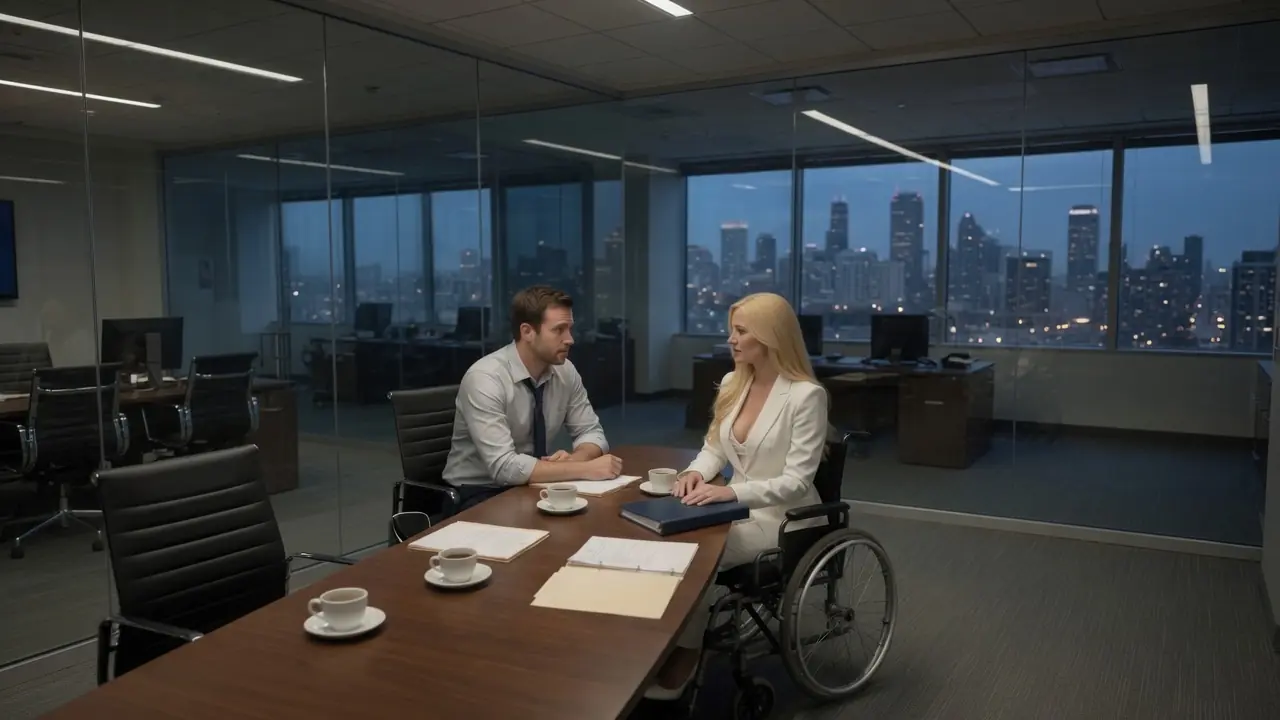
The alarm went off at 4:47 in the morning, same as always. Ethan reached over and silenced it before the second beep. A habit so ingrained his body did it without waking all the way. He lay still for a moment in the dark, listening.
Down the hall, nothing stirred. Lily was still asleep. He had 13 minutes before he needed to start breakfast if he was going to get her lunch packed, her backpack checked, her hair detangled. The last part always took longer than expected, and he still had to make it to the train station with enough margin that he wasn't jogging through the turnstile in a sweat. He swung his legs over the side of the bed and sat there a moment with his hands on his knees, looking at nothing.
It was a Tuesday in October, the kind of morning where the city outside the window was still mostly dark and quiet, and if you tilted your head a certain way and squinted, you could almost pretend the world wasn't in a hurry. Ethan got up. The apartment was small, not cramped, but efficient, the way things get when a single adult spends real time thinking about how a child moves through a space. Lily's drawings covered the lower half of the refrigerator. Her shoes were lined up beside the front door with a precision that was entirely hers and not at all his, and the kitchen table had a permanent coloring station at one end that only got cleared when company came over, which was rarely.
Ethan made scrambled eggs and cut an apple into wedges the way she liked, thin, no skin, and poured a glass of milk and set it all on the table before he went to wake her. Lil. He pushed her door open and leaned against the frame. Time. A pause.
Then a lump under the blanket moved. Five more minutes, she said muffled. You said that yesterday and the day before. Because it's always true. He crossed the room, sat on the edge of the bed, and pulled the blanket back just enough to find her forehead.
She squinted up at him with one eye. "Eggs are getting cold," he said. "You always say that. They're always getting cold." She considered this.
Then she sat up, hair going in four directions, and held out her arms like she expected to be carried. He was 32 years old, and his back wasn't what it used to be, but he picked her up anyway, and carried her down the hall toward the bathroom. "Dad?" "Yeah." "Is today a long day for you?"
He set her down in front of the sink, found her toothbrush, ran water over it. "A little bit. I have to go to Chicago tonight. Remember, I told you last week that you're staying with Mrs. Parish next door."
Lily took the toothbrush and started brushing with the focused expression she used when she was processing something she didn't love but had decided to accept. "How many nights?" she asked around the toothbrush. "Two. I'll be back Thursday morning." "Before school?"
"Before school." She nodded, still brushing, and Ethan went to the kitchen to make his own coffee and try to remember whether he'd printed his boarding pass or left it as a PDF on his phone, which was a distinction that had tripped him up once before and cost him 6 minutes at the airport security line while the man behind him sighed loud enough to be a weather event. Ethan Brooks had worked at Ashcroft Global for 4 years. In those four years, he had fixed three different database migration errors that the IT department hadn't been able to source. Once, he did it at 11 at night from his kitchen table while Lily slept and a rerun played on the television.
He had written a logistics protocol that reduced the company's cross-department processing time by 22%. It was a document that was still in use but had been rebranded under a director's name somewhere along the way. He had flagged a compliance gap in a vendor contract that saved the company a mid-six-figure penalty. The flag had been passed upward through two layers of management before becoming someone else's accomplishment entirely. None of this was on his employee profile.
His employee profile listed his title as operations coordinator level two and his performance reviews described him consistently as reliable and thorough. The kind of language that translated in corporate English to nobody is worried about this person which could mean either that they were brilliant or that they were furniture. At Ashcroft Global, Ethan was furniture. He didn't argue about it. He had decided somewhere around year 1 that the energy required to fight for credit was energy he could spend on Lily and that the math worked out better that way.
He came in early. He did the work. He went home. He made dinner. He read to his daughter and helped her with the subtraction problems that still made her bite her lip in frustration.
And when she fell asleep, he sat at the kitchen table with whatever problem the company hadn't solved that week and turned it over in his head until it made sense. He wasn't resentful about it, mostly. There were nights, not many, but some, when he sat with his coffee and felt something that wasn't quite bitterness, but lived in the same neighborhood. Not for himself exactly, more for the version of himself that used to believe the work was enough. That if you did it well enough and consistently enough, eventually somebody would notice.
He'd learned better. He took the 6:20 train. He always took the 6:20 train, which got him to the office by 7:05, 55 minutes before anyone at his level was expected to arrive. He used those 55 minutes to clear his email queue, review any overnight system flags, and drink a second cup of coffee at his desk in the particular quiet of a half-empty office building that felt to him like the most honest version of a workplace. Before the posturing started, before the conference room politics, before the people who talked about doing things arrived and made it hard for the people who actually did them.
On this particular Tuesday, there was a message waiting for him from HR. He read it twice. Mr. Brooks, please see attached travel confirmation. You have been added to the Chicago delegation for the Hartfield acquisition finalization.
Departure tonight, 7:40 p.m. O'Hare. Hotel confirmation to follow. Please confirm receipt. He stared at the screen.
The Hartfield acquisition was the biggest deal Ashcroft Global had pursued in 11 years. $340 million, a hostile merger with a mid-tier tech infrastructure firm that had more proprietary software assets than it knew what to do with. The negotiation team had been assembled for 6 months. It included the CFO, two senior VPs, a legal team of five, and an outside consulting firm that billed by the quarter hour at rates that made Ethan briefly want to leave the industry entirely. He was not supposed to be on it. He forwarded the message to himself, called Mrs.
Parish to confirm the overnight arrangement, and went back to work. Clare Sterling arrived at Ashcroft Global's executive floor at 8:30 a.m., which was late by her standards. She'd been on a call since 6:15, first with the outside legal team, then with the CFO, then with the VP of strategic acquisitions, a man named Gerald Holt, who had a talent for explaining complicated things in the most convoluted way possible, and seemed to enjoy it. She rolled through the lobby and into the elevator without pausing the way she moved through most of the building efficiently, without making eye contact she didn't need to make, without inviting the small social exchanges that tended to eat the margins off a morning. She had 31 items on her calendar today and a 7:40 flight to catch tonight, and she had not slept more than 5 hours because she rarely did anymore.
Clare had been CEO of Ashcroft Global for 3 years. She'd been in the wheelchair for five. The accident had happened on a Tuesday evening in November on an interstate outside of Columbus when a driver ran a red light at 60 mph and hit her car on the passenger side hard enough to spin it across two lanes. She'd been the only person in the vehicle. She woke up in a hospital bed 4 days later with a neurologist sitting beside her who had kind eyes and a very measured voice and who explained carefully what permanent paraplegia meant in terms of her daily life going forward.
She'd listened to all of it. She hadn't cried. Not then. She cried later alone after the doctors left and the lights were low in the particular kind of silence that comes after you've been told something that splits your life into before and after. She gave herself that one night.
Then she called her assistant and asked for her laptop and started working through the backlog that had accumulated during the 4 days she'd been unconscious. If anyone on her staff found this alarming, they had the good sense not to say so. She had rebuilt herself in the years since, not pretending the wheelchair wasn't there, but refusing to let it become the first thing in every room. It was hard sometimes. There were buildings with bad ramps, conference rooms with chairs arranged in ways that left her cornered, and people who talked to the person standing next to her instead of her.
She had learned to handle the buildings by doing advanced reconnaissance and the people by making her first 30 seconds so precise and direct that redirecting to someone else felt to them like a poor choice. She was very good at her job. She trusted almost nobody. This was not paranoia. It was pattern recognition developed over 15 years in corporate environments where trust was a transaction and loyalty lasted approximately as long as the last quarterly report.
She had been briefed on the Chicago trip four times in the past week. She had reviewed the Hartfield contracts herself, section by section, which was not technically the CEO's job, but which she did anyway, because the last time she delegated that kind of review to the legal team alone. They had missed a licensing clause that cost the company $40,000 in retroactive fees, and she had spent 3 weeks not sleeping over it. She had not been briefed on Ethan Brooks. She first heard his name at 3:30 p.m.
When Gerald Holt knocked on her office door with the particular expression he wore when he was about to say something he believed was important and that she was likely going to find mildly irritating. About Chicago, he said there's been a staffing addition. Who? Someone from operations level two. He was flagged by the IT director as I'm reading here potentially useful for the server-side due diligence.
Gerald lowered the paper. I don't know why he was flagged. I think it was Ramirez being cautious. What's his background? The file is thin.
He's been with the company 4 years. No particular track record. He's Gerald paused. He's mostly invisible, honestly. I asked around.
Nobody had much to say. Clare looked at him for a moment. Is he technically capable or not? I genuinely can't tell from his file. Then have someone check his access credentials and put him on the passenger list.
If he's useless in Chicago, he sits in the lobby and we don't bring him again. And if he's not useless, then I'll figure that out when I'm there. The flight to Chicago was uneventful. Ethan sat in economy, three rows behind the business class section, next to a man in his 50s who fell asleep before takeoff and snored for the duration of the flight with the serene confidence of someone who had made peace with himself completely. Ethan read through the Hartfield technical specifications on his phone.
Documents he'd pulled from the shared drive that afternoon, documents he was fairly certain. No one had asked him to read, but that he'd read anyway because he liked to understand the shape of a problem before he walked into the room with it. The servers worried him a little. Hartfield's infrastructure documentation was clean on the surface, but there were three places in the technical annex where the configuration specifications didn't quite line up with what they claimed to be running. It was the kind of gap that could mean nothing.
Outdated documentation, a clerical error, a tech team that hadn't updated their records after a routine migration. Or it could mean something. He made a note and put his phone away. The hotel was the kind of place where the lobby ceiling was two stories tall and the elevator had a mirror so precisely lit that it showed you every detail you'd hope the day had softened. Ethan found the front desk and gave his name.
The woman behind the counter looked at her screen, typed something, looked again. "Mr. Brooks," she said, her hands flat on the desk. "I'm so sorry about this. We've had a booking issue tonight.
Several of our executive suites were double confirmed for the same dates, and I don't need an executive suite," he said. I put in for a standard room. Yes, I see that. Unfortunately, we're fully occupied at the standard and superior levels tonight. There was a conference.
The entire third floor is taken. She looked genuinely unhappy about this. The only room we have available that isn't spoken for is a two-bedroom executive suite on the 14th floor. It was already assigned to someone in your party. Ethan understood before she finished.
And they put us both in it. He said it was the only option. He nodded slowly. Okay. The other guest has already been notified.
Floor to ceiling windows, a sitting area with two separate couches, a kitchenette, and two bedrooms at opposite ends of the common space. It was larger than the apartment where Ethan and Lily lived, which was a fact that he registered and then set aside because thinking too hard about that comparison wasn't useful. Clare Sterling was in the sitting area when he came in, her chair angled toward the window, a laptop open on the low table in front of her. She looked up when the door opened and took him in with the particular attention of someone who assessed quickly and withheld the result. Ethan Brooks, she said, not a question.
Yes. He set his bag down near the door. Miss Sterling, I'm sorry about the room situation. I can ask them again about alternatives. I already asked twice.
She turned back toward her laptop. The suites are separated by enough space that this is manageable. I need quiet after 10:00. I'll be on calls until about 9 tonight, and I don't want small talk. That works for me, he said.
She looked up again as if she'd expected a different answer. You're from operations. Yes. Ramirez put you on the list, so I was told. Do you know why?
Serverside review. I think the technical specs on the Hartfield infrastructure have a few things I wanted to look at before tomorrow. A brief pause. What things? Configuration inconsistencies might be nothing, she studied him for a moment, long enough that most people would have filled the silence.
He didn't. Get settled, she said finally, and turned back to her screen. We'll see what it is tomorrow. He picked up his bag and went to the second bedroom and sat on the edge of the bed and called Mrs. Parish to confirm Lily was down.
Okay. "She's fine, sweetheart," Mrs. Parish said in the tone she used that managed to be both reassuring and faintly maternal toward him, which he'd stopped after the first year. "She asked me to tell you she saved you a drawing. Tell her I'll look at it Thursday."
He hung up. He sat there another minute in the quiet, looking at the city lights through the gap in the curtain. Then he opened the Hartfield technical annex on his laptop and started working backward through the configurations one by one, looking for the thing that didn't fit. He found it at 12 minutes past midnight. His stomach dropped in the particular way it did when a minor concern turned into something considerably larger.
He leaned forward, tracing the pathway again, making sure. Then he checked it a third time. It wasn't a documentation error. He got up, crossed the common room, and knocked on Clare Sterling's bedroom door. For a moment, nothing.
Then, "What?" "I found something in the Hartfield servers," he said. "I think you need to see it." Another pause, longer. The door opened.
She was in a plain gray t-shirt, no jacket, her wheelchair positioned in the doorway with the practiced ease of someone who had long since stopped registering the motion. She looked at him without warmth, but without dismissal either. The expression of a person who had been interrupted and was deciding whether it was worth it. How bad, she said. He met her eyes.
Bad enough that I knocked. She held his gaze for another second. Then she moved back from the doorway. Show me. She didn't ask him to sit down.
That was the first thing he noticed when he wheeled his laptop over to the coffee table in the common room and pulled up the Hartfield technical annex. Clare positioned herself across from him close enough to see the screen clearly and leaned forward with her elbows on her knees in a posture that said she was paying attention and not much else. There was no small talk. She didn't offer coffee or apologize for the hour. She just looked at the screen and waited.
He appreciated that more than he would have expected. Here, he said, pulling up the configuration tree. This is Hartfield's primary server architecture as documented. On the surface, it looks standard. Three- tier setup, load balancers here and here, encrypted audit layer sitting on top.
He scrolled down. But watch what happens when you trace the data routing on the secondary verification nodes. He navigated through four layers of technical documentation, moving with the quiet efficiency of someone who had done this kind of thing many times in rooms where nobody was watching. Clare followed without asking him to slow down, which told him something. There, he said.
She leaned in closer. On the screen, nested inside what appeared to be a routine network configuration file was a series of pathway redirects that didn't connect to anything in the documented architecture. They just went somewhere else, somewhere unspecified. The kind of thing that looked like a clerical holdover from an old system migration if you glanced at it. The kind of thing that looked considerably more deliberate if you traced every thread to its endpoint and noticed that three of them led back to the same external IP address, one that didn't appear anywhere in Hartfield's disclosed vendor list.
Clare was quiet for a long moment. When was this last active? She said based on the timestamp metadata. 6 weeks ago. He pulled up a side window, which is 3 weeks after the acquisition talks officially began.
She sat back. He watched something move across her face. Not panic, not quite, but the controlled tightening of someone who has just had a calculation confirm that they were hoping was wrong. You're telling me someone inside Hartfield has been routing data externally since we started talking. I'm telling you the configuration exists and it was active recently.
I can't tell you who put it there without access to Hartfield's internal admin logs, which we obviously don't have. He paused. But the architecture of it is deliberate. Whoever built this knew what they were doing. This isn't an accident.
Data exfiltration, she said flat. Possibly, or surveillance of our negotiation timeline, or both. He watched her process this. There's something else. She looked at him.
Our own servers. He pulled up a second window. Ashcroft's verification system, the secure environment they'd been using to exchange encrypted documentation with the Hartfield legal team throughout the acquisition process. I requested read access to the system logs this afternoon before we flew out. Ramirez cleared it.
I've been looking at these in parallel. He pointed to a line of entries near the bottom of the log. This is a network configuration failure. It's been building for about 72 hours. Right now, it's dormant.
Everything looks normal from the front end, but based on the pattern, somewhere between 2 and 4 in the morning, the verification layer is going to fail. And when it does, the encrypted audit files, Clare said, gone or inaccessible, which amounts to the same thing for tomorrow's negotiation. Every verified document exchange we've had with Hartfield over the past 4 months, proof of representations, compliance confirmations, financial disclosures, all of it sits behind that verification layer. He looked at her steadily. If the system goes down before the signing, we have no authenticated paper trail.
The whole deal is built on good faith and our word. She was already thinking. He could see it. The rapid interior calculation of someone who ran a billion-dollar company and had learned to think on multiple tracks simultaneously. But she was also briefly just a person sitting in a dim hotel room at midnight with a problem that was considerably larger than it had been 20 minutes ago.
And he saw that too, the moment before the CEO part of her reassembled. Can you fix it? She said. I don't know yet. I need to look at the underlying architecture and see how deep the failure goes.
He closed the Hartfield window. I wanted to show you first before I started touching anything. It's your call. She looked at him with an expression he couldn't read entirely. Something evaluating, not unfriendly, not yet trusting either.
The look of a person deciding whether a tool is the right tool for the job without knowing yet what the tool can do. Do you need anything from me to access the system? Admin credentials for the verification layer. I can work with the read access I have, but I can't rebuild anything without right permissions. She picked up her phone.
It was 12:23 in the morning. She called someone, Marcus, from the IT director's office, judging by the conversation, and within 4 minutes had Ethan's access escalated to full administrative rights on the verification system. She did it without explaining herself to Marcus, which Ethan noted, and without making it sound like a crisis, which he noted even more. When she hung up, she looked at him. How long?
I don't know. Could be 2 hours, could be five. Do you need me here? He thought about it honestly, which he could tell she appreciated more than a reflexive no. Not unless something breaks in a way I don't understand.
In which case, yes, I'll be up, she said. I sleep badly anyway. She said it without inflection, just a fact. And went back toward her room. At the door, she stopped.
Brooks. He looked up from the laptop. If you fix this, not when, if, she held his gaze. I need to know what we're walking into with Hartfield tomorrow. Not just the servers.
Everything you saw. Okay. All of it. Even the parts you're not sure about. Okay.
He said again. She nodded once and went inside. He pulled the laptop closer and started working. The failure was worse than he'd initially read. The network configuration problem wasn't a single point of collapse.
It was a cascading dependency issue, the kind that formed slowly over time when a system was patched repeatedly without a full architectural review. Three separate configuration layers had drifted out of alignment with each other. Each one compensating slightly for the other's gaps until the whole structure was being held together by workarounds that were themselves starting to fail. Like a building where someone had shored up a cracked wall with wooden beams and the beams were starting to warp. He mapped the whole thing first before he touched it.
That was the discipline. Understand the shape of the problem completely before you start moving pieces because the fastest way to make a broken system worse was to fix one thing without knowing what that thing was compensating for. By 2 in the morning, he had a clear picture. By 2:30, he had a repair sequence. At 2:41 he started.
The suite was quiet. Through the wall he could hear the city, traffic, a siren somewhere distant, the ambient low hum of a place that didn't really sleep. He worked with the kind of focus that had always come naturally to him in the small hours. The part of the night when the noise went away and the problem was just the problem, not surrounded by all the other noise of the day. He rebuilt the primary configuration layer first, which was the most delicate step, like pulling a loadbearing beam and replacing it without letting the wall come down.
His hands were steady on the keyboard. He'd done things like this before in other rooms at other hours for other companies that had never known his name. At 3:15, Clare's door opened. She came out without a word, positioned herself near the kitchenette, and made coffee with the quiet efficiency of someone who'd been doing it in hotel rooms for years. After a few minutes, she came into the sitting area and set a cup on the table beside his laptop, not close enough to be in the way.
He didn't look up. Thanks. She didn't say anything. She set up her own laptop on the far end of the table and went back to whatever she'd been working on. They sat like that in silence for a while.
Two people in a hotel suite in Chicago at 3 in the morning, each doing their own work. The only sound, the faint tap of keys and the occasional low sound of the building settling. It wasn't comfortable exactly, but it wasn't uncomfortable either. It was something more neutral than either, just the particular quiet of two people who didn't need to fill silence to justify being in the same space. Around 4:00, he hit a snag.
The secondary verification layer had a dependency he hadn't mapped fully, a handshake protocol with an external authentication server that had its own configuration file stored separately that had also drifted out of sync. He stared at it for a few minutes thinking. Problem? Clare said without looking up from her screen. Minor detour, he said.
I need to track down a secondary authentication file. It's in the system, but I need to locate it. How long does the detour add? 40 minutes maybe. Depends on how deep it's buried.
She nodded and went back to her screen. He went back to his. He found the file in 31 minutes. Rebuilt the sync protocol in another 12. By 5:20 in the morning, he ran the first full system test.
Everything came back online. He sat back and let out a breath that was less triumphant than it was just finished. The release of a long tension. He ran the test twice more to be sure. Then ran a verification pass on all the encrypted audit files.
Every document intact, every time stamp confirmed, every authenticated exchange from the past 4 months logged and verified and accessible. He picked up the coffee, which was cold now, and drank it anyway. It's back up, he said. Clare looked up from her laptop. She read him for a moment, his posture, his face, whatever she was assessing, and then looked at his screen where the verification system now showed a clean status board, green across every indicator.
All of it, she said. All of it. Audit files, document logs, the full Exchange record going back to June. He turned the laptop toward her so she could see. I also left a repair note in the system admin log documenting the failure points.
Your IT team needs to do a full architectural review when you get back. This was a slow building problem. If you don't address the underlying drift, it'll happen again. She studied the screen. Then she looked at him.
You did this in 5 hours. Four hours and forty minutes, roughly. Our IT team has been on a contract review with an outside infrastructure firm for 6 weeks. I know, he said. I read the status reports.
Something shifted in her face. Not dramatically. Clare Sterling was not a dramatic expression person, but something moved. Some small recalibration. Why do you read status reports outside your department?
He thought about how to answer that honestly without it sounding like either a complaint or a self-promotion. I like to know how things actually work, he said finally. The whole system, not just my piece of it. It's a habit. She looked at him a moment longer.
Then she closed her laptop. Get some sleep. We have 2 hours. I want to go over the Hartfield findings with you first. You said you wanted everything.
After we both sleep for 90 minutes, she said, I'm not walking into that conversation half-functional. He started to say he was fine, then registered that she was probably right and closed his laptop instead. He slept for 83 minutes and woke up already thinking. Clare was already in the sitting area when he came out, dressed, coffee made, her own materials spread across the table with the organized precision of someone who thought spatially and knew it. She had a notepad beside her laptop with three columns of handwriting, her personal shorthand, from the look of it, not meant for anyone else.
He got coffee and sat across from her and they went through everything he'd found in the Hartfield architecture, the external routing pathways, the IP address that didn't match any disclosed vendor, the timeline of activity relative to the acquisition talks. He walked her through it without editorializing, laying out what he knew, what he suspected, what he couldn't confirm, and keeping the categories distinct. She asked good questions, precise ones. She didn't ask him to repeat things, which meant she was processing quickly, and she didn't ask him to simplify anything, which meant she wasn't performing comprehension she didn't have. By the time they finished, it was 7:40 and the delegation was gathering in the lobby.
Gerald Holt found Ethan near the elevator bank and looked at him the way he'd probably looked at him every time they'd passed in the Ashcroft corridors. Not unkind, not rude, just the blank visual passage of someone who didn't register the other person as worth registering. Brooks, he said, checking something on his phone. You're down for technical support during the session. If anyone from Hartfield needs document verification, he'll be at the table, Clare said from behind them.
Gerald turned. I'm sorry. Ethan will be at the table, not in technical support. She moved past them toward the elevator. Adjust the seating.
Gerald looked at Ethan with an expression that was trying very hard to be neutral. Ethan looked back with an expression that was genuinely neutral because he didn't particularly care about Gerald's reaction either way and followed Clare into the elevator. The Hartfield negotiation was held in a conference room on the 32nd floor of a glass tower downtown with views of the lake that nobody in the room was looking at because everyone in the room was looking at each other with the particular careful attention of people who had a great deal of money on the line. Hartfield's team was led by a man named Douglas Crane, their CFO, mid-50s, silver-haired, the kind of polish that came from 20 years of conference rooms exactly like this one. He had two attorneys, a financial analyst, and a man introduced as their head of technology infrastructure who was younger than the rest, and had the specific look of someone who'd been told to look confident and was working at it.
The first two hours went smoothly enough, the way the beginning of these sessions always did. Both sides restating positions that had already been stated in writing, establishing the rhythm, assessing where the real pressure points were going to be. Then they got to the technology transfer provisions. It was page 214 of a contract stack that ran to just over 300 pages. The clause in question was written in The kind of language that looked standard from a distance, dense, technical, heavily qualified, and it addressed the transfer of Hartfield's proprietary software assets in the event of certain acquisition conditions being met.
Ethan was reading it for the second time when he felt something catch. He read it a third time slowly. He read the subsection. He read the definitions appendix it referenced. He followed the cross reference to a clause on page 81 that addressed derivative technology platforms and their classification for purposes of the ownership provisions.
Then he set the contract down and looked at Douglas Crane who was currently listening to the Ashcroft CFO explain something about the payment timeline with the expression of a man who knew exactly how the conversation was going to end. Ethan leaned toward Clare, who was to his left. Page 214, he said quietly. Subsection C, clause 3. Read the cross reference to page 81.
She didn't react visibly. She found the page. He watched her read it. He watched the moment it landed. She closed the contract folder without changing her expression and set it squarely on the table in front of her.
Mr. Crane, she said. The room shifted. Something in the way she said it made everyone adjust. Not loudly, just the minor physical refocus of a group of people who recognized that the thing they'd been waiting for had arrived.
"Yes, Ms. Sterling," Crane's voice was pleasant. "I'd like to discuss the derivative technology clause." She paused, "Not for drama, but the plain functional pause of someone organizing a precise thought. Specifically, I'd like you to explain to me how the language in subsection C, clause 3, when read in conjunction with the definitions in appendix 6 and the ownership provisions on page 81, does not effectively transfer ownership of all technology platforms developed by Ashcroft within the next 7 years that share any architectural framework with Hartfield's current systems.
A silence. The kind of silence that happens when a room full of people suddenly recalculates. Crane's attorney moved first, reaching for her own copy of the contract. The technology head looked at the table. Crane himself maintained his expression with the practiced ease of a man who had been in difficult rooms before, but something behind his eyes went very still.
That's a liberal reading of it's not liberal, Clare said. It's precise. The definition of derivative platform in appendix 6 is written broadly enough to include any system sharing and operational architecture with Hartfield's current stack. Given that we're in the process of acquiring that stack, any technology Ashcroft builds on this infrastructure going forward would qualify. That's not a hypothetical.
That's the contract is written, Crane looked at his attorney. A wordless exchange, very brief. We can discuss clarifying language, the attorney said carefully. We're past clarifying language, Clare said. This clause is either a drafting error or it isn't.
If it's an error, we need the section redrafted and reviewed before any signatures go on anything. If it isn't, she let the pause do the work. Then we have a different kind of conversation. The Hartfield technology head had gone the particular shade of someone who was hoping the floor would open. Ethan looked at him and then looked away because he understood the specific misery of being the person in the room who knows exactly how the problem happened and is watching everyone else figure it out.
And there was no satisfaction in prolonging it. What followed was four hours of renegotiation. Gerald Holt, to his credit, adapted quickly once the ground shifted. He was a competent attorney, even if he was a dull conversationalist, and he drove the technical revision hard, working with Clare and the Hartfield legal team through the replacement language word by word. Ethan answered the technical questions that came his way.
Flagged two additional places where the original language created unintended ambiguity and otherwise stayed quiet because the work was the work and it didn't need performance on top of it. By 4:00 in the afternoon, they had a revised agreement. By 5:30, they had signatures. In the elevator going down afterward, Gerald stood beside Ethan for a moment without speaking. Then he said in the tone of a man acknowledging something he found genuinely inconvenient.
Good catch. "Thanks," Ethan said. "How did you see it that fast?" "I read slow," Ethan said. "I just read everything."
Gerald processed this. The elevator opened. He walked off without responding, which was probably the best either of them could have managed. The team dinner that night was at a restaurant near the hotel, the kind of place with good lighting and a wine list and the ambient murmur of business conversations happening at every other table. Ethan sat near the end next to one of the junior attorneys who was young enough to still be visibly relieved that the day had gone well, and they talked about Chicago Winters and whether the deep dish pizza was actually better here, or whether it was just geography making people loyal to it.
Across the table, he was aware of Clare watching him once, maybe twice, not staring, just the peripheral awareness of someone recalibrating. He had a glass of water and an unremarkable steak, and he thought about Lily, who was probably at this moment doing homework at Mrs. Parish's kitchen table, and complaining that the subtraction problems were unfair in some specific way that made perfect sense to a 7-year-old. He thought about Thursday morning when he'd be back before she left for school. He thought about the drawing she'd saved for him, which he was going to put on the refrigerator next to the others without looking at it first because she liked to be there when he opened it.
He got back to the hotel at 9:30 and called to check in. "She's asleep," Mrs. Parish said. "Has been since 8. She was tired."
"Good," he said. "Thank you." He hung up and sat in the chair by the window in his room, looking at the city lights. The lake was out there somewhere in the dark, enormous and quiet, not caring at all about billion-dollar acquisitions or server architecture or the particular exhaustion of a day that had started at midnight and run through to now. He was tired in the good way, not the depleted way, not the hollow way, but the way that came from doing something real, from a problem that had needed solving and getting solved.
He didn't often get to feel that at work anymore. There was a knock at his bedroom door. Come in, he said. Clare opened it. She didn't come in, just stayed at the threshold the way she'd done the night before, her posture balanced and still.
I wanted to say something before the morning, she said. He waited. What you did last night, the system repair. I had our IT director on a call this afternoon while you were in the documentation review session. He said, 'The failure you found and rebuilt would have taken their team 3 to 5 days minimum with outside contractors.
She paused and the pause had something in it, not discomfort, but the particular awkwardness of someone who didn't say this kind of thing often and knew it. The clause today was the difference between a good acquisition and a catastrophic one. I need you to know I understand that. Okay, he said. She looked at him.
That's all you're going to say? I wasn't looking for a reaction, he said. I was just doing the work. She held his gaze for a moment. Something in her expression shifted fractionally in a direction he couldn't quite name.
That's what I thought, she said quietly, and it wasn't a compliment exactly, but it wasn't nothing either. She pulled the door closed. He turned back to the window and the city lights and sat there a while longer, not thinking about anything in particular, until the tiredness finally won, and he went to bed. They flew back Thursday morning, same as he'd promised. The flight landed at 7:12, which gave him 40 minutes to get from the airport to the apartment, swap his bag for a clean shirt, and walk Lily to school.
He made it with 6 minutes to spare, which wasn't comfortable, but was enough. And when Lily came out of Mrs. Parish's door with her backpack already on and her hair already in the two braids she'd apparently done herself, slightly uneven, one higher than the other. She looked at him with the satisfaction of someone who had managed things competently in his absence. You're late, she said.
I'm 6 minutes early, he said. You're usually 10 minutes early, so you're late. He didn't argue with this because it was functionally correct. He took her backpack from her and they walked the four blocks to school in the October morning cold. And she told him about the drawing she'd saved.
It was a dog, she explained, though not a dog they had. A dog she wanted, a specific kind with floppy ears that she had researched thoroughly by asking Mrs. Parish's neighbor who had one. "We've talked about the dog," he said. "We've talked about why we can't have one," she said.
"I'm still deciding if I agree." He dropped her at the school gate and watched her go through without looking back the way she did now. The way that had started maybe 6 months ago when she'd decided that looking back was for kids younger than her. He stood there another 10 anyway, then turned around and went to catch the train to the office. He was back at his desk by 9:05.
The return to a Tuesday caliber morning felt strange in the specific way that always happened after something significant. The world hadn't adjusted to match the weight of what had just occurred. So, it just looked like a regular office with regular coffee and regular fluorescent lights and his inbox full of things that had accumulated while he was gone and didn't know or care about Chicago. He worked through the backlog and didn't think too much about it. Clare came back to the office the same morning earlier than him and spent the first part of the day in back-to-back calls that were the necessary aftermath of closing a major deal.
Legal confirmation, board notification, public relations coordination, the particular administrative avalanche that followed a success. She was good at all of it. She had always been good at all of it. But between calls, in the small gaps where her assistant wasn't immediately putting through the next one, she found herself thinking about Ethan Brooks. Not in a way she could have easily articulated and not in a way she was particularly comfortable with because Clare had built her professional life on knowing exactly what she thought about everything and being able to state it.
What she thought about Ethan was not yet fully formed. It was more like a question, a specific gap in her picture of the company and by extension of herself as the person who ran it. She had been CEO for 3 years. She had reviewed 4,000 personnel files. She prided herself on knowing if not every name then every function, every meaningful contribution, every loadbearing piece of the organization.
That was what she had told herself and she had until Chicago believed it. The fact that Ethan Brooks existed in her company the way he did, invisible, unrecognized, apparently extraordinary was not a comfortable fact. She pulled his HR file on Thursday afternoon, the same day they got back. It was, as Gerald had said, thin. Four years of annual reviews, all in the same corporate boilerplate language, reliable, thorough, contributes consistently to team objectives, no commendations, no disciplinary notes, no record of any particular achievement, which she now understood wasn't because there hadn't been any.
It was because the system had simply not caught them. She read the file twice and then sat for a moment with the particular feeling of someone who has just found a structural flaw in something they built. Then she opened the company's internal archive system and started searching backward. The archive search took the better part of 2 days. She did it herself without asking her assistant or anyone from HR, which was a choice she made deliberately.
She wasn't sure what she was looking for exactly, not a smoking gun, more like a pattern. The way Ethan moved through the company, what he touched, what changed after he touched it, whether anyone had noticed. She started with the logistics protocol. She found it in a department folder dated 14 months ago filed under the name of a director named Paul Sutter in the operations division. It was a 43page document that had reduced cross-department processing time by 22%.
A figure she vaguely remembered from a quarterly report attributed to a process improvement initiative in Sutter's team. She had signed off on Sutter's bonus that quarter. She read the document carefully. Then she searched the metadata. The original file had been authored under a generic system login used for document processing which told her nothing.
But attached to the initial submission was a version history. And the version history showed a draft uploaded 48 hours before Sutter's final submission from a workstation registered to Ethan Brooks. The draft and the final submission were word for word the same document. She sat with that for a while. Then she went looking for the compliance gap.
It took her longer to find it because it hadn't been formally documented anywhere. It existed only as an email chain that she located by searching the legal department's archive for vendor contract amendments in the previous 3 years. The chain started with an email from Ethan to his direct supervisor at the time, a man named Roy Callender, flagging a licensing clause in a vendor agreement and recommending it be reviewed by legal. The chain showed Callender forwarding it upward where it was eventually addressed and the amendment was executed and the $40,000 penalty was avoided. Callender had received a commendation in his year-end review for proactive compliance management.
Ethan's name did not appear anywhere in the chain after his initial email. She closed the archive and looked out her office window at the city below for a long time. These were two instances. She suspected there were more, but two was already enough to understand what she was looking at. Not a man who had been overlooked because he was quiet and unremarkable.
A man who had been producing quietly extraordinary work for years in an environment that had a specific structural failure. It rewarded the people who submitted the work, not the people who did it. And no one, including her, had looked closely enough to notice the difference. She thought about the repair in Chicago, the clause, the way he'd work through the night without complaint or theater, without checking to see if anyone was watching. She thought about the way he'd said when she'd thanked him, "I wasn't looking for a reaction.
I was just doing the work." She picked up her phone and called her head of HR, a woman named Diana Park. I need you to pull everything you can find on an employee named Ethan Brooks. She said, "Full background, not just what's in the current file. Go back before he joined Ashcroft.
Whatever you can find in the external record." Diana was quiet for a second. "Is this a disciplinary matter?" "No," Clare said. "It's a curiosity matter, and Diana, this stays between us for now, sir."
Diana's report came back the following Monday morning, and it sat in Clare's inbox for 3 hours before she opened it, which was not her usual relationship with information. She was not normally someone who delayed reading things. She was someone who read things immediately and acted on them efficiently, but she had a feeling looking at the subject line that whatever was in this file was going to require her to sit with it for longer than she usually sat with things. She was right. Ethan Brooks, 32 years old, operations coordinator level two before Ashcroft Global, eight years as an independent corporate consultant working primarily in technology infrastructure recovery and strategic restructuring.
His client list, as reconstructed from publicly available sources, included four midsize companies that had been in genuine operational distress when he'd taken them on, three of which had stabilized and returned to profitability within 18 months of his engagement. One of which had gone on to a successful acquisition at a significantly improved valuation. He had been before the age of 28 one of the more effective turnaround consultants in the mid-market space. Diana had included a note at the bottom of the report in the slightly cautious tone she used when she wasn't sure how something would land. There is no apparent reason in the professional record for why he would have moved from that career trajectory into an entry-level operations role.
The transition appears to have been entirely voluntary. Clare read the report twice. Then she sat back and stared at the ceiling for a moment, something she rarely did because it wasn't useful. And she was generally allergic to things that weren't useful. He had walked away from it.
That was the part she kept returning to, not been pushed out, not failed, walked away. From a career that most people in her industry would have killed for voluntarily and into an operations coordinator role at a midsize corporation where he'd quietly been doing good work for 4 years without asking for any recognition at all. She needed to understand why. She went to his floor herself on a Tuesday afternoon. She took the elevator down from the executive level, which she didn't do often, not because she was above it, but because her schedule rarely left room for unscheduled movement.
The operations floor was open plan, the kind of layout that had been installed during an office renovation 3 years ago that she had approved without visiting after completion. And she was briefly aware of the gap between the schematic she'd signed off on, and the actual human geography of the space, the coffee station in the wrong corner, the natural clustering of desks in ways that bypassed the organizational chart entirely, the particular low-level sound of a floor that was working. She found Ethan's desk near the back wall by a window that faced a building rather than the sky. He was at it when she arrived, looking at something on his second monitor, and he didn't notice her immediately because nobody on that floor expected the CEO to come to them. When he looked up and saw her, something moved across his face.
Not alarm exactly, more like a recalibration, the same thing she'd seen in Chicago when she'd knocked on his door the first night. Miss Sterling," he said. "Do you have a few minutes?" He looked at his screen, then back at her. "Sure, somewhere we can talk privately."
He glanced around the open floor, then then nodded at a small glass-walled meeting room at the edge of the space that was currently unoccupied. They went in. He held the door open without making a production of it, and she went through and he closed it behind him and sat in one of the chairs at the small table. She positioned herself at the end of the table where she usually sat in meetings because it was practical and because it was habit. I need to ask you something directly, she said.
And I want you to answer directly. He nodded. I've been looking into your background, your history before Ashcroft. She watched him. His expression didn't close off, which she had half expected.
The defensive reaction of someone whose privacy had been walked into. He just looked at her steadily, waiting. You were a consultant, a good one from everything I can find. You were working at a level most people twice your age don't reach. She paused and then you stopped and you came here and filed logistics reports and fixed server problems that nobody noticed you fixing.
She folded her hands on the table. I want to understand why. Ethan looked at the window for a moment. Not evasively, just the brief interior movement of someone deciding how to say something that's true and also complicated. It's not a dramatic story, he said.
I know it probably looks like one from the outside. Tell me anyway. He was quiet for a few seconds. I was good at the work. I'm not being modest about that.
I was good at it and I knew it. And I think for a long time I used that as a reason to prioritize it over everything else. He looked back at her. My marriage ended when Lily was three. It didn't end because of one thing.
It ended because I was never there. Physically sometimes, but mentally, I was always in the next problem, the next engagement, the next company that needed fixing. My wife used to say she felt like she was married to a concept of a person. A brief pause. She wasn't wrong.
Clare said nothing. After the divorce, I had Lily half the time at first, and I looked at her. She was three. She couldn't really articulate anything yet, but she looked at me sometimes like she was checking whether I was actually there. Not physically, actually there.
He shook his head slightly. I couldn't answer that. I wasn't most of the time. I was already somewhere else. He shifted in his chair, the small restless movement of someone unaccustomed to sitting still and talking about themselves.
I took a month off after the divorce was finalized. Told myself it was to regroup. And I spent 30 days just being with her, being actually there. We went to the park and we made terrible pancakes. And I read her the same three books every night because those were the ones she wanted.
And I read them until I had them memorized. He stopped. And I realized I had missed about a year and a half of her actual life. Not the events. I'd been at most of the events, but the life, the daily texture of who she was becoming.
I had missed it because I was always partially somewhere else. Clare was watching him carefully. "So you quit," she said. "I restructured. I needed something stable, predictable hours, no travel, an operations role fit."
He looked at her without defensiveness. "I know what it looks like. I know what people here think of the position. I'm not It's fine. The work is real.
It matters that things run correctly and I'm home by 6:00. Lily has dinner with her father every night. Something shifted in his voice. Not much, but enough. That's not nothing.
Clare held his gaze. No, she said quietly. It's not. A beat of silence. She had spent 5 years since the accident telling herself that the work was what she had, that it was enough, that building something real and lasting out of Ashcroft Global was a sufficient answer to the question of what her life was for.
She believed it mostly on the days she believed at least, she worked harder. And here was a man who had voluntarily stepped back from the version of success she was running toward, not because he'd failed at it, but because he'd decided it cost too much, and had been quietly, stubbornly living by that decision for 4 years in a cubicle by a window that faced a building instead of the sky. She wasn't sure what to do with that information. She filed it in the part of her mind that held things she was still processing and came back to what she'd come to say. "There's something else I want to discuss," she said.
The logistics protocol, the one filed under Paul Sutter's name 14 months ago. The expression on Ethan's face was hard to read exactly. Not uncomfortable, not bitter. Something more like resigned. The face of a person looking at a thing they'd made peace with and finding the piece slightly disturbed by having it named.
I wrote it, he said. It wasn't a question. I know. She paused. Did Sutter know you wrote it when he submitted it?
A beat. Yes. Did he tell you he was submitting it? He told me he was going to formalize it into a department proposal. I assumed that meant it would go in with attribution.
He looked at the table briefly. When the quarterly came out with his name on it, I went to his office and asked him about it. And Ethan's jaw moved once. He said the document was developed in collaboration and the department credit covered everyone. He said it was how the system worked.
A pause. He wasn't yelling. He was very calm about it. That was almost the worst part. Did you escalate it?
To who? He looked at her with an expression that wasn't hostile, but was very honest. His supervisor was two levels above me. The review had already gone to the board. I'm an operations coordinator level two.
If I walk into someone's office and say, "My director stole my work." He left the rest of it unsaid because they both understood how the sentence ended. I have a daughter. I need this job to be stable. Clare looked at him for a long moment.
I should have known, she said, not dramatically, not as a performance of guilt, just as a statement of fact. It's my company. I signed off on that bonus. I should have asked more questions. You run a 6,000 person company, he said.
You can't audit every document submission. I can build a system that doesn't reward that kind of thing, she said. I clearly haven't. He didn't argue with that, which she respected. She had one more thing to cover, and she had been deciding since she walked in whether to bring it up, and she had decided yes, because not bringing it up felt like continuing the original error in a different form.
3 years ago, she said there was a technical disaster, a server collapse in the middle of a board audit. The entire verification system went down for 6 hours, and we nearly had to postpone a regulatory filing. She watched his face. I was new as CEO. I was briefed afterward that the IT department had fixed it through the night.
I thanked the director. I sent the team a bonus. Ethan was very still. I found the incident log last week. She said, "The original repair request was flagged from your workstation at 11:48 p.m.
The fix was committed under a batch admin login, which is why it wasn't immediately attributable to any individual. But the directory timestamp on the repair architecture file traces back to your employee workstation. He was quiet for a long moment. Then the director knew. Not at the time.
He figured it out about 2 weeks later when he was cleaning up the logs. What did he say? He pulled me into a conference room and told me that the batch login meant the repair was officially department property and that if I had any concerns about recognition, I should think carefully about how a junior employee raising a complaint about a senior director would look, especially one who was still in his probationary window at the time. Ethan said it without heat, in the flat tone of something recalled rather than felt. I thought about Lily.
I went back to my desk. The room was quiet. Clare had run this company for 3 years with the conviction that she knew its bones, its people, its weak points, its real architecture beneath the official chart. She had been wrong. Not about the business numbers, not about the strategy, but about the human structure beneath all of it, the way credit actually flowed and where it pulled, who got seen and who did the same work and got nothing.
That director left the company 8 months ago, she said. He took a VP role elsewhere. Ethan nodded slightly. He'd known. The bonus from that quarter went to his team.
He received the largest individual commendation. She said it plainly. You received nothing. It wasn't the first time, he said, and then quietly. It wasn't the last.
They sat with that for a moment. I want to fix it, Clare said. Not symbolically, structurally. And that starts with you not being in a level two operations role anymore. She held up a hand before he could speak.
I'm not asking you right now. I'm telling you I'm going to make an offer and I want you to actually consider it, not reflexively say you're fine where you are because you don't want the conflict. He looked at her. What kind of offer? There's a division I've been trying to stabilize for 8 months.
Consumer technology integration. It's bleeding performance. The team morale is poor. And I've had three directors in there in 2 years because the structural problems are deeper than any of them understood. She paused.
I want you to take it. Ethan was quiet for a moment. She could see him thinking, not about whether he wanted it, but about all the adjacent things, the hours. Lily, what more responsibility would mean for the life he'd built carefully around the thing that mattered most to him, "The position," he said. "What are the expected hours?"
It was exactly the right question. She had thought about this because she was not a person who walked into a conversation without considering the other side's constraints. "You define them," she said. "I need results, not presence. If the division is performing and your team is stable, I don't care when you leave.
I do care about outcome. He looked at her with something careful in his face. You're serious? I rarely say things I'm not serious about. No travel requirements, limited, no more than what you've already been doing.
Less if you manage it right. He was quiet for another moment, looking at the table, then out the window at the building across the way. I'll think about it, he said. That's all I'm asking, she said. She moved toward the door, then she stopped.
Ethan, it was the first time she'd used his first name. She wasn't sure afterward why she had. What you've been doing for 4 years, showing up, doing the work, not asking for anything. I understand why. I'm not going to tell you it was wrong.
She paused and the pause cost her something. But I think you've been in a building full of people who should have seen you and didn't. And I'm sorry it took me this long. He looked at her. She couldn't fully read his expression.
Something complex lived there. A mix of things that weren't purely one feeling. Thank you, he said, and then after a beat. Clare. It was the first time he'd used her name either.
She held his gaze for one moment longer than was strictly necessary, then pulled the door open and went back to the elevator and rode it up alone to the executive floor. She sat at her desk for a full 3 minutes without opening anything, which was not her habit. She was thinking about a man who had chosen his daughter over his ambition and been punished for it by the same machinery that was supposed to reward good work. She was thinking about the director who had walked away with the bonus and the commendation and the VP title at another firm. She was thinking about the 6,000 people in this building and how many of them she actually knew and how many were invisible in the same way Ethan had been invisible and how much of that was the company's architecture and how much of it was hers.
She opened her laptop and started writing the longest internal memo she had written in 3 years. It was addressed to Diana Park and the entire senior leadership team. The subject line read, "Attribution and recognition structural review initiative." She typed for 40 minutes without stopping. But Ethan told her yes on Friday morning via a three-sentence email that was she thought exactly as long as it needed to be.
The first sentence confirmed his acceptance. The second said he would need two weeks to transition his current workload to someone else cleanly. The third said he had some thoughts about the division's structural issues that he'd like to walk her through before he officially started if she had an hour. She replied with one sentence. Monday at 9:00, my office.
She closed her laptop and allowed herself briefly the small private satisfaction of something going right. Not perfectly. Nothing went perfectly, and she had learned to mistrust the feeling when it showed up, but right. The way a corrected course feels when the correction finally holds. Outside her window, the city was doing what it always did, indifferent and enormous.
And somewhere in it, a seven-year-old girl was probably arguing with a subtraction problem and saving a drawing for her father to look at when he got home. Ethan Brooks, who had been invisible for 4 years, would not be invisible anymore. Whether that was good for him in all the ways that mattered, in the ways that didn't show up in performance reviews or org charts, was a question only he could answer. And Clare understood that well enough to leave it alone. She had said what she had to say.
The rest was his. He showed up Monday at 9:00 with a legal pad, two printouts, and a cup of coffee he'd made himself before leaving the apartment because the coffee in the executive suite kitchen he had determined on his one prior visit was optimized for appearance rather than function. Clare's assistant waved him in. She was already at her desk when he entered, which meant she'd been there for at least an hour, and she had the particular alert stillness of someone who had already done a significant amount of thinking before the meeting started. She gestured at the chair across from her, not the long conference table on the side of the room, which was the formal setup, but the smaller worktable near the window where she apparently had the conversations she considered real rather than procedural.
He sat. She looked at the legal pad and the printouts. You said you had thoughts about the division. She said the structural problems go deeper than personnel. He said, I want to make sure we're aligned on that before I officially start because if we're not three, show me.
He turned the first print out toward her. This is the division's performance data going back 20 months. Revenue decline is 11% year-over-year, which is what most people focus on. But look at the team turnover rate. He pointed to a column on the right side.
43% in the last 18 months. That's not bad luck. That's a system problem. Clare studied the numbers. The previous directors attributed it to compensation.
Compensation is part of it, but it's not the root. He pulled the second print out. I talked to three people still in the division this week. Informally, not as their future director, just as someone who asked them to grab coffee. What they described was a team where the people closest to the actual work had no input on decisions, no visibility into outcomes, and no sense that their effort connected to anything larger than their individual task.
He set the printout down. They didn't leave for better pay. They left because they felt like they were working inside a machine that didn't know they existed. Clare was quiet for a moment. You talked to three people in the division before you officially have the job.
I wanted to know what I was walking into. How did you get them to talk honestly to you? He looked at her. I asked them questions and didn't say anything when they answered. People will tell you everything if you don't interrupt them.
Something moved in Clare's expression. Not quite a smile, but the adjacent thing. What are you proposing? Structurally, three changes. He walked her through them, and he was specific and practical.
A restructured reporting system that gave team leads direct visibility into the division's performance metrics so they could see how their work affected outcomes, a recognition protocol where project contributions were logged at the point of completion rather than summarized upward through management where they could get lost or absorbed. And a weekly divisionwide sync that included everyone from senior analysts down to the logistics coordinators. Not a status meeting, a problem-solving meeting where whoever had the clearest view of a problem presented it regardless of their title. He knew the last one would get push back. The existing senior staff, the ones who'd survived the three previous directors, had established themselves in a hierarchy, and hierarchies didn't enjoy being flattened, even partially, he said.
So, there's going to be friction with some of the senior staff, he said. Probably two or three people who've gotten used to being the filter for information going up and down. When that filter disappears, they're going to feel like I'm removing something from them. Are you? Clare asked.
I'm removing their ability to take credit for other people's work and block other people's access to leadership, he said. If they want to call that something being removed from them, yes. She looked at him steadily. And if they push back hard, then I'll have a direct conversation with each of them about what I need from them and what they can expect from me. And if we can't find a working arrangement, we'll part ways professionally.
He picked up his coffee. I'm not going in there to be liked. I'm going in to fix it. Most people in a new leadership position spend their first month trying to win over the existing power structure, she said. Most people in a new leadership position in that division have left within 8 months.
He said, "I don't think that strategy is working." She looked at him a moment longer, then gave a single nod. "You have the resources. HR will clear whatever structural changes you need. Come to me if you hit a wall.
I need room to move." She paused. "I'll stay out of the day-to-day." "I'd appreciate that," he said. "Don't make me regret it."
"I'll try," he said, which was more honest than I won't. And she appeared to register that. He left her office at 9:47 and went down to the consumer technology integration floor to start. The division had 61 employees when Ethan took over, distributed across four functional teams, product, engineering, client relations, and operations support. The first thing he did when he arrived that morning was not call a meeting or send an announcement email.
He walked the floor. He introduced himself to each person individually, learned their names, asked what they were working on, and listened to the answer. Some of them were visibly suspicious. The weariness of a team that had been through too many leadership changes to believe a new one meant anything. A few were politely blank, waiting to see.
One woman in the engineering team, a senior developer named Priya, who had been with the division for three years and had the particular guarded quality of someone who'd been burned before, looked at him when he sat at the edge of her desk and said without preamble. Are you staying? I plan to, he said. The last three directors planned to. Then I'll try not to plan, he said.
I'll just stay. She looked at him for a moment, then went back to her screen, not convinced, but not dismissing him either. He moved on. By his third week, he'd identified the two senior staffers who were going to be the friction points. A project manager named Dennis Brier, who had survived all three previous directors by being indispensable to each of them in ways that required them to route everything through him.
And a client relations lead named Sandra Fitch, who ran her team like a closely held private company within the division with loyalty structures and information flows that did not map onto the official org chart at all. He met with both of them separately in his second week in the glass-walled meeting room at the edge of the floor. He told them directly and without theater what he'd observed and what he intended to change. He told Dennis that the reporting would be restructured so that team leads had direct visibility into performance data and direct access to Ethan and that his role going forward would be coordination rather than filtration. He told Sandra that her team's client contacts would be logged in the shared system going forward.
That client relationship ownership was a team asset, not an individual one, and that he expected her team's metrics to be presented in the divisionwide sync by whoever had the most direct knowledge, not by her as proxy. Dennis said he understood and that he thought the changes sounded reasonable with the smooth, accommodating manner of someone who had decided to wait and see whether the new director had enough staying power to actually enforce what he was describing. Sandra said she had concerns. What concerns? Ethan said, "The people on my team have built these client relationships over years.
Putting that information in a shared system means anyone in the division can access it. That creates confusion and it undermines the client experience. Or it means that if one of your team members is sick, someone else can step in without the client experience falling apart." He said, "Which version sounds more like a concern about the clients and which sounds more like a concern about the information staying where it is?" Sandra looked at him with the expression of someone who was deciding whether she'd been insulted.
"I'm not suggesting your intentions aren't good," he said more evenly. "I'm suggesting the current system creates a single point of failure and removes accountability from the team level, and that's not good for anyone, including your clients." He paused. "I want you on this team, Sandra. I think you're good at this work, but I need you to work with the new structure, not around it."
She said she'd think about it. He said he'd give her a week. She came back in 5 days with a detailed proposal for how the client contact logging could be implemented in a way that protected relationship context, actually useful, actually thought through. He read it, made two amendments, and implemented it. He told her in front of her team at the next sync that the protocol was her design.
She didn't warm up to him overnight. She was not a warm-up overnight person, but she stopped working around the structure, and that was what he'd asked for. 40 days in, the division's weekly output numbers started moving. Not dramatically. Not the kind of jump that made people stand up at board meetings.
More like the gradual pressure change before weather shifts. The kind of thing you noticed because you'd been watching carefully and you knew what the baseline was. The team turnover stopped. Three people who had submitted internal transfer requests in the weeks before Ethan arrived withdrew those requests. The project completion rate, which had been running at 67% on time for six quarters, hit 81% in the second month.
Priya, the senior developer who had asked him if he was staying, shipped a client integration framework that she'd been trying to get approved for 8 months under the previous leadership. She presented it in the division sync on a Thursday morning, walking through it herself, and the team asked good questions, and she answered them, and the thing went into production the following week. After the sync, Ethan found her in the kitchen getting coffee. That framework is good, he said. She poured coffee without looking at him.
I know. I've known for 8 months. Why couldn't you get it through before? She looked at him then. Because I'm a developer.
The project managers decided what went to leadership. If a PM didn't pick it up and carry it, it didn't move. She took her coffee. Dennis didn't think it was strategic enough. Ethan nodded.
It'll go in your personnel record as the originating engineer. I'm putting that in writing today. Priya looked at him for a moment with an expression that was complicated. Not purely gratitude, something older and more worn than that. The look of someone receiving something they'd been owed for long enough that receiving it now came with a layer of feeling that couldn't be entirely good.
"Thank you," she said, and left the kitchen. He stood there for a moment with his own coffee, thinking about that expression, knowing in a way he understood personally that getting recognized late wasn't the same as getting recognized. That the gap itself left a mark that acknowledgement afterward couldn't fully close. He couldn't fix that for her. He could make sure it didn't keep happening.
He went back to his desk and wrote the personnel note and CC Diana Park in HR. The board noticed at the 60-day mark, Clare got a call from the board chair, a man named Robert Whitfield, who was 71 years old and had been involved with Ashcroft in various capacities since before Clare had joined the company, and who expressed his opinions by asking questions and then waiting very quietly to see how you answered them. The consumer technology division, he said, "What about it?" The Q3 numbers are early, but they're moving in the right direction. I'm hearing the team morale has changed.
It has. Who's the new director? Ethan Brooks. He came from internal operations. A pause.
I don't recognize the name. You wouldn't, she said. He's been with the company 4 years. He was in a level two operations role. Another pause.
This one longer. You promoted a level two operations coordinator to run the division. I did. And the senior leadership team signed off. They were informed, she said, which was precise and accurate and answered a slightly different question than the one he'd asked, a fact she was aware of, and he was probably aware of as well.
Gerald Holt told me the team had concerns, Whitfield said. Gerald's concerns were noted, Clare said. The division is performing. Whitfield was quiet for a moment. I'll want to meet him at the Q4 review.
He'll be there, she said. She hung up and allowed herself 30 seconds of something that wasn't quite satisfaction but was adjacent. The feeling of having made an unconventional call and watching it hold. Then she opened her next email and went back to work. At the 90-day mark, Ethan presented the division's performance report in the executive conference room on the 14th floor to Clare, Gerald, the CFO, and two members of the board, including Whitfield.
He was aware walking into that room that the people seated around the table were not people who expected to be impressed by him. Gerald had made a point of sitting directly across from him in the seat that created the maximum amount of eye contact in the way of a man who wanted to observe very carefully. Whitfield sat at the end with his hands folded and his face neutral. Ethan put the report on the table and presented it the way he did everything without theater, without slides designed to obscure the numbers in favorable lighting, without the particular corporate performance he'd watched too many directors give in the past four years where the presentation was the product and the actual data was somewhere inside it struggling to breathe. He walked them through the numbers.
Revenue decline reversed up 4% on the quarter compared to an 11% decline in the prior year period. Team retention 100% over the quarter against a 43% annualized turnover rate in the 18 months preceding his arrival. Project completion rates, client satisfaction scores, engineering output. Each number with its baseline, its current state, and the specific change that had driven the movement. The framework that produced these numbers isn't complicated.
He said the team was already capable. They were operating in a structure where their capability wasn't reaching the output because the information flow was broken and the recognition wasn't connecting to the actual work. He paused. We fixed the structure. The team did the rest.
Whitfield looked at the report for a moment, then at Ethan. You attribute this primarily to structural changes rather than personnel changes. Three personnel changes, Ethan said. Two were voluntary, people who fit better elsewhere and moved internally. One was a mutual separation, but the performance improvement is a team result, not a product of swapping people out.
You kept Dennis Brier, Gerald said. It landed with a particular weight, the tone of someone raising a point they expected to cause trouble. I restructured his role, Ethan said. He's a strong coordinator when his function is coordination. The problem wasn't Dennis.
The problem was how the role had been defined and what it enabled. Gerald looked at him. He's been raising concerns with leadership about the new reporting structure. I know, Ethan said. He raises them with me, too.
I take them seriously. I explain my reasoning and I move forward. He's adapting. Gerald seemed to have expected a different answer. He moved his pen on the table slightly.
The small physical adjustment of someone recalibrating. These are strong numbers for 90 days, the CFO said, which was the highest register of compliment he appeared to have available for professional situations. Whitfield said, "What does the next quarter look like?" Ethan walked them through his projection, which was conservative. He had deliberately built it below what he thought was achievable, because sandbagging upward was better than missing a number he'd oversold, and also because he didn't trust rooms full of confident projections, having been in enough of them to know how they usually ended.
After the meeting broke up, Gerald caught him in the hallway outside the conference room. Brooks. He said it in the tone he used for everything, which was not exactly unfriendly, but contained the residual friction of a man who had been wrong about something and hadn't entirely processed it. Good quarter. Thanks.
A pause. I want you to know I'm not I didn't have a personal issue with your promotion. I had concerns about the process. Ethan looked at him. I know, Gerald.
I still think it was unorthodox. It was, Ethan said. It worked. Gerald processed this. We'll see how Q4 goes.
Yes, Ethan agreed and went back to the elevator. About three weeks after the quarterly presentation, Clare called a companywide meeting. These happen twice a year at Ashcroft. The whole company, or as much of it as could be gathered, in the main atrium of the headquarters building with overflow rooms on three floors carrying the video feed to the rest. 6,000 people, give or take, in person or on screen.
Clare usually used these meetings for strategic updates, the state of the company, major initiatives, the kind of broad communication that kept a large organization from fracturing into 6,000 separate understandings of what it was doing. She was good at them in the specific way of a leader who didn't perform for audiences. She was direct and organized, and she meant what she said, which was not as common as it should have been. This one started the same way. Revenue update, acquisition integration status, Q3 performance overview.
The room listened with the collective attention of a large group that had learned this particular leader was worth listening to. Then she said, "I want to take some time today to talk about something that doesn't appear on a performance chart." The room shifted slightly. 6,000 people, some of them hundreds of miles away on a video feed, adjusting their attention. 3 years ago, she said, there was a technical emergency that nearly derailed a regulatory filing.
Our verification system went down at 11 at night. The internal team worked through the night and had it back online before dawn. She paused. That team received a commendation. The director received a personal recognition and a significant bonus.
The room was very quiet. What I didn't know at the time, what I found out recently is that the repair was not done by the team who received the credit. It was done by a single employee who worked alone through the night from a workstation in the operations department and who was told afterward by the director whose team took the credit that the batch login meant the work was department property and that raising a concern would reflect poorly on him. She stopped. He went back to his desk.
He never said a word. She let that sit for a moment. The employees name is Ethan Brooks. Most of you don't know him. He's been with this company for four years.
In those four years, he has also authored a logistics protocol that is still in use and that carries someone else's name, flagged a compliance gap that saved the company a significant sum that another person received credit for, and spent 5 hours in a Chicago hotel room at midnight rebuilding our verification architecture before the most important negotiation in recent company history, without which we would have walked into that room without an authenticated paper trail. In the atrium, nobody moved. On the video feeds, three floors of overflow rooms were similarly still. He did all of this without complaint, without escalating, without asking for anything. Her voice was level and clear and did not perform emotion, but the emotion was in it anyway in the way compressed things make themselves felt because he was trying to protect his job.
Because he'd learned from experience that the system here did not reliably protect the people who did the work. It protected the people who were positioned to take the credit for it. She looked out at the room. That's on me. Partly on the individuals involved, one of whom is no longer with this company and whose separation I'm authorizing Diana Park to document formally with the reasons I've just described, which will go into the permanent record.
She paused, but mostly on me for building and running a company where this was possible for 4 years without my noticing. The CFO sitting near the front was looking at his hands. Gerald was somewhere in the back of the room and Ethan could feel the direction of the thing without looking for him. Ethan himself was standing near the left wall back from the main body of the gathering because he had not known this was coming. Clare had not told him.
He had walked into the atrium expecting a standard companywide update and he was now standing very still with the particular physical sensation of being in a room where everyone had just learned your name. He was not comfortable. He was not going to pretend he was comfortable. A private person having their professional history narrated to 6,000 people in a large atrium is not comfortable even when the narration is sympathetic. Maybe especially when it is because sympathy from that many people at once is its own kind of weight.
But he was also, and he was honest enough with himself to register this, relieved in a way that sat at a level below the discomfort. The particular relief of something true being said out loud in a room where it had been hidden for a long time. Clare spoke for another few minutes. She announced the attribution review initiative that she'd been building with Diana Park since October, a companywide audit of project records going back 5 years with a dedicated team empowered to correct the attribution on any contribution that had been misassigned. She outlined the new documentation protocol being rolled out across all departments.
She said the word accountability not as a corporate slogan, but as a functional description of what she expected from every leader in the room, including herself, and the tone made the distinction clear. Then she looked toward the left wall where Ethan was standing. "Ethan," she said, "I know you're back there." Several hundred heads turned. He looked back at her across the room.
"Come up here," she said. He didn't want to. He also knew that declining in this moment would create a scene in a way that would be considerably more uncomfortable than walking forward. So he moved through the crowd, which parted in the way crowds do when they've just been told someone's story, with the particular difference of people encountering a person newly made real to them. He stood beside her at the front of the room.
She looked at him, and for a moment it was just the two of them in the way it sometimes was when they were in the same space. The rest of it at a slight remove. I owe you a public apology, she said. I'm going to give you one in front of everyone because a private one isn't enough for what happened in public. He looked at her.
His voice, when he found it, was quieter than hers had been. You don't. I do. She said it simply. Then to the room.
We failed this man. We won't do it again. The applause that followed was not the polished corporate variety. It was the real kind with the slightly ragged edges of 6,000 people, not entirely sure what they were feeling, but feeling it anyway. Ethan stood there and did not look at the crowd and instead looked at a point in the middle distance that was approximately where the back wall met the ceiling because if he looked at the crowd, he was going to have a reaction.
He preferred to keep private and he was a private person and he intended to stay one. After a moment, Clare moved beside him and said under the noise. I should have told you I was doing this. Yes, he said. You should have.
Are you angry? He thought about it honestly. Ask me in an hour, he said. She almost smiled. He saw the edge of it.
Not quite forming, but present. Fair enough, she said. He drove home that night in the particular drained quiet that follows days with too much feeling in them. He picked up Lily from Mrs. Parish's at 6:15, slightly later than usual.
And she looked at his face when he came in the door and said with the directness of a 7-year-old who had learned to read him, "Are you okay?" "Yeah," he said. "Long day." "Good long or bad long?" He thought about it.
The 90-day numbers, Priya's framework in production, the companywide meeting, and Clare's voice in the atrium saying things that had been true for four years and unsaid until now. The uncomfortable standing at the front of the room part and the underneath it all relief part and everything else he hadn't finished processing. Both, he said, "Come on, let's make dinner." She took his hand and they walked back to the apartment and she talked about the subtraction problems, which were still unfair, but which she had a new strategy for. And he listened and made the appropriate responses and felt the day slowly drop back to its proper size.
He made pasta because it was late and pasta was fast and they ate at the kitchen table under the coloring station end of it. And Lily told him about a dog she'd seen on the walk to school that morning that had ears exactly like the one she'd described wanting, which she took as evidence that the universe was making a point. The universe isn't making a point about getting a dog, he said. How do you know? Because the universe doesn't care about dogs.
She considered this with the gravity it apparently deserved. I think you're wrong, she said finally and went back to her pasta. He looked at her across the table, 7 years old, entirely certain about most things, generous with the things she wasn't certain about. She had his eyes and her mother's stubbornness and a laugh that had been for 4 years the most reliable good thing in his life. He thought about Clare standing at the front of that room, about the things she'd said and what it had cost her to say them, which was not nothing for a person who had built her professional armor as carefully as she had.
He thought about the particular look she'd given him as the room applauded, not triumphant, not satisfied, something more private than either. He was not sure what was happening there in the slow building space between them. He knew enough about himself to know he was not someone who rushed toward things, that he had learned the specific cost of throwing himself fully at something without first understanding its shape. But he also knew, sitting at this table, eating pasta with his daughter in the small, warm light of an ordinary evening, that something had shifted, not dramatically, not with any announcement, just the quiet, unmistakable movement of a thing that had been still for a long time beginning cautiously to change direction. He put his fork down and looked at Lily.
"Tell me about the dog again," he said. She lit up. She told him about the dog again. He listened, and he was actually there, and the evening did what evenings do when you let them. It held.
The anger he'd asked her to wait an hour for, never quite arrived. He checked for it a few times in the days following the companywide meeting, the way you probe a bruise to see if it still hurts, and found something more complicated in its place. Not gratitude, not exactly. Not resentment either. More like the disorientation of someone who had spent four years building walls around something and then watched another person walk up and take the walls down in a single afternoon without asking first.
The walls had been there for reasons. He'd built them deliberately, and now they were gone, and the thing they'd been protecting was just out there, visible, in a building full of 6,000 people who now knew his name. He told himself he was fine with it. Most days he was. What he was actually fine with, he eventually admitted to himself around day four, was the result.
The attribution review initiative was real. Diana Park had assembled a team of five and begun the audit, and in the first week, they'd already corrected the record on 11 separate contribution misassignments across four departments. The logistics protocol now carried his name in the company archive. The incident report from 3 years ago had been formally amended. The documentation protocol was being rolled out floor by floor.
These were not symbolic gestures. They were structural changes, the kind that lasted beyond the person who initiated them. And he understood the difference. So no, he wasn't angry. He was something harder to name.
Something that lived in the vicinity of being seen after a long time of not being seen, which is its own complicated experience. Not simple relief, not pure happiness, but a feeling with texture and history in it. Worn at the edges, the way things get when they've been carried too long before being set down. He went back to work. The division had a Q4 target to hit.
The first time Clare met Lily was not planned. It happened on a Saturday in November, 6 weeks after the companywide meeting in the kind of unremarkable way that turns out to matter more than the planned versions. Ethan was at the office. Not unusual for a Saturday during a push period, though he kept it to mornings and was always home by 1, and Lily was with him because Mrs. Parish had a family thing and the usual Saturday morning arrangement had fallen through.
Lily, as a general rule, adapted to changes in plan with the equanimity of a person who had decided early on that the world was mostly interesting rather than threatening, which was a quality Ethan tried to be grateful for, and occasionally found exhausting. She sat at the small worktable in the corner of his office with a coloring book and a set of markers she'd brought in her own small backpack with the same careful preparation she brought to everything, and she colored while he worked, and the morning was going fine. Then Clare appeared in the doorway. She had clearly not expected to find a child in Ethan's office. The slight recalibration was visible for about half a second before her face settled back into its usual composed register.
But Lily, who noticed things, was already looking up. "Hi," Lily said. "Hi," Clare said. Lily looked at the wheelchair with the open curiosity of a seven-year-old who had not yet learned the particular social code that told adults to look away and then feel bad about it. She looked at it the way she looked at most things she hadn't encountered before, so directly with genuine interest, arriving at a conclusion.
"Does that go fast?" she said. Clare blinked. Excuse me, your chair. Can it go fast? Lily, Ethan said.
It's a real question, Lily said with the particular dignity of a child who was being interrupted in the middle of a perfectly reasonable inquiry. Clare looked at her for a moment, then with something in her voice that wasn't quite what she normally sounded like at work, faster than you'd think. Lily appeared satisfied by this. I'm Lily. I know.
I'm Clare. You're my dad's boss. I am. Lily considered this. He talks about you sometimes.
Not a lot, but sometimes. Ethan set down his pen. What were you coloring? A horse, Lily said, not taking her eyes off Clare. Do you want to see it?
Clare rolled to the worktable with the unhurried ease of someone who had learned not to make her movement into a thing that required anyone else's adjustment. And she looked at the horse, which was aggressively purple with a green mane and a level of detail that suggested genuine investment. "That's a very specific color choice," Clare said. "Horses should be more interesting," Lily said matter-of-factly. "That's actually a reasonable position."
Ethan watched this exchange from his desk with the particular stillness of a person witnessing something they hadn't known they were waiting for. Clare stayed 12 minutes. She was there to drop off a contract revision she'd marked up that she wanted Ethan's eyes on before Monday. She could have emailed it, he noted, and did not note this aloud. And she spent two of those 12 minutes on the contract and the other 10 at the worktable with Lily, who showed her the entire coloring book with the systematic thoroughness of a curator giving a private tour.
When she left, Lily watched the door close behind her and then went back to her horse. "She's sad about something," Lily said. Ethan looked up. What? She has a sad face underneath.
Lily selected a different marker. Not on top. Underneath. You can see it when she looks at something and thinks nobody's watching. He looked at his daughter for a moment.
7 years old, three feet tall with her shoes on. "When did you become such an expert?" he said. Lily shrugged. "I pay attention," she said, which was so precisely what he would have said that he didn't have an answer for it. He picked up the contract revision and got back to work.
But the 12 minutes stayed with him for the rest of the day in a way he didn't fully examine until much later. The thing between Ethan and Clare built the way those things build when two people are both paying attention and both cautious, not in a straight line, not with any declaration of direction, but in the accumulation of small things that add up to something larger than any of them individually. There was the habit that developed of her stopping by his office when she was passing, which was not entirely accidental, given that his office was not technically on the way to anywhere she was usually going. There were the working dinners that started as practical and stayed later than practical required. There was the walk they took one evening after a particularly long joint session with the legal team through the parking structure and out into the street because she needed air, and he fell in to step beside her without either of them remarking on it.
And they walked four blocks and talked about things that had nothing to do with work, about what it was like to run a company from a wheelchair in winter, about Lily's escalating campaign for a dog, about a book she'd been reading that she'd expected to dislike and hadn't. There was the afternoon she called him from her car, stuck in traffic, not about anything specific, just calling, the way people call when they want to talk to a particular person and use whatever adjacent reason presents itself. He recognized what was happening. He was not oblivious, and he was not the kind of person who needed things spelled out. But he was also a person who had learned from experience that moving towards something without understanding its full weight was how he'd made his worst decisions, and he moved accordingly, carefully, without rushing, letting the shape of the thing reveal itself before he acted on it.
Clare, he came to understand, was moving in the same way and for different reasons. She had built over 5 years since the accident a very precise life, controlled, efficient. The wheelchair had forced her to think about the world in terms of access and contingency in ways most people didn't. And that thinking had extended into everything, her relationships, her routines, her emotional architecture. She did not extend trust easily because she had learned that people's response to her disability was unpredictable in the specific way that felt like kindness on the surface and was often something more complicated underneath.
She had been treated as fragile by people who meant well. She had been overlooked by people who didn't know how to talk to her. She had been in one relationship after the accident that had ended because the man involved, however decent he was, eventually could not separate his care for her from the particular patronizing quality of a person who believes they are doing someone a favor by staying. She did not want to be someone's favor. Ethan did not treat her that way.
He had not from the first night in Chicago treated her differently from how he treated any situation with attention, practicality, and the absence of theater. He held doors when he was closer to them and didn't when she was closer to them. He didn't stand over her in conversations. He didn't slow his speech down or change his register. When she was having a hard day physically, there were hard days.
Nerve pain and fatigue that varied unpredictably part of the landscape she'd learned to manage. He noticed without making it the center of the conversation offered what was practical and left her her dignity. She noticed all of this. She had learned to notice all of this because in the years since the accident, she had developed the particular attention of someone who had been handled poorly enough times to recognize handling well when it happened. She was also afraid, not of him specifically, but of the general territory of wanting something, of building toward something, and having it matter in the ways that made losing it costly.
She had made her life very carefully. She did not want to introduce something she couldn't control into it. She thought about it for a long time. She was a person who thought carefully before acting. This was one of her genuine strengths and one of the ways she sometimes got in her own way, and she knew both things.
The conversation happened in December on a Wednesday evening after a late strategy session that had run until 8. The building was mostly empty. They were in the small conference room off her office, the materials from the session still spread across the table, and they'd been sitting in the particular comfortable quiet that had become natural between them over the months. The silence of two people who'd established that silence between them was allowed. She said, "Can I ask you something?"
He looked up from the projection he'd been reviewing. "Sure. What are you doing?" He looked at her steadily. He understood the question.
"What do you think I'm doing? I think you're being careful, she said. She said, which is smart. I think I'm also being careful, which is also smart. And I think we're both being so careful that we're going to careful our way into nothing happening and then pretend we chose that.
She said it with the directness she applied to everything. Not aggressive, just precise. And I'd rather have the actual conversation than arrive at that outcome. He was quiet for a moment. What do you want the conversation to be?
I want to know if what I think is happening is actually happening. And what do you think is happening? She looked at him. I think I've been paying more attention to you than is professionally explainable for about 4 months. I think you've noticed.
I think you've been trying to decide what to do about it. She paused. And I think the reason you haven't done anything is because you're protecting something, and I understand that. I'm not asking you to stop protecting it. He held her gaze.
She comes first, he said. That's not negotiable. It's not a condition I can change for the right circumstances. Lily is first. I know.
She said I'm also not. He stopped found the honest version. I'm not easy. I keep things close. I don't communicate well when I'm in the middle of something.
I go quiet when I should talk and I work when I should rest. And I spent 2 years after my marriage ended convinced the problem was my career and only understood later that the problem was me. I've gotten better at it. I'm still working on it. I know that, too, she said, and then more quietly.
I have a list also. Tell me. She looked at him for a moment, and the professional composure she wore in this building with its 6,000 people, the armor that had been functional and necessary and hard-earned, sat slightly differently in this light at this hour in this room with nobody watching. I have bad days that I can't predict and can't entirely explain. And I've learned to manage them alone because needing help is the thing I'm worst at.
She said it flatly. I work too much because work is the place where I know I'm competent and some part of me still isn't completely sure I'm competent at being a person outside of it. I don't cry in front of people. I have had exactly one person tell me they loved me since the accident. And he also 2 years later told me he wasn't sure he'd made the right choice, which was the most honest and most devastating thing anyone had said to me in a long time.
She stopped. I'm telling you the list because you told me yours and because I think you deserve to know what you'd be taking on. Ethan looked at her for a long moment. Clare, he said, "What? I've known most of that for a while."
She looked at him and I'm still here at 8:00 on a Wednesday. The silence that followed was the kind that had weight and warmth in it rather than the empty kind. "Okay," she said finally quietly. Okay, he said. It wasn't a declaration.
It wasn't a scene. It was two people who'd been cautious for reasons that made sense to them in a room with the city dark outside the window, arriving at the same place by different routes and deciding with open eyes and full information and no particular guarantee of anything to stop being careful in the direction of nothing. He told Lily in January on a Sunday morning when the apartment smelled like the French toast she'd decided they were having and the coloring station at the kitchen table had expanded to cover more than half the surface. He told her that Clare was someone he was going to be spending time with outside of work. That it was new and he wasn't sure how it would go and he wanted Lily to know.
Lily put her fork down. She looked at him with the particular gravity she brought to things she had decided were important. The sad underneath, she said. Yeah, he said. Is she less sad now?
He thought about it honestly. A little. I think it takes time. Lily picked her fork back up. She can come to dinner, she said.
I'll make sure we have something she likes. What does she like? I'll find out, he said. Okay. She ate a bite of French toast.
She should come on a Thursday. Thursdays are better than Fridays because on Fridays you're tired and you forget to set out the good plates. He looked at his daughter. "I didn't know you had opinions about the plates." "I have opinions about a lot of things," she said serenely.
He knew this. He should not have been surprised. Clare came to dinner on a Thursday in February, and Lily had, without telling anyone, made a drawing to give her. Not a horse this time, but a picture of three people standing in front of a house, rendered in the specific visual vocabulary of a 7-year-old, where the figures were approximate, but the emotional content was precise. She gave it to Clare at the door before they'd even gotten to the kitchen.
Clare looked at it for a moment. Three people, a tall one with a purple chair underneath. Is this? She stopped. "That's you," Lily said, pointing at the figure with the chair.
"And that's Dad." "And that's me." She pointed at the smallest figure who had notably elaborate hair. "I gave myself good hair because it's a special picture." Clare looked at the drawing for another moment, and then she looked at Lily, and Ethan from the kitchen doorway saw the thing Lily had described.
The sad underneath shift, shift, not disappear. Just shift the way weather changes when something moves through it. Thank you, Clare said. It came out quieter than she'd probably intended. You can put it somewhere, Lily said helpfully.
Like a refrigerator. That's where important things go. I'll find a good place, Clare said. She did. It went on the refrigerator in her apartment that same night, slightly off-center because she'd put it up in a hurry when she got home, and then stood looking at it for a long time in her kitchen, alone with the particular feeling of someone whose careful, careful life had just been walked into by a small person with a purple crayon who hadn't asked permission and didn't need it.
There is a thing that nobody tells you about starting over, which is that it doesn't feel like starting over. It doesn't have the clean slate quality that the phrase implies. It feels like continuing, like carrying everything you've always carried and finding gradually. That the weight redistributes when there's someone beside you. And that the redistribution is both a relief and a vulnerability because you've organized yourself around the weight and without it, you have to learn a different balance.
Ethan understood this. He had been reorganizing since Lily was three, learning the different balance. He'd gotten good at it. What he hadn't expected was that getting good at one kind of balance could prepare you for another kind. He was not a romantic in the declarative sense.
He did not have the vocabulary for big statements and would not have trusted himself to deliver them convincingly. What he had was the habit of showing up at 4:47 in the morning, at midnight in a hotel suite, in a boardroom where nobody expected him, in an atrium where someone said his name. And he applied that habit to Clare the way he applied it to everything else. He showed up consistently without theater. She told him once in March, lying on her couch on a Sunday afternoon with a book she wasn't reading because they were talking instead that this was the most radical thing anyone had done for her in years.
Showing up isn't radical, he said. It is when you haven't had it, she said. He thought about that for a long time afterward. About how the most ordinary acts become extraordinary when they've been absent long enough. About how much human suffering could be traced back to people not being there.
Not dramatically absent, not cruelly gone, just partially elsewhere, which was its own kind of leaving. He thought about who he'd been at 26, always partially elsewhere. He didn't hate that version of himself. Hating past versions was a luxury he'd never found useful. But he understood him better now.
Understood that the ambition had been real and the talent had been real and the damage had also been real and that none of those things canceled the others out. He had chosen his daughter over his career without framing it as a sacrifice because it hadn't felt like one. It had felt like arithmetic, like understanding finally what the correct answer was to a problem he'd been solving wrong. The arithmetic now included Clare, which he hadn't planned for and wouldn't have known how to plan for, and which was therefore maybe the truest version of how good things come, not as the product of a plan, but as the consequence of continuing to show up until something real has time to grow. The formal title came in April, director of strategic innovation, reporting to the CEO.
Clare announced it in a leadership meeting with the same matter-of-act tone she used for quarterly numbers. And if anyone in that room had residual objections, they had learned by then that the objections were not going to stop the thing. They were only going to put the objector on the wrong side of a story that was already being written. Gerald Holt, who had been recalibrating since the 90-day numbers, shook Ethan's hand afterward with something that was close to genuine. "You earned it," he said.
"The team earned it," Ethan said. Gerald looked at him with the expression of a man who had learned to stop correcting this particular response. "Sure," he said, "but you built the team." Ethan let that stand. The division ended the fiscal year as the company's fastest growing unit by revenue percentage.
Not the largest, not the most visible, but the one that had moved the most distance in the least time. The team survey scores, which Diana Park ran quarterly now as part of the recognition initiative, showed the highest engagement numbers in the division's history. Priya was promoted to lead engineer. Sandra Fitch's client retention numbers were the best in the company. Dennis Brier left voluntarily in March for a coordinator role at another firm.
And when he did, Ethan wrote him a professional reference that focused genuinely on what Dennis was good at. Because Dennis wasn't bad. He had just been operating in a structure that rewarded his worst tendencies. And that wasn't entirely his fault. Ethan believed this.
It was not a generous fiction. It was how he actually understood people, which was as products of the structures they lived inside, capable of being better or worse, depending on what the structure asked of them. He had built a structure that asked for more. And most people had risen to it. Not everyone, but most.
They went back to Chicago in September, not for business or not primarily for business. There was a conference Clare was keynoting and Ethan had a meeting with a partner firm that was straightforward enough to not require extensive preparation and they had arranged to take an extra day and spend it not in conference rooms. They walked along the lake in the morning, or rather she rolled and he walked beside her. And the city was in that particular September state where the summer hasn't fully let go yet, and the fall is arriving anyway, and the light on the water was the kind of light that makes everything look like something worth remembering. They found a spot on a bench near the water where the path widened, and she stopped there, and he sat on the bench beside her, and they looked at the lake for a while without saying much.
"A year ago," she said. "A little more than a year," he said. "You knocked on my door at midnight." You answered. She looked at him.
I almost didn't. I know. I thought you were going to tell me something trivial and I was going to have to be polite about being woken up. Instead, I told you the company's server infrastructure was going to collapse in 3 hours, which is considerably less trivial. She looked back at the water.
I've thought about it a lot that night. The way you just worked without needing anything from me. Just did the thing that needed doing. The thing needed doing, he said. People who can do things like that usually need you to know they can do things like that.
She said they need the audience. You didn't. She paused. I kept thinking about it afterward. I couldn't figure out why it stuck with me so much.
Did you figure it out? She was quiet for a moment. The water moved somewhere behind them. The city continued doing what cities did. I think I recognized something, she said.
In how you worked, the not needing to be seen of it," she paused. "I spent 5 years building that after the accident, learning to move through rooms without needing people to adjust, without needing them to notice or accommodate or make a thing of it. I got very good at not needing to be seen." She looked at him. "And you'd gotten good at it for completely different reasons and seeing it in someone else.
I think it caught me off guard." He looked at her. "Do you still want that?" not being seen. She held his gaze. No, she said, "I think I was very good at it, and I think it cost me things I didn't fully account for."
A pause. I think being seen by the right person is different from needing everyone to see you. He said nothing. He understood the distinction, and he understood that she was saying something with it, and he let it land without covering it with words. After a while, he reached into his jacket pocket.
He had thought about this for 3 months. He was not an impulsive person, and this was not an impulsive decision. He had thought about the practical things, Lily, the life they'd built, what adding something to it meant, and what it risked. And he had thought about the feeling things, too, which he was less fluent in, but was learning to take seriously. He had decided, with the full and unromantic acknowledgement of everything it entailed, that he wanted this, not because it was perfect, because it was real, and because the real things were the ones worth choosing.
He held out a ring, simple, plain, the kind of thing that stated its intent without performing it. Clare looked at it, then she looked at him. "Ethan," she said. "I know what I'm asking," he said. "I know what it comes with.
I know what you come with. I'm asking anyway." She looked at the ring for another moment. Her hands were in her lap, and the lake was behind him, and the city went on being itself around them. "Lily knows," she said.
She told me to do it on a Thursday, he said. I'm a little early. Something moved across Clare's face. The sad underneath things shifting again further this time, making room for something that didn't have a name that covered it completely, but that was related to the feeling of being chosen. Really chosen by someone who knew the full inventory and wasn't rounding up.
"Yes," she said. He put the ring on her finger. It fit because he'd borrowed one of her other rings to have it sized, which had required a minor operation involving her jewelry box and a Saturday morning while she was on a call, and he had been worried the whole time about being found out, which was the closest he'd come to genuinely nervous in years. She looked at it on her hand, then she looked at him. You borrowed a ring to size it.
I did without telling me. That was the point. She looked at him a moment longer. Then she did something he had seen rarely and recognized as real precisely because of its rarity. She laughed, the actual kind, unguarded with her whole face.
He thought about the first night, the hotel suite, the midnight knock, her face in the doorway, asking how bad with no softening in it, no performance. He thought about the companywide meeting and the way she'd looked at him across that room. He thought about Lily's drawing on her refrigerator and the Thursday dinner and the Sunday afternoons and all the ordinary accumulating evidence of a life being built by people who were paying attention. He was 33 years old. He had made his choices, the right ones and the costly ones, and the ones he was still sorting out.
And they had landed him here on this bench in September with a woman who had chosen him back. He was not a man who believed everything worked out. He had seen too much to believe that. But he believed in the work itself, the showing up, the doing the thing, the being there in the daily unremarkable texture of a life that was real rather than impressive. He believed that was the only version of any of this that lasted.
They sat by the lake for a long time. The light changed the way it does in September, tipping towards something golden and specific, and the city moved around them, and neither of them was in a hurry to be anywhere else. That same month, Diana Park closed the attribution review. The final report identified 47 instances over 5 years where credit had been systemically misassigned. Not all of them as deliberate as what had happened to Ethan.
Many of them simply the result of a structure that hadn't tracked contributions at the source. Each one was corrected in the record. Where the original person was still with the company, a direct acknowledgement was made. Where they had left, the corrected record followed them externally.
47 people. Some of them were still there in the building, having spent years doing work that existed in the archive under someone else's name. Some of them would never know about the correction because they'd moved on far enough that it could no longer reach them. That part was hard to sit with. Not everything could be fixed retroactively.
The years didn't come back. The promotions that hadn't happened didn't unhappen. The recognition given to the wrong person didn't unspool itself and return to its source. Ethan knew this better than anyone. He'd accepted it for himself, and he accepted it as a general fact about the world.
That some wrongs got corrected and some didn't. And the point was not to use the incorrectable ones as a reason to stop correcting the correctable ones. He kept the review framed on his office wall, not for show. He didn't have the kind of office where framed things existed for show. He kept it because it reminded him of what structures could do when you paid attention to them, what they allowed and what they obscured, how much invisible work existed in any functioning system, and what happened when you built a system that made the invisible visible.
His daughter visited the office once on a school early release day and found him there in the middle of a review document, and she stood in the doorway with her backpack still on and looked at the framed report on the wall. "What's that?" she said. A list, he said, of what? People who did work that mattered and didn't get credit for it. We corrected the record.
She looked at it for another moment. Is your name on it? Not on the list, he said. My name is in the report. Different part.
She considered this with the seriousness she gave to information she was organizing. Did it feel good getting credit? He thought about the most honest answer. It felt complicated, he said. But yes. Eventually, she nodded, apparently satisfied, and set her backpack down and started on her homework.
He went back to his review document, and the afternoon did what afternoons do when you've got the right things in the right place. It passed simply, without ceremony, one hour following another in the way that constitutes, in the long final view of things, a life. Somewhere in the city, Clare was finishing her last call of the day and looking at a drawing on her refrigerator that was slightly off-center and entirely right. In six months, they would sign papers together, and Lily would wear the shoes she'd already picked out, and Mrs. Parish would cry, and Gerald Holt would shake Ethan's hand again at the reception with something that was this time unambiguously genuine.
In a year, they would repaint the apartment, the new, larger one. And Lily would argue for purple walls and get a compromise of one purple wall in her room. And consider this a qualified victory. But that was all ahead.
Right now there was just this, a man at a desk, a child at a table, the ordinary Tuesday afternoon light of a life that had been chosen deliberately and imperfectly and well and was continuing, which is in the end the whole of what anyone can honestly hope for. Not the absence of cost, not the smooth untested surface of a story where everything works out because it was always going to, but the presence of something real chosen with full knowledge of what it costs, sustained by the daily unremarkable act of showing up and therefore worth in the truest sense of that word exactly what it took to build it.