Paramedics approached the small brick house on Maple Ridge Drive. It's 2:47 p.m. on a Tuesday afternoon in October. The lawn is overgrown. Mail spills from the box by the door.
The blinds are drawn tight against the autumn sunlight. Her name is Veronica Ashford. She is 73 years old, a retired music teacher, and a widow of 6 years. Her daughter requested this welfare check after 3 days of unreturned phone calls.
Veronica always answered. Always. Paramedic Lewis Brennan knocked on the door. No response. He knocked again, harder this time. Still nothing.
Within 20 minutes, what they found inside this house would trigger the largest missing person's investigation in the county's history. This was not a simple welfare check. It was the discovery of something far more sinister. Veronica Ashford lived alone in the two-bedroom house she'd shared with her husband, Arthur, until his death in 2019.
She taught piano lessons 3 days a week from her home. She attended church every Sunday. She called her daughter, Barbara Simmons, every Monday, Wednesday, and Friday evening at exactly 6:00 p.m. On Monday, October 14th, the phone rang unanswered. Barbara wasn't immediately concerned.
Her mother occasionally forgot her phone in another room or dozed off in her reading chair. But when Wednesday's call also went unanswered, Barbara felt the first stirrings of worry. By Friday, she was calling the police. At 2:45 p.m. on October 18th, emergency medical services dispatched paramedics Lewis Brennan and Karen Fletcher to 847 Maple Ridge Drive for a welfare check.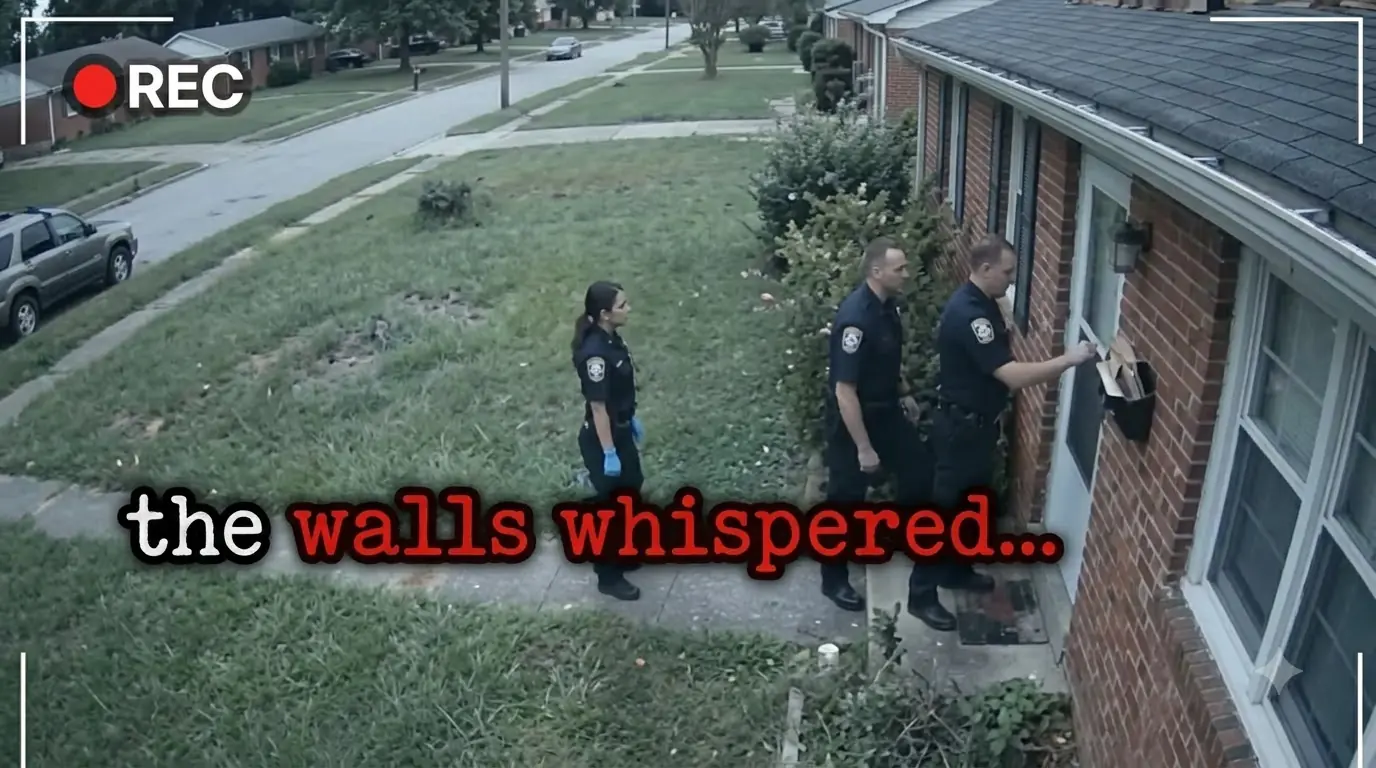
They arrived to find a house that looked ordinary from the outside: neat brick facade, small porch, flower boxes that had once held geraniums but now contained only dried stems. Lewis knocked. No answer. He knocked again, louder.
Still nothing. Police officer Trent Blackwell arrived as backup at 2:52 p.m. Standard procedure for welfare checks. He tried the doorbell. The sound echoed inside the house.
No movement. No response. At 2:58 p.m., Officer Blackwell made the decision to enter. The front door was locked, but the side kitchen door gave way easily.
Too easily. The lock had been forced. The kitchen was dark. The shades were pulled.
A book lay open on the side table. A mystery novel bookmarked at page 147. A half-empty teacup sat on the coffee table. The tea had grown a film of mold.
The television remote sat on the arm of the chair pointing toward a dark screen. Everything suggested she'd simply stood up mid-afternoon and vanished. Officer Blackwell checked the downstairs bathroom. Empty.
He moved toward the bedroom hallway. That's when Karen heard it. A sound, faint, but distinct. It was coming from the walls.
She froze. Lewis was checking the front bedroom. Veronica's sewing room. Officer Blackwell was upstairs checking the second floor.
Karen stood alone in the hallway listening. There it was again. A scraping sound, then a muffled thump. It was coming from behind the wall near the basement door.
She called out to Lewis. He emerged from the sewing room and she gestured toward the wall. They both stood silent, listening. Scrape, thump, scrape.
It wasn't random. It was rhythmic, deliberate. Someone was down there. The basement door was in the kitchen just off the hallway.
Officer Blackwell came down the stairs and joined them. Lewis opened the door and flipped the light switch. Nothing. The bulb was dead or the circuit was cut.
Lewis pulled his flashlight from his belt. The beam cut through absolute darkness. Wooden stairs descended into black. The scraping sound had stopped.
Officer Blackwell went first, weapon drawn. Lewis and Karen followed, their flashlights sweeping the space. The basement was unfinished: concrete floor, exposed beams, a furnace in the corner, boxes stacked along one wall, a washer and dryer in an alcove, and a door. A heavy wooden door set into the far wall.
Padlocked from the outside. The scraping sound started again. It was coming from behind that door. Officer Blackwell approached the door carefully.
He called out, identifying himself as police. The scraping stopped. Then a voice, weak and hoarse but unmistakably human, said, "Help me." It was Veronica Ashford. Officer Blackwell radioed for backup and additional medical personnel.
Lewis grabbed bolt cutters from his emergency kit. The padlock was heavy-duty, meant to secure something permanently. It took three attempts to cut through. The door swung open.
The room behind it was small, maybe 6 ft by 8 ft. No windows. A single bare bulb hung from the ceiling. Currently dark.
The smell was overpowering. Human waste. Unwashed bodies. Fear.
Veronica Ashford sat on a thin mattress on the floor. She was dehydrated, disoriented, and weak. But she was alive. She was not alone.
In the far corner of the room, chained to a support beam by her ankle, was another woman. Younger, maybe late 20s. She had dark hair matted with dirt and sweat. Her eyes were wide with terror and hope.
Her name was Janine Caldwell. She had been missing for 6 weeks. Janine Caldwell disappeared on September 4th from a shopping center parking lot in Westbrook, 15 miles away. She'd gone to Target to buy school supplies for her daughter's kindergarten class.
She never came home. Her husband, Roy Caldwell, reported her missing at 8:00 p.m. that night. Her car was found in the Target parking lot the next morning. Her purse was on the front seat.
Her phone was on the passenger floor, battery dead. There were no witnesses. No surveillance footage of the abduction. No leads.
The case went cold within 2 weeks. Roy Caldwell did television interviews, posted flyers, organized search parties. He begged anyone with information to come forward. No one did.
Janine Caldwell had simply vanished. Now she was found chained in a basement that didn't belong to Veronica Ashford. It belonged to someone else. Someone who had been using this house for something terrible.
As paramedics attended to Veronica and Janine, police swept the rest of the basement. In a corner behind the furnace, they found a workbench. On that workbench, rope, duct tape, zip ties, a stun gun, and a laptop. The laptop was password protected, but it was running.
Someone had been using it recently. Detective Hannah Cross arrived on scene at 3:34 p.m. She took one look at the room, at the two women being brought up the basement stairs, and at the materials on the workbench, and she knew immediately what they were dealing with. This was an abduction site, and based on the supplies and the setup, the perpetrator had done this before. The question was: who?
Veronica Ashford was transported to Mercy General Hospital. She was severely dehydrated and malnourished. She'd been locked in that room for 5 days with minimal food and water. She told investigators that a man had broken into her house on October 13th while she was reading in her living room.
He'd entered through the kitchen door sometime after 3:00 p.m. She heard the door open and stood to investigate. He was in the hallway before she could react. He wore a ski mask. He was tall, over 6 ft.
He spoke calmly, almost politely. He told her he wasn't going to hurt her if she cooperated. Then he forced her into the basement into that room. He locked the door from the outside.
He told her someone would find her eventually. He needed time. He left the house that evening. She heard him moving around upstairs for hours, opening drawers, moving furniture, typing on a computer.
Then silence. For 5 days, she'd been alone in the dark. The only sound was the woman in the corner, chained and silent. Veronica didn't know who she was.
They barely spoke. The younger woman seemed terrified to make noise. Janine Caldwell's condition was worse. She'd been held for 6 weeks.
She was emaciated, traumatized, and barely responsive. She was rushed to the ICU with Lewis and Karen Fletcher accompanying her. Roy Caldwell received the call at 4:12 p.m. His wife was alive. She'd been found.
He broke down on the phone. Unable to speak, he arrived at the hospital at 4:58 p.m. Janine was conscious but sedated. When she saw him, she wept. Roy held her hand and didn't let go.
The police needed to interview her, but they gave the family time. Some things couldn't be rushed. Detective Hannah Cross focused on the basement. The laptop was sent to the digital forensics unit.
The workbench materials were photographed and cataloged. The room itself was processed for fingerprints, DNA, and any trace evidence. The house belonged to Veronica Ashford. She'd lived there for 32 years.
She had no criminal record, no suspicious connections, no reason to be involved in abductions, which meant someone else had access to this house, someone who knew the layout, someone who knew Veronica lived alone, someone who could come and go without arousing suspicion. Detective Cross ran through the possibilities. Family member, neighbor, maintenance worker, piano student. Veronica had only one child, Barbara Simmons.
She was ruled out immediately. She'd been at work in another city when her mother disappeared and had phone records and witnesses to confirm it. The neighbors reported nothing unusual. No strange vehicles, no unfamiliar people.
The house had been quiet for days. Detective Cross requested a list of everyone who had been inside Veronica's house in the past 6 months. Barbara provided names, a plumber who'd fixed a leak in July, a handyman who'd repaired the porch railing in August, and several piano students. Cross started with the handyman.
His name was Eugene Marsh. He was 46 years old, operated a small home repair business, and had lived in the county for 8 years. He had no criminal record. Detective Cross and Officer Blackwell arrived at his apartment at 6:15 p.m. Marsh wasn't home.
His landlord confirmed he hadn't been seen in several days. His work van was missing. His phone went straight to voicemail. Cross obtained a warrant to search his apartment.
Inside, they found a file cabinet containing receipts and client information. Veronica Ashford's address was in that file. So were four other addresses. All four belonged to elderly women who lived alone.
Cross ran the addresses through the system. Three of the women had been contacted by police for various reasons. Welfare checks, reports of suspicious activity, minor thefts. One had reported a break-in 3 months earlier.
Nothing was taken, but her basement door had been forced open. The fourth woman, Lorraine Garrett, had been reported missing 4 weeks earlier. She was 79 years old and lived in Hillside, 12 miles west of Maple Ridge. Her son had requested a welfare check when she missed their weekly Sunday brunch.
Police found her house empty. No signs of struggle. No evidence of foul play. Her car was in the garage.
Her purse was on the kitchen counter. She'd simply vanished. The case was still open. Detective Cross immediately requested a forensics team to re-examine Lorraine Garrett's house, specifically the basement.
The team arrived at Lorraine's house at 8:43 p.m. They went straight to the basement. There, behind a stack of storage boxes, was a door. It had been concealed, easy to miss during the initial search. It was padlocked from the outside.
They cut the lock. Lorraine Garrett was inside. She'd been there for 27 days. She was barely conscious.
Paramedics rushed her to the hospital. She would survive, but her physical and psychological recovery would take months. The room was identical to the one in Veronica Ashford's house. Small, dark, no windows, a thin mattress, a bucket in the corner, and materials on a makeshift shelf.
Rope, duct tape, zip ties, a stun gun. Eugene Marsh had been using these women's homes as holding sites. He'd been doing it for months, possibly years. The manhunt for Eugene Marsh intensified.
His photograph was distributed to every law enforcement agency in the region. His van's license plate was flagged in the automatic license plate reader system. His phone records were subpoenaed. Marsh had been careful.
He used burner phones for most communication. He paid for everything in cash. He had no significant online presence. But he'd made one mistake.
The laptop found in Veronica Ashford's basement contained his digital footprint. The forensics team cracked the password on October 19th. Inside they found files, dozens of files, photographs of women, elderly women, all living alone, maps of neighborhoods, property records, utility schedules, lists of potential targets. Eugene Marsh had been planning abductions systematically, targeting vulnerable women whose disappearances might be attributed to age-related confusion or health crisis.
And he'd been successful. The laptop revealed notes on seven women. Veronica Ashford and Lorraine Garrett were two. Janine Caldwell was a different kind of victim.
Younger, taken from a public location, held longer. The team identified three more names in the files. All three women were reported missing within the past year. None had been found.
Where was Eugene Marsh keeping them? On October 20th, police tracked Marsh's van through license plate readers. It had been spotted twice near a storage facility in Oakidge, 25 miles north. Detective Cross obtained a warrant for the facility.
Marsh rented two units under a false name. Unit 47 and unit 52. The SWAT team breached both units simultaneously at 11:23 a.m. Unit 47 was empty. It contained only supplies, food, water, blankets, cleaning materials.
It was a staging area. Unit 52 was not empty. Inside unit 52 were three women. All three were alive, barely.
Their names were Dorothy Mills, 71, Patricia Hogan, 68, and Sandra Ye, 74. All three had been reported missing within the past 8 months. All three had been held in that storage unit, chained and locked away for weeks. They were rushed to the hospital.
They would survive, but their trauma was profound. Eugene Marsh was not at the storage facility. He'd abandoned the site, likely after learning about the discovery at Veronica Ashford's house. The hunt continued.
On October 21st, a gas station attendant in Milbrook, 40 miles east, recognized Marsh from the news. He'd stopped to fill up his van at 6:34 a.m. The attendant called 911. Police converged on the location. By the time they arrived, Marsh was gone, but he'd left a trail.
His credit card, one he hadn't used in months, had been used at the gas station. It was a mistake born of desperation. The transaction gave police his direction. He was heading east, possibly toward the state border.
At 2:17 p.m., a state trooper spotted Marsh's van on Interstate 70. The trooper attempted a traffic stop. Marsh accelerated. The chase lasted 14 minutes before Marsh lost control of the van on a curved exit ramp.
The van crashed into a concrete barrier. Marsh was pulled from the wreckage with minor injuries. He was arrested at 2:31 p.m. on October 21st. Eugene Marsh was charged with seven counts of kidnapping, seven counts of unlawful restraint, four counts of breaking and entering, and additional charges related to assault and false imprisonment.
Janine Caldwell was his intended long-term victim. The elderly women were, according to investigators, experiments, low-risk targets who allowed him to refine his methods. He'd been escalating. Marsh refused to speak during his interrogation.
His court-appointed attorney entered a plea of not guilty by reason of insanity. The defense argued Marsh suffered from severe dissociative disorder and had no memory of the crimes. Prosecutors disagreed. The laptop files, the meticulous planning, the multiple abduction sites all pointed to a calculated predator.
The trial lasted 3 weeks. The jury deliberated for two days. On March 8th, Eugene Marsh was found guilty on all counts. He was sentenced to seven consecutive life terms without possibility of parole.
Janine Caldwell spent 3 months recovering physically and emotionally. She returned home to her husband and daughter in January. She began therapy and gradually rebuilt her life. She testified against Marsh at trial, describing her captivity in stark, unflinching detail.
When she finished, the courtroom was silent. She would later say that testifying gave her control back. It wasn't justice. Nothing could undo what happened, but it was something.
Veronica Ashford recovered more slowly. The physical injuries healed within weeks, but the psychological impact lingered. She sold the house on Maple Ridge Drive. She couldn't live there anymore.
She moved into a senior community where Barbara could visit more frequently. She never taught piano again. The three women found in the storage unit, Dorothy Mills, Patricia Hogan, and Sandra Ye, also survived, though their recoveries were complicated by pre-existing health conditions and the extended duration of their captivity. All three required long-term care.
Their families filed civil lawsuits against Eugene Marsh, though he had no assets to compensate them. The case prompted changes in how missing persons cases involving elderly individuals are investigated. Previously, many such disappearances were attributed to wandering due to dementia or voluntary relocation without notification. Now, protocols required home inspections, including basements and outbuildings, during welfare checks.
Background checks for home repair workers and contractors were strengthened. Community awareness programs were launched to help elderly residents identify potential threats. Barbara Simmons became an advocate for these changes. She testified before the state legislature, describing her mother's ordeal and the systemic failures that allowed Eugene Marsh to operate undetected for years.
In 2027, the state passed the Ashford Garrett Act, requiring enhanced protections and investigative protocols for vulnerable adults. Paramedic Lewis Brennan was commended for his role in the discovery. He told reporters later that he'd conducted hundreds of welfare checks in his career. Most were false alarms.
Elderly people who had simply forgotten to call family or had unplugged their phones. This one was different. "When I heard that noise from the walls," he said, "I knew something was wrong. You trust your instincts in this job.
That day, our instincts saved lives." Karen Fletcher, his partner, agreed. She'd heard the scraping first. That sound would stay with her. Officer Trent Blackwell, who'd made the decision to breach the home, described the case as the most disturbing of his 15-year career.
He'd seen domestic violence, drug labs, and worse. But the cold calculation of Eugene Marsh's operation haunted him. Detective Hannah Cross worked the case for months after Marsh's arrest, identifying potential additional victims. Two more elderly women who'd gone missing in neighboring counties showed patterns consistent with Marsh's methods.
Their disappearances remained unsolved. Their families still waited. The house on Maple Ridge Drive stood empty for a year before it was sold. The new owners gutted the basement, removing the hidden room entirely.
They renovated the entire property, erasing the physical traces of what happened there. But the neighborhood remembered. Every time a police car drove slowly down the street, residents watched. Every time an unfamiliar van parked nearby, someone called to check.
The sense of safety had been shattered, and it would take years to rebuild. Janine Caldwell returned to the Target parking lot once. She needed to. Roy drove her there on a Saturday morning, 6 months after her rescue.
They parked in the same section where her car had been found. She sat in the passenger seat for 10 minutes, staring at the store entrance. Then she got out. She walked through the automatic doors.
She bought a pack of gum and walked back out. It was a small thing, but it was hers. Roy held her hand on the drive home. Neither of them spoke.
Some victories didn't need words. Eugene Marsh is incarcerated at a maximum security facility. He receives no visitors. He has filed multiple appeals, all denied.
He will die in prison. In interviews, forensic psychologists describe him as a classic organized offender, methodical, patient, and lacking empathy. His victims were objects to him, not people. But they were people.
They had names, families, lives. Veronica Ashford, Lorraine Garrett, Janine Caldwell, Dorothy Mills, Patricia Hogan, Sandra Ye. They survived. That's what matters most.
The house on Maple Ridge Drive is no longer a crime scene. It's a home again. The new owners planted flowers in the boxes on the porch. Children play in the yard.
Life moves forward. But on October 18th each year, Barbara Simmons places a bouquet at the doorstep. A private memorial for the mother who lived, for the woman who was found, for the sound in the walls that changed everything. Some stories don't end, they echo.