Nobody on Flight 728 knew who he was.
And that was exactly the problem.
Because before people knew his name, before they knew his story, before they knew why every person in first class stood up when he walked through the cabin door, they had already decided what kind of man he was.
The first thing most passengers noticed was the color.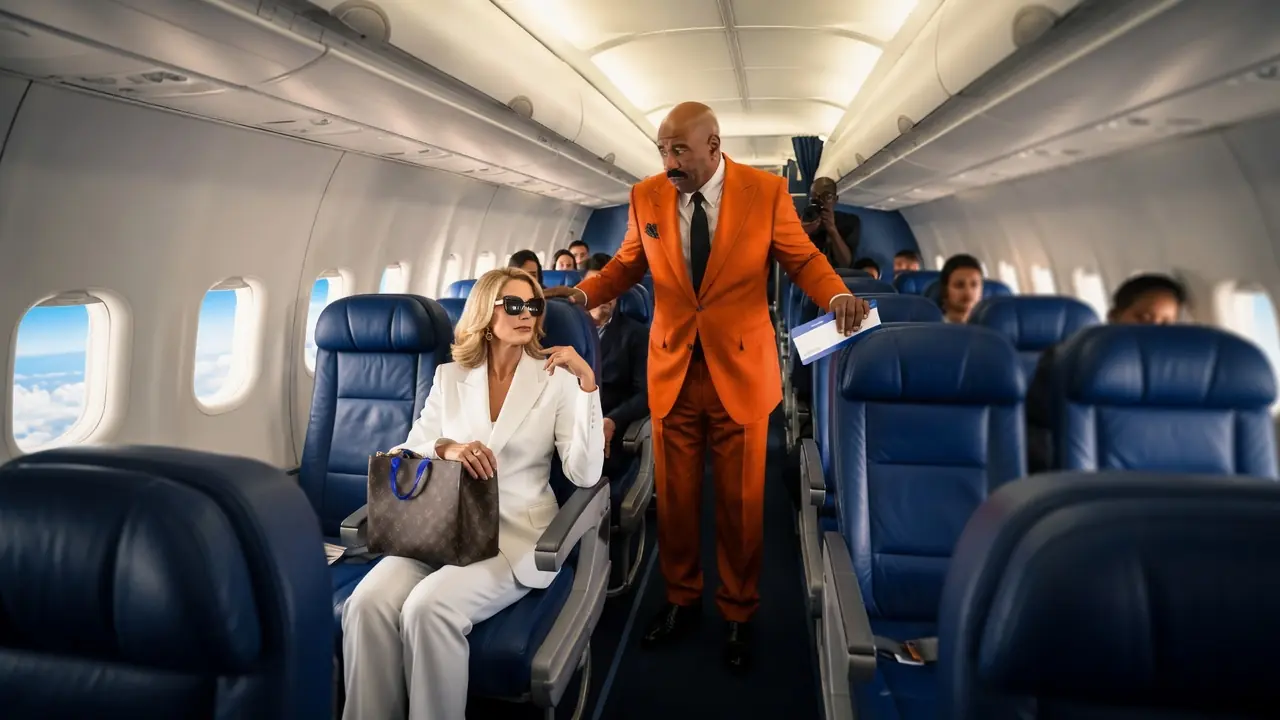
Orange.
A bright, impossible-to-ignore orange suit moving through a sea of navy jackets, gray sweaters, and black business coats.
It looked almost wrong inside the quiet atmosphere of a morning flight from Atlanta to New York.
Then they noticed the man wearing it.
He was tall.
Broad.
A Black man in his late fifties with a shaved head, a neatly trimmed beard, and the calm expression of someone who had spent his entire life walking into rooms where people expected him to prove he belonged.
He carried a small leather briefcase in one hand.
Nothing else.
No assistant.
No bodyguards.
No expensive luggage.
Just a simple briefcase and that unforgettable orange suit.
His name was Marcus Ellison.
But nobody knew that yet.
To most passengers, he was just the unusual man walking down the aisle.
And people are often more honest with their assumptions when they think nobody is watching.
A woman sitting in 3A leaned toward her husband.
“Is he supposed to be here?”
Her husband glanced up from his newspaper.
“What do you mean?”
She lowered her voice.
“I don’t know. He just doesn’t look like someone who flies first class.”
Her husband looked uncomfortable.
“Don’t start.”
“I’m not saying anything.”
But she was.
Everyone was.
Not with words.
With eyes.
A businessman near the window stopped typing on his laptop and watched Marcus carefully.
A young couple whispered to each other.
A flight attendant smiled professionally but kept checking the passenger list longer than necessary.
Marcus noticed.
Of course he noticed.
He had spent decades noticing things other people hoped he wouldn’t.
The pause before someone answered him.
The way security guards followed him longer than they followed others.
The way people sometimes looked surprised when he spoke with confidence.
The world had taught him to read those small moments.
But he had also learned something else.
You cannot spend your entire life fighting every battle someone else tries to start.
Sometimes you simply keep walking.
So Marcus adjusted his jacket, gave the flight attendant a polite smile, and continued toward his seat.
Seat 2D.
First class.
A place where people assumed everyone belonged.
Until someone like him walked in.
The woman in 2C looked at him when he sat down.
Her name was Evelyn Parker.
She was a wealthy real estate investor in her sixties, traveling to New York for a board meeting.
She had expensive jewelry.
A designer handbag.
And the kind of confidence that came from spending her entire life being listened to.
She looked at Marcus’s suit.
Then at his briefcase.
Then back at his face.
“You’re in this section?”
Marcus turned politely.
“Yes, ma’am.”
She looked surprised.
“Oh.”
Just one word.
But Marcus had heard that word thousands of times.
Not because people said it.
Because they felt it.
The quiet surprise.
The invisible question.
Are you really supposed to be here?
Marcus smiled slightly.
“Something wrong?”
Evelyn quickly looked away.
“No. Nothing.”
But there was something.
The entire cabin felt it.
A few minutes later, the plane doors closed.
The engines started.
The passengers settled into their seats.
A flight attendant named Claire Bennett walked through the cabin checking seat belts.
When she reached Marcus, she smiled.
“Mr. Ellison, can I offer you something before takeoff?”
“Coffee would be great.”
“Anything else?”
“No, thank you.”
Claire nodded.
She had seen thousands of passengers.
But she remembered Marcus immediately.
Not because of the suit.
Because of the way he treated everyone.
He thanked the cleaning staff.
He moved his bag so another passenger could pass.
He spoke to the flight attendants like they were human beings, not people serving him.
Small things.
The kind of things nobody notices until they disappear.
The plane lifted into the sky.
For twenty minutes, everything was normal.
Then something changed.
A businessman sitting behind Marcus received a phone call after the plane reached cruising altitude.
He listened for a few seconds.
Then his expression changed.
He looked toward Marcus.
The man next to him noticed.
“What happened?”
The businessman whispered.
“That’s him.”
“Who?”
He pointed slightly.
“The man in orange.”
The other man frowned.
“You know him?”
The businessman shook his head.
“No.”
A pause.
“But I know that name.”
The whisper moved quietly through the cabin.
Not everyone heard it.
But enough people did.
Marcus Ellison.
Some passengers searched the name on their phones.
Some stopped pretending not to look.
And slowly, the expressions changed.
Because Marcus Ellison was not a random businessman.
He was the founder of Ellison Global Technologies.
A company responsible for creating medical systems used in hospitals across the country.
A man who had built a billion-dollar company from nothing.
A man who had donated millions to childhood cancer research.
A man whose story had appeared in newspapers around the world.
The same man some passengers had quietly questioned five minutes earlier.
The same man they assumed did not belong.
Evelyn Parker looked at her phone.
Then at Marcus.
Her face changed.
Because she realized something uncomfortable.
The problem was never the orange suit.
The problem was the story she had created before knowing the truth.
Marcus noticed the change around him.
The sudden silence.
The different looks.
He had seen this transformation before.
People were always more comfortable respecting success than respecting humanity.
But Marcus did not enjoy that moment.
Because he remembered every time nobody knew his name.
Before the company.
Before the money.
Before the recognition.
Back when he was just a young man trying to survive.
A young man who had once sat at the back of buses because people thought he belonged there.
A young man who had walked into interviews wearing his only good suit and watched employers judge him before he ever spoke.
A young man who learned that sometimes the hardest part of success was not achieving it.
It was remembering who you were before people started respecting you.
Marcus looked out the airplane window.
Clouds stretched beneath him like an endless ocean.
And for a moment, he remembered the first person who told him he could become something.
His mother.
A woman who worked three jobs.
A woman who owned two dresses.
A woman who always told him the same thing:
“Marcus, never let someone else’s opinion become the size of your world.”
He carried those words everywhere.
Even onto airplanes.
Even into rooms where people questioned him.
Even when wearing an orange suit nobody understood.
Because Marcus Ellison knew something most people learned too late.
A person’s worth does not begin when the world finally recognizes it.
It was always there.
The world was just sometimes too slow to see it.
For the next hour, the cabin felt different.
Not because anything had changed.
The seats were the same.
The passengers were the same.
The airplane was still thousands of feet above the ground, moving steadily through the morning sky.
But something invisible had shifted.
People were no longer looking at Marcus Ellison with suspicion.
They were looking at him with curiosity.
And Marcus noticed.
He always noticed.
A man sitting across the aisle who had avoided eye contact earlier suddenly smiled and nodded.
A woman who had barely acknowledged him when he sat down now leaned slightly forward, trying to start a conversation.
“Mr. Ellison?”
Marcus looked up.
It was Evelyn Parker.
“Yes?”
She smiled politely.
“I hope you don’t mind me asking.”
Marcus closed his book.
“Not at all.”
“I saw your name online.”
He nodded.
“I figured.”
Evelyn hesitated.
“You’ve done a lot of impressive things.”
Marcus smiled.
“I’ve had a lot of help.”
That answer surprised her.
Most people with his level of success usually talked about themselves.
Their achievements.
Their victories.
Marcus talked about other people.
Evelyn looked at him carefully.
“I have to admit something.”
Marcus waited.
“I judged you when you walked in.”
The honesty caught him off guard.
Not because he had never heard it before.
Because most people never admitted it.
Evelyn looked down.
“I saw the suit. The way you looked. And I made assumptions.”
Marcus nodded slowly.
“Most people do.”
“I’m sorry.”
Marcus looked out the window.
For a moment, he said nothing.
Then he answered.
“Don’t apologize for seeing something you were taught to see.”
Evelyn looked confused.
“What does that mean?”
“It means the problem isn’t just one person.”
Marcus turned back toward her.
“It’s the idea that we know someone’s value before we know their story.”
The words stayed with her.
Because they were not angry.
They were not a lecture.
They were simply true.
Before Evelyn could respond, the cabin suddenly changed.
A flight attendant rushed from the back of the plane.
Her expression was different.
Not panic.
Concern.
Claire Bennett.
She quickly spoke to another crew member near the galley.
Something was wrong.
Passengers noticed immediately.
People always notice fear before they understand the reason.
A child began crying.
A man removed his headphones.
Several people looked toward the back.
Marcus watched carefully.
He had spent years in high-pressure situations.
He knew the difference between normal concern and real trouble.
This was real.
Claire walked toward the front.
“Ladies and gentlemen, please remain calm.”
That sentence never made people calm.
Everyone knew that.
It meant something had happened.
A few passengers began asking questions.
“What’s going on?”
“Is everything okay?”
Claire looked toward the cockpit door.
Then back at the cabin.
“We have a medical situation.”
The words spread quickly.
A medical situation.
Someone was sick.
A passenger near the middle of the plane had collapsed.
A young woman in her thirties.
She was traveling alone.
Her name was Natalie Brooks.
A nurse sitting several rows behind immediately stood up.
“I’m a registered nurse.”
Claire nodded quickly.
“Thank you. Please come with me.”
The nurse rushed forward.
But seconds later, another voice spoke.
“Move.”
Everyone turned.
It was Marcus.
He had already unbuckled his seat belt.
A few passengers looked surprised.
The businessman behind him frowned.
“Why is he getting involved?”
Nobody answered.
Marcus ignored the looks.
He walked toward the aisle.
Claire recognized him.
“Mr. Ellison?”
“I can help.”
The nurse looked at him.
“You’re a doctor?”
“No.”
“Then?”
Marcus knelt beside Natalie.
“I’m a trauma response specialist.”
That was true.
But it was only part of the truth.
For twelve years, before building his company, Marcus had worked with emergency response teams.
He had spent time training medical groups in dangerous environments.
He had seen people collapse.
He had seen panic destroy situations faster than injuries.
The nurse checked Natalie’s pulse.
“She’s having trouble breathing.”
Marcus looked around.
“Do you have an oxygen mask?”
Claire nodded.
“Coming.”
“Good.”
His voice was calm.
Not loud.
Not commanding.
Just steady.
And somehow, everyone listened.
The same passengers who had questioned whether he belonged in first class were now watching him take control of the entire situation.
Marcus looked at Natalie.
“Can you hear me?”
Her eyes opened slightly.
She nodded weakly.
“What’s your name?”
“Natalie.”
“Okay, Natalie. Stay with me.”
She looked scared.
“I can’t breathe.”
“I know.”
Marcus kept his voice low.
“But you’re not alone.”
Those words changed the entire atmosphere.
Because fear spreads.
But so does calm.
Within minutes, the situation was under control.
The nurse continued monitoring Natalie.
The flight crew contacted the ground medical team.
And Marcus remained beside her.
He did not return to his seat.
He stayed.
Just in case.
After everything settled, passengers slowly returned to their routines.
But nobody was looking at Marcus the same way anymore.
Not because of his company.
Not because of his money.
Because they had seen something much more important.
Character.
The businessman behind him leaned forward.
“Mr. Ellison?”
Marcus turned.
“Yes?”
“I owe you an apology.”
Marcus smiled slightly.
“For what?”
The man looked embarrassed.
“I assumed things.”
Marcus nodded.
“You’re not the first.”
The man looked down.
“I thought I knew who you were.”
Marcus closed his briefcase.
“Most people do that.”
A pause.
“Sometimes we don’t judge people because of what we know.”
He looked around the cabin.
“Sometimes we judge them because of what we imagine.”
The businessman had no answer.
Because everyone in that cabin understood.
They had all imagined something about Marcus.
Before hearing him speak.
Before knowing his story.
Before seeing what kind of man he really was.
Several hours later, as the plane began descending toward New York, something unexpected happened.
The captain made an announcement.
“Ladies and gentlemen, before we land, there is something I would like to share.”
The cabin became quiet.
The captain continued.
“Earlier today, a passenger experienced a serious medical emergency. Thanks to the quick response of several people onboard, especially Mr. Marcus Ellison, the passenger received immediate assistance.”
People looked toward Marcus.
He immediately shook his head.
He hated attention.
But the captain continued.
“Mr. Ellison, on behalf of the crew, thank you.”
The cabin filled with applause.
Not loud.
Not dramatic.
Just sincere.
Marcus looked uncomfortable.
He looked down.
The same man who had walked through the cabin wearing a bright orange suit without fear now looked embarrassed by kindness.
Evelyn smiled.
“You don’t like attention.”
Marcus laughed quietly.
“No.”
“Why?”
He looked at the passengers.
“At some point, you realize the things that matter most are usually done when nobody is watching.”
Evelyn remembered those words.
Years later, she would still remember them.
Because that day on Flight 728, she learned something.
The man in the orange suit was never the unusual thing.
The unusual thing was how quickly people decided they knew him.
Before knowing his name.
Before hearing his voice.
Before understanding his heart.
When the plane landed, Marcus picked up his briefcase and prepared to leave.
Passengers stepped aside.
But this time, it was different.
They were not moving away.
They were making room.
A little boy near the exit looked up at Marcus.
“Cool suit.”
Marcus smiled.
“Thank you.”
The boy pointed.
“Why orange?”
Marcus looked at the suit.
For a second, he thought about all the years behind it.
Then he smiled.
“Because my mother told me never to be afraid of being seen.”
The boy nodded like that answer made perfect sense.
Maybe to children, it did.
Marcus walked through the airport doors.
The crowd swallowed him.
Another traveler.
Another person.
Another story.
But everyone on Flight 728 carried the same lesson with them.
A person’s appearance can introduce them.
But only their actions reveal who they really are.
And sometimes the person everyone notices first...
is the person everyone understands last.
Most people who met Marcus Ellison after that flight knew the successful version of him.
The billionaire.
The entrepreneur.
The man whose company changed the way hospitals managed emergency care.
The man whose name appeared on buildings, scholarships, and medical research programs.
But success has a strange way of hiding the years that came before it.
People see the finished house.
They rarely think about the years someone spent carrying bricks.
Marcus Ellison was not born into success.
He was born in a neighborhood where people learned early that dreams needed protection.
His mother, Angela Ellison, worked two jobs.
One during the day at a small grocery store.
Another at night cleaning offices downtown.
She came home exhausted almost every morning, but somehow she always found the energy to ask Marcus the same question.
“How was your day?”
Not because she needed the answer.
Because she wanted him to know that someone cared.
Their apartment was small.
The paint peeled from the walls.
The kitchen window never closed properly during winter.
But Angela always kept one thing in perfect condition.
A small orange scarf hanging near the front door.
Marcus asked about it when he was young.
“Mom, why do you keep that old thing?”
Angela smiled.
“Because everyone needs a little color when life gets dark.”
Marcus never forgot that.
Years later, when people asked why he wore orange, they expected some complicated business explanation.
A marketing strategy.
A personal brand.
A symbol of success.
The truth was much simpler.
Orange reminded him of his mother.
The woman who taught him that being seen was not something to fear.
When Marcus was nineteen, he wanted to become an engineer.
He loved building things.
Taking broken objects apart.
Understanding why they stopped working.
His mother always said he had the patience of someone twice his age.
“You don’t just fix things,” she told him.
“You listen to them.”
Marcus laughed.
“Machines don’t talk.”
Angela smiled.
“Everything tells you what it needs if you pay attention.”
That lesson followed him his entire life.
After college, Marcus applied for dozens of jobs.
Most companies looked at his resume.
Some interviewed him.
Few called back.
The reasons were never spoken directly.
But he understood.
Sometimes people saw his background before they saw his ability.
One interview stayed with him forever.
The company manager looked through his application and asked:
“You grew up in East Monroe?”
“Yes.”
“That’s a difficult area.”
Marcus nodded.
“It was.”
The manager looked at him.
“Must have been hard getting opportunities.”
Marcus answered honestly.
“It was.”
The man smiled politely.
“Well, we’ll let you know.”
Marcus knew what that meant.
He walked out.
Sat on the bus stop bench.
And for the first time in years, he felt something close to giving up.
That night, he came home late.
His mother was waiting.
She noticed immediately.
“Mama knows that face.”
Marcus smiled weakly.
“What face?”
“The face of someone letting another person decide his future.”
He looked at her.
She sat beside him.
“Marcus, listen to me.”
“You cannot control what people see when they look at you.”
“But you can control what you become when they look away.”
Those words changed something inside him.
The next morning, Marcus started again.
Not because the world became fair.
Because he decided unfairness would not decide his life.
Years passed.
He worked.
He studied.
He built.
He failed.
Then he built again.
His first company was created inside a tiny rented office with two employees and a broken coffee machine.
People laughed.
A young man from a poor neighborhood trying to compete with corporations?
Impossible.
But Marcus remembered what his mother taught him.
Listen.
Learn.
Fix.
The company grew slowly.
Then quickly.
Then suddenly, everyone who once questioned whether he belonged wanted to know how he succeeded.
But Marcus never forgot the people who were there before success arrived.
Especially one person.
Dr. Samuel Grant.
A doctor who had treated Marcus’s mother years earlier.
Samuel was the first person who saw Marcus’s potential.
Before the money.
Before the awards.
Before the headlines.
When Marcus was struggling to build his first medical technology prototype, Samuel gave him access to his small clinic.
“You need somewhere to test this.”
Marcus shook his head.
“I can’t afford it.”
Samuel smiled.
“Then build something worth believing in.”
That became the foundation of Marcus’s company.
His goal was never just money.
It was simple.
Make healthcare faster.
Make emergencies safer.
Make sure families did not have to wait helplessly while someone they loved suffered.
Because Marcus understood that feeling.
He remembered waiting outside hospital rooms.
Waiting for doctors.
Waiting for answers.
Waiting for miracles.
That was why, years later, he donated millions to hospitals across the country.
That was why he funded emergency response programs.
That was why, when he saw Natalie collapse on Flight 728, he did not think.
He acted.
Because helping people was never something he learned after becoming successful.
It was something he learned before anyone knew his name.
After the flight landed, Marcus did not attend interviews.
He did not appear on television.
He did not post about what happened.
But someone else did.
A passenger uploaded a short video.
It showed Marcus walking through the cabin.
It showed the medical emergency.
It showed him helping Natalie.
And it showed something else.
The way people looked at him before.
The way they looked at him after.
The video went viral.
The title was simple:
“Everyone Judged The Man In Orange Until They Needed Him.”
Millions watched it.
Some people praised Marcus.
Others criticized the passengers who judged him.
But Marcus refused to join the conversation.
When reporters finally reached him outside his office, one asked:
“Mr. Ellison, what do you think about the people who underestimated you?”
Marcus paused.
Then smiled.
“I think everyone has moments where they see a person and create a story before learning the truth.”
The reporter asked:
“Do you forgive them?”
Marcus looked toward the city.
“I don’t think forgiveness is the most important thing.”
The reporter waited.
“What is?”
Marcus answered:
“Understanding.”
He continued.
“Because people cannot change what they refuse to recognize.”
That response surprised everyone.
Because Marcus had every reason to be angry.
But he chose something else.
He chose to remember.
Not the insults.
Not the assumptions.
The lesson.
Months later, Marcus received a letter.
It came from Evelyn Parker.
The woman who sat beside him on Flight 728.
Inside was a handwritten note.
She wrote:
“Marcus, I have spent my life believing I was a fair person. But that flight showed me something uncomfortable. Sometimes we don’t realize the biases we carry because they feel normal.”
She continued:
“I want you to know that meeting you changed me.”
Marcus read the letter several times.
Then he placed it in a drawer with other important things.
Not awards.
Not business contracts.
Letters.
Moments.
Memories.
Because those were the things that reminded him who he was.
Years later, Marcus visited his mother’s old apartment.
The building had changed.
The neighborhood had changed.
But the front door was still there.
He stood outside for a long time.
Then he noticed something.
The old orange scarf was still hanging inside.
His mother had passed away many years earlier.
But someone in the family kept it there.
Marcus touched the glass of the window.
And he smiled.
Because suddenly he understood.
His mother was never teaching him to wear orange.
She was teaching him not to disappear.
Not to shrink.
Not to let other people’s expectations become his limits.
The world had spent years telling Marcus Ellison where he belonged.
But his mother taught him something stronger.
You don’t find your place in the world.
You create it.
And sometimes the people who stand out the most...
are the people who spent their entire lives being told to blend in.
The man in the orange suit was never just a man wearing bright clothes.
He was a reminder.
That every person walking past you has a story you cannot see.
A battle you do not know about.
A reason they became who they are.
And before you decide someone does not belong...
Maybe take a moment.
Because the person you are judging today...
might be the person who saves you tomorrow.