Burglar Uncovers Shocking Crime During Robbery, Turns Himself In and Exposes Serious Offense
Facts 16/12/2025 23:59
Despite their dramatic name, fire rainbows are neither rainbows nor related to fire in any way. Scientifically, they are known as circumhorizontal arcs, a rare-looking but well-understood optical phenomenon that forms under very specific atmospheric conditions. What makes them captivating is not danger or heat, but geometry, light, and ice suspended high above the Earth.
Circumhorizontal arcs occur only when the sun is positioned higher than 58 degrees above the horizon, which typically happens around midday during late spring and summer. But sunlight alone is not enough. The second essential ingredient is the presence of cirrus clouds — thin, wispy clouds that exist at high altitudes where temperatures are extremely low. At these heights, water vapor freezes into flat, hexagonal ice crystals.
When those ice crystals align horizontally and sunlight passes through them at just the right angle, the crystals act like millions of tiny prisms. The light bends, or refracts, separating into vivid bands of color that stretch parallel to the horizon. The result is a glowing, rainbow-like arc that appears to hover in the sky, often far brighter and more saturated than an ordinary rainbow (NASA; American Meteorological Society).
Unlike rainbows, which require rain droplets and a specific observer position, circumhorizontal arcs can be seen by anyone within a wide area — provided the atmospheric conditions are right. They also differ in shape: instead of a curved arc centered opposite the sun, fire rainbows appear flat, elongated, and detached from the sun itself.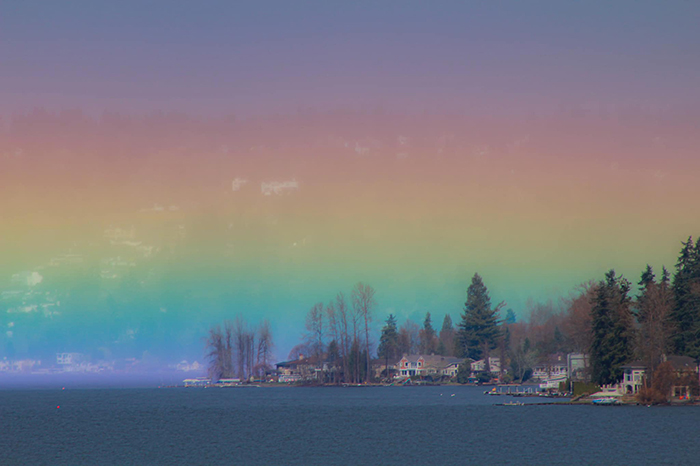
One of the most common misconceptions is that fire rainbows are extremely rare. In reality, their frequency depends largely on geographic latitude.
In regions closer to the equator or at lower mid-latitudes, the sun reaches the required height more often. In the United States, particularly in southern states like California, Texas, and Arizona, circumhorizontal arcs can be observed multiple times each summer. By contrast, in northern and mid-latitude Europe, the sun rarely climbs high enough, making sightings far less common.
Meteorologists estimate that the likelihood of seeing a fire rainbow in Los Angeles is five to ten times higher than in London due to differences in solar elevation and climate patterns (National Weather Service; Met Office UK).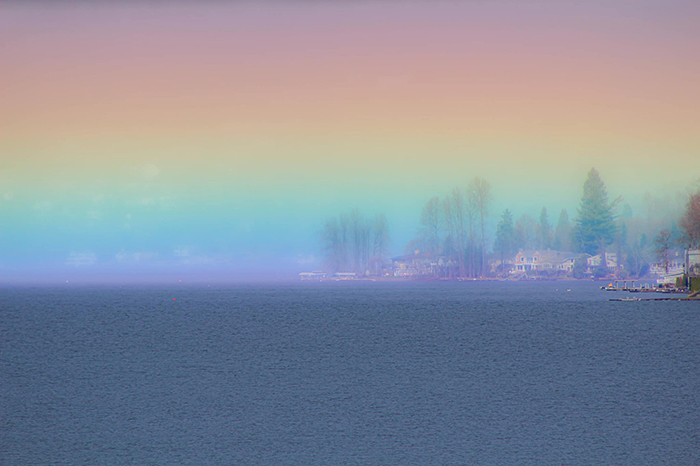
One particularly striking example was captured by photographer Cessna Kutz, who photographed a vivid circumhorizontal arc over Lake Sammamish in Washington State. The image quickly went viral after she shared it on Instagram.
“Witnessed a pretty cool phenomenon out on Lake Sammamish today,” Kutz wrote. “A horizontal rainbow. To me, it felt like a reminder to hold onto hope and love instead of fear and panic in these unknown times.”
The photograph spread rapidly across social media and news platforms. Kutz later told reporters that she had no expectation the image would receive global attention. She described the experience as surreal and expressed gratitude that her work resonated with so many people worldwide (CNN; AccuWeather).
Beyond its aesthetic impact, the viral moment sparked renewed curiosity about atmospheric optics and reminded viewers that many natural phenomena we consider rare are simply misunderstood.
Fire rainbows are a powerful example of how nature creates spectacle not through chaos, but precision. No flames, no storms, no supernatural forces — just sunlight, ice crystals, and geometry aligning perfectly for a brief moment.
They also serve as a reminder that the sky is constantly producing phenomena that go unnoticed unless we happen to look up at the right time. What feels extraordinary is often happening quietly, governed by physics that has existed for millions of years.
In an age where dramatic visuals are often attributed to technology or digital manipulation, circumhorizontal arcs stand out as proof that the natural world still produces imagery more striking than fiction — no filters required.
Here’s what people online had to say