What the hell is this? You're making the whole neighborhood stink with this pile of garbage. The policeman grabbed a bag of oranges and threw it forcefully onto the street. People like you don't belong here. The old black man stood still. His hands didn't move. His voice was low and even. Sir, they've all been paid for. Every single one.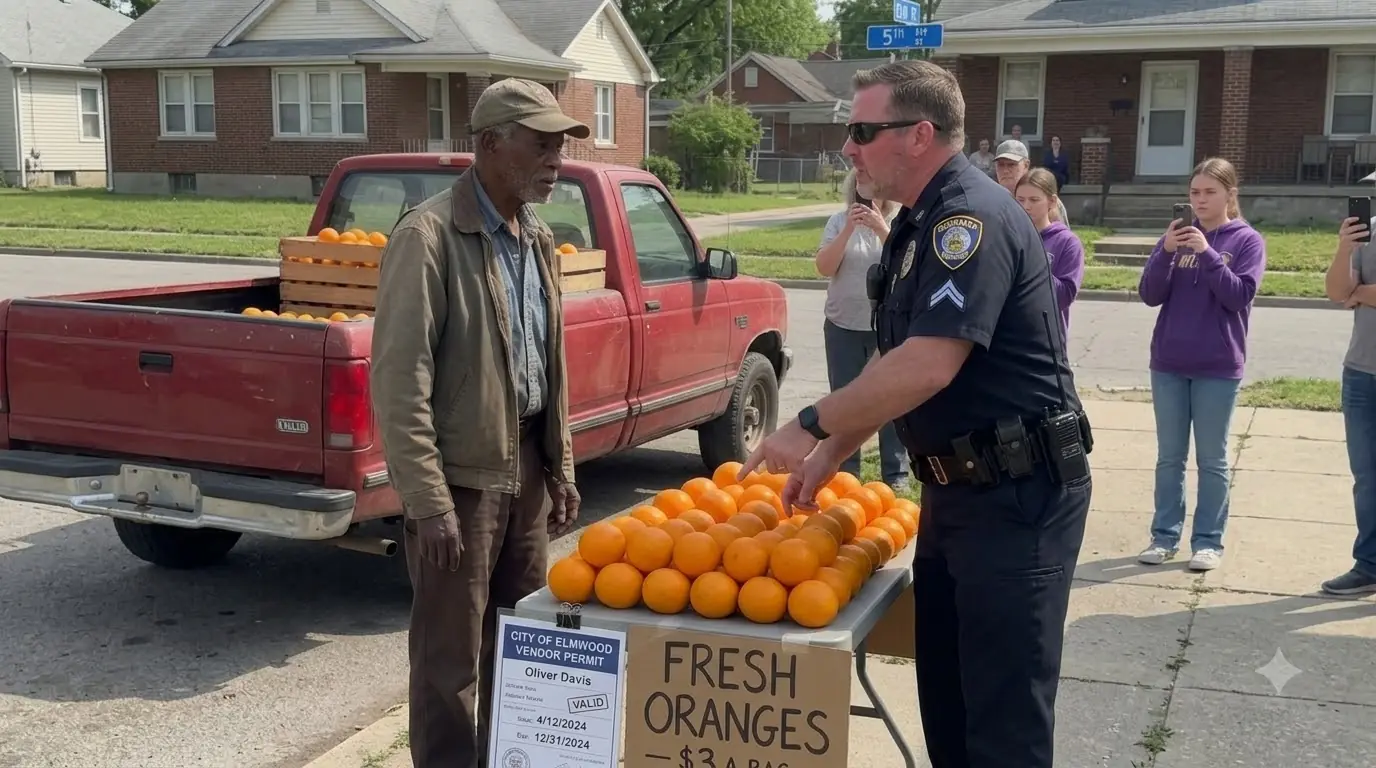
Paid for? The policeman laughed. With what? Food stamps? He crushed an orange under his heel. Orange juice splattered all over the old man's shoes. Now get out of my neighborhood before I drag you away. The old man said nothing. He just looked at the policeman, calm, unfazed. The policeman had no idea that he had just threatened a man whose life could be ruined forever.
Three hours before those oranges hit the pavement, Oliver Davis was already awake. At 5:15 in the morning, no alarm. His body had been waking at this hour for 41 years. Some habits don't retire, even when you do. He sat on the edge of the bed for a moment. The house was quiet. Morning light crept through the curtains and stretched across the wooden floor. He could hear birds outside, a dog barking somewhere down the street, the low hum of the refrigerator in the kitchen.
Oliver stood, put on his slippers, and walked downstairs. The house was modest, three bedrooms, a small yard with a vegetable garden, nothing fancy. But if you looked closely, you'd notice things. A shadow box hung in the hallway near the stairs. Behind the glass sat a row of medals, bronze, silver, ribbons of deep red and blue, the kind of medals most people only see in museums. Oliver walked past them every morning without a glance. To him, they were just part of the wall.
In the living room, a framed photograph sat on the bookshelf, a younger Oliver shaking hands with someone in a dark suit. The other man's face was half hidden behind a glare on the glass. The shelves around it were packed with thick books. Military history, strategy, leadership. But this morning, none of that mattered. This morning, Oliver Davis was just a man making coffee. He filled the pot, the water sputtered, the kitchen filled with the warm, bitter smell of dark roast. He poured a cup, added one sugar, and stood by the window, looking at the sky turning gold over the rooftops.
Dorothy came downstairs in her bathrobe. Forty-two years of marriage, and she still kissed him on the cheek every morning. You're loading up the truck again? she asked. It's Saturday, he said, like that explained everything. She shook her head and smiled. Don't give them all away for free again, Olly. You always come back with an empty truck and an empty wallet. He chuckled. No promises.
By 6:30, Oliver's old pickup was loaded. Twelve crates of oranges from a local farm outside the city. A folding table. A hand-painted sign he'd made three years ago. The paint was fading at the edges. It read, Fresh oranges, $3 per bag or free for kids. He drove 10 minutes to the corner of Elm Street and Fifth Avenue. Same corner every Saturday for three years. The neighborhood knew him. The neighborhood loved him. It was a transitional part of the city, historically black, old brick homes, a barber shop that had been there since the 70s, a church with a cracked parking lot, and a gospel choir that rehearsed with the windows open.
Mrs. Coleman came by first, 80 years old, walked with a cane. Oliver handed her a bag before she could reach for her purse. You keep that, he told her. She patted his hand and called him a saint. A group of kids on bikes circled the table. Oliver tossed each one an orange. They caught them like baseballs and rode off laughing. A young mother stopped with a stroller. Two neighbors argued about football across the street. The church bells rang at 9:00. It was a good morning, warm, peaceful, the kind of morning that makes you forget the world has sharp edges.
Then a patrol car turned the corner. It rolled slow, too slow. The windows were down. The officer behind the wheel scanned the block like he was looking for something specific. One of the neighbors noticed. An older man sitting on his porch leaned over to his wife and muttered, There goes Lawson again. A teenage girl across the street glanced up from her phone, saw the cruiser, and opened her camera app almost instinctive. She'd seen enough to know. The car circled the block once, twice, then it parked.
The driver's door swung open hard. The hinges groaned like they were tired of this, too. Sergeant Craig Lawson stepped out like he owned the entire block. Boots hit the pavement heavy and deliberate, sunglasses on, jaw tight, one hand resting on his belt near the holster, the other tugging at his vest like he was suiting up for a war zone. He didn't look at anyone on the sidewalk. He looked through them, past them like they were furniture. His partner, Officer Pete Sullivan, climbed out on the passenger side, early 30s, sandy hair, soft face. He stayed near the hood of the cruiser, arms folded across his chest, eyes aimed at the ground, the kind of cop who never started anything, but never stopped anything either. A spectator with a badge.
Lawson walked straight toward Oliver's table. No greeting, no nod, no good morning, just a hard straight line across the sidewalk. His shadow cut across the oranges before he even opened his mouth. Oliver saw him coming from 20 feet away. He set down the orange he'd been handing to a neighbor and straightened his back. His posture shifted. Not aggressive, not defensive, just aware. The way a man stands when he feels a storm rolling in, but refuses to flinch.
Lawson stopped less than two feet from the table. He tilted his head and looked at the oranges. Looked at the hand-painted sign. Then looked at Oliver, slow up and down, the way you'd examine something unpleasant on the bottom of your shoe. A long pause, deliberate, designed to make the other person feel small. You got a permit for this little setup? Oliver nodded once. Yes, sir. Three years running now. It's posted right there on the side of the table. He gestured toward the laminated card clipped to the front leg. City seal printed clearly at the top. Issue date, expiration date, vendor category, everything in order, everything visible.
Lawson didn't look at it, didn't turn his head, didn't move his eyes even an inch in that direction. I don't see any permit. That means you're operating illegally on city property. Sir, it's right there. Oliver pointed again, patient. You're welcome to inspect it yourself. Lawson sniffed hard through his nose. Could be fake. Could be expired. I don't know where you got that from. I'm not accepting it. It was issued by the city clerk's office downtown. Oliver's voice stayed level, measured like a man used to speaking in rooms where every word was recorded. You're welcome to call them and verify. I'll wait. I'm not calling anybody for you.
Lawson's voice didn't get louder. It got heavier, lower. The kind of quiet that feels louder than shouting. I'm telling you to pack this whole thing up right now. Don't make me say it again. Oliver exhaled slowly through his nose. His hands stayed at his sides, open, still. Officer, I'd like your badge number, please, and I'd like to speak with your supervisor. The words were polite, respectful even, but something about them landed like a match on gasoline. Lawson's neck flushed red, his nostrils flared wide. He stepped forward, closing the last bit of distance between them, until Oliver could smell the stale coffee on his breath and hear the leather of his duty belt creak with each inhale.
You don't get to make demands here. Not today. Not ever. You understand me? Before Oliver could respond, Lawson reached across the table with both hands. He grabbed a full crate of oranges, 15 pounds of fruit, and flipped it off the edge. The crash split the morning wide open. Wood cracked against concrete. Oranges exploded on impact. They bounced and rolled in every direction into the gutter, across the asphalt, under the tires of parked cars. Juice sprayed across the sidewalk in bright sticky streaks. Pulp and rind scattered like shrapnel. The smell hit instantly. Sharp sweet citrus mixed with hot concrete and dust.
Everything on the block stopped. A woman at the crosswalk covered her mouth with both hands. A little boy pulling a red wagon froze and pointed. The man on his porch stood up from his chair so fast it scraped across the wood. Oliver watched his oranges scatter. Three years of Saturday mornings. Three years of waking before dawn, loading the truck, setting up the table, painting that sign. He watched all of it roll into the gutter in two seconds. His jaw tightened just barely, just enough for someone paying attention to notice. But he didn't step back. He didn't raise his hands. He didn't raise his voice.
Officer, the word came out like it was carved from stone. Those belong to me. You have no legal right to destroy my property. Lawson stared at him like he just heard the funniest joke of his life. What property? This junk. He kicked a loose orange off the curb. It burst against a fire hydrant. You should be thanking me for cleaning up after you. This neighborhood doesn't need your kind turning it into a swap meet. I've been selling here for three years, officer. No complaints, no violations. I am the complaint. Lawson jabbed a thick finger toward Oliver's face, close enough to touch. People like you just set up wherever you want. Make the place look like a third world flea market. Decent folks around here are tired of it. People like you. The phrase hung in the warm morning air like a stain that wouldn't wash.
Oliver said nothing. Not because he had nothing to say, because he knew deeply from decades of experience that nothing he said would reach this man. Two blocks south, Dorothy Davis was walking toward the corner carrying a small paper bag, a water bottle and a turkey sandwich. Same as every Saturday. Her routine. Their routine. She saw the patrol car first, then the oranges on the ground. Then her husband, 68 years old, standing perfectly still while a white officer stood so close to his face she could see the veins in the man's neck from across the street. Her steps slowed, her breath caught. Her hand pressed against her chest like she was holding her heart in place. Then her expression shifted. Confusion first, then disbelief, then something colder, something deliberate.
She reached into her jacket pocket and pulled out her phone, tapped the camera, tapped record. Her hands were trembling, but the phone stayed level. The frame stayed steady. Across the street, the teenage girl from earlier was already live streaming. She held the phone low against her hip, angled upward. The red dot blinked. The viewer count climbed. 50, 100, 300, 500. Comments poured in faster than anyone could read. More people gathered. The barber stepped outside with foil still pressed into a client's hair. Two joggers stopped midstride on the opposite sidewalk. A mail carrier paused his route and stood with his bag hanging open, watching. Everyone was watching. Everyone was recording.
Lawson noticed. He turned his head and counted the phones. Six. Seven. Maybe more. Something flashed across his face. Quick, just a flicker, maybe doubt, maybe calculation, maybe the faintest whisper of self-preservation. Then it was gone and he doubled down. Put the phones away, every single one of you. This is an active police matter and you are interfering with an officer. That's a misdemeanor. Nobody moved. Nobody lowered a single phone. Lawson turned back to Oliver. Slower now, heavier. Last warning, old man. I haven't done anything wrong, officer.
Lawson unclipped the radio from his shoulder strap. The static popped and crackled, sharp, electric, cutting through the thick morning quiet. He pressed the talk button and spoke without looking away from Oliver's face. Dispatch, unit 44. I've got an unlicensed street vendor on Elm and Fifth refusing to comply with a direct lawful order, requesting backup at my location. The radio crackled back, a flat voice. Copy 44. Unit on route. Oliver didn't blink. His feet were planted shoulder width apart. His hands hung at his sides, open, visible, perfectly still. His chin was level. His breathing was even. It was the posture of a man who had stood before generals and senators and presidents. A man who had given orders that moved armies across continents. But Lawson couldn't see any of that. All Lawson saw was a black man who refused to do what he was told.
Sullivan shifted by the cruiser. His arms were still crossed, but his face had gone pale. He rocked his weight from one foot to the other, staring at a crack in the sidewalk. Sarge, he murmured. Maybe we should just let this. I said shut it, Pete. Sullivan pressed his lips together and looked away. The sun climbed higher. The sidewalk baked. Somewhere down the block, church bells rang 10 times. The juice from the crushed oranges was already drying into dark, sticky stains on the concrete, and this was only the beginning.
Lawson held Oliver's driver's license between two fingers like it was something dirty. He tilted it toward the light, squinted, flipped it over, squinted again. Then he walked back to the patrol car and leaned through the open window, running the ID through the system. He took his time. A long time. The kind of time that isn't about checking anything. The kind of time designed to make a man stand on a sidewalk in handcuff distance and sweat. Oliver stood exactly where he was, hands at his sides, feet still. The sun pressed down on the back of his neck. Sweat gathered at his temples, but he didn't wipe it. Three minutes passed. Five. Seven. The neighbors watched. Dorothy watched. The phones kept recording.
Finally, Lawson walked back, slower than before. His jaw was working side to side like he was chewing on something bitter. The ID came back clean. Completely clean. Not a parking ticket, not a warning, nothing. And that made him angrier. He tossed the license onto the ground at Oliver's feet. It spun across the concrete and landed face down in a puddle of orange juice. Pick it up, Lawson said. Oliver looked at the license on the ground. He looked at Lawson. Then he bent down slowly, the way a 68-year-old body bends, and picked it up. He wiped it on his shirt without a word. Lawson watched him do it. A small smile pulled at the corner of his mouth. Then his nose twitched. He sniffed the air, exaggerated, theatrical, the way a bad actor performs surprise. What's that smell? Oliver said nothing.
Something doesn't smell right around your truck. Lawson turned toward the old pickup parked along the curb. I think I need to take a look. There's nothing in my truck but oranges and a folding table. That's for me to decide. Lawson was already walking toward the truck bed. I've got probable cause. No, sir, you don't. Oliver's voice was firm but flat. No anger, no fear, just fact. The Fourth Amendment protects me from an unreasonable search. You need probable cause based on specific facts or a warrant. You have neither. Lawson spun around, his lip curled. Are you a lawyer now, huh? You selling law degrees out here, too? He turned back to the truck and yanked the tailgate open. The metal screamed against its hinges. He climbed halfway into the bed and started throwing things out. A toolbox hit the pavement with a bang that echoed off the houses. Wrenches and screwdrivers spilled across the asphalt. A folded blanket landed in the gutter. A cooler full of water bottles tipped and cracked open. Water pooled around Oliver's shoes. Then Lawson grabbed the last two crates of oranges. He shoved them off the truck bed one at a time. They hit the ground and split apart. Oranges everywhere. The entire sidewalk was covered. Crushed fruit, broken wood, juice running into the storm drain in a thin orange river.
Lawson jumped down from the truck. He wiped his hands on his pants. Nothing illegal. He said it like it was Oliver's fault. But you've got a hell of a mess to clean up. Oliver stared at the destruction. His entire morning reduced to pulp and splinters on the concrete. The toolbox his father had given him 30 years ago was lying open in the street. The blanket Dorothy kept in the truck for cold mornings was soaking in gutter water. He didn't speak. He didn't need to. His silence said more than any words could. And that silence, that absolute unshakable calm was what broke Lawson's last thread of composure.
Lawson stepped directly into Oliver's space, close enough to feel his breath, close enough to count the pores on his skin. You think you're smart? The words came out in a low hiss. You think quoting the Constitution at me makes you better than me? Oliver didn't step back. Didn't lean away. Didn't blink. I know my rights, officer. That's all. Your rights. Lawson almost whispered it like the word tasted rotten. Let me tell you about your rights. His hand shot out and grabbed Oliver by the upper arm. The grip was hard. Hard enough to leave marks on a 68-year-old's skin. He spun Oliver around and shoved him chest first against the side of the pickup truck. The metal was hot from the sun. It burned through Oliver's shirt. Hands on the vehicle now. Spread your feet. On what charge? Resisting a lawful order. Obstruction. Whatever else I feel like writing up. Lawson kicked Oliver's feet apart and began patting him down. Rough, aggressive. His hands moved like they were searching for something he knew wasn't there.
The crowd erupted. Leave him alone! a woman's voice high and sharp. He didn't do nothing. A man from the porch stepping into the street. This is wrong. Somebody call somebody. Voices overlapped and crashed into each other. The teenage girl's live stream now had 4,000 viewers. The comments were a wall of fire. Sullivan stood by the cruiser. His face had gone from pale to gray. His hands were shaking. He opened his mouth twice and closed it both times. He looked like a man watching a building burn and holding an empty bucket. Dorothy was 10 feet away now. Tears ran down her face. Her lips were pressed so tight they'd gone white. But the phone was steady. The camera never moved. She kept recording like her life depended on it. Maybe it did.
Lawson pulled a pair of handcuffs from his belt. The metal clinked. Bright cold. Final. He grabbed Oliver's right wrist and snapped the first cuff on, then the left. The sound of the cuffs locking echoed across the silent block. Oliver, a man who had once commanded over 100,000 soldiers, stood handcuffed against his own truck, surrounded by his own crushed oranges on his own street on a Saturday morning. Lawson stepped back and admired his work. Then he did something that made every single person on that sidewalk hold their breath. He walked to the few remaining oranges on the ground, the ones that had survived the earlier destruction, and he began stepping on them one by one, slowly, deliberately, grinding each one flat under his boot with a slow twist of his heel. The wet crunch of each orange was the only sound on the block. He looked directly at Oliver while he did it. Eye to eye, a smile pulling at his lips. Oops. He ground another one flat. Looks like your little business is closed for today.
A little girl, maybe 6 years old, stood behind her mother's leg, clutching a small bag of oranges Oliver had given her earlier. She was crying, quiet, confused, shaking tears. She didn't understand what was happening. She just knew the nice man who gave her oranges was in handcuffs, and the police officer was smiling about it. Oliver closed his eyes, not in defeat, not in surrender, in restraint. This was a man who had made decisions that shaped the security of nations. A man who had sent soldiers into combat and brought them home. A man who had sat across the table from world leaders and never flinched. He was choosing actively, deliberately, with every fiber of his being to hold his power in reserve because he knew something Lawson didn't. He knew exactly how this was going to end.
Then a second patrol car turned onto Elm Street, but it wasn't backup for Lawson. The car stopped. The door opened. Out stepped Captain Elaine Howard, a black woman in full uniform with captain's bars on her collar. Tall, sharp-eyed, every crease on her uniform pressed to a razor's edge. She had been monitoring dispatch when the call came in. But that's not why she came. She came because the teenage girl's live stream had been flagged on social media. A sergeant in the department's public affairs office had texted Howard directly. You need to see what's happening on Elm Street right now. Howard stood at the edge of the scene and took it all in. One slow sweep of her eyes. An elderly black man in handcuffs. Crushed oranges covering the sidewalk. A truck with its contents thrown across the road. A crowd of angry witnesses, a dozen phones recording, and two officers, one smug, one ghost white.
She walked forward. Her boots were quiet on the pavement. Every step measured. Sergeant Lawson. Her voice cut through the noise like a blade. What exactly is going on here? Lawson straightened up. He shifted into report mode. Automatic rehearsed. Captain, I've got an unlicensed vendor who refused to comply with a lawful. I can see the permit from here, Sergeant. Howard pointed at the laminated card still clipped to the overturned table. It's right there. Lawson's mouth opened. Nothing came out. Howard turned to Oliver. She looked at his face, then at his hat, a faded veteran's cap with a military insignia stitched above the brim. She looked at the hat for a long time. Then her expression changed. Something behind her eyes shifted. Recognition, realization, and then something that looked very much like controlled fury.
She stepped closer. Sir. Howard's voice dropped low, almost private, like she was afraid to say it too loud in case she was wrong. Are you General Davis? General Oliver Davis? The entire block went silent. Even the birds seemed to stop. Oliver, still in handcuffs, turned his head to face her. He nodded once. Slow, simple. Yes, ma'am. I am. Howard's eyes closed for half a second. When they opened, they were on fire. She turned to Lawson. Her voice didn't rise. It didn't need to. It carried the kind of authority that comes from rank, from discipline, from years of earning respect the hard way. Sergeant Lawson, remove those handcuffs right now. Lawson let out a short laugh. Reflex. Nervous, stupid. Captain, with all due respect, I don't care if he says he's the. This man is Lieutenant General Oliver Davis, retired, four stars. Howard stepped toward Lawson with each sentence, 41 years of active service to this country, three distinguished service medals, deputy commanding general of Forcecom. He has commanded more soldiers than you will ever meet in your entire life. She stopped inches from Lawson's face. Remove the handcuffs. Now.
The silence that followed was so thick you could feel it pressing against your chest. Every phone on the block was locked on this moment. The live stream had crossed 12,000 viewers. Lawson's face went through three colors in 5 seconds. Red to white to gray. His mouth hung open like a door with a broken hinge. He reached for his keys. His hands were shaking so badly the keys jingled against each other like loose change. He fumbled with the lock once. Twice. On the third try, the cuffs clicked open and fell away. Oliver brought his wrists forward slowly. Red marks circled both of them, dark against his skin, already bruising. He rubbed them one at a time. No rush, no relief on his face, just patience. The patience of a man who had waited through worse. Then he looked at Lawson, not with anger, not with triumph, with something far more devastating, a steady, unwavering gaze that carried the weight of four decades of command. The kind of look that made colonels stand straighter and generals reconsider. Lawson couldn't hold it. His eyes dropped to the ground.
Oliver spoke, and when he did, every word landed like a gavel. Captain Howard, I want this officer's full badge number and name. I want his direct supervisor's name. I want the incident case number for this interaction, and I want copies of all body cam footage from both officers, unedited, timestamped, and preserved. He paused. Let the weight settle. I will be filing formal complaints with the department's internal affairs division, the city council, the mayor's office, and the Department of Justice Civil Rights Division. I will also be contacting my attorneys. Every word was measured. Every word was precise. This was not a man making threats. This was a man issuing orders. And everyone on that block, including Lawson, could feel the difference.
Lawson opened his mouth. His voice cracked before the first word came out. Sir, I I was just doing my. I didn't know you were. You didn't know what? Oliver cut him off. Not shouting, not harsh. Worse, calm. Absolutely calm. That I was a general. That shouldn't matter, Sergeant. Not one bit. He took one step closer to Lawson. Just one. You should treat every citizen standing on this sidewalk with the same basic dignity. Every single one. Whether they have four stars on their shoulder or four oranges on a table. The fact that you don't, the fact that you chose not to tells me everything I need to know about you. Lawson had no answer. His mouth moved, but nothing came out. His arms hung at his sides like they didn't belong to him anymore. The sunglasses he'd worn like armor all morning were crooked on his face now. He didn't fix them. He looked like a man watching his entire career collapse in real time because he was.
Sullivan hadn't moved from the cruiser. His head was in both hands. His shoulders were shaking. He didn't look up. He couldn't. Then the block came alive. It started with one person clapping, then another. Then the whole sidewalk erupted. Not in chaos, but in something deeper. Vindication. Relief. The kind of sound people make when they've been holding their breath for too long and finally get to exhale. Cheers. Applause. Tears. A man pumping his fist in the air. The woman from the barber shop pressing both hands over her heart. Dorothy pushed through the small crowd and reached Oliver. She wrapped her arms around him so tight her feet nearly left the ground. He held her with one arm, his other hand rested gently on the back of her head. She was still holding the phone, still recording even now. The teenage girl's live stream had crossed 100,000 viewers. The comments were moving so fast they blurred into a single stream of light on the screen.
Howard turned to both officers. Her voice was steel wrapped in ice. Both of you back to the precinct now. Weapons on the hood. Lawson unholstered his sidearm with trembling fingers and set it on the cruiser's hood. Sullivan did the same without being asked. They got in the car, Lawson in the passenger seat this time. Howard drove. Nobody spoke. The crowd watched the patrol car pull away. Someone started a slow clap that rippled down the block. Oliver stood in the middle of his crushed oranges, his wife at his side, and did something nobody expected. He smiled.
By the time Lawson walked into the precinct, Chief Ronald Greer was already standing behind his desk with both fists pressed into the wood. His computer screen was open to the live stream replay. His phone was ringing. It had been ringing for 20 minutes straight. The mayor's office, two city council members, a reporter from the Associated Press, and someone from the governor's communications team. Greer was a 30-year cop, big man, thick neck, the kind of chief who ran a tight department and hated surprises. This was the worst surprise of his career. Lawson was escorted into the office by Captain Howard. He walked in the way men walk when the ground under them has turned to sand, unsure of every step. Sit down, Greer said. He didn't offer coffee. He didn't close the door. Chief, I can explain. The guy didn't have his permit visible. I was following standard procedure. Greer repeated the words like they were poison. He turned the monitor around so Lawson could see himself on screen. Grabbing the crate, dumping it, stomping the oranges, shoving a 68-year-old man against a truck. That looks standard to you, Sergeant. Lawson said nothing.
Greer pressed play on the body cam footage. His own officer's camera had captured everything. Every word, every shove, every sneer. The audio was crisp. You could hear the wet crunch of each orange under Lawson's boot. You could hear the little girl crying. You harassed a retired four-star general of the United States Army. Greer's voice was shaking now, not from fear, from rage. You destroyed his property. You conducted an illegal search of his vehicle. You handcuffed him without cause. You did all of this on camera in front of 50 witnesses on a live stream that currently has, he glanced at his phone, 4 million views and counting. Lawson's mouth opened. Closed. Opened again. I didn't know who he was. That's the problem. Greer slammed his palm on the desk. The coffee mug jumped. You shouldn't need to know who someone is to treat them like a human being.
Down the hall in a separate room, Sullivan was falling apart. Two internal affairs investigators sat across from him with a recorder running. Sullivan's leg bounced under the table. His eyes were red. His voice kept cracking. He told them everything. He told them Lawson had targeted Oliver the moment he saw a black man with a vendor table. He told them Lawson had said in the car before they pulled over, Watch me make this guy's day miserable. He told them there was no smell. No probable cause. No reason for any of it. He told them this wasn't the first time. He does this, Sullivan said, staring at the table. He picks people, always the same kind of people. And I never I never said anything. I just stood there. His statement was 14 pages long.
Within four hours, the decisions came down like dominoes. Lawson was placed on immediate unpaid suspension pending a full internal affairs investigation. His badge was collected. His service weapon was already on the captain's desk. His access to all department systems was revoked before he left the building. Sullivan was placed on paid administrative leave as a cooperating witness. He would face a separate review for failure to intervene, but was told his cooperation would be noted. Chief Greer held a press conference on the steps of the precinct at 4:00 that afternoon. The sun was still high. Cameras lined the sidewalk three rows deep. Microphones bristled from the podium like a steel garden. Greer called the incident deeply disturbing and fundamentally contrary to the values of this department. He pledged a full transparent investigation. He promised accountability. Reporters shouted questions. Greer took three and then walked inside.
Oliver Davis held no press conference that day. Instead, he went home. He sat on his front porch with Dorothy. She brought him a glass of lemonade with too much sugar, the way he liked it. He leaned back in his chair and watched the shadows stretch across the yard as the sun went down. His phone buzzed on the table beside him. Reporters, producers, old military contacts. He let it buzz. Dorothy reached over and held his hand. You okay, Olly? He took a sip of lemonade, looked at the sky. I will be. By midnight, the footage, Dorothy's video and the teenager's live stream had been viewed over 12 million times. Every major network had picked it up. The story was everywhere. And it was only Saturday.
By Monday morning, the story had a name. The internet called it the orange stand incident. It trended on every platform. Cable news ran the footage on a loop. The crate flipping, the oranges bursting, the handcuffs clicking shut on a man who had done nothing wrong. Pundits argued about it. Commentators wept over it. The clip of Lawson stomping oranges while smiling was turned into a symbol overnight. But the real story, the one beneath the surface, was just beginning to emerge. Journalist James Whitfield cracked it open. He worked the city beat for the region's largest newspaper. Thorough, relentless, patient. He filed a public records request within 2 hours of the video going viral. What came back changed everything. Sergeant Craig Lawson had 14 prior excessive force complaints on file. Fourteen. Every single one filed by a black or Latino resident. Every single one dismissed by internal review. Not a single sustained finding. Not one disciplinary action. Not even a written warning in his personnel jacket. Fourteen complaints, zero consequences.
Whitfield published on Tuesday. The article hit like a grenade. By Wednesday, three more victims had come forward publicly. A woman named Gloria Sims told reporters Lawson had destroyed her flower cart on the same block two years earlier. He dumped her buckets, crushed her arrangements under his boots, and told her to take her little garden project back to where she came from. She filed a complaint with the department. Nothing happened. Not a phone call, not a follow-up, nothing. A man named Curtis Hall described how Lawson impounded his food truck over an allegedly missing permit. A permit that was sitting on the dashboard in plain view the entire time. It took Curtis 4 months and $2,000 in fees to get his truck back. His business nearly collapsed. His complaint was marked unfounded. A teenager named Andre Price said Lawson had stopped him on his bicycle three times in a single month, each time for matching a description. Andre didn't match any description. He was 15 years old, riding home from school, wearing his school uniform. His mother filed complaints after each stop. All three were dismissed within a week.
The pattern was undeniable. This wasn't one bad morning. This was years of targeted, systematic abuse aimed exclusively at people of color, protected by a department that buried every complaint and shielded every offender. Whitfield's headline read, 14 complaints, zero consequences. How one sergeant operated without accountability for years. It was shared over 2 million times in 48 hours. By Thursday, the Department of Justice Civil Rights Division announced a formal investigation, not just into Lawson, into the entire department. The scope covered hiring practices, complaint handling procedures, use of force policies, and patterns of racially discriminatory policing. Federal investigators arrived within a week. They brought boxes. They brought subpoenas. They weren't leaving anytime soon.
Oliver gave one interview, just one. He sat in his living room across from a national news anchor. Dorothy sat beside him, quiet, her hand resting on his arm. He spoke the way he always spoke, measured, precise, without a single wasted word. He described the incident plainly, no embellishment, no dramatization. And somehow the simplicity of his account made the cruelty feel even more obscene. Then he said something that stopped the country. I survived that encounter because of who I am. Because I have stars on my record and connections in Washington and lawyers who answer my calls. He paused, looked directly into the camera. But what about the man who doesn't have those things? What about Gloria and her flowers? What about Curtis and his food truck? What about a 15-year-old boy on a bicycle? His voice didn't crack. It didn't waver. The question isn't what happened to me. The question is what happens to them every single day when nobody's recording. That clip, 43 seconds, was viewed over 30 million times. It was played on the floor of the United States Senate. It was quoted in editorials across four countries.
Six weeks later, Sergeant Craig Lawson stood trial in federal court. The charges were severe. Deprivation of civil rights under color of law, a federal felony, destruction of property, false arrest, filing a false police report. Judge Helen Bradford presided, known for two things: fairness and zero tolerance for abuse of power. The prosecution's case was overwhelming. They presented body cam footage, unedited, Dorothy's recording, the live stream. They called Sullivan to the stand and he testified for 3 hours detailing not just that Saturday but months of Lawson's behavior he had witnessed and never reported. They brought the 14 prior complainants. One by one they told their stories. Gloria Sims, Curtis Hall, Andre Price's mother speaking on his behalf because Andre was too anxious to face the courtroom. Each story different in detail, identical in pattern. Expert witnesses testified on racial profiling and the statistical impossibility of 14 minority complaints being coincidental. Lawson's defense argued he followed department procedures. Judge Bradford was unmoved. The jury deliberated less than 4 hours. Guilty. All counts. 36 months in federal prison. Complete forfeiture of his pension, a lifetime ban from any law enforcement position, local, state, or federal. His name entered into the National Decertification Index. Lawson stood motionless as the sentence was read. His attorney placed a hand on his shoulder. Lawson didn't seem to feel it.
Sullivan received 2 years of probation, 200 hours of community service, and mandatory retraining. His cooperation was noted, but his career in law enforcement was effectively over. The consequences didn't stop at the courtroom. Chief Ronald Greer resigned 3 weeks after the DOJ investigation released its preliminary findings. The report described a systemic culture of complaint suppression, inadequate oversight, and racially disparate policing outcomes. His resignation letter was one paragraph. He admitted nothing, but he was gone. The city council moved fast. Within two months, they passed a package of reforms. An independent civilian review board with full subpoena power, mandatory body cam activation for all interactions, no exceptions, no manual override. A codified duty to intervene policy requiring any officer who witnesses misconduct to act immediately or face termination.
Oliver was invited to the signing ceremony at city hall. He stood at the back of the room. He didn't want the podium. But he brought someone with him, the little girl from that Saturday morning, the one who had stood behind her mother's leg clutching a bag of oranges and crying. Her name was Amara, 6 years old, yellow dress. She held a single orange in both hands. When the mayor signed the last page, Amara walked forward and handed him the orange. The room went silent. Then it erupted. An Associated Press photographer captured the moment. A four-star general standing behind a six-year-old girl in a yellow dress handing an orange to the mayor of the city. The image ran on the front page of 11 newspapers the next morning. It became the photograph that defined the entire story.
The following Saturday, Oliver Davis drove his old pickup truck to the corner of Elm and Fifth. Same corner, same time, same folding table, same hand-painted sign. He'd touched up the faded letters with a fresh coat of blue paint the night before. But this Saturday was different. There was a line around the block. People from every part of the city had come. Some drove 40 minutes. Some took the bus. They didn't all come for oranges. They came to shake his hand, to say thank you, to stand on the same sidewalk where a man had refused to break and feel something real beneath their feet. Oliver greeted every single person. He shook hands. He hugged strangers. He let a little boy try on his veteran's cap and saluted him when the boy saluted first. He didn't charge a cent that day. Every orange was free. Dorothy stood beside him the entire morning. She wore a yellow sundress, the same shade as Amara's, and smiled so wide her cheeks hurt by noon. She told a reporter, He's always been like this. He just needed the world to see it.
By afternoon, the table was empty. Every crate cleared. Oliver folded up the table, loaded it into the truck, and stood for a moment looking at the corner. The pavement was clean now. No crushed fruit, no broken wood, just a sidewalk in the sun. The neighborhood began to change after that. Not through displacement, but through dialogue. Old residents and new residents formed a community board together. They held monthly meetings at the church with the gospel choir. Oliver was named honorary chair. He attended every meeting. He mostly listened. He was offered book deals, speaking tours, consulting contracts. He accepted a few and donated every dollar to a legal defense fund he created for victims of police misconduct. He didn't name the fund after himself. He named it after Gloria Sims, Curtis Hall, and Andre Price, the ones nobody knew about until it was almost too late. The fund's first case was a young father in a neighboring city who'd been falsely arrested at a grocery store in front of his daughter. Oliver's attorneys took it pro bono.
That Saturday morning, the one with the crushed oranges and the handcuffs and the smiling cop, had started as the worst day of Oliver's year. It became the first day of something much bigger. This story started with a man and a table and a bag of oranges. It started with a cop who saw skin color before he saw a human being. It started the way these stories always start with someone deciding that another person didn't matter. But it didn't end there. It ended with a courtroom, a guilty verdict, a resignation, a new law, a little girl in a yellow dress handing an orange to a mayor. It ended with a man standing on the same corner the next Saturday giving away free fruit to a line that stretched around the block. It ended with change.
Something about this story won't let me go. The system only cares when the wrong person gets hurt. When it's somebody powerful, somebody famous, somebody with connections, then everybody moves. There's an investigation. They say reform. But when it's a regular person, silence. Nothing. Move along. And that's backwards. Justice shouldn't need a famous name to wake up. It should work the same for everybody. The person with nothing should get the same protection as the person with everything. That's not a dream. That's supposed to be the promise. And we are breaking it every single day. And here's what I also learned. You don't have to fight back to win. Sometimes the strongest thing you can do is stay who you are. Don't let them turn you into something angry, something ugly, something they can point at and say, See, I was right. Just stay. The truth always comes out. Maybe slow, but it will come. So if you ever feel like nobody's listening, don't give up. Keep going. Your moment is coming.