Captain Clayton Reeves liked to say the sky still belonged to men who earned it the hard way.
He had been saying it for so long that nobody at Meridian Sky Airlines bothered correcting him anymore. Younger pilots nodded politely, senior flight attendants learned when to keep quiet, and station managers avoided putting anyone “difficult” in his cockpit. Difficult, in Clayton’s vocabulary, meant anyone who did not laugh at his jokes, accept his temper, or treat his four gold stripes like a royal crown.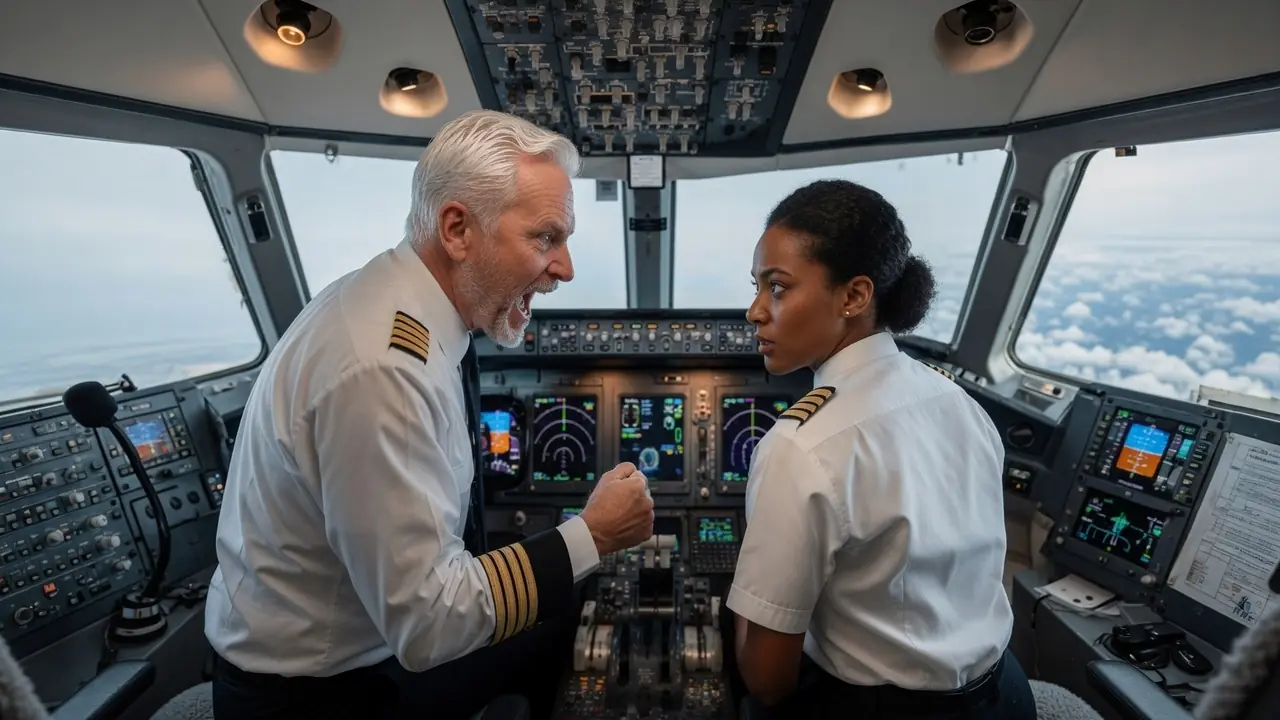
That rainy Thursday morning at Newark Liberty International Airport, Clayton arrived at Gate C72 with the swagger of a man walking into a room already owned by him.
Outside the terminal windows, rain streaked across the glass and blurred the lights of the wide-body jet waiting on the ramp. Meridian Flight 306 was scheduled for Rome, a full overnight run with nearly three hundred passengers, a heavy fuel load, and a crew already anxious about the weather system sitting over the Atlantic. Inside the cockpit of the Airbus A350, Clayton settled into the captain’s seat like a judge taking the bench.
He was sixty years old, broad in the chest, silver at the temples, and proud of every line on his face because he believed each one proved he had survived aviation before it became soft.
To him, modern airlines had lost their nerve. They cared too much about training language, diversity panels, sensitivity modules, and young pilots who asked questions instead of taking orders. Clayton missed the days when a captain could bark once and everyone around him jumped twice.
“Coffee,” he called without turning around.
The lead flight attendant, Janice Bell, appeared at the cockpit door with the cautious smile of someone who had learned his moods by heart. She had worked with Clayton for eight years and knew exactly how hot he wanted his coffee, how little patience he had for delays, and how quickly his irritation could become everyone else’s problem. She handed him the cup with both hands, careful not to spill even a drop.
“Black, no cream,” she said.
Clayton took it without looking at her. “At least somebody still knows how to do a job.”
Janice gave a small, tired laugh because it was easier than silence and safer than honesty. Behind her, the rest of the cabin crew moved through the aircraft, checking galleys, straightening blankets, and preparing for boarding. Nobody loved flying with Clayton Reeves, but everyone had learned to survive him.
Clayton glanced at the crew roster on his tablet and frowned.
His assigned first officer had changed overnight. The original copilot, a man named Peter Lowell, had called in sick after a stomach bug tore through the crew hotel. Scheduling had replaced him at 5:10 that morning, and Clayton had not bothered reading past the first line because he assumed the company had sent him another young nobody who would follow orders and keep quiet.
Then the cockpit door opened.
“Good morning, Captain Reeves,” a calm voice said.
Clayton turned his head slowly.
The woman standing in the doorway was not what he expected. She was Black, somewhere in her late thirties, with steady brown eyes, a clean uniform, and posture so composed it made the narrow cockpit feel larger. Her hair was pulled back neatly, her three-stripe epaulets were sharp, and her flight bag looked worn in the way real pilots’ bags get worn from actual miles.
She extended her hand. “First Officer Amara Whitfield. I’ll be flying right seat to Rome.”
Clayton looked at her hand, then at her face, then back at the hand.
He did not take it.
“There’s a problem,” he said.
Amara lowered her hand slowly, but her expression did not change. “What problem would that be?”
Clayton leaned back in the captain’s chair and gave her the kind of look men like him reserve for people they have already dismissed. “Crew scheduling must have made a clerical error.”
“They did not,” Amara said. “I confirmed the assignment before leaving the hotel. I’m qualified on the A350, fully rested, and current for international operations.”
Clayton gave a short laugh. “Current. That’s a lovely word.”
“It is also the relevant one.”
His smile disappeared.
He stood, filling the small space between the seats, and rested one hand on the back of the first officer’s chair. It was not quite a shove, not quite a threat, but it was enough to block her from sitting down. Amara noticed it, glanced at his hand, and then looked back at him.
“I am going to say this once,” Clayton said. “This is my aircraft.”
“It is Meridian’s aircraft,” Amara replied.
His jaw tightened.
Janice, still near the doorway, froze with the coffee tray in her hand. She had seen Clayton snap at copilots before, but this felt different from the start. It had a bitterness underneath it that no amount of professional language could hide.
Clayton leaned closer. “I don’t fly long-haul international with political placements.”
Amara’s eyes narrowed slightly. “Political placements?”
“You know exactly what I mean.”
“I want you to say exactly what you mean.”
Clayton smiled, and it was an ugly thing.
“I mean I’m not taking a diversity pick across the Atlantic with nearly three hundred souls behind me.”
The cockpit went silent.
Even the rain seemed louder against the windshield.
“My training record is available to you,” she said. “My simulator evaluations are clean. My check rides are current. My last A350 crossing was eleven days ago.”
Clayton waved his hand as if brushing away a fly. “Numbers on paper don’t make a pilot.”
“No,” she said. “Flying does.”
He laughed again, louder this time, hoping the sound itself would make her smaller. “Listen, sweetheart, I have thirty-four years in this business. I know who belongs in a cockpit and who was put here to make a boardroom photo look better.”
Janice whispered, “Captain…”
He snapped his head toward her. “Did I ask you?”
Janice shut her mouth.
Amara looked at the lead attendant for one second, then back at Clayton. That one glance told her more than a complaint file ever could. This was not a bad morning. This was a culture that had been trained to bend around one man’s behavior until bending felt like policy.
“Captain Reeves,” Amara said, “are you refusing to operate this flight with me because I am a Black woman?”
Clayton’s eyes flashed. “I am refusing because I don’t feel safe with you in the right seat.”
“Based on what evidence?”
“Based on instinct.”
“Instinct is not evidence.”
“It is when it comes from thirty-four years of command.”
Amara reached into her jacket pocket and removed her phone, not quickly, not dramatically, just deliberately. Clayton saw the movement and smirked, thinking she was about to call scheduling and complain. Men like Clayton always assumed procedure existed to protect them from consequences, not to deliver those consequences to their door.
“Before I make this call,” Amara said, “I need your answer clearly. Are you ordering me off this aircraft?”
Clayton folded his arms.
“I am ordering you off my flight,” he said. “Tell them to send me a real pilot.”
Amara studied him for three quiet seconds.
Then she smiled faintly.
It was not a warm smile. It was the kind of smile a woman gives when the trap is no longer theoretical.
“All right, Captain,” she said. “I’ll make the call.”
She turned and walked out.
Clayton sat back down, satisfied. He lifted his coffee, took a long drink, and let the warmth settle his nerves. He believed he had protected his cockpit from what he saw as corporate foolishness.
He had no idea that the woman walking down the jet bridge was not calling crew scheduling.
She was calling the chairwoman of the board.
Chapter 2
Amara stopped halfway down the jet bridge, where the noise from the terminal faded and the rain-washed plane filled the window beside her.
Passengers were already gathering near the gate. A few held neck pillows, a few clutched passports, and one little boy pressed his face to the glass, excited to see the jet that would carry him across the ocean. They had no idea their flight was being delayed because a captain with four stripes had mistaken prejudice for authority.
Amara opened a secure contact and pressed the first name.
It rang once.
“Amara,” a woman answered. “You should be in preflight.”
“I was,” Amara said. “Captain Clayton Reeves has refused to fly with me.”
There was a pause.
On the other end was Evelyn Hart, chairwoman of Meridian Sky Airlines and one of only four people in the company who knew Amara’s true position. Evelyn had been a close adviser to Amara’s late father, James Whitfield, the founder of Meridian Sky. When James died the year before, he left controlling ownership to his daughter, but Amara refused to step directly into the executive office.
She wanted to see the company from the inside first.
Not through reports.
Not through filtered surveys.
Through jumpseats, hotel vans, crew lounges, dispatch calls, and cockpit doors.
“What exactly did Reeves say?” Evelyn asked, her voice turning hard.
“He said he doesn’t fly with diversity picks. He blocked me from the seat and told me to have scheduling send him a real pilot.”
“Good God.”
“He doesn’t know who I am.”
“No,” Evelyn said quietly. “Of course he doesn’t.”
Amara looked through the window at the aircraft. “That’s the point. My father told me Meridian had ghosts in the walls. I didn’t understand how comfortable those ghosts were until now.”
“I can have airport security remove him immediately.”
“Not yet.”
“Amara.”
“I need witnesses,” Amara said. “I need to know who stands there and who steps forward. Send Victor Gaines down from operations. He’s at Newark this morning, isn’t he?”
“He is.”
“Good. Tell him to come to Gate C72. Tell legal to stay awake. And Evelyn?”
“Yes?”
“Start preserving every camera angle from the jet bridge, the gate, and the aircraft.”
Evelyn did not ask why.
She had known Amara since she was a girl running through hangars behind her father, asking mechanics why engines sounded different in winter. She also knew that when Amara’s voice became this calm, something decisive was about to happen.
“I’ll make the calls,” Evelyn said.
Amara ended the call and walked back toward the gate.
The gate agent, a young man named Luis Ortega, looked up with worry already written across his face. “First Officer Whitfield, Captain Reeves just told us boarding is on hold. He said there’s a crew issue.”
“There is,” Amara said.
Luis lowered his voice. “Do you need me to call scheduling?”
“No. I need you to document exactly what I’m about to say.”
He blinked. “Okay.”
“Captain Reeves has refused to fly with me because I am a Black woman. He has ordered me off the aircraft despite my assignment and qualifications. I am returning to the cockpit now to give him one final opportunity to correct himself.”
Luis went pale.
Several passengers near the counter heard her. The change in the gate area was immediate. Conversations stopped, heads turned, and phones began rising from pockets and purses. Amara did not perform for them, but she did not hide from them either.
That was another lesson her father had taught her.
When wrongdoing wants darkness, open the blinds.
She stepped back onto the jet bridge and returned to the aircraft.
In the forward galley, Janice stood with two other flight attendants, whispering quickly. The moment Amara entered, all three went quiet. Inside the cockpit, Clayton was laughing into his phone.
“No, I handled it,” he said. “They tried to stick me with one of those corporate poster pilots. I told her not on my aircraft.”
Amara stood in the doorway. “Hang up.”
Clayton turned, surprised first, then furious. “Why are you back?”
“Because my job is here.”
“Your job is wherever I allow it to be.”
“No,” she said. “Your authority ends where discrimination begins.”
Clayton ended the call and rose again, face reddening. “You want to play this game in front of people? Fine.”
He pushed past her into the forward galley and grabbed the cabin interphone handset. Janice reached toward him instinctively, then stopped herself before touching his sleeve. Amara saw that too.
“Begin boarding,” Clayton barked.
Luis appeared at the aircraft door, eyes wide. “Captain, we were told to hold.”
“I said begin boarding.”
Janice looked at Amara, then at Clayton.
Then she looked away.
Luis hesitated only a moment before passengers started filing onto the plane. They entered carefully, sensing something was wrong before anyone explained it. Business class filled first, then premium economy, then a slow line of passengers moving deeper into the cabin while Clayton stood at the front like a man preparing a speech at his own monument.
When enough passengers had boarded to create the audience he wanted, Clayton lifted the handset.
“Ladies and gentlemen,” he said through the cabin speakers, his voice smooth and confident. “This is Captain Reeves. We are currently delayed because Meridian Sky has assigned an individual to the cockpit who, in my professional judgment, is not suitable for this transatlantic operation.”
A wave of murmurs moved through the cabin.
Amara stood near the cockpit door, hands relaxed at her sides.
Clayton turned slightly, making sure everyone could see who he meant. “I have requested a qualified replacement. Unfortunately, this person refuses to leave the aircraft, which means your travel plans are being held hostage by corporate politics.”
A woman in row three gasped.
A teenager near the aisle began recording openly.
Clayton continued anyway because arrogance often mistakes attention for support. “I will not risk your safety for optics. I know that may offend people, but I was hired to fly airplanes, not participate in social experiments.”
He lowered the handset and looked at Amara.
“There,” he said. “Now they know.”
Amara took one step forward. “They certainly do.”
He frowned.
She reached for the handset, and Clayton almost pulled it away before noticing how many phones were pointed at him. Instead, he let her take it, smirking as though he had just handed a child a toy.
Amara pressed the button.
“Ladies and gentlemen, this is First Officer Amara Whitfield. I apologize for the delay and for the unprofessional conduct you have just witnessed. I am fully qualified on this aircraft, current on this route, and assigned legally to this flight.”
Clayton rolled his eyes.
She turned her head slightly toward him, then continued. “Captain Reeves has refused to operate this flight with me after referring to me as a diversity pick and demanding a real pilot. I have asked him to clarify whether his refusal is based on my race and gender. He has not provided any operational evidence for his decision.”
Clayton’s smirk began to fade.
A man in row one said, “That’s outrageous.”
Someone else muttered, “We heard him.”
Then movement came from the jet bridge.
Victor Gaines, regional director of operations, entered the aircraft breathing hard, rain still clinging to his suit jacket. He looked at Clayton, looked at the passengers, then saw Amara holding the handset.
His face went white.
“Ms. Whitfield,” he said softly. “I came as quickly as I could.”
Clayton snapped his head toward him. “Ms. Whitfield? Victor, good. Tell this woman to get off my airplane so we can leave.”
Victor swallowed.
“Captain Reeves,” he said, “you need to stop talking.”
Clayton stared at him. “Excuse me?”
Amara lowered the handset and removed a slim black credential from inside her blazer. It was not the standard crew ID hanging from her lanyard. It was a matte executive card marked with Meridian Sky’s highest corporate access seal.
Only a handful existed.
She held it up so Clayton could see it.
“My full name is Amara James Whitfield,” she said. “Daughter of James Whitfield, majority owner of Meridian Sky Airlines, and acting chief executive officer of this company.”
The cabin went silent.
Victor stared at the floor.
Clayton’s mouth opened slightly.
Amara’s voice did not rise. “Captain Reeves, effective immediately, you are relieved of command. Your employment is terminated for gross misconduct, discriminatory behavior, operational disruption, and violation of company safety culture standards.”
Clayton looked as though someone had pulled the world out from under his feet.
“You can’t,” he whispered.
“I just did.”
Chapter 3
For ten full seconds, nobody moved.
Clayton Reeves stood in the forward galley with a captain’s uniform on his body and no authority left inside it. His face had lost its color, and his hands hung awkwardly at his sides. The passengers watched him the way people watch a building after hearing the first crack in the foundation.
Then the cabin erupted.
Not all at once, not like a cheering stadium, but in pockets of applause, shocked whispers, and phones capturing the moment from every possible angle. Someone in business class said, “Good for her.” A woman near the bulkhead wiped tears from her face. An older man who had remained silent during Clayton’s speech now refused to look at him at all.
Clayton turned toward Victor. “You know me.”
Victor said nothing.
“I’ve flown here for three decades.”
Victor’s voice came out low. “I know.”
“This is a misunderstanding.”
“No,” Amara said. “A misunderstanding is a wrong gate number. This was a decision.”
Clayton tried to recover himself. Men like him always reached for rank when character failed. “I have a union contract. There are procedures. You can’t publicly fire me like some baggage handler.”
“You publicly humiliated a fellow pilot in front of passengers,” Amara said. “You turned a flight deck into a hostile workplace and delayed an international departure because your ego could not survive my presence.”
His eyes darted around the cabin, looking for sympathy.
He found none.
Port Authority officers arrived at the aircraft door with two Meridian security supervisors behind them. Clayton saw the officers and suddenly became smaller. He unclipped his crew badge with shaking fingers and held it as if surrendering a medal from a war he had imagined himself winning.
Victor took it.
Clayton looked at Amara. “Please.”
The word landed strangely in the cabin.
A few minutes earlier, he had called her a corporate experiment. Now he wanted mercy from the person he had tried to erase. Amara studied him for a moment, not with pleasure, not with pity, but with the weary disappointment of someone who had expected ugliness and still hated seeing it confirmed.
“You may leave with dignity,” she said. “Do not force anyone to remove what little is left of it.”
Clayton walked out between the officers.
No handcuffs.
No shouting.
Just the dead quiet of a man understanding too late that power borrowed from fear disappears when fear stops obeying.
Amara turned to the cabin crew.
Janice stood closest, pale and trembling. Two younger attendants were crying silently near the galley curtain. A male attendant named Owen stared at the floor like he hoped the carpet might open and save him from being seen.
“Janice,” Amara said.
“Yes, ma’am.”
“How long has he spoken to people like this?”
Janice swallowed. “Captain Reeves has always been… difficult.”
“That is not what I asked.”
Janice’s eyes filled. “Years.”
“And what did the crew usually do?”
“We tried to keep things moving.”
“By staying quiet.”
Janice flinched.
Amara looked at the rest of them. She saw fear, regret, shame, and something even more dangerous than all three: habit. They had not created Clayton Reeves, but they had adapted around him so completely that his behavior became part of the furniture.
A toxic culture rarely survives because one cruel person is loud.
It survives because everyone else learns the choreography.
“You watched him block me from the cockpit,” Amara said. “You heard him insult my qualifications based on race and gender. You saw him turn the passengers into an audience for discrimination, and no one activated a safety report, called operations, or challenged the breach.”
Owen lifted his head. “He was the captain.”
“He was wrong.”
“We’re trained to respect command authority.”
“You are trained to respect lawful command authority,” Amara said. “You are also trained to protect passengers, protect the crew environment, and report unsafe behavior. A captain who cannot control his prejudice cannot be trusted with cockpit judgment.”
Janice covered her mouth.
Amara took a breath. This was the part that did not feel satisfying. Removing Clayton was easy because Clayton had made himself impossible to defend. Facing the silent machinery around him was harder.
But her father had not left her an airline so she could treat symptoms while protecting the disease.
“Victor,” she said.
“Yes, ma’am.”
“Relieve the entire cabin crew from duty.”
Janice’s eyes widened. “Ma’am, please.”
“Effective immediately,” Amara continued. “Their employment status will be terminated pending final review by legal and ethics. They may appeal through proper channels, but they will not operate another Meridian flight unless the investigation clears them.”
One of the younger attendants began sobbing. “We didn’t do anything.”
Amara looked at her gently, and somehow that made it worse.
“That is exactly the problem.”
The words settled over the galley like smoke.
Amara picked up the PA handset again.
“Ladies and gentlemen, this is Amara Whitfield. I apologize once more for the disruption. For your safety and comfort, we will briefly deplane while Meridian assigns a new flight crew. Every passenger will receive compensation, meal vouchers, and a written explanation from my office. This aircraft will not depart until I am confident every person operating it deserves your trust.”
The applause came stronger this time.
Not wild.
Not performative.
Just steady.
Passengers began leaving the aircraft, many pausing to nod at Amara as they passed. One elderly woman touched her sleeve lightly and whispered, “Your father would be proud.” Amara did not know how the woman knew whose daughter she was, but the words struck deep enough that she had to look away.
Twenty minutes later, Clayton Reeves stood outside security without his badge, without his crew access, and without the myth that had protected him for years.
His phone would not stop buzzing.
The first videos had already reached social media. By the time he stepped into the terminal concourse, airport televisions were showing his face under breaking news banners. The headline moved faster than he could breathe: Meridian Sky CEO, Flying Undercover, Fires Captain After Racist Cockpit Refusal.
Clayton stared at the screen as if watching another man ruin his life.
But the voice was his.
The face was his.
And the world was finally hearing what Meridian employees had heard for years.
Chapter 4
By nightfall, Clayton Reeves had become a national scandal.
Morning shows played the clip. Aviation forums dissected it frame by frame. Former crew members posted stories anonymously, then less anonymously, then with their names attached. Some described insults, some described intimidation, and some simply wrote, “We all knew.”
Amara watched none of it during the flight to Rome.
A reserve crew had been assembled within ninety minutes. Captain Lila Monroe, a sharp and respected A350 captain out of Philadelphia, took the left seat. Amara flew right seat beside her because she refused to let Clayton’s behavior steal the mission from everyone else on board.
The departure was late, but smooth.
When the aircraft lifted through the wet clouds and broke into clear light above the storm, the cabin burst into quiet applause. Amara kept her hands on the controls and her eyes forward. She allowed herself only one breath of relief.
The real work would begin on the ground.
It did.
By the time she returned to New York, Clayton had hired a lawyer named Martin Kessler, a trial attorney famous for turning corporate misconduct cases into public hostage situations. Kessler filed a wrongful termination claim, alleging that Clayton had been ambushed by an undercover executive and denied contractual process. He claimed Amara had provoked him, passengers had recorded edited clips, and Meridian had destroyed his reputation for publicity.
The lawsuit demanded sixty million dollars.
It also threatened to expose “serious operational irregularities” inside Meridian Sky if the company did not settle quickly.
Amara sat in the executive boardroom two days later, reading the complaint under the pale morning light of Manhattan. The room was high above the city, all glass and steel, but the view did nothing to soften the ugly pages in front of her. Across the table sat Helena Cross, Meridian’s general counsel, a woman with white hair, rimless glasses, and the kind of calm that made bad news sound survivable.
“He wants money,” Helena said.
“He wants revenge,” Amara replied.
“He wants both.”
Victor Gaines sat near the end of the table, looking like he had not slept since Gate C72. “The union is distancing itself publicly but supporting him procedurally. They don’t like the video, but they hate management setting a precedent.”
“What about the crew?”
“Janice and two others have submitted statements. They admit Reeves had a history of abusive remarks, but they say they feared retaliation.”
Amara closed the file.
Her father’s portrait hung on the far wall, not large, not dramatic, just a black-and-white photo of James Whitfield standing beside the first aircraft he ever leased. He had built Meridian from a regional carrier with six planes into an international airline. He had also protected people he liked too much and trusted old captains too easily.
Legacy was never one thing.
It was inheritance and debt.
“We are not settling,” Amara said.
Helena did not look surprised. “Then we need to prepare for discovery.”
“Good. Let’s discover.”
Victor shifted in his chair. “Clayton has been here thirty-four years. He knows old mistakes. Maybe real ones.”
“Then we clean them,” Amara said. “But I want him audited first.”
Helena leaned forward. “For what?”
“For whatever made him believe he was untouchable. Men like Clayton do not only break rules in conversations. They break them wherever the system has taught them no one is watching.”
The room went quiet.
Amara tapped the complaint. “Pull ten years of his flight records. Compare fuel orders, duty logs, hotel stays, delay reports, maintenance write-ups, and aircraft data. I want every irregular pattern on my desk.”
Helena’s eyes sharpened. “That is a wide net.”
“So is thirty-four years of arrogance.”
The audit took four days.
On the fifth morning, Helena entered Amara’s office carrying a thin blue folder instead of the thick binders Amara expected. That worried her more than a mountain of documents would have. Lawyers only carried thin folders when the evidence was clean enough to cut.
“You found something,” Amara said.
Helena placed the folder on the desk.
“Clayton Reeves has been stealing from Meridian for at least six years.”
Amara opened it.
Inside were fuel manifests from long-haul flights, vendor invoices, maintenance variance reports, and handwritten notes from an internal auditor who had retired early three years ago. At first, the numbers looked boring, which was how good theft often survived. Then Amara saw the pattern.
Fuel orders slightly inflated.
Weight reports adjusted downward.
Third-party vendor credits issued through shell accounts.
“Fuel credit fraud,” Helena said. “Mostly out of overseas stations. He overordered, redirected unused contracted fuel credits through a broker, and received kickbacks.”
“How much?”
“About 2.7 million dollars that we can trace.”
Amara looked up slowly.
“That alone is criminal,” Helena said. “But it gets worse.”
“It always does.”
“To hide the discrepancies, he signed inaccurate load documentation. Not every flight, but enough. He manipulated weight assumptions to keep the paperwork clean.”
Amara felt cold behind her ribs. “He altered operational numbers?”
“Yes.”
“On passenger flights?”
“Yes.”
For a moment, the office felt too quiet.
There were sins of ego, sins of greed, and sins of stupidity. Clayton had managed to braid all three together at thirty-eight thousand feet. Every falsified number was a gamble placed with passengers’ lives because one man wanted side money and trusted his reputation to shield him.
Amara closed the folder.
“Where is he now?”
Helena checked her phone. “Kessler’s office. They scheduled a settlement meeting for noon.”
Amara stood.
“Call federal investigators. Tell them to meet us there.”
Chapter 5
Martin Kessler’s office sat on the forty-first floor of a building downtown, with a conference room designed to make nervous people feel poorer than they were.
Clayton sat at the table in a dark suit, trying to look wounded instead of ruined. He had trimmed his beard, polished his shoes, and regained enough confidence to believe the world might still bend for him. Kessler sat beside him with a yellow legal pad and the satisfied expression of a man expecting a check.
When Amara entered with Helena, Clayton smiled.
It was not a strong smile, but it existed.
Then two federal agents entered behind them.
The smile died.
Kessler stood. “What is this?”
“A continuation of discovery,” Helena said.
“This is a civil settlement conference.”
“No,” Amara said, placing the blue folder on the table. “This is the moment your client learns why threatening my airline was the second worst decision he made.”
Clayton stared at the folder.
His eyes recognized it before his mouth could lie.
Amara slid it toward him. “Fuel manifests from Singapore, Munich, São Paulo, and Dubai. Vendor credits routed through shell accounts. False load documentation. Auditor notes that should have triggered an investigation years ago.”
Kessler looked at Clayton. “What is she talking about?”
Clayton swallowed. “Standard variance handling.”
Helena gave a humorless smile. “That phrase will sound terrible in court.”
One federal agent stepped forward. “Mr. Reeves, we have a warrant for your arrest.”
Clayton pushed back from the table. “No. This is retaliation. She’s doing this because I sued.”
“You sued because you thought we would be too afraid to look,” Amara said.
“I gave my life to that airline.”
“You risked lives for money.”
His face twisted. “You don’t understand how things work.”
“I understand weight and balance,” she said. “I understand fuel planning. I understand that every false number you signed put passengers and crew at risk because you wanted kickbacks.”
Kessler lifted both hands and stepped away from Clayton. “For the record, I was not aware of any alleged criminal conduct.”
Clayton turned on him. “Martin.”
Kessler did not look back. “Do not speak to me without separate counsel.”
The agents moved around the table.
Clayton stood slowly, all the force drained from him. The man who had once blocked Amara from a cockpit could not stop his own hands from shaking as cuffs closed around his wrists. His voice cracked when he spoke.
“Amara, please.”
She hated hearing him say her name like that.
Not because it softened her.
Because it proved he had always known how to speak respectfully. He had simply chosen not to until power changed sides.
The agents led him out past glass walls and silent paralegals who pretended not to stare. Clayton kept his head down, but the office had already heard enough. By the time the elevator doors closed, his career was no longer collapsing.
It was buried.
The criminal case moved quickly because the evidence did not need much decoration. Clayton pleaded not guilty at first, then changed his plea when two overseas fuel brokers agreed to cooperate. The stolen money had funded a beach house, gambling debts, and a private investment account hidden under his sister-in-law’s name.
The operational falsifications made the case far more serious.
Aviation safety experts testified that while no crash had occurred, the altered records created unacceptable risk during certain takeoff and emergency conditions. Prosecutors did not need to prove disaster. They only needed to prove that Clayton had treated disaster as an acceptable possibility.
That was enough.
Six months after the morning at Newark, Clayton Reeves was sentenced to fourteen years in federal prison for wire fraud, conspiracy, theft, and reckless endangerment related to commercial aviation operations. His pilot certificate was revoked permanently. His pension was frozen pending victim and company restitution claims.
His wife filed for divorce before sentencing.
His country club removed his name from the wall.
The old pilots who once called him “Captain Clay” stopped answering reporters’ calls.
Amara did not attend the sentencing for satisfaction. She attended because companies like Meridian were made of people, and people needed to see that consequences could reach upward. When Clayton turned once in the courtroom and looked at her, there was no apology in his face.
Only disbelief that the world had failed to protect him from himself.
Chapter 6
Meridian Sky changed after that, though not overnight and not easily.
Real culture never changes because of one memo. It changes because people test the memo and discover it has teeth. Amara created the Whitfield Standard, a safety and dignity policy that gave every crew member, from new flight attendant to senior captain, the protected authority to report discriminatory, abusive, or unsafe cockpit behavior without retaliation.
The policy was not popular with everyone.
Some older captains grumbled that the company had gone soft. A few resigned dramatically, expecting applause and receiving paperwork instead. Others adapted because they cared more about flying than bullying, and a surprising number of quiet employees finally began speaking.
Reports came in.
Some were minor.
Some were old.
Some led to discipline.
Some led to apologies that should have happened years earlier.
Janice Bell appealed her termination and requested to meet Amara personally. She came into the room expecting a fight, but instead brought a handwritten list of every time she had stayed silent around Clayton Reeves. There were dates, flights, names, and moments she had buried because survival had seemed more practical than courage.
“I am not asking for my job back,” Janice said. “I am asking to help make sure nobody else becomes me.”
Amara studied her for a long time.
Then she gave Janice a different job.
Not in the cabin.
Not right away.
Janice joined the ethics training division and spent the next year speaking to crews about command authority, fear, and the danger of confusing peace with safety. She told the truth plainly. She did not make herself the hero. That mattered.
A year after Gate C72, Amara stood on the ramp at Newark beside a new Airbus A350 painted in Meridian’s updated colors.
The aircraft bore a name under the cockpit windows: The James Whitfield.
Her father would have hated the attention and secretly loved it. He had believed airplanes were promises with wings. He had also believed, wrongly, that good intentions at the top naturally reached the bottom.
Amara knew better now.
Promises had to be inspected.
So did people.
That morning, she was not undercover. The whole company knew who she was, and the passengers waiting inside the terminal knew too. She wore four stripes now because the board had formally cleared her to fly as captain while remaining CEO, a choice that made consultants nervous and employees strangely proud.
Her first officer was a young Latino pilot named Mateo Ruiz, whose hands moved confidently across the preflight flow.
Janice stood in the forward galley, no longer shrinking from the cockpit door. She was there as a trainer, observing a new cabin crew during their first international flight under the Whitfield Standard. When she handed Amara coffee, her hand was steady.
“Black, no sugar,” Janice said.
Amara smiled. “You remembered.”
“I remember a lot now.”
Outside, the rain had cleared. The morning sun caught the wet pavement, turning the ramp silver beneath the aircraft’s wings. Ground crews moved below in bright vests, baggage carts hummed, and the tower cleared them for pushback.
Amara keyed the PA.
“Ladies and gentlemen, this is Captain Whitfield. Welcome aboard Meridian Sky Flight 118 to Barcelona. We are honored to have you with us today, and we are especially proud to be flying an aircraft named for a man who believed the sky should never belong only to the powerful.”
She paused, looking through the windshield at the open taxiway.
“We will take good care of you.”
Mateo glanced over. “Ready when you are, Captain.”
Amara released the brake.
The tug began pushing the aircraft back from the gate, slow and steady. In the glass of the terminal, she could see the reflection of the jet moving away from the building, nose turning toward the runway and the bright morning beyond it.
For a moment, she thought about Clayton Reeves sitting behind prison walls, still probably telling himself the world had changed too much.
He was wrong.
The world had not changed enough.
But on one rainy morning at Newark, it had changed inside one cockpit, then one cabin, then one company. A man who thought his stripes made him untouchable learned that authority without character is just noise. A crew that thought silence would keep them safe learned that silence can become part of the danger.
And Amara Whitfield, who had stepped onto that aircraft as a quiet Black first officer, walked away as the captain of far more than a flight.
She had inherited an airline.
Then she taught it how to fly straight.