"Empty your bag on the table right now." The hand lands on the boy's shoulder before he can close the laptop screen. The officer’s hand presses through the fabric of the gray hoodie, forcing him back into the chair where he has been sitting quietly for the past three hours. The cafe goes silent. Not gradually, all at once.
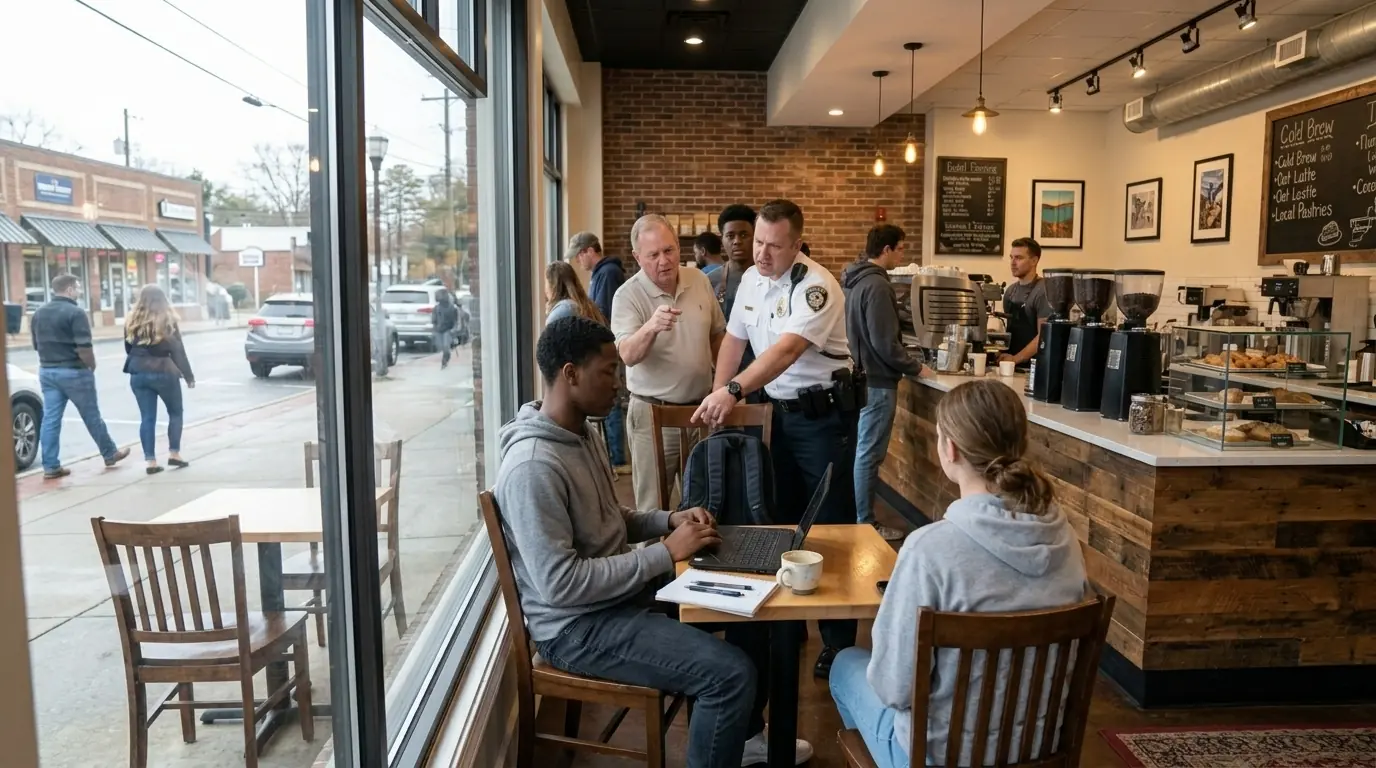
43 people inside Bellamy's Coffee on Whitfield Avenue stop mid-sentence, mid-sip, mid-scroll. The espresso machine hisses once, then nothing. A uniformed officer has just put his hands on a 16-year-old Black boy in a crowded cafe because a white man three tables away pointed a finger and said the word stolen. The boy's mother was 12 minutes away. She had ended careers over misconduct less serious than this.
The officer's radio crackles against his chest. Dispatch, still audible to anyone within arm's reach. Responding unit confirm. Caller reports suspicious Black male approximately mid-teens in possession of personal electronics believed stolen. Caller is on scene.
Believed. Not confirmed. Not verified. Believed because a stranger decided that a Black teenager with an expensive laptop did not look like the kind of person who should own one. The boy does not flinch, does not pull away, does not raise his voice.
He sits perfectly still with his hands flat on the table, palms down, fingers slightly apart. It is the posture of someone who has been taught carefully, specifically by someone who understands the risks a Black child can face during a tense police encounter: never make a sudden movement, and never give anyone with a badge an excuse to misread one. "I said, empty it." The officer taps the backpack hanging on the chair behind the boy, hard enough to make it swing. The bag swings.
"You can do it here or you can do it at the station. Your choice." The boy's eyes move to the officer's chest. Badge number. Four digits.
He reads them once silently. And the way his gaze tracks left to right, deliberate, memorizing, carries a precision that does not belong to panic. "No." The word is quiet, but the cafe hears it. Every table hears it.
"You don't have probable cause to search my belongings, and I haven't been told why I'm being detained." The officer's jaw tightens.
Three hours earlier, Bellamy's Coffee had been unremarkable. A converted brick storefront with tall windows and a chalkboard menu that listed oat milk lattes next to a quote about kindness that nobody read anymore. The kind of cafe that exists in every midsize Georgia city. Two dozen tables, free Wi-Fi, an unspoken understanding that if you bought a $4 coffee, you were entitled to sit for three hours and nobody would bother you.
Kalin Briggs had been coming here four afternoons a week since the beginning of sophomore year. Same table, second from the window, left side. Close enough to natural light that his screen didn't glare. Far enough from the door that the draft didn't reach him when customers walked in and out. He arrived after school, let out at 3:15 p.m., ordered a medium drip with one sugar, and opened his laptop.
The laptop was a refurbished ThinkPad his mother had bought at an auction two years ago. Nothing flashy, matte black, scratched near the hinge, a small sticker on the bottom corner, a QR code he had coded himself that linked to his GitHub profile. He had upgraded the RAM to 16 GB and swapped the hard drive for a solid-state drive. It ran faster than many machines three times its price, because Kalin understood computers the way some kids understood engines. Not just how to use them, but how they thought.
He always set up his workspace the same way. Laptop centered on the table, screen tilted to exactly the angle where the overhead light didn't hit. Charger cord coiled in a tight loop to the left, tucked against the wall outlet. notebook. A plain black Moleskine, grid-ruled, squared precisely with a table edge to the right of the laptop. Two pens laid parallel on top of the notebook.
One blue, one red, the blue for notes, the red for errors. He never mixed them. It was the kind of habit that looked like obsession to anyone who didn't understand it. But it wasn't obsession. It was discipline.
The same discipline that kept his code clean, his commit messages descriptive, his file structures logical. The kind of discipline that is taught, not born, taught by someone who understands that order is not a personality trait, but a survival strategy. Felix Underwood, the barista who worked the afternoon shift four days a week, had memorized Kalin's order 6 months ago. Medium drip, one sugar, no lid. He had it waiting by the time Kalin reached the counter most days.
They didn't talk much. A nod, a thank you, occasionally a question about homework or a new album. Felix was 22, working his way through a community college photography program, and he had the particular awareness of a person who had grown up being watched in stores, the instinct to notice when someone was being noticed for the wrong reasons. Today, Kalin had arrived at 3:27 p.m., backpack on the chair behind him, laptop open, notebook squared, pens parallel. He was three hours into a coding project, a web scraping tool he was building for his AP computer science class, when Gordon Phelps sat down.
Phelps was 53, sunburned across the nose, wearing a polo shirt that strained at the middle button and khaki shorts with cargo pockets that sagged with the weight of keys, a wallet, and a phone in a rubber case. He carried a leather messenger bag and a newspaper folded to the crossword page. He ordered a large Americano with an extra shot, paid with a card, and sat at the table directly to Kalin's left. Not across the room, not by the window, directly to his left, close enough that their elbows could have touched. He set his own laptop, a silver MacBook Air, on the table, opened it briefly, then closed it again and unfolded his newspaper over it.
He pulled a ballpoint pen from his shirt pocket and leaned over the crossword, but he didn't write. Not for the first two minutes. For the first two minutes, Gordon Phelps watched. He watched Kalin's fingers move across the keyboard. He watched the lines of code scroll up the screen.
He watched the boy take a note in his notebook. Blue pen, left hand, quick strokes, and returned to the keyboard without looking up. And then Phelps did something that Felix noticed from behind the counter, but could not have explained if asked why it bothered him. He shifted his messenger bag from the floor to the chair between himself and Kalin. The bag had been on the floor.
Now it was on the chair. A barrier. Nobody moves a bag onto a chair for comfort. You move a bag onto a chair when you want something between yourself and the person next to you. 20 minutes passed.
Phelps filled in four crossword clues. Kalin wrote 47 lines of code. The cafe hummed with its ordinary rhythms. The blender. The bell above the door.