At 6:18 on an April evening, a silver Honda drifted across the right lane of a two-lane road outside Vallejo, California, crossed the shoulder without braking, rolled down a shallow embankment, and stopped nose-first against a stand of eucalyptus trees. There was no screech of tires and no attempt to correct the steering. The car simply wandered off the road as though the driver had stopped understanding where the road was. A landscaping crew in a truck fifty yards behind saw the whole thing, pulled over, and ran toward the embankment. One worker reached the driver’s window first and saw a young man rigid against the seat, arms drawn inward, jaw clenched, body jerking in movements he could not control.
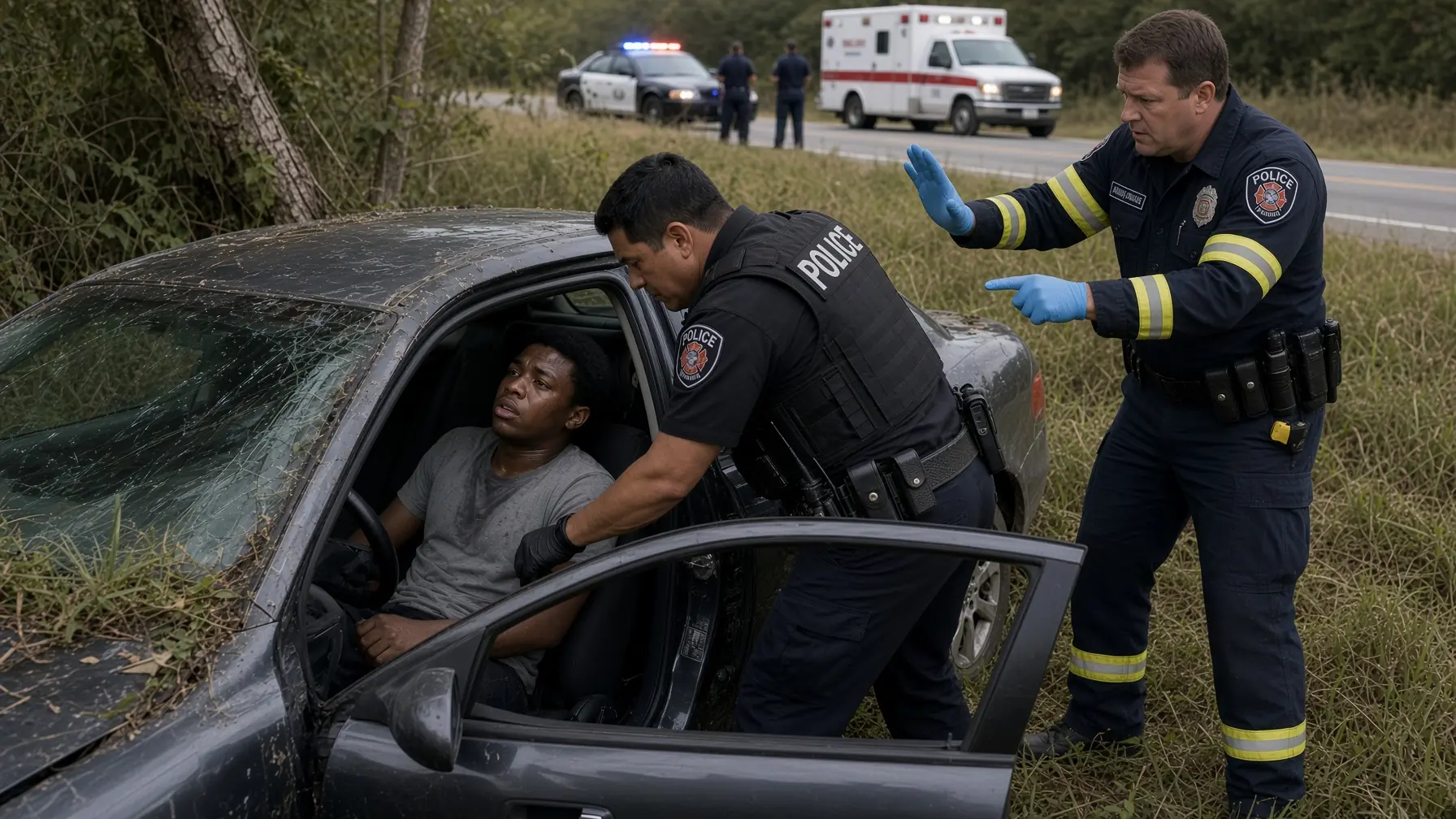
The worker shouted for someone to call 911. Another man did, and the dispatcher asked the questions emergency dispatchers were trained to ask: Was the driver conscious? Was he breathing? Had the vehicle rolled? Was there fire? Could anyone smell gasoline? Then the caller said something important. “I think he’s having a seizure.” The dispatcher repeated it back, entered it into the call notes, and sent the information to fire-rescue and police units responding to the crash. By the time the first officer turned onto the road, the radio traffic was not describing a drunk driver, a fleeing suspect, or someone who had intentionally driven into a ditch. It described a one-car collision involving a possible seizure.
The driver was twenty-one-year-old Evan Mercer, a community-college student who had spent the afternoon visiting his grandmother. He had no known seizure diagnosis and no memory of the final several minutes before the crash. The last thing he would later remember clearly was stopping at a gas station ten miles away for a bottle of water. The next coherent memory would not form until he was inside an ambulance, restrained to a gurney, surrounded by people asking him questions he did not understand. Everything between those moments would be reconstructed from witnesses, body-camera footage, emergency records, and medical notes.
Officer Daniel Ruiz arrived first.
He moved quickly down the embankment, opened the passenger door because the driver’s side was partly blocked by brush, and immediately saw that Evan was not behaving like someone simply shaken by a minor wreck. His breathing was loud and irregular. Sweat covered his face. His eyes opened briefly but did not track consistently. When Ruiz asked his name, Evan seemed to hear the question but could not form an answer.
“Hey, buddy, stay with me,” Ruiz said, keeping his voice low. “Can you hear me?”
Evan breathed.
“That’s good. Keep breathing.”
Ruiz reached only far enough into the car to check whether the ignition was still on and whether Evan appeared trapped. He did not pull him from the seat. He did not begin demanding identification. He radioed that the driver was conscious and breathing but altered, with possible seizure activity, and requested fire-rescue to continue urgently.
A second officer, Melissa Grant, reached the car a minute later.
“What have you got?”
“Possible seizure,” Ruiz said. “He’s breathing. Coming around, maybe.”
“Want to move him?”
Ruiz shook his head. “Not until fire gets here unless we have to. Car’s stable.”
That first several minutes would become important later because they showed the officers recognized the medical possibility. Nobody had to diagnose epilepsy at the roadside. Police were not neurologists. But they did know enough to understand that Evan’s confused behavior might be a consequence of what had happened to his brain rather than a decision to ignore them.
Firefighters arrived next.
Captain Joel Warner crouched near the passenger door and asked Evan whether he knew where he was.
Evan stared at him.
“You were in a car crash,” Warner said.
Evan blinked.
“What?”
“You’re off the road. You’re safe. We need to check you.”
Evan looked toward the windshield and tried to sit straighter.
“My car?”
“Your car’s here.”
“I need to go.”
“No, you’re going to stay with us for a minute.”
“Why?”
“You may have had a seizure.”
Evan shook his head immediately.
“No.”
“Ever had one before?”
“No.”
“Diabetes?”
“No.”
“Any drugs today?”
“No.”
“Alcohol?”
“No.”
The answers came slowly, almost as though each question had to travel through several locked doors before reaching him. Warner noticed that Evan’s orientation seemed to improve for a few seconds and then deteriorate again. That pattern did not surprise him. He had treated seizure patients before. After a generalized convulsive seizure, people could enter a postictal state marked by confusion, fatigue, agitation, impaired memory, fear, slurred speech, poor coordination, or behavior that made little sense to observers. Some recovered quickly. Others did not.
Warner told Evan they wanted to get him out of the vehicle and onto flatter ground for evaluation.
Evan looked down the embankment.
“No.”
“Why not?”
“I’m driving.”
Warner glanced toward Ruiz.
The car’s front bumper was against a tree.
One wheel was partly buried in loose soil.
Evan appeared not to understand what everyone else could plainly see.
“You’re not driving anywhere right now,” Warner said. “Your car is in a ditch.”
Evan pulled weakly at his seat belt.
“I’m good.”
Warner reached toward the buckle but stopped when Evan pushed his hand away.
“Okay,” Warner said. “Nobody’s trying to fight you.”
That was when two more police officers arrived.
Officer Brent Keller came down the slope first, followed by Officer Steven Cole. Neither had witnessed the seizure itself. Both had heard the dispatch information. But what they encountered visually was a young man sweating heavily inside a crashed vehicle, refusing to get out, intermittently pushing away the hands of firefighters.
Keller asked Ruiz, “What’s the deal?”
“Possible seizure. He’s kind of in and out.”
“Drugs?”
“Nothing obvious. No alcohol odor. Fire’s checking him.”
Keller moved to the driver’s side as far as the brush allowed.
“Hey, man, you got ID?”
Evan did not answer.
“Boss, can you hear me?”
Evan turned.
“Do you have ID?”
“I’m leaving.”
“No, you’re not. You crashed.”
“I’m fine.”
Keller’s interpretation began changing at that point. In his later account, he would say Evan became increasingly combative as officers attempted to remove him for medical treatment. The body-camera footage showed something more complicated. Evan did push hands away. He did brace himself against the seat. He did pull back when officers reached toward him. But he also repeatedly asked where he was, why they were touching him, and what had happened. His resistance appeared inseparable from his confusion.
Warner said quietly, “He’s probably still postictal.”
Keller heard him.
That mattered.
Firefighters were discussing how best to move Evan without turning the situation into a struggle when Keller said, “We can just get him out.”
Warner looked at him. “Give us a second.”
Keller stepped back.
For approximately thirty seconds, the scene remained calm.
Then Evan reached toward the ignition.
The keys were no longer there. Ruiz had already secured them.
Evan became agitated.
“Where are my keys?”
Ruiz answered. “I have them.”
“Give them back.”
“You’re not driving right now.”
“Give me my keys.”
“We will figure that out later.”
Evan pulled harder against the seat belt and shoved Warner’s forearm away when the firefighter tried to keep him from twisting.
Keller interpreted the shove as escalation.
“Okay. He’s getting combative.”
Warner answered immediately. “He’s confused.”
“He’s trying to push you.”
“He’s confused.”
Those two statements were both true.
The question was what officers should do with them.
Keller opened the rear door and leaned forward.
“Listen to me. We need you out of the car.”
Evan shook his head.
“No.”
“Get out.”
“No.”
“You’re not staying in here.”
“Why?”
“Because you crashed and medical needs to evaluate you.”
“I’m fine.”
“Dude, look around. You’re in a ditch.”
Evan looked toward the windshield again as though seeing the trees for the first time.
Then he said, “I need to go home.”
Keller reached toward his left arm.
Evan jerked away.
“Don’t touch me.”
“Stop pulling away.”
“What are you doing?”
“Get out of the car.”
Evan’s voice rose.
“Why?”
Cole moved in from the passenger side.
Keller’s tone changed.
“Get out now.”
Warner attempted once more to intervene verbally. “He may not understand.”
Keller replied, “We can’t leave him in the vehicle.”
That concern was not irrational. Evan had been involved in a crash. He was altered. His medical status was uncertain. Leaving him alone behind the wheel was not an option. But between “do not leave him alone” and “forcibly drag him out immediately” existed other possibilities: additional de-escalation, allowing EMS more time to assess capacity, reducing the number of people shouting commands, or medically managing the situation under EMS direction.
Those possibilities narrowed when everyone began talking at once.
“Come on, boss.”
“Get out.”
“Stop pulling.”
“We’re trying to help you.”
“Let go.”
“Wake up, dude.”
“I said I’m fine.”
“Get out.”
“What am I doing?”
“Stop resisting.”
Evan’s fear increased with the volume around him.
His body stiffened.
Keller took his left arm.
Cole reached across for the right.