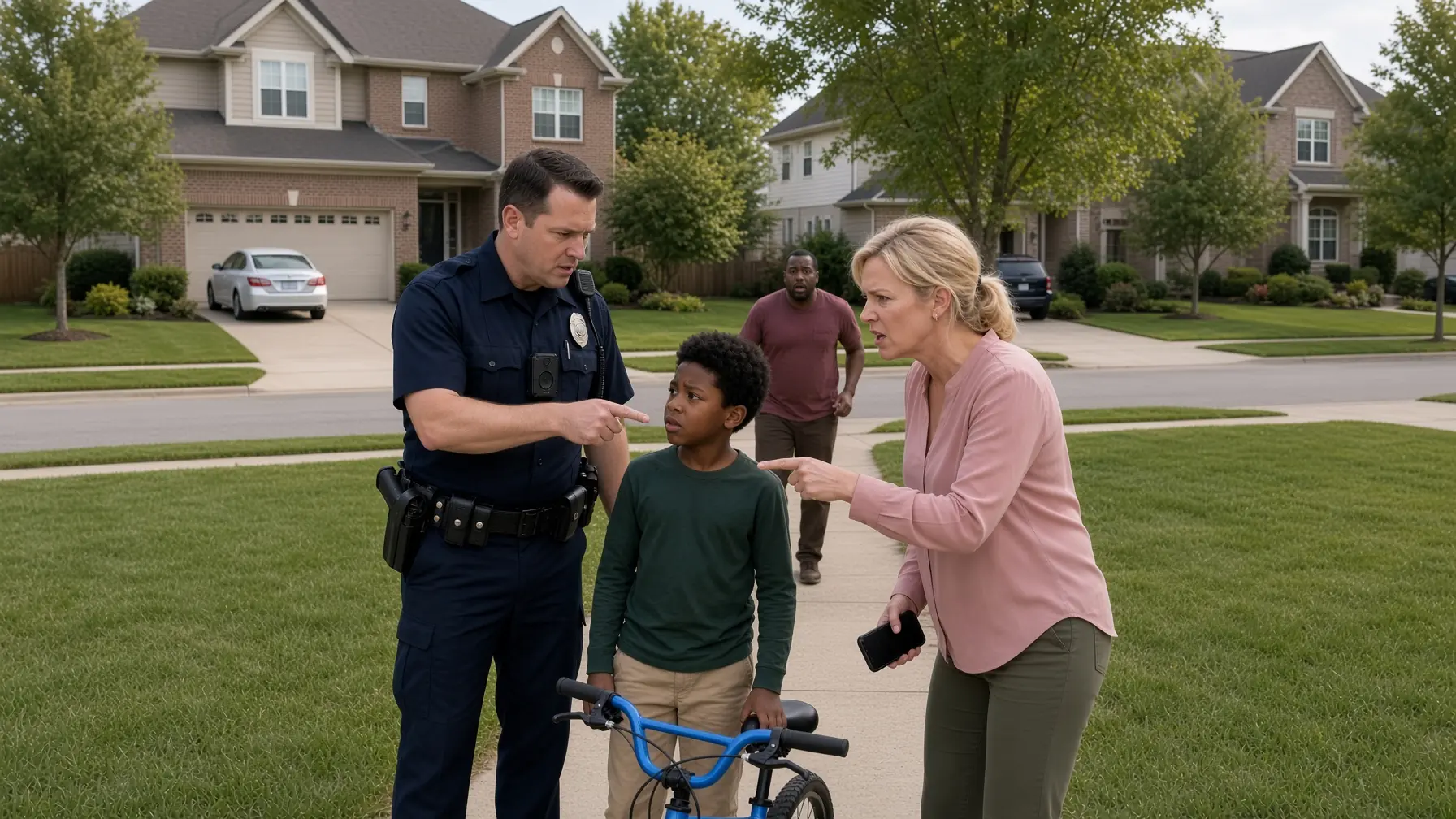
The handcuffs clicked shut before eleven-year-old Isaiah Bennett had time to finish explaining where he lived. He was standing beside a blue mountain bike on a public sidewalk in a quiet Fulton County subdivision, wearing gray basketball shorts, a faded Hawks T-shirt, and one untied sneaker. Officer Nathan Cole had one hand on Isaiah’s shoulder while a white woman stood three feet away pointing at the bicycle as though the case had already been solved. The whole thing had taken less than four minutes.
“That is my son’s bike,” the woman said.
Isaiah looked at her.
“What color is your son’s bike?”
She blinked.
“What?”
“Your son’s bike.”
Isaiah kept his voice steady.
“What color is it?”
“Blue.”
Isaiah looked down at the frame between his knees.
It was royal blue.
Twenty-inch wheels.
Small scrape on the left chain guard.
One worn rubber grip where his thumb rested whenever he rode farther than the end of the neighborhood.
Isaiah nodded toward the scrape.
“Does your son’s bike have that mark?”
The woman’s mouth tightened.
“That doesn’t matter.”
“It’s the same brand.”
“The same color.”
“My son’s was stolen.”
Isaiah looked at Officer Cole.
“Was it reported stolen?”
Cole’s grip tightened slightly.
“Enough.”
Isaiah turned his head.
“I’m just asking.”
“You don’t ask the questions.”
The woman folded her arms.
Her name was Cynthia Reynolds.
She was forty-nine, lived four streets away, and had spent the previous six years serving on various committees for Oak Crest Estates. Landscaping committee. Architectural review committee. Neighborhood safety committee. She knew which houses had overdue HOA fees, which residents left garbage bins out too long, and which teenagers drove cars she considered too expensive for their age.
She had never met Isaiah.
She had seen him only once before.
That did not stop her from calling 911.
At 3:39 that afternoon, Cynthia stood near the end of her driveway and watched Isaiah ride past on the blue bike. Her sixteen-year-old son had complained that morning that his bicycle was missing from the garage. Cynthia had not checked whether he had taken it to a friend’s house, had not called him, had not looked at serial numbers, and had not filed a stolen-property report.
She saw Isaiah.
Saw the blue frame.
Saw a Black child riding comfortably through Oak Crest Estates.
Then dialed 911.
“There’s a boy riding my son’s stolen bicycle.”
The dispatcher asked:
“Did you personally witness the theft?”
“No.”
“Do you have a police report number?”
“Not yet.”
“Do you know the child?”
“No.”
“Can you identify the bicycle by serial number?”
“It’s blue.”
The dispatcher paused.
“Ma’am, what makes you certain it belongs to your son?”
Cynthia looked down the street.
“He shouldn’t have it.”
That sentence entered the dispatch record.
Officer Nathan Cole arrived four minutes later.
He had eight years on patrol and the efficient confidence of someone who believed speed looked like competence. Cynthia reached his window before he finished parking. She pointed.
“That’s him.”
Cole stepped out.
He did not ask Isaiah’s name.
Did not ask his address.
Did not ask if the bicycle belonged to him.
He said:
“Get off the bike.”
Isaiah got off.
“Turn around.”
Isaiah turned.
“Hands behind your back.”
Isaiah froze.
“Why?”
Cole stepped forward.
“Do it now.”
Isaiah put his hands behind him.
The cuffs closed.
Isaiah weighed eighty-nine pounds.
His wrists were thin enough that the steel almost overlapped.
The metal bit into the skin beneath his palms.
He did not cry.
That surprised Cynthia.
It irritated Cole.
Children were supposed to respond to authority in recognizable ways.
Fear.
Tears.
Apologies.
Isaiah did something else.
He thought.
His father had taught him that.
Not because his father expected police encounters.
Because Andre Bennett believed thinking before speaking was useful everywhere.
Teachers.
Coaches.
Arguments.
Emergencies.
People trying to pressure you into answering before you understood the question.
“First thing out of your mouth,” Andre always said, “is the thing people remember when everybody starts telling different versions later.”
Isaiah had laughed the first time.
He was eight.
Now, at eleven, standing in handcuffs beside his own bicycle, the advice no longer felt like one of his father’s annoying speeches.
It felt like equipment.
Isaiah looked at Cynthia.
“Did you file a police report?”
She frowned.
“I told you it was stolen.”
“That’s not what I asked.”
Cole leaned down.
“Watch your tone.”
Isaiah looked at him.
“I’m not yelling.”
“Then stop talking.”
“I want to call my father.”
“You can call him when I say.”
Isaiah swallowed.
“Am I under arrest?”
Cole’s eyes narrowed.
“You think you’re some kind of lawyer?”
“No.”
“Then stop acting like one.”
A second cruiser arrived at 3:47.
Sergeant Paul Haskins stepped out.
Fifteen years in the department.
Broad shoulders.
Thinning hair.
A reputation for closing scenes quickly.
He walked straight to Cynthia.
“What happened?”
She told him.
Her son’s bike disappeared.
She saw Isaiah.
Same color.
Same kind.
Isaiah was riding it “like he belonged here.”
Haskins wrote that phrase down.
He did not ask what “like he belonged here” meant.
He did not ask why Cynthia had not reported the bicycle stolen.
He did not ask if she knew the serial number.
Instead he wrote:
Complainant positively identified suspected stolen juvenile bicycle.
The statement would matter later.
At that moment, it looked like routine paperwork.
Isaiah watched Haskins writing.
Then asked:
“Sir, is there a stolen bike report?”
Haskins looked up.
“What?”
“Did she report it stolen before today?”
Cynthia’s face tightened.
Haskins glanced at Cole.
Cole said:
“He’s been running his mouth since I got here.”
Isaiah looked at the sergeant.
“I’m eleven.”
The whole sidewalk became quiet.
Haskins waited.
Isaiah continued.
“I’m eleven years old and I’m in handcuffs.”
“My dad told me if I’m being detained I can ask why.”
Haskins lowered the notebook slightly.
“That’s true.”
Cole looked at him.
“Sergeant—”
Haskins held up one hand.
Isaiah continued.
“If there’s a stolen-property report, you can check the serial number.”
Cynthia shook her head.
“We don’t need all that.”
Isaiah looked at her.
“Why not?”
“It’s the same bike.”
“Blue isn’t a serial number.”
Cynthia stared.
A woman walking a golden retriever stopped across the street.
She took out her phone.
Nobody noticed.
Not yet.
Isaiah asked again.
“Can I call my dad?”
Cole leaned toward him.
“You don’t control this scene.”
Isaiah did not move.
“I didn’t say I did.”
Cole’s jaw tightened.
“You think you’re smart?”
Isaiah held his gaze.
“I think I want my father.”
Three blocks away, Andre Bennett’s phone vibrated.
He had just finished replacing a damaged railing at a neighbor’s house and was walking back toward his pickup truck. A text from Marcus Ellison, another resident, appeared on the screen.
Police have Isaiah on Brook Hollow. Two cruisers. Come now.
Andre read the message once.
Then again.
His first instinct was to run.
He did not.
That instinct had been trained out of him years earlier.
Running toward confusion made people nervous.
Nervous people with weapons made bad decisions.
Andre placed the phone in his back pocket and started walking.
Fast.
Controlled.
In through the nose.
Four counts.
Out.
Four counts.
His boots were dusty.
Gray T-shirt damp at the collar.
Dark work pants carried a faint line of soot near one knee.
Nobody in Oak Crest Estates knew what Andre did for a living.
Most assumed construction.
Maybe electrical.
Maybe industrial maintenance.
They saw him leave early in a gray pickup and sometimes return after midnight.
Saw rough hands.
Occasional soot.
A small burn scar near his wrist.
They were not entirely wrong.
Andre worked with buildings.
Just not in the way they imagined.
He reached Brook Hollow at 3:50.
He saw Isaiah first.
Then the cuffs.
Then Cole.
Then Cynthia.
He stopped fifteen feet away.
The exact distance mattered to him.
Not because he was trying to prove anything.
Because he understood space.
Andre’s professional life had taught him that distance changed everything during volatile scenes.
Too close became interference.
Too far meant losing sight of details.
He stood still.
Hands open.
Isaiah saw him.
The boy’s shoulders dropped by perhaps half an inch.
Andre noticed.
Cole did too.
The officer’s hand moved toward his belt.
“Sir, stay back.”
Andre looked at him.
“I am staying back.”
“This is an active police investigation.”
“I understand.”
“Step farther away.”
Andre looked down at the sidewalk.
Then back.
“I am approximately fifteen feet away.”
“I’m not interfering.”
“That is my son.”
Cole shifted.
“Sir, I said back up.”
Andre’s voice did not change.
“I would like to know why my eleven-year-old son is in handcuffs.”
Cynthia stepped forward.
“So you’re the father.”
Andre looked at her.
Something in her tone made the word sound like an accusation.
She pointed toward Isaiah.
“He was riding my son’s stolen bicycle.”
Andre did not answer her.
He looked at Haskins.
“Sergeant?”
Haskins nodded.
“We’re investigating a reported stolen bike.”
“Was a stolen-property report filed?”
Haskins glanced toward Cynthia.
She spoke first.
“I was going to file it.”
Andre looked at her.
“When?”
“After I got the bicycle back.”
Andre nodded slowly.
Then looked toward the officers.
“So there is currently no stolen-property report?”
Cole said, “We’re determining that.”
Andre continued.
“Then please determine it.”
Cole’s expression hardened.
“Sir.”
Andre remained calm.
“The bicycle has a serial number underneath the bottom bracket.”
“I purchased it two years ago from Northside Cycle Works.”
“I have the receipt at home.”
“The receipt includes the serial number.”
Haskins closed his notebook.
“We can verify that.”
“That is exactly what I’m asking.”
Andre looked toward Isaiah’s wrists.
“My son is in handcuffs.”
“He has not been charged.”
“He has not been told a specific crime.”
“I am asking you to verify the property before continuing.”
Cole stepped forward.
“Identification.”
Andre nodded.
“Absolutely.”
His hand moved slowly toward his back pocket.
He stopped halfway.
“I’m reaching for my wallet.”
Cole watched.
Andre removed it.
Opened it.
Held out his driver’s license using two fingers.
Cole took it.
Andre Leon Bennett.
84 Willow Bend Court.
Oak Crest Estates.
Four streets from Cynthia’s house.
Cole looked at the address.
“You live here?”
Andre stared.
“Yes.”
Cole looked toward Isaiah.
“How long?”
“Two and a half years.”
Cynthia folded her arms.
“That doesn’t prove the bike is his.”
Andre turned toward her.
“No.”
“The serial number will.”
Haskins lifted his radio.
“Dispatch.”
He gave the bike description.
“Any stolen Trek youth mountain bike matching blue frame, twenty-inch wheel set, within county?”
Static.
Ten seconds.
Then:
“Negative.”
“No active stolen report matching.”
Cynthia immediately said:
“I told you I hadn’t filed it yet.”
Andre looked at her.
“You called 911 and stated the bicycle was stolen.”
“Yes.”
“But you had not confirmed it was stolen.”
“My son said it was missing.”
“Did you call your son?”
Her face changed.
“What?”
“Before calling police.”
Cynthia looked away.
“That’s irrelevant.”
Andre turned back toward Haskins.
“Please check the serial number.”
Cole interrupted.
“We don’t need to jump every time you tell us.”
Andre looked at him.
“I am not ordering you.”
“You’re acting like you are.”
“I’m asking you to check the only objective identifier attached to the alleged stolen property.”
Cole moved closer.
“Lower your tone.”
Andre’s eyes narrowed slightly.
“My tone has not changed.”
Cole put his hand flat against Andre’s chest.
The contact was not violent.
It was deliberate.
A push.
Enough to move a normal person backward one step.
Andre did not move.
His body absorbed the pressure automatically.
Knees soft.
Weight centered.
Hands open.