Water blasted with the force of an industrial hydrant, tearing through manicured hydrangeas and slamming into a man simply standing on his own lawn.
Sirens had not wailed. No crime had been committed. A silver badge glinted in the suffocating summer heat as a sworn oath to protect morphed into a brutal display of unchecked ego. 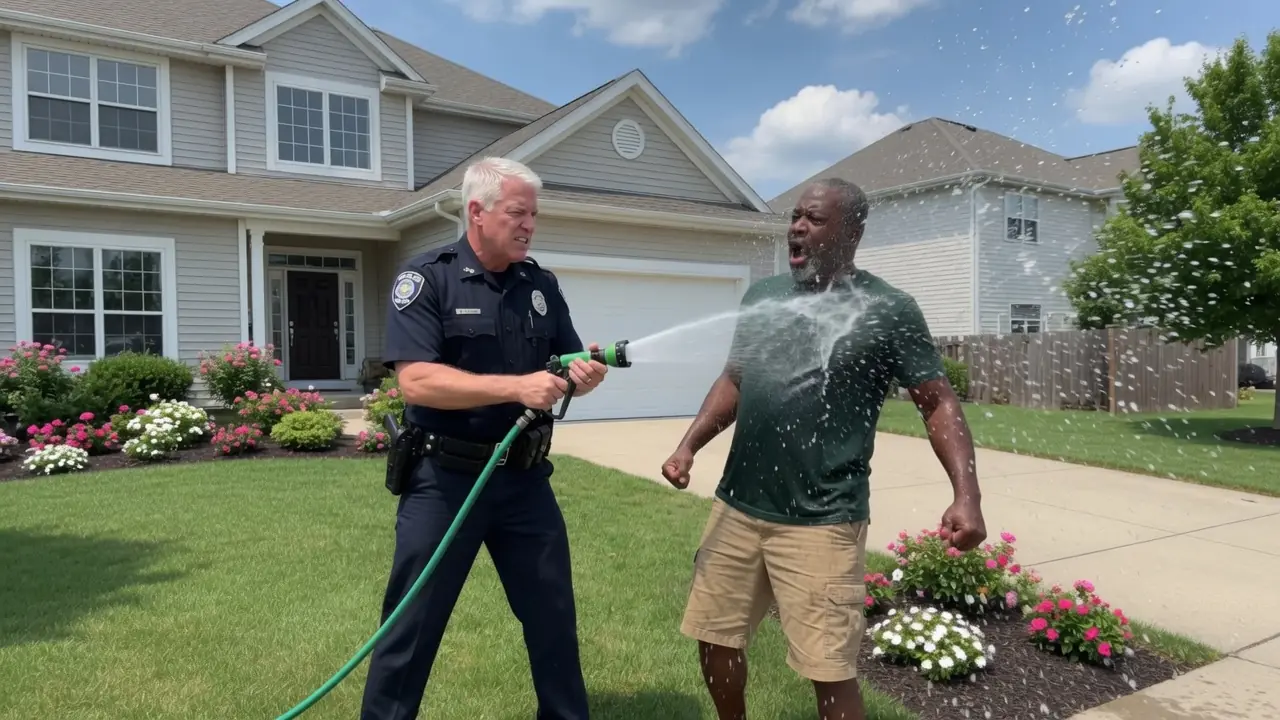
A seasoned homeowner found himself pinned against his own brick facade, gasping for air under a relentless torrent. Yet within moments, the arrogant man wielding the nozzle would drop to his knees on the wet pavement crying and pleading for his career, his freedom, and his miserable future.
The neighborhood of Oakridge Estates was the kind of suburban sanctuary where the loudest noise on an afternoon was the hum of a high-end lawn mower or the gentle splash of a backyard pool. It was an enclave of winding oak-lined streets, manicured lawns, and expansive brick homes.
For Darius Ellison, a structural engineer with a distinguished career, purchasing the sprawling corner property at Sycamore Drive was the culmination of decades of grueling work. He had built bridges, overseen skyscrapers, and tirelessly provided for his family.
He belonged here. It was a sweltering summer afternoon. The heat radiated from the asphalt in shimmering waves.
Darius, dressed in a faded college t-shirt, khaki cargo shorts, and comfortable gardening shoes, was enjoying a rare moment of profound peace. He held a heavy-duty brass-nozzled garden hose, meticulously watering a vibrant row of blooming hydrangeas that lined his front porch.
The cool mist from this water provided a brief, refreshing respite from the oppressive humidity. He was humming softly to himself, lost in the simple rhythm of domestic life.
A few blocks away, Officer Derek Harlan was cruising through the affluent neighborhood. Harlan was a veteran of the local police department, a man whose career was littered with formal complaints, excessive force investigations, and departmental transfers.
He was a broad-shouldered man with a perpetually flushed face and a tightly clipped haircut. Known among his peers for his short fuse and a deeply ingrained biased view of the world, Harlan viewed his badge not as a shield for the public, but as a crown for himself.
As Harlan's cruiser turned onto Sycamore Drive, his eyes locked onto Darius. In Harlan's warped perception, the sight of a black man casually watering the lawn of an estate was an anomaly that demanded his immediate intervention.
He did not see a homeowner. He saw a landscaper who had overstayed his welcome, or worse, someone casing the property. Harlan slammed his foot on the brake, bringing the cruiser to a sudden, aggressive halt right at the edge of Darius's driveway.
The tires chirped against the pavement. He did not bother turning on his flashing lights. This was not an official stop. This was an assertion of dominance.
He stepped out of the air-conditioned vehicle, resting his hand heavily on his duty belt, puffing his chest out as he marched up the concrete driveway. "Hey, you there?" Harlan barked, his voice slicing through the quiet afternoon like a siren.
Darius slowly turned, lowering the hose so the water pooled harmlessly onto the grass. He wiped a bead of sweat from his forehead and looked at the approaching officer with a mixture of confusion and mild annoyance.
"Can I help you, officer?" "What are you doing here?" Harlan demanded, stopping a few feet away, invading Darius's personal space. His eyes darted around the property, looking for any excuse to escalate the situation.
"I'm watering the hydrangeas," Darius replied, keeping his voice remarkably calm and steady. "It is a hot day. They need it." "Don't get smart with me," Harlan snapped, his face reddening.
"Whose house is this? Where's the owner?" Darius sighed, a deep, tired sound. He had faced this kind of insidious questioning before, though rarely on his own property.
"I am the owner, officer. My name is Darius Ellison. I live here now. Is there a problem or was there a report of a crime in the area?" Harlan scoffed, a harsh, ugly sound.
He looked Darius up and down, taking in the faded t-shirt and the muddy shoes. "You expect me to believe you own this place? Let's see some ID right now." "I am standing on my own private property," Darius stated, his tone shifting from polite to firm.
"I am not operating a motor vehicle, and I have committed no crime. I do not carry my wallet while I'm doing yard work. Even if I did, I would not be obligated to show it to you without reasonable suspicion." "I have reasonable suspicion," Harlan growled, taking another step forward, his hand inching closer to his taser.
"I suspect you are trespassing. Now, produce identification or I am taking you in." "You will do no such thing," Darius said, his voice dropping an octave, radiating an unshakable authority.
Turning away was a declaration of equality, and in Officer Derek Harlan's world, that was an unforgivable offense. Something inside Harlan snapped. The sheer audacity of this man ignoring his direct command, dismissing his authority, treating him like a nuisance rather than a threat, ignited a blind, irrational fury.
The officer closed the distance between them in two massive strides. "I said do not turn your back on me." Harlan roared. Before Darius could react, Harlan violently shoved him from behind.
As Darius stumbled forward trying to maintain his balance, Harlan lunged and ripped the heavy rubber garden hose from Darius's grip. The sudden forceful snatch tore the skin on Darius's palm.
But before he could even process the sting, Harlan was already twisting the heavy brass nozzle. He cranked it past the gentle shower setting, past the wide spray, locking it aggressively onto the high pressure jet function.
Harlan sneered, his face twisted into an ugly mask of rage. "Let's wash the attitude off you." Harlan squeezed the trigger. A concentrated, violently pressurized stream of water shot from the brass nozzle like a physical projectile.
It slammed into Darius's chest from less than 3 feet away. The sheer force of the industrial water pressure was staggering. It felt like being punched with a solid wall of ice.
Darius gasped. The breath was knocked completely out of his lungs. He instinctively threw his hands up to protect his face, but the water blasted against his forearms, pushing him backward.
The wet concrete of the driveway offered no traction. Darius's feet slipped out from under him and he crashed hard onto his back, his shoulder slamming painfully against the brick bordering the flower beds.
"Get up!" Harlan yelled, continuing to blast the water directly into the fallen man's face and chest. The jet stream tore through the leaves of the nearby hydrangeas, shredding the delicate pink and blue petals, turning the pristine garden into a muddy disaster.
Darius was choking, sputtering, unable to open his eyes or draw a full breath. The water filled his nose and mouth, a terrifying, suffocating sensation. Every time he tried to push himself up on his hands and knees, Harlan stepped closer, aiming the merciless stream at Darius's back, forcing him down into the muddy pooling water.
Across the street, the heavy oak front door of the house cracked open. Eleanor Vaughn, a retired school teacher who had known Darius since he moved in, stood paralyzed in her doorway.
Her hand flew to her mouth in absolute horror as she watched the officer brutalizing her neighbor. She scrambled for her cell phone, her trembling fingers dialing emergency services, sobbing as she begged the dispatcher to send help because a rogue cop was attacking an innocent man.
"You think you are above the law because you are in this neighborhood?" Harlan taunted, his voice echoing off the brick facades of the houses. He was utterly consumed by a sickening sense of power.
The sight of the successful, dignified man reduced to a soaked, gasping figure on the ground fed his twisted ego. "You are nothing. You hear me? Stop resisting."
Darius was not resisting. He was fighting for oxygen. He curled into a defensive posture, coughing violently, mud and water soaking through his clothes.
His shoulder throbbed with a sharp, agonizing pain from the fall. Satisfied that he had established dominance, Harlan finally released the trigger of the hose.
He tossed it onto the grass with a contemptuous thud. The sudden silence in the neighborhood was deafening, broken only by Darius's ragged coughing and the gurgling of the spilled water running down the driveway into the street gutter.
"Now." Harlan breathed heavily, unhooking the metal handcuffs from his belt. The metallic clink sounded unnaturally loud. "Put your hands behind your back. You are under arrest for assaulting a police officer and resisting arrest."
Darius, shivering despite the summer heat, slowly pushed himself up onto his knees. Water dripped from his eyelashes and his soaked clothes. He looked up at Harlan, his eyes red and burning, but completely devoid of fear.
Instead, there was a terrifying absolute stillness in Darius's gaze. It was the look of a man who knew exactly what was about to happen next. "You have made," Darius rasped, his voice rough from coughing, but laced with a chilling certainty, "a catastrophic mistake."
"Shut your mouth and give me your hands," Harlan ordered, stepping forward to force Darius's arms behind his back. He never got the chance.
The quiet of Oak Ridge Estates was shattered once more, not by sirens, but by the aggressive roar of powerful engines. Two massive black Chevrolet Tahoe SUVs with heavily tinted windows and federal government license plates turned the corner at alarming speed.
They did not just pull up, they swarmed the scene. The lead Tahoe violently mounted the curb, its tires tearing up the manicured grass of Darius's front lawn, stopping just inches from Harlan's parked cruiser, completely boxing it in.
The second Tahoe skidded to a halt directly behind the cruiser, blocking any avenue of escape. Harlan froze, the handcuffs dangling uselessly from his thick fingers.
Confusion washed over his flushed face. Local backup did not drive unmarked tactical SUVs, and they certainly did not drive like this. Before the engines even died, the doors of the Tahoe flew open.
Four men wearing dark tactical suits and bulletproof vests stepped out in unison. They moved with terrifying synchronized precision, their hands resting comfortably, yet warningly, near their holstered sidearms.
The lead man, Special Agent Marcus Whitaker, a tall imposing figure with steel-gray hair and eyes that looked like chipped ice, marched directly toward the driveway.
He did not look at the police cruiser. He did not look at the manicured lawns. His eyes were locked dead onto Officer Harlan. "Step away from him right now." Whitaker commanded.
His voice was not a yell. It was a low, dangerous rumble that carried absolute, unyielding authority. Harlan instinctively took a step back, his arrogance evaporating into sudden, cold panic.
"Hey, back off. I am local PD. This is my scene. This suspect is under..." "I said, step away." Whitaker barked, flashing a gold badge that caught the afternoon sun. "Federal Bureau of Investigation. Keep your hands away from your belt, officer."
Two of the other agents rushed past Harlan, ignoring him completely. They dropped to a crouch beside Darius, who was still kneeling in the puddle of muddy water.
"Director Ellison, are you injured, sir?" one of the agents asked, his voice filled with urgent concern as he helped Darius carefully to his feet. "Do we need paramedics?"
Harlan felt his heart drop into his stomach. The world seemed to tilt on its axis. "Director Ellison?" Darius stood up.
He was soaked to the bone, his shirt plastered to his chest, his palm bleeding, and his shoulder aching. Yet, as he brushed the mud from his knees, he seemed to grow taller.
He looked at Special Agent Whitaker and gave a slight, dismissive shake of his head. "I will survive, Marcus, though my hydrangeas have seen better days." Harlan's mouth went dry.
He looked desperately from the stern FBI agents to the dripping wet black man he had just brutalized. "Director." Harlan whispered, his voice cracking. "Director of what?"
Darius took a step forward. The calm, polite homeowner was gone. In his place stood a man of immense, terrifying power.
"Allow me to introduce myself properly, Officer Harlan, since you were so eager for my identification." Darius said, his voice ringing with absolute clarity. "I am Darius Ellison. I am the newly appointed federal monitor and regional director for the United States Department of Justice's Civil Rights Division."
Harlan's knees literally buckled. He stumbled backward, his back hitting the side of his cruiser. He knew exactly what that title meant.
The local precinct had been under federal investigation for a pattern of excessive force, racial profiling, and civil rights violations. The Department of Justice had recently announced they were sending a special liaison to completely overhaul the department, audit their practices, and recommend federal indictments for corrupt officers.
"I officially take over the oversight of your precinct," Darius continued, stepping closer, closing the distance until he was inches from Harlan's pale face. "My first directive was to move into the city quietly to observe the culture, to see how the citizens of this community are treated when the brass is not looking."
"Oh, god!" Harlan choked out. The color had completely drained from his face, leaving him a sickly terrifying gray. The heavy brass hose nozzle on the grass suddenly looked like a murder weapon.
"I triggered a silent distress signal from my smart watch the moment you aggressively grabbed the hose," Darius explained coldly. "Everything that just happened here, your lack of probable cause, your verbal threats, your unprovoked physical assault with a high-pressure water stream, was broadcast live directly to Special Agent Whitaker and the local field office."
Whitaker stepped forward, pulling a pair of heavy federal handcuffs from his belt. "Officer Derek Harlan, under the authority of the Federal Bureau of Investigation, you are being detained."
The reality of the situation crashed down on Harlan like a collapsing building. In the span of moments, he had gone from an untouchable apex predator to a man staring down the barrel of a federal civil rights indictment, assault charges, and the absolute destruction of his life.
The pension he had worked for was gone. His freedom was gone. The tough, arrogant cop vanished, replaced instantly by a terrified, broken shell of a man.
Harlan did not fight. He did not argue. His legs gave out completely. He collapsed onto his knees, landing squarely in the very puddle of mud and water he had forced Darius into just moments before.
The wet concrete soaked through his uniform trousers. "No, no, no, please." Harlan sobbed. A pathetic, high-pitched sound escaped his throat.
Tears welled up in his eyes, spilling over his cheeks, mixing with the sweat on his face. He looked up at Darius, his hands clasped together in a desperate, begging gesture.
"Please, Director Ellison. I'm sorry. I am so sorry. It was a mistake. A terrible mistake." Darius looked down at the weeping man.
"It was not a mistake, Harlan. It was a choice. A choice you made because you thought I was powerless." "Please." Harlan wailed, his chest heaving with panic as Whitaker stepped behind him and violently wrenched his arms behind his back.
The ratcheting sound of the federal handcuffs locking into place echoed through the quiet street. "I have a family. I have a mortgage. You cannot do this to me. Have mercy."
"Mercy?" Darius repeated softly, the word hanging heavy in the hot summer air. He looked at his ruined garden, then back down at the sobbing officer.
"You held a hose to a man's face and told him you were going to wash the attitude off him. Now you're going to learn what accountability feels like."
The heavy armored doors of the federal Tahoe slammed shut, cutting off the pathetic, desperate wails of Officer Derek Harlan. The sudden silence that descended upon Sycamore Drive was stark, punctuated only by the low rumble of the idling SUV engines and the gentle dripping of water from Darius Ellison's ruined hydrangeas.
Neighbors who had been peering cautiously through Venetian blinds and cracked front doors, now stepped out onto their manicured lawns, murmuring in stunned disbelief. Eleanor Vaughn, the retired school teacher from across the street, walked tentatively across the asphalt, her hands still trembling as she clutched her cell phone.
"Darius," she called out softly, her eyes darting nervously toward the imposing, heavily armed federal agents securing the perimeter of the property. "Darius, dear heaven, are you all right? I called the police, but I suppose these gentlemen beat them here."
Darius turned to her, his wet clothes clinging to his frame, a warm, reassuring smile breaking through the stern facade he had just worn. "I'm perfectly fine, Eleanor. Thank you for looking out for me. These gentlemen are with the FBI."
Special Agent Marcus Whitaker approached, a thick encrypted tablet in his hand. He gestured toward the open front door of the sprawling brick house. "Director, the perimeter is secured, and the local precinct dispatch has been frozen by our cyber division. The local chief of police does not even know his officer is in federal custody yet. The medics are waiting inside to look at that shoulder."
"Let's get out of this heat, Marcus," Darius replied, leading the way into the expansive air-conditioned foyer of Sycamore Drive. Once inside the privacy of his home, the true nature of the afternoon's events began to unravel.
This was no random encounter. Darius Ellison had not chosen this estate by chance, nor was he merely watering his lawn on a summer afternoon without a calculated purpose.
As a federal medic carefully cleaned and bandaged the torn skin on Darius's palm, Whitaker placed the encrypted tablet on the granite kitchen island. The screen displayed a complex web of photographs, bank records, and property deeds.
"Harlan took the bait faster than we modeled," Whitaker noted, tapping a photograph of the disgraced officer. "We anticipated he might harass you, perhaps issue a citation or attempt an illegal search, but escalating to a felony physical assault with a weaponized water stream in broad daylight. The man handed us a federal civil rights violation with a neat little bow."
Darius winced slightly as the medic manipulated his bruised shoulder. "Arrogance makes men predictable. Derek Harlan is not just a racist cop with an anger management problem. He is the blunt instrument for a much larger insidious machine."
This was the twist that the local authorities were entirely blind to. For years, the Department of Justice had been secretly investigating a highly sophisticated, deeply corrupt real estate extortion ring operating out of Oak Ridge Estates.
The operation was masterminded by a prominent local property developer named Nolan Pritchard working in tandem with the local chief of police, Raymond Kessler. The scheme was vile but remarkably effective.
Whenever a minority family or an undesirable buyer purchased a property in the affluent neighborhoods targeted by Pritchard's development firm, Oak Ridge Holdings, the police department would be deployed to make their lives a living hell.
Officers like Derek Harlan were ordered to conduct relentless targeted harassment. They would pull over the homeowners for fabricated traffic violations, park marked cruisers intimidatingly in front of their houses for hours, aggressively question their guests, and issue citation after citation for imaginary municipal code violations.
The goal was psychological warfare. The corrupt cops would traumatize the new homeowners until they were desperate to sell and flee the neighborhood. Once the property was listed, Nolan Pritchard's shell companies would swoop in, buy the house at a severely depressed price, and flip it for a massive profit, kicking back a hefty percentage to Chief Kessler and the participating officers.
"Detective Lena Brooks," Darius said, looking at a photo of a young, sharp-eyed woman on the tablet. "She was the federal informant, a whistleblower buried deep inside the local precinct who had risked her life to pass encrypted files to the Department of Justice."
She warned us that Chief Kessler had flagged this address the moment the deed was transferred to my name. "They saw a black man buying the cornerstone property of the neighborhood, and they deployed their attack dog. And the attack dog just bit the regional director of the Department of Justice Civil Rights Division," Whitaker said with grim satisfaction in his voice.
"We have the assault on the hidden porch cameras in high resolution, Director. We have the audio from your smart watch, but more importantly, we have Harlan. A man that arrogant is inherently cowardly. The moment he realizes he is facing federal prison, he is going to sing like a canary. He will hand us Chief Kessler and Nolan Pritchard to save his own skin."
Darius stood up, adjusting a dry shirt the medic had handed him. The pain in his shoulder was a dull ache, but the fire of righteous justice burned brightly in his chest. "Let's not keep them waiting, Marcus. It is time to bring the house down."
At that very moment, Officer Derek Harlan was sitting in a windowless federal interrogation room, sobbing uncontrollably into his handcuffed hands. The atmosphere inside the local police precinct was one of ignorant bureaucratic boredom.
Chief Raymond Kessler, a heavy-set man with a penchant for expensive cigars and tailored uniforms, was sitting behind his mahogany desk reviewing patrol schedules. His phone buzzed.
It was a private line, one reserved only for his most lucrative illicit conversations. The caller ID flashed, "Nolan Pritchard." "Nolan, my friend," Kessler answered, leaning back in his leather chair, a smug smile plastered across his face.
"Tell me you are calling from the golf course." "I'm calling because your idiot patrolman is not answering his radio or his cell." Pritchard's voice barked through the speaker, tight with agitation.
The developer was pacing the floor of his penthouse office downtown. "I drove past the Sycamore property. Harland's cruiser is sitting in the driveway, empty. The front lawn is torn up and there is mud everywhere. Where is he?"
Kessler frowned, sitting up straight. "Harland was supposed to do a hard knock on the new guy today. Rattle his cage. Maybe cite him for the landscaping. Make him feel unwelcome. You were saying his car is abandoned?"
"I'm saying the situation looks wrong, Raymond." Pritchard snapped. "Call dispatch. Find out what is going on. We need that property back on the market." "Relax, Nolan. Harland probably just took the guy in for resisting."
Kessler said, reaching for his desktop radio to call the dispatcher. He pressed the transmit button. "Dispatch, this is Chief Kessler. What is the status on Officer Harland, unit Bravo?"
Static hissed back at him. Then a voice responded, but it was not his usual dispatcher. It was a sharp, unfamiliar male voice dripping with federal authority.
"Chief Kessler, this is Supervisory Special Agent Marcus Whitaker. Your dispatch communication network has been temporarily commandeered under federal warrant. Remain in your office. Do not attempt to log off your terminal or destroy any documents."
The blood drained from Chief Kessler's face so fast he felt dizzy. The heavy cigar slipped from his fingers, tumbling onto the mahogany desk and burning a hole into a stack of requisition forms.
"Nolan?" Kessler whispered into his cell phone, his voice trembling violently. "Nolan, the feds. What?" Pritchard demanded.
"Raymond, what are you talking about?" Before Kessler could formulate a sentence, the heavy wooden door to his office did not just open. It was breached with terrifying force.
The glass shattered as three heavily armed FBI agents wearing tactical gear poured into the room, their weapons raised. "Hands on the desk, now!" an agent roared.
Chief Kessler whimpered, throwing his hands in the air and dropping his phone on the floor. The phone speaker continued to broadcast Nolan Pritchard's panicked voice. "Raymond!" "Raymond, answer me. What is happening?"
What was happening was a synchronized multi-agency tactical takedown of unprecedented scale. Miles away in the sterile, freezing cold of a federal interrogation room, Derek Harlan was living his worst nightmare.
He was stripped of his badge, his gun, and his power. Across the steel table sat Special Agent Whitaker and Director Darius Ellison.
Now dressed in a sharp, intimidating federal suit, Harlan was a mess. His eyes were swollen from crying. His uniform was stained with the mud from Darius's driveway, and he was shaking so violently his handcuffs clattered against the table.
"I will give you everything." Harlan blubbered, snot running down his upper lip. He did not even try to maintain a facade of loyalty.
The facade had been shattered the moment the water hit Darius's chest. "I have text messages. I have recorded phone calls. Chief Kessler ordered the harassment. Pritchard paid us in offshore accounts. They gave me a list of addresses. The sycamore house was top priority. Just please, please do not put me in a maximum security federal penitentiary. I am a cop. I will not survive."
Darius stared at him with cold, unwavering disgust. "You ceased being a police officer the moment you decided to use your badge as a weapon of racial terror. Mr. Harlan, you are a thug in a municipal uniform. And while your cooperation will be noted by the federal prosecutor, you will serve significant time for the civil rights violations you committed on my property today."
Harlan buried his face in his hands, wailing as the reality of his ruined life crushed him. Simultaneously, downtown, Nolan Pritchard's penthouse office doors were kicked open.
The arrogant developer, who had spent years treating minority homeowners like disposable chess pieces, tried to scramble toward a hidden wall safe to destroy ledgers. He was tackled to the plush carpet by two federal agents, his face pressed hard against the floor as cold steel cuffs locked around his wrists.
By sunset, the local news networks were preempting their regular broadcasts with breaking sensational coverage. Helicopter footage showed the local police precinct completely surrounded by federal vehicles.
The faces of Chief Raymond Kessler, developer Nolan Pritchard, and Officer Derek Harlan were plastered across every screen, labeled as the ringleaders of the most despicable, racially motivated real estate extortion conspiracy in the state's history.
Karma had not just hit back, it had decimated them. The men who had built their wealth and egos by terrorizing innocent people in the sanctity of their own homes were now stripped of their assets, publicly humiliated, and facing decades in federal prison.
Back at Sycamore Drive, the sun began to dip below the horizon, casting a warm golden glow over the neighborhood. A landscaping crew paid for out of pocket by Darius was already meticulously repairing the torn grass and planting fresh, vibrant hydrangeas where the old ones had been destroyed.
Darius stood on his porch, a cup of hot tea in his uninjured hand, watching the peaceful street. Eleanor Vaughn waved at him from her porch, a genuine, relaxed smile on her face.
The oppressive shadow of corrupt authority had been lifted from Oakridge Estates. The predator had unwittingly attacked the apex of the justice system, and in doing so, had triggered the absolute destruction of his own wicked empire.
The air outside at United States District Courthouse was crisp, but the atmosphere on the granite steps was electric with a suffocating, almost predatory tension. Federal barricades lined the sidewalks, holding back a thrashing ocean of journalists, camera crews, and outraged citizens holding placards.
The scandal had transcended local news, becoming a national focal point for the conversation on systemic corruption, racial targeting, and the abuse of police power. Inside courtroom B, the mahogany-paneled walls seemed to press inward, creating a claustrophobic arena where the absolute peak of arrogance was about to be dismantled piece by piece.
Presiding over the case was the Honorable Warren Sterling, a federal judge renowned for his icy demeanor, zero tolerance policy for courtroom theatrics, and a deep abiding respect for the Constitution. At the defense table sat Nolan Pritchard and Chief Raymond Kessler.
They were no longer the untouchable masters of their suburban domain. Stripped of his tailored designer suits, Pritchard wore a standard-issue, poorly-fitting suit provided by his legal team, his skin sallow, his posture rigid with a terrified, vibrating energy.
Beside him, Chief Kessler looked entirely deflated. The heavy-set man had lost considerable weight in federal lockup, his uniform of authority replaced by a wrinkled dress shirt, his eyes darting nervously around the room, entirely devoid of the smug confidence he once wielded like a weapon.
The lead federal prosecutor, Claire Montgomery, stood at the podium. She was a meticulous, devastatingly sharp attorney who built her cases not with emotional rhetoric, but with an avalanche of undeniable, suffocating evidence.
"Ladies and gentlemen of the jury," Montgomery began, her voice resonating with cold, hard clarity. "What you will see over the next weeks is not merely a case of a few bad apples or isolated incidents of prejudice. You will witness the blueprints of a highly organized, ruthlessly efficient criminal enterprise, a syndicate that weaponized the very badges meant to protect us, using them as instruments of terror, financial extortion, and racial segregation."
The prosecution strategy was a masterpiece of legal destruction. They did not start with Darius Ellison. They started by parading the ghosts of the syndicate's past victims before the jury, establishing a brutal, undeniable pattern of racketeering.
The most heart-wrenching testimony came from Ellis and Vivian Grant, a retired black couple in their late 70s. Ellis, leaning heavily on a wooden cane, recounted how they had purchased a modest retirement home in one of Pritchard's targeted development zones.
"It started with the traffic stops," Ellis testified, his voice trembling as he looked at the jury box. "Every time I drove to the grocery store, a cruiser would pull me over. Broken tail light, failure to signal, citations for things I did not do. Then the cruiser started parking at the end of our driveway. They would shine their high beam spotlights directly into our bedroom windows. My wife, Vivian, she developed stress-induced angina. We could not sleep. We could not live."
When a man from Oakridge Holdings called and offered to buy the house for a fraction of what we paid, we took it. We just wanted the nightmare to end. Montgomery then projected the financial records onto the massive screen behind the witness stand.
It showed the purchase of the Grant home by a shell company owned by Pritchard, its subsequent sale months later at a premium, and a direct wire transfer to an offshore account traced back to Chief Raymond Kessler.
The defense attorneys attempted to object, attempting to paint the financial ties as coincidental real estate consulting fees, but the jury was not buying it. The narrative of coincidence completely collapsed when the prosecution called their star witness, disgraced former officer Derek Harlan.
Harlan was escorted into the courtroom through a side door by two federal marshals. He was wearing a shapeless, bright orange federal prison jumpsuit, his wrists shackled to a chain around his waist.
The transformation was staggering. The broad-shouldered, aggressive predator who had assaulted Darius was gone. In his place was a hunched, balding, trembling shell of a man who looked like he had not slept in a month.
When Harlan took the stand, he did not even look at his former boss. He stared down at his shackled hands, his voice barely a whisper into the microphone. "I was given a list," Harlan confessed, tears freely leaking from his bloodshot eyes.
"Chief Kessler called it the adjustment roster. Whenever a minority family bought a house in an Oakridge Holdings zone, the chief would hand the address down to a select group of us. We were told to make them uncomfortable, to apply pressure. The understanding was that the harder we squeezed, the bigger our Christmas bonuses would be."
Montgomery approached the witness stand holding the encrypted tablet that had sealed their doom. "Mr. Harlan, let us turn our attention to the incident at Sycamore Drive. Who directed you to target that specific address?"
"Chief Kessler," Harlan choked out. "He said a high roller had moved into the Cornerstone property and Nolan Pritchard was furious. He told me to go over there, rattle his cage, find a reason to cite him, make him feel like he did not belong."
"And instead you committed a felony assault," Montgomery stated flatly. "I lost my temper," Harlan sobbed. The pathetic excuse echoed off the wooden walls.
"I thought he was just a landscaper at first. When he talked back to me, when he did not show me the respect I demanded, I just snapped. I did not know he was the Department of Justice director. I swear to God, I did not know."
The courtroom erupted into a collective murmur of disgust. The sheer vanity and cowardice of the statement that the assault was only a mistake because of the victim's hidden power, not because it was inherently evil, cemented his guilt in the minds of everyone present.
The climax of the trial arrived when Darius Ellison was called to the stand. Darius wore a dark immaculate suit, his posture perfectly straight, projecting an aura of absolute unshakable authority.
He did not look like a victim. He looked like the very embodiment of the justice system. His testimony was clinical, devoid of excessive emotion, which only made it more devastating.
He detailed the Department of Justice's long-term investigation, the deployment of informant Lena Brooks, and the deliberate purchase of the Sycamore Drive property to bait the extortion ring. Then, Montgomery played the video.
The massive screen illuminated, displaying the high-definition footage captured from the hidden cameras nestled in the eaves of Darius's porch. The courtroom fell into a deathly horrifying silence as the incident unfolded in crystal clarity.
They watched Harlan's cruiser screech to a halt. They heard the aggressive, unwarranted demands, and then they witnessed the violent shove. The collective breath of the gallery hitched as Harlan ripped the hose from Darius's hands, twisted the brass nozzle, and blasted a man at point-blank range with a high-pressure jet of water.
The sound of the water slamming against Darius's chest, his violent coughing as he fell backward onto the hard brick, and Harlan's maniacal booming voice yelling, "Let's wash the attitude off you." filled the room.
It was visceral. It was barbaric. Several jurors visibly recoiled. One woman covered her mouth, tears welling in her eyes.
Even Judge Sterling's stoic expression hardened into a glare of absolute chilling fury directed squarely at the defense table. When the video ended, the silence in the room was heavier than lead.
Nolan Pritchard had buried his face in his hands. Raymond Kessler was staring blankly at the table, completely broken. The defense rested without calling a single witness.
There was nothing left to say. The jury deliberated for hours, a record time for a federal racketeering case of this magnitude.
When the foreperson stood and read the verdict, the word guilty echoed across the various counts of conspiracy, wire fraud, civil rights violations, and extortion. The biting chill of late autumn whipped through the city streets, a fitting backdrop for the cold, hard reality finally crashing down upon the architects of the Oak Ridge conspiracy.
Inside courtroom B of the United States District Courthouse, the air was thick with a suffocating anticipation. The gallery was packed shoulder to shoulder with journalists, civil rights advocates, and the citizens whose lives had been upended by the syndicate.
Ellis and Vivian Grant sat in the very front row, their hands tightly clasped together, their faces reflecting a profound exhausted relief. Eleanor Vaughn, Darius's steadfast neighbor, sat two rows back clutching a damp tissue.
Judge Warren Sterling ascended to the high bench, his expression etched in unyielding granite. He looked down at the three men standing before him in standard-issue, shapeless federal prison uniforms.
Nolan Pritchard, Raymond Kessler, and Derek Harlan were entirely stripped of their expensive, tailored suits, their silver badges, and their manufactured authority. They were no longer the untouchable masters of their suburban domain.
They were nothing but exposed criminals awaiting the scales of justice to balance their vile ledgers. Judge Sterling adjusted his glasses, picking up a thick stack of sentencing documents.
His voice, when he finally spoke, echoed like distant rolling thunder across the mahogany-paneled room. "The entire foundation of our society relies upon the fragile, essential concept of public trust," Judge Sterling began, his piercing gaze locking onto the defendants.
"When a citizen sees a police badge, they must believe inherently that it represents safety, fairness, and the protection of their constitutional rights. Chief Kessler, Officer Harlan, you did not merely violate the law. You took the sacred trust granted to you by the public and you mutated it into an instrument of domestic terrorism. You operated as the taxpayer-funded enforcers for a racist, predatory real estate cartel."
Sterling shifted his furious attention to the disgraced developer. "Mr. Pritchard, your greed is rivaled only by your profound moral bankruptcy. You viewed human beings, families, simply seeking a safe place to lay their heads and build their lives as obstacles to be terrorized and displaced for your profit margins. You believed your immense wealth and your political connections insulated you from the consequences of your cruelty."
The hammer of justice fell with staggering, absolute force. Nolan Pritchard was sentenced to years in a maximum-security federal penitentiary without the possibility of parole. Raymond Kessler, for his role in organizing the syndicate and betraying his sworn oath of office, received years.
When it came time to sentence Derek Harlan, the courtroom held its collective breath. The disgraced officer was visibly trembling. His eyes locked onto the floor, unable to meet the gaze of the people he had tormented.
"Mr. Harlan," Judge Sterling said, his voice dropping to a dangerous, icy register. "The prosecution has offered a leniency recommendation due to your cooperation in detailing the extortion ring's mechanics. However, I cannot in good conscience ignore the sheer, barbaric violence captured on that porch video. You took immense pleasure in humiliating and physically assaulting an unarmed man on his own property. You operated with a sadistic glee that has absolutely no place in a civilized society. Therefore, I am explicitly rejecting the prosecution's recommendation for a shorter sentence."
Harlan gasped, a pathetic strangled sound escaping his throat as his knees buckled slightly against the defense table. "Derek Harlan, you are hereby sentenced to years in federal prison," Sterling declared, striking his heavy wooden gavel with a sharp final crack that sounded like a gunshot in the silent room. "May you use that decade to reflect on the absolute ruin you have brought upon yourself."
The criminal sentences, however, were merely the opening salvo of the karma that decimated the extortion ring. The Department of Justice, wielding the full devastating financial power of the Racketeer Influenced and Corrupt Organizations Act, moved swiftly to obliterate Nolan Pritchard's empire.
Federal agents descended upon Oakridge Holdings, seizing the company entirely. Pritchard's corporate bank accounts, his hidden offshore assets, and his massive illicitly gained real estate portfolio were frozen and systematically liquidated.
His own sprawling mansion in the hills, an estate bought with the tears and terror of innocent families, was seized by the government, auctioned off to the highest bidder, and the proceeds were funneled directly into a massive federal restitution fund.
The Department of Justice aggressively tracked down every single family that had been harassed, targeted, and forced to sell their homes at a loss by the corrupt police department. They were issued massive financial settlements from Pritchard's liquidated empire.
Ellis and Vivian Grant received a government check large enough to completely pay off a brand new beautiful home, cover all of Vivian's stress-induced medical bills, and leave a substantial life-changing inheritance for their grandchildren.
The terror that had stolen their golden years was replaced by an overwhelming wave of vindication and total financial security. Simultaneously, the local police precinct underwent a brutal, uncompromising purge.
Darius Ellison, operating in his official capacity as the regional director of the Department of Justice Civil Rights Division, instituted sweeping foundational reforms that tore the corrupt department down to its studs.
Any officer with even a tangential tie to Kessler's corruption was summarily fired, stripped of their pension, and heavily investigated by federal prosecutors. Darius spearheaded the establishment of a new, independent civilian oversight board complete with federal liaison to ensure that the culture of the department was completely rebuilt.
The new mandate prioritized true community policing, strict constitutional adherence, and severe immediate consequences for any abuse of power. The precinct, once a localized hub of terror, was forced into the harsh cleansing light of absolute transparency.
Over time, the neighborhood of Oakridge Estates underwent a profound, beautiful transformation. The invisible, oppressive walls built by Pritchard and Kessler had been shattered into dust.
Without the looming threat of police harassment and targeted intimidation, the demographic of the neighborhood naturally, organically diversified. Families of all backgrounds moved into the sprawling brick homes, drawn by the excellent local schools and the newly guaranteed, federally protected safety of the community.
Oakridge finally became what it was always meant to be, a true sanctuary. It was a late afternoon.
The biting cold of the winter trial and the oppressive, suffocating heat of the previous summer were distant memories, replaced by a gentle, nourishing spring rain. Darius Ellison stood on the expansive front porch of Sycamore Drive.
He was dressed casually in comfortable sweatpants and a soft cotton sweater, holding a steaming mug of black coffee in his fully healed hand. He leaned against the sturdy wooden railing, watching the rain fall softly onto his front lawn, listening to the rhythmic peaceful tapping of water against the red brick facade.
Before him, the flower beds were a vibrant exploding riot of color and life. The landscaping crew he had hired immediately after the incident had done magnificent work, but Darius had spent his own weekends tending to the soil, pruning the leaves, and nurturing the roots himself.
The hydrangeas had grown back thicker, stronger, and more resilient than they had ever been before the assault. Massive, heavy clusters of deep blue, rich purple, and brilliant pink petals drank in the gentle rainwater.
They stood as a stark poetic contrast to the violent weaponized deluge that had torn them apart. Across the street, the heavy oak door opened.
Eleanor Vaughn stepped out onto her porch, holding a bright yellow umbrella. She saw Darius and waved enthusiastically, her face lighting up with a genuine relaxed smile.
She pointed to a covered glass dish resting on a patio table beside her, miming that she was bringing over her famous peach cobbler later that evening for the neighborhood block party he was hosting.
Darius smiled warmly, raising his coffee mug in a silent grateful salute to his neighbor. He took a deep breath, the rich clean smell of wet earth and blooming flowers filling his lungs.
A profound sense of peace washed over him. The dangerous high-stakes trap he had set had worked perfectly. He had willingly sacrificed his own physical comfort, taking the brutal humiliating hit of a corrupt system head-on in order to expose the deep rot hiding beneath the neighborhood's manicured lawns.
The predator who had sought to wash the dignity off a man had instead washed away his own freedom, inadvertently tearing down a massive corrupt empire in the process. Darius took a slow sip of his coffee, feeling the comforting warmth spread through his chest.
The lush hydrangeas swayed gently in the spring breeze, vibrant and untouched by malice. The violent storm had passed.
The insidious rot had been excised from the community, and justice, much like the gentle steady spring rain, had finally restored life, equality, and true peace to the sanctuary.
The story of Darius Ellison and the Oakridge conspiracy serves as a stark dramatic reminder that unchecked power eventually engineers its own spectacular downfall. Officer Derek Harlan's profound arrogance blinded him to the reality that dignity and authority are not tethered to a badge, but to the content of one's character.
By weaponizing a simple garden hose to stroke his fragile ego, he unwillingly activated the crushing weight of the federal justice system. Karma in this narrative was not some abstract mystical force. It was meticulously organized, legally binding, and ruthlessly executed.
The corrupt syndicate built on racial terror and financial extortion was entirely dismantled, stripped of its wealth, and locked in federal cages. Ultimately, justice prevailed not through violence, but through the unwavering systemic exposure of the truth, transforming a site of brutal humiliation into a lasting beacon of community resilience, restitution, and absolute accountability.