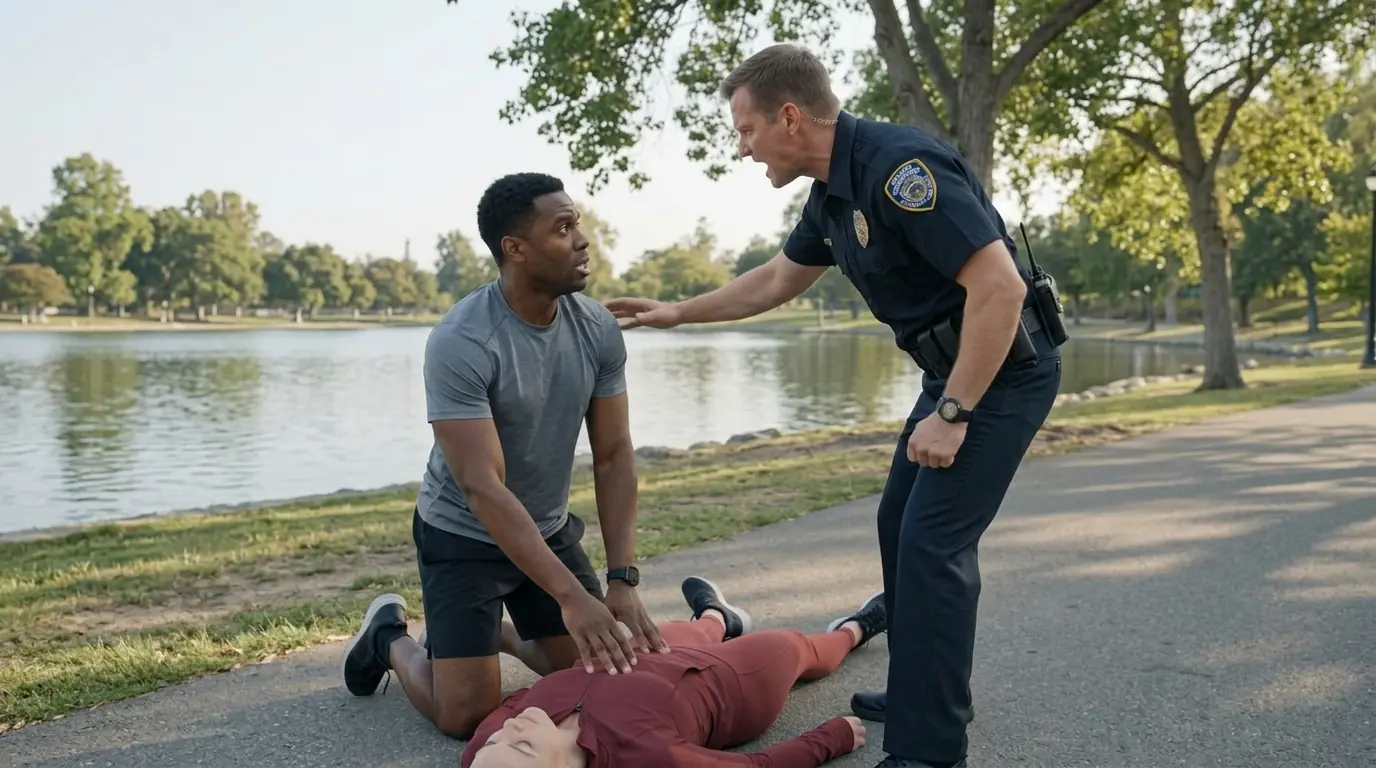
Saturday morning at Riverside Commons was supposed to be ordinary. Families pushed strollers beneath tall oak trees, cyclists rolled along the river path, and children chased one another around the playground while their parents balanced coffee cups on picnic tables. The early-June sun had not yet become oppressive, and a light breeze moved across the water from the Neuse River. Nothing about the morning suggested that one stretch of pavement would soon become the center of an argument about race, fear, medicine, and what happens when authority decides what it sees before it actually looks.
Dr. Andre Lawson was halfway through his usual weekend run. He was forty years old, Black, lean from years of distance training, and worked as an emergency physician at Wakebridge Medical Center less than twenty minutes away. He had spent twelve years treating trauma, heart attacks, overdoses, strokes, and every other emergency people carried through hospital doors at the worst moment of their lives. That morning, though, Andre was thinking about whether he wanted waffles or scrambled eggs when he got home.
He wore black running shorts, a faded blue performance shirt, and a pair of shoes his wife had been telling him to replace for months. One earbud played music quietly while the other remained loose so he could hear bicycles and faster runners approaching from behind. His pace was easy, his breathing settled into rhythm, and he had just passed the river overlook when the woman ahead of him stumbled. One second she was running normally, and the next her legs simply disappeared beneath her.
Her name, Andre would later learn, was Emily Carter. She was thirty-seven, white, athletic, and dressed in a bright coral running top with matching shoes that made her easy to notice on the trail. Andre had passed her earlier in the morning when they were heading opposite directions, but they had never spoken. When she collapsed, she did not throw out her hands or try to protect herself; she simply fell with the heavy, uncontrolled motion of a body that had suddenly stopped defending itself.
Andre ripped the earbud from his ear and sprinted toward her. By the time another runner shouted for someone to call 911, he was already on his knees beside Emily. “Ma’am, can you hear me?” he asked loudly, pressing one hand against her shoulder. There was no response.
He rolled her carefully onto her back, opened her airway, and checked her breathing. Her chest was not rising. Two fingers against the side of her neck found no meaningful pulse, and the conclusion took less than five seconds. Cardiac arrest.
Andre positioned both hands over the center of Emily’s chest and began compressions. “One, two, three, four,” he counted, driving each one deep enough to circulate blood while keeping his arms straight. After thirty compressions, he opened her airway and gave two rescue breaths, then returned immediately to her chest. There was no time for hesitation.
Several people had stopped along the trail. A man holding a Labrador stood frozen nearby, while a young woman asked if Andre needed help. “Call 911 and tell them cardiac arrest,” he said without looking up. “West river loop, just south of the overlook.”
A man wearing a red baseball cap raised his phone and repeated the information to a dispatcher. Another runner said he knew basic CPR and could switch in if Andre became tired. Andre nodded once. “Stay close.”
Thirty compressions. Two breaths. Thirty more.
Sweat rolled down Andre’s temples. His shoulders began burning. He ignored both.
What Andre could not see was Linda Morrison, fifty-four, sitting on a bench almost seventy yards away. She had been drinking iced coffee and scrolling through neighborhood posts on her phone when she looked toward the trail and saw a Black man kneeling over a motionless white woman. From that distance, she could not clearly see his hand position or hear him counting.
Fear filled in everything observation had not yet provided. Linda stood quickly and dialed 911. Her voice sounded breathless before the dispatcher even finished greeting her.
“There’s a man attacking a woman in Riverside Commons.” The dispatcher immediately asked what the man was doing. Linda stared toward Andre.
“He’s over her.” She held the phone tighter. “She’s not moving.”
“Is he hitting her?” the dispatcher asked. Linda hesitated.
“I can’t tell exactly.” She took several steps closer but remained far from the crowd. “He’s on top of her.”
The dispatcher asked whether anyone around them appeared to be helping. Linda looked toward the runners standing nearby. “There are people watching.”
“Are they trying to stop him?” Another hesitation. “No.”
The dispatcher asked whether Linda could move closer safely and determine if the man might be giving medical aid. Linda looked again. “I don’t think so.”
She did not move closer. She did not ask anyone standing beside the scene what was happening. She had already decided.
The call entered the system as a possible assault in progress. The description read: Black male over unresponsive white female, possible physical attack. Nothing in the dispatch summary mentioned CPR. Four minutes later, two Raleigh police cruisers entered Riverside Commons with emergency lights flashing.
Officer Grant Mercer arrived first. He was thirty-eight, had spent almost thirteen years on patrol, and carried himself with the confidence of someone accustomed to acting before others finished explaining. Officer Evan Pike, thirty, followed behind him and had developed a reputation for rarely challenging older partners. Neither officer stopped to speak with Linda, and neither asked the runners surrounding Emily what they had witnessed.
They saw Andre over Emily’s body. They saw his arms moving. They saw exactly what the dispatch description had prepared them to see.
Andre was counting compressions when Mercer came within several feet. “Twenty-five, twenty-six, twenty-seven.” He never heard an order to stop because Mercer never gave one.
Mercer pulled pepper spray from his belt. Evan moved toward Andre from the side with one hand near his service weapon. Neither took the additional second required to recognize the rhythm of CPR.
The spray hit Andre directly across the face. Chemical fire exploded across his eyes, nose, and throat. His hands came off Emily’s chest as he recoiled backward, choking.
For the first time since Emily’s heart stopped, nobody was compressing it. That fact registered in Andre’s mind even before the pain did. “She’s in cardiac arrest!” he shouted.
Evan grabbed both of Andre’s arms. Andre could barely see. “I’m a doctor,” he tried to say, coughing hard as the spray burned down his throat.
Evan forced him face-first toward the pavement. Andre turned enough to prevent his nose from striking first, but the side of his cheek scraped along the concrete. “Stop resisting!”
“I’m not resisting.” Andre’s voice cracked. “She has no pulse.”
Mercer knelt beside him and pulled Andre’s other arm behind his back. Cold handcuffs tightened around both wrists. Andre could hear Emily’s body lying only a few feet away.
A woman near the trail screamed, “He was doing CPR!” Another runner shouted, “He was helping her!”
Mercer looked toward the crowd. “Everybody stay back.” His tone suggested the witnesses themselves had become another problem to control.
Andre turned his head slightly. His eyes were squeezed shut from the pepper spray. “Someone needs to keep compressions going.”
“Shut up,” Mercer said. Andre coughed.
“She’s been down maybe four minutes.” His voice sounded desperate now. “Every second matters.”
Evan gave a short laugh. “You were just attacking her.”
“No.” Andre forced the words through the burning in his throat. “Wakebridge Medical. Emergency department. Dr. Andre Lawson.”
Evan tightened the cuff. “Sure you are.”
Andre had heard patients lie about their identities, medications, drug use, injuries, and everything else human beings became afraid to admit. He understood skepticism. What he did not understand was skepticism so absolute that new information could no longer enter.
“I am an emergency physician.” Andre repeated it slowly. “She collapsed while running.”
Mercer leaned closer. “Everybody suddenly has a career when the cuffs come out.” Then he told Andre he could explain himself at the station.
Andre stopped arguing. Not because he accepted what was happening. Because Emily had become more urgent than his own humiliation.
He knew exactly what her brain was experiencing. No circulation meant no meaningful oxygen delivery. Every uninterrupted minute reduced the likelihood that she would wake without permanent neurological damage.
That was the terror Andre would remember years later. Not the pepper spray. Not the cuffs.
It was lying facedown on concrete while the woman he had been trying to save went without chest compressions. He understood the biology of every second disappearing. He knew what delay did to cardiac-arrest survival rates, and there was nothing he could physically do.
The ambulance entered the park less than half a minute later. Paramedic Carlos Mendoza jumped from the passenger side before the vehicle completely stopped, with his partner Sophie Grant right behind him carrying the AED. Carlos immediately saw Emily unattended on the pavement. He dropped beside her and checked for a pulse.
“Weak pulse, terrible rhythm.” He looked toward Sophie. “Pads on.”
Sophie opened the AED. Carlos began compressions. The machine started analyzing.
Only then did Carlos look around. “Who was doing CPR before us?” Nearly everyone pointed toward the Black man lying handcuffed several feet away.
Carlos followed their hands. He saw chemical residue running down Andre’s cheeks. Then he looked closer.
“Wait.” He stopped for half a second. “Andre?”
Andre turned his head toward the voice. “Carlos.”
Carlos stared. “Dr. Lawson?”
Andre nodded once. “She collapsed in front of me. No pulse, no breathing.”
Carlos stood halfway and looked directly at Mercer. “Why is he in handcuffs?” Mercer said they had responded to an assault.
Carlos looked back toward Emily. “What assault?”
“The caller said he was on top of her.” Carlos stared at him.
“He was doing chest compressions.” Mercer’s expression changed slightly. Evan looked away.
Sophie attached the pads. The AED announced that a shock was advised. Carlos immediately returned to Emily.
“Clear.” The shock delivered.
They resumed compressions. After another analysis, a second shock was advised. Andre lay on the pavement listening to every command.
Then Carlos checked Emily’s carotid pulse. “We’ve got something.” Sophie leaned close.
“Breathing’s coming back.” Carlos nodded. “Let’s move.”
For the first time since the spray hit his face, Andre felt his chest loosen slightly. Emily was alive. Whatever else happened next, she still had a chance.
The witnesses had become louder. Thomas Greene, a retired science teacher, told Mercer he watched Emily collapse before Andre ever reached her. Natalie Brooks, a graduate student, said her phone recording showed Andre counting compressions.
Another runner shouted that neither officer asked anyone what happened. A man near the bicycle rack held up his phone. “I have you spraying him while both his hands were on her chest.”
Mercer glanced toward the phones. Confidence left his expression one piece at a time. Evan’s face had gone pale.
Carlos stepped toward Andre. “Take the cuffs off him.” Mercer hesitated.
Carlos’s voice hardened. “He needs his eyes flushed.” He pointed toward Emily’s stretcher. “And he is the reason she had any circulation when we got here.”
Mercer finally reached for the key. The cuffs opened. Deep red grooves had already formed around Andre’s wrists.
Carlos and Sophie helped him sit. Water from the ambulance flushed his eyes while he coughed and tried not to rub them. His first question remained the same.